Do you feel joy when you go through trials/temptations? I would guess not as it is opposed to our natural inclinations.
But when we go through hard times, we can come out on the other side stronger.
Have you heard Christians say that God won’t give us anything beyond what we can handle? That is a perversion of the truth.
We weren’t created to be able to handle this life on our own. We were made with a need for God. The trouble comes when we recognize our need for something beyond ourselves but turn to something or someone besides God and become dependent on that. That is when idols are created.
God won’t put things in our life that can’t be handled with His help. But there likely will be things in your life that you can’t handle on your own. That is your reminder, if you aren’t already, to depend on God.
1 Corinthians 10:13 is where people get the wrong idea. But they just read part of it. They read “he will not let you be tempted beyond what you can bear.” The verse continues though to say “But when you are tempted, he will also provide a way out so that you can stand up under it.” He will provide a way!
When we try to do things on our own, we can quickly become prideful – thinking we are great, or, become depressed because we can’t do what we tried to.
We can come out of the other side of trials and temptations with a stronger faith if we leaned into God during this time. It should allow us to become more mature in our faith and deepen our relationship with God.
~Stephanie Fletcher
Reflection Questions
What is a past trial you have gone through with God’s help? How did He help you? How did your perseverance grow during this experience? How did you mature through the process? What joys can you take away from that past trial?
What joy can you find in your present trial?
Consider some of the Christians that you most look up to. Have you ever met a really strong Christian who has had a really “easy” life?
What will you say the next time you hear someone say, “God won’t give us anything beyond what we can handle?”
In today’s passage in Galatians, 5:23, we read of the rest of the fruits of the spirit: gentleness, self-control; against such things there is no law. (NASB 1995) The spirit of self-control is a quality that would have served David well in today’s passage in 2 Samuel 11. What can we learn from the story of David? Sin can have a domino effect. One sin can easily lead to another. David’s first sin was probably just looking at Bathsheba longingly while she was bathing. Jesus tells us that for a married person to even look upon someone else with lust is equivalent to adultery. Ideally, David should have looked away immediately once he realized she was not clothed. We can probably safely assume his self-control did not kick in at that moment to prompt him to quickly avert his gaze, which then led to feelings of lust multiplying in him. Then, as the story goes on, we see David actively pursuing her, impregnating her and then frantically trying to figure out how to clean up his mess. David’s struggle with temptation is obviously not unique. We only have to look around to see we have many temptations competing for our attention. Pornography is more accessible than it has ever been and has been named as a major public health crisis due to the impact on individuals and their marriages and families.
Abiding in the living vine is our best defense against the onslaught of temptation that we face on a daily basis. Self-control is not easy to come by naturally because temptations are considered to be temptations because they are powerful and tap into our carnal desires and stimulate our senses. Whether it’s overindulging in alcohol or food, taking drugs that aren’t prescribed to us or abusing prescription drugs, sexual sin, etc., temptation comes in many forms. Thankfully we don’t have to rely on our own strength to resist them. Abiding in Christ helps us to cultivate that fruit of the spirit that includes self-control. Of course, like any plant, a vine must be tended to. We cannot ignore it and expect it to thrive. It is a choice that must be made daily, sometimes hourly, at times even minute by minute, to abide in Christ.
-Kristy Cisneros
Reflection Questions
Besides in this chapter, where else have you seen sin’s domino effect in action?
What temptation grabs your attention and pulls you away from where you should be? Where does it lead to next?
What does it look like when your temptation wins over your lack of self-control? What does it look like when your self-control wins over temptation? How do you feel in each instance? How are others affected in each case? What do you imagine God is thinking or feeling in each scenario?
What specific actions can you take this week to abide in Christ more and more? What will it cost you? What will the benefits be?
The most formidable opponent to our righteousness is the person reflected in the image of a mirror. Being solely tempted is not sin in itself, but it means that we will soon enter the ring or octagon for a fight. The attack will come at the points where we are weakest. Our pride, greed, lust, envy, gluttony, anger, or laziness are soon exposed and without the proper guidance by the words of God, we will soon leave ourselves fully exposed to a finishing move. No matter where the dragging and enticing draw from, submission to temptation to serve ourselves rather than submitting to our Heavenly Father’s will, leads down the slippery slope away from the Kingdom of God.
“When tempted, no one should say, ‘God is tempting me.’ For God cannot be tempted by evil, nor does he tempt anyone; but each person is tempted when they are dragged away by their own evil desire and enticed. Then, after desire has conceived, it gives birth to sin; and sin, when it is full-grown, gives birth to death.” – James 1:13-15
“If you do what is right, will you not be accepted? But if you do not do what is right, sin is crouching at your door; it desires to have you, but you must rule over it.” – Genesis 4:7
We see this pattern unfold in Genesis 4 when Cain is issued a warning directly by God to stop jealousy in its path. God states that “sin is lurking at the door.” By giving temptation a place to live, Cain and each one of us are inviting sin to be the next resident. What started as an unchecked emotion, turned into temptation, which led Cain to selfishly taking the life of his brother. Temptation must be addressed and combatted, otherwise we will find ourselves on a path, either through deliberate action or indecision, that leads us far away from the Will of God.
“Therefore, since we have a great high priest who has passed through the heavens, Jesus the Son of God, let’s hold firmly to our confession. For we do not have a high priest who cannot sympathize with our weaknesses, but One who has been tempted in all things just as we are, yet without sin. Therefore let’s approach the throne of grace with confidence, so that we may receive mercy and find grace for help at the time of our need.” – Hebrews 4:14-16
Jesus, as always, provides our example of dealing with temptation because he was tested in every measure. Specifically in Matthew 4, Jesus is tested in the desires of his flesh, the integrity of his faith, and his pride. Jesus meets each one of these temptations head on, attacking them with words of his Father. In doing this, he removes himself from temptation by placing himself closer to God Almighty. By remaining perfect and being raised to life, He now sits at the right hand of God understanding our struggles and weakness. Christ intercedes on our behalf and beckons us to remember that we have the advantage that Cain did not: we do not have to go through it alone.
The Apostle Peter is no stranger to succumbing , and in all reality, he is the disciple with whom we most identify. His advice to those scattered about Asia Minor in his first letter is to remain watchful and alert for the threat that may approach us. He likens our Adversary to a lion, crouching in the savannah, waiting for our guard to be down and becoming the next prey devoured. We have to be ready for the attack, by remaining sober-minded even in the duress of physical, spiritual, or mental stress. We do this best by filling our hearts with the words of God and repeating them time and again, so temptation is at bay, and when it comes, like Jesus, we are ready to strike it down with the Sword of the Spirit.
-Aaron Winner
Reflection Questions
There is a lot to think about in the following sentence: “Temptation must be addressed and combatted, otherwise we will find ourselves on a path, either through deliberate action or indecision, that leads us far away from the Will of God.” What examples can you think of from your own life?
What temptations do you need to address now?
With what 3-5 specific ways can you combat this temptation?
What roles can God’s Word and God’s Son play in your spiritual battle against sin?
It was the spirit that led Jesus into the wilderness to be tested. It was the devil who tempted him. God does test us, like a father tests his children, allowing us to make a choice between his will and our own, but he does not tempt us to do evil, nor can he be tempted, as everything already belongs to him and therefore wouldn’t be tempting.
God does not tempt with sin, but he does test his children so that they can learn obedience, to overcome sin and become people of character, for their own good, for their survival and for other good things he desires for us. We’ll pass the test every time if we choose his will over our own, just like his son Jesus did.
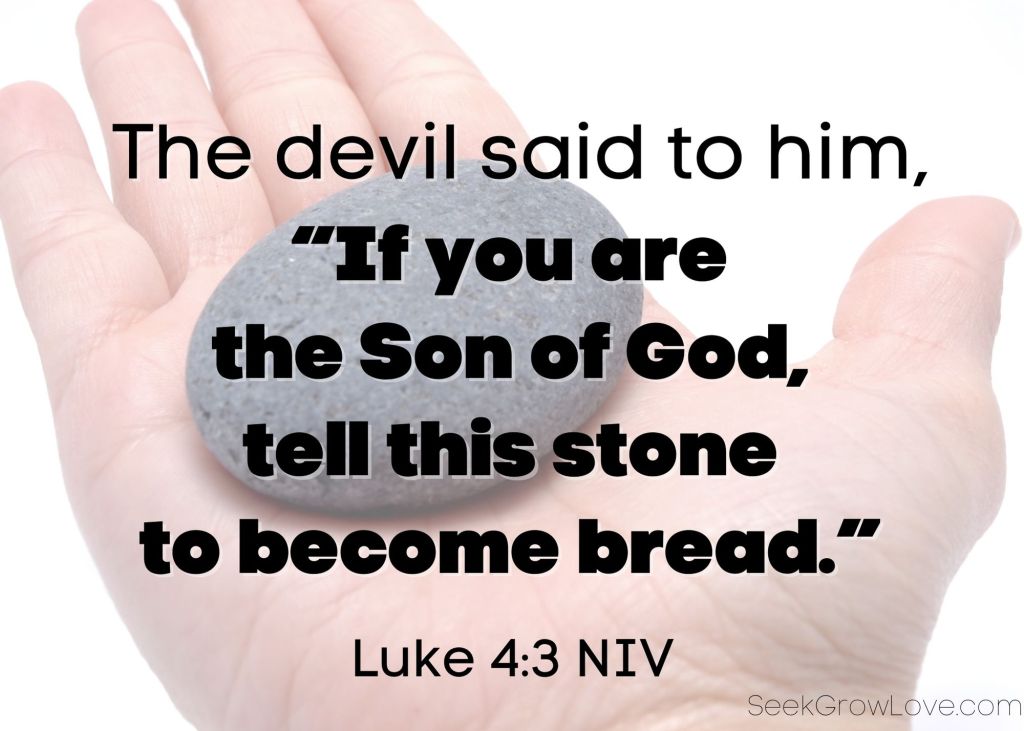
The devil’s temptations to cause Jesus to sin were cunning. With the first temptation, (Luke 4:3 “If You are the Son of God, tell this stone to become bread.”) the devil raises doubt about Jesus’s identity. He then targets Jesus’s need, his hunger, as a result of his fasting. When you are so hungry and deprived of your need to eat, it can be the most powerful time in your life because you have no choice but to cry out to God for help.
This was a very crafty temptation for Jesus, because both he and the devil knew who he was. He was the Son of God. God had already granted him authority and power, which he continued to grow in, which he could have used to meet his hunger need by performing a miracle for himself at his will. But he didn’t. Instead, his response was God’s will (Luke 4:4: And Jesus answered him, “It is written, ‘Man shall not live on bread alone.’”).
The temptation was taken right out of God’s playbook, when he tested his firstborn son, the children of Israel in the wilderness. What is new is knowing the devil’s part in this temptation towards Jesus. Jesus goes straight to God’s will in the matter, referencing Deuteronomy 8:1-10 with his response. The testing was meant to test obedience and build the character trait of humility, as is clear from that passage.
Keep in mind though that it looks like God’s testing came after his firstborn son already tried to put him to the test by blaming him for their hardships and lack of needs in the wilderness. God is Israel’s father. He is going to take care of his children, but they needed to learn to obey and trust him. Our good God sent them bread from heaven despite their evil response because he loved them. It didn’t always fare so well in God’s response to their constant rebellion, but you can see throughout scripture that God was patient and long-suffering with his people.
The second temptation was tempting because the devil was offering the world as Jesus’s kingdom right then and there, if only he’d worship him. Satan is called the god of this world, which meant that he had the power to give Jesus the kingdom. Jesus knew through scripture that through serving God, he was going to gain the whole world and more, but he had to die first. It would have been very tempting for him to set up his kingdom straight away, without having to die first. But his response was to serve God by carrying out his will for him in his plan of salvation (Luke 4:8 8 Jesus answered him, “It is written, ‘You shall worship the Lord your God and serve Him only.”).
Jesus’s response came from Deuteronomy 6, where God gave the children of Israel the first and great commandment, which is to listen; Yahweh is God, Yahweh alone. Love Yahweh God with all your heart, soul, and might. They were told to do this so that they would remember him, fearing him only, and worshipping him, and swearing by his name (Deut. 6:13). They were to remember what Yahweh did, bringing them out of slavery and into the promised land to serve him. He told them these things for their good always and for their survival (Deut. 6:24).
Jesus trusted his father. He knew that God was faithful to do what he said he’d do, and he loved his father. He also knew from scripture that he had to die to be able to bring us with him. He chose us. He chose God’s will.
With the third temptation, the devil tries to provoke Jesus to prove that he is the Christ on his terms. He quotes from Psalm 91, telling Jesus that God will protect him if he performs the miracle that he wants him to do to show everyone that he is indeed who God said he was.
This is tempting because proving that he is the Son of God, the Messiah, could remove a lot of suffering from his life. Picture Jesus performing the miracle from the temple pinnacle in Jerusalem, in front of all the religious leaders. If they saw him doing this act, in front of everyone, from that location, they all would have known for certain that Jesus was the Christ. They probably would have set him up as their king, rather than trying to continuously kill him. Because Jesus chooses not to reveal his identity to anyone, except on God’s terms, it appears that like David, Jesus was always “on the run” from his enemies, because they doubted that he was the Messiah. Falsely claiming to be so was an offense worthy of death to the Jews.
But Jesus wasn’t really just “on the run” from his enemies. He was choosing to do God’s will at every step in his ministry. For the most part, he was on the move because his father told him to preach the kingdom of God to the various cities he was sent to.
The life Jesus chose was hard. He told us often that he spoke his father’s words, not his own. His father’s words were met with resistance and hate from most, except from those to whom it was given to know the things of God. Jesus’s response was the harder, but better route. He chose God’s will. He said, 12”…It is said, ‘You shall not put the Lord your God to the test.’”
This quote comes from Deut. 6:16. It references the bread incident from the first temptation. Again, we’re told what this was all about in Deut. 8:1-10. God does things his way for our own good, for our salvation, and to give us good things. But we have to trust him by doing it his way, even if his ways are harder than what we think ours will be.
If Jesus would have performed the miracle that the devil tempted him with, he would have been no better than God’s firstborn son, who put him to the test in the wilderness. They remembered their former slavery to Egypt, thinking it was far superior to their journey in the wilderness on the way to God’s promised land. The wilderness was hard. Many of them died there, never getting to see the promised land.
Similarly, if Jesus had proved to all that he was the Messiah by choosing his own will over God’s, the seemingly better route to go, he too would have put God to the test. Instead, he never blames God for his circumstances. He endures, looking at his hope, and thinking about all those he will save by choosing God’s will.
The devil left him, but only until another opportune time. Many of the things he said to Jesus make their comeback through the lips of religious leaders, as we’ll see through their interactions with Jesus in the rest of Luke’s narrative.
There were people who admired Jesus, but still doubted his identity. There were people, particularly those in his hometown, who asked Jesus to heal and perform miracles. When they don’t receive what they want from Jesus, which looks like a request for proof because of their doubt that he was the Messiah, they are denied, and they hate him for it. They attempt to push him off a cliff! Jesus doesn’t budge in following his God’s will, despite the consequences from men.
It is interesting that after the devil’s temptations, that Jesus quotes from scripture in Isaiah 61. We’ll eventually read in the rest of Luke’s narrative that Jesus lives out these proclamations from Luke 4:18-19.
Mixed in the quote is a quote from Isaiah 35 (recovery of sight to the blind). Jesus will indeed perform this miracle too. He’s even going to do it in Jerusalem, proving that he is the Son of God for many to take note of, but it will be on God’s time, and it is to the people God chooses for Jesus to reveal himself to as the Son of God, for God’s own purposes. When you read about this, and the other “Messiah” miracles, be careful to investigate the details so that you will know the exact truth about the things you are learning.
-Juliet Taylor – It’s been a joy to write again for SeekGrowLove.com and I’ve grown tremendously from doing it, so thank you Marcia! Hello Seekers! I am a Biblical Unitarian (BU) living in Tennessee with my husband, Wes Taylor, and our two boys, John and James. God has given me a BU church (Higher Ground), the best BU friend (Amy Swanson) to go through this race to the Kingdom with, an online church to fellowship with (Allegiance to the King), and a profession (Behavior Analyst/Sleep Consultant) that allows me time to study God’s word. God is good!
Questions
God cannot be tempted, because there’s no way to get him to desire anything that he doesn’t already have or will have at his will, as he’s the creator of all. But he can be tested (although we shouldn’t, knowing the consequences). In what ways do people test God in our time?
Similarly, God does not tempt us to sin, but he does test us like a father tests his child for her own good. In what ways do you think God has tested you?
What other “Messiah” miracle does Jesus perform in Jerusalem (hint: it’s mentioned in Isaiah 35).
Can you imagine if you lived in Bible times and the son of God handpicked you to be a part of his very exclusive inner circle? How amazing that would have been to be chosen as one of the twelve disciples! Spending time in conversation with him daily, watching him perform many miracles, listening to him teach the people and reveal the coming kingdom, and just being around the most awesome dude ever would have been incredible. Surely, that group of twelve would be so devoted to him that they would never turn against him. Or, maybe they would.
Let’s start with Judas. I’m not making excuses for him, but Luke 22:3 does say that Satan entered into Judas right before he went to the chief priests and officers to devise a plan to betray Jesus so he could be put to death. Although, how in the world could one of the twelve disciples get to the point where Satan would be allowed to have so much influence over him. He didn’t have to go along with the temptation Satan presented to him, but he willingly did turn his back on Jesus. I don’t really understand how he could have justified in his mind such an evil plan, but clearly, he was weak in the faith department and not strong enough to not give in to the temptation.
I think we accept the fact that Judas betrayed Jesus – because he was Judas. Who has anything good to say about Judas? It’s not like he was John, James, or Peter, some of the most impressive disciples. They would never turn their back on Jesus, until Peter did.
Peter showed over and over that he loved Jesus and was totally onboard for the cause. His faith was pretty strong also – strong enough to walk on water for a little bit. So what went wrong? How could he have denied Jesus three times in one night. Furthermore, to make it worse, Jesus even told him right beforehand that he was going to deny him three times. It seems like after the second time he would have thought, “Okay, that was two times, but there’s no way I’m messing up a third time. I’m not falling for that one.” But one of the most devoted of Jesus’ inner circle was not strong enough to not give in to the temptation.
Let’s fast-forward to today. How strong is your faith? Are you onboard with the cause 100% or are you a fair-weather Christian? What can you do to make sure you don’t give into temptation when tough times hit? There is one suggestion from Jesus that he stated in verse 40 and again in verse 46. He told the disciples to pray that they wouldn’t enter into temptation. I find it interesting that he didn’t tell them to pray to not enter into sin; he told them to pray to not enter into temptation. Temptation is not wrong. Jesus was tempted in the same way we are tempted, but he did not give into the temptation and sin. That is deep, at least to me it is.
-Rick McClain
Time to ponder:
Many of us spend time figuring out how we are not going to enter into sin, but have you ever thought about what you could do (or not do) to not enter into temptation? That seems like a great place to be because you will probably not sin if you are not tempted to sin.
Is there anything else you can do to prepare yourself to be strong enough to not give in when strong temptations arise?
I’m not going to give you a third question because I think it would be wise to use your time to keep thinking about the first two questions. There really is a lot there to think and pray about.
One of my all time favorite movies from childhood is Finding Nemo. One of my favorite scenes is when Marlin and Dory meet the group of three sharks who vow not to eat fish anymore. The line that is continually repeated by the sharks is “Fish are friends not food”. The three sharks are attempting to help Marlin and Dory on their quest to find Nemo. Marlin and Dory have a moment where they are arguing over the diving mask that has the address to where Nemo could be. They are pulling the mask to and fro and it snaps against Dory’s nose and she bleeds. The largest of the three sharks, Bruce the Great White, catches a whiff of her blood and he forgets the new motto that he’s trying to live by. A wild chase ensues with one of the most intense scenes from the movie, while the shark who vowed to help lost his way with his desire to eat them.
There are times in our lives where we forget who we have become in Jesus. There are moments where we forget the new life that comes from having a relationship with God and we are tempted to sink back to our old ways. After getting a faint scent of blood Bruce was ready to turn back to his natural shark ways.
In Romans 14 the term that Paul uses is “stumbling block” to refer to areas of temptation in a believer’s life that might not be a hindrance to our siblings in Christ. In fact Paul says to “not pass judgment on one another any longer, but rather decide never to put a stumbling block or hindrance in the way of a brother…so then let us pursue what makes for peace and for mutual upbuilding” (Romans 14:13-19). The blood that came from Dory’s nose was not a temptation that everyone fell for in that scene. Bruce was the weak one who was struggling the most with his new life. The blood was a hindrance and stumbling block that sent him in a frenzy in which he fell into his natural temptation.
If there’s an area that really tempts a brother or sister in Christ, but does not tempt us, we must go out of our way to help our siblings not fall into temptation. Our job is to be our brother’s keeper and to come alongside one another so as to not allow ourselves to fall into sin. Paul implores us and shows the seriousness of bringing temptation to our siblings in Christ by making the statement: “Do not…destroy the one for whom Christ died.” (Romans 14:15). The context of this passage is concerning food and drink that might be a hindrance in the lives of ancient Christians, but the wider application encompasses all temptation that we might face for all time. The greater rule here is that temptation, no matter how insignificant it seems for us, is a big deal to someone who struggles in that area. We must be sensitive to the areas of temptation for our brothers and sisters and make diligent efforts to pursue peace for the mutual upbuilding of the body of Christ.
One of the most practical ways we can limit temptation for those around us is to practice modesty. Modesty is not some old out of date stuffy ideology. Modesty is the pursuit of holiness in Christ through our dress, speech and conduct. Choosing modest clothes, words and actions is something that is so foreign to our world today. God desires us to be set apart and one way we can do that is to make sure that we are honoring God and one another through our appearance, our choice of language and the way we live our lives. This is a way to bring peace to those around us and to make sure that we are not being a stumbling block and a hindrance to those who see us, hear us and live their lives in proximity to us.
Sin and temptation are both extremely serious. They are also both difficult to deal with. But with the help of God and the help of one another we can remove the stumbling blocks from each other’s paths. We can also make sure that we are not hindering one another’s walk with God, but rather enhancing our walks with God by building up one another in Christ.
-Nathan Massie
Application:
Have intentional conversations with your friends about what temptations they struggle with and how you can help them.
Identify your own weaknesses and struggles and ask for help from a trusted and mature Christian friend and/or mentor if you keep falling into the same temptations.
Ask God for guidance on what steps you should take to help your friends with their walks with God.
Build up one another in Christ through accountability. It is nearly impossible to deal with temptation and sin without the help and accountability from mature Christian friends and/or mentors.
As someone who is trending towards 40, I realize there is still some time to grow up. I am not a lost cause. However, the longer I teach middle school, the further delayed my coming of age may be. I still laugh at a lot of immature things. Body noises. People falling. General potty humor. But nothing quite gets me like a “do do.” I remember sitting in an interview for an open position at my school, intently listening, taking notes, giving confirming head nods, and then out of nowhere came “do do.” “I am very aware that I do do…” Every muscle in my body clinched to remain professional. I hid my smile with my hand, furrowed my brow, and increased the quantity of affirming head shakes. I was no longer listening, only trying to hide the fight going on within.
I do not understand what I do. For what I want to do I do not do, but what I hate I do. And if I do what I do not want to do, I agree that the law is good. As it is, it is no longer I myself who do it, but it is sin living in me. For I know that good itself does not dwell in me, that is, in my sinful nature. For I have the desire to do what is good, but I cannot carry it out. Romans 7:15-18
In a similar way, Paul makes it clear in Romans 7 that our body and mind aren’t always on the same page. In our innermost being, we desire the things of God. We desire to be holy. We desire to know His will for our life. We want to ponder, study, and worship. Unfortunately, what we desire and how we act follow different paths. We don’t do the things of God, but we “do do” the things that grasp for the attention of our immature faith, paving our way to fiery judgment with good intentions.
So why are we like this? We are not slaves of sin, but we are very much subject to the circumstance and condition we find ourselves, living in this present evil age. We are sinners, living amongst other sinners, in a sinful world; it’s what comes to us naturally. If we try to fight the battle alone, no matter how valiantly we fight or resiliently we hold the line, we will ultimately crash and burn. It takes the man, Christ Jesus, who fought against sin and came out victorious bringing death to its knees. We must ask and allow him to intercede and succeed in all areas of our lives, but especially in the places we leave ourselves vulnerable. He must be Lord of our screens, and our pride, and our money, and our idols, and our drinks, and of all our vices.
Bind yourself to Him. Cling to the cross of our Savior. Until Jesus returns, temptation will surround us, but praise be to our Heavenly Father, it is Christ who lives within us. Don’t do it any other way. Do do what he says. Bear your cross, increase Christ, and cultivate a mature faith. In turn we will have actions that match the greatest ponderings, pinings, and pursuits of the heart that is completely submitted to God.
-Aaron Winner
Questions for Reflection and Discussion
Choose one area of your life in which you know what you want to do in order to be pleasing to God, but you (often) find you do something else instead. How can you bump up your fight against this temptation? How can you make Jesus the Lord of even this area of your life?
Reading through Romans 7, what verse would be a good one for you to post in a significant location and work on memorizing to bring to mind when faced with what you will do – and not do?
The story of David and Bathsheba is probably familiar to most of us. King David, described elsewhere as a “man after God’s own heart”, had a little too much time on his hands while his army was away fighting. One evening, he got up from his bed and walked around on the roof of his palace; and from his roof, he saw a beautiful woman taking a bath. I’m reminded of 1 Corinthians 10:12, “So, if you think you are standing firm, be careful that you don’t fall!”
You might be tempted to stop right there and ask what this beautiful woman was doing taking a bath in public. Wasn’t she inviting unwanted attention? Presumably, she was in her own fenced backyard, and nobody could see her unless someone was on the roof of the palace next door – and who would be walking around on a roof? Regardless, she isn’t the real topic of the story, David is.
The fact remains that David took a long look at her. David lusted after her. David violated one of the 10 commandments: “Don’t covet your neighbor’s wife…”. Lust is a trap, especially for men – even for a “man after God’s own heart”. David should have stopped right there, confessed, and asked God for forgiveness. Instead, he asked one of his servants who she was. He was definitely showing too much interest.
Once he found out that she was the wife of Uriah, one of his bodyguards, and the granddaughter of Ahithophel, his chief advisor, he certainly should have walked away. But she was gorgeous, so instead, he invited her over and slept with her. David violated another of the 10 commandments: “Don’t commit adultery” – and the punishment for this one was supposed to be death.
When David found out that Bathsheba was pregnant, he recalled her husband from the battle so he could go home – to try to hide the fact that David was the father. But Uriah didn’t cooperate; he didn’t go home. Ultimately, David then schemed to have Uriah put on the front line of the battle, and have everyone else withdraw, so Uriah was killed. And so he violated another of the 10 commandments: “Don’t kill”.
David seemed to successfully hide all of this until after the son was born. But God sent Nathan, the prophet, to confront David. Nathan told David that God was going to discipline David, according to his sins.
David wrote Psalm 51 after Nathan confronted him about his adultery with Bathsheba. In this psalm, we find in verse 1, “Have mercy on me, O God, according to your unfailing love; according to your great compassion, blot out my transgressions.” In verses 11-12, “Do not cast me from your presence or take your Holy Spirit from me. Restore to me the joy of your Salvation…” David’s heart was broken, he confessed, and was reconciled to God.
The discipline came a little later. During Absalom’s rebellion, Absalom slept with 10 of David’s concubines in public; David’s daughter Tamar was raped by her half brother Amnon; four of David’s sons died: this baby, Amnon, Absolam, and Adonijah; and David had problems for the rest of his life. God forgave David’s sins, but David still had to live with the consequences of his sins.
God’s discipline isn’t punishment handed out by an angry God bent on vengeance, it’s difficulty allowed by a loving Father who wants to see his children develop godly character. Otherwise, it would be too easy to just accept and live with sin, and God loves us too much to let that happen without a fight.
This brings us to our application for us today.
Do you consider yourself to be Godly? If so, “If you think you are standing firm, be careful that you don’t fall!” If you don’t consider yourself to be Godly, what do you think your long-term future (eternity) looks like? Isn’t today the best time to solve that problem?
Look at the progression in David’s life. A glance, lust, adultery, then murder. Are there places in your own life where you are at that “glance” stage? The “lust” stage? Further down the path (to destruction)? Wherever you find yourself, don’t continue down the path of sin. Turn around.
Was David’s wild fling worth it? Absolutely not! Is the pleasure of your sins worth it? It never is! I’m reminded of Hebrews 11:25-26, where we’re told that Moses “chose to be mistreated along with the people of God rather than to enjoy the pleasures of sin for a short time… because he was looking ahead to his reward.” Are you strong enough to forgo “the pleasures of sin for a short time” and instead look ahead to your reward? If not, ask God to help you.
And when you do sin, don’t just try to hide it. Remember 1 John 1:9, where God promises, “If we confess our sins, he [God] is faithful and just and will forgive us our sins and purify us from all unrighteousness.” It was only after David’s confession that he was reconciled with God. The same is true for us.
You may be tempted in similar ways as David, or you may be tempted in other ways, but you will be tempted. 1 Corinthians 10:13 reminds us, “No temptation has seized you except what is common to man. And God is faithful; He will not let you be tempted beyond what you can bear. But when you are tempted, He will also provide a way out so that you can stand up under it.”
-Steve Mattison
Questions for Reflection and Discussion
In your own experience, have you ever observed (or are currently in) the downward spiral of sin where one sin leads to another? Where would have been the best place to stop? How? How do you turn around now – look at David’s example (Psalm 51 is a beautiful place to start).
To avoid the painful and long lasting consequences of sin in your own life how can you build your resolve to forego the “pleasures of sin” which last a short time? What can you do now to help yourself stand strong when you are tempted? What can you do when you are right in the the middle of a strong temptation? How can you help others stand firm against their temptations?
Like David, sometimes we need our sin pointed out to us before we reach a point of confession. Read 2 Samuel 12. Have you ever needed a Nathan to help you see your own sin? Pray to see your own sin clearly. Then confess it. Have you thanked those who have helped you see your sin. Then, as David said in Psalm 51 – with a pure heart he could, “Then…teach transgressors your ways, so that sinners will turn back to you.”
When the people didn’t know what was going to happen with Moses, they turned to Aaron to create new gods. God was very angry.
We have struggled with plenty of fear just in the past few years. Not knowing is a great fear of mine. I struggle with not knowing which college I should go to or what I should do with my life.
The people were dancing and worshiping a golden calf. It says in Exodus 32 that the people are prone to evil. They asked for gods that will go before them. Do we all struggle with evil or dirty desires? Most likely, but how we handle those desires is what matters the most.
Just because you can’t see what has gone over a mountain or you don’t know what’s going to happen in the future, this doesn’t mean we shouldn’t push for greatness. The kingdom is our goal. It is our motivation. We must trust in what we can’t see or can’t understand at the moment. We must understand that just because God sent Moses over a hill and we couldn’t see him and his plan – we must know there is one.
-Genesis Dylewski
Questions for Reflection and Discussion
The people were quick to take (sinful) action when they felt like they had been abandoned by God and Moses. Have you ever felt (even for a moment or a day) like you were abandoned by God and/or those who have represented Him to you? What options did you have in how you reacted? What would have been the best course of action?
How can you build your trust in God so that even when He is harder to see, you know He and his plan can be trusted?
What false gods or unhealthy practices are you tempted to turn to when you battle fear? What consequences are there in these actions or attitudes?
I had an art teacher in elementary school who was used to students making mistakes, and at the start of a school year he would advise his students about the need to be careful in his classroom. He told us about the student who spilled a pot of melted wax on his pants. He told us about the student who was sliced with the paper cutter. He told us about the student who, having been warned that the pottery kiln remains hot long after it shuts off, chose to unlatch and open it to see how the artwork looked. Our teacher wanted to make sure we would not be harmed, and he used the damage that others had suffered to warn us. He knew about the risks, and his knowledge had been proven and tested.
I think that is part of the problem we see played out in Genesis 3. Adam and Eve were like inexperienced children, so unused to the risks they faced they would not take them seriously. And what could God point back to? No one had ever died, it seems, so saying that they risked dying may not have meant much to them. It even seems like somewhere along the way someone started trying to expand on the rules, not just saying the fruit wasn’t supposed to be eaten but that it wasn’t supposed to be touched. We don’t know whether Adam invented that idea in passing on the rule to Eve, or if Eve created that rule as a reminder for herself to keep herself mindful not to do what God said not to do. But making extra rules can just be a distraction from what God wants, they are hard to justify. When she looked at the fruit it seemed like the kind people could eat, which was totally beside the point – nobody ever said the reason people shouldn’t eat it was because it was poisonous. God entered into this situation like my art teacher if he had simply said “don’t touch these pieces of equipment in these ways” – and students would have invented reasons for why that mattered, and worked out their own solutions for how to avoid the problems they thought were the issues.
The whole scene with the serpent reminds me of someone getting dared. It isn’t how it is presented, but it is how it comes across. The nudging, suggesting ideas that wouldn’t have come into the mind otherwise, and like so many dares getting a person to cross lines into a bad idea.
I hate dares.
And the results of the situation are such incredible losses we can’t really understand them, because we are only used to the results. A world with death and suffering. A world with toil and sweat. One of the most disturbing is what happened to Eve, she had been created to be an appropriate helper for Adam. In chapter 1 they had been blessed and told to rule over the animals of the world. But by chapter three we are told that the man would seek to rule over the woman, and the desire of the woman would be for the man – perhaps meaning she would desire to return to the closeness and openness they previously had.
Happily, I see no rule requiring us to treat these words as a command. Just as farmers can use pesticides and herbicides rather than letting the struggles of the soil continue as they were originally set up, we can try to improve our situation as humans with each other. Jesus offers us a new pattern for living, based not on rule but on self-giving. The core promise of this passage is that a child would come who would allow changes to be made, breaking the head of the serpent. This is part of the classic “now and not-yet” that affects so much of what the Bible teaches, we know that the ultimate fulfillment is for later, but the start of what we have been offered is already with us and we can rejoice to have it.
-Daniel Smead
Questions for Reflection and Discussion
In what ways today does the Deceiver still use the line, “Did God really say…”? How are God’s words and commands being questioned, twisted and discarded?
What are your greatest temptations? What excuses have you used when you gave into them? Any blaming? How can you better fight the urge to give in to these or other temptations? What do you think would have happened if Eve would have taken her new questions raised by the serpent back to God before eating the fruit? How can God be a part of your fight against temptation?
In their guilt they tried to hide from God. Can you think of a time your guilt has led you to try to distance yourself from God, the church, your family or your Christian brothers and sisters? What was best for Adam and Eve when they were ashamed? What do you think is best for you?
How has the serpent attacked Jesus, the child prophesied? In what ways has Jesus already beat the serpent? What battle is yet to come – with what results? Which side will you be on?