Christ Jesus and Thanksgiving

Theme Week – Thanks: 1 Timothy 1

Old Testament: Daniel Introduction found below

Poetry: Psalm 113

Thanksgiving is a cultural institution; something like 85% of Americans typically partake in the holiday, and in 2022 we spent $1.27billion on Turkeys. Just. Turkeys. 

But when we celebrate thanksgiving, that means we give thanks *to someone*. It *might* be possible to just have a thankful attitude generally, but that’s not thanksgiving. Thanksgiving is giving thanks. And when 85% of Americans celebrate and only 81% believe in God, our culture tends to treat thanksgiving as a time to give thanks to our loved ones, or to be thankful generally. 

As Christians, however, we give thanks to someone. Or someones?

During this week, most of our focus and attention was given to giving thanks to God. 

Giving thanks because it is our duty to the God who gives us all things. 

Giving thanks because it allows our eyes to be open and our minds to be holy toward God.

Giving thanks for our generous blessings during our every time of prayer and to give thanks in every circumstance. 

But when we give thanks, there are times that our thanks should spill out to God’s Son as well. 

In 1 Timothy, Paul says, “I thank him who has given me strength, Christ Jesus our Lord.” (1:12) When we look to Jesus, he sends the Spirit in Acts, he provides wisdom to his people, he provides the Revelation to John. Our Lord Jesus Christ is STILL the empowering, teaching, revealing King of God’s Kingdom. Christ appointed Paul to service (1:12). It is the grace of Jesus, our Lord, that overflowed onto Paul. (1:14) The one who looked upon those who were crucifying him and said “Father, forgive them” is the one who looks upon us, the blasphemer, the persecutors, the insolent opponents to his grace, and still forgives, still gives grace so that faith and love overflow. 

Today give thanks to God, of course. But think about the mercy, grace, love, forgiveness and sacrifice of Jesus, and thank him for his grace. His intercession on your behalf in heaven will be honored when we recognize what he has done for us. 

-Jake Ballard

Reflection and Application

  1. Accurate Thanksgiving : When you give thanks to God and Jesus, it is helpful to distinguish the way they bless you individually. While Jesus empowers Paul and calls him to service, he ends this section in 1 Timothy with “to the King of the ages, immortal, invisible, the only God, be honor and glory forever and ever. Amen.” That is CLEARLY not speaking about Christ, but about his Father, God. Today, for what can you thank God? (Maybe, creation) For what can you thank Jesus? (Maybe, his sacrifice.)
  2. Giving thanks for forgiveness : Christ Jesus came into the world to save sinners, of whom I am the foremost. My friends, we should all say this in unison with Paul. We should see our sin as the most grievous, as the worst. We should consider ourselves as the chief of sinners. Even then, God is saving you through Jesus. Take the time to consider that salvation and give God and his Son thanks today. 

Daniel Introduction

The book of Daniel was written by the prophet Daniel (whose name means “God is my judge”) while in exile in Babylon from 605 BC until 536 BC.  Daniel was among the group of “Israelites from the royal family and the nobility – young men without any physical defect, handsome, showing aptitude for every kind of learning, well informed, quick to understand, and qualified to serve in the king’s palace”.

The Book of Daniel is a fascinating and exciting mix of history (chapters 1-6) and prophecy (chapters 7-12).  Chapter 1 starts by giving Daniel’s example of how to live a Godly life while surrounded by evil influences.  Chapter 3 is Shadrach, Meshach, and Abednego’s example of Godliness despite persecution.  

Daniel contains some well known stories, including:

Chapter 3 – the fiery furnace

Chapter 5 – the writing on the wall

Chapter 6 – Daniel in the lion’s den

Daniel chapters 7-12 are prophetic, prophesying about the rise of world powers after Babylon, including: Medo Persia, Greece, …, and eventually prophesying about the Great Tribulation, and ultimately the resurrection of the dead and the Kingdom of God. 

The book of Daniel highlights the fact that God is in charge.  2:21 says, “He [God] changes times and seasons; he sets up kings and deposes them.”  4:34-35 says, “…His [God’s] dominion is an eternal dominion; his kingdom endures from generation to generation.  All the peoples of the earth are regarded as nothing.  He does as he pleases with the powers of heaven and the peoples of the earth.  No one can hold back his hand or say to him: ‘What have you done?’“

It’s important to remember that in the end, God wins.  This will be particularly important as persecution arises, as we see in 11:33-35, “Those who are wise will instruct many, though for a time they will fall by the sword or be burned or captured or plundered.  When they fall, they will receive a little help, and many who are not sincere will join them.  Some of the wise will stumble, so that they may be refined, purified and made spotless until the time of the end, for it will still come at the appointed time.”

-Steve Mattison

Everythings and Thanksgiving

Theme Week – Thanks: 1 Thessalonians 5

Old Testament: Ezekiel 47 & 48

Poetry: Psalm 112

Today is thanksgiving! It’s THE day of giving thanks, for everything in life!

For everything…

For everything? Is that what the Bible says?

Think about what you have done and been through this year. 

Yes, you moved out. 

You started your job. 

You brought your grades up. 

You had the courage to tell him you liked him, or even just sit next to her. 

But, you lost the game. 

Your best friend betrayed you. 

Your grandpa died. 

You saw war continue across the world and breakout in Israel and Gaza. 

For everything?

“Rejoice always, pray without ceasing, give thanks in all circumstances; for this is the will of God in Christ Jesus for you.” 1 Thessalonians 5:16-18 

“In.” Not “for.” 

Luckily, my version does have “in all circumstances”, not simply “in everything.” The translators and editors want to focus on the fact that “in every circumstance” we are to give thanks to God. 

We are not commanded to give thanks to God for the pain we endure, the loss we experience, or the death of a loved one. God is on a mission to destroy pain, mourning, and death; Revelation 21 makes it clear he doesn’t like that any more than you or I do, and in fact hates it far more than we could. 

We ARE commanded to give thanks to God for the good things even in the middle of the pain. In the middle of the loss. In the death of a loved one. 

I am not claiming it’s easy; I am saying it is possible. It is God’s will for you and I to give thanks in all circumstance. When we are living in the spirit and not quenching it, this is much more easy to achieve. The entire section of Thessalonians is how to live in response to the spirit. 

May you be at peace around your dinner tables today. 

May you encourage, help, and be patient with your family and friends who gather. 

May you always seek to do good to one another. 

May you rejoice. 

May you pray. 

And may you give thanks, in all circumstances. 

Amen. 

_________________________________

(Note : For full disclosure, Ephesians 5:20 does say, in English “give thanks all the time for everything”. According to multiple scholars and commentaries, the word for “everything” (panton in the Greek) doesn’t have to mean “everything there is” but is determined by the context; Ephesians is consistent about the blessings of God coming upon people. There are many who would say this is not about pain, loss, death, or sin, but about the blessings of God. Others would say something like : “we should thank God for even evil things, because God will ultimately use even those circumstances and pains for our good, in spite of the hurt they cause.” While this is true and should be the goal of the mature Christian, the point stands for us still: God is against our pain and suffering needlessly, but he can take the pain and suffering of this world and make it good, and for his blessings, we should give thanks.) 

-Jake Ballard

Reflection Questions

  1. What great blessings have you seen and enjoyed this year? How will you give thanks for them?
  2. What difficult times have you been through this year, or are in right now? Even in those difficulties what did you, or can you, find to give thanks to God for?
  3. By choosing to be thankful to God even in the midst of pain and suffering what other feelings and thoughts do you diminish?
  4. Who do you think gains the most from your thankfulness?

Generosity and Thanksgiving

Theme Week – Thanks: 2 Corinthians 9

Old Testament: Ezekiel 43 & 44

Poetry: Psalm 110

When Abraham (still Abram at the time) was called by God to set off for unknown lands, to seek adventure in going to the place that God would show him, we see that God not only tells him what he is doing, but WHY he is doing it. Genesis 12:1-3 reads this way :

“Now the Lord said to Abram, “Go from your country and your kindred and your father’s house to the land that I will show you. And I will make of you a great nation, and I will bless you and make your name great, so that you will be a blessing. I will bless those who bless you, and him who dishonors you I will curse, and in you all the families of the earth shall be blessed.””

So that you will be a blessing. 

In you all the families of the earth shall be blessed. 

Interesting, isn’t it? Abraham is blessed to be a blessing. When we use that terminology, blessed to be a blessing, we begin to understand that is what happened with every person God used. 

God blessed Abraham with a family so that there will be those who follow God.

He blessed Moses with the Law so that that Israel might walk in his ways. 

And he blessed the prophets with his Word so that the people could be drawn back to God. 

Again he blessed the Kings with success so that there might be peace. 

Ultimately, he blessed Jesus with his Spirit so that the world might be saved. 

But don’t hear Abraham, Moses, Prophets, Kings, and Jesus and think these blessing are out of your reach!

In the time of Paul, Jerusalem was undergoing a severe famine and the church in Jerusalem were rather poor. In contrast, Corinth would have been an extravagantly wealthy region ; a port city with a major trading lane would cause riches to flow in. Paul, in his missionary journeys, encourages the Gentile churches to share in the needs of the poor in Jerusalem. Paul encourages the Corinthians to give generously and cheerfully. He lets them know that they “will be enriched in every way to be generous in every way.” Blessed to be a blessing. 

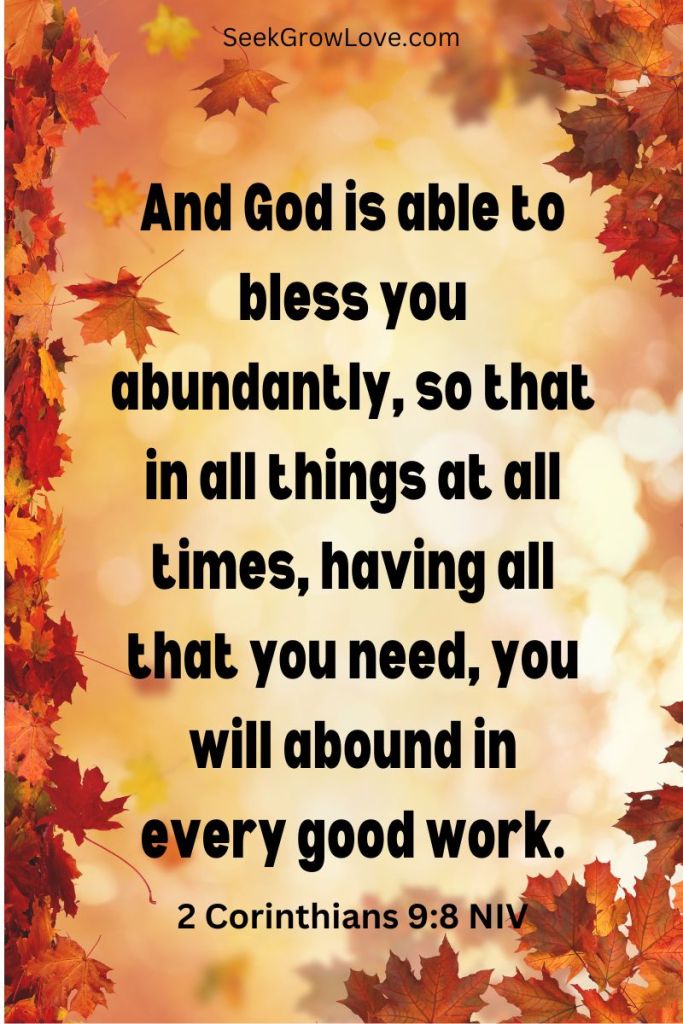
Often, human look at life as a zero-sum game: if I give what I have to someone else, then I lose and they win. But Paul reminds the Corinthians that this world is not a battle of wealth between the haves and the have-nots. “God is able to make all grace abound to you, so that having all sufficiency in all things at all times, you may abound in every good work.” (2 Corinthians 9:8) If God owns the cattle on a thousand hills (Psalm 50:10), do you think he is unable to meet your needs, even when you give “until it pinches a little.” C. S. Lewis speaks about the amount one “ought” to give and he writes “I am afraid the only safe rule is to give more than we can spare.” We might be afraid to give generously, but only in giving generously will we receive generously, just like the farmer can only reap bountifully when he sows bountifully. 

I want to be very clear : when Jesus prayed for his care from the Father, he asked for bread (“daily bread”) and water, rather than steak and Starbucks. This is not a lack of the provision of God, but the reality that giving extravagantly and full of joy does not mean that we will receive a sudden windfall, or be able to buy the nice car. God is not concerned with your riches or wealth in this life but with your obedience. God promises to care for your needs, not necessarily your wants. Obedience does produce something infinitely valuable though : the ability to do more good. ”So that you may abound in every good work.” “You will be enriched in every way to be generous in every way.” Your generosity will “produce thanksgiving to God… overflowing in many thanksgivings to God.” And we have seen how important thanksgiving is. In fact, that is what Paul ends this encouragement to give with, thanksgiving!

 We see that God wants us to give cheerfully and generously, and he will continue to bless us to be a blessing. Our giving is done because we know that every blessing given is already a gift, and everything we own belongs to the God who owns everything. As we give, we can remember that God has already given the greatest gift of all, and our generosity can and will result in thanksgiving to God for his inexpressible gift!

-Jake Ballard

Questions and Application

  1. “Blessed to be a blessing.” :  Have you thought about how this description defined so much of the interaction of God’s people with the world? What are some of the blessings you have been thanking God for this week? How can you use those blessings to bless the world around you?
  2. “Trusting God with Generosity” : Lewis’ call to give more than we can spare requires that we trust that God will meet our needs even when budgets seem to say we can’t. Not everyone is called to sell everything they have and give to the poor, but some were (and maybe are). How much is the right amount to give for you? Who around you needs to be blessed?
  3. “Supplying the needs of the saints” : I have tried to be very clear that Paul was talking about giving money. We should give money to make sure we meet the needs of those around us who lack funds. There are three important points to remember. First, if we are young and don’t have a job, it is very hard to give money. A way to help is to give what you can ; your time or your talents, for example. Second, however, if you give of your time and talents, that doesn’t excuse you from giving money if you can. You should be willing to give everything to God, time, talent and treasure (money). Third, and the opposite of the last points, if you give money to a ministry, that is not a substitute for volunteering your time and abilities. All three, the time you are given, the talents (abilities) you have and the treasure (money) you own, are blessings from God, and are given so you can bless others. 

Standing Firm in the Lord

1 Thessalonians 3

Tuesday, August 30, 2022

When reading this chapter, the joy Paul had stood out to me.  Paul faced challenge after challenge, obstacle after obstacle as he worked to spread the gospel, yet he is still full of joy.


Paul starts the chapter by talking about how he feared that the Thessalonians would be led astray by the temptations and afflictions they would face.  He says that for this reason, he asked someone to report on their faith, hoping that all his work there wouldn’t have been in vain.  But when Timothy returned with a report about the Thessalonians, it became clear that they had stood firm in their faith through all the persecution they faced.


In verse 7, Paul writes that he and his companions were comforted by the news that Timothy brought.  The good news about the Thessalonians was so great that it provided comfort in the midst of affliction!  Paul states that they now really live if the Thessalonians stand firm in their faith.  The Thessalonians provided so much joy to the lives of Paul and his companions that it feels like they just started to really live!  In verse 9, Paul asks what thanks they can give to God for all the joy he has about the Thessalonians.  There is so much joy that he doesn’t even know how to put it into words to thank God.  This joy is so overwhelming that he can’t even start to understand how much thanks he needs to give God.


Are you filling others with as much joy as Paul is full of from the Thessalonians?  Are those who taught you the Bible filled with joy from the way it has changed your life?  Paul’s joy came from seeing that he was able to make this impact on the Thessalonians and that they were able to continue standing firm.  We each need to be like the Thessalonians, providing joy to our teachers and others as we continue to walk in the way of the Lord.


Are you filled with joy like Paul?  God has provided each of us with much more than we ever deserved.  None of us deserve salvation, but God offered it to each one of us.  Our lives should be full of joy because of this great gift.  I can’t even begin to thank God enough for everything that He has given me!


Paul’s response to this joy is shown in verse 10.  He says that he and his companions are earnestly praying that they may see the Thessalonians again and continue to strengthen their faith.  He doesn’t claim that his job is now done, as the Thessalonians were able to stand up to opposition.  Instead, he says that he wants to visit to teach them even more, to make them even stronger, lacking nothing in their faith.


What is your response to being filled with joy?  We need to be constantly giving thanks for all that we have been given, night and day praising God.  Are you asking God that you can continue to do the work which He has prepared for you or are you saying that your job is done?  This joy should cause you to want to do even more, spreading the good news to all those around you so that they too might experience this joy.

-Kaitlyn Hamilton

Questions for Reflection and Discussion

  1. What is the biggest challenge you face in standing firm in the Lord? How can you ask for help from your brothers and sisters in Christ? (If you don’t have a church family yet – make it your first priority to find one!)
  2. Are there brothers and sisters or children in the faith that give you great joy when you see how they are standing firm in the faith even in the midst of trials? Let them know.
  3. Spend an extra ten minutes in prayer today thanking God.

In Need of a Shepherd

John 9:1 – 10:21

Imagery of sheep and shepherd are found all throughout the Bible, in both the old and the new testaments. Because of this, I think we sometimes forget some of the metaphorical imagery that comes with the sheep and shepherd dynamic. Sheep are not an intelligent animal in any sense of the word. They often wander off and get themselves in trouble. When threatened by predators, sheep will often clump themselves together in such a tight pack, that sheep in the center will often suffocate. All in all, sheep are fully reliant on their shepherd for protection, food water, and for their own survival.

Here in John 10, when Jesus is speaking about sheep, and he being the good shepherd, the people probably would have seen it as insulting when he compared them to sheep. But the point that Jesus is trying to make, is that like sheep we could not depend on ourselves for salvation from the consequences of our bad choices. God had to send us a shepherd who would “lay down his life for his sheep”. So he sent us His son Jesus. And as Jesus said, no one took his life from him, but he laid it down of his own accord. I don’t think we could have asked God to send us a better shepherd than who He sent us, His one and only son, Jesus. In just over a week, the Thanksgiving season will begin, and I think that this year we need to spend time thanking God, for the gift of the Good Shepherd, who laid down his life willingly, for us his sheep.

Jonny Smith

Today’s Bible passage can be read or listened to at BibleGateway here – John 9:1 – 10:21

Tomorrow’s passages will be the rest of John 10 and Luke 10.

The Power of Prayer

A reminder to trust in and rely upon our communication line with God 

Psalm 26, 40, 59, 61-62, 64

Psalm 62_8 NIV sgl (1)

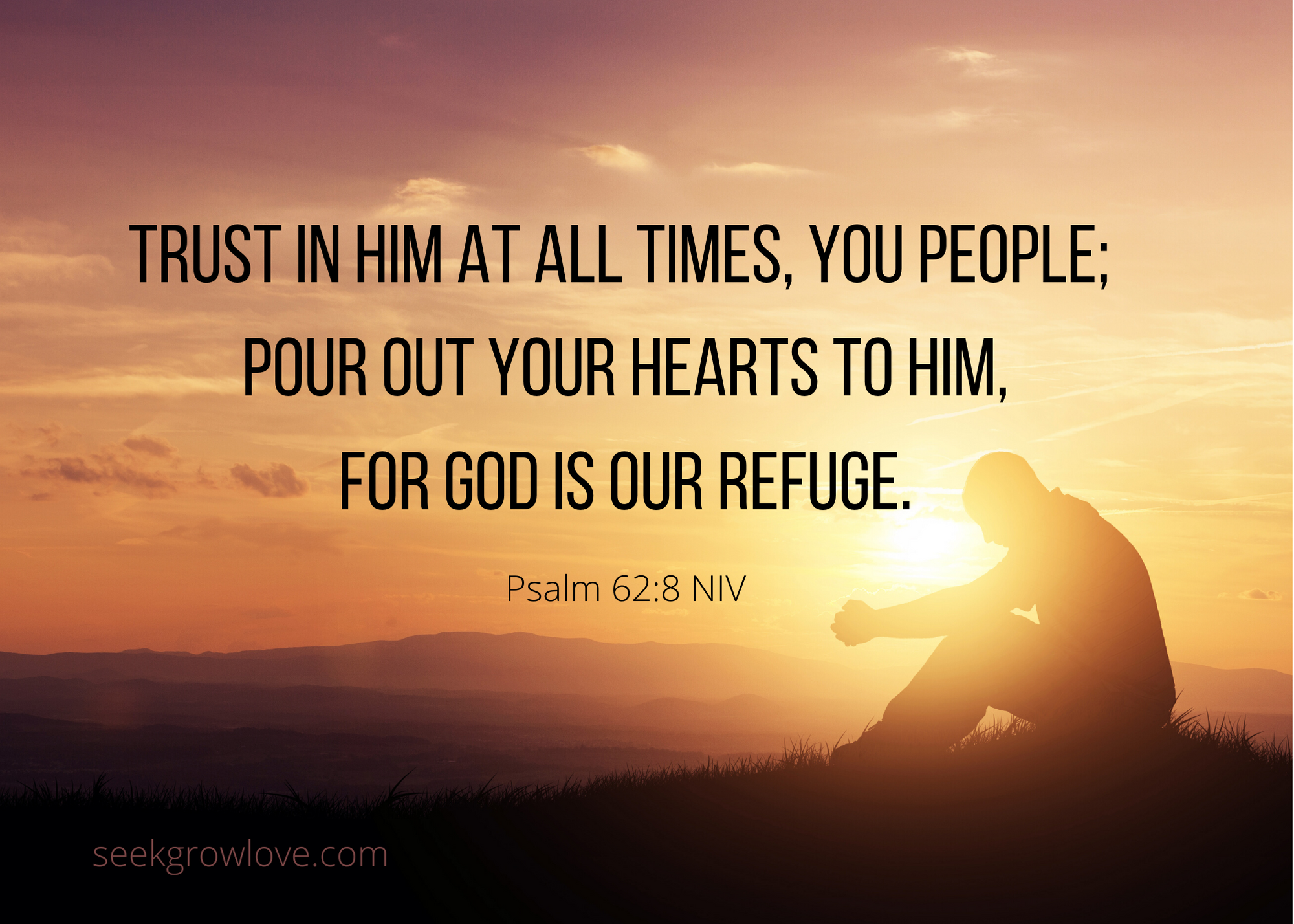
How many times have you faced a situation in your life that caused trouble, evoked anger, or instilled fear? All of us have had these moments, sometimes more days than others, but These Psalms show us that prayer is the most powerful tool that we have as followers of Christ in all sorts of situations and for all purposes.  The things that we are looking for in times of trouble are all things that God can give us if we choose to come before him. In Psalm 26, 40, 59, 60-62, 64, David is a perfect example of how we should be praying to our father persistently, fervently, and earnestly.  David prays for protection, deliverance, justice, and simple intervention in his life, but he also prays to praise his Father and pledge his dedication to him.  Prayer is not just a last-ditch effort for us when things get rough.  Rather, we should model our prayer lives after the example set by this great person of faith who has gone before us.  

Prayer is an open line of communication with God, which allows us to have a beautiful relationship with our father, who is always there to listen to us and hear what we have to tell him. Sometimes, the best time to come to our father in prayer is when we don’t feel like we have a specific reason to pray.  We don’t have to save our prayers for supplication in a time of need.  Prayer can be a wonderful, calming, and empowering thing when it doesn’t come from a place of necessity.  Even when we think we have everything under control, we still need God to intervene in our lives, and even when we are at our lowest point, we still have countless reasons to praise God.  If you feel like you don’t have as strong of a connection with God as you wish you would have, use what you know from the man who God led to conquer a giant.  He is always there for you.  In your prosperity and your weeping, he is always on the other side of the line.  Praise him in the good and in the bad.  Ask for his help in the good and in the bad.  There will always be a reason for both of those things.

I am looking forward to continuing to dive into the Word with you all this week. Consider this an introduction to the remaining devotions we will be walking through together. I leave you with this call to action: 

I wash my hands in innocence,

    and go around your altar, O Lord,

singing aloud a song of thanksgiving,

    and telling all your wondrous deeds.

                               Psalm 26:6-7 NRSV

Let’s strive to have an insatiable faith for God like David. Let us learn to depend upon him, trust in him, and sit at his feet in prayer. And, when he does intercede for you, praise his name. For he is worthy of our thanksgiving. 

-Leslie Jones


Today’s Bible reading can be read or listened to at https://www.biblegateway.com/passage/?search=Psalm+26%2C+40%2C+59%2C+61-62%2C+64&version=NIV

Tomorrow’s reading will be 2 Samuel 19-21 as we continue on our 2020 Chronological Bible Reading Plan