Everyone likes to get a letter in the mail! Especially around Christmas time. Getting a letter from a friend or loved one might seem old fashioned, but letters have a way of being more personal and intimate. Receiving a letter from a mentor or person you respect is especially important when the letter includes an important message.
The Book of Titus is a letter written by Paul to his “true son in the common faith” Titus. Titus was an early Christian leader and a close friend of the apostle Paul. He is best known as being the leader of the churches in Crete and Corinth. He was sent by Paul to these churches to help them solve problems. In this letter, he asks Titus to ask the people in the churches to stop arguing with each other over silly things and to focus on doing good things in the name of Jesus.
To help the church at Crete, Paul sent recommendations on how to pick good leaders to look after the church (Titus 1:5-9). Having leaders who are qualified is important in leading a church. Like shepherds of a flock of sheep, the “elders” of the church look after us and protect us from making mistakes that can harm us. Their job is to help us do good works for God.
Paul also reminds us that we should always do good because we are Christians. Paul writes that the grace of God “teaches us to say ‘No’ to ungodliness and worldly passions”. As Christians we should always seek to serve other people and be good to them. Sometimes it is hard to live obediently for God. Paul asks us to be “self-controlled” and live upright and godly lives. It’s not easy, but God wants to help us and to “purify for himself a people that are his very own, eager to do what is good”. (Titus 2:11-15).
It is important to always remember that God has shown His mercy to us not only because He wants us to be good, but so that He could adopt us into His family. Paul hopes that each of us “might become heirs having the hope of eternal life” (Titus 3:7). Living a godly life is how we declare our thankfulness for His great mercy. As we accept God’s gift of grace, it makes us want to do good things for the Kingdom of God.
Questions for Discussion:
In Titus 2:2, what does it mean to be “self-controlled”?
What does Paul mean when he says to “avoid foolish controversies” in Titus 3:9?
Life is so busy and complicated that I have to create lots of reminders for myself. Fortunately, my phone and computer and watch all have features where I can set reminders for myself. “Doctors appointment Tuesday at 3:00. Take the garbage to the dump on the way to work in the morning. Stop by the store after work and pick up some milk and bread.” I can even set reminders months or years in advance. I can set alarms to remind me that in 2 hours I have a meeting. In 1 hour I have a meeting. In 15 minutes I have a meeting. The Meeting is now starting. Maybe I’m too busy or maybe I’m getting old, but I find myself more and more needing reminders.
Do you ever need reminders? Little kids need to be reminded to brush their teeth, make their bed, do their homework. What do you need reminders for?
The Apostle Paul thought reminders were important for Christians. I guess he understood how easy it can be to forget what’s important when we are busy living life and doing what’s necessary or urgent. Do Christians ever forget important things about God, about Jesus, about how we are supposed to live? Yep, we sure do.
In Titus 3 Paul tells Titus to remind the believers of some important things.
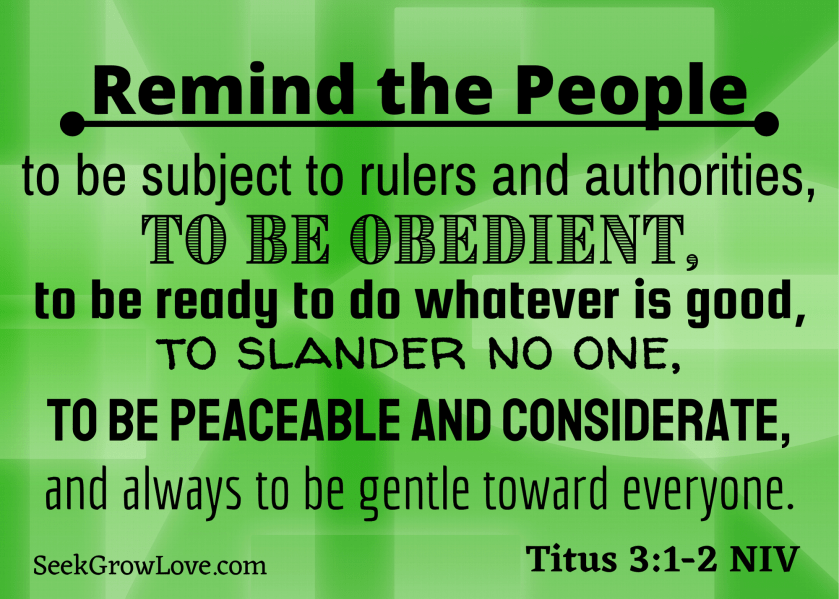
“Remind the people to be subject to rulers and authorities, to be obedient, to be ready to do whatever is good, to slander no one, to be peaceable and considerate, and always to be gentle toward everyone.” -Titus 3:1-2
Those reminders were important in the first century when Christianity was brand new and people were still learning the basics, but it’s been 2000 years. We’ve certainly got being a Christian all figured out by now, don’t we? Do we really need to be reminded to obey people in authority? Do we need to be reminded to always be ready to do good? Don’t all Christians always do what is good? Certainly we never slander or falsely accuse someone of wrong doing. I’m always peaceable and considerate and gentle toward everyone, aren’t you? (My tongue is in my cheek- that means I’m kidding).
To tell the truth, I still need to be reminded of all of those things. Just because I’ve been reading the Bible for over 50 years doesn’t mean I always remember to do good. I still need to be reminded to be considerate and gentle, and so do you. That’s why Christianity was never designed to be lived in isolation, but in community. We need each other. There’s a passage in Hebrews (a different book from today’s reading, but important) Hebrews 10:24-25 says that Christians shouldn’t get out of the habit of meeting together, because we need to encourage (I think Hebrews says “spur one another on”, like a rider spurs on a horse) each other.
Following Jesus is hard some times. Being obedient to God is hard some times. Remembering to do good and be gentle is hard sometimes. I need help, I need encouragement to keep on doing what is right. I need you, and you need me, we need each other.
I’ve read the Bible many times in my life and I need to keep on reading it to help me remember all the important things I need to remember. Today’s readings in Isaiah 63-64 and Titus 3 remind us both about God’s wrath and about God’s mercy. God has both. God hates sin, he hates it when his children are brutal to each other. He hates it when his children fight and argue. He hates sin because he loves us and he knows that sin hurts us. We hurt each other when we sin. No parent likes to see their children hurt each other. We learned that from our Father, God.
So keep reading your Bible and keep coming to Church and meeting with other believers so that you can remind them and they can remind you to keep on following Jesus.
“Hey Siri set a reminder for 7 a.m. tomorrow: be considerate and gentle to everyone.”
“Alexa, remind me to get up for Church Sunday at 8:00.”
-Jeff Fletcher
(Originally posted here on October 4, 2021 – when we were reading Titus and Isaiah together. This year, we get to start Isaiah tomorrow.)
Reflection Questions
What do you need reminders for?
Look at the list of things Paul told Titus to remind the people to do. For each one ask yourself why is this important and how well am I doing this? If you were to choose one to focus on reminding yourself to do for the next 14 days, which one needs your most attention right now?
What is your attitude toward those who give you reminders?
Though I had never met the woman in person, I was pretty certain it was her. I’d seen many photos of this wellness coach, and I had always been stunned at her story: she lost nearly 200 pounds by following the Trim Healthy Mama (THM) plan, which I try to also follow for health reasons, and was now a weightlifter as well. Something about her smile was distinctive and very recognizable. I knew she lived in this general area, so it wasn’t too far-fetched to think it could be her. As we got off the hotel elevator together, I summoned up the courage to ask: “Excuse me, are you a THM coach?” She looked stunned, but kindly replied, “Yes, I am…” I explained that I recognized her from the social media pages and was awed by her story. She gave all the glory to God for helping her become healthy. We said a few more words and then parted ways. Later that night, she posted humorously on the group page that she was now a B-List celebrity because she had been recognized in public looking a bit disheveled on her way back from the hotel waterpark, and then I formally introduced myself on social media as well.
“Before-and-after” posts almost always entice me to stop scrolling and read into the story. Whether it is a weight loss, home makeover, cake decorating challenge, hairstyle tutorial, or hoarder-to-minimalist success story, I feel so thrilled watching a transformation take place. I think we all love a good change for the better, yes? Perhaps that’s why I’m fascinated with the metamorphosis of butterflies too!
Paul tells us how our “before-and-after” should look, beginning in Titus 3:3: “At one time we too were foolish, disobedient, deceived and enslaved by all kinds of passions and pleasures. We lived in malice and envy, being hated and hating one another.” That is who we used to be, but that is not who we are now! He continues, “But when the kindness and love of God our Savior appeared,he saved us, not because of righteous things we had done, but because of his mercy. He saved us through the washing of rebirth and renewal by the Holy Spirit,whom he poured out on us generously through Jesus Christ our Savior, so that, having been justified by his grace, we might become heirs having the hope of eternal life.” So, what do we do now instead of all those behaviors we used to do before we were saved? Paul says, “I want you to stress these things, so that those who have trusted in God may be careful to devote themselves to doing what is good.”
Before God saved us, we were overcome by all sorts of sinful behaviors. But now that we have experienced the kindness and love and mercy and grace of God that we did not deserve, we need to devote ourselves to doing what is good.
We have known since we were children sitting on Santa’s lap that we were supposed to be good! But what exactly does that mean in a biblical kind of way? Hop back up to verse 1 to find a bit more guidance. “Remind the people to be subject to rulers and authorities, to be obedient, to be ready to do whatever is good, to slander no one, to be peaceable and considerate, and always to be gentle toward everyone.” This list seems to be at least a partial, but still challenging, description of “doing what is good”, don’t you think?
Paul urges yet again – it must have been such a problem in their society as it is in ours! – to avoid foolish talk (verse 9). I’ve noticed this theme throughout 2 Timothy and Titus; it is a good reminder that we need to pay careful attention to watch what we say, making sure our words are edifying. We are called to be representatives of Jesus in everything we say and do.
-Rachel Cain
Reflection Questions:
What does your “before-and-after” look like? Maybe, like me, you were raised a Christian and don’t have a dramatic story to tell. But God has still saved you by his grace! Write out your salvation story and testimony, so that you will always be ready to give an answer for the hope that you have. (I Peter 3:15)
In this scripture, Paul calls believers to “do what is good”. What are some specific good things you think God is calling you to do in this season?
During our most recent homeschooling year, my children and I studied world history from Creation through Greek civilization, reading the biblical accounts alongside mainstream history that was happening synchronologically. It was so interesting to see all of the historical events weaving together to validate the Bible! When we studied Greece, we also learned about the Greek gods and goddesses, which proved to be a great opportunity to reinforce to my children the concept of false gods and idols. It also allowed for discussions about why we follow YHWH, the one true God.
Titus, to whom Paul wrote this letter, was a Greek convert to Christianity. He was leading a church, and there were a lot of problems within it. The gods of the Greeks were corrupt (for example, Zeus, the main god, was a promiscuous liar), and the Cretan Christians were getting mixed up with the qualities of the Greek gods versus the one true God, as well as copying the behaviors of the people around them. As such, there were many issues that needed to be addressed to maintain order in the church and help the new Christians get back on track with Jesus. Paul specifically speaks of men and women (both young and old), as well as slaves, with different ideals that were specific to their situation. However, all of the things Paul listed are qualities that we should all aspire to attain. I like the way The Message records verses 1-10 (I’ve put in bold the main actions):
“Your job is to speak out on the things that make for solid doctrine. Guide older men into lives of temperance, dignity, and wisdom, into healthy faith, love, and endurance. Guide older women into lives of reverence so they end up as neither gossips nor drunks, but models of goodness. By looking at them, the younger women will know how to love their husbands and children, be virtuous and pure, keep a good house, be good wives. We don’t want anyone looking down on God’s Message because of their behavior. Also, guide the young men to live disciplined lives. But mostly, show them all this by doing it yourself, trustworthy in your teaching, your words solid and sane. Then anyone who is dead set against us, when he finds nothing weird or misguided, might eventually come around. Guide slaves into being loyal workers, a bonus to their masters—no back talk, no petty thievery. Then their good character will shine through their actions, adding luster to the teaching of our Savior God.”
Yet again, though written for a certain people in a specific time, we are not that different from the Greeks; we, too, have idols, are prone to wander, and can easily be misled by the culture around us. All of these qualities Paul listed are still admirable ambitions for all of us today! Which ones will be your focus in the coming weeks?
Much of Paul’s advice to the Cretan church involved the older people being good examples and leaders to the younger people. There is an old saying that goes, “It takes a village to raise a child,” meaning that it is important for the child to have many good influences, as well as for the parent to have support in the difficult journey of parenting. No one could have prepared me for the mental and physical exhaustion that accompanies the wonderful joy of being a mother – and it isn’t getting much easier as my children grow older, either! I know I need help sometimes and have been grateful to some wonderful ladies in my church family (and actual family) who have come alongside me to offer help when needed. There is someone out there who can benefit from your prayers, your stories, your listening ears, and your godly wisdom, and there is likewise someone more experienced in the faith who could be all those things for you as well.
Paul ends by reminding us that we have been saved by grace, and through our salvation, we are called to deny the passions of this world, striving to “live self-controlled, upright, and godly lives”. But that is not all! We are still waiting for our promised hope, when Jesus will return and redeem us again, bringing us into the Kingdom as his family. That is our goal. That is our hope. That is our happy ending. We must stay focused on the goal, spread the good news, and seek strength to live for God during this life, no matter what it may bring.
-Rachel Cain
Reflection questions:
-What does it mean to you to live a self-controlled, upright, and godly life? Are there any changes you need to make to do so?
– Is there someone younger than you (or younger in the faith, rather than in age) whom you could mentor? What about a godly person who might be willing to mentor you? Invite each of these people into your life.
That was the very first word my then-4-year-old son taught himself to write, all on his own. (Proud homeschooling mama here…)
Like many boys his age, he was fascinated with all things disgusting. It was rare for even a few minutes to pass – especially at supper time! – without him making reference to some sort of bodily function, and laughing hysterically at the mere mention of it while the rest of us just prayed it would stop. My other son, now four years old, has followed suit and is also obsessed with preschool potty humor. To him, every funny noise is flatulence; every repulsive smell must be lingering from the bathroom, and it is all hilarious. Even if we explain that the sound was just a balloon releasing air or the smell was simply spoiled food, he entertains himself for a long while with the (pleasant?) thoughts of bodily functions in the house. He cannot seem to get his mind away from potty talk.
As humankind, we, too, can become stuck in thought patterns or ideas and continue to feed those beliefs. In verses 15 and 16, Paul writes to Titus, “To the pure, all things are pure, but to those who are corrupted and do not believe, nothing is pure. In fact, both their minds and consciences are corrupted. They claim to know God, but by their actions they deny him. They are detestable, disobedient and unfit for doing anything good.” Now, I am not at all implying that innocent preschoolers have corrupted consciences; that was simply a humorous and relatable example about what happens when our minds are focused on one kind of thing. However, there are many people who continue to feed, to themselves and others, lies and negativity and unpleasant thoughts, which are contrary to God. As believers, we are called to live pure lives, demonstrating the redemption of Jesus’ sacrifice. We can claim to know God, but if we deny him by living without pure motives, we have lost our testimonies and are guilty of corrupted minds. Paul calls those kinds of people “detestable, disobedient, unfit for doing anything good.” Ouch. I don’t want those labels assigned to me. When my mind begins to dwell in negativity, judgmentalism, or even perversion, God often brings these lyrics to my mind:
Give us clean hands; give us pure hearts.
Let us not lift our souls to another…
Oh God, let us be a generation that seeks,
seeks Your face, O God of Jacob.
In this book of Titus, much like he did in 2 Timothy, Paul is addressing the issue of “meaningless talk and deception” among rebellious people. Such tendencies must have been rampant then as they still are today. He calls believers to rebuke people who demonstrate this behavior so they will be “sound in the faith.” He also sets high standards for leaders within the church in verses 6-8: “An elder must be blameless, faithful to his wife, a man whose children believe and are not open to the charge of being wild and disobedient. Since an overseer manages God’s household, he must be blameless—not overbearing, not quick-tempered, not given to drunkenness, not violent, not pursuing dishonest gain. Rather, he must be hospitable, one who loves what is good, who is self-controlled, upright, holy and disciplined. He must hold firmly to the trustworthy message as it has been taught, so that he can encourage others by sound doctrine and refute those who oppose it.”
Whew! I’m glad I’m not expected to follow such stringent guidelines, aren’t you? Not so fast. Though these qualifications are given to a specific church, they can still be applicable guidelines for our church leaders – and attenders! – today. Since our leaders are also human and prone to stumble like the rest of us, we must continue to pray for them as they seek God and lead His people. And, as Christians aiming to honor God and constantly growing in our faith, we too should aspire to live up to similar expectations as we serve and connect with our local bodies of believers. I’ll close with this verse that seems to fit with this passage and is a good reminder about how we should think (and therefore how we should behave, since our thoughts influence our actions):
Finally, brothers and sisters, whatever is true, whatever is noble, whatever is right, whatever is pure, whatever is lovely, whatever is admirable—if anything is excellent or praiseworthy—think about such things.Whatever you have learned or received or heard from me, or seen in me—put it into practice.
Philippians 4:8-9
-Rachel Cain
Reflection Questions:
With which of the qualifications in verses 6-8 do you most struggle? Pray for God to help lead you to overcome it.
Most of us who are reading this claim to know God, but have denied him by our actions at times. What are some ways you have done this? Ask God for His strength to live fully for him.
Life is so busy and complicated that I have to create lots of reminders for myself. Fortunately, my phone and computer and watch all have features where I can set reminders for myself. “Doctors appointment Tuesday at 3:00. Take the garbage to the dump on the way to work in the morning. Stop by the store after work and pick up some milk and bread.” I can even set reminders months or years in advance. I can set alarms to remind me that in 2 hours I have a meeting. In 1 hour I have a meeting. In 15 minutes I have a meeting. The Meeting is now starting. Maybe I’m too busy or maybe I’m getting old, but I find myself more and more needing reminders.
Do you ever need reminders? Little kids need to be reminded to brush their teeth, make their bed, do their homework. What do you need reminders for?
The Apostle Paul thought reminders were important for Christians. I guess he understood how easy it can be to forget what’s important when we are busy living life and doing what’s necessary or urgent. Do Christians ever forget important things about God, about Jesus, about how we are supposed to live? Yep, we sure do.
In Titus 3 Paul tells Titus to remind the believers of some important things.
“Remind the people to be subject to rulers and authorities, to be obedient, to be ready to do whatever is good, to slander no one, to be peaceable and considerate, and always to be gentle toward everyone.” -Titus 3:1-2
Those reminders were important in the first century when Christianity was brand new and people were still learning the basics, but it’s been 2000 years. We’ve certainly got being a Christian all figured out by now, don’t we? Do we really need to be reminded to obey people in authority? Do we need to be reminded to always be ready to do good? Don’t all Christians always do what is good? Certainly we never slander or falsely accuse someone of wrong doing. I’m always peaceable and considerate and gentle toward everyone, aren’t you? (My tongue is in my cheek- that means I’m kidding).
To tell the truth, I still need to be reminded all of those things. Just because I’ve been reading the Bible for over 50 years doesn’t mean I always remember to do good. I still need to be reminded to be considerate and gentle, and so do you. That’s why Christianity was never designed to be lived in isolation, but in community. We need each other. There’s a passage in Hebrews (a different book from today’s reading, but important) Hebrews 10:24-25 says that Christians shouldn’t get out of the habit of meeting together, because we need to encourage (I think Hebrews says “spur one another on”, like a rider spurs on a horse) each other.
Following Jesus is hard some times. Being obedient to God is hard some times. Remembering to do good and be gentle is hard sometimes. I need help, I need encouragement to keep on doing what is right. I need you, and you need me, we need each other.
I’ve read the Bible many times in my life and I need to keep on reading it to help me remember all the important things I need to remember. Today’s readings in Isaiah 63-64 and Titus 3 remind us both about God’s wrath and about God’s mercy. God has both. God hates sin, he hates it when his children are brutal to each other. He hates it when his children fight and argue. He hates sin because he loves us and he knows that sin hurts us. We hurt each other when we sin. No parent likes to see their children hurt each other. We learned that from our Father, God.
So keep reading your Bible and keep coming to Church and meeting with other believers so that you can remind them and they can remind you to keep on following Jesus.
“Hey Siri set a reminder for 7 a.m. tomorrow: be considerate and gentle to everyone.”
“Alexa, remind me to get up for Church Sunday at 8:00.”
-Jeff Fletcher
Today’s Bible reading plan passages can be read or listened to at BibleGateway.com here – Isaiah 63-64 and Titus 3
I’ve got some good news and some bad news. Which would you like first? If you’re like me, you’d prefer to rip the band-aid off and get the bad news over with and finish with the good news. So let’s get to it.
The bad news. Humans have made a pretty big mess out of this world. Yes, we’ve done some amazingly good things too, but we’ve made an awful mess of the world. One of my ministry settings is as a hospital chaplain. When I visit with patients, a lot of them are there because either they, or someone else, has made a huge mess of their lives. Sometimes it’s from drug or alcohol abuse, sometimes they are victim of crime, often they have not taken very good care of their bodies. Sometimes they’ve been in such despair that they attempted to end their life by suicide. I’m not going to spend a lot of time listing the ways human beings have made a mess out of the world, if you need proof, just turn on the news for an hour or two.
Here’s the thing about messes, you can ignore them, and they will simply get worse, or you can clean them up. Usually when you clean up a mess you preserve somethings and you discard others. You try to salvage what is worth saving and discard what isn’t. That requires some decision making. What to keep and what to discard. If you want clean dishes, you have to discard the dirty stuff that’s on the dishes. If you want a clean house, you have to purge the junk. If you don’t ever throw anything out then you become a hoarder and that’s an awful mess and no way to live a flourishing and happy life.
In today’s first reading in Isaiah, Israel had made quite a mess. They failed to be faithful to YHWH, the God who created them and called them to be His. Despite warnings and pleadings, Israel worshipped other gods. They failed to give YHWH their exclusive love and devotion. After numerous attempts to get them to stop, God finally allowed them to face the consequences of their unfaithfulness. God allowed their enemies to conquer them, destroy their beloved temple and city, Jerusalem, and they went into captivity for 70 years. That was the bad news.
Now for the good news. God was going to rescue them, restore them and return them to their beloved Jerusalem.
Isaiah 61
“The Spirit of the Sovereign Lord is on me because the Lord has anointed me to proclaim good news to the poor. He has sent me to bind up the brokenhearted, to proclaim freedom for the captives and release from darkness for the prisoners,[a] 2 to proclaim the year of the Lord’s favor and the day of vengeance of our God, to comfort all who mourn, 3 and provide for those who grieve in Zion— to bestow on them a crown of beauty instead of ashes, the oil of joy instead of mourning, and a garment of praise instead of a spirit of despair. They will be called oaks of righteousness, a planting of the Lord for the display of his splendor. 4 They will rebuild the ancient ruins and restore the places long devastated; they will renew the ruined cities that have been devastated for generations.”
Isaiah goes on to describe how much better things will be for God’s people. He uses the image of a bride being rejoiced over by her groom. God’s love for his people is great.
Toward the end of the section is the promise: ” ‘See, your Savior comes! See, his reward is with him”
Notice God’s rescue of his people is good news for some, and bad news for others. It’s both the year of the Lord’s favor and the day of vengeance.
Think about WWII for a minute. When the Allied Forces defeated Hitler and his armies and came to the internment camps like Auschwitz, it was good news for the prisoners, but bad news for the German army. Hitler chose suicide over the swift justice that was sure to come. For the men and woman who were set free it was good news but for the perpetrators of injustice it was a day of vengeance.
Jesus is coming again. In Titus 2 we are told:
“11 For the grace of God has appeared that offers salvation to all people. 12 It teaches us to say “No” to ungodliness and worldly passions, and to live self-controlled, upright and godly lives in this present age, 13 while we wait for the blessed hope—the appearing of the glory of our great God and our Savior, Jesus Christ, 14 who gave himself for us to redeem us from all wickedness and to purify for himself a people that are his very own, eager to do what is good.”
God’s purpose in allowing His people Israel to face judgement was his way of cleaning up the mess that they had made and giving them a chance to start fresh, free from the worship of idols.
God’s purpose in sending Jesus was to extend the opportunity of salvation to all people, again, to clean up the mess and rescue those who are willing to receive the grace of God. While we are waiting for Jesus to come and all the mess to be finally cleaned up, God invites us in the name of Jesus to follow him and live Godly lives, rejecting the mess of the world.
The world is a mess and God is fully and finally going to clean it up through the coming of Jesus Christ. For those who reject God’s grace and mercy it will be a day of vengeance. While we wait, God is working in our lives to clean up our messes and put us to work doing good, helping point others to God. Are you willing to say “no” to ungodliness and worldly passions? Are you willing to be different (FUEL 2019). Are you eager to do what is good? God wants to purify you and put you to work. Are you willing?
-Jeff Fletcher
Today’s Bible reading plan passages can be read or listened to at Biblegateway.com here. Isaiah 61-62 and Titus 2.
In the movie Saving Private Ryan, Tom Hanks’ character spends the bulk of the film working to save the life of one man, Private James Francis Ryan, who is slated to be sent home after his three brothers have all been killed in combat. Near the close of the film, Hanks leans in to Matt Damon, who plays Private Ryan and whispers his last words, “Earn this.”
The final scene of the movie is both touching and convicting. Ryan, now an old man, stands at the grave of the man who gave his life to save him and he weeps. He looks to his wife, “Tell me I’ve lived a good life,” he says, “Tell me I’m a good man.”
For him, the reality of living a good life in response to the sacrifice that was made on his behalf was tangible because he had looked in the eyes of the man who died in his place. I think, perhaps, we miss something because we can’t do that, don’t you?
Paul wanted us to think about doing good with our lives. It seemed to be important to him.
His letter to Titus is not long. It’s only 46 verses. But almost 1/5 of them talk about doing what is good (17.5% for you math heads out there).
“I want you to stress these things, so that those who have trusted in God may be careful to devote themselves to doing what is good.”
Our lives as believers preach louder than any Bible verses we post to our Facebook pages or how pious we consider ourselves to be. Perhaps that’s why Paul concludes his letter to Titus with the reminder that,
“Our people must learn to devote themselves to doing what is good, in order to provide for urgent needs and not live unproductive lives.”
We all know that we can’t earn salvation, but we can earn (or lose) other people’s trust.
— The way that we speak to, and about, our parents or our spouse could make someone want to know more about the God we serve…or less.
— The integrity we exhibit at work might make them want to pick up a Bible…or never set foot in a church.
— Our gentleness, kindness, and considerate behavior may be the thing that draws someone to experience the love of God for the first time…or they might come to believe that God is rude and harsh and uncaring.
To put it another way… why would your unbelieving boss want to consider Christianity if you are the laziest employee they have? Or… Do you think anyone cares how many Bible verses you know if you make everyone around you feel like garbage?
We can all fall into the self-focused trap far too easily. So here’s your reminder that (and you might need to sit down for this): It’s not about you.
I had kind of an ‘a-ha’ moment in Sunday morning worship not too long ago when we were singing the song, Awakening. Some of the lyrics say,
For the world You love Your will be done Let Your will be done in me
Praying for God’s will to be done in your life is a good thing no matter what. But it hit me over the head that Sunday morning that the purpose of Him wanting to do his will in my life wasn’t just for me. “For the world you love…”
While we can’t ever “Earn this” we can embrace the passionate and intentional living that Private Ryan embraced and regularly examine ourselves with questions like he asked…Am I living a good life?
Or more specifically… Is how I’m living drawing people towards God or repelling them from Him? Am I reflecting Him accurately?
Am I devoting myself to doing what is good?
-Susan Landry
Today’s Bible reading can be read or listened to at BibleGateway here – Titus 1-3
Did you panic a little bit when you found you had to read two entire books of the Bible today? As you have hopefully found now both Titus and Philemon are pretty short books. In fact, Philemon checks in as the third shortest book of the Bible (only 2 John and 3 John are shorter).
First, let’s talk about Titus. If you owned a business and were looking to hire managers to oversee the company what would you require? Would your job posting read that the applicant needed silky hair, mad four-square skills, and a deep love of chicken nuggets? If so your company would probably not be in business for long because there would be no purpose behind the requirements you wanted. Hopefully, your requirements might be along the lines of: must be self-controlled, honest and just. If so you and God have those requirements in common except these are the requirements that God asks of the elders of the church which is a person who “manages God’s household” (Titus 1:7).
He also has requirements for those who aren’t elders. In chapters 2 and 3, Paul outlines what God expects from everyone who claims to be a follower of Christ. It says in chapter 3 verse 1- 2 that we are, “to be subject to rulers, to authorities, to be obedient, to be ready for every good deed, to malign (which means to harm) no one, to be peaceable, gentle, showing every consideration for all men.”
Paul carries over the idea of being peaceable and gentle in the book of Philemon. Paul writes to Philemon, who is a brother in Christ, concerning a slave named Onesimus. It seems that Onesimus was full of passion for spreading God’s word so he ran away from his master Philemon to join Paul. Paul sent Onesimus back to Philemon and requested that Philemon would, “accept him as you would me” (vs.17). Paul treats both parties with grace and love to resolve the issue at hand and so once again practices what he preaches showing that he is a fully committed follower of God just as we are to be.




 Seek Grow Love