The Exodus: Starting a new thing

We have been building up in the last couple of chapters to bigger and bigger plagues and displays of God’s might and power over the gods of Egypt, and finally we are coming to the climax of that story.  God is about to unleash his judgement on every firstborn in Egypt, but he will spare the people of Israel if they will sacrifice a lamb and put its blood around their doors.  

3 Tell the whole community of Israel that on the tenth day of this month each man is to take a lamb for his family, one for each household. 

4 If any household is too small for a whole lamb, they must share one with their nearest neighbor, having taken into account the number of people there are. You are to determine the amount of lamb needed in accordance with what each person will eat. 

5 The animals you choose must be year-old males without defect, and you may take them from the sheep or the goats.

6 Take care of them until the fourteenth day of the month, when all the members of the community of Israel must slaughter them at twilight.

7 Then they are to take some of the blood and put it on the sides and tops of the doorframes of the houses where they eat the lambs. 

8 That same night they are to eat the meat roasted over the fire, along with bitter herbs, and bread made without yeast. (Exodus 12:3-8)

The meat of a lamb that you had taken care of for a week and that was cooked with bitter herbs and unleavened bread would not be a special feast that you would enjoy.  Emotionally this would be difficult, and the food would not taste that great.  This is to show the people of Israel that sacrifices and victories are not always joyous or exciting, but come at a personal cost.  For Moses it was seeing the Egyptians, the people he grew up with and who he cared for still, devastated and suffering.  This judgment was difficult for God as well since we know that he does not wish that any should perish, but he needed to show his people that the Egyptian gods they were following were powerless so that he could start to build them into his own people.

12 “On that same night I will pass through Egypt and strike down every firstborn of both people and animals, and I will bring judgment on all the gods of Egypt. I am the Lord. 13 The blood will be a sign for you on the houses where you are, and when I see the blood, I will pass over you. No destructive plague will touch you when I strike Egypt. (Exodus 12:12-13)

God is starting to prepare the Israelites to be his people so that one day he can have Jesus, his son, die for all sins as the ultimate sacrificial lamb whose blood will cover our sins. They have a long ways to go before they are really the people of God, but we can skip ahead to Mark 3 and start to see another major change that is being initiated.

Jesus went into the synagogue again and noticed a man with a deformed hand. 2 Since it was the Sabbath, Jesus’ enemies watched him closely. If he healed the man’s hand, they planned to accuse him of working on the Sabbath.

3 Jesus said to the man with the deformed hand, “Come and stand in front of everyone.” 4 Then he turned to his critics and asked, “Does the law permit good deeds on the Sabbath, or is it a day for doing evil? Is this a day to save life or to destroy it?” But they wouldn’t answer him.

5 He looked around at them angrily and was deeply saddened by their hard hearts. Then he said to the man, “Hold out your hand.” So the man held out his hand, and it was restored! 6 At once the Pharisees went away and met with the supporters of Herod to plot how to kill Jesus. (Mark 3:1-6)

This is very near the start of Jesus’ ministry and we see that he is running into a ruling group who have hard hearts and are therefore unable to follow God’s will.  Sadly this time it is the very teachers of the law that we will see Moses give later this week that are wanting to kill a Godly man.  

The biggest thing stopping God from working strongly in our lives is our own hard heart, and sometimes it can take a really major event in our lives to break down the walls that we set up around our heart, but I encourage you to take the first step and prayerfully listen to what God is trying to tell you.

I really enjoy the story of the Exodus and I hope you enjoy walking through this next chapter in the story of the Israelites and also in the early stages of Jesus’ ministry.  

Chris Mattison

Links to today’s Bible reading passages Exodus 11-12 and Mark 3

Listening to Jesus

Today’s Bible Reading – Matthew 25 and Genesis 49 & 50

                I Love stories, don’t you?

Here’s a story by CS Lewis found in the book: The Voyage of the Dawn Treader as retold by Jennifer Neyhart:

               “Eustace is a character you kind of just want to punch in the face until his transformation experience with Aslan. He was arrogant, self-centered, and all around annoying to Edmund and Lucy.

On one of the islands the crew lands on, Eustace finds a dragon’s lair and is very greedy for the treasure. He puts on a gold bracelet and falls asleep, and when he wakes up, he has been turned into a dragon. Lewis writes, “Sleeping on a dragon’s hoard with greedy, dragonish thoughts in his heart, he had become a dragon himself.” Eustace had fleeting thoughts of relief at being the biggest thing around, but he quickly realizes he is cut off from his friends, and all of humanity, and he feels a weight of loneliness and desperately wants to change.

That night, Aslan comes to Eustace and leads him to a large well “like a very big round bath with marble steps going down into it.” Eustace describes the scene to Edmund after the fact. He says the water was so clear and he thought if he could get in there and bathe it would ease the pain in his leg (from the gold bracelet he had put on when he was human). But Aslan told him he had to undress first. And doesn’t God ask this of us? As Lewis wrote in Letters to Malcolm: “We must lay before him [God] what is in us; not what ought to be in us.”

Eustace found that no matter how many layers of dragon skins he managed to peel off of himself, he was still a dragon.

“Then the lion said – but I don’t know if it spoke – ‘You will have to let me undress you.’ I was afraid of his claws, I can tell you, but I was pretty nearly desperate now. So I just lay flat down on my back to let him do it.

“The very first tear he made was so deep that I thought it had gone right into my heart. And when he began pulling the skin off, it hurt worse than anything I’ve ever felt. The only thing that made me able to bear it was just the pleasure of feeling the stuff peel off. You know – if you’ve ever picked the scab off a sore place. It hurts like billy-oh but it is such fun to see it coming away.”

“Well, he peeled the beastly stuff right off … And there was I as smooth and soft as a peeled switch and smaller than I had been. Then he caught hold of me – I didn’t like that much for I was very tender underneath now that I’d no skin on – and threw me into the water. It smarted like anything but only for a moment. After that it became perfectly delicious and as soon as I started swimming and splashing I found that all the pain had gone from my arm. And then I saw why. I’d turned into a boy again…” – C. S. Lewis, The Voyage of the Dawn Treader

 This scene always grabs my heart. It reminds me that I cannot fix myself. It paints a beautiful picture of baptism and transformation to new life. It humbles me as I put myself in Eustace’s place. And even long after our initial baptism we have the ongoing challenge of surrendering to God’s work in our lives which can be painful at times, even when it’s a good pain.

And I like Lewis’s note of narration at the end of this scene as well:

“It would be nice, and fairly nearly true, to say that “from that time forth Eustace was a different boy.” To be strictly accurate, he began to be a different boy. He had relapses. There were still many days when he could be very tiresome. But most of those I shall not notice. The cure had begun.”        

https://www.jenniferneyhart.com/2014/10/c-s-lewis-undragoning-of-eustace.html

End of Story.

Jeff’s comments:

                Stories have a way of capturing our attention and keeping our interest.  In a really good story like the undragoning of Eustace we might discover after reading it that it stays with us, that it somehow changes the way we see the world or the way that we are in the world.

                Jesus was a master storyteller.  Throughout the Gospels we hear him telling stories, and amazing stories they were as they somehow manage to transcend time and place and language and cultural barriers.

                In Matthew 25 Jesus tells three stories.  One story is about bridesmaids and oil, one is about masters and servants and bags of gold, and one is about sheep and goats.  Jesus told these stories just a few days before he was to be arrested, tried, condemned and nailed to a Roman cross and publicly executed. 

If you’ve ever been around someone who knew that they were going to die soon, you know that near the end of life people usually want to focus on those things which are most important.  They want to say “ I love you” to people they care about.  They want to say “ I’m sorry” to the people they have hurt or they want to say “I forgive you” to the people who have hurt them.  Since Jesus is running out of time and opportunities to preach and teach before his arrest you can imagine that what he has to say is very important to him. This is Jesus saying “I love you” to people he cared deeply about.

I encourage you to read and reflect on those stories in Matthew 25. 

Why is he talking about weddings and bridesmaids and having enough oil and the danger of missing out on the wedding banquet?  What does he want us to do or not do?

Why is he talking about a rich landowner going away on a long trip and leaving behind something valuable and asking his trusted workers to manage his valuable gold well?  What does he want us to do or not do?

Why is he talking about sheep and goats and why is he praising and rewarding some for the good things they do to help others (and him) and condemning  and punishing others for the good things that they fail to do to help others (and him)?  What does he want us to do or not do?

Spend some time thinking about each story.  Imagine yourself there in the story.  What’s it like to be a bridesmaid who wasn’t ready and missed out on your friend’s wedding?  What’s it like to be a worker who gets praised and rewarded for working hard when the master returns?  What’s it like to be called a goat (not The G.O.A.T. –a.k.a. Michael Jordan or Drew Brees) but a goat who failed to care for the sick, the hungry, the prisoners and the naked and gets turned away by Jesus?

Listen to Jesus’ stories and allow them to teach you whatever Jesus wants you to learn.

-Pastor Jeff Fletcher

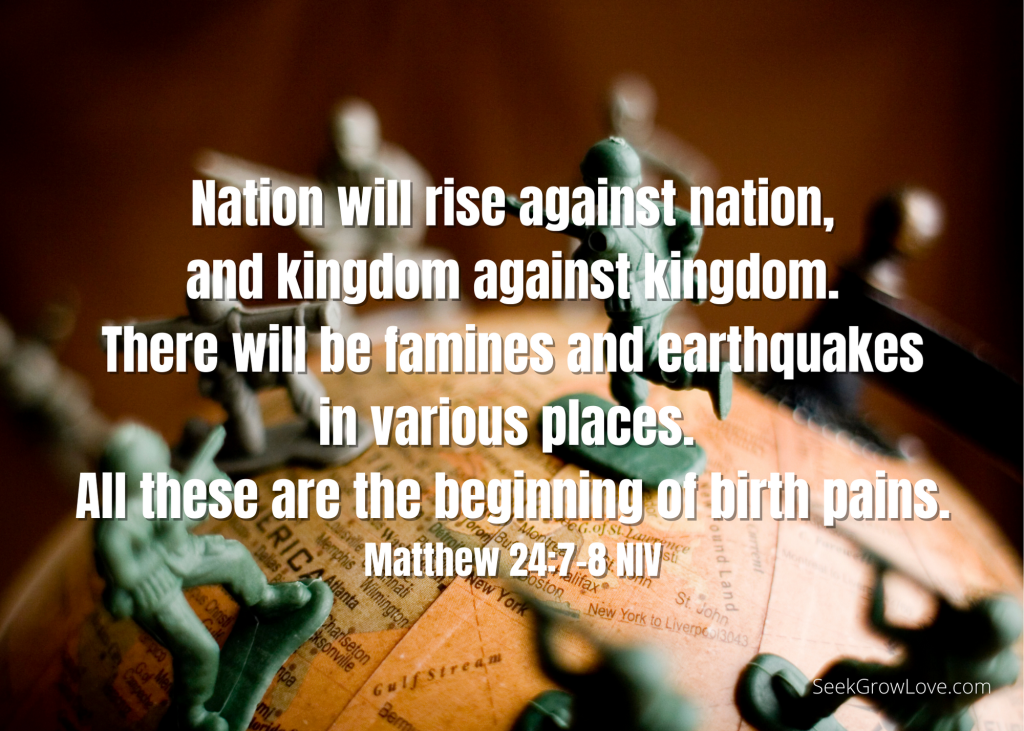
Birth Pains

Today’s Bible Reading – Matthew 24 and Genesis 47 & 48

               I have never had a baby.  Shocker, I know!  As a male member of the human race the act of childbirth has and will forever elude my lived experience.  However, as a father of eleven Fletchers, I have spent many years of my adult life in the company of pregnant women, or more precisely, a pregnant woman.  I was there for all eleven births and I caught most of them (the last one came so quickly that I caught him solo).  All this is to offer to you my credentials that, although never directly experiencing labor, I have been present for enough births to recognize the various stages that women go through in childbirth.  Fun fact, for women who have more than one baby the Braxton Hicks contractions (otherwise known as false labor) can come several weeks or even months before the baby is actually born.  Braxton Hicks contractions are one way that the body prepares itself for labor.  It’s like an athlete doing warm up exercises before the actual event.   Muscles tighten and relax as they practice for the real thing when it comes. 

                Today’s devotion isn’t really about childbirth, it’s about being prepared for the return of Jesus Christ, the end of this present age and the preparation for the age to come, the Kingdom of God.  Matthew 24 is known as the “little apocalypse”.  Apocalypse is another term for Revelation.  In the Bible the book of Revelation is 22 chapters long and goes into a lot of detail about the end of this age and the coming of Jesus.  Matthew 24 is a condensed version, kind of a mini-sermon Jesus preached to his followers shortly before he went to the cross.  (You will run across parallel or “synoptic” passages when we get to Mark 13 and Luke 21 in just a few days/weeks).

                Jesus’ purpose here is to prepare his followers to be ready for times of great tribulation or distress that would come immediately prior to his return.  If you’ve ever read or heard a sermon about the apocalypse or the end of the world or Armageddon you probably are aware that Jesus warned that before things get amazingly better- ie. The New Heavens and the New Earth, Christ returning to rule over all the world bringing a final end to all sin and death and setting free the whole earth from the “curse” of death… before things get amazingly better, there will be a time when they become incredibly hard.

                A brief study of the history of the Church for the last 2000 years will show that Christians have gone through hard times a lot.  In the first 2 centuries the problem was the Roman Empire.  Followers of Jesus were often told that they had to renounce their loyalty to Jesus and declare their loyalty to Caesar alone.  When they refused, some of them were thrown to the lions or burned at the stake.

                Since Christianity was legalized in the Roman Empire it has faced challenges in many parts of the world at different times.  In the 17th century Christian missionaries in Japan were killed for their faith.  In the 1930’s Christians in Germany who failed to support Hitler faced severe persecution and some, most notably Dietrich Bonhoeffer, were executed for resisting Nazism.  Christians in Communist China and the Soviet Union experienced incredible persecution during most of the 20th century.  There are places in the Islamic world today where Christians who attempt to proselytize Muslims face the threat of execution.

                Every generation of Christians since the first century could look at what was happening in the world and see the potential for the end of the world.  Jesus’ own disciples asked him right after his resurrection, before he ascended to God, “Is it NOW, Lord?” (Acts 1:6).

                2020 was a really challenging year with Covid, racial division, murder hornets, wildfires and hurricanes.  I had a lot of people asking me if I thought the end of the world was coming.  Perhaps you’ve wondered that yourselves.

                Matthew 24 is a great place to go when you start wondering if this is the end.  Like a woman who is going to have a baby, she may have “birth pangs” for a long time before the baby is actually ready to be born.  The same is true with the coming Kingdom of God.  I think every generation of Christians experience some amount of persecution or “natural” disasters or other tragedies that leave them wondering if the end could be near.  Just as Braxton Hicks contractions are God’s way of preparing a woman to give birth by having her muscles practice for the big event, God permits every generation to experience a certain amount of trials and tribulations to help prepare God’s people for the final “great push” that will occur right before Jesus returns.

                Jesus himself said that no one knows exactly when he will return.  He said that even he doesn’t know.  That is something that only God knows.  What Jesus does say to his disciples then and to us today is that we need to stay ready, we shouldn’t fall asleep in our faith.  He warns that as troubles and persecution increase and as the world becomes a less loving and more violent place that many of his followers would fall away:

                “At that time many will turn away from the faith and will betray and hate each other, and many false prophets will appear and deceive many people. Because of the increase of wickedness, the love of most will grow cold, but the one who stands firm to the end will be saved. (Matthew 24:10-12).

                Jesus might come very soon. I can’t predict when.  All I can do is make sure that I’m ready whenever he does come.  I must make sure that I stay faithful and don’t turn away even if the persecution gets really bad.  I think Christians living in the United States are getting ready to face some real persecution in the near future.  In fact, I think we already are.  There is a lot of pressure to conform to the changing norms of society.  Cancel culture will not have any respect for Christianity.  Some of the things that the Bible teaches about how we are supposed to live, particularly in areas of morality, sexuality and gender norms are considered anathema by the current progressive climate.  As people place more value on becoming “woke” more followers of Jesus, young and old will be persecuted if they fail to change their values.  Remember, Caesar doesn’t like to be rejected as God, neither does the devil, and neither do the progressive elites.  In the wake of the coming persecution Jesus our Lord tells us to “stand firm.”

-Pastor Jeff Fletcher

Blind Guides

Today’s Bible Reading – Matthew 23 and Genesis 45 & 46

Yesterday we got to spend our whole devotion thinking about a great party and the thrill of receiving an invitation from God to honor His Son. Today – no such fun. The parties and parables are gone and today, in Matthew 23, we read only of strong warnings, harsh words, and blasting condemnation. This is the last recorded time in the book of Matthew that Jesus addresses the crowds. This is what he is going to leave with them – too important to not say. Anyone who believes Jesus would never condemn because he just loved people no matter what, just full of overflowing forgiveness and love, could benefit from a little sit down with Matthew 23.

It is clear that Jesus was not happy with these Pharisees and teachers of the law. He starts by warning the crowd to not be like the Pharisees as he begins describing them: they don’t practice what they preach, they make it harder for people to be godly, they love being honored by men and they pridefully exalt themselves. And then, speaking directly to the Pharisees and teachers of the law he lets loose on what has become known as the “7 Woes”. Six times he will begin with “Woe to you, teachers of the law and Pharisees, you hypocrites!” and once with “Woe to you, blind guides.” Jesus uses some choice language to describe these men: son of hell, blind guides, blind fools, blind men (notice a pattern?), snakes and brood of vipers.

So, what in the world were these people doing that was so bad to receive this 7 part hellfire sermon. After all, we know Jesus often responded to people’s sins with mercy, grace and forgiveness and the all-important chance to start over. He hadn’t called the lying cheating thieving Zacchaeus a son of hell? What was different here?

The Pharisees and teachers of the law were supposed to be the ones to guide people to God. The Wiersbe Bible Commentary suggests there were about 6,000 Pharisees at the time – mostly middle-class businessmen who had devoted themselves to being separate – becoming the religious leaders who would show the Jews how to please God. And, some were indeed authentic in this quest (Nicodemus and Joseph of Arimathea are two named in Scripture). The crowd gathered was likely shocked to hear Jesus speaking of and to the Pharisees in this way because they had been taught (at least by the Pharisees themselves) to revere the position and spiritual leadership held by this Jewish sect.

What started out as a good goal became warped and ungodly. As the Pharisees kept puffing themselves up there was no room left for what really pleases God. They had become blind guides. And it is obviously very dangerous to follow a blind guide. They could lead you straight to somewhere you don’t want to go. And that is exactly the warning Jesus was giving the Pharisees and the crowd. “You shut the kingdom of heaven in men’s faces. You yourselves do not enter, nor will you let those enter who are trying to.” (Matthew 23:13 NIV).

The Pharisees loved the law and specialized in knowing and enforcing each and every little detail of a long long list of do’s and don’ts. This, they thought, would make God happy. But all the while they neglected the larger heart issues of justice, mercy and faithfulness. They mastered in the dotting of i’s and crossing of t’s, but failed to see that the novel they were writing with their lives was tearing down every attempt others were making to please God. They were quick to point out other’s errors, but saw none of their own. It became most important to them to look good before man. So important that they forgot about how to actually look good before God. They were puffed up and proud, greedy and selfish.


It is easy to read this chapter and shake my head and point my finger and say, “Boy, I’m glad I am not like one of them.” But, in so doing – I become like one of them.

Dear God, help me to do what is right – with a heart that is right. May I see the error of the Pharisee’s ways – and my own – and work to clean up my own insides. Help me be humble and not seek the honor of men. Open my eyes to who you are and what truly pleases you. Open my ears to the teachings of your Son, to not just know it but to live it. Help me guide others to you, not armed with a legalistic checklist, but with a heart of justice, mercy and faithfulness. In your precious Son’s name, I pray.

-Marcia Railton

You are Invited!

Today’s Bible Reading – Matthew 22 and Genesis 43 & 44

What was the best party you have ever been to? How did you get invited? What was your relationship with the host? With the guest of honor? Who else was there? What did you wear?

Or, maybe there was a party you were invited to that you didn’t make time for? Perhaps you didn’t really know the guest of honor that well so you weren’t too interested. Or maybe you were mad at the host so you stayed away? Or you figured it would be boring since they didn’t have (insert hobby/entertainment of choice). But then, come to find out – you missed out on the party of the century.

Jesus knew we like to talk about parties. Wedding receptions are particularly exciting – and royal wedding parties top the charts. So what a perfect parable and analogy for the Kingdom God is preparing. God is the King – and as host of the party he decides who to invite to this event of all events which will honor His Son – Jesus.

The guest list starts out somewhat small and elite which is very fitting for a royal party. The Jews were the first to be invited to the party. They could trace their heritage back to Abraham, Isaac and Jacob – the fathers of the faith. But, they ignore their invite and the God who sent it. They don’t even RSVP. God sends his servants out as messengers (the prophets and those who speak for God) to remind God’s people of the graciousness of their host and the splendor of the party. But, the potential guests of the party are too deep into other things – their fields, their businesses, their homes, their selfish pursuits, their false gods. Most just ignore God’s messengers – but some decide the best way to decline the invite is through violence. In rage they attack God’s messengers, even killing some. For a time they may have thought they got away with it. But, God knows and delivers judgment.

The guests didn’t show but the party isn’t cancelled. God sends his messengers again. They hit the streets with new invitations. “Invite them all,” says the host. It no longer matters who your great great great grandfather was. It doesn’t matter who you were or what you did. Old, young, rich, poor, men, women, children, black, white, and every color in between. You are invited! And all your neighbors in the world are invited! Let the party begin.

But, wait – that’s not yet the end of the parable or God’s expectations. The host has indeed invited all and is ready to receive all into His Kingdom Party. But, you must come dressed appropriately for the party so you aren’t tossed out. No, God won’t check to see if you have a designer label – but He will check to make sure you have clothed yourself with salvation. To accept your invitation accept God’s Son as the only way to salvation. And then put on the robes of righteousness – seek to live the life that will bring glory to the Father and the Son. There are many passages that continue the analogy of being properly clothed with righteousness, not stained with sin – some are Job 29:14, Isaiah 61:10, Jude 23, Revelation 3:4 and 19:8).

The greatest party ever to come is about to begin and you and all your neighbors are invited. Don’t turn down the invite because you are mad at God or don’t know Jesus well or are busy at home and work. Accept His invitation. Come to the party. But don’t make the fatal error of trying to sneak in unprepared. Accept His Son and clothe yourself with righteousness. Make sure your neighbors know they are invited and help them select their proper attire.

And then – let the party begin!

-Marcia Railton

Less than a Week before Dying

Today’s Bible Reading – Matthew 21 and Genesis 41 & 42

What would you do if you knew you would die in less than a week? Is there anywhere you would want to go? What changes would you make in your schedule and priorities? Less TV, pinterest or social media? More meaningful interactions with those who mean the most to you? Would your tone change? Would you give more hugs? Are there any difficult conversations you wouldn’t put off any longer? If there was anything you could do to prolong your life would you do it?

Jesus was in a very unique situation as he was coming into Jerusalem in Matthew 21. He knew he was quickly approaching both the time and place for his agonizing death by crucifixion. Many would run in the other direction. Maybe if he laid low and avoided Jerusalem longer the chief priests and leaders of the law would forget about him and find some other religious teacher to get mad at and crucify. Think of how many more people he could heal and teach if he could stay away from them just another month? Wouldn’t it be worth it?

But, Jesus didn’t hide or try to dodge the bullet. If anything he boldly intensified his work and purpose. Previously he had mostly stuck to the smaller towns and villages rather than camping out in Jerusalem – the holy city of all Jews. Often he had told those he healed to be quiet about it. He was never trying to draw a crowd – but the crowds still had a way of finding him anyways. Now, as he made preparations to enter Jerusalem on the back of a donkey (to fulfill Zechariah’s prophecy) he knew the crowds couldn’t be held back any longer. On this day they would shower Jesus with shouts of praise, but in a few days they will cry out for crucifixion.

We don’t know the day or hour or location of our death. We also don’t know how long the tomb will hold us. But, like Jesus – and because of Jesus’ resurrection and God’s promise to send Him to earth again – we can be sure of a resurrection to come. How will that impact the intensity of your ministry today – how you spend your time, what conversations you have, what passion you have for the Father’s work and will?

May we not be like the fig tree that had life but failed to bear fruit for Him.

May we not be like the son who said he would do the Father’s work – but then didn’t.

-Marcia Railton

In the Right Order

Today’s Bible Reading – Genesis 37 & 38 and Matthew 19

I remember a song we used to sing in Sunday School:

“Jesus and Others and You, what a wonderful way to spell J-O-Y!

Jesus and Others and You, in the life of each girl and each boy.

J is for Jesus for he has first place. O is for Others we meet face to face.

Y is for You in whatever you do. Put yourself third and spell Joy.”

It’s not just a sweet song with a catchy tune for little girls and boys. There is a lot of truth in those lyrics. And it comes to play in two passages in Matthew 19 – Jesus’ teaching on divorce and his conversation with the rich young man regarding materialism. Let’s look first at divorce.

Too often marriages start to crumble when the relationship becomes a ‘his side’ vs ‘her side’. Gone is the teamwork and working together and dream of always being together that brought them together in the first place. It is replaced with selfish goals and pursuits, quick tempers and irritations, and eventually seeing their mate tragically not as their better half but as their enemy. It is not a new thing – it was a problem 2,000 years ago as well. The Pharisees asked Jesus, “Is it lawful for a man to divorce his wife for any and every reason.” (Matthew 19:3). She doesn’t make me happy any more. He never picks up his dirty socks. This isn’t as fun as I thought it would be -it’s too hard. I think I love someone else. He’s changed too much. She never has time for me. He works too much – or not enough. Times have indeed changed, but people, not so much. We would do well to remember and put to daily use Jesus’ reply.

Marriage was created by God – for a male and female to become one – for life. What God created is good. Humans have a way of messing up his creation – including finding ways out of marriage. So how do we avoid the hard hearts that lead to divorce? Remember the proper order. Jesus-Others-You. As you and your spouse draw closer to God and His Son it draws you closer to one another so your spiritual health is a great place to start. And nothing breaks the viscous his side/her side battle like seeing yourself as one – the way God intended. It’s harder to go into attack mode when you are actually shooting yourself, or your other half. Before you know it – you are naturally putting him or her ahead of yourself because you realize the team benefit. And the JOY creeps back into your marriage – the way God intended.

And then we have the rich young man who wanted to know what he had to do to ensure eternal life. Jesus said start by following God’s law – that is the part about putting Jesus first since Jesus came to do and teach God’s will. The man was pleased to report he did that well – but what else could he do? Sell your possessions, give the money to the poor and follow Jesus – that is putting others before yourself in a big way. “When the young man heard this, he went away sad, because he had great wealth.” (Matthew 19:22). He lost his JOY because he was too attached to what he had amassed to keep himself comfortable. He boasted of how well he kept God’s commands – but it was too hard to love his neighbors like himself. He got himself out of order. That’s the trouble with wealth – it often makes us forget to put God and others first. Jesus didn’t say NO rich man would gain eternal life, but it would be very hard. Rather than solving problems wealth often creates more. It becomes harder and harder to keep priorities straight and in the proper order when you have more and more to juggle and prioritize.

Jesus – Others – and You. Put yourself at the end of the line because at the judgment, “Many who are first will be last, and many who are last will be first.” (Matthew 19:30). It’s the order that leads to lasting life and joy.

-Marcia Railton

Sin is Serious – And So is Mercy

Today’s Bible Reading – Genesis 35 & 36 and Matthew 18

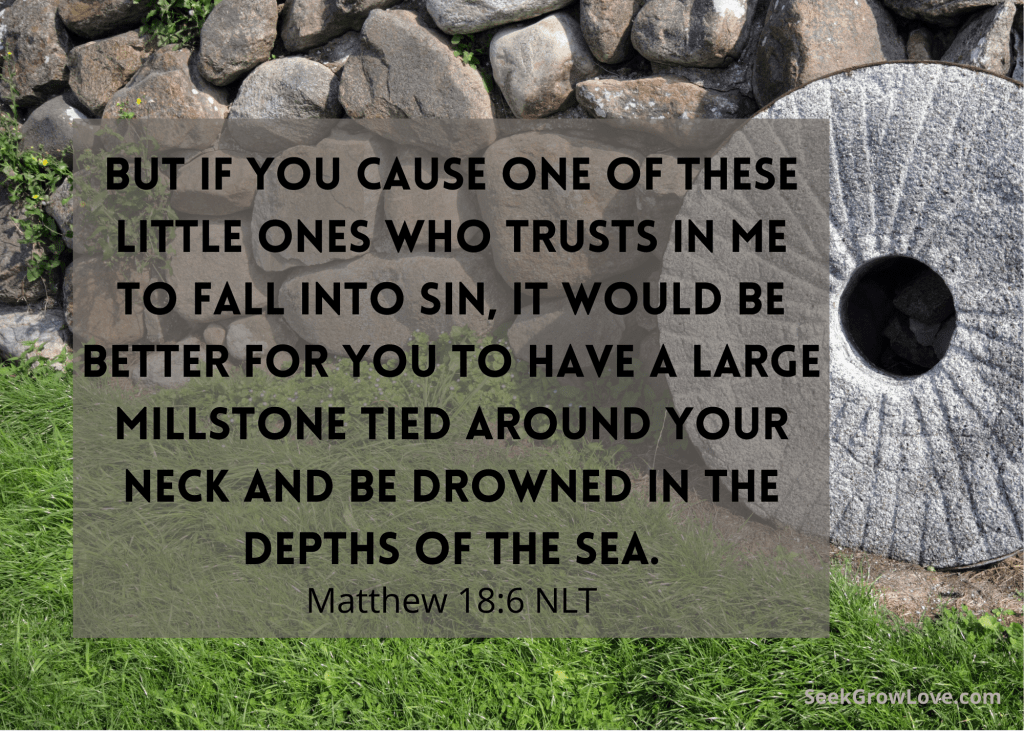
I have watched just enough mobster movies to know the awful fate of those who anger the mafia boss and receive the “cement shoes” treatment. That is the vision that always comes to mind when I read of the seriousness of leading a child to sin. “And whoever receives one such child in My name, receives Me;  but whoever causes one of these little ones who believe in Me to sin, it is better for him that a heavy millstone be hung around his neck, and that he be drowned in the depths of the sea.” (Matthew 18:5,6 NASB) Jesus was giving a pretty heavy answer to the disciples who had asked who would be greatest in the kingdom. He answered that instead of trying to be great, they should focus on being childlike instead – not immature (we see enough of that), but humble, knowing that they don’t know everything and they need a Father and a Savior. And while the child is standing in their midst – Jesus commends those who welcome a child and blasts those who recklessly (or accidentally?) lead a child to sin. As a parent and a Christian this is a strong warning that I will be judged based on how I am spiritually leading and guiding God’s children. I do not know where the line will be drawn. We might be able to safely point out some cases that would definitely receive Jesus’ condemnation (those who exploit children and youth for sex trafficking, pornography, cults or gangs). But what of the parent who signs their child up for the youth sports, campouts and Sunday morning jobs knowing it will take them away from opportunities for God’s little children to grow closer to Him? I don’t know. But it seems wise to do my best to err on the side of caution. What else can I be doing to spiritually guide His children away from sin? Life is easier when you don’t feel the weight of a millstone around your neck or cement hardening in your shoes.

And, if that isn’t scary enough – Jesus broadens the picture next – to all people and sinners and the extreme measures that need to be taken to keep oneself from falling into sin. “Woe to the world because of the things that cause people to stumble! Such things must come, but woe to the person through whom they come!” (Matthew 18:7 NIV). And then comes the gruesome cutting off of body parts that causes you to sin. This gives a strong mental picture of doing whatever it takes to hold oneself accountable and keep oneself from sin. If your eye causes you to sin, cut it out, to save yourself from judgment and hell. This is definitely true in a metaphorical sense. We need to do all we can, even what would be considered extreme measures, to keep ourselves from sin. And, sometimes that will mean cutting off the influence some people hold over us – cutting off a friend or family member or social media/entertainment who entices us to sin. It’s a hard thing to do, just like cutting off your hand – but it could save your eternal life. And, we must watch ourselves to make sure we are not the ones enticing others to sin!

While I love the parable of the lost sheep and it hurts to skip over it…I am going to skip ahead to the next two passages in Matthew 18 which both deal with the brother who sins against you. Having just established the seriousness of sin, the consequences for those who lead others to sin and the extreme measures we are to employ to keep us from sin – it is easy to assume that the best course of action is to shun all sin and sinners. But, wait, what kind of cut off, silent, lonely, bitter world would that be? While we are all sinners – God gave us a way to be forgiven and to restore relationships. Jesus begins to explain it here.

First, if a brother sins against you – go and talk to him. Matthew 18: 15-17 goes through an important series of steps to work towards either resolution or healthy distance and cutting off -and it starts with talking to the “offender”. Too often when we feel someone has sinned against us we talk to others about it. I know I am guilty of this and need to do a better job of lovingly confronting the person I have an issue with – first. So the steps Jesus laid out are: talk privately to the person, if he doesn’t listen take 1-2 witnesses and try again, if he doesn’t listen tell the church, if he still doesn’t listen cut him off. The goal is always to win him back to ‘God’s saving side’, not to humiliate, point fingers or feel better about ourselves or peace at any cost. But, sometimes repentance doesn’t happen, and then we must be willing to cut the ties that would bring others down to sin as well.

So, let’s assume we correctly followed the steps Jesus left. Peter asked how many times he needed to forgive a brother who sinned against him. He thought 7 sounded like a lot. But Jesus said no – 77 or 70 x 7 or whatever number you want to use to remind yourself to keep forgiving – the same way you want others to forgive you. And the same way God has forgiven you. I think we can safely assume this is not the brother who was unrepentant and cast out of the church, but a brother who was repentant and seeking to live a godly life – but still tripped up – like you and me. And so Jesus lays out the powerful Parable of the Unmerciful Servant (make sure you read it again). Now the harsh words and judgment are not for the sinner who tripped up, or even the one who caused him to sin, but for the one who didn’t forgive. “Then the master called the servant in. ‘You wicked servant,’ he said, ‘I canceled all that debt of yours because you begged me to.  Shouldn’t you have had mercy on your fellow servant just as I had on you?’  In anger his master handed him over to the jailers to be tortured, until he should pay back all he owed.” (Matthew 18:32-34).

It isn’t that sin is nothing – and easily forgiven. Sin (of all kinds) is something huge and serious and able to block us from eternal life. If we could see how much our sin hurts others, handicaps ourself and damages our relationship with God we might more readily run from it. But we don’t always, and God in His mercy still lays out a way for us to restore a relationship with Him, ultimately it would cost Him the death of His Son Jesus. To accept the forgiveness offered to you, but not extend it to others puts you again in grave danger. Sin is a big deal – and so is mercy.

-Marcia Railton

Listen to Him

Today’s Bible Reading – Genesis 33 & 34 and Matthew 17

Here we are beginning the 3rd full week of 2021 and so much has happened already. 7 days of careful investigation revealing solid scientific evidence supporting a Biblical view of a miraculous creator (and destroyer) God. And then 7 days of the Old Testament patriarchs of Genesis and fathers of the faith: Abraham, Isaac and Jacob – and what they teach us still today about following God with the faith of Abraham. This week our devotions will be following our New Testament readings in the book of Matthew (one chapter a day) to see what God is doing…

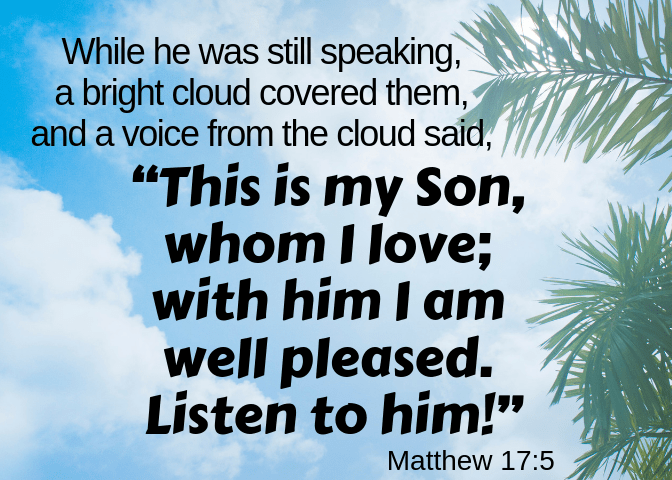
Matthew 17 begins with an awe-inspiring mountain-top experience (often called the Transfiguration) in which God’s glory radiates through and around Jesus Christ – showing a snippet of the beauty, majesty and glory of God’s coming Kingdom which will feature His dazzling Son amongst the risen heroes of the faith. Peter, James and John were there to see it – and they were shaking in their boots at the power of the moment and the voice of God heard from the cloud saying, “This is my Son, whom I love; with him I am well pleased. Listen to Him.” (Matthew 17:5)

But wait…we really can’t start there. Our spiritual journey doesn’t exist only on the glorious mountaintop. What comes before the glory? About a week before the events of Matthew 17, Jesus was telling his disciples that he would face much persecution and even death (before being raised to life) (Matthew 16:21). Bold, strong, impetuous Peter who thinks he knows better than the Son of God tries to correct Jesus – Peter would never let that happen to Jesus. But Jesus isn’t encouraged or amused by Peter but rather calls him “Satan…a stumbling block….you do not have in mind the things of God, but the things of men.” (Matthew 16:23). Jesus continues to prepare his disciples, letting them know that he would not be the only one expected to suffer – but that they too would be required to endure the agony of “taking up their cross” to follow him.

It doesn’t sound fun or exciting. It is hard to get people to sign up for suffering. Peter and the disciples didn’t like the sound of it. Most people today don’t. But it is not suffering without a goal. It is a fight worthy of the cause and the prize. Jesus said those who would suffer for him and lose their life would find it – because after the suffering for Christ – comes the glory. Jesus explained, “For the Son of Man is going to come in his Father’s glory with his angels, and then he will reward each person according to what he has done. I tell you the truth, some who are standing here will not taste death before they see the Son of Man coming in his kingdom.” (Matthew 16:27-28 NIV)

And, a week later, Peter, James and John found themselves on a mountain-top getting a taste of the splendor that will be when God tells His Son, Jesus, it is time to go to the earth to set up a kingdom like none have ever seen before. A kingdom greater than anything set up in the time of the Law (Moses) or the prophets (Elijah) or Jesus’ first coming. God was revealing His perfect plan for His perfect Son and all those who will listen to him.

Contrary to both today’s “prosperity gospel” and Peter’s human thinking, God’s perfect plan does not consist solely of beautiful, bright mountain-top experiences. There is also the ugly, dark and painful cross. For Jesus – and for those who listen to him and carry their cross. But don’t fear, God’s got this. He’s got those who listen to His Son. Our trials will not last forever – but His Kingdom will. “Therefore we do not lose heart. Though outwardly we are wasting away, yet inwardly we are being renewed day by day.  For our light and momentary troubles are achieving for us an eternal glory that far outweighs them all.  So we fix our eyes not on what is seen, but on what is unseen, since what is seen is temporary, but what is unseen is eternal.” (2 Corinthians 4:16-18 NIV)

How can you be sure your suffering will have a reward? Are you suffering for Christ – or yourself? Is your master plan for your life from the mind of man (how can I get ahead and protect myself best?) or from the mind of God (suffer for the sake of God’s Son and look forward to the reward to come)? What will listening to Jesus look like for you in 2021? What will suffering before glory look like for you today?

-Marcia Railton

Back to the Beginning

Genesis 1 & 2 and Matthew 1

Shortly after awakening this morning, your body started releasing cortisol, your fight-or-flight hormone, into your body to prepare for today’s stress.  The concentration of these levels in our body might be higher today than most, as you feel the mounting pressure of the New Year.  You are trying to recover from staying up too late, or trying to implement a new routine, or trying to rid yourself of some addictive behavior.  Unfortunately, what you do today, and any stress that comes about, isn’t an isolated event.  It is the culmination of a lifetime of rehearsed behaviors.  If you are trying to shed a few pounds, you might be looking back to Thanksgiving or further as the culprit.  If you are trying to read your Bible more, which is why you may have very well ended up here today, you may look back to some chaos that was introduced into your life shortly after the beginning of 2020.  If you are trying to quit smoking/drinking, you may be looking back to college or high school years as its introduction.  If you are trying to reduce your screen time, you may look all the way back to your childhood when your parents let you watch TV without any limitations.  No matter the case, lasting change is hard to acquire.  Over time we have fashioned (or maybe more like, warped) our true nature, mold, or patterns, making it so hard to change.  Wow. Deflation complete.  And another round of cortisol is released.  Hang on – Don’t fly!

The Son is the image of the invisible God, the firstborn over all creation. For in him all things were created: things in heaven and on earth, visible and invisible, whether thrones or powers or rulers or authorities; all things have been created through him and for him. He is before all things, and in him all things hold together. Colossians 1:15-17

Today, we revisit the beginning in a couple different fashions.  Not the start of a behavior, but the origin of the heavens, earth,and man.  Everything that has happened up to this point in the universe has its lasting signature of this single event.  The complex ecosystems of the earth, sea, and sky, the hanging of stars, planets, and galaxies in the heavens, and the most beautiful and the reason that all these things exist, our salvation plan that comes through Jesus Christ, come from a single origin: God.  All of them have their catalyst in the events that unfold in Genesis 1 and 2. Generation after generation, Matthew 1 tells of God’s alignment to move us from sin’s patient zero, Adam, in the Garden of Eden, in-and-out of lives of some very messed-up, still-sinning, trying to make their resolutions work people, to the Culminating Curer, Jesus Christ.

“Therefore, if anyone is in Christ, the new creation has come: The old has gone, the new is here! All this is from God, who reconciled us to himself through Christ and gave us the ministry of reconciliation: that God was reconciling the world to himself in Christ, not counting people’s sins against them. And he has committed to us the message of reconciliation” 2 Corinthians 5:17,18

There is more. The plan doesn’t stop there – You and I are part of it. Since Jesus Christ offered propitiation for our sins, we can enter into the nature, the mold, the pattern for which we are created, not that one that has been fashioned by all the paper mache forms we have haphazardly placed in our life.  When we do this, we will find ourselves quite a bit more malleable than before because this is the form for which we’re truly made.  We get into shape by the Great Shaper. When we renew our thinking in this way, maybe the pounds are not the priority, but our prayer life (but it’s okay to lose the pounds, too).  Maybe we point our addictive behaviors in the direction of God to His worship and study.  Maybe we linger at church and fellowship or pile in the car after school to serve somewhere, instead of coming home to a favorite show.  And when you do not do these things, thank God, you can always go back to the beginning: salvation.  We do not have to wait on a sacrifice, we no longer are slaves to these things awaiting a Redeemer, when we seek out God, we are offered an instant renewal through repentance and grace.  Every day we have on Earth is the beginning, a New Year or season, and an opportunity to fight for a closer relationship with God than the day before.

-Aaron Winner

Welcome to the FIRST day of our 2021 Bible reading plan! Print your copy below so you can mark and keep track of your progress. Most days we will read 2 Old Testament chapters and 1 chapter from the New Testament or Proverbs or a few Psalms. Some people like to do one reading in the morning and one later in the day, others like to do both at the same time. Don’t beat yourself up if you miss a day or more – but hop back in so you don’t miss His words to you.