His Touch

Matthew 8:1-13 & Luke 7- Jesus heals a man with Leprosy

Before we get into today’s story, we need to understand the Old Testament law dealing with leprosy.  Leviticus 13:1-46 talks in great detail about leprosy.  There, we find that leprosy is a skin disease that is more than skin deep, it’s highly infectious, it defiles a person, anyone with leprosy must cover their mouth (this sounds like a mask), be separated from other people (social distance), live outside the town (this sounds like isolation), wear torn clothes, and cry out, “Unclean! Unclean!”

In Matthew 8, we find the story of a man with leprosy.  Instead of staying away, we’re told, “A man with leprosy came and knelt before him [Jesus] and said, “Lord, if you are willing, you can make me clean.”  I believe this man had great faith.  He knew Jesus could heal him, he just didn’t know if Jesus would be willing to.  And he violated the law so he could get close enough to Jesus to find out.

Matthew 8:3 says, “Jesus reached out his hand and touched the man.  “I am willing,” he said, “Be clean!”  Immediately he was cured of his leprosy.”  I find this very moving.  Jesus demonstrated how much he cared for this man by not just healing him – which was astounding enough.  Jesus also touched him.  By touching the man, Jesus would have become defiled – made unclean himself.  And remember, since no-one could touch a leaper, who knows how long it had been since this man had someone actually touch him.  I can’t imagine what that touch meant to the man.

Matthew 8:4 goes on to say that Jesus told the man, “See that you don’t tell anyone…”  We find this same story in Mark, and we’re told in Mark 1:45, “Instead, he went out and began to talk freely, spreading the news.  As a result, Jesus could no longer enter a town openly but stayed outside in lonely places.  Yet the people still came to him from everywhere.”

In this story, I see that leprosy compares well with sin.  Sin runs more than skin deep, it is highly infectious, it defiles a person, and whether we admit it or not, it makes us unclean, and separates us from God.  When Jesus went to the cross, he took our sin on himself, causing him to be defiled.  But he demonstrated his obedience to God and his love for us by doing this anyway.  But Jesus’ sacrifice means nothing for us unless we each have faith in Jesus, come submit before him, and ask to be healed (forgiven).  Are you willing to get close enough to Jesus to find out what he can do for you?

Finally, at the end of the story, the man disobeyed Jesus’ direct command to him to tell no one.  Jesus commanded us to tell everyone.  How are you doing with that?

–Steve Mattison

Today’s Bible passage can be read or listened to at BibleGateway here – Matthew 8:1-13, Luke 7

Tomorrow’s reading will be Matthew 11.

Who are You Imitating?

Matthew 5-7

Today’s reading comes from Matthew 5-7.  You may know this as “The Sermon on the Mount”, and this may be among the most well known passages in the Bible.  The Jews Jesus was teaching knew the Old Testament laws really well.  Jesus took this opportunity to focus on what God really requires – he focused on matters of the heart, not just following the letter of the law.

For example, the old law said, “Do not murder, and anyone who murders will be subject to judgment.”  Jesus took it further and taught, “But I tell you that anyone who is angry with his brother will be subject to judgment.”  This is a difficult teaching, but wait – there’s more.  

Then, in Matt 5:42-45, Jesus tells us, “You have heard that it was said, ‘Love your neighbor and hate your enemy.’  But I tell you: Love your enemies and pray for those who persecute you, that you may be sons of your Father in heaven.  He causes his sun to rise on the evil and the good, and sends rain on the righteous and the unrighteous.” – This is even harder to follow.

In this passage, Jesus is telling us more of the reason behind his new rules.  God loves even those who hate him, and he does them good – in spite of their hatred for Him.  And we should imitate this characteristic of God.  Jesus takes this even further in verse 48, where he said, “Be perfect, therefore, as your heavenly Father is perfect.”  – Ok, now this isn’t possible to obey without some serious help from God.

In the Lord’s prayer, Jesus said, “Forgive us our debts as we also have forgiven our debtors.”  Basically, this is asking God to forgive me only to the extent I forgive others.  Jesus then told us plainly in Matt 6: 14-15, “For if you forgive men when they sin against you, your heavenly Father will also forgive you.  But if you do not forgive men their sins, your Father will not forgive your sins.”  – This is a pretty good reason to forgive others! – But still not easy to do.

Then, Jesus tells us in Matt 7: 1-2, “Do not judge, or you too will be judged.  For in the same way you judge others, you will be judged, and with the measure you use, it will be measured to you.”  – Did you catch that?  I will be judged in the same way I judge others.  This is a pretty good reason for me to not condemn others!  This goes back to the old saying, “Hate the sin, but love the sinner.”

As I read these passages, a couple things jump out to me.  First, I need to imitate God as much as possible. Unfortunately, I’m not very good at doing this, so I need to beg for His forgiveness.  Fortunately, He is loving and extends grace.  From His example, I recognize I need to be loving, and extend grace too.

Second, once I recognize I am a worthless sinner, saved only by the grace of God, it’s suddenly easier for me to be less eager to condemn others.  Then, if I can see them through God’s eyes – as other sinners in need of grace – that makes it even easier for me to extend grace to others.  And that grace may take the form of forgiving them, or of not judging them, or even turning the other cheek if they hit me.  On our own, this isn’t possible, but we can do these things with God’s help.  Ultimately, we can (again with God’s help) come to the point of loving or enemies, and blessing those who persecute us.

Jesus closes this section talking about the wise builder (who built on a rock) and the foolish builder (who built on sand).  The wise man was likened to someone who listened to Jesus’ teaching, and put it into practice – building his life on the rock.  The foolish man was likened to someone who listened to Jesus’ teaching, and didn’t put it into practice – building his life without a foundation.  In both instances, storms come.  But only the house built on the rock survived.  By analogy, only the life founded on Jesus’ teachings will not be destroyed.

So again, we find that today’s reading has implications for us today, and for eternity.  And just knowing these truths isn’t enough, we must put them into practice.  Please join me in taking this seriously.  Apply this to your life.  Ask God’s help living up to these requirements that are impossible to accomplish on our own.  Become an imitator of God.  The reward is eternal.

–Steve Mattison

Today’s Bible reading can be read or listened to at BibleGateway here – Matthew 5-7.

Tomorrow’s reading will be Matthew 8:1-13 and Luke 7 as we continue on our Bible reading plan. SeekGrowLove.

All Night Long

Matthew 12:1-21, Mark 3 & Luke 6

There were so many good topics from today’s reading, it was hard for me to pick just one for today’s devotion.  But I finally settled on discussing what Jesus did immediately before calling the 12 apostles.

Jesus had many disciples following him.  A disciple is a follower, an apprentice, someone who is learning.  From among these followers, Jesus was going to choose his apostles – his chosen messengers with a special commission. We’re told in Luke 6:12, that before choosing his 12 apostles, Jesus spent the whole night in prayer.  Did you catch that?  Jesus spent the whole night praying.

Why would Jesus need to spend the whole night praying? First, opposition to him was growing – immediately before this story, we’re told the religious leaders wanted to kill Jesus.  He knew this would eventually end in his crucifixion.  I’m guessing he was praying for strength for the task that lay before him.  Second, this was a turning point in his ministry.  Until how, he had just been a one man show – a traveling preacher and healer.  Now he was picking the men who would be the foundation of the church after he was gone.  I’m guessing he was praying for discernment.  Finally, according to John 6:64, Jesus knew from the beginning who was going to betray him, and He was going to pick him as one of His apostles.  I’m guessing Jesus was struggling with emotions at that prospect; it was through prayer that He made this difficult choice.

We find many instances of Jesus devoting lots of time to prayer.  Whether it was getting up before dawn to pray, or sending the apostles away in a boat so he could pray, or … You get the idea.  But wait, Jesus was the Son of GOD!  In John 3:34, we’re told that Jesus was given the Holy Spirit without measure.  And He still spent a tremendous amount of time in prayer!

What should this mean for me?  

For starters, I suspect I need God’s help far more than Jesus did.  For one thing, I’m a wretched sinner, and Jesus was perfectly sinless.  Also, Jesus had the Holy Spirit without measure, me – not so much.  

From Jesus’ example, I see that I need to spend far more time in prayer, whether asking for strength, or for discernment, or struggling with emotions, or… for dealing with everything life throws at me.  And that’s just the requests for my needs.  Then, there are prayers for confessing and asking forgiveness.  Then, all the prayer requests for people I care about.  Then, there is honoring, praising, and magnifying God in prayer.  And the list goes on.  Bottom line – I need to spend more time in prayer.

What about you?  Will you join me in committing to spending more time in prayer?

This will not only benefit me and you, it may benefit the whole nation.  I’m reminded of one of my many favorite Bible verses, 2 Chronicles 7:14, “If my people, who are called by my name, will humble themselves and pray and seek my face and turn from their wicked ways, then I will hear from heaven, and I will forgive their sin and will heal their land.”

And God knows our nation needs healing.

— Steve Mattison

Today’s Bible passage can be read or listened to at BibleGateway here – Matthew 12:1-21, Mark 3 and Luke 6

Tomorrow’s reading will be Matthew 14, Mark 6 and Luke 9:1-17 as we continue on our Bible reading plan.

Incident at the Pool

John 5 – The Healing at Bethesda

In Jerusalem there was a pool, called Bethesda, where blind, lame, and paralyzed people would gather.  My Bible has a footnote that says John 5:4 isn’t in the most reliable manuscripts.  John 5:4 says “From time to time an angel of the Lord would come down and stir up the waters.  The first one into the pool after each such disturbance would be cured of whatever disease he had.”  If this verse isn’t legitimate, the rest of the story doesn’t make sense, so I’ll assume it is valid.

Anyway, there was a man there who had been an invalid for 38 years.  Jesus asked him if he wanted to get well.  This seems like a strange question to ask someone who was an invalid.  But who knows, maybe he was making a good income begging, and wanted to stay in his condition.  

Instead of saying, “Yes!”, the man started making excuses – he replied that he didn’t have anyone to help him into the pool when the water was stirred, so he never got into the water first.

Jesus then told him, “Get up!  Pick up your mat and walk.”  At once the man was cured; he picked up his mat and walked.

This is a curious miracle.  The man didn’t ask Jesus to heal him.  The man didn’t have faith that Jesus could heal him – when asked, he didn’t even know who had healed him.  Also, there were many sick people there, and Jesus only healed this one man.  First, I do have to acknowledge this is a tremendous example of grace.  But I do have to wonder, why did Jesus heal this man?

If we keep reading the story, we find that instead of being happy for the man that had just been healed, the religious leaders criticized him for carrying his mat on the Sabbath.  He told them he was just doing what he was told by the man who had healed him.  When asked who that was, he didn’t know.

Later, Jesus found him again and told him to stop sinning or something worse would happen to him.  (We can assume Jesus meant the final judgement, but we’re not told.)  After this, the man went back to the religious leaders to tell them Jesus had healed him – on the Sabbath.

Now, I think we are finally at the point of understanding why Jesus healed this man.  I wonder if Jesus wanted to shake up the understanding of the religious leaders of his day, and this was a good way to get their attention.  He told them, “My father is always at his work to this very day, and I, too, am working.”   Notice that Jesus said “My father” instead of “our father”.

The Jews recognized that Jesus was telling them that He is the son of God.  In this chapter, He also called himself the “Son of Man”, which they would have recognized as a messianic reference from Daniel 7:13l.  They were furious that not only was Jesus breaking the Sabbath, he was claiming that He was (is) the son of God.  And they made the mental leap to say that if Jesus was claiming to be the Son of God, he was claiming to be equal with God.

They studied the scriptures regularly, and thought they would “earn” eternal life because of that.  Jesus pointed out, “These are the Scriptures that testify about me, yet you refuse to come to me to have life.” 

The religious leaders of Jesus’ day couldn’t accept what He was telling them.  Instead, they just wanted to kill Him.  What about you?  Do you acknowledge that Jesus is the Son of God who will one day judge the living and the dead?  To paraphrase James 2:19, the demons acknowledge this too – and shudder.

If you do acknowledge Jesus, what are you going to do about it?  I would encourage you to take a cue from the man who was cured, and obey what Jesus said.   No, don’t pick up your bed and walk – instead read your Bible to understand all Jesus taught about, and obey all of that.  Finally, we should all take to heart Jesus’ warning to the man, “Stop sinning or something worse may happen to you.”

Because, as we’re reminded in John 5:28-29, “… for a time is coming when all who are in their graves will hear his voice and come out — those who have done good will rise to live, and those who have done evil will rise to be condemned.”

–Steve Mattison

Today’s Bible passage can be read or listened to at BibleGateway here – John 5

Tomorrow we read Matthew 12:1-21, Mark 3, and Luke 6 as we continue in our Bible reading plan.

Bring Your Friends to Jesus

Mark 2 – Jesus Heals a Paralytic

In Mark 2, we find the story of Jesus healing a paralized man.  Jesus was becoming more well known, and more popular.  He was inside a house, and some men brought their friend to Jesus so Jesus could heal him.  But because such a big crowd had gathered, there wasn’t room to bring him to Jesus, not even outside the door.  So the friends took the man onto the roof, dug through the roof, and let him down in front of Jesus.

I have to admire these friends.  They were very concerned about their friend, and wanted to see him healed.  They believed Jesus could and would heal him, if they could just get him to Jesus.  They didn’t just “pray about it”, they stepped out on faith and did something about it.  They dug through the roof, and let their friend get close to Jesus – and Jesus rewarded their efforts.

Mark 2:5 tells us, “When Jesus saw their faith, he said to the paralytic, “Son, your sins are forgiven.”  Jesus obviously saw that the man was crippled, but Jesus saw what wouldn’t have been nearly as obvious to us.  The man’s biggest problem was his sin – so Jesus healed him of that first.  This is the greatest miracle Jesus performed (and still performs).  

The teachers of the law said that Jesus was blaspheming, believing only God can forgive sin.  I’m guessing they were thinking, “it’s easy to tell someone their sins are forgiven, since you can’t prove they are really forgiven.”  Jesus then told them, “But that you may know that the Son of Man has authority on earth to forgive sins…”  He said to the paralytic, “I tell you, get up, take up your mat, and go home.”  So the man got up, took his mat, and walked out.

I love this story, not only because I love reading about all Jesus’ miracles, but specifically because this is the only story I can think of where someone is healed because of the faith of his friends.  We’re not told, maybe the paralized man asked to be taken to Jesus.  But any way about it, Jesus saw the faith of the friends, forgave the man’s sins, and ultimately healed him.

This story puts me to shame.  I invite you to ask yourself some questions…

Am I this concerned about my friends?  

Am I willing to be uncomfortable – maybe even make a scene – to bring someone to Jesus?  

Am I willing to not just “pray for” someone, but actually “do something” for someone?  

Would Jesus see my faith and forgive and even heal someone I care deeply about?

Finally, do I need Jesus’ ultimate miracle for myself – to have him forgive me of my sins?  This miracle meets the greatest need.  It costs the most.  It brings the greatest blessing.  It has the longest lasting results.  And Jesus is still doing it daily.

–Steve Mattison

Today’s Bible passage can be read or listened to at BibleGateway here – Mark 2

Tomorrow we read John 5 as we continue on our 2020 Bible reading plan.

Jesus Talks with a Samaritan Woman

John 2-4

You may be familiar with the story of the “Good Samaritan”.  But do you know the story of the “Bad Samaritan”?  You might know this better as the story of the woman at the well.

In Jesus’ day, Jews thought very little of Samaritans.  It may not be an overstatement to say the Jews hated the Samaritans.  The origin of this animosity dated back to the Assyrian invasion of Israel around 721 BC.  The Samaritans were of mixed race, partially Jewish, and partially who-knows-what.  They weren’t welcome in the Temple in Jerusalem, so they worshiped in their own temple in Samaria.  And, as Jesus pointed out, they worshiped what they didn’t even understand.

In John 4, we find Jesus arriving at a well near Sychar around noon.  Jesus waited at the well, while his disciples went into town to buy some food.  As Jesus waited, a woman came up to draw water.  I’ve heard this would have been a very unusual time to draw water – and she probably came then to avoid having to interact with others – because even the people in town would have looked down on her.

Anyway, Jesus started up a conversation with the woman, asking her for water.  In doing this, Jesus cut across all the social norms of his day.  First, Jesus was a Jew, and the woman was an “inferior” Samaritan.  Second, as I understand it, men of the day felt superior to women, and again, wouldn’t typically strike up a conversation.  Finally, Jesus was holy and the Samaritan woman wasn’t.  And religious leaders of his day felt superior to common sinners, and wouldn’t associate with them.  Jesus cut through all of those norms to interact with this woman.  The obvious reason given was because Jesus was thirsty, and the woman could draw water from the well.  I believe the ulterior motive was to share salvation with this woman and ultimately with the whole city.

Right from the beginning of the conversation, the woman was surprised that Jesus would even talk with her, since he was a Jew.  Jesus pointed out that if she understood who it was she was talking with, He could offer her something amazing – water welling up to eternal life.  Jesus told her to get her husband, to which she replied, “I don’t have a husband.”  When Jesus told her that she had had 5 husbands and that she wasn’t married to the man she was living with then – she recognized Jesus was a prophet. She said, “I know that Messiah is coming.  When he comes, he will explain everything to us.”  Jesus told her directly, “I who speak to you am he.”  The woman left her water jug and immediately went into town to tell everyone that she had found the Messiah.  The whole town came out and ultimately believed – first, because of the testimony of the woman, then eventually because of their experience with Jesus.

Often, when we read a story like this, we associate with Jesus.  We may think, “I should follow Jesus’ example, break social norms, and associate with those who are “inferior” to me.”  

While this may be true, I’d like to focus on the woman, and see what we can learn from her.  Although presumably “unworthy”, and probably a social outcast, Jesus revealed Himself to her – little by little.  She first recognized he was a Jew, then a prophet, and finally the messiah.  Once she recognized that Jesus was the messiah, the savior, she immediately dropped what she was doing to go tell everyone about her experience with Jesus. Then she literally led the people of the town to meet Jesus.  Think of how little theology she knew – how few spiritual truths.  But she had found the Lord, and she wanted to tell everyone. Her enthusiasm and eagerness to tell others of her experience with the Lord puts us to shame. 

When you were introduced to Jesus, what was your reaction?  Did you tell everyone you knew about Jesus, and what he had done for you?  Did you do everything you could to bring as many people as possible to encounter Jesus?

Jesus pointed out to his disciples, “Open your eyes and look at the fields!  They are ripe for harvest.”  He wasn’t talking about agriculture, he was talking about a crop for eternal life – people needing to come into a saving relationship with the Lord.

I challenge you to first, truly develop a relationship with Jesus.  And once you do, tell everyone you know about the good news, so they can be saved too.  The consequences are literally life and death – for eternity.  What are you waiting for?

–Steve Mattison

Today’s Bible passage can be read or listened to at BibleGateway here – John 2-4

Tomorrow we will read Mark 2 as we continue Seeking God, Growing our Faith, and Increasing our Love on our 2020 Bible reading plan.

Jesus’ Early Ministry

Matthew 4, Luke 4-5, and John 1:15-51

In Luke 5, we find the story of Jesus calling his first disciples. Jesus was at the Lake of Gennesaret (better known as the Sea of Galilee) teaching large crowds.  Peter had been fishing all night, without catching anything, and was washing his nets while Jesus was teaching.  In order to help the crowds hear better, Jesus got into Peter’s boat and asked Peter to push out from shore.  After Jesus finished teaching, he asked Peter to go into deeper water and let down his net.

Let’s think of this from Peter’s perspective. He was a professional fisherman and knew how to fish – fish at night in shallow water.  What did this stranger know about fishing?  And Peter had fished all night, and hadn’t caught anything.  If I had been Peter, I think I might have pointed out these facts and then might have dropped this uninvited guest at the shore.  Fortunately for Peter, and ultimately for us, Peter didn’t argue (much), he just obeyed – and caught so many fish the nets began to break.  After Peter called his partners in another boat, they loaded all the fish into both boats – but there were so many fish, both boats began to sink.

Peter finally recognized he was in the presence of a great prophet of God, and ashamed by his own sinfulness, asked Jesus to leave. Instead of leaving Peter, Jesus invited Peter to follow Him.  So Peter did something else irrational.  He pulled his boat up to shore, left everything, and followed Jesus.

You might be thinking, “This is an interesting story, but how could this apply to me?”  I’m glad you asked.  

First, we see that Peter obeyed Jesus in a very little thing – taking Jesus out a little from shore.  If Peter hadn’t obeyed this tiny command, he never would have witnessed a spectacular miracle.  Later, when Jesus asked Peter to do something that totally defied reason, Peter also obeyed.  I love the reason he gave in Luke 5:5, “but because you say so, I will let down the nets.”  Peter was willing to submit to authority, even though he didn’t understand the rationale – and remember, there may still have been a crowd watching from shore.  Because of his obedience, Peter was then able to witness an incredible miracle.  Finally, when Peter acknowledged he wasn’t worthy, Jesus invited Peter to join Him.  So, Peter left everything and followed Jesus.

I have found that God often builds our faith little by little.  It’s important to obey God in even the smallest of things.  God will then build on those experiences and obedience for the future.  Sometimes, this may take the form of trials.  1 Corinthians 10:13 tells us, “No temptation has seized you except what is common to man.  And God is faithful; he will not let you be tempted beyond what you can bear.  But when you are tempted, he will also provide a way out so that you can stand up under it.”

I believe no one starts as a giant in the faith.  We obey little by little.  We face trials little by little.  And at some point, you can look back on your life and realize, “Wow, God and I have come a long way together.”

So I challenge you to get into God’s word.  As you do, God will prick your conscience and guide your thoughts.  Follow God’s direction, even in the little things.  At some point, you will recognize, like Peter – “I’m not worthy.”  But the good news is, Jesus is still calling people to leave their former life behind and completely follow Him.  This includes me.  This includes you.

— Steve Mattison

Today’s Bible passage can be read or listened to at BibleGateway here – Matthew 4, Luke 4-5, and John 1:15-51

Tomorrow we will read John 2-4 as we continue to SeekGrowLove on our 2020 reading plan.

Jesus as a Child

Matthew 2, Luke 2:39-52

The Gospels describe only a few events associated with the childhood of Jesus. Considering the Greek word for “child” in Matthew 2:8, 11, and the fact that Herod sent to murder all the male children in Bethlehem that were 2 years old and younger, Jesus was months or even a year-old child when Gentile wise men came from the east to acknowledge the arrival of the King of the Jews.

What stands out in Matthew chapter 2 is the different reactions to the birth of the Messiah. The wise men asked, “Where is he who has been born king of the Jews?” They came to honor the king. Most English translations have “worship” – but the word is often used in the Bible to designate proper respect and honor toward other human beings. These wise men represent Gentiles who acknowledge that Jesus is the Messiah, the King of the Jews, and by extension, their own king.

Herod “the Great”, on the other hand, when he heard that these Gentile wise men thought the king of the Jews had been born – Herod was troubled. Ironically enough, Herod was called the “King of Jews” at the time. But he had been given that title by the Imperial Roman Government. He wasn’t born as a descendent of David and given the title by God. His anti-Christ murderous deed is emblematic of the high and mighty humans who refuse to acknowledge that Jesus is God’s chosen king.

The persecution and attempted murder of the King Messiah by Herod also is a parallel to the persecution of God’s chosen people Israel. Matthew quotes a passage from the prophet Jeremiah to illustrate the parallel. The nations opposed God’s work through God’s firstborn servant-son Israel. Even so they opposed God’s work through God’s ideal Israel, God’s servant-son Jesus.

And like Israel God’s son, Jesus God’s Son went to Egypt and was brought out of Egypt by God into the land of Israel. Note that the land was called “Israel” in Jesus’s day, not Palestine (Matt. 2:20, 21). Evoking the ancient name “Philistine”, Palestine was the name given to the land by the Romans 100 years later.

When Joseph, Mary and Jesus returned from Egypt, they originally intended to return to Judea (Bethlehem) since Jesus was technically a Judean of the line of David. But because of the murderous nature of the new ruler in Judea, they went to Galilee instead (cf. Matt. 2:22-23 and Luke 2:39. Luke doesn’t record Herod’s murders or Jesus’s travel to and from Egypt).

Luke describes one other event in the childhood of Jesus. When Jesus was 12 years old, he stayed behind in Jerusalem after the Passover festival. We can see that by this time Jesus knew he was the Messiah, who would relate to God as Father, according to the promise of God to David (2 Sam. 7:14, Psalm 2:7, 89:26).

The humanity of Jesus stands out in these events. There is no declaration, as traditional Christianity claims, of God who was born a human. Rather, “the child grew and became strong, filled with wisdom. And the favor of God was upon him” (Luke 2:40). Jesus “increased in wisdom and stature, and in favor with God and man” (Luke 2:52).

-Bill Schlegel

Bill Schlegel is the author of the Satellite Bible Atlas and general editor of the One God Report podcast.

Bethlehem in Judah

Today’s Bible passage can be read or listened to at BibleGateway here – Matthew 2 & Luke 2:39-52

Tomorrow we will read Matthew 3, Mark 1 & Luke 3 as we continue on our Bible reading plan.

With Great Joy

Nehemiah 11-13 & Psalm 126

Now that the wall’s been built, the city secured, and they’ve read from the Book of the Law to relearn God’s ways, it’s time to dwell in Jerusalem and the

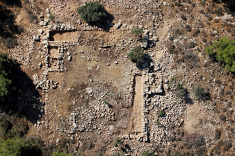
cities.  The leaders were designated to live in Jerusalem and the people cast lots to see which one out of every 10 would dwell in Jerusalem.  The rest would dwell in cities surrounding Jerusalem.  I lived in Israel 25 years and for most of the time we lived in a little village 10 miles west of Jerusalem.  It’s a mountainy and rocky area forested with some trees.  Most villages and Jerusalem were built around a water source, perhaps some type of spring.  Pictured is a photo of ruins of a Nehemiah period fortress in the hills of Judah near Jerusalem. (This photo courtesy of Israel Department of Antiquities.)

            It was a time of rejoicing.  Singers had built themselves villages all around Jerusalem (12:29). Also, two large Thanksgiving choirs with specific names and place locations are listed.  It’s amazing the record we still have today of the detailed descriptions of their locations. Also, great sacrifices were offered for God had made them rejoice with great joy.  The joy of Jerusalem could be heard from afar.  It’s amazing on the quiet of a shabbat or holiday when places are closed the noise that can be heard from a greater distance.  Psalm 126 says with singing they returned from captivity.  There must have been a joy to be back in the land of Israel again after being exiled. Though they “sow in tears, they’ll reap in joy.” At our oldest daughter’s wedding I told this to people as I wept, that I sowed in tears (such hard work raising kids overseas) and now I was reaping and weeping in joy, not out of sorrow but gladness that we made it to that day!! 😊


        Nehemiah returned after some time to Jerusalem and like a good parent had three firm corrections to make.  First, Eliashib, the priest, allowed Tobiah (Ammonite official) to have a large storeroom for himself, where articles and supplies for the Levites, singers, gatekeepers, were to be kept.  Thus, he threw out Tobiah’s things and cleansed the storeroom for proper use.  Then he asked God to remember him. (13:14) Secondly, he contended with the people for buying and selling on Shabbat and commanded the gates be shut and not open until after the Shabbat.  In current the state of Israel, every Friday afternoon stores, including all the malls shut down all over the country and remain closed until after sundown on Shabbat (Saturday), once two stars are visible.  Some weeks with holidays, the malls are closed for THREE full days!… Nehemiah prayed that God remember him. (13:22) Lastly, he contended with some of them, cursed them, struck some of them, and pulled out their hair, and made them swear not to give their children to foreigners!  That’s quite aggressive and zealous. Imagine the uproar he’d receive from all kinds of people and media today for those actions! But he prayed and asked God remember him for good. (13:29,30)

-Stephanie Schlegel

Today’s Bible passage can be read or listened to at BibleGateway here – Nehemiah 11-13 & Psalm 126

Tomorrow’s reading will be our last book of the Old Testament – Malachi – as we continue on our 2020 Reading Plan. God has great things in store! Come follow along!

The Scourge Of Red Tape

Ezra 4-6 and Psalm 137

Part of today’s reading is Psalm 137. I’m starting with it because this is not a note to end on. Sit with it a few minutes, but don’t take it with you for the whole day. Maybe there is no helping that. 

Psalm 137 is a tour through the raw emotions felt by those in exile. It’s the lament of the desperately misplaced. It’s a prayer to remember their home, Jerusalem, and their former standing with God. It’s a chilling and shocking request for God to repay Babylon for what they did to Jerusalem, concluding with the horrifying mental image of babies being smashed against rocks. The emotions are palpable and powerful.

Let that be a “looking back” exercise from where we are in Ezra. Look how far things have come, from complete and utter despair in a foreign land, to being home again and in the process of rebuilding and restoring. Speaking of Ezra…

When you try to do something worthwhile, there is likely to be a few obstacles. Even the most simple of projects can take twice as long as you’d thought. And that’s without anyone trying to sabotage your efforts.

At this point in the book of Ezra, the people of Jerusalem are working hard on rebuilding the city and temple, probably running into all the usual pitfalls of trying to build things. But they have a much bigger problem: Some locals are trying to stop them from building, even actively sabotaging their building plans.

These locals write the king about the people in Jerusalem, employing disinformation and half-truths, and claiming that they are all troublemakers who will rebel once the city and walls are built. The king Artaxerxes can agree that, historically speaking, they are indeed troublemakers, and he orders the construction halted.

Amidst the long hiatus, the Jews in Jerusalem receive some much needed encouragement from the prophets Haggai and Zechariah, and are sparked to begin rebuilding again. Tomorrow we’ll be looking at the part Haggai played in this.

Soon after starting the project back up, they are pestered by the locals again, who are questioning if they have permission to build. They provide their entire story, and inform the locals that Cyrus commanded them to rebuild. Word gets back to the king and they do some fact checking in the archives. They find the papers regarding the edict of Cyrus, and the king makes it clear that the original edict stands. The rebuilding will continue, and the efforts will be subsidized by the empire, including animals to sacrifice.

But did you catch what the king’s motivations are? It is “so that they may offer pleasing sacrifices to the God of heaven, and pray for the life of the king as his children.” So it isn’t so much for the people as much as it’s to ensure the well-being of the king. What, did you think the king wasn’t getting something out this deal?

Overcoming these obstacles, the rebuilding of the temple is eventually finished, followed by a dedication for the temple, a massive sacrifice to atone for the sins of Israel, the appointing of priests, and observing feasts (think back to the first temple in 1 Kings 8). In other words, they are doing all the things they were not able to do while in exile. Now they have a stronger connection to and reestablishment of their worship and traditions they enjoyed before they were exiled.

It is a joyous day. Indeed they’ve come far toward restoration, but we’re left with an anti-climax and the feeling that there is much work left to be done. You can’t just build a temple, go through some motions, snap your fingers, and declare that the people are restored. There is work yet to be done on the hearts of the people.

-Jay Laurent

Today’s Bible passage can be read or listened to at BibleGateway here – Psalm 137 & Ezra 4-6

Tomorrow we will read the two chapter book of Haggai as we continue on the