Rescue from the Coming Wrath

Isaiah 23-24 and 1 Thessalonians 1

As editor of SeekGrowLove, last December I created the Bible reading plan we are using this year. Each day we are generally reading two Old Testament chapters and one New Testament chapter. But, to fit it all into 365 days we’ve included Psalms and Proverbs in chunks throughout the year, taking the place of the New Testament reading. I didn’t pay much attention to what Old Testament and New Testament chapters were lining up together for each day. But, I have been amazed throughout the year at how often the two readings have complimented each other. It just goes to show how God’s scriptures are all connected, forever pointing us to the One Almighty God, His Son Jesus, and His plan of salvation and hope for the future. And, it’s been that way for all the generations who went before us, even for those who were reading His words as they were originally written by their writers.

Isaiah had been writing and preaching to the Jews around 740 BC. He was sharing many prophecies he’d received from God of what destruction was to come if the Jewish people and their neighbors did not repent and turn to God. Many of the things Isaiah wrote about did indeed come true within the next few generations. Some of the prophecies Isaiah wrote about (such as we find in Isaiah 24) were telling of a coming judgment further down the timeline – a time still in our future as well. We have not seen it all take place yet, but we can be sure that God’s words are true and just and will happen as He told Isaiah they would – perhaps in our generation or the next few.

In Isaiah 24 we read that God’s judgments will reach across the earth and affect everyone: priest and people, master and servant, borrower and lender, rich and poor. There are none who will be able to escape it because of their wealth or power or position. “The exalted of the earth languish. The earth is defiled by its people; they have disobeyed the laws, violated the statutes and broken the everlasting covenant. Therefore a curse consumes the earth; its people must bear their guilt.” (Isaiah 24:4b-6a NIV). This will be the fate of the majority, those stuck in their sins without a Savior.

Isaiah also gives hope. To the Jews of his time he spoke of a remnant who would survive the destruction from the conquering armies and return to Jerusalem. This too, has already happened. And, regarding the judgment that is yet to come, Isaiah also has a word of hope and restoration for those who do trust in God in a world that doesn’t – the “very few” that are left after the harvest has taken place. (verse 6 and 13). We have not seen it take place yet, but we can be sure God’s words are true and just and will happen as He told Isaiah they would – perhaps in our generation or the next few.

Those who are left are shouting for joy, giving God praise and singing, “Glory to the Righteous One” (vs. 14-16). Isaiah warns it won’t be easy. This group will be targeted by the evil who tries to trap them. But, God is coming with power and justice. “In that day, the LORD will punish the powers in the heavens above and the kings on the earth below. They will be herded together like prisoners bound in a dungeon…for the LORD Almighty will reign on Mount Zion and in Jerusalem, and before its elders, gloriously.” Satan, his demons, and all sin and evil and those who have turned their backs on God will face God’s judgment. And God will reign.

Truly, there are so many passages that line up so well with Isaiah 24 (Matthew 24, Mark 13, Luke 21, Daniel 12, and Revelation just to name a few). For this is indeed a huge part of God’s story for the ages. It is what God wanted Isaiah to tell the nations nearly 3,000 years ago. And, it is what God wanted Paul to remind the church in Thessalonica less than 2,000 years ago. 1st & 2nd Thessalonians are often called the eschatological letters of Paul because of the many references to the end times (or, the end of this age and the beginning of the next). It was not enough for Paul to tell them how they ought to love and serve at the present, without preparing them for what was to come in the future, even if it wasn’t during their lifetime.

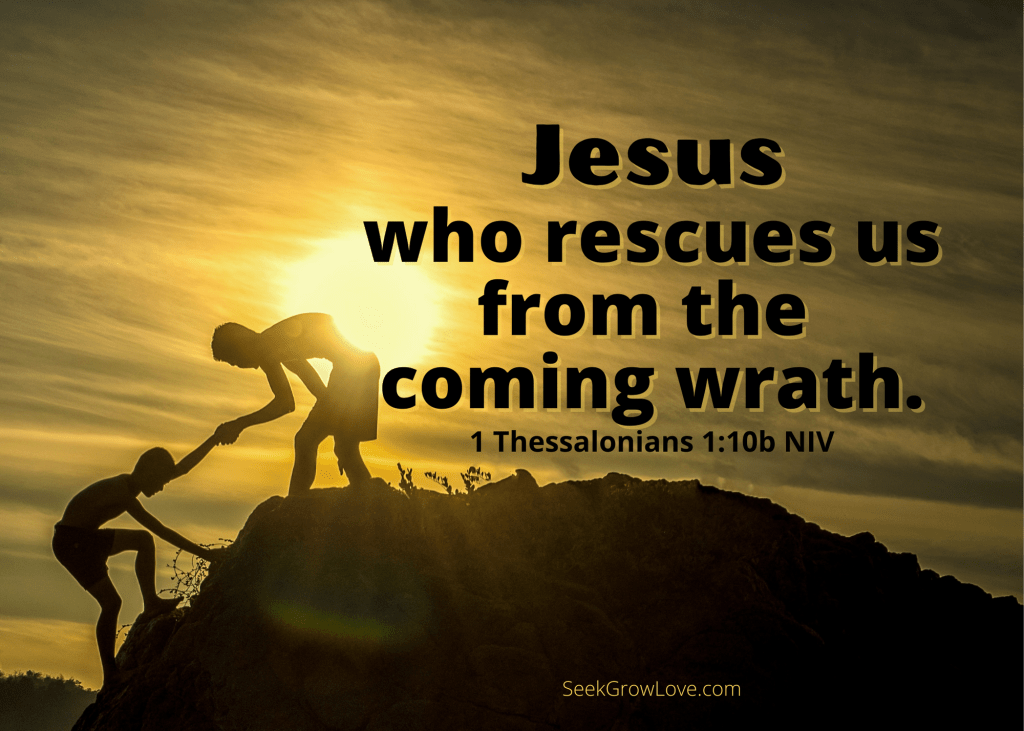
As we read 1st and 2nd Thessalonians this week and next, look for how many times Paul teaches, reminds, warns, and encourages the church with God’s perfect plans for our future. How does each chapter in 1st Thessalonians end? For a clue, let’s look at the end of chapter 1? “They tell how you turned to God from idols to serve the living and true God, and to wait for his Son from heaven, whom he raised from the dead – Jesus, who rescues us from the coming wrath.” (1 Thessalonians 1:9b-10 NIV). It is especially exciting reading of a part of the future that Isaiah was only able to allude to – the second coming of Christ Jesus, since Jesus had not come for the first time at the time of Isaiah’s writing.

May we read and heed the warnings of Isaiah and Paul as sent by God. May we be encouraged by God’s plan for the ages as displayed throughout His scriptures. And may we too turn, “to God from idols to serve the living and true God, and to wait for his Son from heaven, whom he raised from the dead – Jesus, who rescues us from the coming wrath.” (1 Thessalonians 1:9b-10 NIV).

-Marcia Railton

Today’s Bible reading plan passages can be read or listened to at BibleGateway.com here Isaiah 23-24 and 1 Thessalonians 1

Which Will You Be?

Isaiah 21-22 and Colossians 4

Today we are going to look at two different groups of God’s people: those in Jerusalem at the time of Isaiah’s writing and those in Colosse at the time of Paul’s writing. Which will you be?

In many of the previous chapters of the book of Isaiah we read about God’s coming judgments on Israel and Judah’s neighbors and sometimes her enemies. It’s not all bad reading what disasters are coming to your wicked neighbors. Yay, God! Go get em! Show em who’s boss! But, it gets downright personal in chapter 22 as the prophecies of judgment and doom now center on Jerusalem, God’s Holy City. What did they do to deserve this? Well, much. Other scriptures tell of Jerusalem’s idol worship and shedding of innocent blood and even sacrificing their own children. But specifically in Isaiah 22 we are told of their pride and arrogance, their celebrations and their disregard for God. When they saw danger on the horizon they did everything in their own power to protect themselves, including tearing down houses to strengthen the wall and building reservoirs. “But, you did not look to the One who made it, or have regard for the One who planned it long ago” (Isaiah 22:11 NIV). What would have changed if they had only called out to God for help?

God was waiting for His people to seek Him, to turn to Him, to cry out to Him, to confess and mourn and repent. But, instead, they were too busy. Busy with their preparations to save themselves. Busy with their sins. Busy with their celebrations and feasting and misplaced joy. Busy in their “town full of commotion…city of tumult and revelry.” (Isaiah 22:2 NIV).

They had abandoned God first. He was still calling out to them on that day (Isaiah 22:12). But, they were busy. They drowned out the sound of God’s voice with their sinful busy-ness and celebrations. So, His holy and righteous judgement was coming.

Contrast this tragic picture with what we read in Colossians 4 as Paul is closing out his letter to the church in Colosse with his final instructions and greetings. He urges the church, “Devote yourselves to prayer, being watchful and thankful” (Colossians 4:2 NIV). And, while he’s got the people praying – he says pray for me, too. Paul requests prayers for open doors (not to physically get out of house arrests, but open doors to reach more people), for opportunities to proclaim Christ and for clear communication in his ministry. And further on, I love his description of Epaphras, “a servant of Jesus Christ…He is always wrestling in prayer for you, that you may stand firm in all the will of God, mature and and fully assured” (Colossians 4:12 NIV). These people are busy, too – in prayer – in seeking God and in ministry . They are praying for their spiritual leaders and churches and those who will hear God’s message, and asking for prayer. Rather than ignoring God and drowning out His voice, they are seeking God regularly and whole-heartedly, coming to Him in prayer, always desiring to do more for Him and His Son.

Which group are you more like today?

Do you have see any similarities between yourself and God’s people in Jerusalem? Are you surrounded with so much commotion that you miss God’s voice calling out to you? Is he asking you to mourn when you are busy celebrating and feasting? Are you so caught up in your self-preservation preparations that you have neglected to call out to God? Do you rely on yourself instead of on God? When you see trouble coming do you invest time in creating a longer to-do list, throw a party, or fall to your knees before God? What would be different in your life and in your community if you called on Him in prayer instead of trying to do it your own way?

Do you see any similarities between yourself and God’s people in Colosse? Are you devoted to prayer, being watchful and thankful? Are you praying for open doors – not to get ahead or out of a jam – but to advance God’s gospel message? Are you busy praying for your Christian brothers and sisters and leaders and missionaries? Are you asking others to pray for your ministry? What would it look like if you spent time today wrestling in prayer?

Praying for you today – to Stand Firm in God’s Will, mature and fully assured

-Marcia Railton

Read or listen to today’s Bible reading plan passages at BibleGateway here – Isaiah 21-22 and Colossians 4

The Joy of Overcoming

Philippians 3

Paul is one of the few people who can write “Finally” and continue on writing for the same length that he had just written! He writes two chapters, puts “finally” and writes two more. Inspired as he is, obviously Paul thinks of most of what he writes from Philippians 3:1-4:7 as all one idea. To be fair, as you are reading today, he uses “finally” in chapter 4 as well. It reminds me of a “midwestern goodbye;” he keeps trying to end his conversation but doesn’t want to say goodbye just yet.

While Paul starts his writing in verse one on the happy note of “rejoice” in the Lord, he quickly moves to talk of things that we need to beware of and, I think, overcome. That means we need to live differently, have victory over, and to not be defeated by. 

Overcoming Others

In two places in this chapter, Paul discusses two kinds of unfaithful people and the way they live. First, there are those whom he calls “dogs” and “evil workers”. These are both the Jews and the Judaizing Christians who believe they follow God because they are circumcised on the outside and think all must follow them. However, their pride and focus on the law is actually showing that they have a false circumcision (3:2). Paul says that we are the ones who truly follow God, who follow him with a “circumcised” (or pure) heart. 

Secondly, there are those who have never come to faith of any kind. Instead of even trying to honor God through false rules and regulations, they focus on fulfilling their own desires, whether that is food, drink, or sex. They worship those desires as their god. Even, (maybe especially) in our world there are those who glorify their appetites that they indulge as “healthy”, “not-repressed”, and “liberating”. However, Paul weeps knowing that their end is not life, not joy, but destruction. (3:18-19)

Overcoming Ourselves

We need to not be like either of those groups, but that means overcoming ourselves. True, we need to overcome the teachings of those who say following God is keeping a bunch of rules and regulations, but it is easy to feel good about ourselves because we did keep God’s word. It would be easy for Paul, for example, to glory in who he is. (3:4-6) He fulfilled all the credentials of what a successful Jew would be. But he considers it “dung” (skubala) if he might instead have Christ. He would count all these things rubbish in order to have the far greater, far surpassing righteousness of Christ. (3:7-9)

Once we know that our best attributes are only dung in comparison to Christ, we may say we might as well live terribly because we can never measure up. But Paul encourages us to strive to live rightly. Ever upward into the call of God in Christ. He says, though we will never be perfect, let us keep living by the same standard to which Christ has raised us. (3:12-16)

How to Hupernikao (Overcome)

How are we to overcome? How are we to not fall into the traps of being legalistic or being completely wild with our living? We need to live LIKE CHRIST! That should sound familiar! If we live like Christ, forgetting what lies behind and pressing on ahead (12-16) then we will be conformed to him. We will suffer the way he suffered, being mistreated on both sides. We will sound to0 gracious to the “judgmental” and too judgmental to the “gracious”. We won’t look like those who are legalistic and believe that rule following will save them. But we also won’t look like those who believe that everything is OK and permissible.

But this is the way Jesus lived. He was a friend of tax collectors and sinners and yet told them they needed to stop sinning. If we live like him, we will face the suffering he faced, we may even be conformed to him in death. (3:10) But the GLORIOUS news is that if we are connected to him, believe in him, and live like him, we will ALSO be raised with him. If we die with him, we will also live with him. (3:11, cf. 2 Tim. 2:11-13)

It is because we have a savior who will raise us up, and glorify us as he rules over all things that Paul can say, in Philippians 4:1 “Therefore, my beloved brethren whom I long to see, my joy and crown, in this way stand firm in the Lord, my beloved.” Because we have a savior who will redeem us, we can rejoice in the Lord and we can be the joy of those who have trained us in the way we should go. 

May you, my brothers and sisters, overcome those who tell you to be more strictly following all the right rules that only they seem to know. 

May you overcome those who say live with abandon and do whatever it is that makes you happy and fulfills you. 

May you overcome the desires in yourself that push in you in those directions. 

May you instead be conformed to the life, suffering, death, and ultimately resurrection of Christ, as you seek to live like him. 

May you forget what lies behind, press on ahead, and retain the standard, while only trusting in Christ’s sacrifice to save you. 

Amen

-Jake Ballard

Read or listen to today’s Bible reading plan passages at BibleGateway.com here Isaiah 13-14 and Philippians 4

Introduction to Joy

Philippians 1

I’m not gonna lie to you : it’s been a bit rough. Since March of 2020 until now, we have seen a pandemic that caused suffering and panic across the globe, racial and political division across the US, an even greater erosion of trust in our institutions of power, particularly of the media, and financial and political instability the world over, as well as claims from some that some or all of these issues don’t even exist! 

We need to know how to respond to these situations. The Bible doesn’t have a “read this passage in case of global pandemic and division” section, but there are multiple places that describe the appropriate attitude to take in the midst of suffering.

In the book of Philippians, we see Paul in the midst of suffering. In 1:12-13, we learn of Paul’s predicament. He is imprisoned, probably in Rome or Ephesus. (You can read more about Paul’s imprisonment for the Gospel in Acts 25-28.) He seems to believe that he may be going to his death, though he would love to both visit the Philippians again, and to go on to Spain. He wants to continue to do God’s will, but he recognizes that death may be a better alternative, as he would finally rest and have peace in Christ. (1:21)

“To die is gain” is a strange statement from the same man who said “the last enemy to be destroyed is death.” (1 Cor. 15:26) Is death a gain or an enemy? As we said before, Paul is suffering. Being in prison isn’t a cakewalk. But he is not only experiencing suffering for the sake of Christ, but telling the Philippians they will suffer for the sake of Christ as well. (1:29-30) If all this is true, then what should our response be? Gloom? Doom? Wailing and mourning?

ABSOLUTELY NOT! The letter of Philippians is drenched in a word : Joy, or rejoice. This is the theme that pervades the thought of Paul in Philippians, using the word 16 times and talking about joy throughout the letter. He says that he offers his prayers with joy because of the Philippians and what they have done for him (1:4). Paul rejoices over the fact that Christ is preached and that the Philippians will bear Paul up in their prayers. (1:18-19) 

How can Paul have joy in the midst of suffering? What is the joy that Paul talks about? Answering these questions and more like them is the goal of this week. Over the next few days we will be walking with joy. Tomorrow we will see how joy is used in the rest of the New Testament to know what Paul means by joy. Then we will see the joy of being like Christ and the joy of overcoming sin. We will discuss what it means to rejoice always. Finally, we will look to the end of the age and try and rejoice in the joy that we will experience forever. 

Today, my brothers and sisters, may you begin to be excited about the joy that Christ brings. May you taste the joy on this beautiful day, and may it carry you through this week.

-Jake Ballard

Read or listen to today’s Bible reading plan passages at BibleGateway here – Isaiah 7-8 and Philippians 1

Untitled Thoughts About Galatians 4 – or – If Jesus hands you a burger

Galatians 4 (& Ecclesiastes 7-8)

“All this I observed, applying my mind to all that is done under the sun, while one person exercises authority over another to the other’s hurt.” (Ecc 8:9)

As you are all aware, the United States has a deep and dark history with slavery. Generations of family wealth were built on the blood, sweat, and tears of slaves. We abused our power and took advantage of others for our own gain. Thankfully, although through great struggle, we abandoned the practice.

But we still feel the ripples of our past today. Slavery ended, but it took many, many years before everyone could say they had the same fundamental rights. It takes a long time to recover from being held down as a people for so many years, especially as those in power do everything they can to stay in power. It is painful to see that senseless acts of racism and hate still happen, and that the systems and powers still propagate forms of racism. I do not claim to know what the solutions are, but there is still a lot of work to be done to correct our great wrongs.

The United States wasn’t the first nation to have a practice of slavery. For an example, let’s go back in time to the exodus. You probably remember the story, but if not, it’s… in Exodus. Moses and the Israelites were miraculously delivered from slavery in Egypt. This was an important memory for the Israelites and was commemorated by the Passover meal. In fact, we trace our tradition of communion back to one particular Passover meal that Jesus had with his disciples.

If we move forward to the time when Paul was writing to the Galatians, slavery was a thing then too. It was a normal part of the culture. Although, compared to what the United States did, it was milder. Think more along the lines of indentured servitude. It was not a good situation to be in, but it was not to the level of horror that we took it.

Unfortunately, the practice of slavery is still alive and well in our world. There are more slaves in the world than ever before. Usually we call it “human trafficking” now, but the concepts are not that different. It is about owning people. The mindset that you can own a person and profit from them is big business, and it’s terrifying to think about.

We come to Galatians 4 and see that Paul is drawing a strong connection between following the Jewish law and being under slavery. This seems to fly in the face of what we have seen elsewhere in scripture about the law. The law is supposed to be a good thing that was received from God. For the Israelites, it was an important pathway toward connecting with God. Jesus himself upheld it as something good (Matt 5:17 and surrounding verses). In Galatians 3, Paul seems to agree it was good, and even necessary for a time. But if we have a chance to corner Paul and ask if he thinks the law is good or bad, he’ll probably say “Yes!” There are two sides to this.

Usually you don’t think of things as absolutely good or bad. You compare them to other things or judge them in context. A burger is better than salad. It is savory with lots of protein and fat. The salad is better for providing micronutrients and some fiber, otherwise it is worthless. I would put a tomato slice and lettuce on the burger and call it a day. If you are hard pressed for finding food, then a salad is better than nothing. But if you had access to a burger, then you would not bother with a salad. I am the least picky eater I know. I can enjoy and see the value in a salad. They are a good thing. But there is just no comparison to a burger. A burger wins every single time.

The law is like the lettuce that the Jews had to live on until they had burgers. It was the best option for a long time, and it was a blessing from God. But now that we have grace, the promises of God, and the spirit through Jesus, the law looks pathetic in comparison. After a bite of that burger, you won’t go back. Taste and see!

“But when the fullness of time had come, God sent his Son, born of a woman, born under the law, in order to redeem those who were under the law, so that we might receive adoption as children. And because you are children, God has sent the Spirit of his Son into our hearts, crying, ‘Abba! Father!’ So you are no longer a slave but a child, and if a child then also an heir, through God.” (Gal 4:4-7)

Paul is saying it is better to be a child and heir than to be a slave. Because of what Jesus has done, your status has changed from a slave under the law to a child of God and an heir of his promises. If you’re a child and heir, with rights and a large inheritance, you wouldn’t think of going back to having nothing.

You can imagine that trying to follow the letter of the law would feel burdensome, like it owned you. And the law has a way of making you hyper-aware of your sin. And sin is all tangled up with death. Thankfully we are filled with and are influenced by the spirit of God to help guide us. If we keep in step with the spirit and make ourselves vessels of God’s love, we don’t have to worry about breaking God’s laws. It is like they take care of themselves.

Starting in Galatians 4:21, Paul gives us an allegory of the slave woman and the free woman. He’s presenting us with a crossroads of sorts, but the choice should be easy. Of course if Jesus hands you a burger, you take it, and don’t bother with the salad. Why be a child of the flesh when you can be a child of the promise? Why be a slave when you can be free?

With all of this influence from Ecclesiastes lately, I can’t help but think Paul would say being slaves to the law is like chasing after the wind.

-Jay Laurent

Read or listen to today’s Bible reading passages at Bible Gateway here – Ecclesiastes 7-8 and Galatians 4

Fully Proclaim the Gospel of Christ

2 Chronicles 31-32 and Romans 15

Today’s reading is packed with so much good stuff, it’s hard to know what to write about.

I could comment about the overflowing generosity of King Hezekiah and the people when giving to the Lord, as found in 2 Chronicles 31.  But I won’t.

I could stress how God blessed another faithful king, as found in 2 Chronicles 31:21, which says, “In everything that he undertook in the service of God’s temple and in obedience to the law and the commands, he sought his God and worked wholeheartedly.  And so he prospered.”  But I won’t.

I could comment extensively on how Hezekiah trusted God completely when attacked by the Assyrians, and then God sent the death angel, who killed 185,000 of the Assyrian army.  But I won’t.  (Besides, I prefer the accounts in 2 Kings 18-19 and Isaiah 36-37.)

I could talk about how Hezekiah cried out to God when he was about to die, and God added 15 years to his life, as recorded in 2 Chronicles 32.  But I won’t.  (Again I prefer the 2 Kings 21 and Isaiah 37-38 accounts.) 

I could even expound on 2 Chronicles 32:31, “…God left him to test him and to know everything that was in his heart.”  But I won’t.

Since I already commented yesterday about doing things to build up our neighbor, I won’t comment on that even though it is recorded again in the beginning of Romans 15.

Instead, I’d like to point out Paul’s faithfulness in evangelism.  You may remember that Paul had a vision, where Jesus commanded him to spread the gospel to the Gentiles.  In Romans 15:19-22, we read, “… So from Jerusalem all the way around to Illyricum, I have fully proclaimed the gospel of Christ.  It has always been my ambition to preach the gospel where Christ was not known, so that I would not be building on someone else’s foundation. … This is why I have often been hindered from coming to you.”

It’s easy to pass over what Paul just said, so I’ll point out that according to The Wiersbe Bible Commentary, “from Jerusalem to Illyricum” covers about 14,000 miles (yes, fourteen thousand miles).  When you consider Paul’s mode of travel, and the difficulties he endured (read 2 Corinthians 11:23-27), you can understand the immense achievement of Paul’s missionary work.

For your convenience, I’ll include 2 Corinthians 11:23-27 here:

… I have worked much harder, been in prison more frequently, been flogged more severely, and been exposed to death again and again.  Five times I received from the Jews the forty lashes minus one.  Three times I was beaten with rods, once I was pelted with stones, three times I was shipwrecked, I spent a night and a day in the open sea,  I have been constantly on the move. I have been in danger from rivers, in danger from bandits, in danger from my fellow Jews, in danger from Gentiles; in danger in the city, in danger in the country, in danger at sea; and in danger from false believers.  I have labored and toiled and have often gone without sleep; I have known hunger and thirst and have often gone without food; I have been cold and naked.

The real clincher comes in Romans 15:23, “But now that there is no more place for me to work in these regions…”  Did you catch that?  Paul has traveled 14,000 miles and told everyone he could about Jesus.  Paul is basically saying, “But since there’s nobody else to tell (because they’ve all heard now); I’m done here; so I’ll finally come to visit you.”

What an astounding accomplishment.  What an astounding example.

Jesus commanded His disciples to go into all the world and make disciples, baptizing them, and teaching them to obey all that Jesus commanded.  And part of what was commanded includes making more disciples.  So, through the Great Commission, Jesus commanded you and me to share the good news about Jesus with the whole world.  Maybe we weren’t told as directly as Paul was, but we were told.

I don’t know about you, but I can’t say, “since I’ve told everybody I know about Jesus, I need to move on to find more people to tell.”  I think all of us need a good reminder that God still expects us to make disciples today.
–Steve Mattison

Today’s Bible reading passages can be read or listened to at BibleGateway here – 2 Chronicles 31-32 and Romans 15

Self-improvement Help Needed

But Not From Yourself

Romans 7

I think everyone can empathize with Paul when he states, “I do not understand what I do. For what I want to do I do not do, but what I hate I do.” (Romans 7:15)

Even in every day routines there may be areas we want to improve or change. Just look at the huge amount of self-improvement and renewal books that are printed each year. Maybe we want to: lose weight, get fit, stop bad habits, eat healthier, get out of debt and save money, spend more time with family, be less stressed or read through the Bible. Ok, hopefully this one is happening.

So wanting to overcome sin and do good is a great goal, but maybe you feel as Paul did, “For I have the desire to do what is good, but I cannot carry it out.” On our own, we cannot overcome sin, but as Christians we are not on our own. Thank the LORD, He is with us and He has provided what we need to overcome sin. In verse 25 we see that Paul is relying on God’s provision in Christ. “Thanks be to God, who delivers me through Jesus Christ our Lord!”

We are no longer condemned because we are in Christ Jesus, but sin is condemned. Through Christ Jesus the law of the Spirit who gives life has set you free from the law of sin and death. We no longer live by our sinful nature, but according to the Spirit. And as we will discover in Romans chapter 8, we are more than conquerors through him who loved us and nothing in all creation, is able to separate us from the love of God that is in Christ Jesus our Lord. We truly need to realize the love that God has for us and rely on His Spirit working in us. 

-Rebecca Dauksas

Today’s Bible reading passage can be read or listened to at BibleGateway here – 2 Chronicles 15-16 and Romans 7

Unexpected Places

Unexpected Purposes

Acts 28

Have there been times in your life where you’ve been taken somewhere you didn’t expect? Last spring, I was taking a drive when I became lost on some of the backroads. I was filled with uncertainty about my location and starting to get anxious about finding my way back. As I found myself where I didn’t expect to be, a lost lamb appeared on the road. It was nearly hit by oncoming traffic as it frantically sprinted down the pavement. The cream and brown spotted lamb was panting from exhaustion. It was scared and confused. Because I was at this unexpected intersection, I was able to get the lamb off the road and put it in my truck. After searching for its farm and calling the sheriff, eventually it was reunited with its home. Sometimes it is the places that we don’t see coming, where we prove to be the most useful.

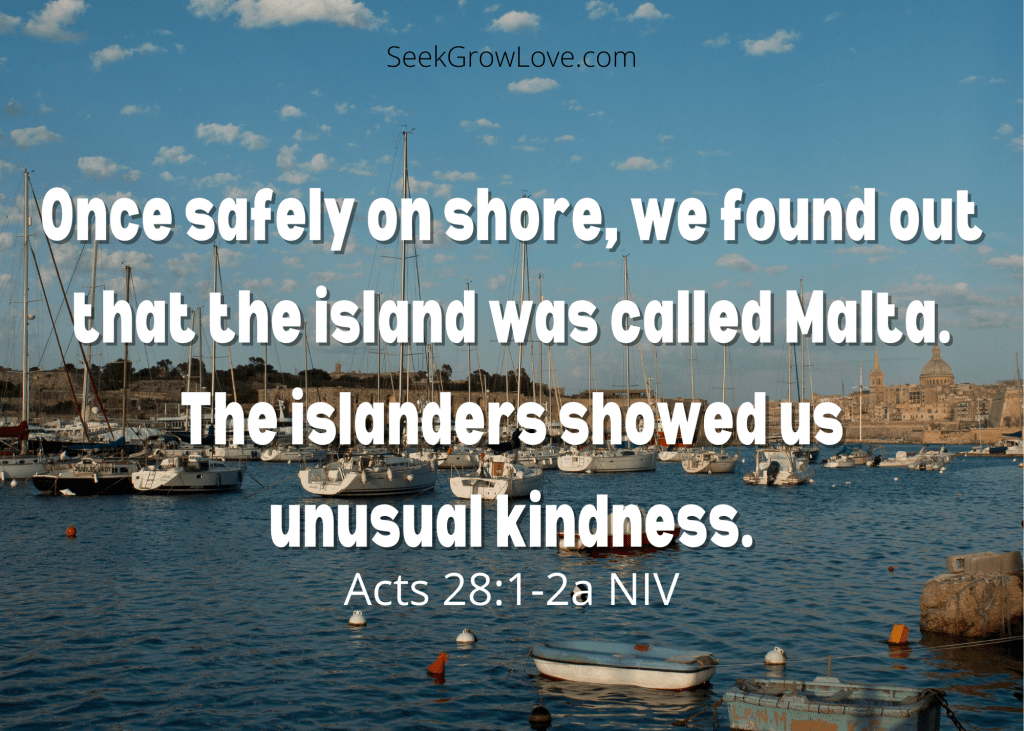
In Acts 28 we learn about Paul’s experiences on the island where he and the rest of the people on his ship came to be shipwrecked. As we read yesterday, Paul’s journey was quite wild. But God had delivered them safely to this Island called Malta. When Paul left for Rome, he probably never expected to make a pit stop, let alone be shipwrecked at this place. Yet, this was where he was taken, and it was not without purpose.

            On this island, in the middle of the Mediterranean, Paul was able to interact with the people. These inhabitants of Malta saw something different about Paul as they had witnessed him being delivered from the sea and from a snake bite. And then Paul was able to pray for and heal their sick. An island that might not have been a priority for people of that time to take the gospel to had nonetheless witnessed it through Paul’s unexpected stay there.

So, although this time and stay in Malta had been unexpected, it proved useful and it exposed others to the One True God. So, while you may at times find yourself in an unexpected place, do not be discouraged. Sometimes it is the most unexpected places in our lives that God uses us for an unexpected purpose.

-Hannah Deane

Today’s Bible reading passages can be read or listened to at BibleGateway here – 1 Kings 13-14 and Acts 28

Believing God in Tough Times

Acts 27

Paul’s journey to Rome in this passage is anything but simple. When those with Paul on the ship to Rome went days without seeing the guiding light of stars or the sun, they gave up hope of ever being saved. But then Paul spoke. He shared with them what the angel of God had told him. He assured them that although their situation seemed dire, they would be delivered. It was God’s plan for Paul to appear before Caesar and Paul, neither Paul nor those with him, were to be lost at sea before that could happen.

Although this situation and the knowledge that he was to be tried by Caesar when he reached Rome must have been difficult, Paul kept trusting God. When God sent word to him, Paul did not look at the situation and doubt what God was saying. He believed God’s word, and so much so that he shared what God had planned. From the passage we can see that Paul did not even question the way in which they were to be saved- a shipwreck! Here Paul is lost at sea, facing trial by the ruler of the Roman empire and now finds out he is to be preserved for that by being saved through a shipwreck. That is a lot to take in and yet, Paul remained faithful.

This made me think of a time in my own life when I was being driven to an airport on a major highway. A car sideswiped us, and we went across several lanes of traffic, nearly hit a concrete barrier and then swerved back over a few lanes. In that moment, it seemed the vehicle I was in was going to be hit again. The situation seemed taut and like there could be no good outcome. However, miraculously the vehicle I was in and the vehicle that had hit us suffered no injuries and were not hit a second time in the busy traffic. Even in a situation that seemed hopeless, God preserved us, and we even got to the airport on time.

Sometimes, though, in these moments it is easier to think of what could happen, like getting hit a second time or being lost at sea and not on what we should be thinking about- God. But we must look to Paul as an example and trust God in tough circumstances as he did.

-Hannah Deane

Today’s Bible reading passages can be read or listened to at BibleGateway here – 1 Kings 11-12 and Acts 27

Conflict

Acts 25

Conflict within the church weakens community, and ultimately destroys the credibility of the church. In the eyes of the Romans, Paul’s arrest was just another Jewish squabble that needed to be controlled and contained. Arguments in the church make the world look down on us, instead of how God intended the church to be; a light to unbelievers, pointing others to God. Certainly God can still bring good out of conflict but the purpose of the church is to be Christ’s hands and feet doing God’s work.

It is hard to be doing God’s work while you are fighting with your brothers and sisters in Christ. Paul was following God’s direction for his life by going to Jerusalem where he knew he would be imprisoned by the Jewish leaders. From the time Jesus called him on the road to Damascus Paul had been obeying God’s instruction to preach the gospel to the Gentiles. Paul and the Jewish leaders had a lot in common. They both believed in God, and followed all the Jewish teachings and traditions. The difference between Paul and the Jewish leaders is that the Jewish leaders were not listening to God like Paul was and it was creating conflict that affected everyone within the church, the Jewish leaders, and the Romans and Gentiles.

-Makayla Railton

Today’s Bible reading passages can be read or listened to at BibleGateway here – 1 Kings 7-8 and Acts 25