“They devoted themselves to the apostles’ teaching and to fellowship, to the breaking of bread and to prayer.” Acts 2:42
One of the things the very first churches did was devote themselves to fellowship. Fellowship means holding all things in common. They would share everything. They began to know and to love one another. Here are 3,000 people suddenly added to a little band of twenty. Most of them probably were strangers before this time. Many of them had come from other parts of the world into Jerusalem for that occasion. They did not know each other. But now they are one in Christ, and they begin to love each other and start to talk to each other, to find out what each other has been thinking and how each has been reacting, and to share their problems and burdens and needs, to talk about these together and pray together about them. There was a wonderful sense of community, of commonality, of belonging to each other. That is the fellowship which is the intended life for the body of Christ.
If the body is not operating, then the life is not manifest. That means there is no power because the life of God is always power. The reason the church has been so powerless lately is that it has been so fragmented and broken. We have estranged ourselves from each other. In Ephesians, the Apostle Paul says, and do not grieve the Holy Spirit of God… (Ephesians 4:30). Then he lists the things that grieve the Holy Spirit: Get rid of all bitterness, rage and anger, brawling and slander, along with every form of malice. Be kind and compassionate to one another, forgiving each other, just as in Christ God forgave you. (Ephesians 4:31-32)
If that is not happening, then the Spirit of God is grieved. When the Holy Spirit is grieved, it does not act. There is no life. The church becomes dull and dead and sterile and mediocre. All this is manifest in an empty ritual, with no vitality in it. God intends that Christians should have fellowship, should share one another’s lives and thoughts and problems — bear one another’s burdens and so fulfill the law of Christ. It is not an option; it is an essential. Therefore, when the Holy Spirit of God begins to move in any congregation, or in any assembly of believers, he starts at this point. He begins to heal the brokenness of their lives and their relationships one with another, to get them to admit to each other their malice and their anger and their frustration and their grudges, and to forgive one another. This is when life begins to flow once again through the body of the Lord Jesus Christ.
What can you do to have more fellowship with fellow believers?
-Andy Cisneros
Questions for Reflection and Discussion
Look again at the list of things that grieve the Holy Spirit, as well as the positives we are to do instead. Slow down and prayerfully consider each one, searching your own heart, words, attitudes and actions. What do you need to ask forgiveness for? Who do you need to forgive?
How can you use fellowship to then bear one another’s burdens?
How devoted are you to fellowship with the body of believers? What can you do to have more? With whom? When? Where? How? And, of course, remind yourself why?
Still gathered around the table in the upper room—the same table where the last Passover meal was shared—Jesus gives his disciples a series of encouraging remarks. One such remark has left many Biblical Unitarians scratching their heads:
“Believe me when I say that I am in the Father and the Father is in me” (John 14:11a).
What does he mean… in? Jesus in the Father? And the Father in Jesus?
I teach English to sixth graders for a living, so I’m well aware of how tricky prepositions can be. In, the supposedly simple, two-letter word, has 18 different usages according to the Oxford dictionary. Now consider we’re reading the translation from the original Aramaic words Jesus spoke to Greek to English, which has muddled the meaning even further.
Fortunately for us, Jesus uses similar language just a couple pages later, in John 17:
“My prayer is not for them alone. I pray also for those who will believe in me through their message, that all of them may be one, Father, just as you are in me and I am in you. May they also be in us so that the world may believe that you have sent me” (John 17:21).
“I have made you known to them, and will continue to make you known in order that the love you have for me may be in them and that I myself may be in them.” (John 17:26).
In these passages, in refers to a tight bond. The intimate relationship between God and Jesus is available to you, too. You can have close communion with the church body, with Jesus, and with God himself.
Now, it’s clear that Jesus wasn’t pointing to a trinity, but a… billionity. Okay, I made that word up (I have an English degree, so I get to do stuff like that). Through Jesus we have unity with God and unity with each other—with all the believers on earth. We’re perfectly bound together with love.
In love.
Jesus is the glue that holds us all together. He takes a billion broken people and makes us Church.
From him (Jesus) the whole body, joined and held together by every supporting ligament, grows and builds itself up in love, as each part does its work (Ephesians 4:16).
-Mackenzie McClain
Discussion & Reflection Questions:
Why did Jesus place such high importance on Church? What can we accomplish together that we cannot do on our own?
Are you doing more than just sitting in the same row with people at Church? How are you, personally, contributing to the mission of the Church?
Thank God for your Church family. Pick a few fellow members and send them a card or a text, telling them of the impact they’ve made on your life.
As we consider the second chapter of James today, the writer gives us another easily understood illustration, as he warns about an attitude of personal favoritism.
“My brothers and sisters, do not hold your faith in our glorious Lord Jesus Christ with an attitude of personal favoritism. For if a man comes into your assembly with a gold ring and is dressed in bright clothes, and a poor man in dirty clothes also comes in, and you pay special attention to the one who is wearing the bright clothes, and say, ‘You sit here in a good place,’ and you say to the poor man, ‘You stand over there, or sit down by my footstool,’ have you not made distinctions among yourselves, and become judges with evil motives? Listen, my beloved brothers and sisters: did God not choose the poor of this world to be rich in faith and heirs of the kingdom which He promised to those who love Him? But you have dishonored the poor man. Is it not the rich who oppress you and personally drag you into court? Do they not blaspheme the good name by which you have been called?” (verses 1-7)
We must note that James is not saying we should ignore the rich in our Christian outreach. But he is saying rich people should not be elevated above others because of their bank accounts.
The result of the sin of favoritism is found in verse 9. “But if you show partiality, you are committing sin and are convicted by the Law as violators.”
So what is the solution? Verse 8– “If, however, you are fulfilling the royal law according to the Scripture, ‘You shall love your neighbor as yourself,’ you are doing well.”
This is why I love the book of James. Simple and direct—easily understood.
A modern-day story I have heard several times fits right in here.
A Pastor transformed himself into a homeless person and went to the 10,000-member church where he was to be introduced as the head pastor that morning.
He walked around his soon-to-be church for 30 minutes while it was filling with people for service– only 3 people out of the 7-10,000 people said hello to him. He asked people for change to buy food — no one in the church gave him change.
He went into the sanctuary to sit down in the front of the church and was asked by the ushers if he would please sit in the back. He greeted people only to be greeted back with stares, dirty looks, and people looking down on him. As he sat in the back of the church, he listened to the church announcements.
When all that was done, the elders went up and were excited to introduce the new pastor of the church to the congregation. “We would like to introduce to you our new Pastor.” The congregation looked around clapping with joy and anticipation. The homeless man sitting in the back stood up and started walking down the aisle. The clapping stopped with all eyes on him. He walked up to the altar and took the microphone from the elders (who were in on this) and paused for a moment then he recited,
“Then the King will say to those on his right, Come, you who are blessed by my Father; take your inheritance, the kingdom prepared for you since the creation of the world.
For I was hungry and you gave me something to eat, I was thirsty and you gave me something to drink, I was a stranger and you invited me in, I needed clothes and you clothed me, I was sick and you looked after me, I was in prison and you came to visit me.
Then the righteous will answer him, Lord, when did we see you hungry and feed you, or thirsty and give you something to drink? When did we see you a stranger and invite you in, or needing clothes and clothe you? When did we see you sick or in prison and go to visit you? The King will reply, Truly I tell you, whatever you did for one of the least of these brothers and sisters of mine, you did for me.”
After he recited this, he looked towards the congregation and told them all that he had experienced that morning. Many began to cry, and many heads were bowed in shame. He then said, “Today I see a gathering of people, not a church of Jesus Christ. The world has enough people, but not enough disciples. When will YOU decide to become disciples?” He then dismissed service until next week.
I hope this story moves you as it moved me. And James reiterates these thoughts in verses 14-17.
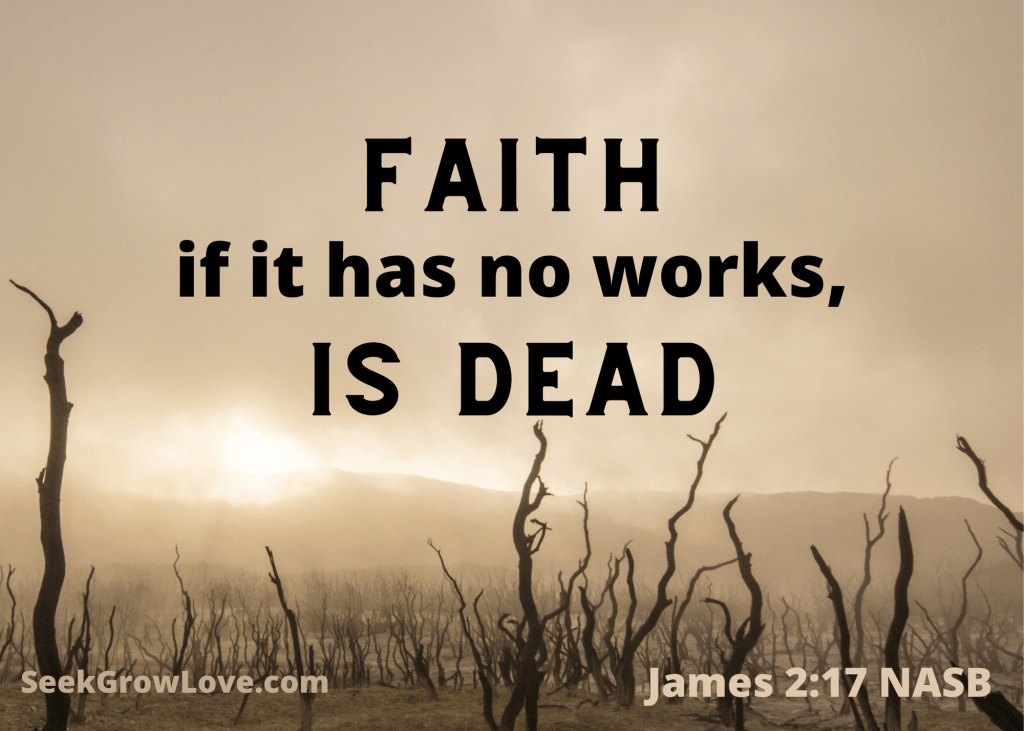
“What use is it, my brothers and sisters, if someone says he has faith, but he has no works? Can that faith save him? If a brother or sister is without clothing and in need of daily food, and one of you says to them, ‘Go in peace, be warmed and be filled,’ yet you do not give them what is necessary for their body, what use is that? In the same way, faith also, if it has no works, is dead, being by itself.”
Faith without works is dead. They go hand in hand, like salt and pepper, bread and butter, peanut butter and jelly. James’ impassioned words teach us that our faith should totally transform our lives and daily actions. Our faith should be reflected in the life we live. “Therefore if anyone is in Christ, this person is a new creation; the old things passed away; behold, new things have come” II Corinthians 5:17
James sums up his thoughts with two examples from the Old Testament, Abraham and Rahab. “Was our father Abraham not justified by works when he offered up his son Isaac on the altar? You see that faith was working with his works, and as a result of the works, faith was perfected; and the Scripture was fulfilled which says, “And Abraham believed God, and it was credited to him as righteousness,” and he was called a friend of God.” (verses 21-23)
We cannot imagine the agony Abraham faced on that mountain, preparing to sacrifice his beloved son Isaac. But he had ultimate trust, FAITH, in God and followed through with WORKS, laying Isaac on the altar before the ram was revealed for the burnt offering. “And as a result of the works, faith was perfected.”
Such an unfathomable example of faith and works, Abraham was called the friend of God, an honor bestowed on no one else in Scripture.
“In the same way, was Rahab the prostitute not justified by works also when she received the messengers and sent them out by another way?” (verse 25) The account of Rahab is found in Joshua 2. Rahab hid the two spies Joshua sent into Jericho. This daring deed brought a rewarding outcome for Rahab and her family, as they were saved when Jericho was defeated by the Israelites. Rahab’s faith and actions blessed her descendants as she is found in the genealogy of Jesus.
James concludes his thoughts with verse 26. “For just as the body without the spirit is dead, so also faith without works is dead.”
Without the breath of life, we are dead. Without a life of daily ACTIVE Christian living and service to others–our works— our faith is dead.
“In the same way, let your light shine before others, that they may see your good deeds and glorify your Father in heaven.” Matthew 5:16
-Paula Kirkpatrick
Today’s Bible reading passages can be read or listened to at BibleGateway.com here – Jeremiah 47-48 and James 2
When children finish high school, and they go off to college or to live on their own for the first time, those frenzied final weeks before leaving are usually a flurry of activities. To-do lists are checked off and then added to, last minute shopping trips become a daily occurrence, and packing everything needed seems an impossible task. Finally, the day arrives, and the slightly panicked parents are often confronted with this stark realization: did I prepare them sufficiently for the challenges they will face in life? And so ensues final reminders, gentle warnings, and many sentences starting with “Don’t forget,” or “Remember.” The parents want the best experience for their children at college and in life.
The writer of Hebrews also desires the best outcome for his dear readers, his spiritual children, as he finishes his letter. Of course, that best outcome is eternal life in the Kingdom of God. Thus, Hebrews 13 concludes with straightforward instruction to reach this prize.
Consider the direct instructions found in verses 1-7, and the reasons WHY these instructions are important.
“Keep on loving each other as brothers”
“Do not neglect hospitality to strangers—(WHY?)—”for by this some have entertained angels without knowing it.”
“Remember the prisoners, as though in prison with them, and those who are badly treated—(WHY?) – since you yourselves also are in the body.”
“Marriage is to be held in honor among all, and the marriage bed is to be undefiled; – (WHY?) – for God will judge the sexually immoral and adulterers.”
“Make sure that your character is free from the love of money, being content with what you have; – (WHY?) – for He Himself has said, “I will never desert you, nor will I ever abandon you.”
“Remember those who led you, who spoke the word of God to you; – (WHY?) – considering the result of their way of life, imitate their faith.”
Verse 17 goes hand in hand with verse 7. “Have confidence in your leaders and submit to their authority, – (WHY?) – because they keep watch over you as those who must give an account. Do this so that their work will be a joy, not a burden, for that would be of no benefit to you.”
Hebrews 13:8 can be a stand-alone statement and beloved promise, easy to memorize (and it should be) and underlined in your Bible.
“Jesus Christ is the same yesterday and today and forever.”
What an assurance to us that Jesus has not changed and will not change—he is our Savior and coming King. Perhaps the writer felt a plain statement of our basic hope was warranted after his beginning list of directives.
Building on that simple reassurance, verse 9 warns the early Christians and us today, not to “be carried away by varied and strange teachings,” just as parents might advise their departing children—stay true to your foundation, the principles of your upbringing. It is firm, it is solid, it will keep you grounded.
Now, remember our reading from Hebrews 10 a few days ago.
“But He, having offered one sacrifice for sins for all time, sat down at the right hand of God,waiting from that time onward until His enemies are made a footstool for His feet. For by one offering He has perfected for all time those who are sanctified.” (Heb. 10:12-14)
Continuing in Hebrews 13, verses 15-16 should be OUR response for this sacrifice.
“Through Him then, let’s continually offer up a sacrifice of praise to God, that is, the fruit of lips praising His name. And do not neglect doing good and sharing, for with such sacrifices God is pleased.”
Our Salvation Gift from God:
Jesus—ONE SACRIFICE for all time
Our Response:
CONTINUAL SACRIFICE of
Praise
Doing good
Sharing
As the end of verse 16 says, “for with such SACRIFICES God is pleased.”
The writer concludes with a benediction or ending prayer in verses 20 and 21 that sums up his thoughts in this chapter.
“Now may the God of peace, who brought up from the dead the great Shepherd of the sheep through the blood of the eternal covenant, that is, Jesus our Lord, equip you in every good thing to do His will, working in us that which is pleasing in His sight, through Jesus Christ, to whom be the glory forever and ever. Amen.”
This prayer serves as the perfect final reminder for young adults off to college, and for each one of us.
-Paula Kirkpatrick
Today’s Bible reading passages can be read or listened to at BibleGateway.com here – Jeremiah 43-44 and Hebrews 13
Forgetfulness is a common ailment. We all forget. We forget where we put the keys. We forget to send the birthday card, forget to get milk at the store and forget to pay the bill or finish the homework or return the library books. We climb in bed after a long day of remembering lots of things and realize we forgot to exercise and read our Bible and call mom. I have done it all. I am pretty much an expert forgetter.
Much of the time our forgetfulness is just inconvenient or unfortunate. It means we have to make an extra stop at the store tomorrow, pay the late fee on our bill, or receive a lower grade. Maybe one day we will learn there are consequences to our forgetfulness and it will help us remember to do what we had planned to do all along – until we forgot.
But sometimes a poor memory will actually lead to death. Tragic cases can occasionally be read in the news. Forgetting to take children out of their car seats and into safety. Forgetting to latch and lock the pool gate. Forgetting the once familiar route home. There can be dreadful, heartbreaking consequences for yourself or others which can lead to death when one simply forgets.
You can also read about the devastating effects of forgetfulness in the Bible. In fact, in both of today’s passages we find instances of forgetful people, with various results. In our Psalm for the day (106), we continue the history lesson of God’s people. In today’s lesson the Israelites are exiting Egypt and traveling through the dessert. Maybe the heat is getting to them because they seem to be having a hard time remembering some pretty big and important events that happened not so long ago.
Psalm 106:7 — When our ancestors were in Egypt, they gave no thought to your miracles; they did not remember your many kindnesses, and they rebelled by the sea, the Red Sea.
Psalm 106:13 — But they soon forgot what he had done and did not wait for his plan to unfold.
Psalm 106:19-21 — At Horeb they made a calf and worshiped an idol cast from metal. They exchanged their glorious God for an image of a bull, which eats grass. They forgot the God who saved them, who had done great things in Egypt
Sometimes the forgetful people are met with God’s mercy and yet another miracle they will also forget further down the road. Sometimes it’s more serious, and even fatal. Poisonous snakes, deadly disease, and the ground swallowing up those who forgot to remember God. What else could God do to help them remember?
Many generations later we see the same tragic forgetfulness recorded in the book of Jeremiah.
Jeremiah 18:15 — Yet my people have forgotten me; they burn incense to worthless idols, which made them stumble in their ways, in the ancient paths.
They had forgotten the MOST important thing of all – the One who gave them life, the One who provided for all their needs, the One who had laid out blessings for those who follow, the One who had laid out curses for those who went their own stubborn way. They forgot God. And because of their repeated forgetfulness God was preparing the curses promised in his covenant: destruction, invasion, death.
It is easy to get so caught up in living our own busy lives, going our own stubborn ways, before we know it, we have forgotten our Life-Giving Teacher and all the lessons He was trying to teach us. And, instead, we face death and destruction.
Thankfully, there are ways to remember. With effort we can fight off this deadly tendency to forget. Here’s some ideas to build your memory.
How to Remember
Keep a thankful journal. Write down at least 3 things each day to thank God for. The act of writing helps you remember, and you will have the written journal to return to when your brain gets fuzzy on the details of how God has provided and cared for you – every day.
Clear an overly busy schedule. Trying to do too many other things that really don’t matter doesn’t leave time and space in your overbooked brain and calendar to remember God and do what is most important. You may even find some of those “extras” in your life that were getting too much of your time and memories were approaching, or at, idol status. Clear ’em out.
Get to church, Sunday school, Bible study, youth group, the church mens or ladies group, church camp, etc… Surround yourself regularly with those who are helpful for jogging your spiritual memory. When left alone brain connections can diminish leading to difficulty recalling. Instead, get to church. It’s a great place to overcome your own memory deficiencies – and it’s a great place where you can even help someone else remember God, His greatness and all He has done.
Add visual or auditory cues. What “tricks” will help you remember to keep God first. The Israelites were told to write it on their doorposts – maybe you need some Bible verses on your wall, mirror and refrigerator. Satan uses many schemes to erase God from people’s memory. Jesus found great power against Satan’s schemes by using God’s scriptures which he had committed to memory. Take out that Bible, the Sword of the Spirit, and use it daily to slash away cobwebs forming in your brain. Time and study and a love for God’s eternal word is the best cure I know for forgetfulness that leads to death.
Remember God and what He has done, is doing and will do!
-Marcia Railton
Today’s Bible reading passages can be read or listened to at BibleGateway.com here – Psalm 106 and Jeremiah 17-18
What is the best way to lead people? You may be a leader in some area of your life, at school, at work, at Church, among your friends, on a sports team, in your marriage, with your children etc… Most of us have had some experience being a leader and I’m going to guess that everyone has had the experience of having a leader, probably many, in your life.
There are a number of leadership styles. Authoritarian leaders impose expectations and define outcomes. It’s a very top down approach. It’s efficient and sometimes required, but doesn’t always create a great experience for those being led. If you’re the parent of a 2 year old, it’s pretty much the only leadership style. But what works with a 2 year old doesn’t work as well with a 16 year old, or with your spouse. It might work okay if you’re the manager of a fast food restaurant with a bunch of first time teen-age employees, but probably not so well if you are managing a medical practice with a group of physicians.
Participative leadership is more democratic and helps people feel more engaged, but it can be more time-consuming and lead to poor decisions if the employees participating lack necessary information or skills.
Delegative leaders step back and let the members of the team set their own agendas, which in the right environment can produce a lot of creativity, but can also lead to disunity.
Transactional leaders use a lot of carrot and stick, reward and punishment. They give clear expectations and offer clear feedback and immediate rewards and punishments. It works well getting a 7 year old to clean her room or finish her vegetables, but doesn’t inspire a lot of creativity in capable adults.
Transformational leaders inspire with a vision and then encourage and empower followers to achieve that vision. They act as a role model. This type of leadership is not coercive and leads to high morale. To learn more check out: https://www.imd.org/imd-reflections/reflection-page/leadership-styles/
Great leaders adjust their leadership style to the appropriate context and situation. The little book of Philemon is a wonderful case study on Christian leadership. The Apostle Paul writes to his disciple, Philemon, about their mutual acquaintance, Onesimus. Paul and Philemon were brothers in Jesus Christ. Paul was responsible for Philemon coming to faith in Christ. Now, Philemon was a leader in the Church and actually had a congregation that met in his home. When he wrote the letter to Philemon Paul was in jail, probably in Rome awaiting his trial. While in prison he met Onesimus. Onesimus was a runaway slave who had been the property of Philemon. It seems that Onesimus became a follower of Jesus Christ through Paul while they were in prison. Onesimus had become a supportive helper to Paul. Paul has a dilemma. He has two Christian brothers, Philemon, a slave owner and Onesimus, a runaway slave. Paul wants Philemon to release Onesimus from his enslavement and either welcome him back not as a slave but as a fellow Christian, or allow him to return to Paul and support him while he’s awaiting trial.
So what leadership style does Paul use? He could have played the authoritarian card and said “Philemon, I’m an Apostle, I met Jesus personally, I brought you to faith, and now I order you to release Onesimus.” Under Roman law Philemon had the right to demand Onesimus’ return. He was not legally obligated to release him. Legally, under Roman law Paul had no authority to force Philemon to let Onesimus go. Paul practiced transformational leadership. He inspired Philemon and gave him a vision of how being a follower of Jesus Christ can transform a person and their values and relationships. He gave him a vision of Onesimus as more than property or an asset, but as a person, a child of God, as a fellow heir of the kingdom of God bought from slavery to sin and death through the blood of Jesus Christ.
In using this leadership style Paul creates space for the spirit of God to transform Philemon’s heart, and have a much wider impact on the Church (for nearly 2000 years). Hopefully, other Christian slave owners saw Philemon’s example and also chose to release their slaves and welcome them as brothers and sisters in Christ.
Paul uses his personal relationship with Philemon to persuade and inspire him to recognize what Paul had done for him and what Paul was inviting him to do for Onesimus. This is a great example of persuasive transformational leadership. In times when God calls you to be a leader either at school, at work, in your family, at Church, in community, or wherever you might be called to lead, remember Paul’s great example of how to be a transformational leader.
The passage in Isaiah also gives a glimpse of leadership. In this instance. God is leading his disobedient and rebellious children, Israel. God’s leadership style here might be interpreted as transactional. God has punished Israel for their idolatrous and rebellious ways. God also promises better days ahead for those who faithfully listen to God and walk in the ways of obedience. Ultimately, God is a transformational leader calling people to look to the vision of a new heaven and a new earth to inspire them to faithfulness now. God doesn’t enjoy punishing the disobedient. It’s true that the “fear of the Lord is the beginning of wisdom”(Provers 9:10), but ultimately God wants us to respond to Him out of love- to love him with all our hearts (Deuteronomy 6:5). God always leads in exactly the way we need, because He is the perfect leader. Let us follow Him and learn from Him just as Paul (and hopefully Philemon) did.
-Pastor Jeff Fletcher
Today’s Bible reading plan passages can be read or listened to at BibleGateway.com here – Isaiah 65-66 and Philemon
Life is so busy and complicated that I have to create lots of reminders for myself. Fortunately, my phone and computer and watch all have features where I can set reminders for myself. “Doctors appointment Tuesday at 3:00. Take the garbage to the dump on the way to work in the morning. Stop by the store after work and pick up some milk and bread.” I can even set reminders months or years in advance. I can set alarms to remind me that in 2 hours I have a meeting. In 1 hour I have a meeting. In 15 minutes I have a meeting. The Meeting is now starting. Maybe I’m too busy or maybe I’m getting old, but I find myself more and more needing reminders.
Do you ever need reminders? Little kids need to be reminded to brush their teeth, make their bed, do their homework. What do you need reminders for?
The Apostle Paul thought reminders were important for Christians. I guess he understood how easy it can be to forget what’s important when we are busy living life and doing what’s necessary or urgent. Do Christians ever forget important things about God, about Jesus, about how we are supposed to live? Yep, we sure do.
In Titus 3 Paul tells Titus to remind the believers of some important things.
“Remind the people to be subject to rulers and authorities, to be obedient, to be ready to do whatever is good, to slander no one, to be peaceable and considerate, and always to be gentle toward everyone.” -Titus 3:1-2
Those reminders were important in the first century when Christianity was brand new and people were still learning the basics, but it’s been 2000 years. We’ve certainly got being a Christian all figured out by now, don’t we? Do we really need to be reminded to obey people in authority? Do we need to be reminded to always be ready to do good? Don’t all Christians always do what is good? Certainly we never slander or falsely accuse someone of wrong doing. I’m always peaceable and considerate and gentle toward everyone, aren’t you? (My tongue is in my cheek- that means I’m kidding).
To tell the truth, I still need to be reminded all of those things. Just because I’ve been reading the Bible for over 50 years doesn’t mean I always remember to do good. I still need to be reminded to be considerate and gentle, and so do you. That’s why Christianity was never designed to be lived in isolation, but in community. We need each other. There’s a passage in Hebrews (a different book from today’s reading, but important) Hebrews 10:24-25 says that Christians shouldn’t get out of the habit of meeting together, because we need to encourage (I think Hebrews says “spur one another on”, like a rider spurs on a horse) each other.
Following Jesus is hard some times. Being obedient to God is hard some times. Remembering to do good and be gentle is hard sometimes. I need help, I need encouragement to keep on doing what is right. I need you, and you need me, we need each other.
I’ve read the Bible many times in my life and I need to keep on reading it to help me remember all the important things I need to remember. Today’s readings in Isaiah 63-64 and Titus 3 remind us both about God’s wrath and about God’s mercy. God has both. God hates sin, he hates it when his children are brutal to each other. He hates it when his children fight and argue. He hates sin because he loves us and he knows that sin hurts us. We hurt each other when we sin. No parent likes to see their children hurt each other. We learned that from our Father, God.
So keep reading your Bible and keep coming to Church and meeting with other believers so that you can remind them and they can remind you to keep on following Jesus.
“Hey Siri set a reminder for 7 a.m. tomorrow: be considerate and gentle to everyone.”
“Alexa, remind me to get up for Church Sunday at 8:00.”
-Jeff Fletcher
Today’s Bible reading plan passages can be read or listened to at BibleGateway.com here – Isaiah 63-64 and Titus 3
If you’ve not read Marcia’s devotion for yesterday, it would be good to give it a quick scan now. She sets us up well for I & II Thessalonians. By the way, thank you Marcia, for all the work you do with SeekGrowLove! These readings and devotions are a great ministry! It is amazing how often the Old and New Testament readings complement each other. Isaiah did speak a great deal of judgment, but as always, God never wasted an opportunity to lay out hope for his people. Isaiah also had much to say about the coming Messiah. I appreciated Marcia’s suggestion that we note what Paul alludes to at the end of every chapter in I Thessalonians. If I had known that before, I had forgotten.
At any rate, let me note just a few highlights in I Thessalonians 2 . . .
Paul was literally driven to preach the gospel, the good news of the Kingdom of God and the Name of Jesus the Christ. Neither opposition, nor disagreement, nor persecution could dissuade him. He was a straight shooter, told it like it was. He would have nothing to do with masking, hiding anything, or any impure motives (See V. 5). He provided for his own needs, toiling at his own profession, rather than to be a burden in any way upon the church. Actually, on another occasion he apologized for that very practice, realizing the church needed to understand and meet their responsibility to care for those who provided for their spiritual needs. The context of the situation would evidently dictate what is right.
Notice the tenderness of Paul’s love and concern for the brethren. He was gentle with them, like a mother caring for her little children (V. 7). Then in Vs. 11,12, he dealt with them as a father deals with his own children – encouraging, comforting, and urging them to live lives worthy of God who calls us into his kingdom and glory. He was thankful for them, and proud of them as they served and obeyed. Who are your spiritual mentors, men and women who have taught you, encouraged you, comforted you, and challenged you spiritually? May we make them proud. May we walk in their footsteps. May we build on the foundation others have laid before us! May we minister to others! May we be true as we wait and watch for the coming of Jesus!
I love etymology, or the study of the origin of words. How do words come to mean what we say they mean? It’s a fascinating subject for a nerd like me. And words sometimes, or maybe often, don’t mean what they sound like. One word that is used commonly in North America, and especially in my experience, in the South, is “doohickey”. For those unfamiliar, when someone says “hand me the doohickey”, they are saying “give me the item to which I am gesturing that you should see I obviously need.” Context, as they say, is key. You need to be in the moment to know what they mean, and you need to be paying attention to understand how you should behave, e.g. giving them the tool, instrument, or whatever they are asking for.
When reading Scripture, we see that certain ways of being, believing, and living are better than others. These better ways should be the standard for those who are redeemed by God. However, we need to always remember that the words we read in scripture weren’t written down by some guy last week in USA-English, but were written down 2000 years ago by men (and women?) who were writing in a different time to a different context and translated to our language today. We CAN understand a lot about scripture; it is clear there is only one God, not 100, and that Jesus is his Son and our Savior. However, studying helps us understand ideas, concepts, and words more clearly. The more clearly we understand Scripture, the better we can live it out and the better our lives will be by living it out.
Today, we are looking at the word “joy”. If we can understand how joy is used in the New Testament, that should shed some light on how joy is used in Philippians.
First, joy (in Greek : charas) is the reaction of those who hear the gospel of the Kingdom of God and the name of Jesus. When Jesus is born, the angels proclaimed it was good news of great joy (Luke 2:10). When the magi find the home of Jesus, they are overwhelmed with joy. (Matt. 2:10) As Jesus is raised, the disciples respond in joy. (Matt. 28:8)
Next, joy is the response of the early church in Acts. The disciples not only receive the Holy Spirit but also joy! (13:52) The people had joy due to miracles being performed. (8:8) Joy came upon all the believers when Gentiles came to the truth of faith in Christ. (15:3)
Finally, Paul has his own way of speaking about joy. Paul looks to those he leads as those who bring him joy. Paul calls the Thessalonians his “glory and joy” because of their steadfastness in faith and proof that God is working through him. (1 Thess. 2:19-20) Paul sees his sufferings and persecutions as a cause for joy because of the work it may do for the message of Christ (Col. 1:24). Finally, over and over, Paul tell his readers that joy is the reality of Kingdom living, a gift of God, a gift God gives through connection to His Holy Spirit. (Rom 14:17, Gal 5:22-23, 1 Thess. 1:6)
That’s a lot of verses to meditate on through today or tonight, but a bunch of verses does not a definition make. So we need to say what joy seems to be in the New Testament.
Here is an example definition. I would encourage you, as you study the verses above, and others, to write your own definition, but this may be a helpful definition for you as we walk in joy this week.
Joy is the state of happiness and contentment as we hear the gospel message and respond in faith. In that response, we are given God’s Holy Spirit, that will allow us to ground our joy in the truth that God is our loving Father and we are his saved children. Then we are able to see the difficult and painful circumstances of life as opportunities for God’s glory rather than as cause for us to lose our happiness. Joy is, therefore, not an emotion like happiness and sadness, but a way of living in response to the work of God and Jesus where we are continually hopeful and peaceful in every situation.
May you, my brothers and sisters, find THAT joy today. May it fill your hearts and minds, and may it pour from the spirit of God into your spirit.
-Jake Ballard
Read or listen to today’s Bible reading passages at BibleGateway.com here – Isaiah 9-10 and Philippians 2
Caitie has been writing all week on our identity in Christ, but as a busy Bible College student she needs the day off to concentrate on her other Bible responsibilities. She’ll be back tomorrow to finish off her series.
Today, let’s look at Ephesians 4 with an eye for who we are created to be – and a little bit of who we are NOT created to be. We don’t have to go far to start creating our list. In verse 1 Paul reminds us he is a prisoner – not an identity we usually strive for – but he wears it rather proudly as a prisoner for the Lord. We must remember to not seek to fit in with what the world may tell us is good and proper and respectable – but what GOD says. Are we living worthy of the calling we have received from God? Even if it puts us in a position that the world doesn’t commend?
What does He call us to be? COMPLETELY humble, gentle, patient, bearing with one another in love (4:2), making EVERY effort to keep the unity of the Spirit through the bond of peace (4:3). In other words – be nice. Put away prideful, rough and rude, easily irritated selfishness. There is no place for it in the church family. In any group or partnership made up of individuals it is easy to have the individual needs, wishes, personalities, selfish desires dominate. And, pretty soon, people aren’t playing nice. Paul reminds us of all the things we have in common with the other members of the body of Christ. ONE body, ONE Spirit, ONE Hope, ONE Lord, ONE faith, ONE baptism, ONE God and Father of all, and that God is the biggest and the best – remember that! (4:4-6). All on the same team – the BEST team. Don’t destroy yourself. You, the church, are ONE body – take care of it.
You all have different roles to play: apostles, prophets, evangelists, pastors, teachers, etc… Don’t neglect yours. Do it the best you can, and appreciate others who are doing their role. Only when we are working together can we create a healthy, growing, maturing body becoming more and more like Christ. (4:11-13)
Wisdom will be needed. We don’t want to stay babes in the faith who are easily led astray. It will take work and wisdom to grow up. Beware of men and women (in and out of the church) who do not speak the things of Christ. Don’t let yourself, or your brothers and sisters, be deceived. Search for God’s truth. Know the truth – and share it – in a loving manner. “Speaking the truth in love.” (4:15).
Remember to ALWAYS keep Christ as the Head. It’s not about you – it’s about Jesus. Keep his mission, his vision, his voice, his dedication, his words, his wisdom, his passion, his love for God and others, his focus foremost. That’s the only way to be a church that brings glory to God. Keep God’s beloved Son as the Head. Do your part, support the other parts, and keep Christ as the Head. (4:15,16)
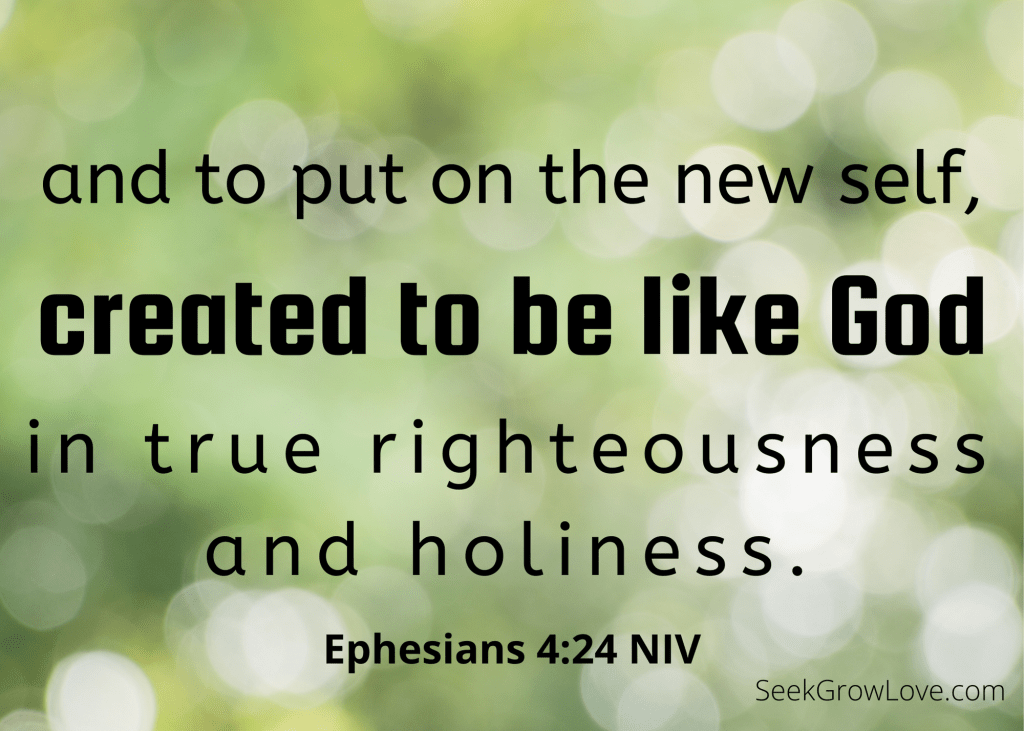
You will be surrounded by worldly people engaging in worldly ways. That is NOT who you are to be. Put off the old self with its wicked ways. Be the new person you were meant to be. Your new self was, “created to be like God in true righteousness and holiness.” (Ephesians 4:24) That’s huge! My new identity is to be LIKE GOD! First we were told to be nice. Then we were told to keep Christ as our Head. NOW, we are told that our new identity is to be LIKE GOD. Not to be like God in His supreme power, majesty and sovereignty. We are not expected to become all-knowing and all-powerful like the Creator. We are told our new self was created to be like God in true righteousness and holiness. Do what God says is right and set yourself apart from the world. How’s our righteousness and holiness looking today? What tweaks – or major construction projects – can you and I begin today to become more and more Godly – by doing the right thing and by being set apart from the world?
Paul gives some suggestions.
Is there an area where we need to practice being more truthful to our neighbor (perhaps even to save their life)? Do it. Become more like God and more set apart from this world.
Is there an area where your anger is controlling you and leading you to sin? Stop giving the devil a foothold. Become more like God and more set apart from this world.
Is there an area where we need to replace harmful habits and lifestyles with time and energy spent doing good to benefit others? Stop leaving the work for others. Get busy helping others. Become more like God and more set apart from this world.
Are there times when our mouths (and hearts) are full of unwholesome talk: put-downs, complaining, lies, swearing, negativity, coarse joking, or slander? What do we do and say that saddens God’s Holy Spirit? Stop it! Get rid of it! Replace it! Be nice. Be kind. Be compassionate. Forgive. Because you have also been forgiven. Become more like God and more set apart from this world.
“Put on the new self, created to be like God in true righteousness and holiness.” (Ephesians 4:24)
-Marcia Railton
Read or listen to today’s Bible reading passages at Bible Gateway here – Isaiah 1-2 (what can you find referring to the old and new self in Isaiah 1?) and Ephesians 4





 Seek Grow Love