A Pretty Awesome Formula

Old Testament: Deuteronomy 15 & 16

Poetry: Job 35

New Testament: Romans 3

Remember that time that you held an imaginary debate or argument in your mind with either an imaginary figure or your spouse, coworker, boss, or friend?  We have all been there before.  Evidently, Paul has been there before as well.  Except this time, Paul records this imaginary debate in Romans 3.  How exciting! 

Romans 3:1-8 gives the impression that Paul is debating an imaginary figure on how the Jews fit into the bigger picture.  Paul’s conclusion to this mini debate is that the Jews are not better off, “For we have already charged that all, both Jews and Greeks, are under sin,” (Romans 1:9 ESV).  There we have it.  All of mankind is under sin.  This conjoins the Jews and the Greeks together.  If you don’t believe Paul, no need to worry.  Paul has plenty of ammunition to help prove this point.  Paul quotes a number of scriptures from the Old Testament in the following verses to bring home this point.

After Paul’s introduction, his letter to the saints at Rome has been rather gloomy thus far.  However, verse 21 is where we start to see a shift.  Paul recognizes that we are all under sin… “BUT NOW…”.  This is where it gets fun!  This passage in Romans 3:21-31 can preach!  Essentially, this is a teaching on the doctrine of salvation, as the righteousness of God is revealed through faith in Christ Jesus for all who believe.

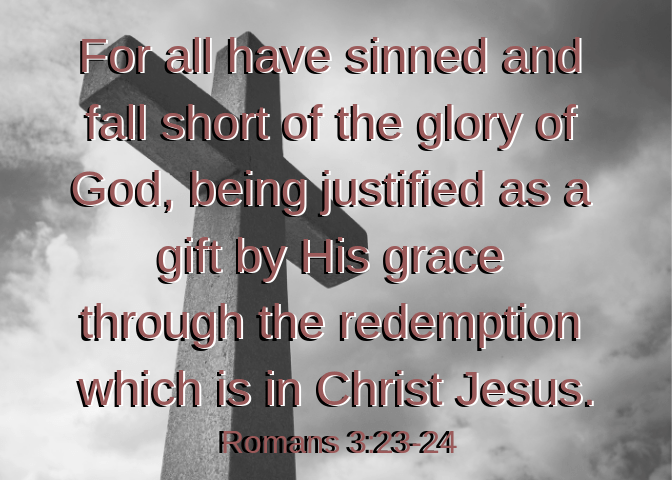
Many are able to quote Romans 3:23: “for all have sinned and fall short of the glory of God.”  Paul is only halfway through his sentence when we have a verse break.  Don’t forget about verse 24: “And are justified by his grace as a gift, through the redemption that is in Christ Jesus.”    Paul compares God’s grace to a gift.  Whenever you are given a gift from someone, you have two choices: you can receive it and open it or you can deny the gift.  I have many memories as a child of receiving gifts from my parents for Christmas, my birthday, or other special occasions.  Not once did I ever reject a gift that my parents gave me; I openly received the gifts every single time.  Nearly every child receives the gifts they are given without a second thought.  We need to mimic the attitude of a child here and gladly receive God’s gift of grace with open arms.  How do we receive God’s grace?  Well, fortunately for us, Paul tells us exactly how to receive that grace in the following verse.  Paul tells us that it is “to be received by faith,” (Romans 3:25).

Paul crams a lot in this short passage to conclude chapter three, as he talks about our salvation.  You can sum up Paul’s discussion in the following formula: sin + grace + faith = justification.  Paul will later reveal to his audience that the justification leads to eternal salvation. For you math nerds out there, that’s a pretty awesome formula.  For those of you not interested in math, trust me, that’s still a pretty awesome formula.

As we go through our lives, let’s remember to keep our arms open wide ready to receive God’s free gift of salvation.

-Kyle McClain

Reflection Questions

  1. Have you ever rejected a gift given to you? Have you rejected or gladly received God’s free gift of salvation? Who do you know who might need some more information or encouragement to receive this gift?
  2. How would you define and describe each of the words in the following formula: Sin + Grace + Faith = Justification. What is the importance of each one?
  3. In the gloomy moments of your life, how can Romans 3 lift your spirits and bring joy, hope and peace?

Go and Tell

Old Testament: Deuteronomy 11 & 12

Poetry: Job 33

New Testament: Romans 1

He is risen indeed!  I write this devotion to you on the heels of celebrating Resurrection Sunday with our church family.  What a joyous celebration, as we celebrate the victory that Jesus had over death and what that means for us today.  The first people who heard that Jesus has risen from the grave were the ladies present when the angel rolled the stone away.  The angel told them that Jesus “is not here, for he has risen” (ESV Matthew 28:6).  The angel then gave the ladies simple instructions: “go quickly and tell his disciples that he has risen from the dead” (Matthew 28:7). Go and tell.  That’s what the ladies were to do; they were to go and tell others that Jesus is alive.  If there has ever been a bona fide star of someone who simply goes and tells others about Jesus, it would have to be the apostle Paul.

From the moment that Paul placed his faith in Christ Jesus, his whole life seemed to revolve around spreading the gospel message of the king and the kingdom.  He took a few missionary journeys and wrote many letters seeking to advance the gospel message of the king and the kingdom.  What we have here in Romans is another example of Paul’s innate desire to go and tell others about Jesus and what was important to him.

Romans 1:1 identifies Paul as the author of this letter: “Paul, a servant of Christ Jesus, called to be an apostle, set apart for the gospel of God.”  I would say that is a pretty good summary of who Paul is.  Paul served Jesus from the moment that Jesus appeared to him on the road to Damascus, and Paul was sent off to advance the gospel message of God.  Romans 1:7 identifies the target audience of this letter: “To all those in Rome who are loved by God and called to be saints.”  Paul was writing to all of the saints in the city of Rome.  A saint is simply someone who, like Paul, is set apart from the world around them.  Paul is writing to those in Rome who have set themselves apart from the world by putting their faith in Christ Jesus.

It is believed that Paul wrote this letter around 56-58 AD – less than 30 years after the death, burial, and resurrection of Jesus.  The Roman Empire is nearing its peak in power.  In 49 AD, the Roman emperor Claudius banished all Jews from the city of Rome.  This decree lasted until Claudius’ death 5 years later.  Thus, at the time of the writing, the Jews were just able to reenter the city of Rome.  Around 56-58 AD, Nero would have just become the emperor.  He would eventually wreak havoc on the Christians in the city of Rome, but this would not have come until after Paul’s letter to the saints in Rome.  The saints in Rome would have consisted of both Jewish Christians and Gentile Christians.  I am sure they experienced similar tension that other groups of Christians experienced as well.

Paul would eventually find his way to the city of Rome in chains, but at the time of his writing, he had not yet been to Rome.  Verses 8-15 detail Paul’s desire to go to Rome.  We learn that Paul was “eager to preach the gospel to you also who are in Rome,” (Romans 1:15).  Paul wanted to go preach the gospel to them in person, but in the meantime, he would write a unifying letter to them about the gospel message.  That is largely what the letter of Romans is – Paul’s presentation of the gospel message.  I like to break down Paul’s presentation of the gospel message in Romans into three parts: 1. Our sin and need of salvation. 2. God’s plan of salvation for us. 3. How to live a Christian life.

After Paul’s introduction in the first 17 verses or so, Paul transitions into the topic of our sin and our need of salvation.  It is not a fun section to read though, but it is needed to get to the fun sections.  Why talk about salvation if we have no need of being saved?  There would be no point!  However, as we will see in the next couple of chapters, Paul does a pretty stand-up job of expressing mankind’s desperate need of salvation.

I look forward to progressing through this letter with you.  In the meantime, I encourage you to consider Paul’s task and desire of going and telling others about the risen savior. Just as the ladies present at the tomb of Jesus and the apostle Paul himself, I implore you to go and tell!

-Kyle McClain

Reflection Questions

  1. Where and to whom might God be directing you to Go and Tell? Paul used both letters and visits to tell the gospel message of the king and kingdom. How could you share the message with those you know – and those you have yet to meet?
  2. What is the importance of each part of Paul’s message: 1. Our sin and need of salvation. 2. God’s plan of salvation for us. 3. How to live a Christian life? What happens when any one of those are not shared and taught?
  3. Pray for the God’s wisdom, words and direction as you follow Paul’s example. Then Go and Tell!

From Death to Life!

Old Testament: Deuteronomy 9 & 10

Poetry: Job 32

New Testament: Mark 16

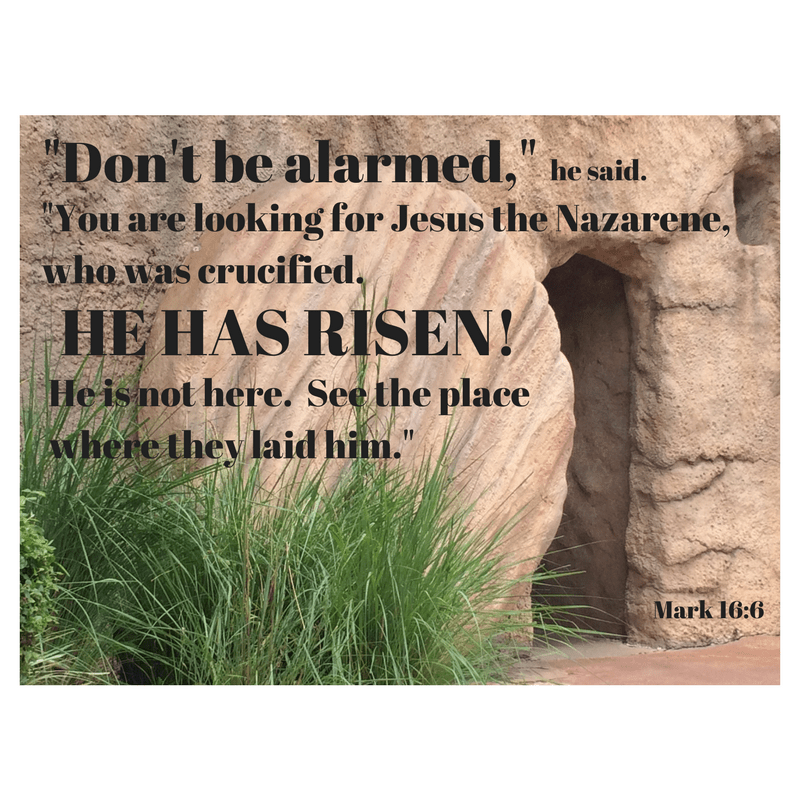
       Looking at Mark 15 allowed us to consider what Jesus suffered, and why. But the dawn has come, and now we can eagerly seek the news that our savior is raised to life. That transition from death to life is as simple for us as turning a page in our Bibles. Most Christians cannot approach Mark 16 without being aware of what should come next, which may always have been the case. Mark may not have written his Gospel primarily to tell people about Jesus, but to remind and encourage believers in their faith. We might imagine the text being read aloud in a group setting.

       We can envision the early listeners to this passage trying to put themselves in the places of Mary Magdalene, James’ mother Mary, and Salome. Certainly they understood what brought those women to the tomb: love, and mourning, and the wish to offer Jesus what support was possible by caring for his body. But from hindsight it was also clear that the tomb would be found open and empty – what a wonderful surprise for the mourners!

       And so as the account was read the listeners waited to hear of the women’s overcoming joy at learning about Jesus’ new life. It was not to be. Rather the three were left trembling, astonished, and afraid. And upon exiting the tomb they say nothing. (We know that ultimately more happened – particularly in the case of Mary Magdalene – but that is where the text stops.)

       Your Bible version, whatever version you are reading, probably does not cut off after verse 8. Perhaps it offers a footnote discussing what scholars think about the verses that follow (they doubt that the verses are legitimate). In fact different manuscripts contain four endings for the Gospel of Mark – aside from the version that simply cuts off after verse 8. That variety of endings not only shows us that some people were disappointed with the ending they had received, and tried to “fix” the issue, but it also demonstrates that the version which cuts off at verse 8 is from a pretty early date (so if there is a “real” ending of Mark lost due to damage that happened a long time ago).

       The way Mark 16 ends at verse 8 has been compared to how the book of Jonah ends. After God reprimands Jonah we never learn Jonah’s response. In Mark there may be a similar tone of leaving issues hanging at 6:52.

       So, let’s consider the possibilities. Mark may have intended to have a somewhat jarring ending to spur his audience to think about their own situations – each of them had the knowledge of Jesus’ resurrection (and had received sufficient time to get over the shock about it), so would they be silent, or would they proclaim it? Perhaps the closing line of Mark’s book was intended to open a discussion, an interactive lesson plan which is so old we have lost the details for it.

       Or it may be that Mark was unconcerned about how the ending of his book came across, because the middle of his book already set up all the promises that were needed regarding Jesus’ new life, they just need to be believed. Having arrived at the end of Mark’s gospel, we certainly have not arrived at the end of Jesus’ story. To quote from Donald H. Juel, who discussed this idea,

There is every reason to believe that the rest of his promises will be fulfilled: James and John will drink from the cup; the disciples will give testimony; the gospel will be preached to all the Gentiles. Jesus will be enthroned at God’s right hand and will one day come with the clouds of heaven so that ‘all will see’ and will send his angels to gather the elect from the four winds.

(Mark, in the Augsburg Commentary on the New Testament series.) The trust that these promises will be fulfilled is not based on human effort, and neither is the end of the story. “The story is not over and will not be until Jesus returns.” (Juel).

       Knowing if one of these possibilities about Mark is correct is not the most important thing. We know that Jesus is alive. Both of these ways of viewing Mark’s book can be useful ways for us to think about our relationship with our living savior, and to better prepare ourselves to continue serving him. We sometimes approach Resurrection Sunday as a time to think about our own future lives, but there is much to be done in the meantime to be prepared, and to invite others.

       Dear God, on this Resurrection Sunday help me recommit my heart to you and to your son Jesus, the Christ, my savior. Allow me to examine myself through the guidance of your Spirit and to determine both what I need to set aside and what I need to take up for the improvement of my service. You offered me a new life, a resurrection into immortality. Please help me be more responsible in how I live this life, so I can relay your wisdom to those around me. Make me a witness of your grace and mercy and love. In the blessed name of your son Jesus I pray these things, Amen.

-Daniel Smead

Reflection Questions

  1. Do you find it strange for a Gospel not to include an appearance of the resurrected Jesus?
  2. Might Mark have stopped where he did because he saw the alternative as a much longer book (perhaps with part of what we know as Acts)?
  3. Over 500 believers saw Jesus alive in his resurrected state (1 Corinthians 15:6), but most have needed to wait to see Jesus, and are blessed for having believed without seeing (John 20:29). What affect do you think it would have had on the church if Jesus had been taken up to heaven without appearing to anyone?

Crowd Pleaser

Old Testament: Deuteronomy 6

Poetry: Job 30

New Testament: Mark 15

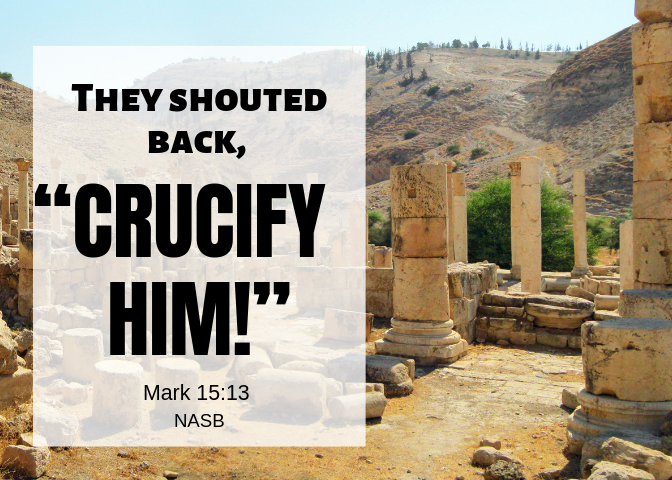
We are nearing resurrection Sunday. Before we can talk about his resurrection, we must talk about his death. In our text in Mark 15 we are seeing Jesus facing his death out in the open for all to see. The Sanhedrin brought Jesus before the Roman governor, Pontius Pilate. He could not find any fault in Jesus, and he said so three times. Late in the trial, Pilate sought a way to free Jesus. It was a Passover festival custom that the governor release a prisoner to the people, so, in a ploy to satisfy the crowd of Jewish leaders who had gathered and to secure Jesus’ release, Pilate allowed them to choose between a convicted criminal named Barabbas and Jesus. Instead of choosing Jesus, as Pilate had hoped, the crowd chose Barabbas for release. Shocked that they would free a hardened criminal, Pilate asked, “What shall I do, then, with the one you call the king of the Jews?” (Mark 15:12). The crowd cried out, “Crucify him!” (verse 13).

Pilate was confused by the crowd’s reaction, for barely a week earlier the people of Jerusalem had welcomed Jesus into the city with the waving of palm branches and shouts of “Hosanna!” (Mark 11:1–11). What Pilate may not have known was the extent to which the religious and political leaders hated and opposed Jesus. Not only did Jesus point out their extreme hypocrisy on many occasions (Mark 7:1–14), but He also claimed to be the Son of God, which was blasphemy to the unbelieving teachers of the law (see Mark 14:60–64). The religious leaders wanted to destroy Jesus (Mark 3:6). Only His death would satisfy them. Over the course of Jesus’ ministry, his teachings had angered the Pharisees, the scribes, the Herodians, and the Sadducees.  But not the crowd. Not the ones who saw Jesus’ love. Who saw him heal, support, encourage, teach. Who gave dignity to those who were oppressed. How could they hear the cries of crucify him and betray him like this? How could they hear Pilate offer Barabbas and choose him over a man who has done nothing wrong? Jesus was no longer the crowd pleaser, but the scorned suffering servant spoken about in the Old Testament. They had no idea who was standing before them. They chose Barabbas. We too face the same decision these Jews had to make between Barabbas and Jesus. When I read this story its hard for me to understand why Jesus is even in this predicament. He is the son of God. Save him. Sometimes, I have a hard time understanding God. How could he let his perfect son suffer and die?

Have you ever expected Him to act in a certain way because of what you understood about Him and His nature—but He did not do things the way you thought they should be done? I have. If I were Jesus, I would be angry. All he ever did was follow what God wanted him to do and it got him killed. Have you ever been angry and disappointed in God? I have been all but convinced that He did not live up to His promise, for I was sure that I knew what He was going to do, and God let me down. My heart was filled with rage that God would act that way, even though God has told us all, again and again, ‘For my thoughts are not your thoughts, neither are my ways your ways,’ declares the LORD. ‘As the heavens are higher than the earth, so are my ways higher than your ways and my thoughts than your thoughts’ (Isaiah 55:8-9). We cannot figure out God. He will be true to Himself, He will never lie, He will never deceive us; but He is more than we can handle. He is bigger than we are. Jesus understood this. He understood the bigger picture. He understood the need for his death. While he did not want to die he gave up his will and took all of the suffering so that we might live. Sometimes I don’t understand God but then I remember God loved us so much that he gave His one and only son for a chance for us to accept his love and have a relationship with Him. Mark 12:10-11  “The stone that the builders rejected has become the cornerstone, this was the LORD’s doing and it is marvelous in our eyes.”  All these words to say, I don’t want to be like the crowd who didn’t understand God’s plan. I don’t want to live another life other than the one I can have with Jesus. I know I’m like the crowd more than I care to admit. And like this crowd, when I (we) get angry with God and don’t want to follow his son and turn from Him, there is always another Barabbas waiting in the wings for me (us) to choose. Another crowd pleaser. One that is a murderer. One that I know is not right, but I choose anyway because I don’t want to follow Jesus. But I’m thankful that God is patient and loving and I have his son as a mediator who draws me gently back to him. Who calms my fears. Who alleviates my doubts. One who is the great shepherd and high priest.

-Andy Cisneros

Reflection Questions

  1. When have you been upset with or disappointed in God’s plan or ways?
  2. When have you been reminded His ways are higher – and better – than yours?
  3. How does the path laid out for Jesus – and his willingness to walk it – remind us that God can be trusted even when we think it doesn’t make sense or isn’t “right”?

Are you ready for the day of Christ’s return?

Old Testament: Deuteronomy 4

Poetry: Job 28

New Testament: Mark 13

After Jesus’ death and resurrection Jesus ascends into heaven in Acts 1:11. “Men of Galilee,” they said, “why do you stand here looking into the sky? This same Jesus, who has been taken from you into heaven, will come back in the same way you have seen him go into heaven.”

In Mark 13:14–37, Jesus prepared his followers for intense persecution and tribulation in the days ahead and especially during the end times. He gives them hope to endure these trials by describing his glorious return as the conquering King of the universe (verses 24–27). To keep them from despairing in dark times, the Lord wants them to live in readiness for His second coming. “However,” Jesus states, “no one knows the day or hour when these things will happen, not even the angels in heaven or the Son himself. Only the Father knows. And since you don’t know when that time will come, be on guard! Stay alert!” (verses 32–33).

“Day” and “hour” are often used in Scripture as references to time in general (see Matthew 7:22; 10:19; 24:42, 44, 50; 25:13; 26:45). But in Mark 13, Jesus focuses on a specific event in the future. Because no one knows the day or the hour of His return, Jesus stresses the need to pay attention, stay awake, and be ready at a moment’s notice. Multiple times in Mark 13, Jesus calls for people to be ready, to be watching: “Be on guard! Stay alert!” (verse 33), “Watch for his return” (verses 34), “You, too, must keep watch!” (verse 35), “Don’t let him find you sleeping when he arrives without warning” (verse 36), and “Watch for him!” (verse 37).

The disciples wanted to know when the end would come (see Mark 13:3–4). But Jesus told them that even he did not know (verse 33). Jesus acknowledges God as omniscient alone. Since no other mortal knows the time of Jesus’ return, Jesus, as the perfect son of God didn’t know the day or hour of his return, nor did the angels in heaven, only God the Father. It is possible that Jesus, now in his glorified state, knows the day and hour of his return. But at that moment, speaking with his disciples, the information was not at Christ’s disposal. Later, just before His ascension, Jesus would remind them, “It is not for you to know the times or dates the Father has set by his own authority” (Acts 1:7). Jesus accepted his human limitations, and so must we. The thing that matters is being ready every day for his return. What is stopping you from being ready?

Believers of every age have experienced persecution, natural disasters, and earthly trials. We all have our cross to bear. We all have our issues to deal with. We know how difficult it can be to live in this world. Genuine disciples must understand that these challenges are a daily reality of life in a fallen world. Yet, believers are not without hope because, in the end, our victorious King will return for us. Romans 8:38-39“For I am convinced that neither death nor life, neither angels nor demons, neither the present nor the future, nor any powers, 39 neither height nor depth, nor anything else in all creation, will be able to separate us from the love of God that is in Christ Jesus our Lord.”

 In the meantime, since no one knows the day or the hour, we are to watch and be ready for Him no matter what we must endure as we continue His mission of spreading the good news of God’s kingdom”. You don’t have to know the day or the hour. You just have to be ready. God has already supplied the victory through his son Jesus Christ

Many have tried to predict the day of Christ’s return, but Scripture is straightforward—no one knows the day or the hour. Jesus said to stay awake because his coming will be a surprise: “Look, I will come as unexpectedly as a thief! Blessed are all who are watching for me, who keep their clothing ready so they will not have to walk around naked and ashamed”. Now we might not know when Christ will return, but we should know when he has come to us and saved us. Do you remember that day? Do you remember that hour that your Lord and savior came to you? The day you accepted him? If not, I hope and pray that you search this day, this hour, to find Christ and know him completely. His day is coming soon. Are you ready?

-Andy Cisneros

Reflection Questions

  1. Are you ready for the return of Jesus Christ?
  2. What can you do to make preparations?
  3. What should we be looking for? Why did Jesus give us these warnings?

What is It Really Worth?

Old Testament: Numbers 33 & 34

Poetry: Job 23

New Testament: Mark 8

What is the most you have ever paid for something? What is the most you have ever gotten from selling something? We value our things and we value our money. It seems that prices keep going up and up on everything that we need. Yet when we sell something it seems the price is never quite as high as we would like it to be. When we buy or sell we must ask ourselves, “What is this really worth to me?” That question will help us decide if we want to buy or sell at the price offered.

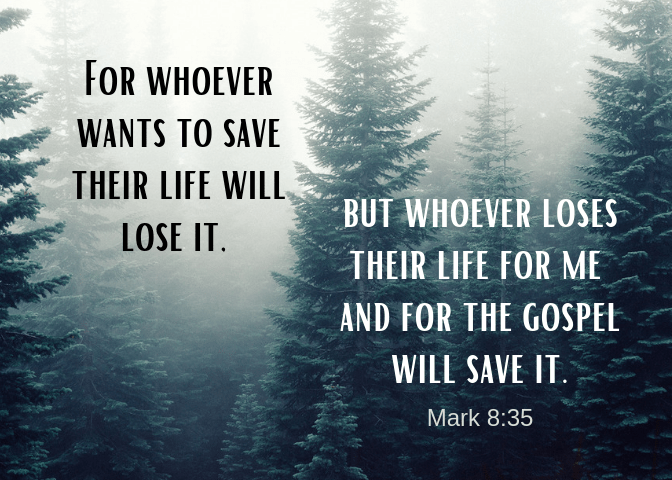
Jesus asks His followers to place value on what may be the single most valuable thing we have, our life and the choices we make in it. In Mark 8:31 Jesus teaches that He, “must suffer many things and be rejected … and be killed, and after three days rise again.” In the verses that follow He tells Peter that Peter had not set his mind on God’s interests, but his own. Then Jesus tells us, “If anyone wishes to come after Me, he must deny himself, and take up his cross and follow Me.” (Mark 8:34) Jesus is saying that we must place a value on being His follower. We must also place a value on following our own desires. We must decide which is of greater value to us. If our desires win and we choose to seek the things of this life and avoid the suffering of following Jesus it is a steep price to pay. Jesus says, “whoever wishes to save his life will lose it, but whoever loses his life for My sake and the gospel’s will save it.” (Mark 8:35) Proverbs puts it this way, “There is a way which seems right to a man, but its end is the way of death.” (Proverbs 14:12, Proverbs 16:25)

I leave you with the 2 questions that Jesus asked His disciples in verses 36 and 37, “For what does it profit a man to gain the whole world, and forfeit his soul? For what will a man give in exchange for his soul?”

-Bill Dunn

(originally posted May 10, 2017 for SGL)

Reflection Questions

  1. What did Jesus call Peter when he called him out for having in mind the things of men instead of the things of God? How often do you find yourself in the same mindset? How can we work at being more intentionally focused on the things/interests of God?
  2. Who have you seen deny themself, take up their cross and follow Jesus? What did it look like? What does it look like when you deny yourself and take up your cross to follow Jesus?
  3. What might it look like for you to “lose your life” for Jesus and the gospel?
  4. Is there anything more valuable to you than your soul? Are your life choices and daily decisions aligning with what you say you value most?

Surviving a Deadly Plague of Snakes

Numbers 21:9 NIV for SGL

Old Testament: Numbers 21 & 22

Poetry: Job 17

New Testament: Mark 3

In today’s reading, the Israelites needed a spiritual “blood transfusion.” Their sinful and rebellious attitude had shown itself in impatience, complaints about hardships, ingratitude for manna, and a lack of faith in God’s leader, Moses. This faithlessness resulted in a deadly plague of snakes that were killing the people.

The Israelites repented and asked Moses to intercede for them. God’s response required them to show their repentance by a simple act of faith. Moses made a bronze serpent and lifted it up on a pole. To be healed, people had to look at the serpent. If they didn’t believe God’s words, they wouldn’t look up and would therefore die. Only through faith could they be saved.

Homeopathic medicine is the practice of curing likes with likes. The patient receives diluted doses of substances that, at full strength, cause the same symptoms the patient already has. This type of medicine is used in many parts of the world, though it remains controversial among medical experts. In this instance, God prescribed a similar remedy for Israel, treating snake bites with a replica of a snake. Going a step further, God undid the effects of the plague through an image of the curse itself.

Today’s story begins with the people grumbling … again. It was the same old story: we’re dying, we’re starving, we don’t like the miraculous food, and we’re sorry we ever left Egypt. But this incident is unique; this time, the people repented.

In past events, Moses had asked God for mercy on behalf of the Israelites, but on this occasion, his prayers were prompted by a recognition of their sin that Israel hadn’t shown before. They realized on their own why the snakes were sent, and they confessed their sin. In that way, this was a spiritual breakthrough for Israel!

If God had followed the formula we’ve seen so far, we might expect Him to demand a sacrifice of some kind, like a lamb without defect. But the Lord told Moses to put a bronze snake, a picture of judgment, on a pole for all to see. He directed the people’s eyes, not to an image of purity, but to a symbol of wrath.

For healing to take place, the people had to close the loop of repentance. They sinned, confessed, and asked for mercy. The last step was to accept God’s remedy by faith and follow His instructions.

We often picture Christ as the perfect sacrifice, and that he is. But He also took upon Himself the shame of sin and the full penalty of wrath. In His conversation with Nicodemus, Jesus compared His upcoming crucifixion to the lifting up of the serpent in the desert. Let’s confess our sins, seek His mercy and turn our eyes to him, who not only gave his life but also received our punishment. Thank Him in word and in deed today.

Andy Cisneros

(Originally posted on March 3, 2020 for SeekGrowLove)

Reflection Questions

  1. What have you most recently complained about? Do you often complain? Is there a problem with complaining and grumbling? How do you think others view your complaining? How do you think God views it?
  2. What role does confession and repentance play in your relationship with God and others? How has God shown His mercy to you when you have repented? Is there anything you need to confess and repent of?
  3. After the Israelites confessed and repented what did they have to do next? What does God expect from us after confession and repentance?

Bring Your Friends to Jesus

Old Testament: Numbers 19 & 20

Poetry: Job 16

New Testament: Mark 2

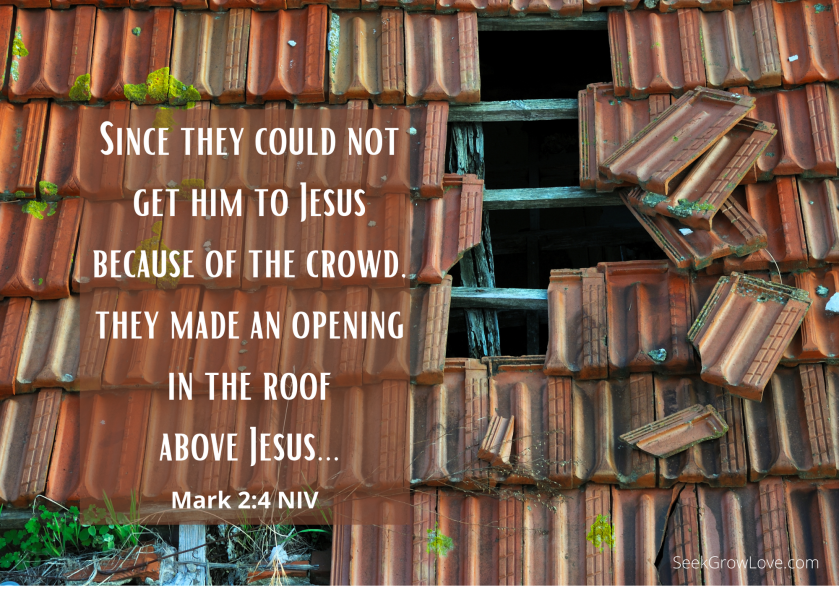
In Mark 2, we find the story of Jesus healing a paralyzed man.  Jesus was becoming more well known, and more popular.  He was inside a house, and some men brought their friend to Jesus so Jesus could heal him.  But because such a big crowd had gathered, there wasn’t room to bring him to Jesus, not even outside the door.  So the friends took the man onto the roof, dug through the roof, and let him down in front of Jesus.

I have to admire these friends.  They were very concerned about their friend, and wanted to see him healed.  They believed Jesus could and would heal him, if they could just get him to Jesus.  They didn’t just “pray about it”, they stepped out on faith and did something about it.  They dug through the roof, and let their friend get close to Jesus – and Jesus rewarded their efforts.

Mark 2:5 tells us, “When Jesus saw their faith, he said to the paralytic, “Son, your sins are forgiven.”  Jesus obviously saw that the man was crippled, but Jesus saw what wouldn’t have been nearly as obvious to us.  The man’s biggest problem was his sin – so Jesus healed him of that first.  This is the greatest miracle Jesus performed (and still performs).  

The teachers of the law said that Jesus was blaspheming, believing only God can forgive sin.  I’m guessing they were thinking, “it’s easy to tell someone their sins are forgiven, since you can’t prove they are really forgiven.”  Jesus then told them, “But that you may know that the Son of Man has authority on earth to forgive sins…”  He said to the paralytic, “I tell you, get up, take up your mat, and go home.”  So the man got up, took his mat, and walked out.

I love this story, not only because I love reading about all of Jesus’ miracles, but specifically because this is the only story I can think of where someone is healed because of the faith of his friends.  We’re not told, maybe the paralyzed man asked to be taken to Jesus.  But any way about it, Jesus saw the faith of the friends, forgave the man’s sins, and ultimately healed him.

This story puts me to shame.  I invite you to ask yourself some questions…

Am I this concerned about my friends?  

Am I willing to be uncomfortable – maybe even make a scene – to bring someone to Jesus?  

Am I willing to not just “pray for” someone, but actually “do something” for someone?  

Would Jesus see my faith and forgive and even heal someone I care deeply about?

Finally, do I need Jesus’ ultimate miracle for myself – to have him forgive me of my sins?  This miracle meets the greatest need.  It costs the most.  It brings the greatest blessing.  It has the longest lasting results.  And Jesus is still doing it daily.

–Steve Mattison

(Originally posted for SeekGrowLove on October 6, 2020)

Questions – See Above

With all Boldness

Old Testament: Numbers 15 & 16

Poetry: Job 14

New Testament: Acts 28

At the end of the book of Acts we are following Paul in his ministry as he shares his testimony and all he is learning from God with established groups of believers as well as with those who have not yet heard the good news of Jesus Christ. He is told through a prophet that he will be bound by the Jewish leaders and sent to the Gentiles to share his story.  He is accused by the Jewish leaders in Jerusalem, then arrested and imprisoned while the Roman authorities try to figure out which side of the story to believe.  Over the course of Paul’s imprisonment he is moved to various cities and meets with several governors as well as King Agrippa.  Then finally he is sent to Rome.  During each of these transitions, Paul has an opportunity to share the story of his conversion…who he was…who he is and who he will continue to be through God’s grace.  Every time he is questioned he says something like the following phrase from Acts 23:1 “My brothers, I have fulfilled my duty to God in all good conscience to this day.” 

Paul faced so much opposition during this period of time and yet he continued to stand firm in his belief that God had a purpose for him which would be fulfilled no matter what…arrest, false accusations, storms, shipwrecks, imprisonment, isolation, death threats, nothing was going to stop God’s message from being spread.

As the book of Acts closes we are given a chance to witness Paul as he teaches a group of Jewish leaders in Rome. 

Acts 28:23-30

They arranged to meet Paul on a certain day, and came in even larger numbers
to the place where he was staying. He witnessed to them from morning till evening,
explaining about the kingdom of God, and from the Law of Moses and from the Prophets he tried to persuade them about Jesus. 24 Some were convinced by what he said, but others would not believe. 25 They disagreed among themselves and
began to leave after Paul had made this final statement: “The Holy Spirit spoke the truth to your ancestors when he said through Isaiah the prophet:

26
“‘Go to this people and say,
“You will be ever hearing but never understanding;
you will be ever seeing but never perceiving.”

27
For this people’s heart has become calloused;
they hardly hear with their ears,
and they have closed their eyes.
Otherwise they might see with their eyes,
hear with their ears,
understand with their hearts
and turn, and I would heal them.’[a]

28 “Therefore I want you to know that God’s salvation has been sent to the Gentiles,
and they will listen!” [29] [b]

30 For two whole years Paul stayed there in his own rented house and welcomed all
who came to see him. 31 He proclaimed the kingdom of God and taught about the Lord Jesus Christ—with all boldness and without hindrance!

Some of those who were listening, heard Paul’s message and their lives were changed.  Others found that they couldn’t believe what Paul was preaching and left.  They heard but didn’t understand, they saw but didn’t allow comprehension. Paul kept right on teaching, preaching and sharing his mess so that God’s message could get through.

Oh to have Paul’s boldness and eloquence!  There are many times that we are provided the opportunity to share our own stories of faith with others and we often let them pass us by.  Are we afraid?  Maybe we don’t think they would be interested, or that we’ll be bothering them if we share.  Or maybe we don’t want to offend anyone…but if we are learning from Paul’s example, we need to be sharing our stories of faith regardless of the personal costs.  God’s message will be heard, don’t you want to be a part of that exciting adventure? I promise it’ll be a good one!

-Joyanne Swanson

(Originally posted for SeekGrowLove on November 8, 2018)

Reflection Questions

  1. What do you admire most about Paul? What do you admire most about how God worked in Paul’s life?
  2. How has God worked in your life? When was the last time you told someone one of your stories of faith (it could be a conversion story, or how God provided or guided)?
  3. Does fear keep you from sharing? What is the worst that could happen if you share a story of faith? What is the worst that could happen if you don’t share? What is the best that could happen if you do share?
  4. If you would like to practice writing out a faith story, leave a comment here, we’d love to hear yours!

What Can Your God Do?

Job 12:13 for SGL

Old Testament: Numbers 13

Poetry: Job 12

New Testament: Acts 26

What can your God do? Is there anything He can not do? In our Bible readings today we get a glimpse into how a few different people might have answered those questions.

Let’s look at Job 12 first. Job is replying to his friend Zophar who just suggested that since God is great and right and true and since Job is suffering, that must mean that Job is deceitful, evil, or witless (or all three) and is being punished. Job is ready with a quick reply. Do his friends think “wisdom will die with you?” (vs. 1). He certainly still has some spirit left in him.

Most of this chapter Job is giving credit to God for what God can and has and will do:

– giving life and breath to every creature and all mankind (vs 10)

– owning wisdom and power, counsel and understanding (vs 12)

– controlling the waters with drought or flood (vs 15)

– holding strength and victory (vs 16)

– overthrowing men long established – even judges, kings and priests (vs 17-19)

– reveals the deep things of darkness (vs 22)

– makes nations great, and destroys them (vs 23)

– deprives the leaders of the earth of their reason (vs 24) – hmm – interesting

Job is agreeing with his friends on the greatness of God! No one can come anywhere close to comparing to what God is and what He can do. No human wisdom, strength, plans, or power can successfully stand against Him. When God wants to bring them down, He can and He has and He will! He can make them rise. He can make them fall.

Oh, if only the 10 scared spies knew that lesson from Job! How might their lives – and the lives of ALL of the Israelites who listened to them – have been different. In Numbers 13 we see Moses following God’s direction to send out 12 men (one from each tribe) to look over Canaan land which God had promised long ago to Abraham’s descendants. The twelve found the land just as wonderful as God had promised – flowing with milk and honey, huge clusters of grapes, bountiful harvests. It must have looked pretty amazing as they had just spent a couple years in the wilderness mostly surviving on God’s manna and quail – which were also true signs of God’s miraculous provision – but ones they had become accustomed to and now took for granted.

But rather than believing God for the promise and remembering how He had bested the powerful Egyptians, they shrunk back in fear. They knew on their own they were no match for the strength and size of all the people who already lived in the land. But they forgot what God could do. They forgot how God had already gotten them this far. They forgot what was most important to remember! They forgot what their God can do!

-Marcia Railton

Reflection Question

  1. What have you seen God do for others? What have you seen God do for you? What promises do you believe God will indeed accomplish?
  2. When you feel like a grasshopper up against a giant, what can you remember about your God? What can He do?
  3. How does your view of what He can do change what you do?
  4. Who have you told what God can and has and will do? Who else can you tell?