As an educator of a dozen years, I find that I have a handful of what I call “pocket TED talks” that I return to time and time again as a way of conveying convincing life lessons to students. These are well-practiced insights that I return to most upon hearing a common signal word or phrase. For example, one cue is the word “just,” which minimizes any role or behavior, demonstrating our belief in its importance. The second, and more relevant to today’s topic, is “what if…” I have heard this opening phrase almost every single day as a history teacher and a principal. “What if World War 3 started today?” “What if there was a real fire in the building?” While I might provide a framing or a forecast, I say you cannot predict the future, but you can look to the past as a tell of what is most likely to happen.
At the opening of Deuteronomy, we find Israel still moving, but now at the edge of the Promised Land. From both a literal and figurative mountaintop, Moses pauses to look backward. He recounts their journey; the victories, the failings, the wandering, and the waiting are all part of his retelling. It is the spiritual season recap for God’s people, who have the tendency to forget.
“The LORD your God has blessed you in all the work of your hands. He has watched over your journey through this vast wilderness. These forty years the LORD your God has been with you, and you have not lacked anything.” — Deuteronomy 2:7
“Who may ascend the mountain of the Lord? Who may stand in his holy place? The one who has clean hands and a pure heart, who does not trust in an idol or swear by a false god. They will receive blessing from the Lord and vindication from God their Savior. Such is the generation of those who seek him, who seek your face, God of Jacob.” — Psalm 24:3–6
Below is a list of some of these important reminders we find in today’s reading. Reflect on the history that is presented to us and consider your own. As we stand at the edge of the coming Kingdom of God, take a moment to survey from the mountaintop.
– God gave manna when there was no food in the desert. Jesus duplicates this in the feeding of thousands while the crowd waited for spiritual sustenance. Reflect on your own blessings of daily bread and how God has given you what you need to live today.
– God directs Israel’s path, guiding them as a cloud by day, fire by night, and through his direction to Moses. Jesus duplicates this when he asks each of us to bear our cross and follow him, showing us the way to live. Reflect on your own walk with God and the path He has you on, and the people he has brought alongside you for the journey.
– God remained faithful to the people of Israel even when they worshiped other gods and disobeyed direct instructions. Jesus remains faithful to his disciples even when they gripe about not having bread shortly after watching the very same miracle performed. Reflect on the faithfulness of God to you. Remember how God has shown up in the most difficult seasons.
– God was on the side of his people in battle, bringing them victory. The death of Jesus, as God’s design, is a battle that Jesus came to fight on our behalf once and for all. While it might be easy to reflect on your current battle, reflect instead on God’s gift of Jesus Christ as a sacrifice oflove, restoring us to Him.
If you are “just” waiting for an answer in the present, or you are reeling in “what ifs” about the future, pause to remember the Lord. The wandering has not been wasted. He has made a path with a purpose. No doubt, we are not out of the wilderness, but we are also at the edge of promise.
Reflection Questions
See bold faced reflection above
Prayer
Dear God Almighty – I praise You for Your faithfulness and mercy. Over and over again You provide for me and You show me which way to go. I thank You for being such a GOOD GOD to me, every day in my past, all day today, and every day in the future. Thank you for the incredible gift of Your Son and the Kingdom You are preparing for those who accept and follow Jesus. Everyday, it is getting closer. Everyday, help me move closer to You, too.
I love Jesus. I don’t just mean that in the way I have dedicated my life to him etc etc, but also in the same way you might discuss your favorite characters on TV. I love the way Jesus acts. I love his role in God’s great plan. He’s compassionate, level-headed, and kind of snarky. He’s real, he tells it like it is. I like that in my story characters, in my friends, and in my Savior.
We get a real juxtaposition in our scripture, today. In Numbers 13 and 14 we see an angry God, fed up with his people’s unfaithfulness, ready to strike. Then we get this moment from Mark 2, where Jesus is eating with sinners and says “Healthy people don’t need a doctor – sick people do. I have come to call not those who think they are righteous, but those who know they are sinners.” (verse 17 NLT). It is this same God who rebuked the Israelites, punishing an unfaithful generation never to enter the promised land, that sent this Jesus in Mark 2.
I have always had a fascination with the continuity of the Bible. I like for things to make sense. I have humbly come to the realization there are simply some things about God we will never be able to comprehend or understand. Yet, I think Mark 2:18-28 helps clarify this juxtaposition between Jesus, the Law and the angry God we see in Numbers. They aren’t meant to contradict one another. Jesus says so himself in Matthew 5:17: “I did not come to abolish the law of Moses or the writings of prophets. No, I came to accomplish their purpose.” (NLT). Traditionally, the purpose of Mosaic law was to set apart God’s people from other nations, protection (we see this in many of the food and clean/unclean laws), and ultimately to show that sin needs a solution. Therefore, if the purpose of the law is to show there is a sin problem and Jesus is the accomplishment of said purpose, he must be the sin solution. This idea is supported in Mark 2 as Jesus essentially tells the Pharisees certain aspects of the law are no longer relevant as he has come to dwell amongst the people (v 18-20). In fact, now that he has come, there are new laws that should be put into practice. We can read a lot of these teachings from Christ’s sermon on the mount found in Matthew 5 – 7.
In Mark 2:22, Jesus says, “And no one puts new wine into old wineskins. For the wine would burst the wineskins, and the wine and skins would both be lost. New wine calls for new wineskins.” (NLT). Basically, Jesus is saying the old ways of doing things aren’t going to work anymore. It doesn’t mean the old ways were bad, just as the old wineskins themselves once had value. However, they are no longer needed. The Mosaic law served its purpose during its time. Jesus is here now. His teachings call for new wineskins.
He drives this point home in the final verses of this chapter. When criticized about how his disciples were spending the Sabbath day he exclaims, “The Sabbath was made to meet the needs of people, and not people meet the requirements of the Sabbath. So the Son of Man is Lord, even over the Sabbath!” (v. 27 & 28). I believe this is an example of a synecdoche, a figure of speech where the part of something is used to refer to the whole thing. In this case, the Sabbath is representative of the law. Substitute the word Sabbath with law and this becomes quite the powerful statement.
In Jesus we see how God can be “slow to anger, and filled with unfailing love, forgiving every kind of sin and rebellion. But does not excuse the guilty” (Numbers 14:18). Jesus is the answer. He is the fulfillment of Old Testament prophecies and law. It is beautiful and poetic. Best of all, it is real.
Reflection Questions
What do you love about Jesus? What do you love about God?
How would you describe the role Jesus plays in God’s great plan?
Are you more often the one who thinks they are righteous or the one who knows they are a sinner?
Do you believe Jesus is the answer? If so, how can you share the Jesus answer with others?
Prayer
Dear God, we praise You for being a God of perfect character and we thank You for Your Son Jesus. You created him with so much for us to love about him. Help us see You and Your Son clearly and Your plan of salvation that You have been working on through the ages. We know so much has been fulfilled already, and more is yet to come. Help us love You and follow Jesus well so we are ready to be his bride.
Now ask yourself, do you believe that Jesus Christ has been raised from the dead (verse 6), and that all authority in heaven and on earth has been given to him (verse 18)? “Given” implies receiving authority — not possessing it inherently. This authority is the result of the Father’s exaltation of the Son after his obedience and resurrection (Philippians 2:9–11). God is the source of all authority; Jesus exercises that authority on God’s behalf.
Let’s continue. He will be with his disciples to the end of the age (verse 20)?
If this is true, then nothing is more important in our lives, nothing is more crucial or more urgent or more necessary than believing it and becoming a follower of Jesus. I know it’s a big if, if this is true, if this is real (you may believe it or not). If the premise is true, wouldn’t you agree with the conclusion? That nothing is more important for everyone in the world than to believe in him and be his follower.
Just think of it. Jesus says in verse 18, “All authority has been given to me in heaven and on earth.” If this is true, then today Jesus Christ is the Lord of the universe. Now it’s important to remember, God’s authority is absolute, eternal, and derived from no one. Jesus’ authority is delegated from the Father to accomplish redemption and judgment (John 5:19–30, Matthew 28:18). But his authority is absolute!
He has authority over politics and government; he has authority over all armies and military, even over the wars that are taking place today.
He has authority over all industry and business (NASDAQ and Dow Jones); farms, and chat GPT, even the industry you work in.
He has authority over science and education — all research and discovery and universities and colleges;
He has authority over all entertainment and media — radio, TV, Internet, social media, theater, art;
He has authority over all sports and activities — over your favorite team and every playoff game;
He has authority over all natural phenomena — all weather and floods and volcanoes and earthquakes and tornadoes and hurricanes and any other storm of life;
He has authority over all planets and moons and stars and light and energy and motion and time;
and therefore he has authority over our lives — health and disease and success and failure and life and death.
I don’t know where you are this morning. You may or may not believe the testimony of Jesus and his disciples. But I hope you see at least that if — if — it is true that Jesus rose from the dead as the Lord of the universe with all authority in heaven and on earth, then believing it and following Jesus as our Lord is the most important, most urgent, most crucial thing in our lives.
Reflection Questions
What do you imagine Jesus was thinking and feeling as he was speaking to the disciples on the mountain in Matthew 28? What do you imagine the eleven disciples were thinking and feeling?
What have you heard about Jesus? What does this passage teach you about Jesus? And about God?
What do you believe about Jesus? Does your life show what you believe? Is there anything that needs to be adjusted to better believe and reflect those beliefs in your daily decisions?
Prayer
Dear God and Giver of all authority, we praise You. And if we truly knew and recognized all there is to know about You, we would praise You even more. We thank You for revealing Yourself in Your Word. Help me to seek You more and more. Thank You for Your amazing son Jesus who is indeed worthy of all the authority You have given to him. I want to follow him well. Show me, Lord, where I need to change my beliefs and behaviors and priorities to better follow Jesus and be Your child now and in that beautiful age to come.
In Matthew 18 we learned that Jesus cares for the lost sheep. In Matthew 19 – we see him calling his disciples to be more like children and making the statement “many who are first will be last and many who are last will be first.” It seems like throughout his teachings, this chapter included, Jesus defines success and portrays the goal of life to be different than what the world is feeding us. Sometimes what the world is forcing upon us.
Psychology Today released an article in 2024 revealing that over the last decade, more Americans polled wanted to be rich than before, more believed that they would be wealthy in their lifetime, and 6 out of 10 interviewed thought they would like to be a billionaire. Granted, the study was also saying wealth does not increase psychological well-being or happiness, but most people still want to be rich. So, that’s us. Then there is Jesus who tells us in such a vivid metaphor that it will be easier for a camel to go through the eye of a needle than a rich man to enter the kingdom of God. So, it will be really really really hard for a rich person to be on the path for eternal life, and that is the only thing that truly matters if we obtain or not. With the vast amount of wealth and material possessions our country has, I think Jesus’ words should make us consider things.
In the opening to Matthew 19, I was struck by some other teachings that are in contrast to what the world teaches us. While reminding the Pharisees that the only reason there even were these “permits to divorce” was because of the hardness of human hearts, Jesus also mentions some significant truths. A man will marry a woman. Period. And “at the beginning, the Creator made them male and female.” (Matthew 19:4). Period. Immediately following these verses Jesus is laying hands on and praying for the children (no thanks to his disciples!). If I ever need reminded to pray for youth, five minutes in a library children’s department (don’t even get me started on the adult or teen!), looking at TV programming targeting youth, social media, the news, literally anything involving technology or a screen, and reading any statistical research on professed Christians and trending beliefs along these subject lines. . . and I am easily reminded to pray. Children are being targeted with agendas of sexualization from a very young age, and it matters. It matters for our churches, our families, our schools, our society, our mental and physical health, and so much more. Unfortunately, I have worked with teen and young adult patients dealing with side effects of interventions associated with this confusion that modern society has allowed. I pray that as we all make decisions on use of time, what we read, watch, laugh at, support, ignore, and how we navigate a very broken world while loving those around us the way Jesus loves. . . that we would continue to seek God’s wisdom and His word for our decisions and how we interact with others.
Jesus assumes the Pharisees were familiar with God’s word, and challenged them saying “Haven’t you read. . .” Today, we live in a world with access to the Bible easier than ever before, but many people simply have not read enough to have conceptualized what God says on topics. Beyond discerning truth, the Bible is so helpful in softening and penetrating our hearts, teaching, encouraging, and enlightening. Before we spout opinions or get riled up by others, before we like, snap, tweet, chat, tick, tock or whatever we do on any of the abundant divisive and confusing subjects in the world. . . let’s make sure we’ve read the words from the author who knows it all and loves us most.
Reflection Questions:
Have you ever felt like a camel trying to get your hump through the eye of a needle? Consider Jesus’s words about what is harder than that.
Why is it hard to be last now even with the hope of being first later? What can help us through those difficulties?
Have you read?. . .
Prayer:
Dear God, thank you for providing easy access to the Bible and the truth written in Your Word. Help us to learn from the teachings of the Bible and practice it daily. Thank you for all you have given us and let us be content with what we have and seek You first above anything else the world offers. Amen.
Matthew 14:13-16(NLT) As soon as Jesus heard the news, he left in a boat to a remote area to be alone. But the crowds heard where he was headed and followed on foot from many towns. 14 Jesus saw the huge crowd as he stepped from the boat, and he had compassion on them and healed their sick. 15 That evening the disciples came to him and said, “This is a remote place, and it’s already getting late. Send the crowds away so they can go to the villages and buy food for themselves.” 16 But Jesus said, “That isn’t necessary—you feed them.”
As we read in Matthew 14 today, we find the “feeding of the five thousand”, a famous story of Jesus doing a notable miracle. But what is the real lesson and reason for doing this miracle? The disciples are very logical and show common sense. “Send the people away to the local Kroger or Aldi and let them buy their own supper while the shops are still open”. For most people their bread would be the staple of their diet, and where most of their calories would come from. As we read the Word, we see the emphasis on bread as sustenance for us repeatedly.
Try to be one of the disciples in this situation. Five thousand with nothing to eat and Jesus just says Hey you feed them!! No prob Jesus we’ll get right on that, lets see. Hey Matthew what’s in the lunch pail you brought? Hello John how about those granola bars you have in your pockets? Hey, Peter and Andrew, how about those sandwiches your Mom made for lunch for us?
Sorry, Jesus, only 5 loaves and a couple of salt fish, not going to get it done, lets go with our plan.
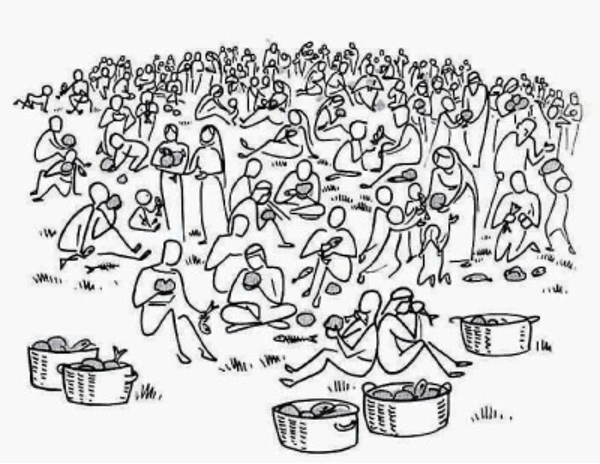
Matthew 14:18-21(NLT) “Bring them here,” he said. 19 Then he told the people to sit down on the grass. Jesus took the five loaves and two fish, looked up toward heaven, and blessed them. Then, breaking the loaves into pieces, he gave the bread to the disciples, who distributed it to the people. 20 They all ate as much as they wanted, and afterward, the disciples picked up twelve baskets of leftovers. 21 About 5,000 men were fed that day, in addition to all the women and children!
Wow what a miracle and how about those leftovers they’ll be eating for days!! Actually, Jesus is using this as a teachable moment for all his disciples both then and now. It is not about the miracle but rather that we would trust God for our sufficiency and nourishment, not our own ability to take care of every situation we find ourselves in. If you examine your life, you will see the hand of God feeding you all through it. Only by His grace and mercy does the rain fall on the just and also the unjust.
What did it take to bring the bread to your table today?
Why are we always so hungry?
John 6:29-40(NLT) Jesus told them, “This is the only work God wants from you: Believe in the one he has sent.” 30 They answered, “Show us a miraculous sign if you want us to believe in you. What can you do? 31 After all, our ancestors ate manna while they journeyed through the wilderness! The Scriptures say, ‘Moses gave them bread from heaven to eat.’” 32 Jesus said, “I tell you the truth, Moses didn’t give you bread from heaven. My Father did. And now he offers you the true bread from heaven. 33 The true bread of God is the one who comes down from heaven and gives life to the world.” 34 “Sir,” they said, “give us that bread every day.” 35 Jesus replied, “I am the bread of life. Whoever comes to me will never be hungry again. Whoever believes in me will never be thirsty. 36 But you haven’t believed in me even though you have seen me. 37 However, those the Father has given me will come to me, and I will never reject them. 38 For I have come down from heaven to do the will of God who sent me, not to do my own will. 39 And this is the will of God, that I should not lose even one of all those he has given me, but that I should raise them up at the last day. 40 For it is my Father’s will that all who see his Son and believe in him should have eternal life. I will raise them up at the last day.”
What is the bread of life we all desire to have?
How can we give it to others?
True believing in our Father and God and the Son He has sent is the only good work that we can do. Nothing else we can do has real value except to believe and act on that belief walking day by day with our Father and our brother Jesus Christ. Beware of the temptations and the sin of religion in this world and see that our help and sufficiency for our lives can only come from the God that loves us and has called us to Him.
Mark 8:14-21(NLT) But the disciples had forgotten to bring any food. They had only one loaf of bread with them in the boat. 15 As they were crossing the lake, Jesus warned them, “Watch out! Beware of the yeast of the Pharisees and of Herod.” 16 At this they began to argue with each other because they hadn’t brought any bread. 17 Jesus knew what they were saying, so he said, “Why are you arguing about having no bread? Don’t you know or understand even yet? Are your hearts too hard to take it in? 18 ‘You have eyes—can’t you see? You have ears—can’t you hear?’ Don’t you remember anything at all? 19 When I fed the 5,000 with five loaves of bread, how many baskets of leftovers did you pick up afterward?” “Twelve,” they said. 20 “And when I fed the 4,000 with seven loaves, how many large baskets of leftovers did you pick up?” “Seven,” they said. 21 “Don’t you understand yet?” he asked them.
You feed them!!
Reflection Questions:
See questions in bold above
Prayer:
Father God help us to look to you for our help in time of need, and for our very lives. Thank you for your sufficiency for every day’s challenges and opportunities as we believe your Word. Help us to become like our big brother Christ as people we see have needs that we can minister to. We thank you every day for calling us to this time and place of fellowship and love. In Jesus’ name we pray.
Whoever loves father or mother more than me is not worthy of me, and whoever loves son or daughter more than me is not worthy of me. 38And whoever does not take his cross and follow me is not worthy of me. 39Whoever finds his life will lose it, and whoever loses his life for my sake will find it.
After commissioning the twelve apostles, Jesus proceeds to teach them about what this commissioning entails. First, they will be persecuted (vv. 16-25), but they don’t need to be afraid because God will be with them and cares for them (vv. 26-31). Then comes a section that deals with the seriousness of the need to acknowledge Jesus as the Messiah, which can be a controversial subject (vv. 32-39). Jesus says that he did not come to bring peace but a sword (v. 34). This proclamation is not Jesus’ war cry as though his intention is to bring violence, but rather, it reveals that Jesus recognizes and discloses that he will be a point of contention and disagreement for many people. In other words, the truth that Jesus came to bring (and which he represents) will inevitably cause disunity and conflict.
It is on the heels of this declaration by Jesus that we read of the even more severe nature of this conflict—it may happen even within one’s own family. Jesus assumes the natural love of one’s family as a premise and then moves to identify that as a lesser priority in life than love for him. When he says that a person who loves him less than their family is “not worthy” of me (v. 37), he is making a value claim upon himself as more important than them. To be “worthy of me” means to “be fit to be a disciple.” It is important to clarify that Jesus is not advocating that his disciples not love their families. Instead, he is simply stipulating that the value attachment of a person to their family must not exceed their value attachment to him. To be Jesus’ disciple is to prize him above even one’s own flesh and blood.
The implications of this statement are far reaching. Who would say that loving a brother, sister, child, or parent should be subservient to the love of another? But this is precisely the demand that Jesus is making of his disciples. It is a declaration of discipleship that calls for absolute devotion. This extreme requirement is extended as Jesus also says that those who would follow him must “take [up] their cross” (v. 38). This is an expression referring to being willing to self-identify and endure the shame and suffering of one who is crucified.
Jesus elaborates by uttering one of the most interesting paradoxes: Whoever finds his life will lose it, and whoever loses his life for my sake will find it (v. 39). In essence, Jesus is saying that the life that matters is the life that is lived for the sake of Christ. To take the road of self-denial and live for something other than one’s self is to “find life.”
From these three criteria of discipleship, where do we find ourselves? Are we willing to follow Jesus no matter what? Does our love for him exceed our love for anything else? Are we willing to take up our cross? Are we willing to die to self in order to find that which may truly be called “life”? Such a price is the price of being a disciple. Are we willing to pay that price? What might be stopping us from wholehearted devotion and service to the Master?
-Jerry Wierwille (originally posted for SeekGrowLove on March 13, 2018)
Reflection Questions
In what ways have you died to self, taken up your cross, and put Jesus before yourself and others? What was the result (so far)? What do you expect the final result to be?
Slowly read again the last paragraph, replacing the ‘are we’ with ‘am I’ and the ‘us’ and ‘our’ with ‘me’ and ‘mine’. Take time to answer each question for yourself.
Do you want to be a more devoted disciple of Jesus Christ? What specific changes are you willing to make? What will it cost you? Why is following Jesus worth it?
Prayer
Dear God Almighty, thank you for your amazing plan of salvation and the gift of your Son. I want to be a wholehearted, devoted disciple of Your Son Jesus Christ who died for me and my sins and is coming again to set up Your perfect Kingdom on earth. May I see clearly what You want me to do to follow better. You know my struggle in sometimes prioritizing other things, such as… (fill in the blank). Help me love Jesus more than these. In his precious name I pray, Amen.
For the last couple of years January often has me writing something on the Sermon on the Mount. I admit, at first it can seem like a chore to do. But, I have been thankful for the opportunity to take a deeper look into these passages, often seeing ways I need to “Think Again” to change my opinions, thoughts and ultimately my actions to become more like Jesus. It is a great way to start the year. But, how would I be different, inside and out, if I read, thought about, lived out the Sermon on the Mount every day?
So today, I will start with a few of the thoughts I have previously shared on Matthew 7 (with a few revisions, that’s part of the beauty of reading the Sermon on the Mount again and again and thinking again). You can read them – or just read Matthew 7 again. And then, in our longer than normal reflection section let’s talk about how we can be more intentional about keeping this spectacular sermon in our minds, mouths, heart and hands everyday.
Unfortunately, the world has heard just the first three words, “Do Not Judge” and has twisted Jesus’ words into permission to sin and accept sin. But that is not the case! Jesus tells us over and over again (and even multiple times in this same chapter) to look carefully and judge whether people and actions and ideas are good or bad, righteous or wicked, wise or foolish, innocent or dangerous, taking us closer to God or further from Him. He warns you and I about the wolf in sheep’s clothing who wants to deceive you and figurative dogs and pigs that will tear you to pieces. And if you have already decided that it is not your place to judge if they are good or evil or to discern if they want what is good and godly for you or what will destroy you, then I fear you are already sitting in a very dangerous spot.
So, what did Jesus mean when he started out with the words, “Do not Judge…or you too will be judged” and then gave the excellent illustration of the speck and the plank? Make sure you read it for yourself from Matthew 7. I think he was saying judge yourself first in order to be helpful in then spotting sin in others. Specks are hard to see clearly when we have a plank lodged in our eye socket. And our restored sight is crucial in then being able to delicately help our neighbor remove the irritating speck in their eye. When we judge rightly we can start out by putting every single one of us in the same sorry sinking boat of sinners in need of a Savior – just make sure you jump into that boat first. Stop bad talking and blaming the neighbors and church members and family and see yourself for what you are and what you do. Don’t sugar-coat the truth trying to make yourself look better than the rest.
Sin causes vision problems – those dangerous specks and planks in the eye are not conducive to seeing the world or yourself clearly. It can be all too easy to completely overlook seeing our own sins and instead attack others for not measuring up to Jesus’ standard. I have been quick to blame my husband and my kids and my friends, when the fault was also with me. I have mistreated people, sometimes to their face, sometimes behind their back. And I have tried to ‘fix’ things my way rather than patiently trusting God for what He said He would do in His time. I can be very selfish and prideful and rude. And the list goes on. And if I don’t accept and work to correct these problems and sins in myself FIRST then I will be hypocritical and ineffective when I, with that plank still stuck in my eye, turn to help my neighbor who has a speck in her eye.
Jesus was not saying specks and planks in the eye are okay and we should leave them be. Sin is not okay. He was telling us the order in which to correct things – self first SO THAT you can actually be useful in helping others recognize and remove the sins that are affecting their sight and health and well-being. Sin surgery for yourself first. Recognize it for what it is and get it out! Then look with compassion not contempt on the neighbors of the world, some of whom do not even know God’s law and have no idea they are stuck in sin because they only heard “Do Not Judge” and never heard the rest.
Jesus too, warns of storms with such driving rains and rising waters which have the power to totally destroy and wipe out homes if we don’t take the proper actions beforehand. Storms are coming – and in some cases they have already begun. Jesus tells us, some houses will stand, some will not. It depends on their foundation. Is the house built on rock - or on sand – which is determined by how wise – or how foolish – the builder is. Both builders listen to the words of Jesus – good first step. The wise builder proceeds to “put it into practice” – and his house endures the storm. The foolish builder with his house built on sand has heard the words of Jesus but does not put them into practice. And when the storm comes, his house is destroyed.
Hear the words of Jesus. And then, put it into practice. It is not enough to sit at his feet listening every week or even every morning – if you don’t then spend your days DOING what he says. We have just spent the last several days reading and looking at Jesus’ Sermon on the Mount (Matthew 5-7). Now, what will we do with it? What will it look like to put it into practice today and tomorrow and every day of 2024 (and now 2026) and the rest of our lives – however long or short that may be? Both houses will experience the winds and the rain. Will your house stand?
Reflection Questions
Judge yourself first – what sins are on the plank in your eye? How has sin (the plank in your eye) affected your vision? Do you want it gone? What are the benefits to having it removed? What is needed to remove it?
Looking through Matthew 7, what thought or call to action strikes you as one God wants to see you really working on this month?
It is not enough to be considering these words of Jesus just every January when our Bible reading plan has us reading through the book of Matthew. We need to be tending to our foundation regularly to ensure our homes will withstand the storms. How can we get these words into our hearts so we make them a part of our daily thought/judging/discerning process and then put it into practice so we don’t find ourselves (and our loved ones) surprised at the end of the wide path that leads to destruction? Every day this year I want to read something from the Sermon on the Mount. How about even multiple times a day? I printed a simple Matthew 5-7 document to hang throughout my house – one page in the laundry room, one page on the inside of the medicine cabinet, another in the front of my Bible, etc…. Through the year I can rotate them around if one is more neglected. Feel free to make yours pretty and colorful and/or underlined and marked up. I am excited about learning this familiar sermon better. But not just learning it – living it, more and more. Will you join me? Here’s one to print for you:
Dear God Almighty, we praise You because you are perfect in all Your ways. Thank you for the gift of Your Son who not only tells us but also shows us how to live different from the world, and also different from the “religious leaders” of his day, on the narrow path, a light for the world, with a heart devoted to pleasing You, with our foundation on the rock, putting into action every day the words and wisdom in this spectacular Sermon on the Mount. Lord, I confess the plank in my eye. Help me see it. I don’t want it to stay. I want to see clearly and I know this requires sin surgery in my own life, thoughts, attitudes and actions. Help me remove it, realizing it might be a painful process – but with such marvelous benefits in this life and the one to come. Thank you for Your forgiveness, Your wisdom shared through Your Son, Your guidance and proddings through Your Holy Spirit. Help me to listen well this whole year to this Sermon on the Mount, that I might become more and more like Your Son Jesus who preached and lived and died these words for me, and is coming again to live eternally with those who choose to hear and DO your words. In his precious name I pray, Amen.
There was a time when I didn’t think very much of Paul. It was as a teenager reading his instructions to Timothy here in Chapter 2. I had faith, though, that God was speaking through this man, and SURELY there was something here that I just wasn’t understanding correctly. It wouldn’t be the first or last time that I had to look at a scripture passage and throw up my hands, admitting that I just didn’t have an answer.
I’ve gone back and forth, looking at explanations and trying to get insight on what exactly was happening at this church. I got the impression that the women there were not behaving the way they should be. Admittedly, some scholars use Chapter 2 as absolute reasoning for why women should not be leaders in the church. Obviously, this doesn’t sit well with me, being a female church leader. Many say that it’s specifically addressing a problem within that church, where women were using wealth, fashion, and beauty to loudly and boldly repeat false teachings that they didn’t fully understand, and it was turning others away. Also, some translations point not to Paul refusing to give women authority over men, but rather specifically not giving them authority over their husbands. I heartily agree here, as that would cause disharmony within a balanced marriage that is seeking to honor Christ.
Looking into the whole of scripture, we actually do see female leaders throughout the Old and New Testaments. Those female leaders had wisdom, were full of grace and mercy, and were servant leaders as we are all called to be. They strove toward truth and righteousness, and they were held up for those qualities. We see many of those qualities listed here in the first chapters of Timothy, giving us a wonderful outline of what a good leader looks like.
We are to worship and pray together without anger. We are to focus more on our actions than our appearances. We are to be faithful to our spouses and full of self-control, managing our lives, money, and families in a way that honors God. We are all to be worthy of respect.
That’s a lot to place on an imperfect human being. We hear about scandals with our leaders all the time. They make for sensational news. But this is not what we want to see in anyone, especially in our church leaders who are to be leading others to Christ.
Stepping up as a leader in our church means greater accountability. James 3:1 warns us about this: “Not many of you should become teachers, my fellow believers, because you know that we who teach will be judged more strictly.”
How many people have turned away from Christ because of the actions of those in his church? Too many.
Reflection Questions:
Are you a sort of leader in your church? Even if you don’t have a named role, are there those who would follow your example? Have you ever thought deeply about what kind of responsibility that is? People are looking to you and your example when you proclaim yourself to be a Christ follower. Are you following his example in your words and actions?
Go through Paul’s list of qualifications of a good leader. Where do you hold up to the standard, and where could you use improvement? How could you do better to be a good example for others, someone others would respect and want to follow.
Prayer:
My prayer is that we all take to heart the fact that we are representing Christ when we call ourselves Christians. Pray that God opens your eyes to where you can be a better example to others and that you lead those around you closer to a relationship with him.
Let’s talk about distractions. One of my greatest frustrations and fears while driving is distracted drivers. I feel a bit ridiculous when I say things like, “It didn’t used to be like this,” with the unsaid “back in my day” hanging uncomfortably in the air. But it’s true. I started driving before cell phones, screens in cars, and most other technology that might take my attention from the road. But now I can’t go anywhere without being cut off or having to swerve my car out of the way of someone crossing that center line. I notice it even more now that I’m teaching my daughter to drive. It’s terrifying.
Speaking of teenage daughters, it seems every time I give them a task and come back later to see it is not done, the response is always, “I got distracted.” I’m just as guilty. We all are. We are a distracted society.
I had to read through these two chapters a few times, trying to decide where I wanted to focus this devotion. What was God trying to tell me here? But I saw a common theme that I’ve never noticed before, and it was distractions.
Paul talks first about being too focused on our own past and on ourselves. We get so wrapped up in everything we’ve done and said that we lose sight of the fact that none of that matters. Pride or shame sets in. Paul lists why he had every reason to be proud of who he was and where he came from, but that it all meant nothing. We get distracted by ourselves and are no longer focused on a relationship with the only one who can actually save us. Paul tells us in 3:13, “But one thing I do: Forgetting what is behind and straining toward what is ahead.” Don’t get distracted by the past or yourself but push on toward Christ.
Next, we are distracted by worldly people and their ways. He says in 3:17, “keep your eyes on those who live as we do.” Stop trying to be like those of the world and surround yourselves instead with Christ-like examples. Stop trying to impress those that don’t matter with what you wear, what you do, and what you say. Reserve your attention and your actions for Christ and his message.
And, finally, my personal favorite distraction – anxiety. Whether you worry about everything, or overthink, or are overly concerned with what others think or do – all distractions. Paul tells us what to focus on instead: “Whatever is true, whatever is noble, whatever is right, whatever is pure, whatever is lovely, whatever is admirable—if anything is excellent or praiseworthy—think about such things.”
Reflection Questions:
What is distracting you from a real relationship with Christ? What attitude within yourself should you change? What habits should you destroy and with what should you replace them?
What are some true, noble, pure, and praiseworthy things you should be focused on and how can you shift your attention toward them more often?
Prayer:
My prayer for you today is that you are able to pick out distractions in your life and burn them away. I pray that you have a closer relationship with Christ and that it outshines everything else. Like Paul said, “…press on to take hold of that for which Christ Jesus took hold of me.” Press on and focus on Jesus.
Prior to the New Covenant, the Jews were like slaves to the law, in the sense that children are slaves to their parents’ rules until the time has come to set them free to do what they’ve learned is right without their parents’ involvement. This is what Paul is trying to reiterate regarding the Law of Moses and the Law of Christ/law of liberty to the Galatians.
When Jesus ratified a new covenant with them (and us), the Jews were set free from the Law of Moses in the same manner that a child is set free from her parents’ rules/laws once she becomes an adult. Because Jesus came, the Jews are now free to walk by faith like Abraham did, without a law to teach him what to do, but with God’s wisdom about what to do, having already learned what is good from their “childhood.”
To make this point clearer, think of the things you still do as an adult because your parents taught you well when you were a child, like holding the door for the person behind you, or waiting patiently for your turn while in line, etc. They’re not things that you’re doing because you’re still under your parents’ rules and will receive consequences from them if you don’t (or do). They’re things you’re doing because they’re ingrained in you to do from their discipline of you, and because you’ve learned that they are good practices to help you live well (to keep yourself and others from harm and to do good to others).
If you engage in the good things your parents taught you once a “free to do as you please” adult, you will probably do well in life. If not, you will understand that you’re not really free, you’re just not under your parents’ authority anymore. They’re not going to be the ones providing you with consequences for your actions because you’re not under their yoke. You’re under a free society’s yoke – one that obviously still expects you to do what’s right so that you won’t harm yourself or others.
And there will be some behaviors that you’re no longer expected to engage in in your free society, such as not talking to strangers. Though your parents may have taught you to heed this rule when you were under their yoke to keep you from harm, it no longer applies in your free society. The opposite is actually expected for love and respect’s sake.
If they (and we) now identify in Christ, they are free from the Laws of Moses (free from their “parent” Moses’s rules), its consequences, and its authority. They are adults, free to serve God without specific laws about how they must live, beyond what their new authority Jesus says to do, which is to love as Jesus loved, giving the world the royal treatment (love your neighbor as yourself).
What’s ingrained in a Christ follower is the Holy Spirit, not the laws from the Law of Moses. It is the Spirit that writes the law (of Christ) on our heart, urging us to do what pleases God. If we (both Jew and Gentile) listen to the urging of the Spirit, we are walking by the Spirit and pleasing God. If not, we’re walking by the flesh and pleasing ourselves (sinning/choosing our own will).
We will reap what our behavior sows in the end, either to the flesh, which leads to death, or to the Spirit, which leads to life. Jesus, our authority under the New Covenant, will be our judge.
So, how have you been doing in loving God and loving people?
If you don’t know how to love like Jesus, ask God for his wisdom about how to love your neighbor (and God), or what actions you should take to love them. His desire is to give you his wisdom about what to do when you ask.
First Corinthians 1:30 says that Jesus has become wisdom for us, so look to him for wisdom; look at his words to help you to know what God’s will is. Look at the people that Jesus entrusted God’s word with, like Paul. At the end of almost all of his letters, he gives those he’s writing to some practical application in how to love like Jesus. James gave us a lot too!
The more we follow the urging of the spirit to do God’s will, the more we become like Christ and will do God’s will. Becoming this type of person takes time, molding, and shaping. There will be times when we miss the mark and wander off the path. Isn’t it a blessing though to be under the law of liberty, free to make mistakes without the consequences from the Law of Moses when we do? What a burden that would be! Thank God that we won’t receive the consequences from the Law of Moses when we miss the mark on our race.
Under the New Covenant, God urges us to restore one who’s wandered off, gently, as consequence. We must help each other stay on the path of righteousness and bear each other’s burdens, like Paul is with the Galatians in his letter. This is how you fulfill the law of Christ/the law of liberty.
So, should we follow the Law of Moses to be sure we are living well? No. We should read and understand all scripture, as it is all God breathed, “profitable for teaching, reproof, correction, and training in righteousness; so that the man of God may be adequate” (2 Tim. 3:16-17), but we should apply what we read and do in light of the New Covenant we are under with our new high priest and mediator Jesus. It is a better way to live, with a lighter yoke. Jesus teaches us how to do this (seek God’s wisdom through him).
For example, before Jesus was crucified, he shared in the Passover meal with his disciples. The Passover was a meal shared to remember what Yahweh God had done for the Jews, leading them out of slavery from the Egyptians, to serving him. But at the last supper Jesus has with them, he tells them to remember something new when they have Passover. He says to remember him, remembering what he did for them in shedding his blood and breaking his body.
Gentiles don’t celebrate Passover, because it doesn’t apply to them. But many Christians do share a meal together once a year that they call communion, remembering Jesus’s shed blood and his broken body for us. God didn’t give Gentiles a law telling them they must celebrate Communion under the New Covenant, but his son told his disciples to remember him. We must remember what Christ did for us too.
Communion is a good practice to help us remember, but it is not a law we must abide by to be in Christ (identified as a Christ follower). What we must abide by is what Jesus said, which is to remember what he did for us.
It is easy to forget what Jesus did for us when we don’t engage in practices that help us remember. However, if a Gentile chooses not to remember Jesus’s blood and body every year, he is not condemned to not enter the kingdom of God. But each year he forgets about Jesus’s sacrifice, the more off track he may get, which can put him in jeopardy of not entering the kingdom of God at the end of his race.
And Jewish Christians no longer need to celebrate Passover/Seder. But it is okay if they do, so long as they’re not doing it to separate themselves from Gentiles as righteous. But when they do, it would be good practice to primarily remember what Jesus did for them, which is much better than what Moses did for them. If they don’t, they are not condemned to not enter the kingdom of God in the end, but the more they forget about Jesus’s sacrifice for them, the more off track they may get, which can put them in jeopardy of not entering the kingdom at the end of their race.
The Galatians (and we) should understand that teaching anyone, even a Jew, to follow the Law of Moses for the purpose of being identified as righteous, is wrong. It is a false gospel. Doing what Christ says to do is the true gospel, and it identifies you as a child of God in Christ. Faith in Jesus, with the faith of Abraham/of Jesus, identifies you as a true child of God.
Paul emphasizes his point with an analogy of two women from the Old Testament. Hagar was a slave, Sarah was free. The enslaved woman will have no part of the inheritance of the free woman, so the Galatians need to get this right. Lives are at stake.
When Paul first preached the Gospel to the Galatians, they were fulfilling the Law of Christ because of their great love for Paul, not only listening to him and receiving his teachings, but also taking great care of him while he was sick. They treated him like he was a messenger from God, like Jesus himself. Paul said if it were possible, they would have torn out their eyes to give them to Paul if he needed them. That is loving like Jesus. It’s sacrificial love. It is giving their neighbor Paul the royal treatment.
There is no law about what exactly we must do to love like Jesus the way the Galatians did at first. But we know that to love like Jesus when we see a brother sick and in need means doing something to help that brother. Think on the wisdom we received from James to understand (James 2:15-17). Your faith is worthless if you don’t give a brother what he needs, and it makes you a sinner.
Again, 1 John 3:16 tells us what loving like Jesus is, and that we should follow suit. This is how we know what love is, Jesus the Christ laid down his life for us, and we ought to lay our lives down for our brothers and sisters. What this verse is saying is that love is sacrifice. We are to sacrifice our lives to love someone else, in all of our doings under our new authority.
For Jesus, it looked like living a sinless life and dying on the cross to save us. For the Galatians when they first met Paul, it was to take care of him in his ill state. Paul is now loving them by urging them to remember their first love (acts of love towards him when he had a need) in the rest of their doings.
There are many things that we can do to love like Jesus. We are going to need to seek God’s wisdom to know the specifics and be led by the spirit in our various circumstances, but we can all heed this bit of wisdom at the end of Paul’s letter to the Galatians to remain on the path of righteousness under the New Covenant through Christ:
Instead of allowing someone to enslave you with their false teaching, a good practice is to serve one another through love, like the Galatians did at Paul’s first preaching. This is the freedom they have in Christ, to do good until Paul without a law that tells them so.
We are called to freedom, but we should not turn our freedom into an opportunity to sin just because there’s no law under the New Covenant. Remember, there’s wisdom! The whole Law (of Moses) is fulfilled in one word, the statement, “You shall love your neighbor as yourself.” Under the new Covenant, this is also wisdom from God. But if you bite and devour one another, you may just be consumed by one another. You won’t be entering the kingdom of God if you’re doing this because you’re not loving your brother like Jesus taught. Instead, walk by the Spirit so that you won’t carry out the desires of the flesh.
The desires of the flesh (not God’s will) are whatever is opposed to the desires of the Spirit of God (God’s will). The spirit he put inside you urges you to do his will, while the flesh urges you to do your own will, or what you think is good for you to do.
If you want to know if you’re walking by the spirit or walking by the flesh, Galatians 5:19-21 gives you a pretty clear list of things that people do when they’re walking by the flesh. These are things that are going to harm yourself or others and if practiced (meaning ongoing without repentance), they’re going to make you forfeit your entrance into the kingdom of God.
Instead, walk by the Spirit’s urging about what you should do, and the fruit of the Spirit will follow. They are things that are produced by people who love like Jesus. If you want to know if you’re a disciple of Jesus, they’re great identifiers: love, joy, peace, patience, kindness, goodness, faithfulness, gentleness, and self-control (Gal. 5:22-23). If these characteristics are yours, you’re not under a law (you can call it the law of liberty if you really want to be under a law). You’re in Jesus’s free society (free to love like Jesus based on the needs of those you’re serving, based on God’s wisdom about it, not by a law outlining specifics you must do to be righteous).
If you are a Christian, you crucified the flesh with its passions and desires when you entered the New Covenant. I think this means that since becoming a Christian, you have decided to live by the urging of the Spirit inside you, as opposed to your former ways following the desires of your flesh, just like Paul proclaimed of himself. But if one of you practices one of those things from the flesh list, then your brother who is spiritual should restore you gently. Be sure the restorer is spiritual though, being sure the one restoring the brother sinning doesn’t have a log in his own eye to clean out first, lest he also be tempted. And bear one another’s burdens. I love how Paul basically reiterated how to fulfill the law of Christ in this situation using the same wisdom that Jesus used when teaching his disciples how to live from the from the Sermon on the Mount (Matthew 5-7).
Some more wisdom to stay on track to the Kingdom of God include sharing good things with the one who teaches you the word. If the one teaching you God’s word took time away from doing other things to support their family, then in return you should support your teacher.
Remember, God is not mocked. Whatever a person sows, he will also reap, whether to the flesh (ongoing sin/your own will) which leads to destruction or to the Spirit (God’s will), which leads to eternal life. The one preaching the false gospel will reap what he sows.
Don’t grow weary in doing good. This can be a hard one with all of life’s ups and downs. I remember when I knew I was growing weary, so I cried out to God to help me keep going. He simply reiterated it back to me through the prophetic word of a dear sister in Christ, and then told me what to prioritize.
In due time, if we don’t become weary, we will reap good things. While we have opportunity, let’s do good to all people, especially those who are of the household of the faith. Amen!
I find it hilarious that Paul says, “See what large letters I have written to you with my own hand!” It sounds like he’s saying that he’s using Caps Lock to shout out to the Galatians this point: All who want to make a good showing in the flesh try to compel you to be circumcised, so that they will not be persecuted for the cross of Christ. In other words, they’re not trying to teach you their false gospel to help you, they’re teaching it to try to help themselves.
Wouldn’t we all like to be able to say this after trying to reprove a fellow Christian, “I boast in the cross of our Lord Jesus Christ, through which the world has been crucified to me and I to the world. Circumcision and uncircumcision is nothing. What’s something is a new creation in Christ.” If you think and behave in a way knowing this, then peace and mercy to you who are now the Israel of God.
Reflection Questions
1. Have you witnessed the cry, “Abba! Father!” since receiving the Spirit of God’s son into your heart?
2. How did the son who was born according to the flesh persecute the one who was born according to the Spirit (Gal. 5 29)?
3. Gal. 5:1 says, “It was for freedom that Christ set us free; therefore keep standing firm and do not be subject again to a yoke of slavery. What do you think “freedom” means in this verse? Freedom from what and to what? (I think it means a little more to a Jew than to a Gentile).




 Seek Grow Love