Have you ever felt completely at home someplace? Maybe it was your family of origin, maybe it was your first home on your own, maybe it was the first home you shared with someone special, like your spouse or a close friend. I hope that you have experienced that feeling.
We want to feel at home in our relationship with God and with our Lord Jesus (and of course, with each other!). But sometimes, our brokenness, shame, and guilt get in the way of our feeling “at home” with God and others. Thankfully, the Bible tells us how to remedy this situation.
In the beginning of 1 John, John talks about this “at home” feeling using the word “fellowship.” The word for “fellowship” basically means to share together or to participate together or to have close friendship with someone. We want to feel close to God, to Christ, and to each other. Those of us in church communities want to feel this closeness especially with those we are in community with on a regular basis. Living this way brings a special sweetness to life that is unlike any other feeling.
Unfortunately, we don’t really experience this fellowship or “at home” feeling to the fullest extent possible in this life. Why? One reason is because, when we sin, our sin makes us feel distant from God.
1 John 1:6-10 (ESV)
6 If we say we have fellowship with him while we walk in darkness, we lie and do not practice the truth.
7 But if we walk in the light, as he is in the light, we have fellowship with one another, and the blood of Jesus his Son cleanses us from all sin.
8 If we say we have no sin, we deceive ourselves, and the truth is not in us.
9 If we confess our sins, he is faithful and just to forgive us our sins and to cleanse us from all unrighteousness.
10 If we say we have not sinned, we make him a liar, and his word is not in us.
Walking in darkness is having our lives saturated with sin. Christians should not live this way. Christians are called to become more and more like Jesus every single day through the power of the holy spirit. This is called “walking in the light.” Walking in the light does not mean that we will never sin again ever in this life, but rather that we will not practice sin.
So, how do we restore this fellowship with God when we do sin? Verse 9 tells us to confess our sins. One often overlooked fact about verse 9 is that it says that God does not hesitate to restore us. It says instead that God is “faithful and just.” We can trust God to forgive us and restore us because He has been faithful through the ages. And when He does so, He is acting in a just way, because Jesus has paid the penalty for sin at the cross.
Forgiveness by God is an act of justice accomplished through Jesus our Lord.
We have a lot to be thankful for!
-Will Barlow
Reflection Questions
Have you ever experienced the “at home” feeling? What conditions made you feel safe and at peace?
Do you have any parts of your life that are “walking in darkness”? What do you need to confess to bring them back into the light?
What are the benefits to those around you when you are walking in the light?
I used to think that Hebrews chapter 10 was the scariest chapter in the whole Bible because it contains the scariest verses—about those willful sins that are committed. I missed the whole point of this beautiful chapter.
I missed that Jesus doesn’t have to make a sacrifice for us yearly like the priests of old did to cleanse the flesh of sin committed that year. His one-time sacrifice takes away sins for all time, cleansing the flesh and the conscience. That’s perfection that the old law could never do. Through Jesus, God’s children no longer needed that reminder that we’re slaves to sin, because we’re not anymore. We are free in Christ. We are perfect, but we have to choose to remain perfect by doing God’s will.
I missed that where there is forgiveness of sin (because of Jesus’s obedience to always do God’s will), an offering for sin is no longer required to enter the holy place of God. His role as high priest of the New Covenant is different than that of the Levitical high priests. He’s always available to save if you draw near to him; to intercede on our behalf when we sin, as opposed to sacrificing himself by dying again and again and again when we sin.
An animal sacrifice for sin is no longer required under the New Covenant law, but drawing near to Christ is required when dealing with my sin. I still need to bring a sacrifice, but it’s of repentance; a contrite heart. And I don’t have to wait outside a tent or a veil, I go right into the heavenly tabernacle where Jesus is and ask for forgiveness in his name. God will be faithful to me when I draw near to him through his son in this way. This is required of me if I entered the New Covenant with God through Jesus. I did, when I was baptized into the name of Jesus. Praise God.
The word says that by one offering (Jesus’s literal sinless body), he perfected for all time those who are sanctified. Those who are sanctified are those who have put the laws of God in their minds and have written them on their hearts because they chose to do God’s will out of love for God and others (just like Jesus did).
Now for those scary verses:
26 For if we go on sinning willfully after receiving the knowledge of the truth, there no longer remains a sacrifice for sins, 27 but a terrifying expectation of judgment and the fury of a fire which will consume the adversaries (read through verse 31 if you want to see how scary this section is).
There no longer remains a sacrifice for sins, but what does remain is something better – drawing near to Christ through repentance when we sin. I think this is true for most sins, even willful sins IF we desire to repent of them because we know how much better God’s ways are for us and desire to get back on track.
If we don’t have that desire and don’t enter the holy place through Jesus’s torn body veil, what should we expect? If we don’t, we should expect just judgment. If we don’t, it means we are choosing to willfully bind ourselves to sin again and remain in it. It means we aren’t looking for forgiveness, because we think it was better when in slavery to sin than being freed from it (and slavesto serving God by doing his will that is good for us).
This reminds me of the children of Israel in Massah and Meribah, complaining in the wilderness, wishing they were back in Egypt. They were slaves there, and perhaps they’d die, but at least they weren’t going to die of hunger or of thirst like they would in the wilderness serving God, so they grumbled. They tested Yahweh God, as they had no faith that God would provide for them as he promised (“Is the LORD among us or not?”). This willful sin, this lack of faith that God would be faithful to do what he said he’d do for them in a time when they were enduring trials and hardship, eventually got them destroyed. The reality was that though God was faithful to uphold his end of the covenant he made with them, they weren’t willing to uphold theirs because they didn’t trust him.
The testing of God’s faith is what I believe the scary section in Chapter 10 is referencing. If we sin because we don’t believe God is faithful to do all he promised for us, especially when times get tough, and we think it was better living the old way when slaves to sin as opposed to being slaves to God, then our entrance into the Kingdom of God is in jeopardy. It’s like saying to ourselves, “We’re slaves to sin, but at least we won’t die hungry or thirsty living in sin.”
Unfortunately, choosing to live like Christ now does come with pain and suffering, because of the consequences of the past and present sins of all people. Not everyone chooses to do what God says is good for us, so our world becomes more and more corrupt. So do our bodies. It’s hard to live for Christ in a world like that. There’s also so much confusion about what’s right and wrong, even among his followers, and so we get hurt. And of course, there is Satan, walking around like a roaring lion, trying to get us off track.
The Hebrews were reminded of their former sufferings for Christ and commended for enduring it with joy because they once knew they had something better awaiting them. Though I’ve been through trials, I’ve never had to go through the trials that the Hebrews here had to go through for Christ. It says that they “32 …endured a great conflict of sufferings, 33 partly by being made a public spectacle through reproaches and tribulations, and partly by becoming sharers with those who were so treated. 34 For you showed sympathy to the prisoners and accepted joyfully the seizure of your property, knowing that you have for yourselves a better possession and a lasting one.” The Hebrews were being exhorted. The writer is pleading with them to behave how they once did, and to stop looking back at their old way of life.
If the people of God who went through this type of hardship needed an exhortation to get back on track, what of us? What of me?
Now that we’ve got the kick in the pants we needed to stop being babies, we can apply this information to do better with some application from the writer:
“19 Therefore, brethren, since we have confidence to enter the holy place by the blood of Jesus, 20 by a new and living way which He inaugurated for us through the veil, that is, His flesh, 21 and since we have a great priest over the house of God, 22 let us draw near with a sincere heart in full assurance of faith, having our hearts sprinkled clean from an evil conscience and our bodies washed with pure water. 23 Let us hold fast the confession of our hope without wavering, for He who promised is faithful; 24 and let us consider how to stimulate one another to love and good deeds, 25 not forsaking our own assembling together, as is the habit of some, but encouraging one another; and all the more as you see the day drawing near.”
-Juliet Taylor
Reflection Questions
1. Notice that we draw near to Jesus in the throne room of God, which is God’s throne room in heaven. We do this in spirit. The bible uses figurative language like this a lot. What other figurative language do you notice in this chapter?
2. How can you encourage one another in love and good deeds through their hardships?
3. How do you live by faith as it says in Hebrews 10:38 (quoted from the old; applied to us in the new)?
No one talks about the sins committed by God’s people in ignorance. But it’s these sins that the Levitical high priest offers a sacrifice for yearly. If that’s the case, then what of the sins of the people that are committed willfully? I think we’ll find out about them in Hebrews Chapter 10.
The more I read, the more I have to change my mind about what God’s will for me actually is. There’s so much confusion that’s been passed on from generation to generation that gets stuck in our minds and in our hearts. Confusion is not good, because if we continue in it, someone’s going to get hurt. This studying of the book of Hebrews has helped me tremendously in that regard.
The Old Covenant had a high priest who sacrificed for sins with regulations that had to do with food, drink, and regulations for the body UNTIL the reformation of the covenant. An example of this is in washing hands and feet prior to entering the tabernacle or making a sacrifice. God told them that if they didn’t do this, they’d die. The priest would do this to make sure they didn’t die (literally), for the purpose of cleansing the flesh (the body) of the sin that was committed that year. But it could not cleanse the conscience. It, along with the various gifts and sacrifices offered amongst the people of God under the Old Covenant, could never make the worshiper perfect in conscience. Why?
The Holy Spirit (God) had not yet revealed the way into the holy place while the outer tabernacle was standing, separating the people from God. Nothing offered could compel the person to desire to flee dead works and serve the living God out of self-sacrificial love (God’s will for us all) because Jesus hadn’t demonstrated this kind of love yet. Jesus’s love is what changes the heart, soul, mind—the conscience, if you will. It causes us to desire to repent when we miss the mark and strive to do God’s will out of love.
The New Covenant, with its better high priest, better promises, and better tabernacle, will help the chosen people of God live well for his kingdom. They (we) can start living that way now because the Kingdom of God is at hand. Our great high priest Jesus is working for us (in us), from heaven for our own good, and for the good of others to do God’s will out of love. We’ll desire this with a clean conscience because of what our savior did for us.
The Levitical high priest was only able to make a sacrifice on behalf of his own and the people’s sin once a year. He was only able to cleanse sin once a year. But Jesus’s one time love sacrifice makes it available to cleanse our conscience of sin at any time, as he is available to save forever those who draw near to God through him, since he always lives to make intercession.
It makes sense that if Jesus is always available to make intercession for us that we can become entangled in sin again that kills. When that is the case, we can draw near to God through our high priest and repent because he’s always available to save. I think this is what the writer to the Hebrews is trying to get across. They needed to draw near to God through their new, better high priest with repentance. And they can do that without dying because Jesus already did that.
The new, better high priest has the job role of cleansing our conscience from dead works to serving the living God once we enter the holy place of God. We are the people who desire that because of what Jesus did for us. He demonstrated for us that love conquers sin and sets people free (to serve God). We must choose to follow in Jesus’s footsteps to remain cleansed, repenting when we miss the mark.
God’s desire for his people isn’t new. This has always been God’s will for his people. That’s why he brought his firstborn son Israel out of slavery to Egypt, to serve him, with a clean conscience (the heart) so that it would be well with them. But most of them chose not to.
How the people would be reconciled back to God is new. It was revealed by the Holy Spirit after the veil was torn. Jesus’s body was torn so that we could be in God’s presence to offer sacrifices, just like the Levitical Priests could, but without a chance of dying when we enter (Jesus already did that). The sacrifices we bring in are repentance, praise, thanksgiving, humility, brokenness, contriteness, etc.
People can now have hope of resurrection from the dead to everlasting life by entering the New Covenant, made available through Jesus’s love sacrifice. We are called to do the same, Jesus showed us how. Jesus was able to do this through the eternal spirit working in him. We can do it through Jesus’s spirit working in us.
Jesus tells us what is required of us. It’s the better requirement than the Old Covenant stipulations because it can make us perfect in conscience. Our requirement is to love, as Jesus loved. How has he loved? Jesus Christ laid down his life for us. And we ought to lay our lives down for our brothers and sisters. Hopefully not literally, but we will be willing to if it comes to that. We can do this through the spirit of Jesus working in us. We can desire this because of Jesus’s demonstration of love. If we don’t, Jesus is always able to save when we draw near to him (repent) with our better sacrifices.
-Juliet Taylor
Reflection Questions
1. Without the shedding of blood, there is no forgiveness. Those under the Old Covenant were forgiven for their sins through the blood of animal sacrifice that year, but it didn’t save them (they had no hope of resurrection). With the shedding of Jesus’s blood, there is forgiveness of sins that saves us. What do you think is the difference between forgiveness under the old law and forgiveness under the new law?
2. Hebrews 9:26 says, “Otherwise, He would have needed to suffer often since the foundation of the world; but now once at the consummation of the ages He has been manifested to put away sin by the sacrifice of Himself.” This does not mean that people don’t sin anymore. We can clearly see that that’s not the case. What do you think it means to “put away sin”?
3. Christ loved us by dying for us. How do you think God wants you to demonstrate his love to someone today who is in need of some love from you?
Yesterday we left off seeking to recognize our sin and what we deserve because of our sins. It is an important place to be, but thankfully, God doesn’t leave us there. So today we get to continue our question format for Psalm 103 verses 11-14, some of my personal favorite verses from this Psalm.
My very first question for verse 11 was actually for Google because I wasn’t sure it was very fair of me to ask you, “How far is heaven above the earth?” So of course AI was happy to give an answer. AI’s answer did not disappoint as I found it surprisingly accurate: “The Bible doesn’t provide any linear measurements for heaven’s distance from Earth, so its exact size is unknown.” I loved that AI recognized the authority of the Bible for this question. If only AI, you, I and the rest of the world would be so wise with all our answers. Since we are accepting verse 11 and 12 as figurative language we don’t really need to know how high heaven is above the earth or how far the east is from the west – as long as we know what God says in His authoritative Word about His great love and forgiveness. So, let’s open up His Word and ask some questions!
VERSE 11 – How great is God’s love for you? What other figurative language could be used to attempt to describe God’s indescribable love? What does it feel like to be loved by such love? Is there a limit to God’s love? What does the rest of this verse say – who is this love for? (You might be interested in reading the verse in some additional Bible translations here. ) What does it mean to fear God? How should we treat God if we truly fear/revere/worship Him? Do you fear God? Do you think it is possible to believe in God – and perhaps even love Him – but not fear Him? Does this verse say anything about God’s love for those who don’t fear Him? How important do you think it is to fear God?
VERSE 12 – Remember back to yesterday and consider again, what are your sins? And what do you deserve because of them? What does it feel like to have your transgressions or sins laid on you? What weights, burdens, shame, guilt, questions do they add to your life when you are carrying them around with you, or only slightly better, when they are hanging over your head? What would it feel like if these same sins were flung as far as only God could fling them? What other descriptions could be used for having sins removed? Does having transgressions removed mean there are no more consequences for those sins? Are all of everyone’s transgressions removed? Why or why not? How does God’s love and forgiveness compliment one another?
VERSE 13 – What does a healthy father/child relationship look like? What is the role of dad? What is the role of the child? What does it look like when the child tries to be in charge? In your relationship with God do you more often try to play the part of adult or child? What does it feel like to be a child of God? What are the benefits? Give some examples of what it looks like when a human father has compassion on his child(ren). Give some examples of when our Heavenly Father has shown compassion on you (and/or His other children). According to verse 13 who does God show compassion to? Where else have we seen this wording? So we could ask again, how important do you think it is to fear God? Can you think of any times where you have not feared God? Is there anything you might consider doing now to help you fear God more or better or more consistently?
VERSE 14 – What does it mean to you that God knows how you are formed? What do the facts that God knows how we are formed and remembers you are dust say about God? What do these facts say about you? What questions do you have for God about His creation process and reasoning, especially as it relates to creating people? How does this verse relate to the previous verse about God’s compassion as a father? Do you think it is important for us to remember that God remembers our creation and how we are formed? What happens when people decide that we just came to be? How many Bible authors referenced God creating? Do you accept the authority of God’s scriptures?
What qualities or characteristics of God do you find in these 4 verses today? What other questions do you have from these verses? Hope to see you back tomorrow as we continue on with verse 15.
Today we continue what we started yesterday – a list of questions to consider for each verse of Psalm 103. Open your Bible and let’s get to work on five more verses.
VERSE 6 – What groups of people do you think would make up the “oppressed” spoken of here? Who do you know personally who falls into the oppressed category? What might adding righteousness look like in their life? What might adding justice look like? Have you seen God working righteousness and justice in their situation – yet? In what ways have you seen and heard of the oppressed receiving righteousness and justice? If this is important to God should it be important to us? How might God want to see you work righteousness and justice for the oppressed?
VERSE 7 – What did God make known to Moses about Himself and His ways? Why? What deeds did God do for the people of Israel? Why? What is the spiritual use of learning history and studying the Old Testament? What about in more recent history? What did God make known about Himself and what deeds did He perform in the New Testament? What about in your family’s history? What ways of God does He want us to know about today? What deeds has He done for you?
VERSE 8 – Where else in the Bible do we find a similar description of God as we find here in Psalm 103 verse 8? (There are multiple places, but don’t miss it in our Old Testament reading for today. God lined that up pretty well for us today! It is also included when God reveals Himself and His ways to Moses as referenced in the previous verse. Where is that passage? HINT: the search feature in BibleGateway.com is pretty useful. Try searching something like compassionate gracious. Sometimes searching in different Bible versions helps.) How would you define/describe and give a Biblical example for each of these qualities of God: compassionate, gracious, slow to anger, and abounding in love. Now, when have you experienced each of these characteristics from God in your own life? When have you shown others God’s character by reflecting these characteristics to others in the way you treat them? Which one is the biggest struggle for you? How can remembering God’s character help you act more godly towards others?
VERSE 9 – Have you ever known someone who is ALWAYS accusing? What is it like to be with him/her? Would the perfect God still be RIGHT if He was always accusing – could he always find something wrong with what we do/have done? Why do you think He chooses not to always be accusing? When, in history or in your life, have you seen or experienced God giving up His right to accuse or be angry? When have you seen or experienced God letting go of His anger, not “harboring his anger forever”? How can we mirror His attitude?
VERSE 10 – What are your sins? Wait. Stop – don’t go on yet. Seriously – spend more than 2 seconds thinking about this answer. It is important. What are you guilty of? What have you done that has grieved God’s heart and the heart of others? What are you ashamed of? Also, are there sins you haven’t even acknowledged yet or feel guilty of yet, perhaps because of your pride or selfishness – 2 other sinful attitudes? When has your sins blocked the opportunity you have to share God’s characteristics with others? What do you deserve because of your sins? What repayment would be just because of your iniquities? Has God given you everything your sins deserve?
It’s not the most pleasant place to end for the day. But, recognizing our sin and what we deserve is such a vital point before we can truly appreciate the incredible verses that come next. See you again tomorrow as we Seek Grow & Love together.
Some days do you feel like you have more questions than answers? Me, too. But, that’s okay. Because, actually, every educator knows that when we can ask and eventually start to answer some really good questions on our own we learn a lot more than if we just read someone else’s answers. So, today, I have NO answers for you. But instead, here’s a whole devotion full of some reflection questions to get us thinking more about Psalm 103, a beautiful psalm of David. In our Bible reading plan we are going to spend today and the next four days reading and re-reading Psalm 103 so today we will just include questions for the first 5 verses but go ahead and read the whole Psalm over and over this week.
So, let’s open up our Bibles and start to look at Psalm 103 verse by verse. Besides thinking about these questions below – what other great questions can you think of?
VERSE 1 – How many times is the word “praise” repeated in this Psalm? What is praise? What does it look like to praise God with “all my inmost being”? How deep does your praise go, or is it more often somewhat shallow? What would be needed to praise the Lord with your inmost being – and do it more regularly? What makes God’s name holy? Do you treat it in a holy manner?
VERSE 2 – What are at least ten (feel free to list more) of the “benefits” God has given you personally? Which ones do you often take for granted? How can we work at not forgetting them – or the God who gave them? What happens when people DO forget what God has done and given to them? What is the relationship between praising and thanking and remembering?
VERSE 3 – Have you asked for and accepted God’s forgiveness for ALL of your sins? How does asking for God’s forgiveness look different now compared to what it looked like when David wrote these words? Why does God want to forgive you of all of your sins? What would it be like to serve a god who loved but never forgave? What diseases (perhaps some physical and some not) has God healed?
VERSE 4 – What does the word “redeem” mean? What pit does God redeem you from? King David says that God “crowns you with love and compassion”. What does it mean to you to be crowned by God – with His unfailing love and compassion? How does it feel? Why do you think He does it? What would it be like to serve a god who forgave but never loved? How would you explain this verse to a kindergartener?
VERSE 5 – What desires have you had that God has already satisfied with good things – perhaps in the way you were imagining, perhaps in another way? What can we learn from David in a similar (but slightly expanded passage) about the desires of our heart – Psalm 37:3-5? What desires are you still waiting for God to satisfy? What do you do while you wait (see Psalm 37)? Might that change what you desire? What might King David be thinking of/imagining/feeling/experiencing when he writes about God satisfying desires, “so that your youth is renewed like the eagle’s”? It might depend on what your actual age is, but have you ever felt like God’s blessings were knocking years off your life, renewing you, or just plain, helping you soar? Where would you be without God’s goodness and generosity in your life? How do His blessings renew you?
What can we learn about God in His Word? What can we learn about our relationship with Him?
Thank you for trying something new with us today. Enjoy your time in Psalm 103! Is there someone you can start a conversation with today by asking them a question about Psalm 103?
1 Thessalonians 4 continues in the instruction of how believers should be living. Paul commends the people in Thessalonica for doing well in following God’s commands and encourages them to do even more. Paul writes that God calls us to sanctification. Sanctification means to be made clean or holy. God calls us to be clean and holy. He provides this cleansing through Christ’s death and resurrection. Hebrews 10:10 says “By this will we have been sanctified through the offering of the body of Jesus Christ once for all” (NASB95). This verse is in the midst of a passage that expresses that Jesus’s sacrifice is sufficient for us and there will be sanctification and forgiveness through his sacrifice. It aligns with what Paul writes confirming that we have been made clean from our sins through Christ.
In the 2 Chronicles reading for today, some of that same theme of cleansing/forgiveness of sin can be seen. God appears to Solomon after the finishing of the temple and tells Solomon that He will be present in the temple. In 2 Chronicles 7:14, God says “and My people who are called by My name humble themselves, pray and seek My face, and turn from their evil ways, then I will hear from heaven, forgive their sin, and heal their land.” God has often reminded His people that He will forgive their sins. In the time of Solomon, the cleansing of sins was sought through prayer with an animal sacrifice. Hebrews shows that the sacrifices are no longer needed because of Christ and 1 Thessalonians encourages how to live out this cleansing of sins.
In 1 Thessalonians 4:9-12, Paul discusses one of the ways to live a sanctified life. Paul reminds the readers to love one another which God has taught them previously. In the case of the Thessalonians they were doing well with showing this brotherly love to those around them. Because they are doing well, Paul encourages them to love even more. What a high praise to have received from Paul and great encouragement to continue not only in doing well but to do it even more! If Paul wrote you a letter inspired by God, would he praise you for the love you show others or would he need to teach you what it means to love those around you?
1 Thessalonians 4:11 says, “to seek to lead a quiet life, to mind your own business, and to work with your hands, as we commanded you” (HCSB). This reminds me of Hebrews 12:14 which says, “Pursue peace with all men, and the sanctification without which no one will see the Lord” (NASB95). A quiet life that pursues peace with all people can be a difficult life to lead. Living a quiet life that is minding your own business and seeking peace with those around you is centered around living out our sanctification. Through our forgiveness, we are called to love those around us which looks like living quietly, minding our own business, and seeking peace.
If you’re in any social setting where people are involved, it can be difficult to both love them deeply and also mind your own business while trying to pursue peace. Everyone has something that you won’t like about them. It might annoy you and get on your nerves. It could be anything from a difference of beliefs or political views, to the way someone pronounces a specific word. It’s really easy to get frustrated and lash out at someone who is annoying you, but that is not living out our sanctification. When a moment comes where you are feeling frustrated, annoyed, upset, or angry with someone, try to take a moment to remember the two verses from the previous paragraph. When in a place of disagreement or frustration, seeking peace and loving the person takes priority over being right and having your way. Showing grace and forgiveness will display the forgiveness you have received. It will also allow the person to feel loved and cared for.
-Makenna Landry
Reflection:
How do you live out sanctification in your life?
When someone is getting on your nerves or you come to a disagreement, how do you seek to live peacefully and quietly with them?
Scripture: “He did evil in the eyes of Yahweh according to the detestable things of the nations whom Yahweh drove out before the Israelites.” — 2 Kings 21:2 (LEB) “Listen, Yahweh, to my prayer, and attend to the voice of my supplications.” — Psalm 86:6 (LEB) “And Jesus said, ‘Father, forgive them, for they do not know what they are doing.’ And they cast lots to divide his clothes.” — Luke 23:34 (LEB)
2 Kings 21 describes the reign of Manasseh, who led Judah into idolatry and wickedness, turning away from the faithfulness of his father, Hezekiah. Manasseh’s actions had devastating consequences for Judah, but even in the midst of such darkness, we can find lessons of hope and redemption when we look at the prayers of Psalm 86 and the forgiveness offered by Jesus in Luke 23.
Manasseh’s reign was marked by the restoration of idolatrous practices that his father had abolished. He erected altars to Baal, worshipped the stars, and desecrated the temple by placing an idol within it. His actions not only provoked God’s anger but also led the people of Judah into deep sin and rebellion against God.
Manasseh’s actions demonstrate the destructive power of idolatry and disobedience. When we turn away from God and pursue false gods, it leads to moral and spiritual decay. Psalm 86 is a heartfelt plea for God’s attention and mercy. In times of spiritual decline, prayer becomes a vital connection to God, seeking His guidance and forgiveness. Despite the evil of Manasseh’s reign, the story of Jesus on the cross in Luke 23 reminds us of the power of forgiveness. Jesus’ prayer for those who crucified Him highlights God’s boundless grace and the possibility of redemption even for those who have strayed far from Him.
-Jeff Ransom
Reflection Questions:
Are there any “high places” or idols in your life that you need to remove to fully commit yourself to God?
How can the prayers of Psalm 86 inspire you to seek God more earnestly and sincerely in your daily life?
How does Jesus’ example of forgiveness on the cross in Luke 23 challenge you to extend grace and forgiveness to others?
This week, reflect on the life and reign of Manasseh, and consider how you can remain faithful to God. Seek to remove any idols and influence others toward righteousness. Let the prayers of Psalm 86 inspire your own prayers, and remember the forgiveness and redemption offered through Jesus Christ.
You are a powerful man in ancient Israel. You hear about a miracle worker and rabbi. This guy, in just the last couple days reportedly saved a slave of some centurion without even being near him. More than that, he brought the dead back to life! Could such a thing be? Nothing like it has happened in your lifetime. This man reminds you of Moses, Elijah, and the prophets that you have grown up hearing about and spent your life studying. You know that such a man must be holy, must be from God. You invite this man to eat with you, so you can see for yourself how this holy, miraculous man interacts with people.
So you see him. And he’s shorter than you expected. Actually, he’s quite unremarkable in appearance. He is not wealthy, he does not come from money or make much when out teaching. He is lean from walking and fasting. He has an entourage of men with thick accents, no training, and a certain lack of decorum. They look and act like fishermen. To your surprise, you learn they ARE fishermen. One is even a tax collector. It’s only natural to begin to doubt. But when he opens his mouth to teach, it intrigues you. The passion with which he speaks. The intensity in his eyes. The compassion in his touch, to all people, draws you in, and you invite him over for dinner. Doubts gnaw at your mind, but surely in a personal setting those will fall away.
However, at dinner, things get really out of hand. As per usual, you have your home open to use by the people of the city, because God has blessed you for your devote life and upright character. Everyone, all thirteen (and more) of this teacher’s usual crew start to relax, kick back their feet, and eat. But, in the middle of dinner, she comes in. The years of hard life, of acting in such impolite, anti-social, uncouth, wicked and sinful ways, of trying and failing to do better, showed in every movement in the presence of this teacher. But instead of running like she should have, she bends down, weeping, and cries on his feet, wipes his feet clean with her tears. She takes his barely washed feet and anoints them with the sweetest perfume, the smell wafting over you all. She is making a scene, at YOUR dinner. And you know what kind of person she is. She doesn’t deserve this attention, she only wants to ruin your hospitality, because that’s the kind of person she is.
No, no this man must be a phony. How could a man who raises the dead not know what this woman does every day? How could such a “holy man” allow so much uncleanness to caress his feet? Why let someone like her defile someone like him?
Then he says your name and breaks you out of your reverie. He calls your name. He tells you about two debtors, both forgiven – one much and one little. He asks “Who will love the forgiver more?”
“The one who was forgiven much,” you answer wisely.
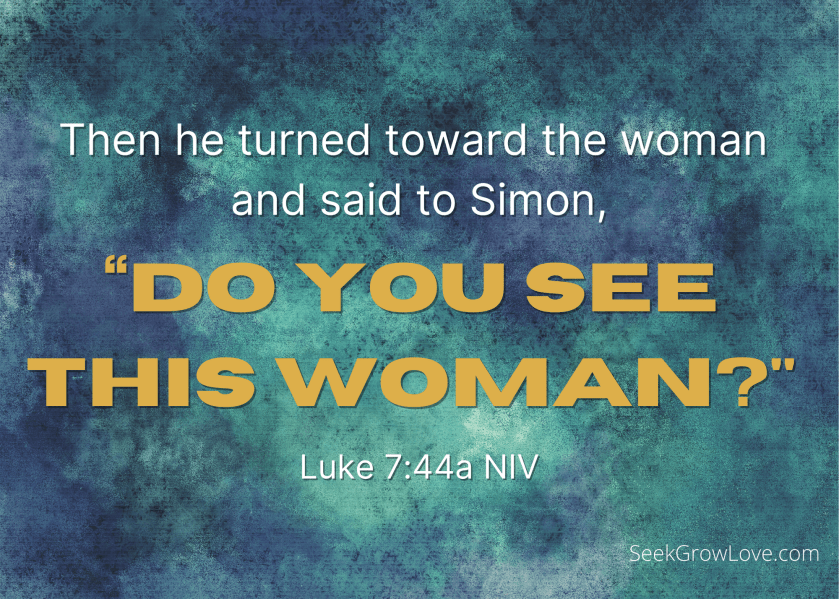
He turns to the woman and takes her worried, nervous, anxious trembling hands in his own. He turns his soft but piercing eyes to her own, red from weeping. He says to you, “Do you see this woman?” He lets the words hang in silence for a moment. She rubs her nose. For the first time you notice that some of her hair is starting to turn gray. You notice that she is not old, but the lines come from stress. You notice that she must have washed to come, as she looks cleaner than you have seen her in a long time… You see yourself seeing this woman, who you see everyday, in a new way. She is a whole person. She is more than the sum of her mistakes. She is loving this teacher. She is showing him honors “She has done for me what you have not,” he says. “She has much to be forgiven for, and so she loves, knowing now that she is forgiven. In your own eyes, your sins are so much smaller, and so your love is so much less.”
The rest of the table murmurs about the teacher forgiving sins, but as they talk he says to the woman “Your faith has saved you, go in peace.” She smiles at him with gratitude and joy…
Do you see this woman?
Or do you see the sins? The immorality? The wickedness? The hardness of life? The addictions? The abuse?
Jesus opened the eyes of the blind, and more importantly, causes the spiritually blind to see the world. May this imaging open your eyes. This man who raised up the dead, more importantly, raised up the living to new life. May this story cause you to raise the living to new life.
And may this question reverberate in your head all day :
Do you see this woman?
(Optional note for those confused about the devotion : spiritual imagining, putting ourselves in the story, is an ancient spiritual tradition. One great example that is often used is in Luke 15, the parable of the “Lost/Prodigal Son”, or better “The Lost Sons” or best “The Searching/Prodigal Father”. You may see yourself as the son who runs off, the servants rejoicing, the son who is angry for forgiveness, or the father looking for his boys. It says much about ourselves and our relationship with God and others to see who we identify with, and to put ourselves in strange places in the story. Today we looked through Simon’s eyes in Luke 7, not because it is the best, but because of course he would doubt Jesus. Of course he would question him. Of course he would be offended at the woman. And of course, all of that is undue, because Jesus overcomes our doubts through miracles, our questions through answers and better questions, and our offense by unending grace. May this story take a new meaning to you as you ask yourself: Do you see this woman?)
-Jacob Ballard
(originally posted for SeekGrowLove March 16, 2021)
Reflection Questions
Would you more often see yourself as the sinful woman or as Simon the Pharisee?
What do each of these 2 characters need?
Jesus initiates the discussion with Simon after Simon had just “said to himself”. What recent thoughts of yours might Jesus question if he were in your house today? What do you think he would ask/say/explain to counter your thoughts?
In 2 Samuel 12 we read all about how King David is rebuked for his sinful ways and the real consequences he would suffer as a result of his sin.
9 Why have you despised the word of the Lord by doing evil in His sight? You have struck down Uriah the Hittite with the sword, have taken his wife to be your wife, and have killed him with the sword of the sons of Ammon. 10 Now therefore, the sword shall never depart from your house, because you have despised Me and have taken the wife of Uriah the Hittite to be your wife.’ 11 Thus says the Lord, ‘Behold, I will raise up evil against you from your own household; I will even take your wives before your eyes and give them to your companion, and he will lie with your wives in broad daylight.
Proverbs 1:31 from today’s reading gives us a sobering reminder of what happens when we choose to be ruled by the flesh rather than by the Spirit.
“So they shall eat of the fruit of their own way
And be satiated with their own devices. (NASB 1995)
If we want to avoid disastrous consequences brought on by sin, Galatians 5 gives us some sound advice:
24 Now those who belong to Christ Jesus have crucified the flesh with its passions and desires. 25 If we live by the Spirit, let us also walk by the Spirit.
Proverbs 1:7 further instructs us on how to live wisely:
The fear of the Lord is the beginning of knowledge;
Fools despise wisdom and instruction. (NASB 1995)
The Bible is full of examples from which we can learn. Sometimes I read the story of David and think how on earth could he do those things, but then I quickly remember that saying, “As soon as you point a finger at someone, you have four fingers pointing right back at you.” God’s word is a mirror for our hearts. If we are left to our own devices and follow the ways of our flesh, disastrous consequences inevitably ensue. We must make a conscious choice to live and walk by the Spirit. The good news is that we are not irredeemable if we have been led astray by our flesh at one point. The story wasn’t over for David and it doesn’t have to be over for us. We can make that choice to reconcile with God and we can be assured by the parables of the prodigal son and the lost sheep that He will welcome us with open arms. Your story is not over while you still have breath. If you’ve walked away from God, please know His heart yearns for you to return to Him and He will welcome you back with loving arms. The choice is up to you.
Romans 8:37 No, in all these things we are more than conquerors through him who loved us. 38 For I am convinced that neither death nor life, neither angels nor demons, neither the present nor the future, nor any powers, 39 neither height nor depth, nor anything else in all creation, will be able to separate us from the love of God that is in Christ Jesus our Lord.
Did you notice that nothing can cause God not to love us? God forgave King David and He can certainly forgive you.
-Kristy Cisneros
Reflection Questions
What consequences for sin have you experienced or are you still experiencing? What would you recommend to someone (including yourself) contemplating the sin which brought the consequences?
What role did Nathan play in 2 Samuel 12? Who sent him to David and why? As uncomfortable as it may seem, is there someone God wants to send you to?
Living by the flesh or living by the Spirit – what are the pros and cons of each? Which will win in your life?
What does reconciliation with God look like in your life? What blessings did David receive after his sin and reconciliation? What blessings have you received after sin and reconciliation? How would you describe God’s love?






 Seek Grow Love