Ever have a bad day? Maybe there were relationship troubles. Maybe a conflict or difficult day at work. Maybe all the little things just added up to having a no fun day. I know I’ve had days like that. But, when I read Psalm 22, I realized maybe my days aren’t that bad.
I’ve never been poured out like water with all my bones out of joint. There have never been lions and bulls all around me. ALL the people that saw me didn’t mock me and hurl insults at me. I have never been encircled by a pack of villains that pieced my hands and feet. Now, granted, the lions and dogs and bulls are metaphors for the enemies, but I wouldn’t describe the boy in kindergarten who told me I couldn’t cut well, or the girl who pushed me on the playground, as bulls or lions.
According to the notes in my study Bible, this psalm is the most quoted psalm in the New Testament. And, it fits Jesus’ circumstances, hence Jesus quoting the first part of it while on the cross. He was tortured and tormented for things he didn’t deserve, and I’m sure it hurt more than rude kids on the playground.
This psalm goes on, with David mentioning many hardships, but he doesn’t just ask God to magically fix his circumstances instantly. Instead, the end of the psalm talks about praising the LORD. That’s pretty impressive, and I think it should be a goal of mine, to take hard situations and continue to praise God and tell others about Him.
I’m going to use this psalm as a reminder of the no pain, no hardships time of the Kingdom. And to go about my days, whether difficult or seemingly easy, praising God and knowing that it’ll just get better in the Kingdom, because of what Jesus did for us and the plan God has for us.
-Moriah Railton
Application Questions
Looking at Psalm 22 what descriptions do you find of the pain and agony Jesus endured while carrying your sins to the cross? Why do you think God chose this way to draw you close to Him?
Why do you think Jesus quoted this Psalm on the cross?
How can you focus on praising God even on the hard days?
Do you like skittles? It seems like everyone has a favorite color and a color they dislike. For me, I dislike the yellow ones. If someone were to give me a pack of skittles, I would simply pick out the yellow ones and eat the colors that I do like. Life, however, is not like this. We cannot pick and choose what we like and don’t like. Our lives are not as simple as pulling weeds out of a garden.
In this chapter of the book of Job we find him in the aftermath of losing everything. To make matters worse, Job is now being afflicted with painful boils. Destroying everything in Job’s possession did not persuade him to curse the name of God, so Satan has now turned to physical attacks.
Even Job’s wife believes that Job should give up. His wife has also lost everything. The children whom she carried in her womb are dead. The life she knew- gone. She was in great turmoil as well. Her grief causes her to go out to her husband, who is sitting among the ashes, and plainly tell him to curse God for the calamity that has befallen them. And then she says that Job should die. For all that Job has endured certainly there is no reason to continue. No reason to attempt treating himself for boils, which is what he is attempting during this conversation.
Job’s response is a great reminder. He says in verse 10, “Shall we indeed accept good from God and not accept adversity?”
Such an attitude can be extremely difficult to cultivate in times of such pain. Even Job’s friends, when they first see him in this chapter, weep at the sight of him. Even amongst his pain Job refuses to curse God. Job was unable to cherry pick what was happening in his life. It was out of his power to dispose of his yellow skittles in life.
It is impossible for us too. We are not promised a perfect life in this fallen world. As a result of the fall of man and sin entering the world, we live in a corrupt world where bad things happen. We are given many good skittles, but that does not mean we will never have taste of a yellow one. But we have hope that one day if we put our trust in God that we will taste eternal life. Every tear and pain from this fallen world will be wiped away and what was imperfect will be made perfect.
So, until that day comes, let us trust God and know that the taste in our mouth that the yellow skittle leaves is not forever. Remember Job’s words, “Shall we indeed accept good from God and not accept adversity?”
-Hannah Deane
Questions for Reflection and Discussion
What have been the yellow Skittles in your life? How did you respond to them? More like Job did? Or his wife? The next time you encounter a great trial or suffering how would you like to envision you will respond? What could you do now to prepare for this response?
What good have you accepted from God? Thank Him for them!
How does keeping an eternal perspective give you strength and hope through the difficulties?
Take a moment to think about your life? Is there a particularly bad day you can remember having? A day where everything that could possibly go wrong does? Maybe that day is today or maybe it was 10 years ago. Regardless of when, though, those kinds of days are challenging.
I have had quite a few days like this. From having a high fever during final exams and then having my laptop shut down in the middle of the final exam or learning that my older sister had passed, life can be very challenging. There are ups and there are downs. And usually it is on the way down when we begin to ask where we are going. Most often we don’t know, or at least not in the moment.
The book of Job is quite interesting. Some Bible scholars have even argued about it being included in the biblical canon. However, the book of Job has nonetheless become a favorite book for many who are in the midst of hardship. It is a book that a struggling Christian in the fallen world can relate to. It also offers insight into the struggles we face in life.
In this very first chapter we find Job living a prosperous life. He is beyond wealthy and has everything anyone at that time, and probably today, could ever want. Yet in one singular day it all comes crashing down. No matter how bad of a day I have had in my life, I don’t think any could quite top Job’s. One servant after another comes to tell him that they are the lone survivor of terrible tragedies. From his sheep being burned in the fields to a building falling in on and killing his children, the heartbreak and nausea he must have suffered in that moment is unthinkable.
The introspective we have into the calamities that have befallen Job is not a luxury that Job had. He, like us in our own hardships, did not know why this was happening. He didn’t know that Satan himself was attacking him and baiting him to curse the name of his God. He was not able to witness the conversation between God and Satan and say, “Oh, ok that’s why this is happening.” He was genuinely shocked and grieved by this unexpected course of events that rattled his life.
In the midst of all this suffering, though, Job did not lose his faith. In fact, we are told that he worshipped God despite this. However, this does not mean he was not grieved and filled with a deep sorrow. For we are also told that he tore his robes, shaved his head, and fell to the ground. He was broken, but he worshipped God in his brokenness. Sometimes it is that moment of being broken that the light of the love of God warms our cold and tired hearts through the newly formed cracks. So, like Job, lets worship God in our brokenness.
-Hannah Deane
Questions for Reflection and Discussion
Describe Job. What impresses you the most about him?
Why do you think God allowed Satan to test Job?
What can it look like to worship God in our brokenness? Have you been there before – or are there now?
In this chapter, Paul, awaiting a trial before Caesar, finds himself stuck on a ship in the middle of a storm with 275 others. To me, this sounds like a very frustrating situation to be in; being taken as prisoner despite being innocent, and then being completely ignored when you (an experienced traveler on the Mediterranean) warn against continuing on through the storm even in this current season, and consequently being trapped at sea in the midst of a perilous storm.
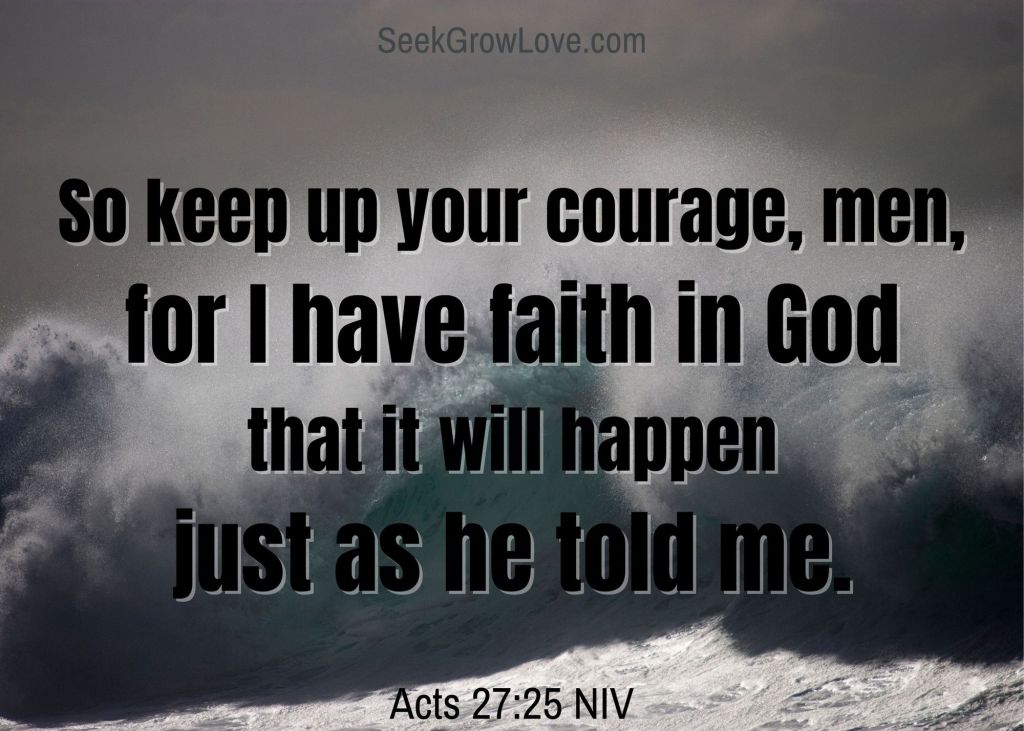
But Paul did not lose faith, and he would not let his fellow passengers give up either. After being tossed about in the storm for days on end, Paul encourages everyone onboard:
“Men, you should have listened to me and not have set sail from Crete and incurred this injury and loss. Yet now I urge you to take heart, for there will be no loss of life among you, but only of the ship.” Acts 27:21-22
He proceeds to tell them of the angel who promised not only his own safety, but also that of everyone with him on the ship.
“‘Do not be afraid, Paul; you must stand before Caesar. And behold, God has also granted you all those who sail with you.’ So take heart, men, for I have faith in God that it will be exactly as I have been told.” Acts 27:24-25
Weeks passed, and though everyone stayed alive, their situation had yet to improve. But still, Paul insisted that they would all be okay, urging them to eat while giving thanks to God. Eventually there was a shipwreck, in which the soldiers planned to kill the prisoners to avoid their escape, however the kind centurion Julius would not allow them to carry out this plan, and they all made it safely to shore.
In Acts chapter 27, we watch as an epic tale unfolds (once again), and points us to the unrelenting faithfulness of our God. This amazing miracle was a small-scale example of what God is going to do for the entire world. As terrible as it gets, and as hopeless as our situation may feel, God’s promises do not change; He will always follow through. So we can eat our bread and find peace, even in the middle of the most terrifying of storms, resting in the knowledge of God’s coming Kingdom and never losing faith that His promises prevail. He will not fail you, He will not let you down, and He will not break His promises. So take heart, for I have faith in God that it will be exactly as I have been told.
-Isabella Osborn
Discussion Questions:
How can you be an influence to help others find hope in their storms?
In what ways has the knowledge of God’s promises and faithfulness affected your life?
When do you find it most difficult to take heart? How can you help remind yourself, even in these trials, of the hope we have in Christ Jesus?
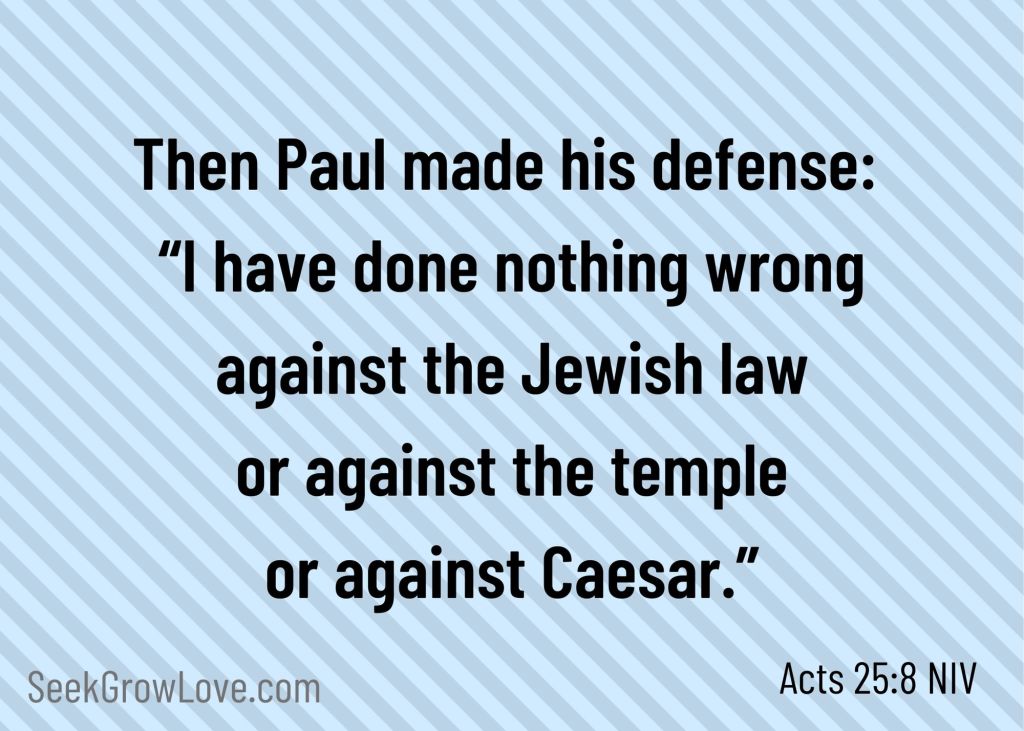
It’s been more than 2 years since the Jews made their accusations against Paul. He’s under house arrest. Time after time the Romans find him innocent under the law. But they lack the political will to go against the Jews. How frustrating this must have been. The Jewish leaders just won’t give up. They are determined to push their agenda.
Society today is in a similar state. Factions try to wear us down with their agendas. 2 Timothy 3:2-4 tells us “ 2 People will be lovers of themselves, lovers of money, boastful, proud, abusive, disobedient to their parents, ungrateful, unholy, 3 without love, unforgiving, slanderous, without self-control, brutal, not lovers of the good, 4 treacherous, rash, conceited, lovers of pleasure rather than lovers of God.”
In spite of his unfair treatment, Paul deliberately chooses to act in a Godly manner. He patiently continued to spread the good news. He wrote encouraging letters to fellow believers. We need to follow his example. He exhorts in 2 Corinthians 10:3 “though we live in the world, we do not wage war as the world does”. Be firm, not belligerent. Be loving, not proud Be kind, not conceited. Teach truth in love. We are called to remain holy in spite of what is going on around us. Above all, we need to deliberately choose to focus on things above. In Philippians 4:8-9 Paul tells us to think about whatever is true, noble, right, pure, lovely, admirable, excellent or praiseworthy. And then to put it into practice.
-Annette Osborn
Questions for Reflection and Discussion
How would you describe Festus from this chapter? How would you describe the Jewish leaders? How would you describe Paul?
Have you are ever been faced with injustice against you? How did you respond?
Next to the greatest story ever told, the story of Joseph is by far my favorite Bible story. There are so many valuable lessons one can learn from reading it. Some lessons that stand out to me are the sovereignty of God, the importance of trusting God even in the midst of tragedy and suffering, and the beauty and power of forgiveness.
I have often asked myself if I would have had Joseph’s attitude in the midst of a seemingly unending chain of absolutely horrific events. In spite of the terrible hand that he continued to be dealt, we don’t see him being consumed by anger, self-pity or a quest for vengeance. There’s something very powerful about Joseph’s unwavering faith in God that inspires me. He seems to possess a quiet assurance that everything is ultimately going to be okay.
In this 45th chapter of Genesis, we see Joseph revealing his true identity to his brothers. We know he had risen to a very prominent position of power as second in command of Egypt. The stage could have been set for him to get the “perfect revenge” against his brothers. We read in verse 5 right after Joseph reveals his identity to his brother: “And now, do not be distressed and do not be angry with yourselves for selling me here, because it was to save lives that God sent me ahead of you.” I find it especially poignant that not only does Joseph not want to exact revenge in this situation, he actually chooses to comfort his brothers in this moment rather than “giving them what for.” We know from earlier scriptures that Joseph was clearly hurt by their previous actions, but he wants to spare them the hurt of being angry with themselves or beating themselves up because of their actions. He points them to an understanding of God’s sovereignty and that they were players in God’s plan.
How differently that 45th chapter of Genesis could have played out if Joseph had been bent on vengeance. Instead, we see the true beauty and power of forgiveness and a reminder that God is in control even in the midst of our darkest hours.
If we choose to be consumed with anger or self-pity, we miss the important lessons God is trying to teach us. We read in Romans 8:28, “And we know that in all things God works for the good of those who love him, who have been called according to his purpose.” Perhaps the answer in those dark times is to focus on loving God even more deeply and purposely than ever before.
-Kristy Cisneros
Questions for Reflection and Discussion
1) When you encounter hardships and tragedies, does your attitude reflect one of unwavering faith in God? If not, how can you further nurture and strengthen that faith so that it is at the ready when life’s storms come your way?
2) What action can help us love God more deeply and purposely than ever before?
3) What other lessons can you learn from the story of Joseph?
In our lives we all have dreams. We have plans and wishes that we hope and pray will come to pass someday.
Joseph is born, the son of Jacob, favored by his father over his other siblings. Jacob was the golden child if you think about it. He was hardworking, honest and kind. That is why his brothers hated him so much. Joseph reported his brothers wrong doings to his father, which made his brothers see him as a snitch. But the fact that their father, Jacob, loved Joseph more made their hatred even worse. Joseph was a young man of integrity, blessed by God with dreams of leadership and prosperity. These dreams and hopes brought jealously from his brothers. Because of this, his brothers set out to get rid of Joseph by selling him as a slave, where Joseph went through many hardships. Regardless of how tough things got for Joseph, he kept his faith, and God’s plan was brought to the light.
Even though Joseph’s brothers were in the wrong for their actions, Joseph also acted in pride when he went and talked about his dreams. We all have our short comings, but what matters is that we learn from them and let God rule our lives.
Joseph was called by his brothers, “the dreamer”. But because of their cruelty, he became a slave. He went through challenges. But because of Joseph’s faith, his struggles turned into blessing.
We can often be slaves to our temptations and sins. We get sidetrack by the things in our lives. The thing is, that when we really look at it, we choose what we let rule our lives. We have the power to move mountains with God on our side. God is working in us, our lives, and our world. Even in the struggles, he is working.
God has a plan for every one of us. That doesn’t mean it is going to be easy and without hardship. It does mean however, that we are going to receive God’s promises through our struggle, and it is going to be better than anything we ever expected or imagined.
-Hannah Eldred
Questions for Reflection and Discussion
What in your life are you struggling through, or what temptation are you facing?
How can you use your situation to grow?
What is your dream for your life? How do you think God can use that?
Tomorrow we will read more of Joseph’s account in Genesis 45.
As we begin reading Peter’s second letter we find that he is writing “to those who have received a faith of the same kind as ours, by the righteousness of our God and Savior, Jesus Christ.” That means he is writing to you and I as well!
We find that God has granted us knowledge of Him along with “precious and magnificent promises” allowing us to escape the corruption in the world. As we look around we can see corruption at every corner. We see corrupt leaders, corrupt organizations, even corrupt friendships.
How do we escape the corruption of this world? Peter tells us in verses 5-8 we are to be diligent to allow our faith to supply moral excellence. However we do not stop there. We are to be in constant growth and that will lead us through to knowledge, self-control, perseverance, godliness, brotherly kindness, and love! This is a truly amazing list that can guide you through the troubles of each day.
Although we each fall short and make mistakes, we are told that if we practice these things we will never stumble. It isn’t too difficult to show brotherly kindness, self-control, and even perseverance on occasion, but to maintain these things constantly is much more challenging. When we struggle we should expect our brothers and sisters to remind us of the calling that has been given to us.
Tomorrow we will look at what Peter has to say concerning the behavior of many and how it affects the judgement of others.
-Bill Dunn
Today’s Bible reading plan passages can be read or listened to at BibleGateway.com here – Ezekiel 9 & 10 and 2 Peter 1
Accomplished athletes, musicians and artists alike are often asked what it means to be “in the zone”. In psychology circles, being “in the zone” is referred to a state of flow – when an individual is completely absorbed in doing a challenging, yet doable, task. They are somehow able to shut out all of the external noise and distraction to focus on the very present moment to do one thing.
Performers and entertainers are not the only ones who are able to find their flow. Scientists and mathematicians; emergency responders; and everyday average Joes like you and me are able to concentrate so intently on a task that time just seems to slip away and we find ourselves doing something extraordinary.
As I meditated on Lamentations chapters three through five, I couldn’t help but be bombarded with how devastated the author was over losing their home, being held in captivity, and witnessing depravity all around him.
And yet, right in the middle of all those laments, there are these verses that stand out, that give hope and encouragement.
Yet this I call to mind and therefore I have hope:
Because of the LORD’s great love we are not consumed,
for his compassions never fail.
They are new every morning; great is your faithfulness.
I say to myself, “The LORD is my portion; therefore
I will wait for him.”
The LORD is good to those whose hope is in him;
it is good to wait quietly for the salvation of the LORD.
Lamentations 3:21-26
How is it that the author, in the midst of all the calamity, is able to break out these words of great expectation?
Maybe, the author was just for a moment, able to quiet his thoughts and instead of focusing on the turmoil he and the other captives were facing, meditated on God’s character. As he penned these words, he found himself in a state of flow of sorts.
Whenever we find ourselves in difficult situations, it is so easy to concentrate on all that is wrong; all that pains us; all that is overwhelming.
But what if, instead, we were able to quiet our minds, to completely block out all of the negativity, and just simply rest in the quietness of God’s character: his love, his compassion, his grace and mercy, his forgiveness, his holiness, his faithfulness.
This is the space where we are able to renew our hope, to find the strength to dig deep and do the hard things, to press on through the challenge having complete confidence that God is ultimately on our side; that He is bigger, greater, higher than anyone or anything that we may be facing.
If you are in the middle of a difficult circumstance, you may be tempted to lament all day long to anyone who is willing to listen. Instead, I urge you to refocus your thoughts and “set your minds on things above, not on earthly things”. (Colossians 3:2) Find yourself in God’s flow zone. Here you will experience the peace that passes all understanding.
-Bethany Ligon
Today’s Bible reading passages can be read or listened to at BibleGateway.com here – Lamentations 3-5 and 1 Peter 1
We begin a new book of the Bible today—James. James is one of my favorite Bible books. I participated in Bible quizzing on James as a teenager in IL, and coached Bible quizzers on James in IN and MN. More than half of the verses of this first chapter of James are underlined in my Bible.
James’ writing style differs from the author of Hebrews. He is blunt and forthright in his writing.
The author of James was most likely the son of Joseph and Mary, which made him the half-brother of Jesus. Interestingly, James and other family members did not initially accept the teaching of Jesus.
In Mark’s account of Jesus, we find these verses.
“He came home, and the crowd gathered again, to such an extent that they could not even eat a meal. And when His own people heard about this, they came out to take custody of Him; for they were saying, ‘He has lost His senses.’” Mark 3:20-21
The book of John tells us “For not even His brothers believed in Him.” John 7:5
However, after Jesus had risen from the dead, (“then He appeared to James, then to all the apostles” I Cor 15:7), James’ life was transformed. He became an important leader of the church in Jerusalem and the surrounding early churches.
The first verse of James ties in with his widespread influence to the churches. He addresses his letter “to the twelve tribes which are dispersed abroad.” This audience was actually Jewish Christians, many of whom had been forced to leave their homeland due to persecution. They were new in their faith and needed instruction and encouragement that was straight forward and easily understood.
Think about the opportunities and choices available today for people who want to be a “do-it-yourselfer.” Whether it is home building or remodeling, cooking, gardening, crafting, “you name it,” there is a book, a manual, a TV program, a YouTube video, or a website that can help you out. (DIY network, HGTV, Craftsy, are a few that come to mind.) Paul A. Cedar calls the letter of James a “how -to-do-it manual for the Christian life.” James offers solid, practical instruction for Jesus’ followers.
“Consider it all joy, my brothers and sisters, when you encounter various trials,knowing that the testing of your faith produces endurance. And let endurance have its perfect result, so that you may be perfect and complete, lacking in nothing.”
Verse 2 tells us to be joyful when we face trials. It seems like a difficult thing to do, but remember, the Christians who first received this letter had experienced extreme trials to the point they had fled their homes to survive.
Paul writes in I Corinthians 10:13, “No temptation has overtaken you except something common to mankind; and God is faithful, so He will not allow you to be tempted beyond what you are able, but with the temptation will provide the way of escape also, so that you will be able to endure it.”
This is the joy we should have when trials confront us. And, as verse 3 says, “the testing of your faith produces endurance.” When we experience trials, our faith grows in the Lord, as we work towards our “perfect self” in God’s Kingdom. (verse 4)
James’ brother Jesus, our Savior, often told parables, or simple stories to help his audience understand his teaching. I find it interesting that James, like his brother, uses several illustrations in his letter to further explain his instructions to his readers.
If you lack wisdom, ask God for it, but don’t doubt you will receive it. One who doubts “is like the surf of the sea driven and tossed by the wind. Let not that man expect that he will receive anything from the Lord, being a double-minded man, unstable in all his ways.” (verses 5-8)
Blunt and to the point! No commentary by me needed!
Story/illustration #2–Verses 9-12
“Now the brother or sister of humble circumstances is to glory in his high position; but the rich person is to glory in his humiliation, because like flowering grass he will pass away. For the sun rises with its scorching heat and withers the grass; and its flower falls off and the beauty of its appearance is destroyed; so also the rich person, in the midst of his pursuits, will die out. Blessed is a man who perseveres under trial; for once he has been approved, he will receive the crown of life which the Lord has promised to those who love Him.”
A Christian with limited means for livelihood “glories” in his coming inheritance in God’s Kingdom. A rich man/Christian should glory in the fact that his wealth is temporary, only of this world. Verse 11 gives us a visualization of the fleetingness of this life—hot sun, scorching wind, dead grass and flowers. (This picture reminds me of the drought areas around the US this past summer.) Both men are equal in their future reward, a “crown of life,” IF they “persevere under trial.”
James continues with straightforward, sensible instruction.
“No one is to say when he is tempted, ‘I am being tempted by God’; for God cannot be tempted by evil, and He Himself does not tempt anyone.But each one is tempted when he is carried away and enticed by his own lust. Then when lust has conceived, it gives birth to sin; and sin, when it has run its course, brings forth death. Do not be deceived, my beloved brothers and sisters. Every good thing given and every perfect gift is from above, coming down from the Father of lights, with whom there is no variation or shifting shadow.”
God, the Father of Lights, loves us, and is a generous giver. His greatest gift was His Son Jesus and the plan of salvation, but He has also given us the beautiful natural world to delight in and discover its wonders each day. God has given us our families, friends, jobs, food, homes. How blessed we are. And His care, His protection, His love never changes—“with whom there is no variation or shifting shadow.” This phrase reminds me of one of my favorite verses, Malachi 3:6a. “For I, the Lord, do not change.”
James continues with his direct approach in verse 19. He tells his readers to be “quick to hear, slow to speak, and slow to anger.” Why? Verse 20 says, “For the anger of man does not achieve the righteousness of God.” (Insert drum rimshot here!) Obviously!
Quick, Slow, Slow. In other words, 30 seconds to think and respond during a contentious conversation. Even Thomas Jefferson had this sage advice. “When angry, count to 10 before you speak. If very angry, a hundred.”
Verses 21-25 bring us another story/illustration to make James’ point, if we still don’t get it! The guidance is repeated with action words this time to begin the illustration.
“Put aside filthiness and the remains of wickedness.”
“Receive the word”
“Proveyourselves doers, (not merely hearers, who delude themselves.)”
Don’t hold back, James!
Here comes the explanation/story. “For if anyone is a hearer of the word and not a doer, he is like a man who looks at his natural face in a mirror; for once he has looked at himself and gone away, he has immediately forgotten what kind of person he was. But one who has looked intently at the perfect law, the law of freedom, and has continued in it, not having become a forgetful hearer but an active doer, this person will be blessed in what he does.” (verses 23-25)
A man looks at himself in a mirror, walks away, and immediately forgets what he looks like. This man is like a person that listens to God’s Word, hears what “the preacher says,” and then leaves church on Sunday and lives his life the rest of the week not connected to God.
However, one who not only looks into God’s Word, (the perfect law of liberty) abides in it, and follows through with appropriate actions, is truly blessed in his life. Paul said it this way, “For all the law is fulfilled in one word, even in this: ‘You shall love your neighbor as yourself’” Galatians 5:4. Where do you start?
James gives us an example in the last verse of James 1, verse 27. “Pure and undefiled religion in the sight of our God and Father is this: to visit orphans and widows in their distress, and to keep oneself unstained by the world.”
Simple love in action. The Bible is our guidebook/how-to manual. We can’t just read it and not follow through. James 1 is direct instruction for the do-it-yourself generation.
-Paula Kirkpatrick
Today’s Bible reading passages can be read or listened to at BibleGateway.com here – Jeremiah 45-46 and James 1









 Seek Grow Love