Together in Christ

Old Testament: 2 Kings 24-25

Poetry: Psalm 89

New Testament: Philippians 2

The second chapter of Philippians is a lesson in unity and behavior. 

Conflict happens. Any time there are people gathered, there will be a difference in thinking. God gave us beautiful brains and the ability to reason and rationalize in different ways. He blessed us with the ability to form opinions. And those opinions are bound to differ. 

Too often, though, we give our own opinions too much power. We allow them to shoulder their way into our relationships with great force and little apology and we let them overshadow the important things like love, compassion, tenderness, and humility. 

Humility. It’s such an underrated quality in society. But which is more important: having your way, or being more Christ-like? Sounds like an easy answer, but it’s SO DIFFICULT to practice. 

Have you ever allowed your opinions too much power? Have they ever kept you from displaying the humility of Christ? Is there a current relationship that could be improved if you showed more humility in the name of Jesus? 

Verses 1-4 lay out such a heartfelt plea from Paul to the believers in Philippi. He begs them to be united. 

He tells them, and now us, that if we have any blessings from being united with Christ, from his grace and his salvation, then we must be united with each other as believers. Value others above ourselves. We must lay our opinions to the side and focus on our job as Christians: to show others Christ and further his message. 

In verses 5-11 he lays out the mindset of Jesus Christ – the one who had the ability to ask anything of God and have it granted to him, but instead chose to make himself a servant to others. Because Jesus loved that hard. 

I lay aside my own opinions and preferences for my family all the time. It’s easy because I love them more than I love myself. I frequently do the same for my friends. But what about the church member or coworker or acquaintance or family member that I find “difficult”? Am I so willing to lay aside my opinions or preferences on how things “should be done” for them? Are you? 

 And yet that is what Christ asks of us. As a church body we are called to unite. And so many churches and Christians struggle with this. I struggle. I struggle so hard. When I should be loving hard. Like Jesus. 

Do you get distracted by doing things your way? Does your method really matter in the grand scheme of spreading the gospel message? What relationships could be improved if you showed more humility? How could your faith and relationships be better if you placed Furthering the Kingdom over Getting Your Way? 

Verses 12-30 sting a little bit for me. “Do everything without grumbling or arguing.” I like to call it “venting” but it’s really complaining. And I’m told not to. We are called to be united as Christ followers so that when we are out in this wicked world we can “shine among them like stars in the sky.” 

The world is full of darkness and we are called to be stars. Paul asks us to show others love and humility, like Timothy and Epaphroditus. He asks that rather than look after our own interests, we look after the interests of Jesus Christ. 

That’s so powerful: look after the interests of Jesus Christ. 

My prayer for you today is that you are able to examine your relationships with others in full humility and see how you can place others before yourselves. I pray that we, as believers, can interact with one another in a way that will show the world Jesus Christ. I pray that we can all stop letting our differences get in the way of our purpose, and that we would instead focus on furthering the gospel message in unity. Blessings and love from your sister in Christ! 

-Jenn Haynes

Reflection Questions Given aBove

Waiting & Acting

Old Testament: Micah 7

Poetry: Psalm 85 (day 2)

New Testament: Luke 19


“But as for me, I will look to Yahweh; I will wait for the God of my salvation. My God will hear me.” — Micah 7:7 (LEB)


“For the Son of Man came to seek and to save the lost.” — Luke 19:10 (LEB)


In a world often overwhelmed by corruption and despair, both Micah 7 and Luke 19 offer us powerful messages of hope and redemption. These passages remind us that no matter how bleak our circumstances may seem, God’s love and salvation are always within reach.


Micah 7 depicts a society engulfed in sin and injustice. The prophet agonizes over the overwhelming corruption, yet he chooses to watch in hope for God. Micah’s confidence is not rooted in the present circumstances but in the unchanging nature of God. He waits patiently for the God of his salvation, assured that God will hear him.


In Luke 19, we see the fulfillment of the hope that Micah clung to. Jesus encounters Zacchaeus, a tax collector despised for his dishonest, corrupt ways. Despite Zacchaeus’ reputation, Jesus seeks him out, calling him by name and choosing to stay at his house. This act of grace leads to Zacchaeus’ repentance and transformation. Zacchaeus’ story vividly illustrates Jesus’ mission: to seek and save the lost.


Both Micah and Zacchaeus found their hope in God. Micah trusted in God despite his society’s moral decline, while Zacchaeus found redemption through an encounter with Jesus. We, too, are called to place our hope in God, trusting in His promise of salvation. Zacchaeus’ transformation shows the power of God’s grace. No one is beyond redemption; Jesus seeks us out, offering a chance for a new beginning. Our lives can be profoundly changed when we come to God through Jesus. Micah’s patient waiting for God’s salvation and Zacchaeus’ immediate response to Jesus’ call both demonstrate the importance of faith in action. We must wait with hope, but also be ready to act in response to God’s call.

-Jeff Ransom


Reflection Questions:

  1. How can you place your hope in God amid the challenges and uncertainties in your life?
  2. In what areas of your life do you need to experience the transformative power of God’s grace?
  3. How can you be a faithful steward of the resources and opportunities God has entrusted to you, making Him known, while actively waiting for His guidance?


This week, consider these questions and take steps to deepen your relationship with God, embodying the hope and transformation He offers to all who seek Him through Jesus.

Lost

Old Testament: Hosea 6-8

Poetry: Psalm 78

New Testament: Luke 15:8-10

It is fairly maddening how quickly I can lose an object. I will set down car keys to load a child into the car and they are gone.  I can be in the middle of a text conversation, get up for a drink, and my phone disappears. Parking passes, debit cards, proof of insurance, checks, grade verifications, etc – there is no limit to what I can lose. My students will even tell you that I don’t collect work directly into my hands because if I touch it, I’ll subconsciously place it near my next conversation. It is infuriating to lose items so important, but each time, I rise to the occasion to search with determination that matches the importance of what is missing.

When we consider those who have not yet heard the Good News of Jesus Christ, what responsibility do we have to recover the lost?  If it is gauged upon the importance of the object, and we are searching for those who were paid for with the blood of Christ, then it requires all the strength we can muster.  We do not sit patiently in our homes and churches, waiting for our doors to be darkened by their presence. If we do this, then the searching is being done by the wrong party. We are to turn on the light, get our butts moving, and carefully search each room where our feet land.

Fallen out and forgotten, lost in the shuffle, moved out of place, and never properly cared for are the people of God we are looking for. They are every bit as equal in value, but they need to be found with the Gospel in hand. It is possible that they choose to remain wherever they are.  Unlike lost coins and keys, there very well may be a struggle. Like a teenager who slips back under the covers on a school morning, they too may crawl back into the couch cushion or make a home with the dust bunnies.  No matter, our role is the same in the search, to find them and expose them to the Light.

God remains steadfast in his desire to continue the search despite Israel’s determination to commit to being unfaithful. While Israel acknowledges guilt and recognizes revival is needed, their actions do not yet match their lips,“Come, let us return to the LORD. He has torn us to pieces but he will heal us; he has injured us but he will bind up our wounds.” They continue to reject what is good and are forced to deal with the consequences of a rebelling nation.

“We will not hide them from their descendants; we will tell the next generation the praiseworthy deeds of the LORD, his power, and the wonders he has done” – Psalm 78:4

Whether it is with a coworker, an acquaintance, a straying brother or sister in Christ, or our own children, we do not simply wait patiently, but continue to pursue the lost coin.  We share our own experiences of feeling lost.  We share the consequences of our own rebellion against God.  We share our testimony and the promises of God, not hiding our faith for the sake of relationship.  We cannot simply pick them up and place them in our pocket, but we can surround them in love and prayer.  We extend the love of God to them determinedly and unconditionally. No one is less valuable in the eyes of God. Ultimately, we hope to rejoice and reap a return, giving praise to our gracious God who has searched for all of us with salvation’s plan.

-Aaron Winner

Reflection Questions

  1. What does Hosea, the woman searching for her lost coin, the writer of Psalm 78, and the heart of God have in common?
  2. Do you most often sit and wait for the lost to come find you and the gospel message – or do you spend time and effort seeking out the lost?
  3. “No one is less valuable in the eyes of God.” Do you believe this? Can you find Scriptural evidence to support it? Do you live like this is true?
  4. What lost coin can you pursue this week? Why? When, where and how? Pray for God’s heart, guidance, wisdom, words, and love.

Jonah’s Object Lesson

Old Testament: Jonah 4

Poetry: Psalm 73 (on repeat the rest of this week)

New Testament: Luke 12:13-21

In Jonah chapter 3, the great city Nineveh repented, and they turned towards God. Afterwards, God had mercy on the people and relented on the upcoming disaster that Jonah was warning them of. 

For those who follow God, it should be easy to rejoice when God shows his mercy and love. However, in Jonah chapter 4 we see that Jonah was displeased with the mercy that was afforded to the people of Nineveh. Why was Jonah angry at this? This is possibly due to Nineveh being the capital of the nation of Assyria, an enemy of Israel. Perhaps being on opposite sides, Jonah wanted to see his enemies destroyed, or perhaps his own personal morality guided that the Ninevites deserved destruction. Perhaps the disaster never befalling Nineveh also delegitimized the words that he spoke to them, and made him feel less powerful. Either way, Jonah’s heart was not in the right place, and God saw to it that Jonah saw this too. 

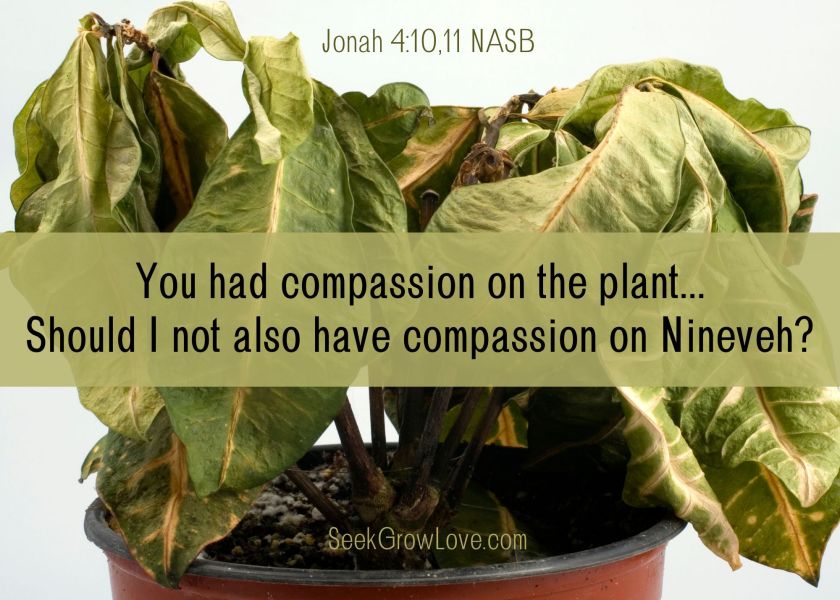
After Jonah complained to God, he rested. There, God allowed a plant to grow. Jonah found joy in this. Then, God caused the plant to die in the morning, and called in a great heat to overcome the area that Jonah was in. Again, Jonah cried out at the demise of the plant that he had. 

God then likened this plant to Nineveh. It gave great joy to Jonah despite him not being the reason it grew, and it was only there overnight. So too Nineveh should also receive mercy even if recently they turned from their wicked ways. 

Although only 11 verses long, Jonah 4 reveals a lot to us about who God is, and how we should interact with him. First off, God used the plant as a metaphor for Nineveh, much like how his son Jesus would use parables to teach spiritual lessons to people in ways that they may understand. 

Secondly, God has love for people, even for those that are not his chosen people. Perhaps Jonah may have disagreed with this at the time, but regardless this goes on to show the legitimacy of the great commission given by Jesus in Matthew 28, and carried out through the rest of the New Testament. The love of God is for everyone. 

Thirdly, we should always want what God wants. Even if we do not understand God, or if we do not agree with the way things may be going for us, we must adopt the viewpoint that aids so many people throughout the Bible: “not my will, but yours be done.” “Yours” referring to God, our father in heaven. 

-Colby Leggitt

Reflection Questions

  1. Even when we feel that we are worthless, how can we remind ourselves of the greater purpose that God has called us to?
  2. Why was Jonah so upset that God relented to the disaster to befall Nineveh? How can we connect this to times in our lives when we are angry that things don’t go our way? 
  3. What does God tell us about the worth of being angry (without very good reason)?
  4. Was God’s lesson on Jonah too harsh? Are such tribulations the kind of tough love that is needed sometimes for us to see things the way God wants us to?

Wounds from a Friend

Old Testament: 2 Kings 9 & 10

Poetry: Proverbs 27

New Testament: Luke 10:1-24

The Proverbs are, in many cases, fairly self explanatory. Don’t be lazy, don’t be a wicked ruler, don’t be foolish but be wise, be a righteous ruler, be diligent in your work. Each Proverb has it’s own meaning but they go along those lines. But some are not so self explanatory. They are counterintuitive.

A short example is found in 28:27. If you want to be prosperous and blessed, to never be in want, then we give our money to the poor. The world, our own sinful heads, and many economists believe that the way to grow our wealth and not be in want is to hoard our money. But that’s not the way God works. It is only in generosity and giving that we will be blessed. This comes from the fact that God will bless and many times he blesses us through the care of others in our time of struggle and hardship.

Also, 27:5-6 doesn’t seem to be true in the moment. I don’t like to be rebuked. I don’t like it when a friend calls me out on the garbage way I am acting. But the Proverb teaches us that we should delight when a friend rebukes us because their correction comes from a place of love and they want our life to be one of wisdom and righteousness. This is especially true for  our brothers and sisters in our local church. Many times, we may feel judged by the people of our church, but more often than not, they are wanting the BEST for us. The “wounds” they give are better than any kisses of those who tell us we have nothing wrong with us. There could be people who act like a friend and hurt you in terrible ways, but here we mean TRUE friendship, TRUE companionship, TRUE love from a brother or sister in Christ. That true love is shown in forgiveness and compassion, especially in our moments of weakness and humility. Many times, when we are sinning and are fearing the rebuke of those people, we hide our sin away, like 28:13 says. But counterintuitively, by hiding our sins, we only hurt ourselves more when they are brought to light in some other way. We need to confess our sins and turn away from them. When we do, compassion and forgiveness are waiting for us from the people of God and from God himself.

Jake Ballard

(originally posted for SeekGrowLove June 17, 2020)

Reflection Questions

  1. What other proverbs have you run across that seem counterintuitive and the opposite of how the world thinks or operates? How is God’s wisdom better than the world’s?
  2. Can you think of a time a true friend gave you correction or a rebuke? Can you think of a time you, as a true friend, gave correction or rebuke? What is the value of correcting a friend? What problems can develop if we don’t correct in love, or if we don’t accept the correction given in true love?

Do You See?

Old Testament: 2 Kings 3 & 4

Poetry: Proverbs 24

New Testament: Luke 7:36-50

I want you to imagine with me. 


You are a powerful man in ancient Israel. You hear about a miracle worker and rabbi. This guy, in just the last couple days reportedly saved a slave of some centurion without even being near him. More than that, he brought the dead back to life! Could such a thing be? Nothing like it has happened in your lifetime. This man reminds you of Moses, Elijah, and the prophets that you have grown up hearing about and spent your life studying. You know that such a man must be holy, must be from God. You invite this man to eat with you, so you can see for yourself how this holy, miraculous man interacts with people.

So you see him. And he’s shorter than you expected. Actually, he’s quite unremarkable in appearance. He is not wealthy, he does not come from money or make much when out teaching. He is lean from walking and fasting. He has an entourage of men with thick accents, no training, and a certain lack of decorum. They look and act like fishermen. To your surprise, you learn they ARE fishermen. One is even a tax collector. It’s only natural to begin to doubt. But when he opens his mouth to teach, it intrigues you. The passion with which he speaks. The intensity in his eyes. The compassion in his touch, to all people, draws you in, and you invite him over for dinner. Doubts gnaw at your mind, but surely in a personal setting those will fall away.

However, at dinner, things get really out of hand. As per usual, you have your home open to use by the people of the city, because God has blessed you for your devote life and upright character. Everyone, all thirteen (and more) of this teacher’s usual crew start to relax, kick back their feet, and eat. But, in the middle of dinner, she comes in. The years of hard life, of acting in such impolite, anti-social, uncouth, wicked and sinful ways, of trying and failing to do better, showed in every movement in the presence of this teacher. But instead of running like she should have, she bends down, weeping, and cries on his feet, wipes his feet clean with her tears. She takes his barely washed feet and anoints them with the sweetest perfume, the smell wafting over you all. She is making a scene, at YOUR dinner. And you know what kind of person she is. She doesn’t deserve this attention, she only wants to ruin your hospitality, because that’s the kind of person she is. 

No, no this man must be a phony. How could a man who raises the dead not know what this woman does every day? How could such a “holy man” allow so much uncleanness to caress his feet? Why let someone like her defile someone like him?


Then he says your name and breaks you out of your reverie. He calls your name. He tells you about two debtors, both forgiven – one much and one little. He asks “Who will love the forgiver more?”

“The one who was forgiven much,” you answer wisely. 


He turns to the woman and takes her worried, nervous, anxious trembling hands in his own. He turns his soft but piercing eyes to her own, red from weeping. He says to you, “Do you see this woman?” He lets the words hang in silence for a moment. She rubs her nose. For the first time you notice that some of her hair is starting to turn gray. You notice that she is not old, but the lines come from stress. You notice that she must have washed to come, as she looks cleaner than you have seen her in a long time… You see yourself seeing this woman, who you see everyday, in a new way. She is a whole person. She is more than the sum of her mistakes. She is loving this teacher. She is showing him honors “She has done for me what you have not,” he says. “She has much to be forgiven for, and so she loves, knowing now that she is forgiven. In your own eyes, your sins are so much smaller, and so your love is so much less.”


The rest of the table murmurs about the teacher forgiving sins, but as they talk he says to the woman “Your faith has saved you, go in peace.” She smiles at him with gratitude and joy…

Do you see this woman?

Or do you see the sins? The immorality? The wickedness? The hardness of life? The addictions? The abuse?


Jesus opened the eyes of the blind, and more importantly, causes the spiritually blind to see the world. May this imaging open your eyes. This man who raised up the dead, more importantly, raised up the living to new life. May this story cause you to raise the living to new life. 


And may this question reverberate in your head all day :

Do you see this woman?

(Optional note for those confused about the devotion : spiritual imagining, putting ourselves in the story, is an ancient spiritual tradition. One great example that is often used is in Luke 15, the parable of the “Lost/Prodigal Son”, or better “The Lost Sons” or best “The Searching/Prodigal Father”. You may see yourself as the son who runs off, the servants rejoicing, the son who is angry for forgiveness, or the father looking for his boys. It says much about ourselves and our relationship with God and others to see who we identify with, and to put ourselves in strange places in the story. Today we looked through Simon’s eyes in Luke 7, not because it is the best, but because of course he would doubt Jesus. Of course he would question him. Of course he would be offended at the woman. And of course, all of that is undue, because Jesus overcomes our doubts through miracles, our questions through answers and better questions, and our offense by unending grace. May this story take a new meaning to you as you ask yourself: Do you see this woman?)

-Jacob Ballard

(originally posted for SeekGrowLove March 16, 2021)

Reflection Questions

  1. Would you more often see yourself as the sinful woman or as Simon the Pharisee?
  2. What do each of these 2 characters need?
  3. Jesus initiates the discussion with Simon after Simon had just “said to himself”. What recent thoughts of yours might Jesus question if he were in your house today? What do you think he would ask/say/explain to counter your thoughts?

Unity

Old Testament: 2 Samuel 20-21

Poetry: Proverbs 6

New Testament: Ephesians 4

After the attacks on September 11, 2001, President George W. Bush spoke to the emergency workers in Ground Zero through a megaphone, finding a response that resonated with the entire country and even more, the world, “I can hear you. The rest of the world hears you. And the people who knocked down these buildings will hear all of it soon.” A historical 92% of the country approved of the job he was doing, bringing together a country that was fraying at the seams in the previous election cycle. It is hard to imagine something similar happening today; no matter who is the president-elect in November, half of the country will be instantly dissatisfied with the results.  These are typical terms we accept in our government, but also this “majority rules” culture has historically found its way into boardrooms and even churches. Let me quickly lower the tension by stating that today’s devotion is not about politics or presidents.  It does not upend or chastise any church form of government. Its sole purpose is to examine the expectation of unity laid out for the church body, as it might be equally unimaginable. 

This spirit of unity was on the mind of Jesus before being arrested in the garden of Gethsemane. He prays for his disciples and all believers when he leaves us the following words, “Holy Father, protect them by the power of your name, the name you gave me, so that they may be one as we are one. (John 17:11b)” Jesus knew his departure to the cross would scatter His apostles, create infighting, and feed doubt. Fortunately, with the exception of Judas, each of them found their way back to a unified front. Having seen Jesus Christ raised to life, they each waited for the Holy Spirit at Pentecost.  They each dedicated their lives to sharing the Good News of the Kingdom of God. They each shared in martyrdom or exile for the sake of Christ.

In the same manner, I have seen churches unite during revival, when facing tragedy, or during persecution from the outside. It is easy for the dross to fall away when the metal is hot, but what about when the metal starts to cool? What does unity look like in maintenance mode? Within the day-to-day routine of uniting relationships, mulling through ministries, and discerning what is best for a body of believers? In Ephesians 4, Paul describes this as “walk[ing] in a manner worthy of the calling, with all humility and gentleness, with patience, bearing with one another in love, eager to maintain the unity of the Spirit in the bond of peace.”

While there could be a devotion on each of the elements of this verse, let’s quickly unpack the key points given to Ephesus. First, walking implies that it is not a quick process, but instead requires some dedication to go the distance (Eph 2:10). Next, humility is the acknowledgement that self-reflection should be the first step in the process, making adjustments and amendments when necessary (Matt 7:3-5; Phil 2:3), and gentleness is the grace that is extended to my brother and sisters during this same process, as imperfect people try to discern the will of God (Col 4:6). Additionally, we are required to commit to patience and love, easily spoken but in reality, conflict makes us more unbearable to one another (Col 3:12-14; Matt 18:15-20). In the body of believers, this is similar to taking the last rep of weight training, it burns the most, but it is the one that produces the result. Finally, eagerness to maintain unity means we stay focused on what unites us (Rom 14:19), defending against the six things the Lord hates (Prov. 6:16-19), and keep our mission far away from doctrinal nuances or extra-biblical preferences.

Unity takes far more work than building a majority.  It isn’t a compromise or consensus because there are no losers. We grow as one together. We move towards one another as we move towards our Heavenly Father. Today, let us be extra mindful in our prayer time to dwell on the topic of unity and ask God to reveal our vision and repair divisions that may exist.  May we live out the prayer of Jesus and the petitions of Paul to become one like our God and His Son, Jesus Christ.

-Aaron Winner

Reflection Questions

  1. Where and when have you experienced or seen the beauty of a united church body?
  2. Dedication, humility, gentleness/grace, patience, love, focused on what unites. How can you exhibit these qualities today? How can you use them to increase the unity of your church? What can happen when just one is missing?

God’s Amazing Character

Old Testament: 2 Samuel 9 & 10

Poetry: Psalm 72

New Testament: Galatians 5:22

We previously read the Seek.Grow.Love year’s readings with the objective of focusing on what we could discover and celebrate about God’s character. Today’s reading in Psalm 72 paints a beautiful picture of the kingdom and highlights wonderful attributes of God’s amazing character. We read in verses 4 and 12-14 about His heart for the afflicted, the crushed and the needy.

Give the king Your judgments, O God,

And Your righteousness to the king’s son.

May he vindicate the afflicted of the people,

Save the children of the needy

And crush the oppressor.

12 

For he will deliver the needy when he cries for help,

The afflicted also, and him who has no helper.

13 

He will have compassion on the poor and needy,

And the lives of the needy he will save.

14 

He will rescue their life from oppression and violence,

And their blood will be precious in his sight;

I am always blown away that we are blessed enough to have a Heavenly Father with such compassion and unconditional love for us. Let that sink in for a minute. This passage actually made me think of a few other passages. One was from the story of Ruth and Naomi and we read how they were able to glean the fields per the provision of God’s law. Those harvesting the land were not to clear the grounds of the crops that had fallen or clear all the way to the edges so that the needy could glean the field. 

We can read about this law in Leviticus 19:9 “‘When you reap the harvest of your land, do not reap to the very edges of your field or gather the gleanings of your harvest. 10 Do not go over your vineyard a second time or pick up the grapes that have fallen. Leave them for the poor and the foreigner. I am the Lord your God.

Here are a couple of other passages that came to mind:

James 1:27 Religion that God our Father accepts as pure and faultless is this: to look after orphans and widows in their distress and to keep oneself from being polluted by the world.

Isaiah 1:17: learn to do good; seek justice, correct oppression; bring justice to the fatherless, plead the widow’s cause.

If reading these passages doesn’t give you pause, it really should. Take a moment to really think about God’s heart and what that means for you. Take time to deeply celebrate and appreciate who He is! May we seek to imitate His character by looking after the needy, the fatherless and the widow.

-Kristy Cisneros

ReFLection Questions

  1. Where have you seen evidence of God’s amazing character?
  2. How would you describe God’s heart?
  3. How can you pass on God’s compassion and helping hand to others?
  4. Can the fruits of the Spirit of love, kindness and goodness be seen in you?

Recognized by Your Fruit

Old Testament: 2 Samuel 5 & 6

Poetry: Psalm 71

New Testament: Galatians 5:22

Matthew 7:15-20:

15 “Watch out for false prophets. They come to you in sheep’s clothing, but inwardly they are ferocious wolves. 16 By their fruit you will recognize them. Do people pick grapes from thornbushes, or figs from thistles? 17 Likewise, every good tree bears good fruit, but a bad tree bears bad fruit. 18 A good tree cannot bear bad fruit, and a bad tree cannot bear good fruit. 19 Every tree that does not bear good fruit is cut down and thrown into the fire. 20 Thus, by their fruit you will recognize them. (NIV)

“By their fruit, you will recognize them.” The fruit we bear in our lives is a litmus test for our spiritual health and the strength of our relationship with our Heavenly Father and His son Jesus Christ. We just read yesterday how apart from Christ we can do nothing. So our ability to bear good fruit depends on our willingness to abide in Christ. Take an inventory of your life. Do you see evidence of love, joy, peace, patience, kindness, goodness, faithfulness, gentleness and self-control? Taking this inventory of my life highlights areas where I need to repent of sin and abide more deeply in Christ. It is also important not to just take a cursory, shallow glance at that list of fruits, but to dig deeper and investigate more in depth what the scriptures have to say about the various fruits. For example, with the fruit of love, Jesus tells us in Matthew 5:44, “But I tell you, love your enemies and pray for those who persecute you.” Does my life show evidence of loving my enemies? Whew, I’m going to be real here, that is a tough one! To actually pray for someone who might be actively working against you or for your demise seems so counterintuitive to our human nature and our survival instinct. God, you want me to give my enemy a salt shaker so that they can rub it into my raw wound even more? Doesn’t that leave me vulnerable and unprotected? Do the scriptures support that God leaves us vulnerable and unprotected? In a couple of weeks you will be reading in Ephesians 6:10-17 about the spiritual suit of armor that God provides us. I won’t go too in depth with it since there are devotions coming that week, but that passage shows us that God protects us from head to toe. Also, remember we are talking about the fruit of the Spirit and John 15 reminds us that we are not alone in this battle.

John 15

26 “When the Helper comes, whom I will send to you from the Father, that is the Spirit of truth who proceeds from the Father, He will testify about Me, 27 and you will testify also, because you have been with Me from the beginning. (NASB 1995)

The scriptures also have something to say about who fights our battles. Let’s take a close look at Romans 12:19-21: 

19 Do not take revenge, my dear friends, but leave room for God’s wrath, for it is written: “It is mine to avenge; I will repay,” says the Lord. 20 On the contrary:

“If your enemy is hungry, feed him;
    if he is thirsty, give him something to drink.
In doing this, you will heap burning coals on his head.”

21 Do not be overcome by evil, but overcome evil with good. (NIV)

Did you catch that part about putting that love of our enemies into action by feeding them if they are hungry, giving them something to drink if they are thirsty? That’s taking that command to love your enemies to the next level, isn’t it?!?!  Are you prepared to do that? Am I? It’s time for a heart check.

It really boils down to trusting God, doesn’t it? Do we believe Him when He says that He’s got it handled? If we find our faith lacking in this area, this is something we can pray about. It brings to mind the passage in Mark 9:

17 A man in the crowd answered, “Teacher, I brought you my son, who is possessed by a spirit that has robbed him of speech. 18 Whenever it seizes him, it throws him to the ground. He foams at the mouth, gnashes his teeth and becomes rigid. I asked your disciples to drive out the spirit, but they could not.” (NIV)

Later we read in verses 21-24:

21 Jesus asked the boy’s father, “How long has he been like this?”

“From childhood,” he answered. 22 “It has often thrown him into fire or water to kill him. But if you can do anything, take pity on us and help us.”

23 “‘If you can’?” said Jesus. “Everything is possible for one who believes.”

24 Immediately the boy’s father exclaimed, “I do believe; help me overcome my unbelief!” (NIV)

That verse always touches my heart because I can relate to it so well. I know what the scriptures tell us, but sometimes my trust and faith are lacking. Sometimes my prayers sound something like this, “Father, I know that Your word tells me that I am to love my enemies, but it’s so hard, God. It hurts so much. I need Your strength to show them the love Your word says I should show them. Father, I know that Your word says that You will work all things together for the good of those who love Him. Help me to love You more deeply and fully and to trust that promise so that my fear does not hold me back from being obedient to Your word to love my enemies. Help my lack of faith in this area. Help my unbelief.”

In today’s passage in Psalm 71 we read how God handled David’s enemies:

24 My tongue will tell of your righteous acts

    all day long,

for those who wanted to harm me

    have been put to shame and confusion. (NIV)

Our only job in regards to our enemies is to love them and to follow through with loving action that helps meet their needs. God’s got the rest of it.

-Kristy Cisneros

Reflection Questions

  1. If a stranger watched you for an hour yesterday, would they have seen good fruit or bad? Would they guess that you abide in Christ? Do you? How can you do so more and more?
  2. Who might you consider as your enemy? How do you typically treat them? What is Jesus asking you to do for them? Will you? When and how?

Turn to Forgive

Old Testament: Ruth 2

Poetry: Psalms 62 (again-what do you notice, today?)

New Testament: 2 Corinthians 2

In 2 Corinthians 2 Paul teaches us how we should forgive as Christians. Paul expresses the idea that the people who grieved him should not be met with revenge, but instead with reconciliation.

“Now instead, you ought to forgive and comfort him, so that he will not be overwhelmed by excessive sorrow. I urge you, therefore, to reaffirm your love for him.”

Unfortunately, some Christians today have a false definition of forgiveness. We have all heard the saying “I can forgive, but I can’t forget”. When you forgive someone, you don’t keep track of their wrongdoings. This is a way we show love as Christians. 1 Corinthians 13:4-5 states:

“Love is patient, love is kind. It does not envy, it does not boast, it is not proud. It does not dishonor others, it is not self-seeking, it is not easily angered, it keeps no record of wrongs”

Why is Paul so willing to practice forgiveness? It’s because he has been forgiven by God through Jesus. When we feel it’s “too hard” to forgive someone we have to remember how often we are forgiven ourselves.

Forgiveness needs to become part of our new nature. As image bearers of God, we need to become forgiving like God is. We need to recognize that forgiveness is part of God’s nature (Exodus 34:6-7), just as many people in the Bible recognized that God’s nature was forgiving (Numbers 14:17-19). If God is forgiveness we need to be forgiving. Forgiveness was the mission of Jesus Christ, let that be our mission as well.

-Brooke Cisneros

Reflection Questions

  1. When have you forgiven someone else? How did that make you feel?
  2. What is the problem with unforgiveness? What is the connection between unforgiveness and being “outwitted by Satan”? (see verse 11)
  3. Explain how God has forgiven. Have you accepted His forgiveness through accepting His Son? If so, how can you pass forgiveness on to others? If not, why not?