Have you noticed one of Jeremiah’s repeated themes yet? So far we have seen it in 3:17, 5:23, 7:24, 9:14, and in today’s reading in 11:8. It will surface again in 13:10, 16:12, 18:12 and 23:17. Chapter divisions were not included in the original writings of Jeremiah, but it’s interesting that throughout the first half of his book about every 2 chapters (or perhaps every column or two on his scroll), Jeremiah writes of the stubbornness of the people.
Jeremiah 5:23 – But these people have stubborn and rebellious hearts; they have turned aside and gone away.
Jeremiah 7:24 – But they did not listen or pay attention; instead, they followed the stubborn inclinations of their evil hearts. They went backward and not forward.
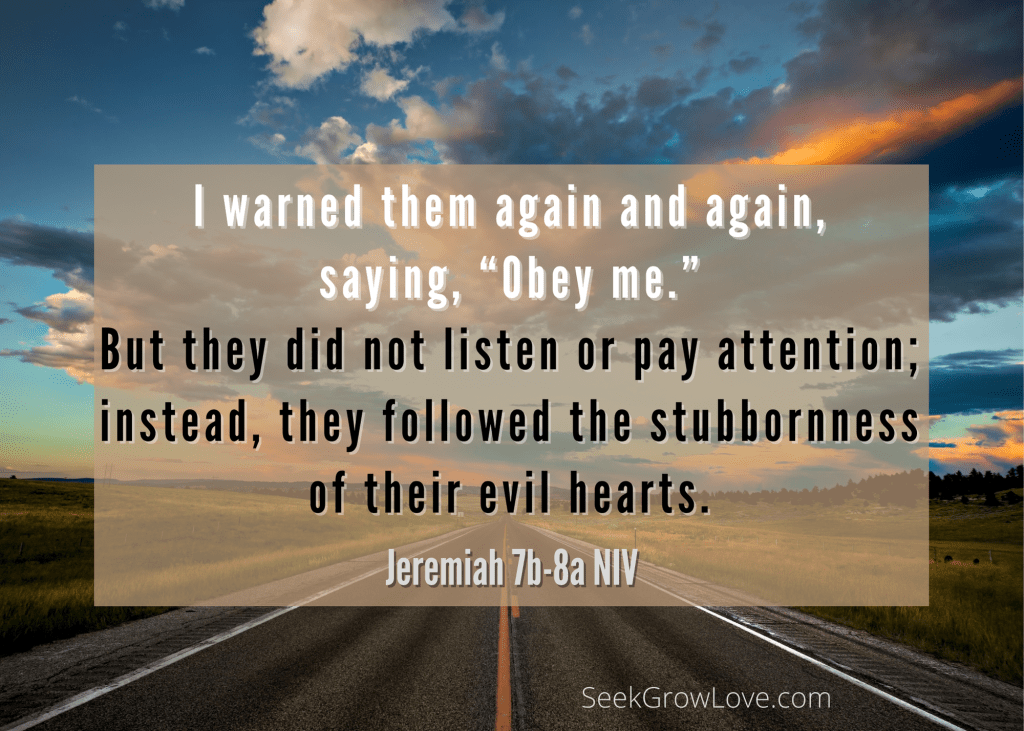
Jeremiah 11:6-8 – The Lord said to me, “Proclaim all these words in the towns of Judah and in the streets of Jerusalem: ‘Listen to the terms of this covenant and follow them. 7 From the time I brought your ancestors up from Egypt until today, I warned them again and again, saying, “Obey me.” 8 But they did not listen or pay attention; instead, they followed the stubbornness of their evil hearts. So I brought on them all the curses of the covenant I had commanded them to follow but that they did not keep.’”
I can envision some stubborn starved Hebrew men and women who have been shut up in Jerusalem as the enemy surrounds and destruction is eminent. And they are belting out Frank Sinatra’s hit song – “My Way”.
They had been determined to do what they wanted. They had shut their ears and their hearts to God’s call and His commands. They had refused to comply, agree to or give in to the terms of their Creator’s covenant. They had turned their backs on the Almighty and were going backward not forward. They had chased after pagan idols. In their pride they had elevated themselves, their pleasure, their dreams, their wants, their ways above God’s. Their evil hearts were caught up in sin. They were stubborn and rebellious and there would be a price to pay.
Do you have any stubborn streaks? Sometimes we prefer to use words like determined, headstrong, set in one’s ways. Got any stubborn children – or should I say – strong-willed and opinionated? How often do we remember that God’s opinion is the only one that matters? How often do we remember, “Not my will, but yours be done.”
Funeral homes in the UK reported that the song “My Way” is the most often requested song for funerals. A lot of people would like to be remembered as the strong, bold, unbending trailblazer who did life his/her own way. Will you be one of them?
Or will you hear God’s voice calling, “Obey Me”? Stop trying to stubbornly do life your way. Your way leads to disaster and death. My prayer is that we may be a people who surrender to God’s will and way and can say, “I did it God’s Way!”
-Marcia Railton
As an interesting note, Frank Sinatra disliked his great money-making hit, “My Way”. Songfacts.com states: “This became Frank Sinatra’s signature song, but he couldn’t stand it, saying he “loathed” the song. In his later years, he described the song as “a Paul Anka pop hit which became a kind of national anthem.” In a 2000 interview with the BBC show Hardtalk, Sinatra’s daughter Tina said, “He always thought that song was self-serving and self-indulgent. He didn’t like it. That song stuck and he couldn’t get it off his shoe.” Beware of turning your life into a catchy, popular, people-pleasing tune that is actually self-serving and self-indulgent. Thanks for the lesson, Frank.
Today’s Bible reading plan passages can be read or listened to at BibleGateway.com here – Jeremiah 11-12 and Psalm 102-103
The Old Testament prophets who spoke for God, including Jeremiah, were entrusted with preaching a lot of doom and gloom. Because God’s children had strayed from his commands, judgment would be coming and the people needed to know. I loved Jeff Fletcher’s illustration in his devotion yesterday of a doctor who could be charged with malpractice if he knew the sick condition of a patient’s insides and knew how to fix it and what changes the patient would need to make in order to cure the potentially deadly ailment, and said nothing. This would be like the Christian who sees the broken sinful world and pretends everything is okay. Don’t withhold the cure.
Jeremiah paints a very vivid picture of a world that is not okay. Chapter 9 opens with the prophet mourning the sinfulness of God’s people. He would love nothing more than to pack up and go to a desert retreat where he could get away from and forget this crowd of unfaithful people. Can you relate? But, rather than abandoning the people in their sin, Jeremiah continues passionately speaking truth for God, over and over, even though his words often seem to fall on deaf ears. He still must speak and write and hold out the cure to these wayward people.
God has had it, too. He aptly describes the situation this way:
“It is not by truth that they triumph in the land. They go from one sin to another; they do not acknowledge me,” declares the LORD. (Jeremiah 9:3b NIV)
and again, “They have taught their tongues to lie; they weary themselves with sining. You live in the midst of deception; in their deceit they refuse to acknowledge me,” declares the LORD. (Jeremiah 9:6 NIV)
It sounds to me like God and Jeremiah are describing the sad state of affairs in 2021. So many lies and deceptions abound when attempting to justify and explain and even celebrate sin and sinful lifestyles that fester and grow when individuals and nations and societies have turned their backs on God.
It is as though God is left without a choice. “What else can I do because of the sin of my people?” (Jeremiah 9:7 NIV) “‘Should I not punish them for this?’ declares the LORD. ‘Should I not avenge myself on such a nation as this?’ ” (Jeremiah 9:9 NIV). God had drawn up the rules long ago with blessings promised to those who followed and curses to those who stubbornly disobeyed. Many chances had been given. Prophets had been sent to remind the people of the deadly disease and of the cure – repentance, turning away from sin and turning back to God. But these were a very stubborn people who took delight in continuing in their sin and lies and more sin and more lies.
God had given mercy. God had given reminders. God had given prophets. God had stretched out the cure. But, to no avail. So, God says – it is time. It is time to teach your daughters how to wail – death and destruction is coming. (Jeremiah 9:20,21).
Towards the end of chapter 9 an interesting section seems almost out of place…
This is what the Lord says:
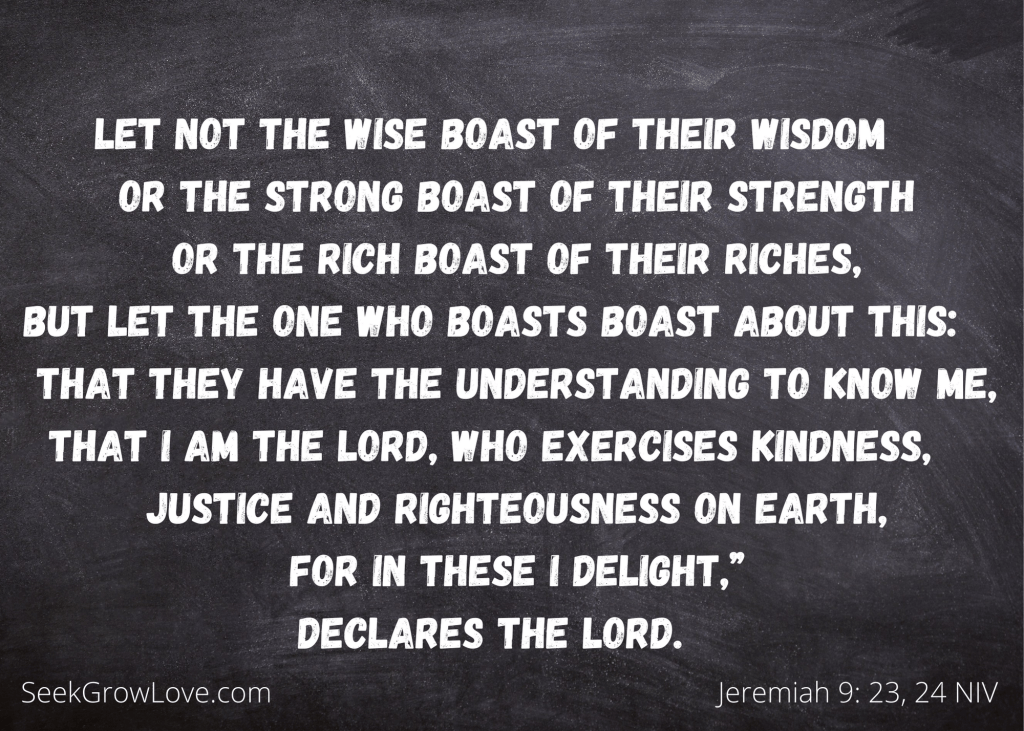
“Let not the wise boast of their wisdom or the strong boast of their strength or the rich boast of their riches, 24 but let the one who boasts boast about this: that they have the understanding to know me, that I am the Lord, who exercises kindness, justice and righteousness on earth, for in these I delight,” declares the Lord. (Jeremiah 9:23-24 NIV)
Perhaps it was written more for us who would be reading Jeremiah centuries later, to remind us of the choice we have. And, the great opportunity we have to boast about our God, our Creator, Our YHWH. He created the cure. His Son is the cure that was not yet available in Jeremiah’s day. Sin is the same and comes with the same consequences – death. People today need to know about the cure. They don’t need to hear you bragging about your dinner, your kids, your car, your job, your grades, your house, your ______ (on social media or at the checkout line). They need to know about the LORD our God who exercises kindness AND justice and always righteousness. The Psalms passages today have some great examples of boasting about our God while holding out the cure. How can you hold out the cure today to a nation and world that is unknowingly in the stages of the deadly disease of disobedience?
-Marcia Railton
Today’s Bible reading passages can be read or listened to at BibleGateway.com here – Jeremiah 9-10 and Psalms 99-101
Over 100 years ago Eleanor Porter wrote the children’s novel, Pollyanna. I like the version Disney did in the 1960’s starring Haley Mills as Pollyanna Whittier, a young girl, the daughter of missionary parents who both died. She moved to a new town to live with her rich but stern Aunt Polly (Fun Fact, in the Disney Movie Aunt Polly is played by Jane Wyman, an actress who was President Ronald Reagan’s first wife- I have a lot of trivial information in my head, sorry).
Pollyanna’s minister/missionary father had taught Pollyanna to play the “glad game” as a way of coping with life’s challenges. Essentially, she learned that no matter what happens, you should always look on the bright side. Essentially, it’s a way of life that is exceedingly optimistic in every situation. Throughout the story Pollyanna met neighbors in challenging situations and preached her gospel of positivity and as a result changed lives and made her town a much more positive place to live.
In a particularly memorable scene Pollyanna brought her positivity message to the local pastor who, at her dour Aunt Polly’s behest, had been giving his congregation a steady diet of fire and brimstone, anti-positivity. Pollyanna encouraged him to notice and begin preaching the “glad texts” of the Bible. He, listened to her counsel, changed his preaching to become more positive, and everyone in the Church became much happier. There’s more to the story, but that’s the part that is relevant to our conversation.
During the last 30 years there has been a revolution in psychology. In the past, psychologists and counselors focused on psychological pathology, all the things that are wrong: anxiety, depression, shame, anger, addiction, poor relationships etc… From Freud onwards psychiatrists were trained to dig into a person’s past to find the cause of their neurotic thoughts and behaviors. But positive psychology introduced the benefits of focusing on positive thoughts and behaviors like gratitude, hope and other glad things. This corresponds historically with a more positive oriented approach to preaching. Many pastors traded in fire and brimstone sermons warning people against sin and judgement for more positive messages. Norman Vincent Peale, founder of Guidepost magazine, wrote “The Power of Positive Thinking.” Robert Schuller, famous TV preacher of the 70’s-90’s, preached a gospel of positive thinking. Many preachers began preaching a prosperity gospel. Joel Osteen is popular today because of Norman Vincent Peale and Robert Schuller and others like them.
So the question at hand is, which is more biblical, the hellfire and brimstone preacher who speaks against sin and calls people to repent, or the positive thinking pastor who focuses on preaching all of the “glad texts” in the Bible and ignores icky verses that talk about sin and judgment? I think the answer is both, or better yet, neither.
I like the old expression that says that the preacher’s job is to “comfort the afflicted and to afflict the comfortable.” Solomon said it pretty well in Ecclesiastes 3- there’s a time and a season for everything. Sometimes preachers need to say hard things and issue dire warnings to their hearers. Sometimes preachers need to give words of comfort and encouragement. Jesus gives examples of this. Sometimes Jesus got angry and called his listeners, a.k.a. the Pharisees, a “brood of vipers”. Another time Jesus told a woman caught in adultery that he did not condemn her, while telling her also to not sin anymore. Jesus showed that one can be both firm and compassionate as they speak for God.
Today’s reading in Jeremiah 7-8 has a clear absence of the “happy texts” that Pollyanna was so fond of noticing:
“This is what the Lord Almighty, the God of Israel, says: Reform your ways and your actions, and I will let you live in this place. Do not trust in deceptive words and say, ‘This is the temple of the Lord, the temple of the Lord, the temple of the Lord!’ If you really change your ways and your actions and deal with each other justly, if you do not oppress the foreigner, the fatherless or the widow and do not shed innocent blood in this place, and if you do not follow other gods to your own harm, then I will let you live in this place, in the land I gave your ancestors for ever and ever. But look, you are trusting in deceptive words that are worthless.”
“‘Will you steal and murder, commit adultery and perjury,burn incense to Baal and follow other gods you have not known, and then come and stand before me in this house, which bears my Name, and say, ‘We are safe’—safe to do all these detestable things? Has this house, which bears my Name, become a den of robbers to you? But I have been watching! declares the Lord.” -Jeremiah 7:3-11.
God criticized their priests:
“They dress the wound of my people as though it were not serious. ‘Peace, peace,’ they say, when there is no peace.”- Jeremiah 8:11
I love Pollyanna and her innocent joyful optimism. We all need a good dose of Pollyanna to get us through hard times. But at the same time, we need to balance that with a good dose of reality and hard truth as well. We need to hear how important it is to be grateful and have hope, we need to hear how forgiving and merciful God is. And… we need to be reminded that God absolutely hates certain things and is going to bring an end to sinful actions and that those who do not repent and turn away from pursuing a life in rebellion against God will face judgment. Some of the priests in the time of Jeremiah were giving false assurance to the people. They were wrongly assuring them that because they were God’s chosen people who worshipped at the right place, the temple, and came from the right family, descendants of Abraham through his son Isaac, that it really didn’t matter how they lived their lives, they were okay with God. They were giving false hope and false assurance. “They dress the wound of my people as though it were not serious. ‘Peace, peace,’ they say, when there is no peace.” –Jeremiah 8:11.
Part of my ministry is in the hospital. Sometimes people who are in the hospital are sick and will probably get better. Sometimes people who are in the hospital are sick and will probably NOT get better. Sometimes the doctor has to tell people hard things like, “if you don’t quit your… smoking, drinking, injecting heroin, allowing your diabetes to go uncontrolled, etc… you will probably die sooner than later.” Do people like hearing those things? Nope. But if the doctor simply said to them- “You’ll be fine, just keep doing what you’re doing” that would be malpractice. Doctors need to tell people the truth. So do pastors. So do all Christians.
So as you read through your Bible, I hope you will notice all of the “glad texts” like today’s Psalm 97:1 “The Lord reigns, let the earth be glad”.
And also pay attention to the “not so glad texts” like “So beware, the days are coming, declares the Lord, when people will no longer call it Topheth or the Valley of Ben Hinnom, but the Valley of Slaughter, for they will bury the dead in Topheth until there is no more room. Then the carcasses of this people will become food for the birds and the wild animals, and there will be no one to frighten them away. I will bring an end to the sounds of joy and gladness and to the voices of bride and bridegroom in the towns of Judah and the streets of Jerusalem, for the land will become desolate.”-Jeremiah 7:32-34
Thank you for reading both the glad and not so glad texts of the Bible with me this week. I hope that God will use all of it to help you grow as a faithful disciple of Jesus.
Jeff Fletcher
You can read or listen to today’s Bible reading passages at BibleGateway.com here – Jeremiah 7-8 and Psalm 96-98
Life is so busy and complicated that I have to create lots of reminders for myself. Fortunately, my phone and computer and watch all have features where I can set reminders for myself. “Doctors appointment Tuesday at 3:00. Take the garbage to the dump on the way to work in the morning. Stop by the store after work and pick up some milk and bread.” I can even set reminders months or years in advance. I can set alarms to remind me that in 2 hours I have a meeting. In 1 hour I have a meeting. In 15 minutes I have a meeting. The Meeting is now starting. Maybe I’m too busy or maybe I’m getting old, but I find myself more and more needing reminders.
Do you ever need reminders? Little kids need to be reminded to brush their teeth, make their bed, do their homework. What do you need reminders for?
The Apostle Paul thought reminders were important for Christians. I guess he understood how easy it can be to forget what’s important when we are busy living life and doing what’s necessary or urgent. Do Christians ever forget important things about God, about Jesus, about how we are supposed to live? Yep, we sure do.
In Titus 3 Paul tells Titus to remind the believers of some important things.
“Remind the people to be subject to rulers and authorities, to be obedient, to be ready to do whatever is good, to slander no one, to be peaceable and considerate, and always to be gentle toward everyone.” -Titus 3:1-2
Those reminders were important in the first century when Christianity was brand new and people were still learning the basics, but it’s been 2000 years. We’ve certainly got being a Christian all figured out by now, don’t we? Do we really need to be reminded to obey people in authority? Do we need to be reminded to always be ready to do good? Don’t all Christians always do what is good? Certainly we never slander or falsely accuse someone of wrong doing. I’m always peaceable and considerate and gentle toward everyone, aren’t you? (My tongue is in my cheek- that means I’m kidding).
To tell the truth, I still need to be reminded all of those things. Just because I’ve been reading the Bible for over 50 years doesn’t mean I always remember to do good. I still need to be reminded to be considerate and gentle, and so do you. That’s why Christianity was never designed to be lived in isolation, but in community. We need each other. There’s a passage in Hebrews (a different book from today’s reading, but important) Hebrews 10:24-25 says that Christians shouldn’t get out of the habit of meeting together, because we need to encourage (I think Hebrews says “spur one another on”, like a rider spurs on a horse) each other.
Following Jesus is hard some times. Being obedient to God is hard some times. Remembering to do good and be gentle is hard sometimes. I need help, I need encouragement to keep on doing what is right. I need you, and you need me, we need each other.
I’ve read the Bible many times in my life and I need to keep on reading it to help me remember all the important things I need to remember. Today’s readings in Isaiah 63-64 and Titus 3 remind us both about God’s wrath and about God’s mercy. God has both. God hates sin, he hates it when his children are brutal to each other. He hates it when his children fight and argue. He hates sin because he loves us and he knows that sin hurts us. We hurt each other when we sin. No parent likes to see their children hurt each other. We learned that from our Father, God.
So keep reading your Bible and keep coming to Church and meeting with other believers so that you can remind them and they can remind you to keep on following Jesus.
“Hey Siri set a reminder for 7 a.m. tomorrow: be considerate and gentle to everyone.”
“Alexa, remind me to get up for Church Sunday at 8:00.”
-Jeff Fletcher
Today’s Bible reading plan passages can be read or listened to at BibleGateway.com here – Isaiah 63-64 and Titus 3
Paul fits so much into the 18 verses of 1 Thessalonians 4. The chapter is probably best known for laying out the great hope Christians have of the coming of Christ when the dead in Christ shall rise from death to meet their resurrected Lord Jesus at the trumpet call of God. (Remember, “a great trumpet sounding” and a fabulous reunion on God’s holy mountain was also mentioned in yesterday’s reading of Isaiah 27). This indeed will be a moment in time like no other – a celebration like never before – ushering in a Kingdom beyond what we can imagine! Today is a great day to be reminded. Today marks the 6th year that my dad, Pastor Ray Hall, has been dead in the ground. We miss him greatly. But we do not grieve as those with no hope. We look forward to the day of Jesus’ return when the graves will be opened and the dead in Christ will rise to new life! And those believers who are still alive will join in the party. It is a great day to look forward to!
And in the meantime, there is work to be done. Paul cautions against idly waiting. He says stay busy, work with your hands, mind your own business, support yourselves, so you will be a good witness to outsiders – those who currently have no hope for the future, dead or alive.
And, there’s more…in fact, twice in the first ten verses Paul uses the phrase, “More and more”. Do it again. Over and over. An ever increasing spiral. More and more.
The first time Paul uses the phrase in 1 Thessalonians 4:1 is in connection to how we are “to live in order to please God”. Do it more and more. This was my dad’s goal. Even up to what would be the last week of his life, from his hospital bed, when the nurse asked him what his goal was for the day, his goal was to please God. Good answer, dad! I’m guessing it’s not an answer she heard much. People want to be comfortable and pain-free, they want good health, they want good food, they want companionship, they want freedom to pursue personal pursuits, they want to get out of the hospital. But how would our lives look different if our very first and most pressing goal was to please God? And, not just once in a lifetime, or on Sundays, or when convenient, or when you have free-time, or when you feel well, but to strive to live a life that is pleasing to God, and to do it more and more.
If pleasing God is our goal, it becomes very important to know what pleases God. We obviously don’t have time in this devotion to list everything possible, and nor did Paul in his letter. But he did take time to write about the importance of avoiding sexual sins, controlling lusts and living pure, holy lives, for there is punishment coming for those who don’t.
The second thing Paul wanted to see more and more from the Thessalonians was brotherly love. He commended them for learning how to love from the best lover and teacher of all time – God himself. (Isaiah also wrote about God instructing and teaching the right way – Isaiah 28:26. How and what are you learning from Him?) I am still working on learning how to love from God and the loving Christian earthly (but far from worldly) parents He gave me – all 4 of them. Dad did teach some great lessons in brotherly love – making time for people (even when you are tired or had other plans), showing grace and second chances (because grace has been given to us), providing for needs (whether it might be a ride to work, a meal, or a visit) and teaching God’s word (because without it, people will perish and have no hope).
More and More. Live to please God.
More and More. Love others.
It’s a great way to spend our time while we wait in eager expectation for the trumpet to announce the arrival of the King, the resurrection of the dead and the beginning of the Kingdom of God. Come, Lord Jesus, Come!
-Marcia Railton
Today’s Bible reading plan passages can be read or listened to at BibleGateway.com here – Isaiah 29-30 and 1 Thessalonians 4
I really just wanted to talk about Colossians today. But, I couldn’t. I try to avoid embarrassing discussions of nakedness. But, today I can’t.
Isaiah 20 is an incredibly short though (at least for me) difficult chapter to read. And it is one I definitely don’t remember learning in Sunday School class growing up. We learned about Isaiah, the faithful servant of God who had a powerful calling from God. When he saw a vision of God’s majesty he crumbled in unworthiness and guilt, but then God cleansed him with a burning coal to his lips and Isaiah boldly declared, “Here am I. Send me!” (Isaiah 6:8). We knew Isaiah wrote lots of chapters with many warnings and some beautiful passages of the promised Messiah. But, we didn’t know about the humiliation of chapter 20.
Today we read, “At that time the Lord spoke through Isaiah son of Amoz. He said to him, ‘Take off the sackcloth from your body and the sandals from your feet.’ And he did so, going around stripped and barefoot.” (Isaiah 20:2 NIV). No, argument is recorded. Just obedience. “And he did so.” And, it wouldn’t just be for the day or even a week – but for three years! Commentaries kindly mention he would still have had a loin cloth (a.k.a – underwear). But that’s not too reassuring to Isaiah, his family, or his readers today.
It is natural to ask WHY, God? There has to be a reason why a loving God would ask His faithful servant to go through this embarrassing and painful object lesson for three long years. In this case I believe God was having Isaiah dramatically get the people’s attention to remind them just how degrading and dehumanizing their lives would be as prisoners of war (who were often marched around in such fashion). And, that is what they will become if they choose to forsake the Lord and put their trust instead in foreign ungodly allies like Egypt and Cush.
It makes me wonder – what am I willing to do for God? What amount of personal pain, sorrow, and humiliation am I willing to endure in order to be doing what God has asked of me? Am I more concerned about what men will think of my service to God, or what God would say? Certainly Isaiah would have never lasted for three nearly naked years if he held in greater regard the approval, understanding or encouragement of his peers over pleasing God.
Could I have done what Isaiah did? I think when faced with God’s awesome majesty I could say, “Here am I. Send me!”. After all, it sounds like pretty good resume material to be a messenger for God – I bet it’s a job that comes with some great benefits, too. I would even name my baby boy Maher-Shalal-Hash-Baz (meaning quick to the plunder, swift to the spoils) just as Isaiah did for God. That is an object lesson I feel I would willingly participate in, even though others might laugh and ridicule my choice. But, is there a cut off line where my loyalty and devotion to God would end? Is there a job He could ask of me that I would say ‘no’ to? I hope not.
Too often when we sign on for a position working for the Almighty, we try to choose what it will look like. “I will go here for God and do this for God.” And everyone will be amazed. But, sometimes, God has different plans. Bigger plans. Sometimes, more confusing plans. Sometimes, plans that will take you far out of your comfort zone and even into the midst of personal pain, loss, turmoil, and ridicule.
While the apostle Paul never faced the exact same jobs Isaiah endured, he also gained a lot of experience facing trials and difficulties, misunderstanding and persecution while following God, and His Son Jesus. He wrote in Colossians 3:17 “And whatever you do, whether in word or deed, do it all in the name of the Lord Jesus, giving thanks to God the Father through him.” We can learn a thing or two from both Paul and Isaiah about serving the Lord.
What would you do for God?
-Marcia Railton
Maybe, you are interested in writing a day of devotions? This week was going to be covered by a young pastor from Indiana, but instead…he is anticipating a slightly early arrival of his first son – so if anyone would like to write for a day -contact Marcia at mjmjmrailton@gmail.com. And, remember the growing Paul family in your prayers.
Read or listen to today’s Bible reading plan passages at BibleGateway.com here – Isaiah 19-20 and Colossians 3
In response to yesterday’s definition of joy, you may be asking, “how do I get joy?” As the example definition says, it comes from hearing the gospel message, responding in faith, and receiving the Holy Spirit. There is a truth to the fact that salvation is a one time event, being transferred from the domain of darkness to his Kingdom of marvelous light. (Col. 1:13, 1 Peter 2:9) But there is also the truth that we are called to continue to grow in faith. We bring joy to ourselves and others as we pursue faith and Christlikeness.
Philippians 2 is known primarily for the “Christ Hymn” in verses 5-11. These verses contain a powerful, beautiful, early Christian hymn sung to the glory of God in honor of Christ. We could spend a long time discussing the theology, christology and soteriology, but that would miss the MAIN POINT for why Paul wrote this section. He is trying to teach the Philippians to “live like Jesus.” Jesus, who had every right to think of himself as great and wonderful, instead lowered himself and followed God’s will. Because Jesus did this, we should not be selfish, vain, or arrogant, but should regard others more important than ourselves. (2:3)
Paul tells the Philippians that being like Christ is going to fill them with joy. Verse one shows that if we seek Christlikeness, we can have encouragement in Christ, the consolation of love, fellowship of the Spirit, affection and compassion. If we seek any of those things, we need to maintain love, be united, and intently serving God (2:2). Maintaining love, being united and intently serving are all descriptions of how Christ lived. If we want the joy that Christ had, the connection to God that allowed him to be joyful in the midst of what, by all accounts, was a tough life, then we need to live as Christ lived, obedient and following God.
Which is why in verses 12-13, we are told to obey and work our salvation directly after the Christ hymn. Obedience leads to joy! So often we think rebellion, independence, being novel will lead to joy. But that may only be true if we are rebelling against wicked things and unjust systems. Rebelling against good and loving commands of God will only bring heart ache. God is working for our salvation, and we are to work alongside him. Along with the old hymn, we sing “trust and obey, for there’s no other way to be happy in Jesus, but to trust and obey!”
One final note, I said in the first paragraph that we bring joy to ourselves and others when we pursue faith and Christlikeness. When we obey the commands of God like honoring others over ourselves and taking care of their needs, he will bless us with joy. But how does that bring joy to others. Of course, we can and should expect it to bring happiness, which is a fine emotion in itself, but it isn’t the lasting joy we are talking about. But it’s not often the recipients of our blessings that are filled with joy. When we live like Christ, those who led and taught us the faith see and rejoice that we are more like the one they love. Paul asks the Philippians to “make my joy complete” in 2:2 by living like Christ. If the Philippians lived blameless and innocent lives, which they could do by the power of the Holy Spirit, then Paul could rejoice in their faith. In like manner, as we live in faith by the power of Spirit, our parents, grandparents, or spiritual ancestors will react in joy, knowing that we are going to be rejoicing together one day in the Kingdom with Christ.
May you, my brothers and sisters, live like Christ through the power of the spirit, and by living with that humility, focus on others, and blameless innocence, that you bring joy to yourself and others.
-Jake Ballard
(I know the days are off, but I needed to define joy yesterday. I am gonna focus mainly on joy and that will take over the first couple days of Colossians, too.)
Read or listen to today’s Bible reading plan passages at BibleGateway.com here – Isaiah 11-12 and Philippians 3
I have two dramatically different directions I’d like to go with today’s reading, and decided I’d share them both.
In 2 Chronicles 33:1-2, 6, we find, “Manasseh was twelve years old when he became king, and he reigned in Jerusalem fifty-five years. He did evil in the eyes of the Lord, following the detestable practices of the nations the Lord had driven out before the Israelites. … He sacrificed his sons in the fire in the Valley of Ben Hinnom, practiced sorcery, divination, and witchcraft, and consulted mediums and spiritists. He did much evil in the eyes of the Lord, provoking him to anger.”
Did you catch that, he sacrificed his sons in the fire. As repulsive as everything else is that he did, in my mind, nothing can compare with that. That sounds horrible, and in my mind, he deserved a horrible punishment.
2 Kings 24: 1-4 tells the end of that story. It goes like this, “During Jehoiakim’s reign, Nebuchadnezzar king of Babylon invaded the land, and Jehoiakim became his vassal for three years. But then he turned against Nebuchadnezzar and rebelled. The Lord sent Babylonian, Aramean, Moabite and Ammonite raiders against him to destroy Judah, in accordance with the word of the Lord proclaimed by his servants the prophets. Surely these things happened to Judah according to the Lord’s command, in order to remove them from his presence because of the sins of Manasseh and all he had done, including the shedding of innocent blood. For he had filled Jerusalem with innocent blood, and the Lord was not willing to forgive.”
God annihilated the nation of Judah because of all the innocent blood Manasseh had shed. God wasn’t willing to forgive. As I read this, I have to agree that God was right in his judgement against Judah. They deserved everything they got.
But this makes me wonder, how are we different from Judah? We may not sacrifice our children in the fire, but we do have rampant abortion in our nation. I wonder, in God’s eyes, how do those two ways of shedding innocent blood differ? Which makes me wonder how much we are provoking God to anger, and what will be the end of our story as a nation. I see parallels, and they concern me.
The second thing that jumps out at me from today’s reading is that Manasseh was born during the additional 15 years that God had extended Hezekiah’s life. If Hezekiah had died when he was originally very sick, Manasseh would not have been born, and someone else would have been king. It may have been that Judah would have existed as a nation far longer. In this case, I think we can agree that for the greater good, it probably would have been better if Hezekiah had died young, so Manasseh would not have been born.
I know probably more than most, how we long to have life extended, and how we may plead with God to spare life. But I’m reminded of Isaiah 57:1-2, “The righteous perish, and no one ponders it in his heart, devout men are taken away, and no one understands that the righteous are taken away to be spared from evil. Those who walk uprightly enter into peace; they find rest as they lie in death.”
We don’t often think that sometimes the righteous die, basically for their own good. We view death as the enemy, and rightly so, but this life isn’t our final reward. This life is the test to see which eternal reward we will receive, life or death. It’s easy to say, but hard to put into practice that we should live so sold out for God, that we shouldn’t be concerned about our life or our death. We need to seek first God’s kingdom, and God will take care of everything else.
–Steve Mattison
Today’s Bible reading passages can be read or listened to at Bible Gateway here – 2 Chronicles 33-34 and Romans 16
So far this week, I’ve been focusing on the Old Testament reading, since fewer people are as familiar with the Old Testament, and there is a lot to learn from it. But today, I’d like to point out something from Romans 14.
Romans 14 is written to “strong” Christians, and discussed the topic of doing things that may offend a brother (i.e. cause someone to stumble into sin). Back in the day, apparently there were some who felt they shouldn’t eat meat, because it may have been sacrificed to an idol. But since we know idols are nothing, it’s fine to eat meat, as long as we thank God for it. But here comes the rub, in Romans 14:15, “If your brother is distressed because of what you eat, you are no longer acting in love. Do not by your eating destroy your brother for whom Christ died.”
It continues in Romans 14:19 by saying, “Let us therefore make every effort to do what leads to peace and to mutual edification.” And in Romans 14:21, “It is better not to eat meat or drink wine or to do anything else that will cause your brother to fall.”
I share this because it hits me personally. Years ago, we had someone in our church who thought it was a sin to drink wine. I happened to drink wine (sparingly, but still…). Somehow, it came up that I drank, and he came to me to point out my sin. I was familiar with this passage, and others like it, and knew it wasn’t a sin to drink, but it’s a sin to get drunk. Of course I thanked him for his concern and for pointing this out, while secretly I was scoffing.
But Beth, my late wife, pointed out 1 Corinthians 8:9, “Be careful, however, that the exercise of your freedom does not become a stumbling block to the weak.” In my arrogance, I was quick to point out that he was the weak one here, and I am the strong one. That was irrelevant. I was commanded to do things that lead to peace and to not put a stumbling block in front of the weak. So, with Beth’s persistence, I was able to comply.
This points out a truth I’ve come to understand over the years. Many times, we may recognize what God has to say, but we don’t necessarily want to do it. In cases like these, I have found that it really helps to have an accountability partner to help hold us accountable, to do what God demands, even if we don’t necessarily want to obey. And ultimately, obeying God works out best for everybody.
So if you haven’t considered having an accountability partner before, you may want to consider how this could be used to draw you closer to God.
-Steve Mattison
Today’s Bible reading passages can be read or listened to at BibleGateway here – 2 Chronicles 29-30 and Romans 14
Even though King Jehoshaphat “did what was right in the eyes of the Lord.” He was sure stupid when it came to raising his kids. He had arranged a marriage between his son, Jehoram, and Athaliah, Israel’s evil king Ahab’s daughter. This was a stupid arrangement for two reasons. First, this would virtually guarantee Jehoram would be evil and lead Judah into evil. Second, the future of God’s plan of salvation depended on the continuation of David’s dynasty through Jehoram, and as we will see, that came into peril.
Anyway, 2 Chronicles 21 starts with Jehoshaphat’s death, and Jehoram’s ascension to the throne. Once he established himself as king, Jehoram killed all of his brothers and some of the princes of the land – basically, anyone who may challenge his authority. (Presumably, he wanted them out of the way so they couldn’t oppose his promoting the worship of Baal.) Then he proceeded to follow the evil ways of the evil King Ahab, because he had married Ahab’s daughter.
Jehoram received an astounding warning. He received a letter from Elijah pronouncing judgment on him because of his sins. This is astounding, because this is several years after Elijah was caught up to heaven in a whirlwind (as recorded in 2 Kings 2:11). This passage in 2 Chronicles 21 corresponds to events recorded in 2 Kings 8. Elijah had obviously written this prophetic letter and had directed it to be delivered at a particular future date. Anyway, this letter declared a curse on Jehoram because of all of his sins and the sins he caused Judah to commit. According to the letter, he was going to be inflicted with a disease of his bowels until his bowels came out. And two years later, that’s exactly what happened, and how he died.
As the story continues, Jehoram’s son, Ahaziah, became king but only reigned one year. After his death, Athaliah (remember her from the first paragraph?) killed all her kids and grandkids so she could rule the nation. (Remember my comment in the first paragraph about David’s dynasty being in peril?). Athaliah was no descendant of David! As it turned out, her infant grandson, Joash, was whisked away while everybody else was being killed.
The main thing that jumps out at me from today’s reading is the importance of not only following the Lord ourselves wholeheartedly, but also how imperative it is to pass along a love for the Lord to our children (both physical and spiritual children). I’m convinced Jehoram could have been a great king, who loved the Lord, and had a blessed reign, if only Jehoshaphat had stressed the importance of following the Lord, and if Jehoshaphat had chosen a godly wife for Jehoram.
The second thing that jumps out to me is the importance of choosing a godly spouse. This is literally the second most important decision any of us can ever make (after the decision to follow the Lord). And this will either make it easier to live for God, or will make it harder – and the implications are eternal.
The third thing that strikes me is how God alerted Elijah in advance, so he could write a letter to be delivered to Jehoram years later, declaring his downfall. And then Elijah had to have someone deliver this letter on a specific future date, at just the right time. God really does know everything. (Maybe He knows a thing or two about how we should live, and maybe I should read His word to find that out, and maybe I should live for Him.)
The final thing that I see is that God saved exactly one descendant of David – and that was a baby – so he could continue David’s line, and fulfill His promise to David. Despite everything seeming to go wrong, God was still in control. And much later, He would ultimately fulfill His promise to David through another baby, Jesus.
I want to be on God’s side – since God can still be in control, even when everything seems to be falling apart. How about you?
–Steve Mattison
Today’s Bible reading passages can be read or listened to at Bible Gateway here – 2 Chronicles 21-22 and Romans 10