Saul committed disobedience. But was the kingdom taken from Saul because of one act of disobedience?
In 1 Samuel 15, God commands Saul, through Samuel, to kill and destroy everything of King Amalek. That is gruesome, but it is the command of God; you will kill all the people and destroy all their stuff. In warfare of the ancient world, after an enemy army was defeated you would take their survivors as slaves, their flocks as property, and their land as your own. To win a war was to become wealthy. But that is not the reason God desires the Israelites to go to war; they go to war because they are listening to the Lord, because he is creating a people for himself, not for their gain and profit.
Saul disobeys God because he spares a man and the best animals. What our world, our culture might consider “mercy” is considered an act of disobedience. Samuel comes to Saul at Gilgal, and after the Lord told Saul to explicitly kill the sheep, the bleating carries across the hills of the region. After the Lord told Saul to explicitly kill the oxen, their lowing can be heard. Saul had set up a monument for himself (15:12) and even declares that he had completed the will of the Lord! Samuel has to clue him in that in declaring that he intended to sacrifice these animals, he was in fact disobeying God’s direct orders.
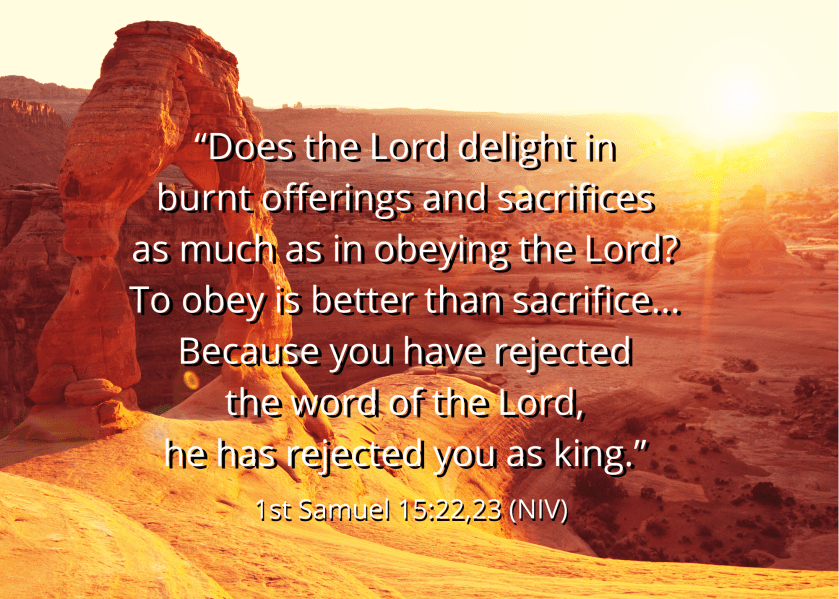
To obey is better than sacrifice.
To heed is better than the fat of rams.
The Lord regretted he had made Saul king over Israel.
However, in the town of Bethlehem, a young boy, ruddy, beautiful, and handsome, also stands among sheep. A young boy who has been slinging stones at predators, not knowing he would need to fell giants. A young boy who is learning obedience, learning hearing and obeying the word of the Lord. A boy, a man, after God’s own heart.
David.
Imagine you are Samuel. The last time you smelled lanolin, you had a king crying at your feet, ripping your robes, and it breaks your heart. You had anointed this tall man while he was chasing donkeys, through the desert, but he never truly learned how to be king, how to follow the commands of God. And you grieve.
And now, the boy covered in the smell of sheep walks in through the front door and the Lord speaks to your spirit “Arise, anoint him; for this is he.”
With a sense of irony you realize that you have seen the Lord change the times and the ages.
He took the kingdom of a king, and he gave the kingdom to another.
Two Kings among the sheep…
-Jake Ballard
Reflection Questions
Worship and Obedience: Because it is Sunday, there is just one difficult question for you. Today will be or was a day of worship. In Christ, our sacrifice is our heart and our praise to God. (Romans 12, Hebrews 13) However, have you been obedient to God? Have you done all that he has commanded? Are there any broken relationships that need to be mended? Are there any hurts for which you should ask for forgiveness? How can you be obedient to the prompting of the spirit, or to the commands of scripture? Or are you simply “worshipping” God, content that you are giving him something subpar, something less than the obedience he demands?
Sorry for the lack of “spoiler warnings”. He doesn’t make it.
What’s more sad and more of a shocker, is that he *could* have succeeded at being king. At building a dynasty for himself and his children. The language of 1 Samuel 13:13-14 is pretty clear.
“You have done foolishly. You have not kept the command of the Lord your God, with which he commanded you. For then the Lord would have established your kingdom over Israel forever. But now your kingdom shall not continue. The Lord has sought out a man after his own heart, and the Lord has commanded him to be prince over his people, because you have not kept what the Lord commanded you.” (ESV)
The foolish action of Saul was… sacrifice. Worship. How can that be wrong? Because it was not in accord with the commands of God. Saul was not supposed to do the sacrifice; he was supposed to wait for Samuel. Saul’s impatience and his presumptuous attitude caused him to fall into sin, because he did not obey the word of the Lord. He was keeping the “outward” signs of the law (the sacrifice) but not the details (who, how, when). He wanted the armies to see the sacrifice, rather than keeping it the way God wanted. This impatience and presumption becomes worse later in the story (chapter 15).
Saul is told that another is rising up in his kingdom. A man after God’s own heart, who would obey the word of the Lord. That is who will replace Saul.
But notice the end of verse 13 : “For then (if you had kept his commands), the Lord would have established your kingdom over Israel forever.” I don’t think Samuel is stating his own personal opinion here nor do I think he is speaking falsely. God was willing to allow Saul to have a kingdom dynasty. He would have allowed him and his children to sit upon the throne… if Saul had obeyed.
Far too often, we think all things are set in stone, that our days are done, that the story of our life is written. Before all time, before all actions, either God has claimed us or rejected us.
In glorious praise and holy fear, that is not true.
God would like to allow you to reign with Christ in God’s Kingdom. However, you have choices to make. Will you obey? Will you heed the word of the Lord?
If you do, then all your sins can be forgiven. God will forgive, God will restore, God will empower.
But, if you do not obey… “he would have established your kingdom”? More “he would have established you in his kingdom.”
You have choices to make. Rather a choice: will you obey the Word of the Lord.
-Jake Ballard
Reflection Questions
The Law We Obey: 1 John 3:23 tells us the commandment that we are called to obey now. What is new about this commandment? What is ancient about this commandment? How can you live out the commandment today?
The Perseverance We Have: In John 10:29, we are promised protection by the Father and that we, as sheep, are not going to be stolen away. How does this promise of protection relate to the story of Saul and the removal of his Kingdom? How does it relate to the choices we are called to make and the salvation we are called to have?
Once Saved, Always Saved?: While some people find comfort in phrases like “there is nothing you did to earn your salvation, so there is nothing you could do to lose it,” is that phrase true? Can people who have “seen the light” reject the salvation of God? (Check out Hebrews 6:4-6.) It seems obedient relationship with Christ through the power of the spirit is necessary for salvation! (1 John 5:2) Have you asked God to give you his spirit, so that you can obey the commands of Jesus?
Today’s Old Testament reading of Joshua 23 and 24 provides such good closure and an excellent way to wrap up the week. A farewell address from a man who had helped lead the Israelites into the promised land, and reminiscent of some of the things Moses said at the end of his life to the same people.
As I read Joshua 23 a phrase jumped out at me that was used several times. “Be careful!” As a mother, an occasional babysitter, a friend, neighbor, wife, and occupational therapist, this phrase is……one I try to avoid. Well, unless used more like Joshua. We’ve all said it, and chances are if we’ve survived this far, we’ve all had it said to us. It pops out before we even have the chance to think sometimes. What else would you say when seeing someone……dangling from the top of the climbing rainbow at Camp Mack, driving back to college, hiking with middle-aged directionally-challenged individuals in the Upper Peninsula, climbing up the bookcase while drinking from a bottle, using a walker to get around while trying to carry a cat, or pretty much any of the very exciting choices made by my “sensory seekers” at work.
The thing is, the phrase “be careful” is super abstract and subjective, and it just has very little meaning in most cases if left hanging in the air as it often is before…..kaboom/crash/oops. Given it is often said to children with little to no abstract reasoning capabilities, or in the case of many of my friends of all ages who come to see me at work, those who may not be emotionally or cognitively able to process that abstract language at the time…..it is far more useful with something concrete attached. You won’t hear it much where I work, though I assure you we witness many choices which are the opposite of careful. Instead, you will hear things like….“keep both hands on the monkey bars”, “push up from the chair first, then place your hand on the walker”, or a fun conversation I got to have recently, “Do you think that was too rough, too light, or just right?”…… “I agree. Bikes are for riding. The balls are for throwing.”
It seems as Joshua was saying farewell, he wanted the Israelites alerted to potential concerns, but he left them with excellent concrete directions. In verse 6 they are told to be careful, but at the same time instructed to know and obey the Book of the Law of Moses, to not associate with pagan nations, and to “hold fast” to the LORD. In verse 11 they are cautioned again to “be careful”, and instructed to love the LORD, to avoid intermarrying with pagan nations, throw away pagan gods, and serve the LORD alone. One would think the Israelites must have known a bit themselves by now that they kind of struggled with these things historically, and they were certainly still in reach of potential corruption and distraction. Joshua’s farewell address to them is a beautiful balance of cautious reminders and powerful directives laying out the choice they were given. Joshua chose for himself as stated in verse 15, and the people answered with their choice that day in verse 18….again in 21….and again in 24. We have the same choice, and we are blessed to have such tremendous access to the Bible for the concrete foundation on which to establish our worldview. We also have so many resources, commentaries, and Christians surrounding us with the freedom to seek clarity for the things we don’t understand or might need help getting tightened up from abstract to concrete.
So many rights could be wronged, if we all did what the Israelites said they would do….
“And the people said to Joshua, “We will serve the Lord our God and obey him.”
(Joshua 23: 24)
-Jennifer Hall
Questions:
If you tend toward being a “nervous Nellie” sort, or perhaps are just struggling with worry and being careful today, how could you redirect some of your attention to what you should be doing and who you should be trusting and serving?
If you might benefit from a few more cautious reminders in life or perhaps have some contamination from the world to throw away today, what can you extract from Joshua to apply to your life and mind?
What can you do right now to serve and obey the LORD?
To keep up with our reading in Job, starting back in chapter 38, God began His rebuttal to Job. God is still giving Job examples of his greatness and Job’s lowliness. He’s still responding in chapter 41. God could go on so much longer with His “Were you there when…”, “Who determined…”, “Do you know…”, “Can you….” questions. After a brief allowance for Job to respond in chapter 40, God jumps right back in with his proclamations. It certainly explains why God told Job to put on his big boy pants before he began (“Who is this that darkens counsel by words without knowledge?Dress for action like a man; I will question you, and you make it known to me.” Job 38:2-3)! More to come tomorrow….
Back in Deuteronomy 11, God tells the Israelites about the events that are now taking place in chapters 27 & 28. Deut. 11:29: “And when the Lord your God brings you into the land that you are entering to take possession of it, you shall set the blessing on Mount Gerizim and the curse on Mount Ebal.” Can you imagine? Two groups of men standing on different mountains shouting the blessings and curses which God will send based on their choices? Clearly God takes accountability seriously!
After reading the curses in 27:6 (and there are some pretty odd and icky ones), it wraps up with a very broad umbrella, “Cursed be anyone who does not confirm the words of this law by doing them”. God wasn’t going to allow any loopholes here!
Sadly, we don’t get to sit with this image of a loving, blessing-giving God for long. They jump right back into more curses. And in verse 45 he uses the same phrasing, “All these curses shall come upon you and pursue you and overtake you till you are destroyed, because you did not obey the voice of the Lord…”.
Remember, the Levites are proclaiming these loudly from facing mountains. Participating in the yelling or just listening to it, I imagine you would feel like the matter of us choosing to obey God or not is very important to God. They were obviously making a big deal out of it. Our choices matter.
Deuteronomy 27:9-10 says, Then Moses and the Levitical priests said to all Israel, “Keep silence and hear, O Israel: this day you have become the people of the Lord your God.10 You shall therefore obey the voice of the Lord your God, keeping his commandments and his statutes, which I command you today.” Moses commands the Israelites to obey. We have a choice – God gave us a free will to choose to obey or not. Moses simply tells the Israelites that since they are God’s people, they shall obey Him. If it were only that simple to do! But, isn’t it? Well, it should be.
Amy Blanchard
Reflection Questions
I read this beautiful definition of being overtaken by blessings, “the blessings of the Lord will be so abundant, that they will chase us down.” Have you ever felt overtaken by blessings?
Listening to the voice of the Lord your God will change you – your thoughts and behaviors and attitudes. If you are not seeing that change, first honestly look at if you are really listening to God’s voice. Read the curses. Read the blessings. And make your choice.
One of my favorite pastimes is sewing simple bags and quilts and occasionally even clothes. I love looking at fabrics and dreaming about what could be made with it. Yesterday I even drove four hours for a really good fabric sale – and lunch with mom -thanks mom! I can spend hours on the internet researching what people are making with their fabric, how did they do it and who has the best detailed directions to help me make what I want to make.
So, pretty much, Exodus 39 was written for people like me. The rest of you might not be too interested in the detailed step-by-step directions of what the fiber and gold artisans created for the priests to wear when they were ministering in the tabernacle. You might not be curious how they fastened the gold filigree settings which held the precious onyx stones to the shoulder pieces. You might not have nodded knowingly when they explained that a band was added around the neckline to prevent it from tearing because you saw the same need on the Nativity costumes.
But there is something big in this chapter that anyone can notice and appreciate – even those who have never in their life held a needle in their hand or contemplated making clothes. And that is the number of times the phrase, “as the Lord commanded him/Moses” is repeated. Seven times it is used just in the sections of chapter 39 regarding the priestly clothes. Additionally, the same or very similar phrases are used eleven more times in the rest of this chapter and the next as Moses inspects and then assembles in place all the final pieces of the tabernacle created by the craftsmen: the magnificent ark of testimony with its stately gold cherubim, the altar for burnt offerings, the altar for incense, the intricate lampstand, the wash basin, the courtyard curtains, bases and stands, and coverings, the garments and all the other pieces, right down to the ropes and tent pegs. When all these pieces are put together – just as the Lord commanded – then, they finally have a place where God’s glory would dwell. So why is it recorded 18 times in these two chapters that the work was done as the Lord had commanded? Perhaps because it matters to God if the work is done as He commands.
If I want to make an outfit I can find countless books and blogs, patterns, tutorials and videos showing me the steps I can take. Some create clothes I am just not interested in or wouldn’t fit me at all. Others have glaring errors, or sometimes even little mistakes that end up making a big difference in the end: missed steps, mismeasurements, or sloppy work. It can be a big challenge finding the best directions I can truly trust that will help me create the final product I desire.
Similarly, there are countless sets of directions for how to make the life you desire. You can find directions for life everywhere: TV commercials, movies, self-help books, classrooms, churches, parents, peers, and endless online sites to name a few. Some directions I know I am not interested in at all: the end product wouldn’t fit me, just isn’t my style or not what I am looking for. Others look like they would create a life that would be perfect for me. But, it turns out the directions have errors: they don’t include all the proper steps, they add in steps that trip you up, they don’t give the correct measurements, they use materials that won’t stand up to the wear and tear life brings, they lead to sloppy work and sloppy lives. If I follow those directions my finished product will not be what I intended to create.
God alone has the best detailed directions for making what I want to make – a life devoted to Him, ready for His Son’s return, and ready to dwell in His glory forever and ever. While I wait for His full glorious kingdom on earth, I want to make a place – my life – where a sliver of God’s glory dwells in me and shines through. In order to create this project I need all the pieces created just as He commands. I need to use all the proper materials and resources and carefully follow the step by step tutorial I trust. The directions God gives in His Word tell me every step I need to take, and those I don’t need and those I definitely don’t want. Following God’s directions and commands will keep me from creating a sloppy life with fraying edges. God knows the best way to do life, will I listen and do as the Lord commands?
God knows. How often I forget. God knows the best way. His commands can be trusted. In Exodus 39, this seamstress loves that God even knows how to keep the neckline from fraying – and he tells us – add a band. Do it right. Follow the Lord’s commands and the end product will be a thing of beauty that brings glory to Him.
We have work to do. Will we do it the way God commands?
-Marcia Railton
Reflection Questions
As I considered all the gold and ornaments and details God chose for the priests I had two thoughts regarding our worship today. 1 – While our pastor’s roles are different from the priests of Moses’ day, I wonder if God wants us to show more honor and respect to their position than we do, even if they no longer wear jewels on their breastpiece. 2 – Maybe God cares a bit more than we previously thought about our own attire when we come before Him. What do you think?
Why do you think it mattered to God what the priests wore? Why do you think it mattered to God what the tabernacle looked like?
What kind of a life are you working to create? Whose directions are you following or are you making up your own? What bad directions have you already decided you won’t be using? What does following God’s directions look like?
In yesterday’s reading of Exodus 35 God filled the tabernacle craftsmen (Bezalel, Oholiab and others) with his Spirit providing them with the skill, ability and knowledge to do the work the Lord desired them to do for Him. In today’s reading of Acts 2 God pours out His Holy Spirit on Jesus’ followers and they, too, are enabled to do the work the Lord desired them to do for Him. This time the Spirit was not delivering the ability to create beautiful gold cherubim and lampstands or embroidered curtains. God had a different job in mind for these workers.
In the Old Testament we see the Spirit given, or described as “in” various leaders so they are able to carry out the work that God wants them to do. Joshua is chosen to succeed Moses due to “the spirit” in him (Numbers 27:18). Gideon receives the Spirit of the Lord, and he blows a trumpet to assemble an army to go up against the Midianites (Judges 6:34). Ezekiel records that the Spirit came into him as he heard God call him to be a prophet to carry God’s words to the rebellious and obstinate nation of Israel (Ezekiel 2:1-4). And there are other instances found in the Old Testament. Sometimes the spirit was given to provide gifts of leadership and skills (including but definitely not limited to craftsmanship). Sometimes the spirit was given to embolden and provide power and strength to overcome the enemy. Sometimes the spirit was given to the one chosen to carry God’s precious words and warnings of His judgment to God’s people, whether they listen or not. The Spirit was a special gift to those leaders willing to do what He says and do His work.
Fast forward to the beginning of Acts and we find Jesus’ followers who had witnessed Jesus’ death and the empty tomb now get the privilege of 40 days with the risen Christ as he tells them all about the kingdom of God. He also tells them his Father has a gift for them – but they can’t have it quite yet – they have to wait for it in Jerusalem (Acts 1:4). Can you imagine their excitement! They are ready to see this kingdom start. They are ready for their gift. They might even be thinking the hard part was now behind them. They had followed Jesus for 3 years. They had watched him die. But now Jesus is alive and by their side and the kingdom is around the corner. Little kink in their plan, Jesus tells them only the Father knows when it will begin; but he encourages them with these words: “You will receive power when the Holy Spirit comes on you; and you will be my witnesses…” (Acts 1:8). THEN, Jesus leaves, again! He isn’t dead, he is very much alive this time, raised in the clouds to heaven and the men in white assure them that this same Jesus will return the same way. What should the disciples do next? Probably obey. Go to Jerusalem and wait for that gift Jesus mentioned.
They do what Jesus told them to do and in Acts 2 they are waiting in Jerusalem. Perhaps receiving the gift requires obedience first. Approximately ten days later, on the Day of Pentecost, the gift was delivered – and what a delivery it was. Much more dramatic than a singing telegram or balloon delivery, the gift was accompanied with the sound of a violent blowing wind. I have never heard a tornado myself, but it is often described as the sound of a freight train getting closer and coming at you. Imagine hearing these violent winds coming into the room you are in. And what you hear is only surpassed by what you see: a ball of fire suspended in the air which then separates as a tongue of fire comes to rest on each one of you! God was definitely getting their attention with this gift delivery! I think He wanted them to always remember this moment and never doubt that He had indeed delivered what Jesus had promised his Father would deliver.
In fact, Jesus was not the first one to promise the delivery of this gift. Many years earlier the prophet Joel had foretold of a time when God would, “Pour out my Spirit on all people. Your sons and daughters will prophesy…even on my servants, both men and women, I will pour out my Spirit in those days and they will prophesy.” (Joel 2:28-32 and Acts 2:17-21). This was now a pouring out of God’s Spirit! It was not just for a few select leaders who had a job to do. Now everyone seems to have a job to do! The sons and daughters, young and old, even on my servants, both men and women, Joel says God says. So pour that Spirit on – they are going to need it! They are going to prophesy and speak for God. Prophecy is sometimes thought of as just foretelling the future but it actually includes hearing and speaking for God whatever message He sends.
And this time He sent His message in many foreign languages, all at once, to the disciples who had previously not known or understood or spoke these foreign languages, but now their words were heard and understood by the Jews gathered from many foreign lands and tongues. “All of them (the Jesus followers gathered in Jerusalem who had just heard the wind and saw the tongues of fire land on each of them) were filled with the Holy Spirit and began to speak in other tongues as the Spirit enabled them” (Acts 2:4). Turns out God not only wanted to get the disciples’ attention – but also the attention of all the Jews from many foreign lands and tongues who were in Jerusalem for the Day of Pentecost celebration. The people each hear their own language from these Galileans and they are amazed and perplexed – and listening!
So Peter stands up and speaks for God – with an amazing sermon in Acts 2 you don’t want to miss! This is the same Peter who approximately 53 days earlier denied Jesus three times. He wouldn’t even admit to the servant girl that he had been with Jesus. This is the same Peter who wept at his weakness. Now he is preaching to the multitude to tell the Jews of every nation about Jesus whom God has made both Lord and Christ. The Spirit makes a difference -a big difference. Peter explains from Joel, to the man Jesus. He explains to the Jews how they put Jesus to death and God raised him to life, freeing him from death. He explains how David is in the grave, but Jesus is not. When the people hear, understand and are convicted they ask what they must do. Peter replies, “Repent and be baptized, every one of you, in the name of Jesus Christ for the forgiveness of your sins. And you will receive the gift of the Holy Spirit” (Acts 2:38). Obey these steps – and the gift is ready for you.
God’s gift of His Spirit is no longer just for the Bezalels, Joshuas, Gideons, and Peters. It is no longer just for the disciples who physically walked with Jesus. Now, if you repent and are baptized, this gift is for you! Are your ready to obey and do the work God has for you? You, too, can receive the gift of God’s Holy Spirit to do the work that God has for you to do. The gift is not always delivered with the sound of violent winds and tongues of fire. What the gift enables you to do still depends on what job the Lord has for you to do. Without it, you are weak. With it, comes power, words, skills, and energy you are not capable of on your own. Are you ready to receive God’s gift?
-Marcia Railton
Reflection Questions
What are your thoughts on God’s Spirit? What does Scripture teach about God’s Spirit?
What work do you think God has for you to do? Are you already using His Spirit to do this work?
What does one have to do to receive God’s gift of His Spirit?
I have been involved in many food service jobs over the years, including food delivery. There was one particular food delivery job that I will never forget because of the absurdity involved with my employer. I had signed up to simply deliver food from restaurants for a company that was like a local GrubHub or UberEats. Things went along smoothly for the first month, until my employer got a wild idea: he wanted to deliver the local newspaper as well (he was nervous about losing business because of larger companies coming into town). For the second month, I was taking on a newspaper delivery route, as well as taking food orders when I could (sometimes working 12-hour days). It didn’t take long before I left that job because it wasn’t what I signed up for: my employer was adding requirements to the job that were not agreed upon from the beginning.
Does this happen in church too? When it comes to eternal life and being saved, do we add requirements that were not originally stated by Jesus or the apostles? Jesus encountered this in our passage today with the Pharisees and scribes. They were teaching that one must wash their hands before eating in order to be “pure” before God, something that is called the tradition of the elders. While washing your hands is still a good practice, there was nothing in the Old Testament that ever stated this as a requirement: God was not requiring this to be in His presence, but men were. They were seeking control over the people and adding requirements that were not original.
Unfortunately, the Church today oftentimes does the same thing: adding requirements for salvation that were not original. For example, the Nicene Creed (325 AD) that is recited at many churches today states that Christians must believe that Jesus is “true God from true God, begotten, not made, consubstantial with the Father…” There isn’t a single verse in Scripture that describes Jesus in this way, but it is a required belief for salvation in many churches today. Not only that, but there are usually cultural expectations in many churches that are required for fellowship, such as the clothing you wear or the way you have your hair put up.
What does Scripture say about salvation? “If you confess with your mouth Jesus as Lord, and believe in your heart that God raised him from the dead, you will be saved.” (Romans 10:9) Many might call me a minimalist, but I don’t believe Jesus intended salvation to be complicated: it’s difficult to make him the Lord of our lives and do what he says, but it’s not complicated. It is supposed to be simple enough for a child to understand (Matthew 18:3).
Reflection Questions
What church traditions are alive around you that are beyond Scripture?
What have you been taught is required, even if it’s not found on the lips of Jesus or the apostles?
The book of Jonah fascinates me. I think the main reason is that my understanding of it has changed so much since I first heard the story as a child. And honestly, even now when I read it, my opinion of Jonah is still changing as I keep changing.
In children’s’ classes, the story of Jonah is typically used as an example of obedience to God. He didn’t listen at first, but then he was swallowed by a large fish and changed his mind and went and did what God told him to do. So that was my opinion of Jonah growing up for the most part – great example of obedience.
I know I had read through the whole book, but I must have glossed over the ending. As a parent, I understand why most classes do stop at Jonah’s obedience to God in going to Nineveh. My kids need good examples. They don’t really need more ideas of bad behavior or attitudes – they can come up with plenty on their own.
When I got a little older and continued to read through this story, it finally struck me – yes, Jonah did obey God’s direction to go to Nineveh, but 1) that was after he had been swallowed by a giant fish, lived, and was spit back out, and 2)his behavior is like a child telling a sibling they were sorry for hitting them because they were told by their parents to do that. Not because they really felt sorry and wanted to, but because they were made to. His obedience didn’t really seem to come from the heart.
And we see that as the book continues. He did what God asked. He told the Ninevites that they were doing bad things and that God was going to destroy their city. And this changed their lives! They turned from their evil ways – at least for a time; we do know they went back to evil – but Jonah didn’t care about that. He only wanted to see the destruction that he preached.
While this isn’t the example I want to present to my children, I get it. Jonah speaks to me as an adult as a reminder that I can’t just do the “right” thing. I have to do it with the right heart. It reminds me of 1 Corinthians 13 which lists all these things that one could do that are good, but says “but if I have not love, I am nothing.” We can do all the right things. By the book. But if we do them without love, does it really matter?
The Ninevites were saved for a time by Jonah’s preaching. His reluctant obedience made a difference for their lives. But did it make a difference in Jonah’s own life? I think God can use our reluctant obedience to still make a breakthrough to others, to serve them. But when we do things without love, we miss out on the best God has for us – the joy and blessings of serving.
More on Jonah tomorrow.
~Stephanie Fletcher
Reflection Questions
When have you obeyed – but reluctantly and with a wrong heart? In your case was that better than not obeying at all? How might have things been different if you had obeyed – done the right thing – with a right heart?
Re-read Jonah’s prayer in Jonah 2. What do you learn from Jonah in this prayer?
12 Even now— this is the Lord’s declaration— turn to Me with all your heart, with fasting, weeping, and mourning. 13 Tear your hearts, not just your clothes, and return to the Lord your God. For He is gracious and compassionate, slow to anger, rich in faithful love, and He relents from sending disaster. Joel 2:12-13 (HCSB)
Today we’re going to read the book of Joel (hey, that’s my name!). It is one of the shortest books in the Old Testament, so I’ll keep my thoughts on it brief. It was written as a wake up call to God’s people. As you’ve been reading through the Prophets, it should have been quite apparent that God wasn’t the happiest about the actions of His people. That’s why we have this particular section of scripture; if Israel hadn’t messed up so bad, God wouldn’t have had to tell them so. Joel doesn’t say much different than the other Prophets; he is just rehashing the same message because apparently, Israel still hasn’t learned its lesson. Here’s the condensed version of the message: you’ve sinned and made God angry, but He loves you and wants you to live, so turn away from your wickedness.
This message, which was proclaimed to the Jews first, is just as relevant today for us as it was then for them. Only today we have the added part: God loved you so much He sent His only begotten son so you can live eternally (John 3:16). We still live in nations full of wickedness, we still raise idols to a status reserved only for Yahweh, we still do wrong when we know what’s right, and we still let the ungodly have undue influence over us. The words spoken through the Prophets to the people of Israel still hold value for us, and I hope we will do a better job heeding them than the original recipients.
-Joel Fletcher
Reflection Questions
What idols do you/have you raised to a status reserved only for Yahweh?
What wrong do you do when you know what is right?
In what ways have you let the ungodly have undue influence over you?
What does the book of Joel reveal will happen to those who don’t return to the Lord? What is revealed will happen to those who do?
I was touched by the beautiful imagery of the LORD calling to Israel as a child. Teaching him to walk and taking him into His arms. Here the LORD is also leading with kindness and bonded to His people in love. And I can just imagine a compassionate care taker releasing an animal from its burden-taking off the bridle and bit to allow the animal to freely eat and drink. The love and compassion of God are so evident in these passages. But Israel’s obstinance is also evident. These collections of poetry are calling out again to the people. Turn to God, do what is right and be saved. God desires for people to come to Him to be healed, forgiven and saved, but as we have seen over and over, the people continued to reject Him.
We are told what the result is, “Because there is no faithfulness or kindness or knowledge of God in the land. There is swearing, deception, murder, stealing and adultery. They employ violence, so that bloodshed follows bloodshed. Therefore, the land mourns, and everyone who lives in it languishes (4:1-3a)”. It is disturbing that this scripture could be describing parts of our own country today. But the poetic words of the prophet Hosea still speak through this book. Telling us about the LORD’S perfect character and His justice. We still hear a main theme of not rejecting, but accepting and remaining faithful to our God. How horrible to become stubborn and self-willed against the Only True Living God. That is a place that we never want to occupy. Unfortunately, I know that we could name some individuals who have turned away and have chosen lives that are in complete opposition to God. But we want to be those that faithfully hold to God. Hosea 14 describes it this way, “Whoever is wise, let him understand these things; Whoever is discerning, let him know them. For the ways of the Lord are right, and the righteous will walk in them, but transgressors will stumble in them (v.9)”. Hosea explains that someday the sons of Israel will return and seek the LORD their God; they will come trembling to the LORD and to His goodness. It is incredible that we can know, walk with, and most of all be in a loving relationship with Him right now.
-Rebecca Dauksas
(originally posted for SeekGrowLove on November 4, 2022)
REFLECTION QUESTIONS
How is your nation like Israel? How are they different from Israel? How are you like Israel? How are you different from Israel?
How would you describe God as a parent?
How will you respond as His child? When have you been rebelled against Him? What is His desire for You?








 Seek Grow Love