Prayer and Thanksgiving

Theme Week – Thanks: Philippians 4

Old Testament: Ezekiel 45 & 46

Poetry: Psalm 111

Some laws we have make very little sense. 

In Los Angeles, you can’t use silly string on Halloween. 

In the UK, you can’t “handle salmon in a suspicious manner.”

In Barbados, you can’t wear camouflage. (Sorry, hunting fans!)

However, once you know the context, these laws begin to make sense. 

In LA, it cost the city nearly $200,000 to clean up the silly string every year from just Halloween. 

In the UK, they were trying to stop illegal salmon fishing, and it’s a crime to take fish that you suspect to have been illegally fished. 

In Barbados, the government has decided that the Defense Force are the only people who can wear camouflage (like a uniform) and wearing camo might be seen as an attempt to impersonate an officer. 

In Philippians 4, Paul gives a couple commands that, on the surface, seems to make very little sense. 

“Rejoice in the Lord always; again I will say, rejoice!” (4:4)

And 

“Do not be anxious about anything.” (4:6)

It’s almost like Paul doesn’t know what it is like to be human! We can’t control our emotions. I don’t choose when to be happy, or when to be anxious. Nor does anyone else, though we try ; over 12% of the US population over age twelve take antidepressants and 6% of the population is on anti-anxiety medication. What a strange command that makes very little sense. 

Until we add context. 

To “rejoice” is not “feel happy” but “find joy in”. Joy is not the ephemeral, fleeting happiness that comes and goes based on what happens to us moment by moment, but the unshakeable reality that God’s desire for us is to be blessed by him forever. Will we have pain, heartache, grief and mourning in this world? Yes, because it is fallen. However, we don’t rejoice because of those things, but in the midst of those things, we are commanded and encouraged to find our joy in God. God’s grace, his gifts, and his promises will always outweigh our pain in the grand scheme of the universe. One day, all will be made new, and the old things will pass away and only the new and eternal will remain. 

Similarly, God does not expect us to overcome our worries and cares for the future through sheer willpower ; instead he says “do not be anxious about anything, but in everything by prayer and supplication with thanksgiving let your requests be made known to God.” The command is more than not being anxious, but about being in relationship with the one who overcomes our anxiety, and who overcomes our depression. 

I hope this week, as you have been spending 5, 10, or 15 minutes thanking God for the good things in your life, that you begin to recognize that God appreciates your thanksgiving, but also cares about your prayers and supplications. He hears it all and he is always working for your sanctification, your salvation, and your life to be abundant. He is working to bring joy in your life, joy found in what Christ has and will do in you, and to meet your needs so you will not need to be anxious. 

APPlication & Reflection

Today, instead of having questions to answer, take the time to 

Pray to God. 

Give him thanks.  

Let him know all that is on your heart that makes joy seem so far away, and all that is on your mind that makes anxiety close at hand. 

As you do, may “the peace of God, which surpasses all understanding, … guard your hearts and your minds in Christ Jesus.” (4:7)

-Jake Ballard
Generosity and Thanksgiving

Theme Week – Thanks: 2 Corinthians 9

Old Testament: Ezekiel 43 & 44

Poetry: Psalm 110

When Abraham (still Abram at the time) was called by God to set off for unknown lands, to seek adventure in going to the place that God would show him, we see that God not only tells him what he is doing, but WHY he is doing it. Genesis 12:1-3 reads this way :

“Now the Lord said to Abram, “Go from your country and your kindred and your father’s house to the land that I will show you. And I will make of you a great nation, and I will bless you and make your name great, so that you will be a blessing. I will bless those who bless you, and him who dishonors you I will curse, and in you all the families of the earth shall be blessed.””

So that you will be a blessing. 

In you all the families of the earth shall be blessed. 

Interesting, isn’t it? Abraham is blessed to be a blessing. When we use that terminology, blessed to be a blessing, we begin to understand that is what happened with every person God used. 

God blessed Abraham with a family so that there will be those who follow God.

He blessed Moses with the Law so that that Israel might walk in his ways. 

And he blessed the prophets with his Word so that the people could be drawn back to God. 

Again he blessed the Kings with success so that there might be peace. 

Ultimately, he blessed Jesus with his Spirit so that the world might be saved. 

But don’t hear Abraham, Moses, Prophets, Kings, and Jesus and think these blessing are out of your reach!

In the time of Paul, Jerusalem was undergoing a severe famine and the church in Jerusalem were rather poor. In contrast, Corinth would have been an extravagantly wealthy region ; a port city with a major trading lane would cause riches to flow in. Paul, in his missionary journeys, encourages the Gentile churches to share in the needs of the poor in Jerusalem. Paul encourages the Corinthians to give generously and cheerfully. He lets them know that they “will be enriched in every way to be generous in every way.” Blessed to be a blessing. 

Often, human look at life as a zero-sum game: if I give what I have to someone else, then I lose and they win. But Paul reminds the Corinthians that this world is not a battle of wealth between the haves and the have-nots. “God is able to make all grace abound to you, so that having all sufficiency in all things at all times, you may abound in every good work.” (2 Corinthians 9:8) If God owns the cattle on a thousand hills (Psalm 50:10), do you think he is unable to meet your needs, even when you give “until it pinches a little.” C. S. Lewis speaks about the amount one “ought” to give and he writes “I am afraid the only safe rule is to give more than we can spare.” We might be afraid to give generously, but only in giving generously will we receive generously, just like the farmer can only reap bountifully when he sows bountifully. 

I want to be very clear : when Jesus prayed for his care from the Father, he asked for bread (“daily bread”) and water, rather than steak and Starbucks. This is not a lack of the provision of God, but the reality that giving extravagantly and full of joy does not mean that we will receive a sudden windfall, or be able to buy the nice car. God is not concerned with your riches or wealth in this life but with your obedience. God promises to care for your needs, not necessarily your wants. Obedience does produce something infinitely valuable though : the ability to do more good. ”So that you may abound in every good work.” “You will be enriched in every way to be generous in every way.” Your generosity will “produce thanksgiving to God… overflowing in many thanksgivings to God.” And we have seen how important thanksgiving is. In fact, that is what Paul ends this encouragement to give with, thanksgiving!

 We see that God wants us to give cheerfully and generously, and he will continue to bless us to be a blessing. Our giving is done because we know that every blessing given is already a gift, and everything we own belongs to the God who owns everything. As we give, we can remember that God has already given the greatest gift of all, and our generosity can and will result in thanksgiving to God for his inexpressible gift!

-Jake Ballard

Questions and Application

  1. “Blessed to be a blessing.” :  Have you thought about how this description defined so much of the interaction of God’s people with the world? What are some of the blessings you have been thanking God for this week? How can you use those blessings to bless the world around you?
  2. “Trusting God with Generosity” : Lewis’ call to give more than we can spare requires that we trust that God will meet our needs even when budgets seem to say we can’t. Not everyone is called to sell everything they have and give to the poor, but some were (and maybe are). How much is the right amount to give for you? Who around you needs to be blessed?
  3. “Supplying the needs of the saints” : I have tried to be very clear that Paul was talking about giving money. We should give money to make sure we meet the needs of those around us who lack funds. There are three important points to remember. First, if we are young and don’t have a job, it is very hard to give money. A way to help is to give what you can ; your time or your talents, for example. Second, however, if you give of your time and talents, that doesn’t excuse you from giving money if you can. You should be willing to give everything to God, time, talent and treasure (money). Third, and the opposite of the last points, if you give money to a ministry, that is not a substitute for volunteering your time and abilities. All three, the time you are given, the talents (abilities) you have and the treasure (money) you own, are blessings from God, and are given so you can bless others. 

Holiness and Thanksgiving

Theme Week – Thanks: Romans 1

Old Testament: Ezekiel 41 & 42

Poetry: Psalm 109

Yesterday, we learned that giving thanks to God is a part of our duty as those saved by grace through faith in Jesus. Today in Romans we see what happens to our souls when we don’t give thanks to God. 

In the magnum opus that is Romans, Paul lays out the case that Jews and gentiles both are redeemed by grace through faith in Jesus, that we are all members of Israel made new and we all can be grafted into the people of God. But to get to that point, Paul has let us know there is some bad news ; people are unrighteous. To be clear, God is angry at sin and those things that oppose his good will upon the Earth. God’s desire for humanity has been “made clear” by his creative action and people are without excuse to worship him. (Rom. 1:18-20)

Then we get to the point : “For although they knew God, they did not honor him as God or give thanks to him, but they became futile in their thinking, and their foolish hearts were darkened.” (Rom. 1:21)

Read that again : Paul seems to be connecting what they did not do and what happened to them. When people who could know God do not honor him or give thanks to him, they THEREFORE become futile in thinking and have darkened hearts. Which could also mean that if we want to not become futile in our thinking, if we do not want our hearts to remain in the dark, we need to honor God as God and give thanks to him. 

Now, let’s be clear about Paul’s point : we are not going to give thanks to God enough to be saved. Romans presents a powerful case that we can’t save ourselves! “We have all sinned and fallen short of the glory of God” (Rom. 3:23) and “the wages of sin is death.” (Rom. 6:23) However, we also remember what God gave: “the free gift of God is eternal life through Jesus Christ our Lord.” (Rom. 6:23) 

Rather than simply “being thankful”, today give thanks to God for Jesus Christ our Lord, through and in whom we have salvation : “Thanks be to God through Jesus Christ our Lord… There is therefore now no condemnation for those who are in Christ Jesus.” (Rom. 7:25-8:1)

Application and Reflection

Paul gives us a number of different ideas of what to be thankful for today : 

  1. Paul gives thanks to God for the church in Rome. (Rom. 1:8) When was the last time you gave thanks to God for your local church? Your local youth group or youth pastor or pastor? Take a moment to give thanks to God for that today.
  2. Paul gives thanks to God for the salvation of others! (Rom. 6:17) Look around at your mom, dad, brothers, sisters, and other family. Think about those people around you who know the salvation of God found in Jesus. Thank God for those who know Jesus around you. If you have some people who need to know more about Jesus and God, how can you share the gospel message of salvation by grace through faith with them?
  3. Paul says that we should give thanks for our food (Rom. 14:6) Will you take the time before every bite of food today to remember that God has given you this food? Will you make sure that God is honored by your thanks today?

-Jake Ballard

Unworthy Servants and Thanksgiving

Theme Week – THANKS: Luke 17

Old Testament: Ezekiel 39 & 40

Poetry: Psalm 108

By Luke 17, Jesus has set his face to go to Jerusalem (Luke 9:51), and every step he takes is taking him one step closer to his ultimate act in this world : his death for sin upon a cross. 

With that in mind, he knows the days of ministry are limited. On the way to Jerusalem, he entered a village, and he sees ten lepers (people who suffer from various skin diseases) who are unable to participate in community life due to laws in the Torah. In a culture like Judea in the time of Rome, family, community and tribe were not just important; they were what gave life connection, purpose, meaning. To get a skin disease which banished you from community was akin to a living death. These suffering people look to Jesus the one who can heal them, as their “Master”. 

Interestingly, the last words Jesus said before speaking to these men, in Luke’s narrative, were of masters and servants. Specifically, masters do have authority over their servants or slaves. They have the authority to command them to work and rest only when the master’s wishes are fulfilled. To post-chattel-slavery-American ears, we recoil in horror about how masters might have treated their slaves. But Jesus’ point isn’t about the actual institution of slavery but about how his disciples should consider their own responsibility when following him : “When you have done all that you were commanded, say, “We are unworthy servants; we have only done what was our duty.”” Jesus wants his disciples (that’s us) to recognize that the God who owns all things owns us, and the savior who saves all people saved us. Therefore, God and Christ deserve all things, and when we give them our all, we are not going above and beyond the call of duty, we are giving God and Christ exactly what they deserve. 

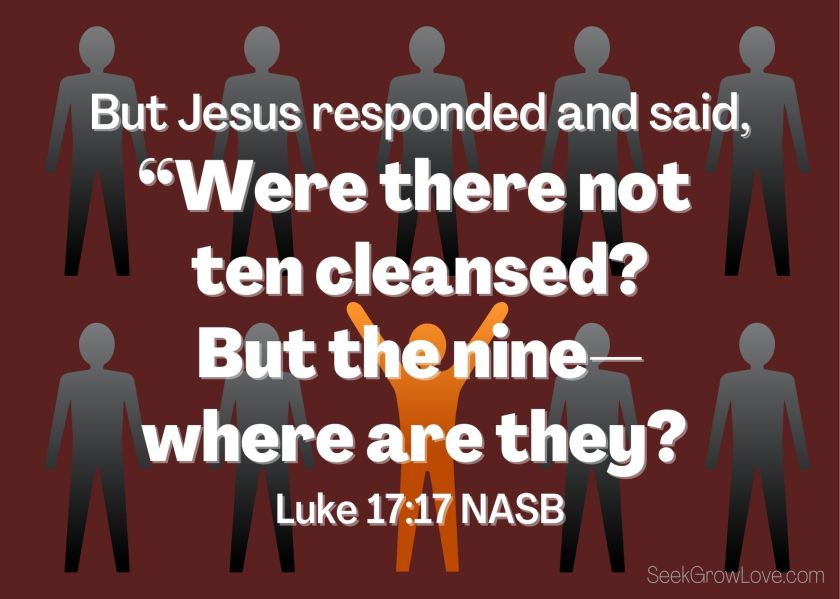
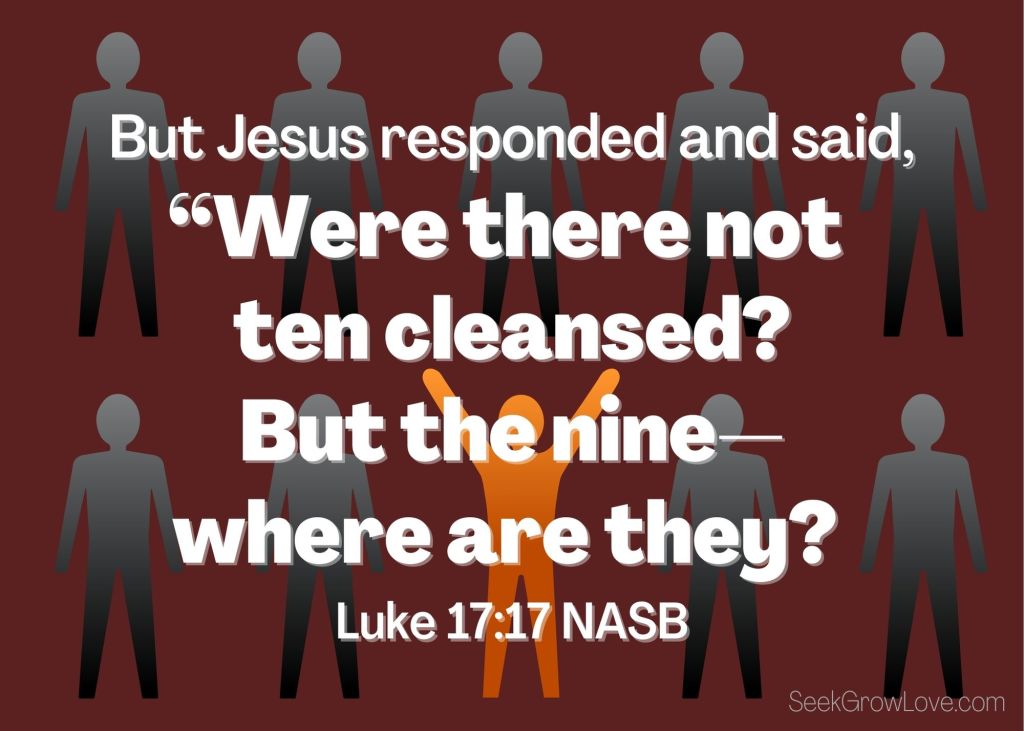
Jesus tells the lepers to go and show themselves to the priest. This is a reference to a priest being able to see if they are “clean” in order to fulfill Torah and allow the unclean to return to community. Note: he does not heal them. He says “go” and “as they went they were cleansed.” It was in the going, it was in the action, the trusting, the faith that they were cleansed, made whole, restored. 

But one stopped. 

One turned around. 

One praised God in a loud voice. 

One fell at the feet of the Master Jesus. 

One gave thanks. 

Jesus seems to expect the other nine, inquires into there whereabouts, but looks with grace at this Samaritan leper-no-more, and says “your faith has made you well.”

Giving thanks is not an element of the Christian faith that moves us from normal to turbo-charged-Christianity

Giving thanks is a vital part of understanding that God, who owns all things, has given us all things. (Rom. 8:32) Giving thanks is a vital part of understanding that Christ, our Master and Savior, gave himself to save us upon the cross, and by his wounds we are healed. (Isa. 53:5-6) Giving thanks is a vital part of the Christian faith, because God and Christ deserve all things, and to give them thanks and to shout loudly the praise of God and fall at the feet of Christ is the most common, natural, expected response to those who have been saved by grace through faith. 

When we give thanks, we are not being amazing, super Christians, wonderful and worthy of praise ourselves. 

When you give thanks and give it all to God, then say, “We are unworthy servants; we have only done our duty.”

-Jake Ballard

Reflection Questions

  1. When we consider our position as Christians, we are slaves, bought from one master (sin, death, the devil) to serve another (God through Christ). Do you bristle at the thought of being a slave or a servant? We are being adopted, heirs of God and coheirs with Christ (Rom. 8:17), but one image doesn’t completely negate the other. Why do you and I feel uncomfortable with being own by the God who already owns everything?
  2. “Your faith has made you well.” I find it interesting that Jesus, who seemed to be very necessary in the completion of the miracle, implies that the man was cleansed by his own faith, as if Jesus didn’t have anything to do with it. Why is this phrase used here and in other miracles? Is Jesus implying that he was not needed or is this humility? How should we understand this phrase to a man who was healed “as he went”?
  3. When was the last time you gave God thanks for everything in your life that you could remember? Try it this week. Everyday, after devotions, spend 5, 10, 15 minutes in prayer, thanking God for everything good in your life, in your family, in the world. Let this week be a week of giving thanks, and still realize that this is our appropriate response to the God who gives every good and perfect gift. (James 1:17)

Good!

Old Testament: Ezekiel 23 & 24

Poetry: Psalm 100

New Testament: Revelation 15

I chose to write about Psalm 100 because of how much we can learn from it despite its shortness. This is a great chapter to read, and it only takes a minute of your whole day. The first thing I would like to point out is that in verse four it says, “Bless his name.” This verse is talking about God and how we should give thanks to him and bless his name. Now if you’re like me you might be thinking, why should we bless God’s name? Well, God blessing us and us blessing God are not the same thing at all. God does not profit from us blessing him. It’s not like he gets stronger or better anytime someone blesses him. On the other hand, when God blesses us, we benefit from it. In this verse, it is talking more about how we should praise him.

Throughout the whole Psalm, it talks about how we should praise God. As a church, I believe we should be more joyful, and excited. This Psalm is a great example of how we should praise God. It tells us we should serve God with gladness, shout joyfully, enter his gates with thanksgiving, and give thanks to God.

Usually when we think of ‘good’ we use it to mean something between ok and great. But in this passage, it is saying that he is righteous and about how great God is. This reminds me of the popular song below:

God is good, all the time

And all the time, God is good.

This Psalm is a great one to meditate on. Here are some points from Psalm 100 that you can meditate on.

God made us

We are the sheep in his pasture

The Lord himself is God

His lovingkindness is everlasting

The Lord is good

His faithfulness continues to all generations

Throughout the whole book of Psalms, it says, “His lovingkindness is everlasting”. In fact, it says it 34 times. Of those 34 times, 26 of them are all in Psalm 136. It even says it in every single verse.

Even in this short Psalm we can take so much from it.

-Makayla Railton

(Originally posted for SeekGrowLove on January 26, 2018)

Reflection Questions

  1. Do you believe the Lord God is good? Why?
  2. How can you work to bless His name today?
  3. Where can you post Psalm 100 to see and remember it often?

1 Out of 10

*NEW TESTAMENT: LUKE 17

Poetry: Psalm 117

Old Testament: Ruth Intro below

(and I forgot to include Judges 21 yesterday, so you can finish that up today)

The story of the ten lepers is familiar to many of us. Luke 17:11-21 is often included in youth Sunday School lessons as a powerful tale of healing and to give thanksgiving. In the parable, we read about the ten men who were cleansed but learn that only one returned to give thanks to Jesus. Often, we use this parable to teach young children about the importance of giving thanks.

Though like many, I learned this tale in my youth, it wasn’t until my adulthood that I more fully understood the need for thanksgiving. Verses 15-16 of this parable are what jump out at me as an adult. “Now one of them, when he saw that he had been healed, turned back, glorifying God with a loud voice, and he fell on his face at His feet, giving thanks to Him. And he was a Samaritan.”

It’s interesting to me that it’s specifically pointed out that the man who returned to give thanks was a Samaritan. This man had a double whammy in society! First, he had leprosy and would have been kept apart from others. Secondly, he was a Samaritan, considered less than desirable among people of Jesus’ time. In that simple phrase at the end of verse 16, we see yet again that Jesus’ ministry sought out and served the marginalized people. Healing and grace was for all people, not just an elite few.

That phrase jumps out to me, because at heart, I am a Samaritan. I’m one of the less desirable that Jesus came to save. As a youth, I didn’t have life experience to fully appreciate and understand the gift of God’s grace or the need for thanksgiving. As an adult, I have both the education of life and Bible study to have a full awareness of God’s grace and mercy. Just like the marginalized people that Jesus served in His day, I am in great need of healing and grace due to my sin. 

Verses 15-16 also strike a chord in me because of the manner in which the leper gave thanks. Look at the way he praised Jesus! He used a loud voice and he fell on his face before Christ. He did not shrink in giving praise and thanksgiving because he understood the power of the healing bestowed upon him. He had a true gratitude to Jesus. Do we have a true gratitude for the way in which we have also been saved?

Oh, how I want to praise Jesus just like the leper who fell at his feet! He has given me much, so let me praise him much! In our lives, can we live out Psalm 117? “Praise the Lord, all nations; Laud Him, all peoples! For his lovingkindness is great toward us, And the truth of the Lord is everlasting. Praise the Lord!”

Today, can you offer true gratitude for the mercy and loving kindness that God has offered to us through the gift of Jesus’ life on the cross? Can you share that mercy with others? As a church, can we seek out the marginalized people of our society and offer them the same love that Jesus lived in His ministry?

~Jen Siderius

Reflection Questions

  1. How can you (will you) offer true gratitude for the mercy and loving kindness that God has offered to us through the gift of Jesus’ life on the cross?
  2. How can you (will you) share that mercy with others?
  3. As a church, how can we (will we) seek out the marginalized people of our society and offer them the same love that Jesus lived in His ministry?
  4. In our Bible reading today what do we learn about God? What do we learn about Jesus? Why do you think it says that as the cleansed leper was throwing himself at Jesus’ feet he was praising God?

Ruth Introduction

The Book of Ruth is one of only two books of the Bible named after a woman.  It takes place during the time of the Judges in Israel.  It is named after the main character in the story, a Moabite woman by the name of Ruth, who became a believer in God, and followed her mother-in-law back to Israel.  Because it mentions Ruth’s great-grandson, King David, the book of Ruth must have been written after David became King.

One of the most familiar passages is Ruth 1:16-17, which says, “…Where you go I will go, and where you stay I will stay.  Your people will be my people and your God my God.  Where you die I will die, and there I will be buried.  May the Lord deal with me, be it ever so severely, if anything but death separates you and me.”

The Book tells about a woman, Ruth, a foreigner, born to a people with no relationship to God, who became a believer, and was richly blessed by God.  Ultimately, she was listed in Matthew 1:5 in the ancestry of Jesus.

The Book of Ruth shows the incredible loyalty of Ruth to Naomi.  It also shows the kindness of Ruth to her mother-in-law, Naomi, as well as the kindness of Boaz to Ruth.  These remind us of God’s kindness toward us.  We are also introduced to the concept of a “kinsman redeemer” – a relative who will redeem someone when they can’t pay their own way.  This reminds us of Jesus, our relative, who paid for our sins, because we couldn’t pay for them ourselves.

As you read the Book of Ruth, consider how God watches over and blesses those who follow Him.

-Steve Mattison

I Love the LORD Because…

Old Testament: Judges 19 & 20

Poetry: Psalm 116

New Testament: Luke 16

As was discussed in two previous days’ devotions, Psalm 116 is another of the Hallel (literally, “Praise”) Psalms that are particularly associated with joyous events for Jews. They are prominent in the liturgies of the primary seasonal festivals such as Passover, and Psalm 116 is additionally part of the “Egyptian Hallel” subset of Hallel psalms. Psalm 116 does not make specific reference to Egypt, Passover, or the Exodus of Israel, but it is very straightforward to adapt its structure into a prayer of praise for the salvation of the nation of Israel. By connecting the psalm to that event, it is easily transformed into a pedagogical device that teaches the listener to acknowledge God for His grace toward Israel.

The Psalm is most naturally structured into three parts, but let us draw out the first two verses as an introductory dialogue (ellipsis of psalm text in bold):

I love the LORD. Why? Because He hears my voice, my supplications. Because He has inclined His ear to me. How should I respond? …. I shall call upon Him as long as I live.

The psalmist has provided a simple justification for the reader, all of us, to reverence and petition God: Because He hears me; the implication is that God answers those petitions. And because He hears me I should not fail to call on Him again and again.

Beginning in verse three, the psalmist builds upon the introductory dialogue to stretch and flesh out what could be the reason for calling on God and a more specific supplication: Cords of death wrap around me; the terror of the grave has come upon me; I found distress and sorrow. It is easy to see how this text was associated with Passover and the exodus: these words could be those of enslaved Israel, looking for deliverance from Egypt. Now look at verse four: Then I called upon the name of the LORD… “Save my life!” Taken in association with the enslavement in Egypt, these are the collective words of Israel, longing for deliverance, longing for God to “Hear my voice and incline His ear to me” (v 1). Verse four ends the first part of the psalm. 

The second part of the psalm does not begin with a description of the salvation desired by the writer (later usage: the nation of Israel), but instead utilizes another introductory statement: Gracious is the LORD .. our God is compassionate … the LORD has dealt bountifully with you. (vv 5-7). Only in verses 8-11 is the desired salvation described. The psalmist acknowledges God for who He is before getting to specifics about what He has done. Cast as part of the Hallel, we have Israel 1) acknowledging God as LORD and 2) thanking God for salvation from Egypt. To see a record of a similar acknowledgment, take a look at Exodus 15, a poem or song of adoration sung by Moses and the Israelites after passing through the sea.

Finally, beginning in verse 12, the psalmist builds out eight verses to answer the question What shall I render to the Lord? It is the question that must be asked after reflecting and acknowledging what He has done. And the answer, given in the text, is a catalog of options for worship and reverence toward God.

When the psalm is sectioned as outlined here, one can see how it was adapted for the celebration of Passover. It provides context (terrible circumstances, like Egypt) and a call for salvation, it identifies the LORD God as the agent of deliverance, and then provides options for adoration of God. Imagine sitting around a table, each member of a family saying or offering (perhaps competitively?) an option for active reverence: “I shall lift up the cup of salvation” (the mealtime allusion is especially apt in relation to Passover), “I shall pay my vows to the LORD” and “I’ll pay my vows in the presence of all His people.” The point is that the reverence, acknowledgment, and worship derive directly from the active role that God takes (took!) in deliverance from the circumstances of verse three.

Psalm 116 is a wonderful outline of one context for the why and what of thankfulness toward God: I may be in terrible circumstances, but the God that is gracious and compassionate can and will rescue me. In response, I bow to Him in reverence and worship, declaring my thankfulness to Him in the presence of others.

-Dan Siderius

Postscript

The Psalms, as poetry, always carry some underlying structure, though perhaps lost in the translation from Hebrew to English. One of the features of many psalms that I appreciate is doublet structure, in the form of question-and-answer. For example, Psalm 116:1:

Question: I love the LORD

Answer: Because He hears my voice

These doublets can be used to impart rhythm to the reading of certain psalms. One way to take advantage of the inherent rhythm is to speak the psalms antiphonally, where one person reads the first part of the doublet and a second person reads the response. Another option is to incorporate movement, by walking through the first half of the doublet, pausing, and then resuming with the second half. It can greatly liven the Psalms!
If you are interested in reading the Psalms whose translation purposefully retained rhythmic and melodic elements, I encourage you to use the Coverdale Psalter (e.g., Psalm 116: https://psalter.liturgical-calendar.com/en-emodeng/Coverdale/116) or its newer revision, the New Coverdale Psalter (available for viewing online: https://bcp2019.anglicanchurch.net/index.php/downloads-pdf/).

Reflection Questions

  1. How would you finish the sentence/poem/song which begins, “I love the LORD because…”? Think on it, write it down, share it with the LORD. Who else could benefit from hearing your testimony of why you love the LORD?
  2. What are some options for how you can respond to the LORD? Write them down as well. Some responses, perhaps some we do most often, are not very good responses – if your list includes any poor responses you can cross them out now. Put a star next to a response you will work on today.

Forevermore!

Old Testament: Judges 13 & 14

Poetry: Psalm 113

New Testament: Luke 13

Psalms 113-118 are known as “Hallel,” which means praise. These Psalms are recited, either in unison or responsively, in Jewish observances such as Passover and Hanukkah. This specific passage of Psalms is a prayer of thanksgiving and praise to God for the blessings He poured out on Israel during the Exodus from Egypt. Though “Hallel” typically refers to Psalms 113-118, two other sections of Psalms are also referred to as “Hallel.” Thus, Psalms 113-118 are also specifically referred to as the “Egyptian Hallel” due to recounting of the Exodus story in Psalm 114.

In Passover remembrances, the Hallel is used within both the temple and homes. Before the Passover meal, Psalm 113-114 would be sung together. Most scholars believe that Jesus and his disciples would have sung these verses together while gathered for the Last Supper. When you read the verses of Psalm 113 closely, they seem a fitting hallmark to Jesus’ ministry.

In verses 7-9, we read, “He raises the poor from the dust, and lifts the needy from the ash heap, to make them sit with princes, with the princes of his people. He gives the barren woman a home, making her the joyous mother of children.” Throughout Jesus’ ministry, his work angered many because he focused on the ones that others forgot or ignored. Just like the words of the Psalm, he shook social norms. How many instances can we recount of him healing the less desirable, such as the woman at the well, or socializing with sinners, such as Zaccheus? Jesus acknowledged in words and actions that all will be made equals in God’s kingdom? 

In today’s New Testament text, we read another example of Jesus lifting the needy, while others found fault. In Luke 13: 10-13, we read, “Now he was teaching in one of the synagogues on the sabbath. And there was a woman who had had a spirit of infirmity for eighteen years; she was bent over and could not fully straighten herself. And when Jesus saw her, he called her and said to her, “Woman, you are freed from your infirmity.” And he laid his hands upon her, and immediately she was made straight, and she praised God.” Later in the text, we read how the Synagogue leaders were indignant that Jesus healed on the Sabbath, causing Jesus to rebuke them. He had once again turned expectations upside down.

While reciting this Psalm during their Passover meal, did any of Jesus’ disciples connect his ministry to the words they were singing? It’s also poignant to think that despite his imminent betrayal and death, Jesus could recite this prayer of praise and thanksgiving from the Psalm. “Blessed be the name of the Lord from this time forth and for evermore! From the rising of the sun to its setting the name of the Lord is to be praised! The Lord is high above all nations, and his glory above the heavens!” 

When we are faced with trials, can we do the same as Jesus? These verses remind us that in all things, the Lord is worthy of continual praise. It does not instruct us to be thankful once. Rather, it is imploring us to offer thanks “forevermore.” God is unchanging and there will never be a time in which we cannot offer homage to Him. 

My daughter’s teacher has her students complete a daily task in their agendas. At the end of each school day, the students are tasked with reflecting on the day and writing down two positives that happened to them. The teacher is striving to enable a mindset of gratitude and positivity within her class.

Could we take on the same task in order to offer continual praise to God? At the end of each day, let’s take time to reflect on that day. What can we praise God for? Perhaps your day at work was rough. But could you thank God that you had a job to go to that will provide for your needs such as food and shelter? This week, I challenge you to find at least two things in your day for which you can offer God praise and thanksgiving.

~Jen Siderius

Jen Siderius is a member of the Fair Oaks Community Church of God in Virginia. She and her husband Dan live in Maryland, where she works as an elementary school media specialist. When she’s not busy being entertained by the antics of their 9-year-old daughter, she loves to read, run, knit, quilt and try new crafts.

Reflection Questions

  1. Where do you see Jesus upsetting social norms? What was his purpose in doing so? Where have you – and can you – follow Jesus’ example?
  2. How would you rank yourself in the thankfulness category? Do you daily praise God for what He has done and who He is? How can you work at increasing your spirit of thankfulness?
  3. What did you see about God in today’s reading that you will praise Him for? What is Jesus revealing about His Father and God that we can praise God for?

Pushy, Pushy

Luke 18

Sunday, December 25, 2022

            Pushy people can be annoying.  They’re relentless until they get what they want.  But you must admit, they usually get what they want.  Luke 18 is loaded with chunks of wisdom, but one of the teachings throughout the chapter is that pushy people get what they desire, and Jesus says we should be just like them.

            Jesus started with a parable about prayer.  He talked about a widow that kept coming to a judge asking for legal protection.  For a while the judge was unwilling to give her what she wanted, but the woman kept pushing and he finally gave in.  He said that the reason he gave her what she wanted was because the widow kept bothering him and he was concerned if he didn’t help her, she would continually come to him and wear him out.  It may be surprising to you that we are told to be like the pushy widow when it comes to prayer.  Don’t just pray for something one time and forget about it.  God wants to see how bad you really want it.  It’s Christmas today and I am reminded of when my kids were young and would ask for a particular gift for Christmas.  If they were relentless and asked for it over and over, there was a pretty good chance they were going to get it.  Furthermore, it was more exciting as a parent to watch their reaction when they opened that gift that they really really wanted because they were extra appreciative when they saw what it was.  God is the same way.  He likes to give us what we want and need, and I am sure he enjoys our reaction when we show Him how appreciative we are.

            A little later in the chapter, parents were bringing their babies to Jesus so that he would touch them.  Apparently, they were being a bit pushy, so the disciples started to rebuke them.  Jesus saw what was happening and told the disciples to back down and let the children come to him because “the kingdom of God belongs to such as these”.  The aggressive parents got what they wanted, and Jesus was happy to give it to them.

            Lastly, Bartimaeus was a blind man who was sitting by the road begging.  He heard a crowd go by and asked what was going on.  They told him that Jesus was passing by, so he called out to Jesus asking for Jesus to have mercy on him.  Those who led the way sternly told him to be quiet…so he gave up and sat quietly as to not bother anyone.  Not!  He kept crying out even more!  Jesus heard him and asked that he be brought to him.  Jesus asked Bartimaeus what he wanted Jesus to do for him.  He said he wanted to regain his sight.  Jesus said, “Receive your sight; your faith has made you well.”  Immediately, he regained his sight and began following him and praising God.  What do you suppose would have happened if he kept his mouth shut after he was told to be quiet?  I think we know the answer to that, and it doesn’t have anything to do with regaining sight.  It was because he was pushy, and dare we say a bit obnoxious, that he received his sight.

            I don’t think the lesson here is that it is a good idea to be rude and bad-mannered to others; rather, when you really want something from God, be persistent in your prayers and tell God how badly you really want it.  And then ask Him again and again.  It pleases Him to see that we are reaching out to Him and depending on Him instead of relying on ourselves.

-Rick McClain

Time to ponder:

What messages are we giving to God when we continually ask Him for something?  Conversely, what messages are we giving to God when we don’t continually ask Him for something?

Is there something you really want from God, but you haven’t spent much time letting Him know that?  What are you waiting for?

How can you bring children to Jesus, rather than being like the disciples who tried to keep them from Jesus?

How are you doing at showing appreciation for God’s greatest gifts? Specifically this holiday season, how will you show thanks for the gift God gave – his Son born to die (and welcome children, and show the Pharisees a better way, and heal the blind, and open the way to eternal life …) – and rise again (Luke 18:31-34) – and come again!

Celebrate and Remember

Deuteronomy 16

February 21

Chapter 16 begins with the reminder to celebrate the Passover. It was a time that was set aside to remember how their God saved them from Egyptian slavery. More specifically from the angel of death that passed over those Jewish people who placed the blood of a lamb on their door posts.

We also see the reminder of the Festival of Weeks (celebrating the harvest/first fruits) and the Festival of Tabernacles (remembering the years of wandering). Each were given specifications as to how and when to celebrate. 

Each of these celebrations was to be a reminder of where they came from and to celebrate God’s provision. God provided a way out, he provided the harvest and he provided for the Jewish people in their 40 year wilderness wandering. 

Knowing that God will provide in all life circumstances should give us joy and help encourage us in difficult times. God has been there before and he will be there again. He provides, always!

We all should set up reminders to celebrate the way God has worked in our lives. The reminders can help us remain thankful and never take for granted what God has done, is doing or what he will do in the future. 

-John Wincapaw

Questions for Reflection and Discussion

  1. Make a list of how God has provided for you. How will you express your thankfulness to the Lord? What reminders do you already have in place, and what reminders can you add to your home, your routine, and your calendar to ensure that you remember and thank God for the way He has provided?
  2. What is the danger in not being intentional in remembering what God has done and provided?
  3. What is your favorite holiday? Why? How do you celebrate it? What might God want you to remember as you celebrate? How could you do that better?
  4. Each of the three festivals decreed in Deuteronomy 16 included bringing a sacrifice, gift or offering to the Lord. “No one should appear before the Lord empty-handed: Each of you must bring a gift in proportion to the way the Lord your God has blessed you.” (verses 16b & 17) What can you give to the Lord so you do not come before Him empty-handed?