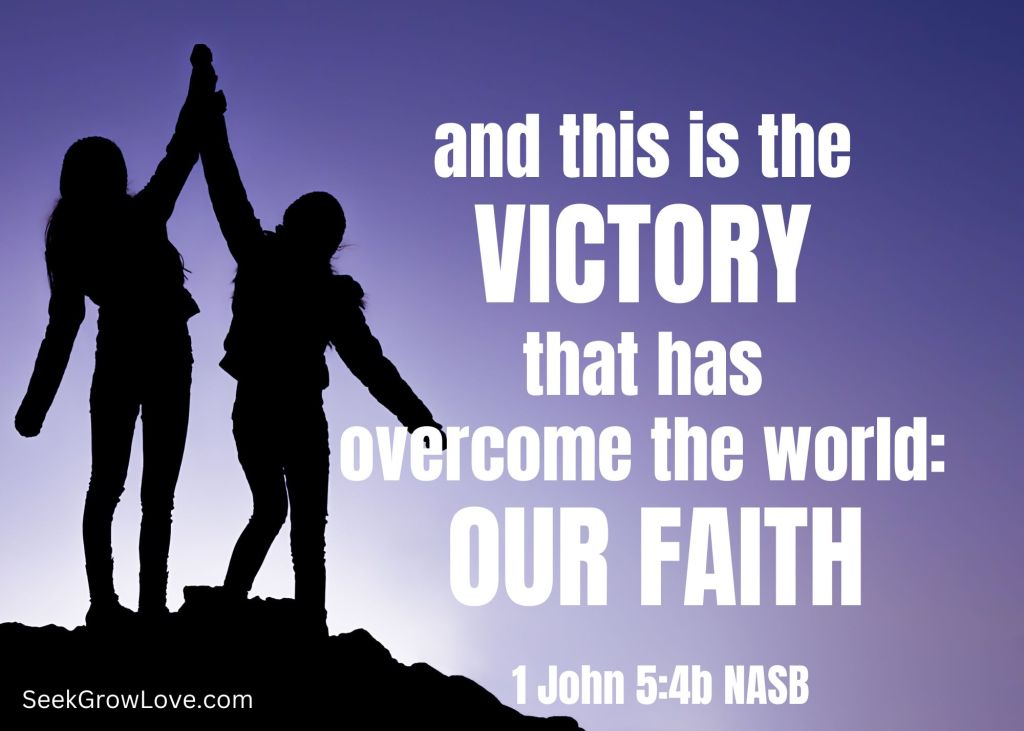
One more song this week – 1 John 5:4-5 “for everyone born of God overcomes the world. This is the victory that has overcome the world, even our faith. 5 Who is it that overcomes the world? Only he who believes that Jesus is the Son of God.”
Those two verses are the song, but verse 4 picks up in the middle of a sentence & thought, so backing up a couple verses:
This is how we know that we love the children of God: by loving God and carrying out his commands. 3 In fact, this is love for God: to keep his commands. And his commands are not burdensome, 4 for everyone born of God overcomes the world. This is the victory that has overcome the world, even our faith. 5 Who is it that overcomes the world? Only the one who believes that Jesus is the Son of God.
When we have faith, we can overcome this world. Our faith that Jesus is the son of God gives us victory and makes God’s commands not burdensome thereby helping us to keep His commands. And by keeping His commands, we can love one another – the children of God.
Verse five is also a reminder that the victory is exclusionary. Who overcomes the world? Only those that believe that Jesus is the Son of God. We have to strike a balance in our love for others. Because if we love based on the world’s terms, we accept anything. But to do that would not be love. Because onlythose who believe that Jesus is God’s son overcome this world. So if we in our “love” just leave our friends alone because we don’t want to make them feel uncomfortable, or we don’t want to feel uncomfortable, we put them in a position of not having that victory. That isn’t real love.
We give a lot of reasons not to share the love of God with other people and I think fear forms the basis of a lot of it – fear of rejection, fear of being ostracized, fear of losing money/power, etc…
But when we read verses like this, we should be reminded that we have to push through that fear. To show our love in actions (chapter 3), we need to share with others that while we have been separated from God, God provided an atoning sacrifice for our sins (chapter 4), and with this sacrifice, if we believe, we can overcome and have the victory (chapter 5).
And what is that victory? As he wraps up his letter, John tells his audience – 13 I write these things to you who believe in the name of the Son of God so that you may know that you have eternal life.
We need to believe in Jesus as the Son of God to be a part of that eternal life, and if we are loving others, we should be telling them so they can have that victory too.
~Stephanie Fletcher
Reflection Questions
1.”Who is it that overcomes the world?” (1 John 5:5a – see 5b for the correct answer). Who thinks they are overcoming the world? What are they missing? Do you fall into the overcoming category?
2. Who do you know who does not believe that Jesus is the Son of God? How can you truly love them?
3. What is the victory that you have to share? How would you explain it? How will you share it?
Kid play songs of the day are from 1 John 4: 9 & 10 “This is how God showed his love among us: He sent his one and only Son into the world that we might live through him. 10This is love: not that we loved God, but that He loved us and sent His son as an atoning sacrifice for our sin.” (Aaron Winner has a great song with these verses too).
Having grown up in the Christian church, I think this wonderful news is something that I can often gloss over. God loved us, so he sent Jesus to die on the cross for our sins that we might be saved. Yeah, I know.
But when you stop and read it, it is really amazing, especially from our human perspective. It is pretty easy to do something nice for other people when they love you, when they are nice to you. But God did this for a people who had turned away from Him, and for future people that would continue to turn from Him.
Thankfully, God’s love does not have a prerequisite. Based on literally nothing we or anyone else has done, He loves us. And loved us enough to put His son through excruciating pain to the point of death so that we might be reconciled to him.
How do we show our love? Do we have requirements for who we show our love to?
The concept of loving someone no matter what they have or have not done goes against our human nature. It is something we probably need to ask for God’s help for. It’s ok if we can’t do it on our own. Because of God’s great love for us, we can be reconciled to Him, and we can ask Him for help in loving others.
I don’t know about you, but I forget to ask for help sometimes. It is not even always conscious, but my pride gets in the way. I think I should be able to do what I’m supposed to do on my own. But as humans, we are flawed. And I do believe that it is ok to ask God for help in loving people the way we are supposed to.
~Stephanie Fletcher
Reflection Questions
Take time to consider Stephanie’s questions: “How do we show our love? Do we have requirements for who we show our love to?”
If you have never heard of G.T. and the Halo Express, 1) you are missing out on quality kids music/plays and 2) sorry, you won’t be able to sing along with my devotions for the next few days.
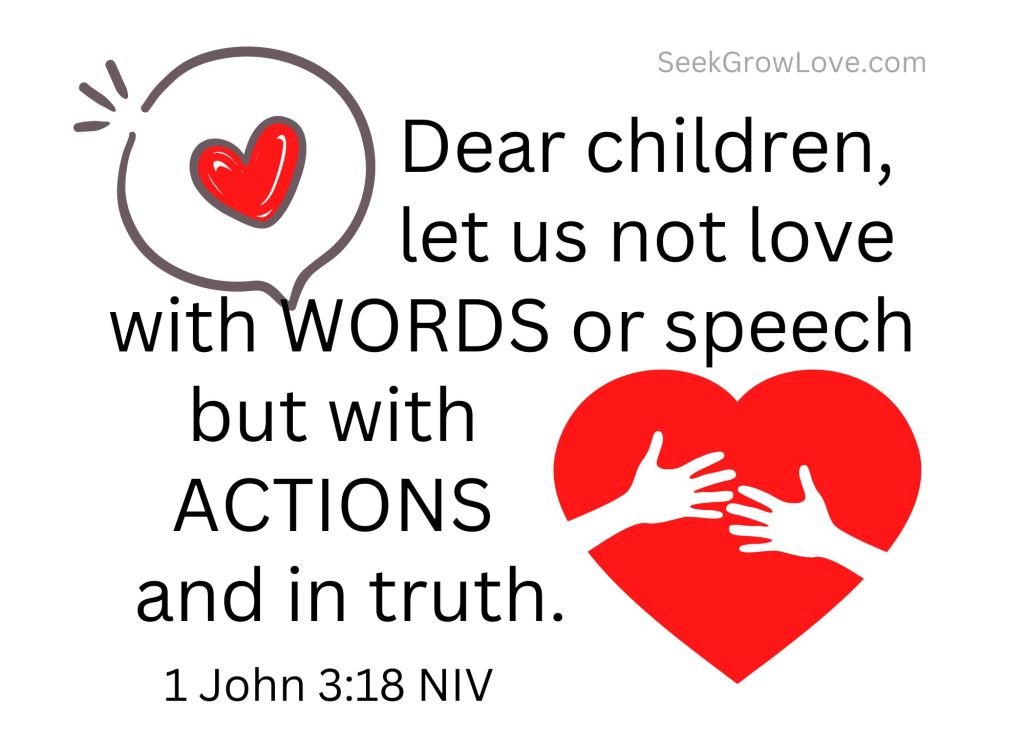
I encourage you to read the whole chapter of 1 John 3, but I am just going to focus on one verse, my favorite – 18, (thanks to memorizing it in this kids play growing up). The translation I learned was “Dear children, let us not love with words or tongue but with actions and in truth.”
I have been listening to this one with my daughter, and it has sparked some discussion. The song breaks it up a little bit, and the line that is sung together is “let us not love with words or tongue.” When we look at the whole verse, it is easy to know that we shouldn’t stop there. But for a 4 year old who doesn’t quite understand all the subtleties of language yet, that was confusing. Why should we not love with words?
This isn’t saying we shouldn’t use our words to be loving, but rather that it shouldn’t stop at that. If all we do is say that we love someone, it really means nothing. We need to show people that we love them in how we act, and by being truthful.
It reminds me of James 2:17“In the same way, faith by itself, if it is not accompanied by action, is dead.”
My dad taught a memorable object lesson to our class when I was growing up. He took us for a car ride in one of the many winter months (it’s Minnesota – they all blend together) with the windows rolled down. As he drove, he asked us, “Are you cold?” When we of course said yes, his response was, “I’m really sorry you’re cold! I wish you were warm.” And he kept on driving. His point was that even if you say the right things, when you can make a difference in the situation (such as putting the windows up) but do nothing, what you say doesn’t matter.
Jesus truly showed his love in action by his sacrifice for us. We ought to show others that we love them, not just tell them.
It is a good reminder for a 4-year-old to be loving in her actions toward her little brother and a good reminder for everyone to be loving in their actions towards anyone they interact with.
~Stephanie Fletcher
Reflection Questions
When have you found yourself saying the loving thing – but not showing love with your actions? What problem is created here? How can you fix this?
According to the rest of the chapter what else do our actions show?
“My dear children, I write this to you so that you will not sin.”
That is how this chapter starts off. Good plan, more easily said than done. Thankfully, John doesn’t stop writing here.
“But if anybody does sin, we have an advocate with the Father—Jesus Christ, the Righteous One. 2 He is the atoning sacrifice for our sins, and not only for ours but also for the sins of the whole world.”
If you are reading this, you probably already know it. You have read it before – in this chapter, or elsewhere in the Bible. But isn’t that a good reminder? We are not perfect, but thankfully, we have an advocate.
This whole chapter is full of “good reminders.” And John presents them in little different ways.
In verses 12-14 he went about it in a positive way. Instead of saying don’t forget this, don’t slip back into your old ways, he turns it to the positive and says “you are strong” and “you have overcome the evil one.”
He approaches it from the other side too in the next verse saying “Do not love the world…”
But throughout the chapter, I am drawn back to the positive affirmations that he writes to his audience.
20 But you have an anointing from the Holy One, and all of you know the truth
24 As for you, see that what you have heard from the beginning remains in you. If it does, you also will remain in the Son and in the Father. 25 And this is what he promised us—eternal life.
28 And now, dear children, continue in him, so that when he appears we may be confident and unashamed before him at his coming.
Good instruction can come from both telling people what not to do, but also telling people what to do, and telling them to keep doing the good they are doing. It is an encouragement as well as a reminder, and that sticks with me today as I write this.
~Stephanie Fletcher
Reflection Questions
Reread 1 John 2 looking specifically for the things John tells us to do, as well as those things we are not to do. Which instructions do you find easiest to follow? Where do you need a little push in the right direction to keep yourself on the right path – or off of the wrong path?
What do you think our “advocate with the Father—Jesus Christ, the Righteous One” sees you doing and would tell you to keep doing? What will you do today to keep doing that! How will you ‘continue in him’?
It is impossible for me to read this opening statement in 1 John 1:1 without immediately thinking of its strong parallel to John 1:1. John 1:1 says in the beginning was the word and 1 John 1:1 says that all they have seen and heard and touched – that was from the beginning (what beginning?) concerning the word of life. John was with Jesus from the beginning of his ministry, so he may be referring to the beginning of Jesus’ ministry. There is a lot to unpack here, so I will leave that for another day, but you can think about some of these correlations.
John says that they are proclaiming the word so that his readers may have fellowship with John and his community, as well as fellowship with God and Jesus through the ministry of the word (that is an implication of having true fellowship with John et. al.). Also, John emphasizes that he is writing these things so that joy may be made complete. True joy, that transcends all circumstances, is a direct result of having fellowship with God and Jesus in a life of faith (see also James 1 for insight into the relationship between authentic faith and joy).
John then gets into a dichotomy between light and darkness. God is light and in him there is no darkness, therefore if we are walking in darkness (not in the midst of darkness but having elements of darkness ingrained into our life) we do not have fellowship with God. We are deceiving ourselves if we think that we can live a dualistic life embracing both God’s will and abiding in the ways of the world. Purity of heart precludes us from walking in darkness. If we’re doing this (walking in darkness), the implication is that we are liars and live a life that is antithetical to the truth.
Conversely, if we walk in the light (i.e., the truth, abide in the word), we have true fellowship with one another and we have our sins cleansed by the blood of Jesus. Walking in light does not mean that we have no sin, that would be a ridiculous assertion, but it means that we do not live lives defined by sin. We all stumble, but there is a difference between falling short and living in sinful pursuit. Our self-deception can come from being double-minded, or from a false notion that being forgiven makes us sinless. We are free from the bondage of sin through Christ, but we still fall short of perfection. In confessing our sin (and repenting of it), we are cleansed and through our faith are counted as righteous. If we don’t acknowledge our sinfulness, how can we confess (we can’t!)? Worse than deceiving ourselves, if we deny that we sin, we make God out to be a liar!
It’s not a good look to make God out to be a liar, so I would strongly encourage each of us to take into consideration our behaviors and not try to explain them in a way that denies the authority of scripture to call out wicked behavior and attempt to justify our (sinful) behavior as acceptable. Sin is offensive to God, so we should not attempt to explain it away as inoffensive. Confession is a powerful tool, and we should be quick to utilize this, rather than explain away or double down on any sinful elements that encroach on our lives. It is better to suffer for doing what is right now (deny our sinful desires) than to embrace sin and deception now and miss out on the amazing Kingdom of God (which will trump all imaginable satisfaction in this life).
-J.J. Fletcher
Reflection:
1. Do I regularly confess my sin to God? Do I confess my sin to other believers (1 or 2 people who you can trust) and reap the benefits of having accountability in brothers or sisters (who likely have had similar struggles) that can speak truth into my life?
2. What am I doing that could constitute self-deception? How might you assess and address this?
3. What relationships do I have that allow people to speak truth into my life? Do I surround myself with yes men? Do I live in an echo chamber? What changes can I make in my life that can help me more effectively eliminate sinful habits?
“I am stirring up your sincere mind by way of reminder” (2 Peter 3:1 ESV).
Not every letter written has the same intent. Some of the New Testament letters are written to address very clear and direct issues (I think of Paul addressing specific sexual immorality in 1st Corinthians 5). Sometimes they are multi-faceted – some specific – some more general teaching or correction. What Peter writes here makes another point – even if there is nothing specific that may need to be corrected, reminders are still valuable and necessary. When we aren’t reminded about things, we can lose track or lose sight of what is ahead of us… We can become passive, apathetic, or incredibly distracted. The tyranny of the urgent can cause us to put things on the backburner, and if you are like me, it can be hard to remember to pull them back to the front. Sometimes we just need to have our attention drawn to what we need to be doing in the present or near future (like when you think you are signing up to write devotions for October of 2023, but it’s really 2022). Much of what I view my role as in pastoral ministry is reminding people what scripture says – sometimes I address actual needs that I see in the body, but typically it is looking at a text, reminding my congregation of what it says, and then trying to highlight its significance in its historical context and how it is significant for us today.
In verse 3, Peter states that scoffers will come in the last days… I bet each one of us knows someone that would fit that description (maybe many people). You probably can’t turn on the tv, or radio, or fire up the old interwebs for very long without finding someone speaking out against or mocking a scriptural worldview. Why are they scoffing? Because a biblical worldview does not mesh with their sinful desires, and they must push back at it or try to discredit it in some way to justify their way of living (or to clear their conscience).
Peter points out that the promise of “this ‘coming'” (2 Peter 3:4) has been spoken about for a long time, but where is this promised day that things will begin to be set right through God’s anointed one? He says that they deliberately overlook in part that the world has existed for a long time, and that God has passed judgement before, but now God’s judgement is being stored up (and in the grand scheme of time, Jesus’ ascension isn’t that far back). Our conception of time is different than that of God and while sometimes we may wonder why this delay of the Parousia is happening, we must recognize this fact that Peter lays before us: God is not slow, but is merciful! God is not willing that any should perish, but he desires all to come to repentance (and he gives us so many opportunities to do so!). It would, however, be unwise to be cognizant of this fact and delay our repentance, because if we have placed that on the backburner, we might get distracted and forget to bring it back to the front. We don’t want to diminish the urgent need for repentance and reconciliation… If we are not paying attention to the things of God, we will be caught off guard, but if we are watching, we will be ready when he sends his son like a thief in the night and starts the restoration of the earth.
I’ll leave you with a few of the final verses or the chapter to reflect on.
“Therefore, beloved, since you are waiting for these, be diligent to be found by him without spot or blemish, and at peace. And count the patience of our Lord as salvation, just as our beloved brother Paul also wrote to you according to the wisdom given him, as he does in all his letters when he speaks in them of these matters. You therefore, beloved, knowing this beforehand, take care that you are not carried away with the error of lawless people and lose your own stability. But grow in the grace and knowledge of our Lord and Savior Jesus Christ.” (2 Peter 3:14–18 ESV)
-J.J. Fletcher
Reflection Questions
What reminders do you find in 2 Peter 3 that you needed to hear this week? What important things have you slid to the backburner that could use your attention today?
What does God’s patience, mercy and timing mean to you?
Peter draws to attention the fact that in the history of Israel, false prophets arose among the people and the same thing will happen in the church age… False teachers will arise, so we must be on the watch. If many will follow, we must be watchful and call out these false teachers as to prevent as many people as we can from falling into these destructive teachings. In thinking of what modern teachings this applies to we could put “Word of Faith” or “Prosperity” teachings into this category. We could also think about the many “liberal” denominations that reject the sexual ethics of scripture and the “evangelical” teachers that often seem to conflate (at least in the way I see it) being a Christian with voting for a particular political party. We need to make sure that we stand in the word and do not allow ourselves to be deceived and exploited, but also we must stand in the gap (Ezekiel 22) and do what we can to keep others from being deceived and exploited.
Peter then delves into ideas concerning judgment and preservation of righteous people standing up in the midst of wickedness. If God will rescue Noah and Lot, will he not also rescue some of us from perishing in this present age of wickedness? Of course, God does not keep all of his people from perishing (for reasons that are known to him and not us… i.e. Stephen and many of Jesus’ disciples), but he does in many instances deliver his people out of dire straits. Not only will he in many instances rescue us, but those who stand in wickedness stand in punishment. While we may not see the unrighteous handled in ways that we desire, we must recognize that God deals in his own ways (Isaiah 55:8-9). Peter then writes of the ways of deceivers and references Balaam (see Numbers 22 to begin his story) as he is pointing out many of the traits of these wicked opponents of God.
Peter states that those who depart from the corruption of the world and come to Jesus, but then depart from him and return to deception are worse off than they were at first. Can we wrap our minds around that? It’s better to have never known Jesus than to come into that saving knowledge and then depart from him. That makes it all the more important for us to keep in Christian community and to have people who can speak truth into our lives when we stumble and fall short in our pursuit of righteous living. The self-deception that comes from a lack of self-control is more than just a minor issue, it can cost us everything (abundance now, but more importantly, that abundance that we can embrace in the coming Kingdom).
We just got a new puppy about a month ago, so when I read Peter’s reference to a dog returning to its vomit, it gives me an all too clear visual of what that means. Our dog ate a couple of our children’s socks and had a miserable night (gagging constantly) and then when my wife took him out in the morning he proceeded to puke them up (it was Sunday morning, so in the rush of things getting ready to leave for church, the socks remained on the ground). When I took the dog out after several hours in the kennel, what did he do? He went right for one of the socks and tried to eat it (I got rid of it this time). Later that day (or the next), he got lucky(?) and ate the second sock… I’ll spare you the details of the next morning… The socks were bad for my puppy (he got lucky all things considered), but that did not stop him from going after them. Sin can be the same way for us, even though things are bad for us (and even when we absolutely recognize this), we often return to it (or at the very least are enticed by it) which makes it ever more important that we stay vigilant (constant vigilance!) in abiding in our lord Jesus, because without his advocacy and without the helper that he will send, i.e. the spirit of God, his father) , we are done for.
-J.J. Fletcher
Reflection:
1. What do I need to be most on the guard for? What types of deception might entice me to neglect my faith in Jesus and his kingdom message?
2. Why do the promises of false teachers often sound so sweet? Do they play around with scripture and make it sound like it is saying something that it is not? What can we do to limit the voices of deception that are lurking not only in the shadows, but out in the limelight?
“His divine power has granted to us all things that pertain to life and godliness, through the knowledge of him who called us to his own glory and excellence, by which he has granted to us his precious and very great promises, so that through them you may become partakers of the divine nature, having escaped from the corruption that is in the world because of sinful desire. For this very reason, make every effort to supplement your faith with virtue, and virtue with knowledge, and knowledge with self-control, and self-control with steadfastness, and steadfastness with godliness, and godliness with brotherly affection, and brotherly affection with love. For if these qualities are yours and are increasing, they keep you from being ineffective or unfruitful in the knowledge of our Lord Jesus Christ. For whoever lacks these qualities is so nearsighted that he is blind, having forgotten that he was cleansed from his former sins. Therefore, brothers, be all the more diligent to confirm your calling and election, for if you practice these qualities, you will never fall. For in this way there will be richly provided for you an entrance into the eternal kingdom of our Lord and Savior Jesus Christ.” (2 Peter 1:3–11 ESV)
We have great and precious promises that have been made that will enable us to become partakers of the divine nature! As Jesus put on a new nature in his resurrection from the dead, so shall we when through faith, we endure through life’s many challenges and inherit the promise of the coming Kingdom of God.
Hebrews 11:1 says that “…faith is the assurance of things hoped for, the conviction of things not seen.” As we have faith that God will restore all things (Acts 3:21), upon our faith we must add virtue: meaning good quality of life or uprightness – not simply believing but living out our lives as something that reflects the nature of God’s goodness, justness, and righteousness. After believing and living a changed life, we are to add knowledge to that; we should always be striving to learn from God’s inspired word and learn from his spirit as it is active in us… And more than that, seek after his spirit that we might become more in line with his will and come to a greater understanding of its importance and how beneficial it is to us to walk in his ways.
Following the call to add knowledge, we encounter again the call to be self-controlled! It really does seem that much of what we read in scripture hinges on self-control and that circles back to our need to not stifle the spirit in our lives. If one of the elements that the fruit of the spirit brings forth in our lives is self-control, then we ought to do whatever it takes to drive away any behaviors that might cause God’s spirit to depart from us (Judges 16, 1 Samuel 16). Self-control allows us to endure – to stay on the course – as Paul might say, “to run the race”. We have to endure through all of the challenges and temptations that life throws at us, and we must allow the motivation of our hope, our uprightness, and the self-control that we are enabled to have through God’s spirit carry us through.
As we endure, we ought to have a reverential feeling or devotion to God, that’s what the Greek work translated godliness indicates. As we experience God’s goodness and see how His spirit works in us, we should feel more and more awe and reverence to our creator… After all, He put the plan into place that leads us into a life that transcends the brokenness that sin imparts on our lives – even though we sin and are affected by sin, God’s directives lead us onto a path that (through Jesus) casts that sin aside and draws us into community with him.
And as all these things are ingrained into our life, the part that affects others the most is the cherry on top… We are to have brotherly affection (love) as a defining characteristic in our lives! Love and care for one another as believers will lead us to speak into one another’s lives and help us when we hit rough patches. Even the most spiritually minded people hit dark periods in their lives (google the dark night of the soul). If we love our brothers and sisters in Christ, we will take the time to come alongside them, to care for them, to call them out, to admonish and encourage – brotherly affection means being intimately involved in the lives of our faith family – not being apathetic or half-hearted. We need to invest in each other as Christ has invested in us through his sacrifice (sometimes we must be self-sacrificial).
These qualities keep us from being ineffective witnesses and fruitless workers. We must be bearing the fruit of the word implanted in us (James 1) and strive to be effective ministers to the lives of those who are hurting and struggling. Peter says that whoever lacks these qualities is so nearsighted that he is blind! Yikes… lacking these qualities as I read this means that we cannot see beyond ourselves, and that it a tremendous problem when one of our chief goals is to preach the gospel to all creation.
If we take these qualities to head and practice them diligently it says we confirm our election (or being chosen out) into beneficiaries of the grace of God. Also, it says if we practice these things we will never fall. So, practice these things so that you may have entrance into the eternal kingdom of our Lord and Savior Jesus Christ (v11).
-J.J. Fletcher
Reflection:
1. Think about how Jesus exemplified all these characteristics listed in verses 5-7. If he had not exemplified all these things, would he have had the wherewithal to endure through his father’s plan of salvation through him? How can we expect to live exemplary lives if we do not take these characteristics to heart.
2. Think about the first 6 items listed (faith, virtue, knowledge, self-control, steadfastness, and godliness) and the final one: brotherly affection/love. What do the first 6 produce without the 7th? We’re designed (as individuals and as a church body) to be in community, how might we be rendered fruitless and ineffective if we excel at the 6, but lack the 7th?
Chapter 4 ends with verse 19: Therefore, let those who suffer according to God’s will entrust their souls to a faithful Creator while doing good (ESV).
The suffering in the New Testament is related to living a life set apart from worldliness, which is opposed to God’s will. It is not God’s will that we should suffer, but when we follow in the ways that he has prescribed for us we will undoubtedly face opposition and ultimately suffer for the sake of the Gospel. We need to trust that our creator will ultimately use that suffering for good. There’s a popular song that we sing at my church that has the line “you take what the enemy meant for evil, and you turn it for good” (drawing on Genesis 50 for inspiration).
Chapter 5 then begins with Peter addressing the leaders of the church, specifically calling to mind the sufferings of Christ. Pastors/elders are to function in the role of shepherds for the congregations that have been entrusted to them in leadership. The verb that is translated as “shepherd” also can be translated as “feed” – does this directive remind you of any instructions that Peter himself received from Jesus?
In John 21 three times Jesus asks Peter if he loves him (notice a correlation between Peter’s three denials of Jesus and the three affirmations that Jesus receives from him?) and three times tells him to feed his sheep (this is a different Greek word in John, but it means essentially the same thing). As the primary leader of the church Peter was to feed Jesus’ sheep, meaning Christians. The impetus for this spiritual leadership is not to be out of self-importance or in Peter’s case even that Jesus chose him to lead, but out of love for his master and savior (and friend!). When we see Peter lead, he is following in obedience to the one who called him out of the boat and invested in him and entrusted him to feed his sheep. Peter certainly was not doing this for gain or for an easy life, I imagine his life would have been much easier had he simply decided to go back to fishing full time, but he faced many trials and much opposition in his preaching the word and leading the church.
In the same way, those of us who are called to be pastors and elders (who are specifically addressed here, but anyone who holds an office in the church should take heed of this) should be using their love of Jesus as their motivation for leading. Presumably most church leaders start off this way, but it can easily go to one’s head. There are many public instances of pastors who have become controlling, power hungry, and abusive (quite often we see this in large churches with lucrative opportunities for pastors) – but even in small churches the desire to control can infiltrate the hearts of those who are called to lead or “run” the church. Elders (I’ll include pastors in this title from here on out) are to be willing and eager to carry out the work that they have been called to. With a calling to leadership comes responsibility – a significant thing to note is that we who are in authority (and who teach) are held to a higher level of accountability (James 3:1). Those who are in authority are to be an example to those who they oversee spiritually, and humility is one way in which we should be an example. Jesus stated that he was gentle and humble (Matthew 11:29), and we see in Philippians 2 that humility was essential in Jesus salvific work as God’s anointed one.
As Jesus was humble and as we who are elders (overseers) are to be humble (following Christ’s example), so then are the members of the body to exercise humility and submit to those who are in authority over them. If leaders are humble and operating as Jesus would expect them to, then humble Christians submitting to the godly authority that has been placed over them will thrive in their submission. We’re never going to agree on everything and that is why the decisions of local congregations are to be subject to the elders and not left up to the democratic will of a large collective. Elders absolutely can delegate responsibilities and set up clear roles for the body (Acts 6), but the authority over the church should lie with them.
We just added two new elders at my church yesterday. The process was not a short one… Myself and our other elders had many discussions on who we thought would be a good fit to assume these offices and eventually recommended that these two individuals be confirmed as elders. We don’t accept nominations for elders, but rather we look for men who meet the requirements of elders as listed in Titus 1, and then we have a confirmation vote. Other churches do things differently and may have boards structured in different ways or may be more egalitarian in the way that they define elders, I don’t condemn that, but we need to take seriously the guidelines that are listed in scripture and not be too quick to structure things in a way that is more reflective of the nation/society we live in than how the early church did things. Regardless of our views on church leadership one thing we need to be able to do is disagree with grace and love.
We need to make sure that whatever disagreements we have are dealt with in love and we need to not let them distract from what God would have us do and we need to make sure that we keep our minds clear (5:8, reaffirming 4:7), be on the lookout, and refrain from being anxious (cast those anxieties on God, see also Matthew 6), because the enemy prowls like a lion looking for someone to devour. When we allow conflict to take root or we allow anxiety to be prevalent in our churches, bad things will happen. We may often think about the enemy being on the prowl for individuals, but he’d also love to devour a local church and render it ineffective at making disciples or worse, cause it to die out (is that really worse?). I bet we could all think of examples of things we can (or do) divide over, one such argument could be what Peter means by “our enemy the devil”, but we need to take seriously the words of the author of Hebrews when he/she says: “Strive for peace with everyone, and for the holiness without which no one will see the Lord. See to it that no one fails to obtain the grace of God; that no “root of bitterness” springs up and causes trouble, and by it many become defiled;” (Hebrews 12:14–15 ESV).
-J.J. Fletcher
Reflection Questions:
1. For those of you in authority: do you do it willingly? Eagerly? Without being domineering? Sometimes we do have to be forceful and make unpopular decisions, but that can still be done in a graceful and kind way. Do you need to be humbler, or do you think you have that well under control? Do you have an individual in mind that has authority problems with whom you can practice extra grace?
2. For those of you under authority: Do you respect those who have been placed in authority over you? Do you easily submit to that authority? Do you gossip about the leaders of your church and cause problems that way? Do you stop attending church when changes occur, or decisions are made that you disagree with? Do you go church hopping and just stick around till someone ticks you off and move on to the next place (which might just be going back to a former church until the vicious cycle starts over again?
Podcast Recommendation: The Rise and Fall of Mars Hill (from Christianity Today). It can be difficult to listen at times, but it has lots of examples on how to do leadership wrong, which we can benefit from.
At the beginning of chapter four Peter says to “arm yourself with the same way of thinking” aligning this directive with Jesus suffering in the flesh. While Jesus’ suffering was likely to exceed what these Christians endured, they were still facing a culture that might ostracize, if not outright persecute or kill them.
Peter points out distinctions in how the gentiles live according to the flesh (perverting many things that God intended for good), and how we as believers are to pursue the will of God – this means among other things giving up things that might feel good or make us feel like we belong.
We’ll home in on what Peter writes in verses 7-11:
“The end of all things is at hand; therefore be self-controlled and sober-minded for the sake of your prayers. Above all, keep loving one another earnestly, since love covers a multitude of sins. Show hospitality to one another without grumbling. As each has received a gift, use it to serve one another, as good stewards of God’s varied grace: whoever speaks, as one who speaks oracles of God; whoever serves, as one who serves by the strength that God supplies—in order that in everything God may be glorified through Jesus Christ. To him belong glory and dominion forever and ever. Amen.” (1 Peter 4:7–11 ESV)
Considering the coming kingdom (which is immanent, but we don’t know when it will come): Exert Self-Control! Many times, we see this attribute called for in the life of believers (at least 18 times in the ESV). Looking in the letter of James (which I preached from yesterday), lack of self-control can lead to self-deception. When we allow our thoughts to be clouded by worldly things or self-centered behaviors, we are going to miss what God would have us do. By being sober (or clear) minded we can think critically, and we need to think clearly so that we can be effective in our prayers. Jesus gave us a model by which to structure our prayers, but our prayers are not meant to be mindless or rote… We need to be looking at things through the lens of God’s spirit, which allows us to see things that our physical eyes cannot see. Think back to 1 Peter 3 where it says a man should live with his wife in an understanding way as not to have his prayers hindered – the way that we think, live, and act has a direct impact on how we pray and the effectiveness of our prayers.
We’re instructed to love one another earnestly, because love covers a multitude of sins. (Greater love has no one than this, that someone lay down his life for his friends. John 15:13). “…in the face of extreme social hostility, love will be necessary for spiritual survival. For Peter the primacy of love is accompanied by a qualification, and this qualification is a partial citation of Proverbs 10:12 similar to James 5:20—’love covers over a multitude of sins,’ rather than magnifying the faults of others. After all, love is patient and doesn’t keep a record of wrongs (1 Corinthians 13:4, 5)” (J. Daryl Charles, “1 Peter,” in Hebrews–Revelation, vol. 13 of The Expositor’s Bible Commentary Revised Edition).
How does the Church expect to thrive if we let piddly little things (or even larger disagreements) get in the way of caring for each other? How are we to expect to overcome the world through Jesus if we don’t exercise with others the grace that we have been shown (we all kind of stink at times, to put it mildly)?
We need to show hospitality in a world that that is oft inhospitable to Jesus’ way of living. If we’re inhospitable to other believers, they might find hospitality in places that will draw them away from the grace of God. We shouldn’t grumble when we have an opportunity to be hospitable, but rather see it as an opportunity to be the hands and feet of Jesus (Genesis 12 says Abraham was blessed to be a blessing, and through grace and mercy we’ve also been blessed to be a blessing as well).
In everything we do we need to do so viewing ourselves as representatives of God, as ambassadors of the kingdom, and imitators of Christ Jesus (Philippians 2:3-8).
-JJ Fletcher
Reflection Questions
How does my life look like the life of Jesus and how does it look different?
How does hospitality with fellow believers prime me to be hospitable to those who I disagree with?
Am I doing well at being self-controlled? What are my biggest obstacles to living in this way? Who can I ask for help or be accountable to help me in this endeavor?








 Seek Grow Love