Worship God in Every Life Situation

Glorify the Lord with me; let us exalt his name together

Free theme of the week: Worship
Chapter reading of the day: Psalm 34

Worship is a loaded word in the American church. Part of the misunderstanding of
worship today is that “worship” is something that only happens on a Sunday or
Wednesday. On the contrary, worship is something that should happen everyday in
every circumstance we find ourselves in. This may seem as common sense or a basic
thought, however, many Christians only worship God when things are going well in life
or only on Sundays or Wednesdays. Biblical worship is worship that permeates every
season of life including the bad ones. Today’s devotion is to encourage you to praise
God in every life season.
Here are some verses to meditate on for this topic:
“I will bless the LORD at all times; his praise shall continually be in my mouth.” – Psalm
34.1
“Do not get drunk with wine, for that is dissipation, but be filled with the spirit, speaking
to one another in psalms, and hymns, and spiritual songs, singing and making melody
with your heart to the Lord; always giving thanks for all things in the name of our Lord
Jesus Christ to God even the Father” – Eph. 5.19-21
“In everything give thanks; for this is God’s will for your life” – I Thessalonians 5.17
I want to encourage everyone who is reading this that is going through a tough season
that it’s ok to feel sad, upset, frustrated, etc. The Bible tells us just because we follow
Christ that does not mean our lives will be problem free, actually it says the opposite.
Our lives will become harder because as our lives are conformed to Jesus we live
against the grain of culture and our own sin nature. And other times the trouble we have
in our life is self-inflicted. Regardless of the source of our troubles, God is worthy to be
praised in our trouble.
When problems in life arise the best response we can have is to press into God and
praise him. This is so easy to say and so hard to do. You may wonder “what does it
mean to praise God in seasons of trouble?”. Here are some practical suggestions that
you can use to help stimulate praise when life is hard:
1. Tell God and Jesus “thank you” – You can thank God for anything in your life,
the big things and the small things. When we thank God we stop focusing on our
problem and start glorifying God. Being thankful changes our perspective.
2. Remind yourself of God’s faithfulness in your life – Remembering how God
has moved in your life is important during times that you may not feel or hear from
God. The Old Testament is full of sections where the people of God remember how
the Lord has been faithful to encourage them during present crises (the Psalms
are a great place to start).
3. Remember that suffering that is brought on by following Jesus is an honor
and suffering for his name sake is the mark of a true follower of Jesus. In other words, your suffering is not in vain or meaningless – Suffering from following Jesus is honorable and does not escape God’s notice. When you experience this type of suffering consider it joy because it means that you’re following Jesus in a deeper way than the people around you. God is worthy of our praise not just on a Sunday or Wednesday or when life is going well. But he desires worship in every season of life. Don’t run from God when life gets hard. Praise and worship him through it.
-Jacob Rohrer

Worship God with your Heart and Voice

Acts 16 25

Free theme week: Worship
Chapter reading for the day: Acts 16

Singing is usually the first thing that comes to mind when people think of worship.
However, singing is not just some common and mundane practice that believers do
when they gather, say on a Sunday. Actually the Bible teaches that singing praises to
God and Jesus is incredibly powerful and moving and has consequences in the
supernatural realm.
The difference between worship music that is alive and worship music that is dead is
based on two things. 1. The hearts of the music leader and/or band are not in the right
place and they will not be authentic and genuine in their worship. And 2. because their
hearts are far from God, God will not dwell and inhabit their praises meaning the spirit of God will not move in them or through them. Inversely, if the music leader/band’s heart is ready to praise God and solely be devoted to his glory then God will inhabit their
praises, the spirit will be moving, and exciting things will happen. When speaking about
praising God through our voice it is imperative that our heart be in the right place. God
doesn’t want a voice to sing to him. He desires a heart overflowing with love and
worship that manifest in singing praises. There’s a difference.
With that being said we’ll look at Acts 16.22-34. I won’t type out the passage but I’ll
summarize it. In Acts 16 Paul and Silas are in the city of Thyatira. While preaching a
slave girl was following them praising their work. However, she was demon-possessed
and was being a hindrance to their work. Paul cast the demon out of her and her
owner became furious. Paul and Silas were arrested, beaten, and thrown into prison.
Then read what happens next as they are in jail:
“But about midnight Paul and Silas were praying and singing hymns of praise to God,
and the prisoners were listening to them; and suddenly there came a great earthquake,
so that the foundations of the prison house were shaken; and immediately all the doors
were opened and everyone’s chains were unfastened.” – Acts 16.25-26
Paul and Silas were singing songs of praise and were praying prayers of praise. Despite
their circumstances, their hearts were solely set on God and praising him. The result
was God caused an earthquake, the inmates were set free, and the jailer and his family
were saved.
Setting aside the circumstances and details of the story, we see two men praise God
wholeheartedly and their worship in the natural realm moves God in the supernatural
realm to affect their current circumstances. We see from this account that singing and
praying can actually move the heart of God. Our worship in the natural can make waves
in the supernatural.
We see the same principle in II Chronicles 20.1-23 (please read). Worship can move
mountains in the supernatural realm. Singing can be a weapon used against the enemy
and dark spiritual forces. Our warfare in the supernatural is waged by singing and praying. Praising God and Jesus with our voice does not have to be mundane and
routine though sometimes it can be. Rather, singing has the ability to make waves in the
supernatural realm, move God, and wage war against the enemy. But this is only
possible with a sold-out heart seeking the glory of God. A heart that praises him in all
circumstances and gives him glory in all seasons of life. That is the kind of worship that
God responds to.

-Jacob Rohrer

Worship God with your Speech

1 Thess 5 18

Free theme week: Worship
Chapter reading for the day: I Thessalonians 5

The most obvious way people communicate is through speech. Much like thinking,
because we talk so much, and it is such an integral part of our life experience we often
don’t think about what we say. We live in an age where being heard is more important
than the quality and validity of what is being said. When it comes to speech and talking
do you worship God? Is your tongue obedient to Jesus? Jesus often only presents two
options when it comes to examining your life. You’re either on the broad road that leads
to death or you’re on the narrow road that leads to life. You’re either a good tree that
produces good fruit or you’re an evil tree that produces evil fruit. You either serve God
or wealth. You either hear the words of Jesus and don’t act on them or you hear the
words of Jesus and act on them. Ask yourself,  “Do the words I speak honor God and
Jesus or do they not?”
God and Jesus care about what comes out of your mouth. What you say has power and
consequences. Because of this truth the Bible has a lot to say about words and speech
conduct:
“An evil man is ensnared by the transgression of his lips, but the righteous will escape
from trouble” – Proverbs 12.13
“The one who guards his mouth preserves his life; the one who opens wide his lips
comes to ruin” – Proverbs 13.2
“Death and life are in the power of the tongue, and those who love it will eat its fruit” –
Proverbs 18.21
“You brood of vipers, how can you being evil, speak what is good? For the mouth
speaks out of that which fills the heart…But I tell you that every careless word that
people speak, they shall give an accounting for it in the day of judgement. For by your
words you will be justified, and by your words you will be condemned” – Matthew
12.34,35,36
“Let no unwholesome word proceed from your mouth, but only such a word as is good
for edification according to the need of the moment…” – Ephesians 4.29
“There must be no filthiness and silly talk or coarse jesting, which are not fitting, but
rather giving of thanks.” – Ephesians 5.4
“In everything give thanks; for this is the will of God for you in Christ Jesus” – I
Thessalonians 5.18
“No one can tame the tongue; it is a restless evil and full of deadly poison. With it we
bless the Lord and Father and with it we curse men…from the same mouth come
blessing and cursing, my brethren, these thing ought not to be this way” – James 3.8-9
We can see that the Bible teaches about speech in different ways. Sometimes the
Bible teaches using wisdom and starts with the point that the tongue is powerful and
wisdom should be used when speaking. Jesus teaches us that what we say we will beheld accountable to. And the Bible teaches about positive and negative speech. We
should abstain from “unwholesome” words that don’t edify or encourage others. This
could be constant negative speaking, sarcasm, curse words, unnecessary criticism, etc.
Whereas we are urged to be grateful in our speech and speak life and uplift others.
Jesus says that out of the heart the mouth speaks. What does your speech say about your
heart condition? Do your words worship God or do your words sound like the world?
God wants all of you including your speech. Glorify God with your words. Speak life and
not death.
-Jacob Rohrer

Worship God with your Mind

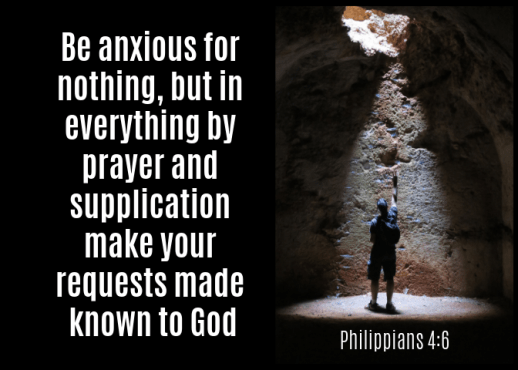
Philippians 4 6

Free theme week: Worship

Chapter reading for the day: Philippians 4


The mind is incredibly powerful. Because the mind is powerful and directly affects how we live our life and how we think about ourself, setting our mind on God is of paramount importance. If Satan and dark spiritual forces can win over your mind and have you believe their “truth” then they control you. We see this when Jesus was led into the wilderness and then was tempted by Satan. Satan questioned Jesus’ identity twice trying to get Jesus to believe that he was not who God said he was. Satan was attacking the mind of Jesus. But Jesus had a strong mind that was set upon God and his promises and did not fall for Satan attacks. Worshipping God with our mind is essential if we want to stand firm against the schemes of the enemy. Today we’ll look at one way that we can love and worship God with our mind.

The definition of anxiety is a being in a state of apprehension, uneasiness, or nervousness. Anxiety wrecks the mind and bombards it with endless “what if’s”. All of us have experienced anxiety at one time or another. There are many situations that we can become anxious about including our relationship with God. If left unchecked anxiety can consume a person and drastically affect their relationship with God and Jesus. When this happens the person and their mind is living in a state of “non-worship”. In Philippians 4.6-8 God reveals to us the remedy of anxiousness:

“6 Be anxious for nothing, but in everything by prayer and supplication make your requests made known to God. 7 And the peace of God which surpasses all comprehension, will guard your hearts and your mind in Christ Jesus. 8 Finally brethren, whatever is true, whatever is honorable, whatever is right, whatever is pure, whatever is lovely, whatever is of good repute, if there is any excellence and if anything worthy of praise, dwell on these things.”

Philippians 4.6-8 is a call to worship God with our mind. To set our mind on God and Jesus and not dwell or focus on anxiety. Here are some things we learn from this passage:

  1. Let nothing in life give you anxiety
  2. Because we are called to give everything to God in prayer (including anxiety)
  3. The supernatural peace made available to us because of Jesus will guard our heart and mind
  4. We are to set our mind on things that are good, godly, and wholesome.

Notice that Philippians 4 does not say that life will not have anxiety. But when you do have episodes or seasons of anxiety do not let it consume you. Surrender it to God in prayer. When we allow ourselves to be consumed with anxiety and fear we live in a state of non-worship of the mind. But when we obey what God has said we worship God with our mind, it says I will not let [fill in the blank] define me or consume me, I will bring it to God. That is worshipping God with our mind. This is worship that God desires from his people.

-Jacob Rohrer

Worship God with your Body

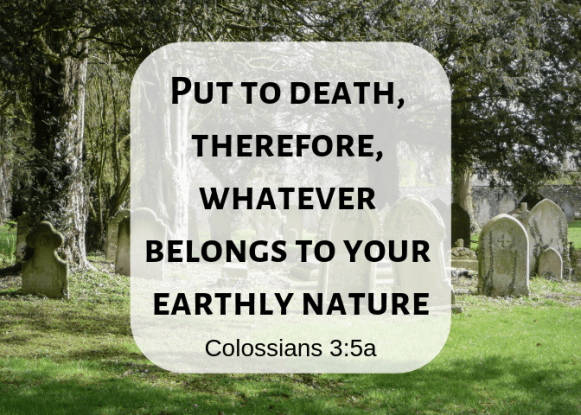
Col 3 5a

Free Theme Week: Worship

Chapter reading for the day: Colossians 3

There is a particular “truth” that is extremely pervasive in our culture, the news, social media, etc. This “truth” is that you are the sole determiner in what you decide to do with your body and that no one else has the right to tell you what you can or can’t do with it. If you want to tattoo your whole body do it. If you want to fill your body with botox and recreate your image through plastic surgery have at it. If a woman wants to get an abortion, how dare anyone tell her she cannot. If you want to sleep around with different people in the name of finding yourself and wanting non-committal sex, more power to you. We are bombarded with messages everyday about how the individual is the authority of their body. There’s a problem though; this is a lie.

The truth is that humans are not the sole authority over their bodies, God is. The reason he is the authority is because he is the creator of our bodies (Psalm 139) and as disciples of Jesus we are to honor and glorify God and Jesus in our body. We are to subject our bodies to the Lordship of Jesus Christ and use our body for the glory of God and Jesus. Now there are many ways we can do this but for today we will look at two ways in which we can worship God in our body.

  1. Food
  2.   Sex

Food is a particular problem in America. We can eat food whenever we want and eat however much we like. The problem with this is that many Christians, along with Americans, are overweight and unhealthy. God created food to be good and for us to enjoy. The problem is when we indulge too much in food and we hurt our bodies with disease and premature death. The Bible warns against gluttony (Prov. 23.21, Philippians 3.19). When our bodies are slowed down by being overweight, too tired, and fighting disease the ministry God has given us is hindered. The remedy to being in control of food and honoring God with your body is self-control. Self-control is a fruit of the spirit (Gal. 5.22-23). Let us pursue self-control when it comes to eating. Let us pursue self-control when it comes to the quantity and quality of the food we eat. When we do this we honor and love God with our body. Your body is for more than just to take pleasure in food it is to worship God and minister to others.

A second way to love and honor God with our body is to obey God in his design of sex. Again God created sex to be good but only within the parameters that he set up. These parameters are the marriage union between a husband and wife. Whether you are married or single, any person can use sex outside of God’s will. Instead of listing activities that fall outside of God’s design for sex, I’ll speak positively to God’s will for sex. It really only comes down to two things:

  1. A husband and wife are to be sexually fidelitous
  2. A single person is to be abstinent in their body and mind until marriage

God states plainly in I Thessalonians 4.3, that his will for his people is to abstain from sexual immorality. Participating in sex the right way results in us loving and worshipping God with our body. As Paul states in his letter to the Corinthians:

“Do you not know that your body is a temple of the holy spirit which is in you, which you have from God, and that you are not your own? For you have been bought with a price: therefore glorify God in your body” – I Corinthians 6.19-20

-Jacob Rohrer


Worship is Not a Song

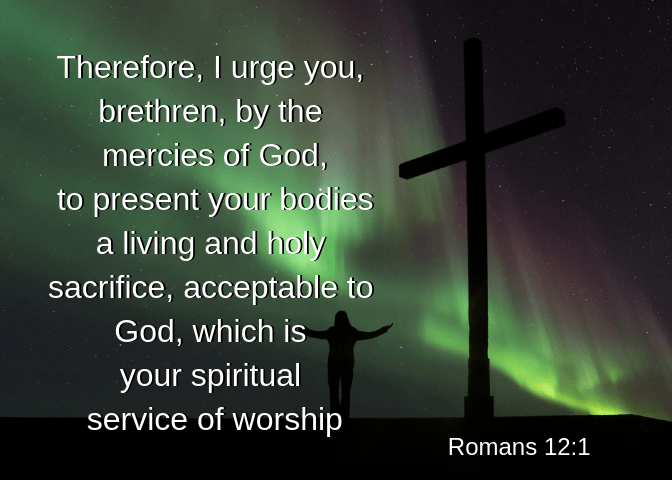
Romans 12 1 (1)

THEME WEEK BREAK – WORSHIP .  (Next Sunday we will continue with our chapter by chapter New Testament devotions in the book of Romans)

Today’s Reading – Romans 12

The topic for this week’s devotion is one that God has been teaching me about for the last few years. That is the topic of worship. This is an immensely broad topic with many details and facets to it. But don’t worry, given the devotion format of this I will keep it concise, streamlined, and bring out only essential points. With that being said, I pray this will broaden our understanding of worship and convict us to live a more consecrated worshipful life for God and Jesus and live the best life God has for us!

What is worship? From what I read in the Bible and what God has taught me, worship is having the right heart condition that loves him and desires him to be glorified in every aspect of our life. Equally important is the understanding that biblical worship is worship that engages that whole person. This brings me to making a critical point. If you forget everything else or don’t read the rest of these devotions remember this: WORSHIP IS NOT A SONG IT IS A LIFESTYLE. Biblical worship engages the body, mind, heart, and soul. God desires his people to worship him and Jesus with everything they are in every aspect of their existence with the right heart condition motivating it all. This is what I believe biblical worship is.

Two foundational verses that speak to this topic are Deuteronomy 6.5 and Romans 12.1-2 (all bible quotations will come from the NASB) :

Deuteronomy 6.5:

“You shall love the Lord your God with all your heart and with all your soul and with all your might”

Romans 12.1-2:

“Therefore, I urge you, brethren, by the mercies of God, to present your bodies a living and holy sacrifice, acceptable to God, which is your spiritual service of worship. And do not be conformed to this world but be transformed by the renewing of your mind so that you may prove what the will of God is, that which is good and acceptable, and perfect.”

Take a moment to examine your understanding of worship. Do you think of worship as just a song or prayer? Do you worship God and Jesus with every aspect of your existence? Something I forgot to mention at the beginning was why should this matter at all? God has created us to worship him. Worship is central and essential in a believer’s life and walk. To live the best possible life God has for us in this lifetime is inextricably tied to worship.

-Jacob Rohrer


About Jacob: Jacob is an assistant pastor and worship pastor at Lawrenceville church of God. Currently he is engaged and will be getting married this June.

The Cliffhanger

JPEG image-5457EAF908AB-1 (1)

Acts 28

Starting with the arrest of Paul in chapter 21, Luke has been steering his readers to a grand finale, where Paul will finally stand in front of the most powerful man in the world to give his testimony. The Apostle endured conspiracies against his life, corruption in government, and finally storms at sea to make it to Rome. Paul was willing to go through all this because he had a clear vision and purpose for his life and knew Rome was where God wanted him to be and the Emperor was who God wanted him to see.

But the conclusion Luke had been building towards is suddenly cut short with Paul under house arrest. We’re not told if he ever got the chance to defend his case before the Emperor, but we can be confident that he did since God said he would. Though exactly how it came about or what happened after is a mystery. There are traditions that say he was acquitted and then brought the Gospel to Spain, but Luke doesn’t confirm or deny it. He just closes his book with a cliffhanger.
So what are we to take away from this saga with the abrupt and unresolved ending and why would Luke decide to leave it the way he did?
Luke began the Book of Acts by reporting the last interactions Jesus had with his disciples before he ascended. He told them that they would be his witnesses in their local regions and then throughout the world. Luke then proceeded to show his readers how the disciples went about doing this. But he left his story open-ended, and he did all this for a reason.
The Acts of the Apostles is about how the disciples carried out the Great Commission and it is left unresolved because the story wasn’t supposed to end with Paul in Rome, it was supposed to progress with disciples continuing to fulfill the final instructions of Jesus. And it did. The reason you’re reading this now is that the witnessing has endured to this day. And it will continue so long as people like you and me keep spreading the Good News of the Kingdom of God.
So don’t worry about this cliffhanger. The final resolution will come when Jesus himself returns to see the fruit of his disciples’ labor and to establish the Kingdom they represent. Until then, we must maintain the work that was started in Christ and continued with his disciples. May the perseverance and commitment of Paul and the rest of the Apostles act as an example for you on your journey and encourage you to remain faithful in the advancement of the Great Commission.
-Joel Fletcher

The Long Journey to Rome

JPEG image-56512E7E40C1-1

Acts 27

Today it only takes a few hours to travel from the Holy Land to Rome. A non-stop plane ticket costs just a few hundred bucks. For a couple of hundred more, you can get upgraded to first class. That sounds rather nice–flying over the beautiful Mediterranean sea, being waited on hand and foot, heading to the former center of the Roman empire to take in the sights and sounds of this majestic ancient city.
For Paul, though, the journey was not so short…or luxurious. And it certainly wasn’t non-stop. The trek to Rome included a slew of problems for this man from Tarsus and his companions, such as a snakebite, a shipwreck, and a plan to slaughter prisoners. What happened during this voyage would have tested the most experienced seafarer. But throughout the storms and chaos, Paul remained calm and determined. When others had lost hope and were filled with fear, the Apostle took charge and restored order.
Paul was able to remain composed and didn’t cave to fear because of where he placed his trust. He had been informed by the Lord that he would make it to Rome to testify there and he believed this wholeheartedly. God had been faithful thus far and Paul knew this would continue. After all, he did write the words of Romans 8:28.
“We know that God is always at work for the good of everyone who loves him. They are the ones God has chosen for his purpose.” – Romans 8:28 (CEV)
God has a plan. From the Bible, we can gain a general understanding of it. We can see how He has worked in history and what He intends to do in the future. Sometimes, though, it can be difficult for us to see where we fit in the grand scheme of things or how God can work in us. God used Paul as an instrument for His glorious plan. It wasn’t because he was special that God chose to employ Paul as His messenger to the Gentiles; he was special only because he was chosen. We don’t have to be special for God to use us either (which is a good thing…because we’re not).
Paul found himself on that arduous adventure because he was doing work for God. If we are going to be active followers of Christ and productive promoters of his Good News, sometimes we’re going to find ourselves in difficult situations as well. But we, like Paul, can have courage knowing the plan God has for the future and confidence because we are doing His will.
-Joel Fletcher

Paul Speaks Freely

image (3)

Acts 26

Because of his appeal to Caesar in chapter 25, Paul was guaranteed his next trial would take place in Rome. So when Paul stood before King Agrippa and other dignitaries, he wasn’t required to defend himself or give testimony. Having said that, Paul wasn’t going to pass up an opportunity to witness about the works God had performed in his life–this was one of his life’s missions. So Paul, being able to speak freely, gave his most passionate testimony yet.
There are three things we should learn about apologetics (defending the Christian faith) from Paul’s final defense before he headed to Rome.

1. Know Your Stuff.

Although Festus called Paul crazy, he recognized him as a man of great understanding. Going back to his days as a Pharisee, Paul demonstrated his great zeal for truth and reason. He didn’t lose this enthusiasm when he became a follower of Jesus, he refocused it. Paul knew the Hebrew sacred writings better than anyone and was a master at reconciling the long-held truths of Scripture with his new-found recognition of Jesus as Messiah. Paul was also well learned in the other philosophies and religions of the day. This is most clearly seen in his visit to Mars Hill.
If we are going to be able to defend our faith, we must be knowledgable of both the ideas of Scripture and those contrary to them.

2. Live Above Reproach.

One of the most common critiques leveled against Christianity today is that its adherents are hypocrites. Nothing ruins credibility more effectively than saying one thing then doing the opposite. The Jews had quite a difficult time trying to get charges against Paul to stick. As has been mentioned before, Paul strived to live life with a clear conscience. So in order to discredit and disgrace Paul, the religious leaders had to contrive charges against him.
To be an effective witness and apologist for the Christian faith, we must also strive to live with a clear conscience.

3. Be Positive.

Another issue some have with Christians is that they can be too harsh when talking about their faith. Street preachers and picketers are tuned out and labeled as unfriendly fanatics (or worse) by passersby. Sadly, they are the only representatives of Christ some people every meet.
When Jesus was harsh it was with those who should known better (the religious elite). When Paul was trying to convince unbelievers of the wonderful nature of the Good News, he would do so in a positive way–highlighting things like the resurrection, the power of God, and the mercy He extends to sinners.
The truth is that there are certain tenets of Christianity that non-believers don’t like. When witnessing we should focus on the recognized positives of the faith that appeal to most people–mercy, justice, eternal life, etc. Once people start understanding things like the nature of God and morality, then we can start discussing the perceived negative doctrines of Christianity.
Paul was knowledgeable, had a clear conscience, and was positive when defending his faith and promoting the Good News. The power of the Gospel message is amazing and life-changing. If we want to further its reach and be better able to defend it, we must follow these three principles from Paul.
-Joel Fletcher

Paul Exercised His Privilege And So Can You

image (2)

Acts 25

In chapter 16, we found out that Paul was a Roman citizen. Being a citizen of this vast empire was a great privilege. There were only two ways to gain Roman citizenship; you could either purchase it (something only the rich could afford to do), or be lucky enough to inherit it from your parents when you were born. Paul was born a Roman citizen.
The reason why you would want to be a Roman citizen in the first century is that they were given rights others were not guaranteed. The rights to marry another Roman citizen, to sue and to be sued, to have a legal trial, and to not be crucified were just some of the benefits offered to those privileged enough be Roman citizens.
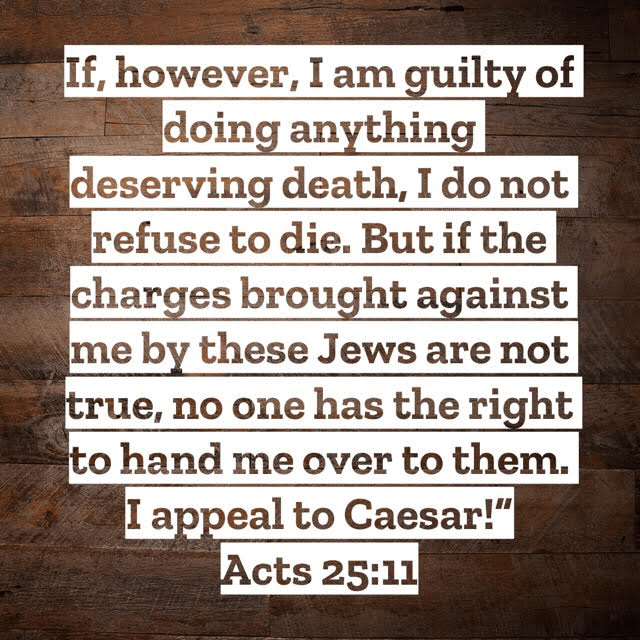
As we saw in chapter 21, Paul had already used his citizenship to get out of being flogged (Romans, legally, could not be tortured or whipped). In chapter 25 Paul exercised another of his rights–the right to appeal to Caesar. Paul knew that if he was brought back to Jerusalem, the men that had pledged to kill him would probably succeed. He also knew that he had to get to Rome to testify there. Thus Paul used his privilege to get to where he needed to go, so he could do what he was required to do (though, as we shall see in the coming chapters, this journey would not be an easy one).
If you were born in the West (especially the United States), you, like Paul, are privileged. You have rights like freedom of speech, freedom of religion, and freedom of the press. But there are many parts of the world today where these rights that are taken for granted are only the ideals of dreamers. There are Christians throughout the world who have to look over their shoulder as they travel to church (if a public place of worship is even allowed) and others who are worshiping with the knowledge that every gathering may easily be their last.
There is another privilege you share with Paul: you are a citizen of Heaven. This citizenship cannot be purchased or inherited. It is not exclusive. The Kingdom of Heaven (or, Kingdom of God) is open to anyone. The poor and the rich, the weak and the strong, the lost and the found are all welcome. The cost of this privilege was paid for by God with the blood of His Son. It is offered to any who will receive it.
Paul was first and foremost a citizen of Heaven. He lived his life devoted to advancing the Kingdom and the One who will establish it in its fullness. The rights his Roman citizenship granted him were nothing compared to those his Lord did. That being said, Paul exercised his privilege as a Roman in order to promote God’s Kingdom as a Christian. He wanted to make sure as many people as possible would become citizens of the Kingdom. You also can use your rights as a citizen of your country to further the cause of the Kingdom. Exercise your earthly privileges in a way that leads others to receive heavenly ones.
-Joel Fletcher