Leadership

1 Timothy 1-3

Devotion by Jenn Haynes (OH)

There was a time when I didn’t think very much of Paul. It was as a teenager reading his instructions to Timothy here in Chapter 2. I had faith, though, that God was speaking through this man, and SURELY there was something here that I just wasn’t understanding correctly. It wouldn’t be the first or last time that I had to look at a scripture passage and throw up my hands, admitting that I just didn’t have an answer. 

I’ve gone back and forth, looking at explanations and trying to get insight on what exactly was happening at this church. I got the impression that the women there were not behaving the way they should be. Admittedly, some scholars use Chapter 2 as absolute reasoning for why women should not be leaders in the church. Obviously, this doesn’t sit well with me, being a female church leader. Many say that it’s specifically addressing a problem within that church, where women were using wealth, fashion, and beauty to loudly and boldly repeat false teachings that they didn’t fully understand, and it was turning others away. Also, some translations point not to Paul refusing to give women authority over men, but rather specifically not giving them authority over their husbands. I heartily agree here, as that would cause disharmony within a balanced marriage that is seeking to honor Christ. 

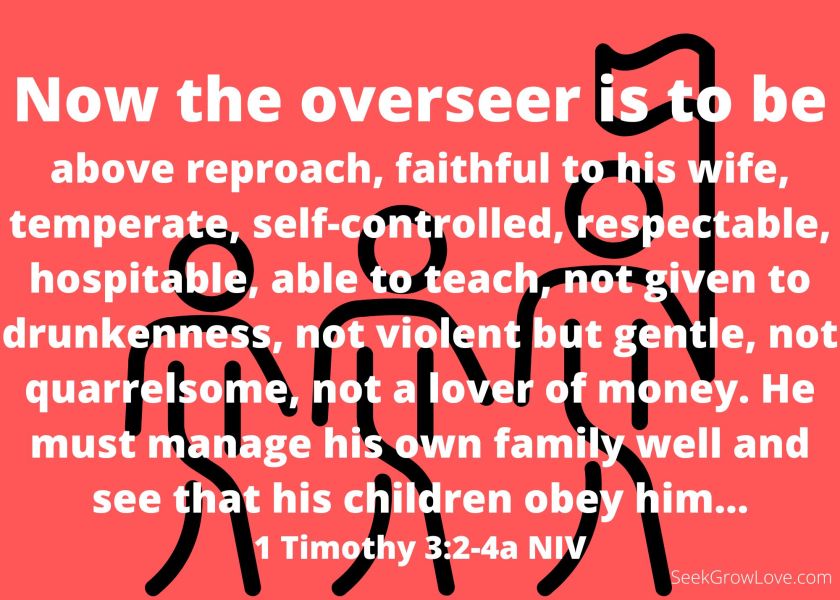
Looking into the whole of scripture, we actually do see female leaders throughout the Old and New Testaments. Those female leaders had wisdom, were full of grace and mercy, and were servant leaders as we are all called to be. They strove toward truth and righteousness, and they were held up for those qualities. We see many of those qualities listed here in the first chapters of Timothy, giving us a wonderful outline of what a good leader looks like. 

We are to worship and pray together without anger. We are to focus more on our actions than our appearances. We are to be faithful to our spouses and full of self-control, managing our lives, money, and families in a way that honors God. We are all to be worthy of respect. 

That’s a lot to place on an imperfect human being. We hear about scandals with our leaders all the time. They make for sensational news. But this is not what we want to see in anyone, especially in our church leaders who are to be leading others to Christ. 

Stepping up as a leader in our church means greater accountability. James 3:1 warns us about this: “Not many of you should become teachers, my fellow believers, because you know that we who teach will be judged more strictly.”

How many people have turned away from Christ because of the actions of those in his church? Too many. 

Reflection Questions: 

Are you a sort of leader in your church? Even if you don’t have a named role, are there those who would follow your example? Have you ever thought deeply about what kind of responsibility that is? People are looking to you and your example when you proclaim yourself to be a Christ follower. Are you following his example in your words and actions? 

Go through Paul’s list of qualifications of a good leader. Where do you hold up to the standard, and where could you use improvement? How could you do better to be a good example for others, someone others would respect and want to follow. 

Prayer:

My prayer is that we all take to heart the fact that we are representing Christ when we call ourselves Christians. Pray that God opens your eyes to where you can be a better example to others and that you lead those around you closer to a relationship with him. 

Just and Tender Father

Isaiah 40-43

Many, many years ago, as a novice classroom junior high teacher, I was learning what it meant to “be firm, be fair, be consistent”; which now as a veteran educator is my favorite word of advice to pass along to the next generation of teachers. 

One of my nicest, most reliable, hard-working students entered the classroom tardy one day. Any other week of the school year, I would have not given it a second thought and have her sit down and get to work – something she would have done naturally. However, the previous day, I had just had a stern conversation with the class about the importance of showing up on time and the consequences if anyone chose to be late to my class in the future. I had already taken attendance and wondered out loud if anyone knew where this particular student was. No one knew. A few minutes later, she walks in – without a pass. She paused as she entered the room. The rest of the class looked at her and then looked at me – was I really going to hold this ‘good kid’ accountable for what I just had said the day before? As much as I hated to do it, I reminded her that she would be eating lunch with me that day and the rest of the class knew if I meant business with this kid, I was absolutely serious about my message for the rest of them. 

Later on as I was holding this student during lunch, we talked about where she had been, why she didn’t have a pass, and how the entire incident was so out-of-character for her. Her explanations made sense and she understood why I had to do what I did. She was never late again.

In leadership, this style of management is often referred to as a “velvet hammer”. In other words, “be firm, be fair, and be consistent” with everyone, every time. 

As I read the opening verse of Isaiah 40 and the next couple of chapters of today’s Bible reading, I am reminded of the velvet hammer and my educator mantra. 

Through the prophet Isaiah, God had just completed pronouncing judgement on the Israelistes in the previous chapters, aka the “hammer”. Now, in what is sometimes referred to as the “Second Isaiah”, God is now offering comfort and encouragement to His people, aka “the velvet”. 

“Comfort, comfort”. With the repetition, you can almost hear the tenderness of a parent reassuring a child, “There, there, now. It’ll all be alright.” Discipline is never pleasant when the relationship is loving. The authority figure in the relationship knows that the pain and discomfort associated with accountability is necessary in order to provide guidance and direction for the child, follower, or subordinate. For the child, it’s a difficult reminder of the offense and the actions required to make things right again. However, with the reassurance that things can indeed be made right, the discipline is easier to accept. 

“My people”. Even though the Israelites have continued to make disappointing choices, God still claims them as His. Any other sovereign probably would have given up on such an obstinate group, but not the Almighty. His covenant with the Israelites is reaffirmed with these two words. God is not going anywhere, He is not giving up. 

“Says Your God”. And just as resolute as God is in holding up His side of the covenant relationship, He wants to remind the people that He longs for them to do the same. He still desires to be known as the God of Israel. There is nothing that can be said or done to make Him want anything less. Additionally, God is reminding them that amid all the other false idol gods that have been manufactured, He alone is their God. He is the one who is worthy of all glory, honor and praise. He alone is “the LORD, the everlasting God, the Creator of the ends of the earth” (v.40:28).

My hope and prayer for you reading this today is that if you’ve ever experienced God’s discipline, you’ve also experienced His tenderness and mercy. God loves you more than you can possibly imagine and His discipline is evidence of this love. Cling tightly to our Father because He is always faithful, always present, always full of grace and mercy, always all-powerful, always right there where we need Him to be. May you be comforted by this covenant of love today. 

Reflection Questions

  1. When have you experienced God’s ‘velvet hammer’ – a moment of discipline wrapped in love and mercy?
  1. How does God calling the Israelites “my people” after their failures, influence your own identity and relationship with God, especially after you have missed the mark?
  1. How does knowing that God is both just and tender shape your trust in Him?

-Bethany Ligon

Remind the People

Old Testament: 2 Chronicles 31-32

Poetry: Psalm 105

New Testament: Titus 3

Life is so busy and complicated that I have to create lots of reminders for myself.  Fortunately, my phone and computer and watch all have features where I can set reminders for myself.  “Doctors appointment Tuesday at 3:00.  Take the garbage to the dump on the way to work in the morning.  Stop by the store after work and pick up some milk and bread.” I can even set reminders months or years in advance.  I can set alarms to remind me that in 2 hours I have a meeting.  In 1 hour I have a meeting.  In 15 minutes I have a meeting.  The Meeting is now starting.  Maybe I’m too busy or maybe I’m getting old, but I find myself more and more needing reminders.

Do you ever need reminders?  Little kids need to be reminded to brush their teeth, make their bed, do their homework.  What do you need reminders for?

The Apostle Paul thought reminders were important for Christians.  I guess he understood how easy it can be to forget what’s important when we are busy living life and doing  what’s necessary or urgent.  Do Christians ever forget important things about God, about Jesus, about how we are supposed to live?  Yep, we sure do.

In Titus 3 Paul tells Titus to remind the believers of some important things.

“Remind the people to be subject to rulers and authorities, to be obedient, to be ready to do whatever is good, to slander no one, to be peaceable and considerate, and always to be gentle toward everyone.” -Titus 3:1-2

Those reminders were important in the first century when Christianity was brand new and people were still learning the basics, but it’s been 2000 years.  We’ve certainly got being a Christian all figured out by now, don’t we?  Do we really need to be reminded to obey people in authority?  Do we need to be reminded to always be ready to do good?  Don’t all Christians always do what is good?   Certainly we never  slander or falsely accuse someone of wrong doing.  I’m always peaceable and considerate and gentle toward everyone, aren’t you? (My tongue is in my cheek- that means I’m kidding).

To tell the truth, I still need to be reminded of all of those things.  Just because I’ve been reading the Bible for over 50 years doesn’t mean I always remember to do good.  I still need to be reminded to be considerate and gentle, and so do you.  That’s why Christianity was never designed to be lived in isolation, but in community.  We need each other.  There’s a passage in Hebrews (a different book from today’s reading,  but important) Hebrews 10:24-25 says that Christians shouldn’t get out of the habit of meeting together, because we need to encourage (I think Hebrews says “spur one another on”, like a rider spurs on a horse) each other.  

Following Jesus is hard some times.  Being obedient to God is hard some times.  Remembering to do good and be gentle is hard sometimes.  I need help, I need encouragement to keep on doing what is right.  I need you, and you need me, we need each other.

I’ve read the Bible many times in my life and I need to keep on reading it to help me remember all the important things I need to remember.  Today’s readings in Isaiah 63-64 and Titus 3 remind us both about God’s wrath and about God’s mercy.  God has both.  God hates sin, he hates it when his children are brutal to each other.  He hates it when his children fight and argue.  He hates sin because he loves us and he knows that sin hurts us.  We hurt each other when we sin.  No parent likes to see their children hurt each other.  We learned that from our Father, God.

So keep reading your Bible and keep coming to Church and meeting with other believers so that you can remind them and they can remind you to keep on following Jesus.

“Hey Siri  set a reminder for 7 a.m. tomorrow:  be considerate and gentle to everyone.”

“Alexa, remind me to get up for Church Sunday at 8:00.”

-Jeff Fletcher

(Originally posted here on October 4, 2021 – when we were reading Titus and Isaiah together. This year, we get to start Isaiah tomorrow.)

Reflection Questions

  1. What do you need reminders for?
  2. Look at the list of things Paul told Titus to remind the people to do. For each one ask yourself why is this important and how well am I doing this? If you were to choose one to focus on reminding yourself to do for the next 14 days, which one needs your most attention right now?
  3. What is your attitude toward those who give you reminders?
  4. How can you encourage others to do what is right?

Friday – June 24th, 2022

2 Corinthians 7

I recently attended a great Young Adult Getaway hosted by the Church of God General Conference. Around 60 (somewhat) young adults got together and had a great time fellowshipping with one another, learning about God, and worshipping God together. The theme for the weekend was “Find Your People” based on a book by Jennie Allen. Especially after living through the social changes brought about by social media and the pandemic, we probably can all relate to feeling both more socially connected and socially isolated than ever before. I can spend hours scrolling to see the engagement and pregnancy announcements from people I went to high school with (that I haven’t seen or spoken to in years), but I don’t feel like I have time to deeply connect with my present-day family and friends. The getaway focused on how we can connect with people – which is an essential yet often overlooked part of the Christian faith. 

While we were there, I spoke about one uncomfortable aspect of connecting with others in a Christian context: holding others accountable. When we first become a Christian, we may think that our fellowship with others is all based on the love we show each other… which is actually true. But, early on in our walk with Christ, our idea of love is based on what we see in movies and TV shows. Love supports each other no matter what. It speaks encouragement (only) and never criticism. It does not judge. Love never makes the other person feel bad. So, we think, based on this understanding of love, that our Christian relationships should follow the same blueprint, but this is not the case. 

Our understanding of what love is changes when we become a Christian. Jesus did say, “By this all people will know that you are my disciples, if you have love for one another” (John 13:35). But, at the same time our idea of love has changed. John later says in 1 John 4: 10-12, “This is love: not that we loved God, but that he loved us and sent his Son as an atoning sacrifice for our sins. Dear friends, since God so loved us, we also ought to love one another. No one has ever seen God; but if we love one another, God lives in us and his love is made complete in us.” Love becomes much more about self sacrifice than mindless tolerance, much more about spurring each other on than accepting where we are currently at. 

Paul recognizes this. As I’ve read through his letters, a common Pauline trait has stood out to me; he is a master at accountability. In his letters, he is constantly calling his fellow brothers and sisters in Christ to higher standards and encouraging them to hold fast to the standard set before them in Christ. This is especially true in his letters to the Corinthians. In today’s reading,  we see Paul continue to do this. He tells them, “Therefore, since we have these promises, dear friends, let us purify ourselves from everything that contaminates body and spirit, perfecting holiness out of reverence for God” (v. 1). But, he doesn’t say this because he dislikes the Corinthians in any way. Instead he tells them later on, “I do not say this to condemn you; I have said before that you have such a place in our hearts that we would live or die with you. I have spoken to you with great frankness; I take great pride in you.” (v. 3-4a). Paul deeply cares about the Corinthian church, which is why it is so important to him that they live right in the eyes of God. 

We also are called to live right and hold others accountable. How are you spurring others on to love and good deeds (Heb. 10:24) today? 

~ Cayce Fletcher

Questions for Application: 

  1. Do you feel more connected or more isolated when you think about your everyday life? Who are ‘your people’ that you live close by that can spur you on in the faith? 
  2. Have you ever experienced accountability (whether it was you holding someone accountable or someone else holding you accountable)? What was that experience like? 
  3. How does accountability strengthen our Christian walk? 

The Blessing With a Price

Genesis 27

February 4

This Bible story is one of the classics, and I am happy to revisit it because when I was younger, I had no clue what the moral of the story could be. Genesis 27 features Isaac, now old and blind, his wife Rebekah, and his two sons Esau and Jacob. In his old age, Isaac realizes that his death is drawing nearer every passing day, so he instructs his eldest son Esau to go out and hunt some wild game to prepare for him in exchange for his blessing. As Esau goes out to hunt, Rebekah, having heard all this, instructs Jacob to fetch two young goats to make just the way his father likes it. She then proceeds to dress Jacob in Esau’s clothing and adorned the open parts of his skin with goatskins so that he can receive Esau’s blessing from Isaac.

Their plan ends up working as Jacob receives Esau’s blessing, and I remember thinking as a kid, “Well, that just doesn’t seem fair.” I had all sorts of questions fill my mind, and I was so distracted by this that I neglected the second part of the story as a kid. When Esau returns and learns that his blessing has been stolen, he does not respond in a very loving manner. He makes plans to kill Jacob! Rebekah learns of this and warns Jacob, telling him that he must flee until Esau’s anger subsides and he forgets what happened in the first place. The chapter comes to an end with Rebekah setting Jacob’s escape plan in action.

After some reflection, it’s no wonder I didn’t understand the moral of the chapter as a kid because it’s something we’re told all the time but doesn’t really click until you’re older and more experienced. This part of the Esau and Jacob story teaches us that our actions have consequences. Here, Jacob receives all the blessings from his father and is set up to live a successful life, but once his brother found out what he did, Jacob had to leave behind everyone he loved and all he owned to go somewhere unfamiliar to save his life. All the deception was for naught as Jacob had to give up his peaceful life at home to live in strange new lands with only the clothes on his back and supplies to get there. As we go throughout life, it is easy to forget that every little thing we do has consequences. They may be seen immediately afterward or they may even show up way down the line, but as a family of believers, we must hold one another accountable to ensure that our actions produce consequences that are pleasing to God and the life that he wants us to live.

-Austin Kizer

Questions for Reflection and Discussion

  1. Why do you think Rebekah wanted Jacob to receive Isaac’s blessing instead of Esau? What would you have done in Jacob’s position if Rebekah proposed this idea to you?
  2. Was Esau’s reaction justified or overboard? How do you think this reaction will impact Jacob and Esau’s relationship moving forward?
  3. Was there ever a time when you recognized the consequences of your actions? What did you learn from this experience? How did it impact similar situations later on?

Tomorrow we will be reading Genesis 37

Reminders

Isaiah 63-64, Titus 3

Life is so busy and complicated that I have to create lots of reminders for myself.  Fortunately, my phone and computer and watch all have features where I can set reminders for myself.  “Doctors appointment Tuesday at 3:00.  Take the garbage to the dump on the way to work in the morning.  Stop by the store after work and pick up some milk and bread.” I can even set reminders months or years in advance.  I can set alarms to remind me that in 2 hours I have a meeting.  In 1 hour I have a meeting.  In 15 minutes I have a meeting.  The Meeting is now starting.  Maybe I’m too busy or maybe I’m getting old, but I find myself more and more needing reminders.

Do you ever need reminders?  Little kids need to be reminded to brush their teeth, make their bed, do their homework.  What do you need reminders for?

The Apostle Paul thought reminders were important for Christians.  I guess he understood how easy it can be to forget what’s important when we are busy living life and doing  what’s necessary or urgent.  Do Christians ever forget important things about God, about Jesus, about how we are supposed to live?  Yep, we sure do.

In Titus 3 Paul tells Titus to remind the believers of some important things.

“Remind the people to be subject to rulers and authorities, to be obedient, to be ready to do whatever is good, to slander no one, to be peaceable and considerate, and always to be gentle toward everyone.” -Titus 3:1-2

Those reminders were important in the first century when Christianity was brand new and people were still learning the basics, but it’s been 2000 years.  We’ve certainly got being a Christian all figured out by now, don’t we?  Do we really need to be reminded to obey people in authority?  Do we need to be reminded to always be ready to do good?  Don’t all Christians always do what is good?   Certainly we never  slander or falsely accuse someone of wrong doing.  I’m always peaceable and considerate and gentle toward everyone, aren’t you? (My tongue is in my cheek- that means I’m kidding).

To tell the truth, I still need to be reminded all of those things.  Just because I’ve been reading the Bible for over 50 years doesn’t mean I always remember to do good.  I still need to be reminded to be considerate and gentle, and so do you.  That’s why Christianity was never designed to be lived in isolation, but in community.  We need each other.  There’s a passage in Hebrews (a different book from today’s reading,  but important) Hebrews 10:24-25 says that Christians shouldn’t get out of the habit of meeting together, because we need to encourage (I think Hebrews says “spur one another on”, like a rider spurs on a horse) each other.  

Following Jesus is hard some times.  Being obedient to God is hard some times.  Remembering to do good and be gentle is hard sometimes.  I need help, I need encouragement to keep on doing what is right.  I need you, and you need me, we need each other.

I’ve read the Bible many times in my life and I need to keep on reading it to help me remember all the important things I need to remember.  Today’s readings in Isaiah 63-64 and Titus 3 remind us both about God’s wrath and about God’s mercy.  God has both.  God hates sin, he hates it when his children are brutal to each other.  He hates it when his children fight and argue.  He hates sin because he loves us and he knows that sin hurts us.  We hurt each other when we sin.  No parent likes to see their children hurt each other.  We learned that from our Father, God.

So keep reading your Bible and keep coming to Church and meeting with other believers so that you can remind them and they can remind you to keep on following Jesus.

“Hey Siri  set a reminder for 7 a.m. tomorrow:  be considerate and gentle to everyone.”

“Alexa, remind me to get up for Church Sunday at 8:00.”

-Jeff Fletcher

Today’s Bible reading plan passages can be read or listened to at BibleGateway.com here – Isaiah 63-64 and Titus 3

Guard your Hearts

Hebrews 3

hebrews 3 12

Hebrews 3:12-13, “See to it, brothers, that none of you has a sinful, unbelieving heart that turns away from the living God. But encourage one another daily, as long as it is called Today, so that none of you may be hardened by sin’s deceitfulness.”


If we don’t guard our hearts, it will lead to sin. The more we sin, the easier it becomes and the more we let our guard down. The more we let our guard down, the more we lose the good that is stored up in our hearts. The more we lose, the more bad things will replace it. The more of the bad things that get stored up in our heart, the harder it becomes. The harder it becomes, the more we deflect any good things that try to work their way back into my heart.


Unfortunately, I see it happen on a yearly basis. So many students leave an event like Fuel on fire for God. The first couple weeks – in the word, involved at church and avoiding former bad habits. But then one slip often leads to another – and eventually this year wasn’t “Different” and they are back to normal.


Over time their hearts harden up and they become resistant to the things of God. Things like church or the Bible are no longer a part of their lives. They lash out at you when you try to talk to them about it. They dismiss any attempt at getting them to see what has happened to them.


Like the frog in the kettle. Put a frog in a boiling pot and he will immediately jump out. Put him in a pot of warm water and slowly turn up the heat and he will stay in until it’s too late.


Therefore we need to encourage one another to guard their hearts, be vigilant and watchful.


For those that attended FUEL, we are only a month out. Are you still letting your light shine and proclaiming your differences? What about your friends? Keep in touch and keep each other accountable.


Guard your hearts!

John Wincapaw

Building Your Prayer Life

James 5_16b

Another common resolution of Christian’s is that they want to pray more. What does that mean though? Does this mean that they will pray more during meals, or they will remember to pray before bed? Does this mean praying at random times or scheduled times during the day? What exactly is prayer, and how do you have more? If your goal this year is to grow closer to God, then this topic is something you should really consider and maybe work on. (I am also not claiming that I am good at this, I know that this is something I plan to work on this year.)

Some passages to read this week: Matthew 6:5-13, James 5:13-18

Prayer is conversation with God. It is a time for you to talk with him and tell him what is going on in your life and to ask him for guidance or support or help. Prayer is for you to build your relationship with God. It is a way for you to give him praise and thanks for everything that he has done in your life. Besides these, prayer is for you to ask for what you desire and what you need. God is pretty awesome and he loves to give us what we want as long as it is good for us and it is in accordance with his plan for our lives. Matthew chapter 6 talks about how and where to pray. It says not to be like the hypocrites who pray in front of the synagogues so that people could see them and what they were doing. It says to pray in your room alone, because prayer is for you and God, and between you and God. Now do I think that you can only pray in your room alone? No, you can absolutely pray wherever and whenever you want, but the motivation behind your praying should not be to get attention from other people, but to converse with God. In Matthew 6, Jesus tells us the Lord’s prayer, he was giving a simple prayer that people could remember, and it covers a lot of different things in there, but your prayers do not all have to be like the Lord’s prayer.

Different ways to pray. There are as many different ways to pray as there are people on earth, and even more than that. Every single person of faith has their own relationship with God, and this means that their prayers are going to be their own, and different from anyone else. If you are trying to add more praying into your life and you do not know where to start, here are some ideas.

Just start praying; tell God anything and everything that is going on in your life. Talk out loud, or quietly to yourself and just thank God for the little things, or ask him questions, or ask for things in your life. Start a conversation, and listen for the response. Look for it in the world around you. God will make things clear when they are meant to be clear and known to you.

Listen to music, or sing a prayer. I personally feel closest to God when I am singing, or when I am listening to praise music. Is that praising? yes, but for me it is also how I talk to God, and I often get chills that tell me God is hearing me. My favorite prayer is actually a prayer that my family sings before meals. It goes like this; “Be present at our table Lord, be here and everywhere adored, these mercies bless and grant that we, may feast in fellowship with thee. Amen.” It is a tradition that I have always loved, and it is where I feel closest to our heavenly father.

Write in a journal. Again, prayer is meant to be a conversation between you and God. Maybe talking and singing is not comfortable for you, or you do not feel God’s presence when you do those. Try writing and journalling. Write your thoughts down and then just give them to God. He can still understand what you are asking of him, and this is still a form of communication. I sometimes journal and write down my thoughts, and it helps me in that moment. However, sometimes I re-read what I wrote and it helps me again later.

James 5:13-18 This passage talks all about when to pray. I’ll let you in on a little secret, it basically says to pray all the time, in any and every circumstance. We should pray when we are sick, troubled and lost. We should pray and sing praise in the joyous times. When we have wronged someone we need to tell our brothers and sisters in Christ and ask them to pray for us and with us. We should being praying in EVERY circumstance. I know I pray to God when I am really having a hard time, but I sometimes forget to pray in the good times and thank him for everything that he has done for me and given to me. This is on me, and I should do better about this.

James 5:16 talks about confessing your sins to your brother and praying for each other. To me, this also talks about accountability. Sometimes with the business of life it is difficult to remember what we promised, or to pray. If prayer is something you want to take more seriously in your life, or have more of, think about asking for an accountability partner. Ask a friend if they are willing to pray with you daily, or if they are willing to send you a text asking if you have been praying. Whatever an accountability partner would mean for you, I encourage you to seek that out. You will deepen your relationship with God, and you may even build deeper connections with fellow believers as well.

-Jana Swanson

Make Better Investments

Matthew 25:14-30

Matt 25 21

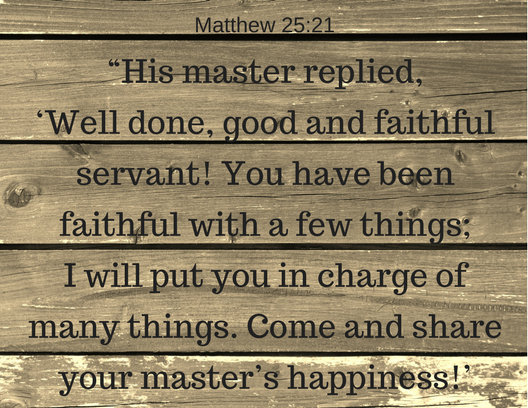
Today we are talking about the New Year’s resolution of making better investments. This is a common resolution in the world whether people are people of faith or not. However I am going to talk about faith investments, more than monetary investments. Yes finances and being responsible are important in our lives and in our faith, however we need to be able to ask God for guidance in all areas of our lives including that one and we need to be flexible enough to listen to him.

At the start of the New Year one of my friends asked God, “Where and in whom should I invest my time, in 2018?” My thought was this, invest your time in the people who will give your time more meaning than just the time that they spend with you. Yes sometimes it is nice to have friends and family who will spend time with you, without there being a specific reason or purpose. However, you need to truly invest your time and energy in the people who will do something big with that time, not necessarily for you but maybe for them and their future. Today we are reading from Matthew 25:14-30. This passage is the parable of the talents. It is about the Master who gave 3 servants different number of talents, which were a type of coin. One was given 5, one was given 2, and one was given 1. The one with 5 invested them and doubled the money. The second servant did the same. The last servant buried the 1 talent in the ground, he did not even put it in the bank to at least collect interest. The first servant proved himself and so the master gave him even more, but to the last servant he gave him nothing, and he actually threw him out into the darkness where there would be weeping and gnashing of teeth. (That seems a little harsh to me, but the reality is life can be pretty difficult sometimes.)

I take a few things from this parable. 1.) Make smart choices and smart investments in your life, and take care of things that people entrust you with. The servants who made their master happy increased the master’s wealth, but they also did not lose the money that he gave them because they were proactive and took care of what they were entrusted with. The servant who did not make his master happy, did nothing with what he was given. This is what we should pay attention to. God gives us a lot of things. He gave us a life to live, and he has a plan for each of us. If you are not listening to him, how are you taking care of the gift that he has given you? If you are not taking care of the earth, and being conscious of how your actions affect other people and other creatures, how can you be taking care of a gift that was given to you? You are not. Think about this as you go about your daily life. How can you take care of the life you have been given? How can you listen to and follow God’s plan for your life?

2.) Invest in the people who are going to give you more than just time. Invest in the people who are going to give you wholesome friendships. Invest in the people that push you to be a better person, and those who hold you accountable to the things that you see. Invest in people who will push you in your relationship with God, and invest in those who will support you when you fall. We are imperfect beings and we will fall short sometimes. We will not always meet others’ expectations of us, God’s expectations or even our own expectations. Those will be difficult moments, but they will be easier to face if we have surrounded ourselves with people who will support us. It will also be easier if we have nurtured those relationships and given them the time that they deserve.

3.) Invest in God. This seems simple, and you’re probably going to guess what I am going to say. A relationship with God is not a one way street. You can not accept that Jesus is your savior and the son of God, and that God is one and only God, and not do anything else. You have to live a life with works. James 2:17 “Even so, faith, if it does not have works, is dead in itself.” This means investing in time in prayer, and in time in the word, and even in time with other believers in fellowship. Find little ways to do more of these in your daily life. Later in the week we will talk more about how to do more in the investment of your relationship with God, as we enter into this new year.

-Jana Swanson

A True Friend

PROVERBS 27 – Monday

Prov 27 17

Verse 6 reads “faithful are the wounds of a friend…”  In this context, the wounds of a friend appear to be necessary.  Friends who love us enough to be honest with us, even when it hurts, are the best kinds of friends.  I can remember multiple times in my life in which I didn’t enjoy the truth that I was told, but my friends and family loved me enough to tell me anyway.  We often think that allowing people their momentary happiness is a kindness, but if someone is in sin, it is our duty to tell loved ones the painful truth.  Just as iron sharpens iron (verse17) by chipping away the outer bits of metal, honest friends sharpen each other by helping each other to turn away from sin and helping to recognize the things that are keeping us spiritually dull.


Finding a friend or a group of friends who can be open enough with each other to share this kind of love is invaluable.  Someone told me that a friendship that lasts 7 years is a lifelong friendship—if you can make it 7 years, you can make it forever.  I don’t particularly like the idea that a length of time is necessary to determine true friendship; I think that real friendship is proven by friends who can be brutally honest in love.  I was close to a girl in college for 4 years, but I could never tell her hard truths.  It weighed on me when I saw things that needed attention, but I was too scared of upsetting her to be a forthright friend.  “As iron sharpens iron, so one person sharpens another.”  Don’t be afraid to confront your people when you see them in or approaching sin.  We need each other to keep us accountable.

-Megan Bryant