God’s True Purpose for You

Romans 11-13

Read these chapters carefully with discernment from the spirit of Christ in you.  They contain great and precious promises that we can claim as Christians.  These chapters give us instruction in who is the church, who is Israel and how to live in true fellowship with God and our fellow believers.  A whole book could be written on this section and not fulfill all that God intends for us to do and think.

Romans chapter 11 continues Paul’s appeal to his fellow Israelites to accept Christ. He sets in order the relationship of the nation of Israel in the Old Testament to the current relationship the church has with the Father.  God meant for Israel to be a national witness of Him to demonstrate grace and love to all the world.  If they had done the purpose they were called for the kingdom of God could have come when Messiah Jesus appeared in the world.  

Romans 11:11-12(NLT) Did God’s people stumble and fall beyond recovery? Of course not! They were disobedient, so God made salvation available to the Gentiles. But he wanted his own people to become jealous and claim it for themselves. 12 Now if the Gentiles were enriched because the people of Israel turned down God’s offer of salvation, think how much greater a blessing the world will share when they finally accept it.

Their rejection of the law and then of Christ himself causes their national purpose to be postponed to a future time.  God still has a special heart for those in Israel that loved God’s plan and were anticipating the coming of Christ and the establishment of the kingdom of God on the earth.  God has never changed in His devoted relationship with all people.  Those that truly seek Him with their hearts are rewarded for faith in every age and time.  Those that trust in the one true God have a pathway to the future kingdom.  

Romans 1:16-17(NLT) For I am not ashamed of this Good News about Christ. It is the power of God at work, saving everyone who believes—the Jew first and also the Gentile. 17 This Good News tells us how God makes us right in his sight. This is accomplished from start to finish by faith. As the Scriptures say, “It is through faith that a righteous person has life.”

In chapter 11 God shows us the true position and attitude we should have with the Old Testament saints and the New Testament church.  Paul writes by inspiration that we are part of the mighty tree of God built on the trunk that is Christ.  It grows from the root of promises made to Abraham, but then the nation of Israel is cut down to a stump.  Jesus is the new tree which grows from the root of promise to Abraham and patriarchs that continues until today.

Isaiah 11:1-5(NLT) Out of the stump of David’s family will grow a shoot—yes, a new Branch bearing fruit from the old root.

Romans 11:17-18(NLT) But some of these branches from Abraham’s tree—some of the people of Israel—have been broken off. And you Gentiles, who were branches from a wild olive tree, have been grafted in. So now you also receive the blessing God has promised Abraham and his children, sharing in the rich nourishment from the root of God’s special olive tree. 18 But you must not brag about being grafted in to replace the branches that were broken off. You are just a branch, not the root.

When Jesus is the new tree that grows from the stump of the nation of Israel, we the Gentiles are grafted onto the tree by God as it pleases Him.  We are an unnatural branch and even come from a tree which is not really an olive tree.  Look up “oleaster” on the internet to see what a poor branch we were before being grafted.  We weren’t even good olive branches.  God breaks us off the oleaster tree (a tree with no good fruit) and grafts us into the richness of the olive tree nation of Israel with Godly fruit.  Then the promises made to Abraham, Isaac and Jacob become available to us also.  This is a wonderful picture of the love that God has for us today joining us into His family.  

Isaiah 11:10(NKJV)  “And in that day there shall be a Root of Jesse,
Who shall stand as a banner to the people;
For the Gentiles shall seek Him,
And His resting place shall be glorious.”

Does this section change your thoughts about Israel and the church?

Are you more thankful for all God has done for you and me?

In Romans chapters 12 and 13 Paul gives us great encouragement to walk in this new life that we have.  Paul writes to instruct us how to please God and live with others.

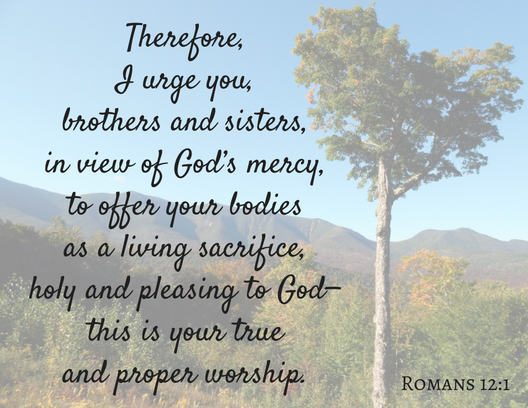
Romans 12:1-2(NKJV) I beseech you therefore, brethren, by the mercies of God, that you present your bodies a living sacrifice, holy, acceptable to God, which is your reasonable service. 2 And do not be conformed to this world, but be transformed by the renewing of your mind, that you may prove what is that good and acceptable and perfect will of God.

God wills us to present our lives as a sacrifice of praise to Him.  We are not to be “stamped” into conformity with the world but to be “metamorphosed” into the Christ in us by changing our minds to hear the Word of God.  When we put the Word into our minds and hearts and act on it, we will be changed from the death and destruction of this world into people that are children of God with power to do good.  

Romans 13:8-10 Owe nothing to anyone—except for your obligation to love one another. If you love your neighbor, you will fulfill the requirements of God’s law. 9 For the commandments say, “You must not commit adultery. You must not murder. You must not steal. You must not covet.” These—and other such commandments—are summed up in this one commandment: “Love your neighbor as yourself.” 10 Love does no wrong to others, so love fulfills the requirements of God’s law.

How does Jesus fulfill all the requirements of the Mosaic Law?  

He did not do all the regulations of the Pharisees and scribes.  Rather Jesus points us to the righteous life-giving purposes of God.  When he loves God and is obedient to all God asked him to do Jesus is fulfilling God’s purpose for him.  That is acting in God’s true love.  When we are obedient to God and act in true love to Him and others, we also walk in the true purpose God has called us to live by.

Do we have to do the law of Moses today? 

What happens when we do not love others like Christ did?

Love in Christ, Tom Siderius
The Error of Innovation

1 Kings 12-14

If you’re like me, you’ve purchased an “assembly required” item and unpacked the contents without thumbing through the instructions. “How hard could it be to turn a few screws and boards into a bookshelf?” Halfway through the build, you realize you used the wrong board in one section, another is fitted upside down, and in your haste, you’re now down at least one screw. Necessity may be the mother of invention, but sometimes innovation comes from darker places—with consequences far greater than a shoddy IKEA build. Pride and fear can quickly lead us into folly as we try to adjust and adapt without seeking counsel. Likewise, our spiritual life was never meant to be self-driven, self-led, or self-defined. To build our relationship with God, we are called to be faithful to His instructions and selfless in their pursuit.

In today’s reading, King Jeroboam is appointed as the new leader of Israel. As he takes the reins, he surveys the political pieces of a recently split kingdom. His people had long worshiped in Jerusalem, which remained part of the rival kingdom of Judah. Jeroboam feared that his people’s loyalty would ultimately shift back to Rehoboam, king of Judah, from the anointed house of David. Instead of consulting the God of Abraham, Isaac, and Jacob or one of His prophets, Jeroboam devises his own solution to keep the people close to home.

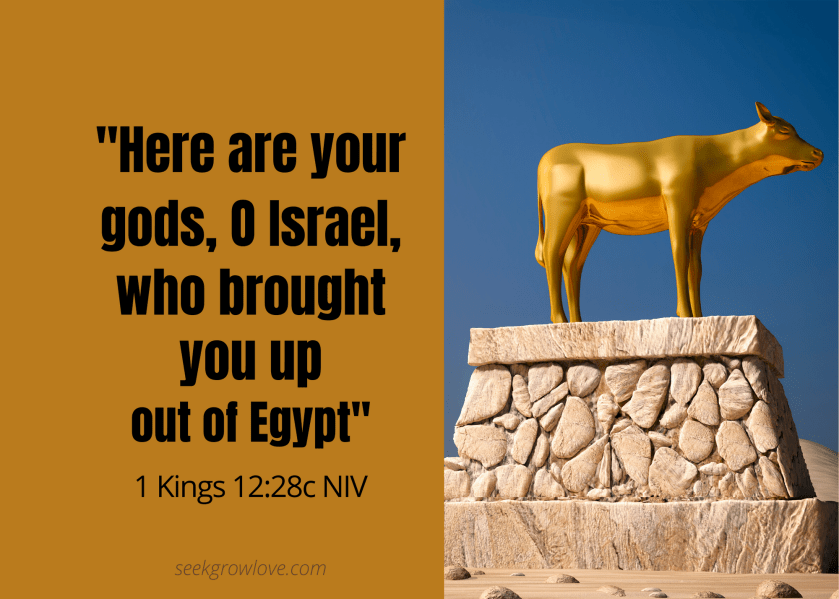
“Jeroboam thought to himself, ‘The kingdom will now likely revert to the house of David…'” So the king made two golden calves. He said to the people, ‘It is too much for you to go up to Jerusalem. Here are your gods, Israel, who brought you up out of Egypt.'” (1 Kings 12:26, 28)

Jeroboam took up his place as both the political and spiritual leader of Israel, but motivated by fear and a desire for control, he led God’s people astray. He created false idols, counterfeit altars, and bogus festivals—all in an attempt to keep his people from returning to the holy city of Jerusalem. Leaving behind the moral clarity of God’s commands, it became easier and more accessible to engage in a made-up religion that appeared similar on the surface to what they knew to be true. They were working with the same pieces, but some were flipped upside down, some placed in the wrong spot, and others lost along the way. As their worship moved farther from Jerusalem, the distance between Israel and God grew greater.

There is a stark warning here for the adjustments and innovations we see in the Church today. We must be careful that our worship, ministry, and evangelism do not favor convenience over obedience or comfort over conviction. If we fail to heed this warning, we may end up with well-developed systems that contain many of the same pieces—but are no longer building the Kingdom of God. Instead, we risk creating idols and events that offer no eternal hope. Granted, we may not be fashioning golden calves, but when we prioritize comfort over truth, we risk building spiritual lives rooted in fear, insecurity, and pride—lives that are void of God’s instruction.

It has never been about innovating what works for us or embracing a “you do you” mentality. God demands surrender and faithfulness in our daily worship, which means we will likely find ourselves worshiping in the city of our enemies from time to time. Resist the urge to craft a god who fits us. Instead, let us be molded to fit His purpose and to build His Kingdom according to His Gospel instructions.

-Aaron Winner

Reflection Questions

  1. What problems do you think God saw in Jeroboam? Do you think God ever sees these same problems in you?
  2. What does God desire from us – in our worship and in the way we live our lives?
  3. What are your thoughts about the following: “If we fail to heed this warning, we may end up with well-developed systems that contain many of the same pieces—but are no longer building the Kingdom of God” ? Have you seen this occur? How can we better heed this warning for our lives and for our church and for the Kingdom of God?

A First Fruit Sacrifice

Deuteronomy 24-27

And behold, now I bring the first of the fruit of the ground, which you, O LORD, have given me.’ And you shall set it down before the LORD your God and worship before the LORD your God. Deuteronomy 26:10 (ESV)

It is Sunday morning. What are you going to do this morning (or, depending on when you read this, what did you do this morning)? It is the first day of the week; did you spend it on yourself, or did you give some of your time in worship of Yahweh our God and in remembrance of his son, Jesus, our savior? Most of those reading this likely attended a local church this morning, but some of you may have needed to work, or perhaps there was another reason for not being in church today.

Why am I asking these questions? Deuteronomy 26 speaks of the act of giving the first fruits of the harvest as an offering to God. Looking forward to the entrance into the land of milk and honey, the promised land, the Israelites are instructed to take a portion of their first fruits and bring it to the priest to set before the altar. Taking a portion of what God has blessed them with and giving it back as a sacrifice or offering. Things are different now. We are not under the ceremonial law, but are we exempt from sacrifices?

Through him then, let us offer up a sacrifice of praise to God continually, that is, the fruit of lips that make confession to his name. Do not neglect to do good and to share what you have, for such sacrifices are pleasing to God. Hebrews 13:15-16 (REV)

Worship is something God desires of us, and while it is not for us, it does us good, for it puts God into our focus and puts him in his exalted place. Jesus told his disciples to break bread and partake of the cup whenever they got together “in remembrance of me”. We need to remember Jesus’ sacrifice as we try to live sacrificial lives.

Gathering for worship and fellowship is important, but it is a sacrifice. Many people don’t work on Sunday, a day to sleep in and relax! We may see the value of setting this time aside for worship, but sometimes we may struggle with it. Churches are filled with imperfect people (sorry if this comes as a surprise to you), and sometimes those people are a source of pain in our lives. We hurt one another and sometimes struggle to confess our sins against one another, and sometimes we fail to forgive those who sin against us (that seems backwards from how Jesus instructed us to pray). Maybe we see this sacrifice of our time as a duty, and we lose some of the wonder that we experienced toward Christ’s church.

There can be reconciliation through our sacrifices of praise and obedience, just as Christ’s sacrifice reconciles us to God, as we spend time in community and in fellowship through the spirit of God, we should be transformed to be like Jesus, who was able to forgive the betrayal and brutality that was directed to him. Jesus had to slog through difficulties and disappointments like we do; he had his times of questioning, and maybe he even struggled at seeing the wonder of it all at times. Through obedience, sacrifice, and confession, we can be conformed to his image of Jesus and also glorify God as we recognize him as our provider and source of our hope.

-J.J. Fletcher

Reflection Questions:

  1. What do we have for first fruits that can be brought before God?
  2. I see time as being our most valuable resource. When we give time to God, what does this do to and for us?
  3. Do you give money to your church or other ministries? How does financial offering correlate to first fruits?
  4. When you give the first fruits of your day or week to God in devotion or worship, does it differ from giving him whatever you have left at the end of a long day or week?

Make a Sanctuary

Exodus 25-27

               Places of worship come in all different shapes and sizes.  I have worshipped God in huge cathedrals with impressive pipe organs and altars overlaid with gold and stained glass windows.  I have also worshipped God in open-air tabernacles with sawdust floors.  I have worshipped God in a deer stand, at the beach, on a mountaintop and on a table undergoing radiation.  I have worshipped God in loud and energetic services with guitars, drums, and electronic keyboards and I have worshipped him in places with no sound at all except the flickering flame of a single candle.

                I believe God loves to be worshipped in lots of ways and in lots of places.  Even in the Biblical stories God was worshipped on simple stone altars, in burning bushes, on mountain tops and down in valleys.

                Israel was at a critical time in their formation and it was important for them to have a steady reminder of God’s presence.  God made his presence visible to them as they journeyed with both a pillar of cloud in the day and a pillar of fire at night.  As they continued their journey across the wilderness, God chose to make his visible presence known to them in a portable house of worship.  This place would provide structure in the midst of their community wherever they stopped to make camp.  The tent of meeting or tabernacle would be an ongoing visible sign that God’s glory was in their midst.  And God taught them how to be a holy nation. He used various symbols and rituals of sacrifice and worship as a way to drill home to them his holiness and the consequences of sin.

                How God chose to do this is quite interesting.  He could have simply built a temple Himself in the heavens and dropped it down fully formed on earth.  However, God chose instead to invite His people to become active participants in creating this place of worship.

                First, God began with their willing desire to give.  “Tell the Israelites to bring me an offering. You are to receive the offering for me from everyone whose heart prompts them to give. These are the offerings you are to receive from them: gold, silver and bronze;  blue, purple and scarlet yarn and fine linen; goat hair;  ram skins dyed red and another type of durable leather acacia wood;  olive oil for the light; spices for the anointing oil and for the fragrant incense; and onyx stones and other gems to be mounted on the ephod and breast piece” (Exodus 25:2-7).   This was not a mandatory tithe that was required; this was an offering to be willingly given and received.

                Where did the people get all of these valuable commodities?  If you will recall, as they were leaving Egypt they were given many valuable items by the Egyptian peoples – one might say this was payment to help compensate for years of slavery.  They had these items in their possession already.  Those who were willing could give them to help create the tent of meeting and the prescribed worship items inside of the temple, which included the Ark of the Covenant, the table, the lampstand as well as the material for the tabernacle itself, and the altar, courtyard and the oil to keep the lamps burning.  All of the materials were freely donated.  The people of God used their own skill to build the items from these donated materials – carpenters, weavers, stonemasons, goldsmiths and others each made their own contributions to the creation of this place of worship.  In this way, everyone in the community that wished to participate had buy in to the tabernacle.  It truly was a communal place of worship.

                Once the nation finished their journey through the wilderness and took possession of the Promised Land, they would eventually transition from a portable tent of meeting to a permanent temple under the leadership of King Solomon.  However, this tent of meeting served them well for 40 years in the wilderness and many more during the times of the judges, and kings Saul and David.

                For Christians, we do not worship God in a tabernacle or physical temple and we do not bring sacrifices of sheep or goats or bulls for an offering to God.  For us, the Church itself is the temple of God.  I am not talking about the building where the Church gathers to worship, I am talking about the actual people who gather to worship, and we are the Church.  Jesus said whenever 2-3 gather in his name that he is there in their midst.  There is no one single right way or place to worship God.  It is wherever God’s people come together.  Christian Worship does not have to follow a strict pattern.  Worship is where we gather to read the word of God, pray, worship, encourage each other and exhort one another to good works, break bread and proclaim the resurrection of Jesus.  Blood sacrifices are not necessary because Jesus is the Lamb of God who takes away the sins of the world and he entered into the holy of holies once and for all and gave his own body as the final sacrifice for all of our sins.

                One thing remains unchanged from the time of Israel in the wilderness tent of meeting and the Church today.  God still welcomes us to bring our offerings from the heart as a way to say thank you.  We can still bring tangible offerings, and we can still offer our gifts and talents as ways of showing God our deep gratitude for all of his blessings to us.  It is not all that important how we worship or where we worship, but it is very important that we worship and we bring our offerings freely to worship God.

Jeff Fletcher

(originally posted February 7, 2020 for SeekGrowLove)

Reflection Questions

  1. Why do you think God wanted the Israelites to have a tabernacle? What are some benefits today to having a place to go to worship God together with God’s people? What are the additional benefits to being able to worship God anywhere?
  2. Why do you think God gave Moses so many details for how to make the tabernacle and its furnishings?
  3. Where do you find a sanctuary where God dwells with you? What offerings do you freely bring to God as part of your worship?

The Branch of the Lord

OLD TESTAMENT: Zechariah 5-6
POETRY: Psalm 144
NEW TESTAMENT: John 17:6-19

Zechariah 6:12-13(NLT) Tell him, ‘This is what the LORD of Heaven’s Armies says: Here is the man called the Branch. He will branch out from where he is and build the Temple of the LORD. 13 Yes, he will build the Temple of the LORD. Then he will receive royal honor and will rule as king from his throne. He will also serve as priest from his throne, and there will be perfect harmony between his two roles.’

Psalms 144:12-13 (NLT) May our sons flourish in their youth
like well-nurtured plants.
May our daughters be like graceful pillars,
carved to beautify a palace.
13 May our barns be filled
with crops of every kind.
May the flocks in our fields multiply by the thousands,
even tens of thousands,

John 17:13-21  (NLT)“Now I am coming to you. I told them many things while I was with them in this world so they would be filled with my joy. 14 I have given them your word. And the world hates them because they do not belong to the world, just as I do not belong to the world. 15 I’m not asking you to take them out of the world, but to keep them safe from the evil one. 16 They do not belong to this world any more than I do. 17 Make them holy by your truth; teach them your word, which is truth. 18 Just as you sent me into the world, I am sending them into the world. 19 And I give myself as a holy sacrifice for them so they can be made holy by your truth. 20 “I am praying not only for these disciples but also for all who will ever believe in me through their message. 21 I pray that they will all be one, just as you and I are one—as you are in me, Father, and I am in you. And may they be in us so that the world will believe you sent me.

This is a wonderful story that we are a part of in the church today.  We are called members of this wonderful church of the body of Christ where God has set us.  We are called out from the world for a purpose and God is building a holy temple for us to be part of where God will dwell.  To be called out from the world is the same as being made holy. When you build a structure out of stone the rocks must be cut or dressed to make them ready to be used in the construction of the structure.  Look at these verses from Ephesians.

Ephesians 2:19-22 (NLT) So now you Gentiles are no longer strangers and foreigners. You are citizens along with all of God’s holy people. You are members of God’s family. 20 Together, we are his house, built on the foundation of the apostles and the prophets. And the cornerstone is Christ Jesus himself. 21 We are carefully joined together in him, becoming a holy temple for the Lord. 22 Through him you Gentiles are also being made part of this dwelling where God lives by his Spirit.

God has chosen you who were rocks with no shape and dressed you to become part of His holy temple.  We have been separated from the world and given a purpose to be part of this great plan.  We are carefully joined together making us part of each other as well as part of God’s dwelling place.  Yesterday we looked at a different figure of the “Branch” who is Jesus Christ.  This word would be better translated as “shoot” or “tree”.  Israel is called the olive tree of God in the OT.  Jesus is the new olive tree growing from the stump and roots of Jesse.

Jeremiah 11:16 16 I, the LORD, once called them a thriving olive tree, beautiful to see and full of good fruit.

This figure has the same meaning as the dressed stone from Ephesians.  Both of the figures of the dressed stone and the grafted branch give us insight into God’s matchless grace and love for mankind.  God is doing everything for His glory and the glory given to Christ Jesus His son.  We are His masterpiece in Christ, another figure of His love for us.  Live today as a wonderful child of God part of a present and future plan of deliverance for all heaven and earth.

-Tom Siderius

Reflection Questions:

Which figure of speech stands out the most in your mind?

How is God dressing (shaping) you for His service today?

Dear Church in Sardis – and You

OLD TESTAMENT: Jeremiah 37-39

POETRY: Psalm 119:57-64

NEW TESTAMENT: Revelation 3:1-6

Rev. 3:1-6 – Letter to Sardis

We’ve made it to the fifth letter in our series!  Thanks for joining again!

Sardis is another church not mentioned elsewhere in the Bible with limited information.  Historically, we are told Sardis was once a wealthy city citizens thought was well-defended because of their geographical location up above most other cities. Because of this, Sardis experienced multiple significant attacks they were ill-prepared for, and as a result, the city had deteriorated significantly from what it once was or what it could have been.  Keep this in mind as we take a look at the letter itself today.

Jesus does not take much time before diving right into some pretty critical correction for this church.  He immediately jumps to calling out their fake reputation – calling them dead instead of alive as it may seem (v.1).  This would have been a pretty close comparison to how their city also had the appearance of being well-off, when in reality, they could not withstand the attacks of those around them!  So what are they to do?  WAKE UP. Jesus tells Sardis to take action in strengthening what little remains (possibly referencing the few in the church that have remained worthy (v.4)), because he still sees a chance for them to finish or perfect their deeds or purpose (v.2).  Some Bible translations use the language, “…I find your actions do not meet the requirements of my God.” This means there are some actions happening, but they are unfinished and not up to standard.

Sardis was a church full of barely believers who were just scratching the surface of what it means to be a Christian.  Full of people coming together and going through the motions, maintaining the look of a “good” church, and yet missing out on true spirituality and fellowship with Christ.  People who weren’t motivated by their love of Christ, or love of others, but rather by their desire to be viewed with the “Christian” label.  That is why Jesus calls this church to remember what they learned at first, Biblical truths of who he is and what the Kingdom will be, hold it fast, clinging to these truths with passion and deep love, and repent, because where they are is dangerous for their salvation (v.3).  Jesus uses the analogy of a thief coming at an unknown time because he knows this would be an image that resonates with this group of people, and he desperately wants to convey the urgency behind his words. 

It is incredibly simple to slip in a pattern of apathetic worship and works.  All it takes is falling out of good spiritual habits like daily fellowship with God through prayer, reading our Bible, and genuine worship to fall into a rut of maintaining a reputation.  I personally feel this is one of the biggest ways Satan draws Christians away from Christ in the United States today.  BUT, when we listen and act on what Jesus tells the church in Sardis (remember, hold fast, and repent), we have the best chance of our name being written in the Book of LIfe, acknowledged by Jesus to his Father, and angels (v.5). 

It is overwhelming to feel like or recognize that you or your church may be spiritually dead.  But be encouraged that we worship a God who raises the dead.  His Kingdom is coming, and you have a chance to be part of it.  Praise God!

Reflection Questions:

  • What is one thing you have done recently (or can do), to re-energize your love of Christ?  How can this help you avoid a pattern of apathy?
  • What are the things you learned at first that God may be calling you to remember?  What does it look like for you to hold fast to these things in your daily life?  
  • Our other passages today offer multiple examples of people who held on to God’s words regardless of their reputations. In Psalm 119:58 David writes how he has sought the Lord’s face with his whole heart.  Despite his own shortcomings, David clearly had a deep relationship with God and was blessed because of his dedication.  Living in a post-Jesus world with access to Old Testament scriptures, we are at even more of an advantage to developing a relationship with God. How are you utilizing the time you live in now to further your relationship with God and His Son?

-Sarah Johnson

Testimony Time

Old Testament: 2 Chronicles 17 & 18

Poetry: Psalm 97

New Testament: 1 Timothy 1

The 2024 Summer Olympics has just been completed in Paris. During the two weeks of competition, there were 32 sports and 329 events across 48 disciplines.   Around 10,500 athletes from 206 National Olympic Committees competed.  Among those athletes, several shared their Christian witness with the media. 

Hezley Rivera, Women’s Gymnastics, was asked how she made the 2024 team. Her first response was to give God credit for her success. Later she posted Philippians 4:13 on her Instagram account under pictures of her with the Olympian team.  In a recent interview, she said, “I’m just enjoying the journey and the process, and I’m so blessed, and I thank God every day.” Hezley won a team Olympic gold medal on July 30th in Paris.

Sydney McLaughlin-Levrone, who competes in the Women’s 400 Hurdles, shared her personal testimony in her memoir, Far Beyond Gold: Running from Fear to Faith.  Her perspective changed from gaging her worth by a perfect run, to being balanced spiritually in her personal life as well as her sport. In January, Sydney told “Women’s Running” this– “My life wasn’t about me. It was about showing the world God’s power, wisdom, kindness, love, and forgiveness.”

McLaughlin-Levrone won her second consecutive Olympic gold medal in the 400-meter hurdles on Aug. 8th, posting another world record time at 50.37.  As the only woman to win the event in two consecutive Olympic Games, she said, “Just grateful for all that has been taking place. God has been good to me.”

In our reading of I Timothy 1 today, Paul begins his letter to Timothy, his son in the faith, by urging him to stay in Ephesus, even though the work might be difficult.  The Ephesians needed to hear God’s truth, and Timothy had been called by God to deliver that truth to them. Then, in a way to encourage Timothy to stay strong, Paul shared HIS PERSONAL TESTIMONY. 

“I thank Christ Jesus our Lord, who has given me strength, that he considered me trustworthy, appointing me to his service. 13 Even though I was once a blasphemer and a persecutor and a violent man, I was shown mercy because I acted in ignorance and unbelief. 14 The grace of our Lord was poured out on me abundantly, along with the faith and love that are in Christ Jesus.

15 Here is a trustworthy saying that deserves full acceptance: Christ Jesus came into the world to save sinners—of whom I am the worst. 16 But for that very reason I was shown mercy so that in me, the worst of sinners, Christ Jesus might display his immense patience as an example for those who would believe in him and receive eternal life. 17 Now to the King eternal, immortal, invisible, the only God, be honor and glory for ever and ever. Amen.” I Timothy 1:12-17

What a plain, powerful testimony Paul shared with Timothy.  Paul’s past persecution of Christians didn’t make him ineligible to serve God.  Mercy and grace were given to him on the road to Damascus.  He claims to be the worst of sinners, but Jesus saw the potential in Paul to be a mighty missionary for him.  And in verse 17, his one sentence prayer expresses his highest allegiance and worship to Almighty God. 

These heartfelt words were meant to encourage Timothy, who might have felt unworthy to deal with the challenges at Ephesus.  

Paul had a moving testimony, the Olympians above have shared their testimonies.   What is your testimony?

Amy Blanchard, the Christian Education Director for the Pine Grove Bible Church, Brooklyn Park, MN developed a plan for willing adults in the church to share their testimonies with the high school and young adult Sunday School classes. The testimony sharing time takes place every few years over a period of several months—that way each young person growing up in the church eventually hears the Pine Grove members’ stories of their personal calls to follow Jesus. 

Her goals, (in her own words) are as follows;

  • “To allow kids to meet/get to know others in our church and hear their stories and see how they can relate to them (and for you to see how you can relate to our kids)
  • To open the door for the kids to hear that there are many times and ways one can come to the Lord
  • So our kids can hear how others influence us and see that we, in turn, influence others
  • To allow us to share our testimonies – we all have a story.  Sharing our personal story helps us to, ‘…have a full understanding of every good thing we have in Christ.’ “

What a tremendous way to hear conversion experiences, and to show by example that everyone has a story that needs to be told –not only to our brothers and sisters in Christ, but with those we interact with each day.

Paul shared his personal testimony with Timothy to strengthen and embolden him.  But it also encourages us to think about our “call to Christ” and how our lives can impact those around us.

I Peter 3:15 says, “Always be prepared to give an answer to everyone who asks you to give the reason for the hope that you have. Do this with gentleness and respect.”

What is your personal testimony?  Pray for opportunities to share it, and you will be blessed in ways you never could have imagined.

-Paula Kirkpatrick


Reflection Questions

  1.  Do you have a personal testimony?  If the answer is no, why not?
  2. Has someone ever encouraged you with their personal testimony?  Have you later told them how it impacted your life?

Excited about Church

Old Testament: Micah 5

Poetry: Psalm 84 (day 2)

New Testament: Luke 18:9-14

How excited are you about going to church?  You might think church is boring, the singing doesn’t inspire you, the sermon puts you to sleep, the building is nothing to write home about, etc.  If you think like this, you are probably also thinking, “Why even bother going to church when there are so many more exciting things I could be doing?”

If you think church is bad now, just imagine how bad it was when they used a tent as a church (called the Tabernacle), and slaughtered animals to cover sins.  How well would you have liked going to church then?!  (Can you imagine the smell?)

Our reading today is from Psalm 84, which starts out, “How lovely is your dwelling place, O Lord Almighty!”  The writer wasn’t talking about the throne room of God in heaven, he was talking about the Tabernacle (tent) where he went to worship God.

Psalm 84 continues, “My soul yearns, even faints, for the courts of the Lord; my heart and my flesh cry out for the living God.”

The writer wasn’t getting excited about visiting a tent, he was getting excited about being able to be in the presence of God.  He was yearning, fainting, crying out to be near God.

Verse 4 goes on to say, “Blessed are those who dwell in your house; they are ever praising you.”

I’m guessing the writer is referring to the singers whose job was to stay at church and sing praises to God all day long. He was envious they didn’t even have to leave there to go to work (they were at work) – they were so lucky!  They got to be near God all the time.

Verse 10 says, “Better is one day in your courts than a thousand elsewhere; I would rather be a doorkeeper in the house of my God than dwell in the tents of the wicked.”

You may dread going to church.  The writer of Psalm 84 dreaded having to leave church.  He’d rather spend one day at church than almost 3 years anywhere else.  He’d rather be a doorstop at church than party all the time with his wicked friends.

Why did the author crave going to church so much?  The answer is: because he loved God, and he associated being at church with being in God’s presence – so he couldn’t get enough of it.  

Today, as a result of Jesus’ sacrifice on the cross, we have far greater access to God than the people in the Old Testament (including the writer of Psalm 84) had.  We’re told in Hebrews 4:16, “Let us then approach God’s throne of grace with confidence, so that we may receive mercy and find grace to help us in our time of need.”

God didn’t just send Jesus to die for our sins, God also wants to adopt us as His children.  And there’s an inheritance involved – the Kingdom of God.

1 Corinthians 2:9 says, “… No eye has seen, no ear has heard, no mind has conceived what God has prepared for those who love him.”

I don’t know about you, but I have a pretty vivid imagination, and can imagine some amazing things.  But, according to this verse, I can’t imagine how great the Kingdom will be.  Start with no more death or mourning or crying or pain, add in a little euphoria in the presence of God forever, and you’re just scratching the surface for what God has prepared for those who love him.

I want that!

God wants to adopt us as His children, but there’s a catch.  He will only adopt us if we accept Jesus as our Lord and Savor, are baptized, and live our lives for Him.  Only then will we get to live with Him forever.

Maybe, our level of excitement in going to church is related to our level of excitement for God.  Once we recognize how much God has already done for us, and what He has planned for those who love him, we’ll get more excited about God.  And once we do, I suspect we’ll get more excited about going to church too. 

-Steve Mattison

Reflection Questions

  1. What are your thoughts and feelings right now about going to church? Where do you think they come from?
  2. How excited for God are you? What has He done for you already? What do you know about – and what can you imagine – about being in the Kingdom of God? Have you already been adopted into God’s family? Are there steps you need to do in this adoption process?
  3. Is there anything about your perception and understanding about going to church that you think God wants you to change?

A Team Effort

Old Testament: Judges 1-3

Poetry: Psalm 52

New Testament: 1 Corinthians 12

            I love baseball. (If you don’t, don’t leave just yet, please). Baseball is a team sport.  This was put on display for me recently.  I was watching a Washington Nationals game this weekend and the commentators brought in a retired pitcher who used to play for the Nationals in their 2019 World Series winning season.  During the playoffs that year, Anibal Sanchez came very close to pitching a no-hitter.  It was broken up in the 8th inning by a Cardinals batter.  When asked about it Sanchez said he wouldn’t have come close to having a no-hitter without his teammates making great plays.  He said no pitcher should ever get sole credit for a no-hitter.  It’s impossible without your teammates making plays.   Sanchez wasn’t just being humble, he was 100% right.  It takes a catcher to catch the pitch, fielders to make plays and throw the ball to first, outfielders to run and catch fly balls.  Without good teammates, you can’t pitch a no-hitter.  When a no-hitter does happen, or even rarer a perfect game, the pitcher gets the accolades and they stick a microphone in his face after the game, but it was a team effort.

            The same is true for the Church.  That’s what Paul was trying to get at in 1 Corinthians 12.  There are a few people that are “up front” during a worship service.  The worship leader, the soloist, the scripture reader, and the pastor all have visible roles and they are important.  But they aren’t the only important people.  Many important people are working behind the scenes in nearly invisible ways.  The person running the sound system is important.  The pianist, guitar player, and other musicians are important.  The person who makes the coffee before Sunday School is important.  The people who set up tables for Church dinners are important.  The people who teach children’s church are important.  The people who clean the bathrooms, take out the trash, and vacuum the floors are important.  The people who buy toilet paper are important, very important.  If those people don’t do their jobs what have you got?  A mess.  Also important are the people who type the bulletin and change the slides with the worship song lyrics, and the people who make sure that the heat is turned on or the a/c is turned on.  All of these people are important.  So are the people who faithfully place their financial contributions in the offering, and the people who count and collect those offerings, and the people who write checks so that the pastor can feed their family and the lights stay on.  Even in smaller churches, it takes a lot of people to share their gifts and talents.

            Apparently, in the Church at Corinth, there was a lot of jealousy and rivalry going on between Christians.  It was causing division in the Church.  The Apostle Paul wrote this letter to correct some of those problems.  He wanted them to understand that Churches need to maintain unity to be healthy and carry out the mission that God has given us to do.  Everyone in the church is not gifted in the same way.  Some people love to be up front serving in visible ways.  Some people are not gifted to speak or lead worship, but they have other gifts.  I have a special needs sister, Christine, who wants to help and has claimed her gifts by handing out the church bulletins.  She grabs a stack and goes to each person in Sunday School and gives them a bulletin.  She wants to help by sharing her gifts.  She also loves to sing very loudly in worship and her exuberance is infectious.  (And she likes to say “amen” when her brother the preacher says that he’s winding up the sermon).

            Read through all of the Apostle Paul’s letters in the New Testament and see how much Paul depended on others to help him carry out his ministry.  Often when he wrote letters to encourage and teach Churches he was in jail for preaching the Gospel of Jesus, which was a threat to both the religious leaders and the Roman Empire.  Paul depended on people to take the letters he wrote from prison and deliver them to the Churches.  He also depended on people to bring him food, an extra blanket, his books and letters, and medicine.  He had poor eyesight so he depended on a secretary to write down his words. He also longed for fellowship with other followers of Jesus.  Paul was the face of much of the teaching and spread of the Church in the first century, but it took a team to support him.

            What are some ways that you are serving in your Church?  You can’t start too early.  Our church has a 7-year-old help take up the offering some Sundays. As you read through 1 Corinthians 12, try not to get too bogged down thinking about the theological issues that continue to divide Christians today (are the spiritual gifts Paul mentions for now or did they stop after the first century?)  It’s amazing how this chapter that Paul wrote to help a church not be divided has caused many Christians to disagree and divide.  If God decides to give you the gift of miracles or healing, who am I to tell you that God did away with those gifts 1900 years ago?  (if you do have the gifts of miracle or healing, please come visit me, I could use it.)

            Remember, there is no “ I” in “Team”.  And there is no I in Church.  It’s all about how we use the gifts God has given each of us to serve.

Pastor Jeff Fletcher

Reflection Questions

  1.  What similarities do you see between sports teams or work teams and the team work needed to carry out the work of Jesus and the Church?
  2. Are you currently using any of your gifts to help carry out the mission of the Church?
  3. Are you willing to test your gifts and potentially experience some failures and disappointments as you seek to carry out the mission of Jesus Christ and the Church?  What will you try and risk next?

Unleavened

Old Testament: Joshua 11 & 12

Poetry: Psalm 50

New Testament: 1 Corinthians 5

As is frequent with God’s word, we see connections, themes, and promises fulfilled which transcend centuries, and today’s readings are an example of this. From our Old Testament reading of Joshua we see a thorough purging and annihilation of pagan people who were not followers of God in the land God wanted inhabited by his chosen people. Terms like “captured”, “struck every person”, “no survivor”, and “utterly destroyed” used more than once paint a pretty clear picture of what Joshua and the Israelites were busy doing. But, why? That is also repeated throughout, and while it could be summed up as “God said so”, it seems more beautifully stated in Joshua 11:15,

“Just as the Lord had commanded His servant Moses, so Moses commanded Joshua, and so Joshua did; he left nothing undone of all that the Lord had commanded Moses.” New American Standard Bible (La Habra, CA: The Lockman Foundation, 2020), Jos 11:15.

Over a thousand years later, our New Testament reading in 1 Corinthians written to the church in Corinth also references instructions on purging out the evil. And just like the pagan people and cultures surrounding and within the promised land in the time of Joshua, Corinth was certainly a place full of evil. A city known for immorality (not immortality as I just accidentally typed!), for all varieties of sexual sins and deviance, statues and idols of lovely false gods like Aphrodite and none other than a thousand prostitutes kept busy at the temple. One could imagine as new converts came out of this culture to Christianity, and for the existing church functioning within that society, there were some things that needed cleaned up. And then there were some things that just straight up needed called out, purged, and done away with. Finding ourselves progressed another couple thousand years from there, I think we can relate.

Tomorrow, the Jewish people and those celebrating Passover will be starting their remembrances and celebrations. I really like that the Jewish holidays have Biblical and spiritual meanings, and Passover is directly mentioned in our New Testament reading today. One instruction the Hebrews were given for the Passover was to remove the yeast/leaven from their homes on the first day. Today, there are all sorts of traditions on how to do this for Passover including varieties of special cutlery and cleaning to remove every speck of potential leaven from  cookware to corners of homes and cabinets. Even the kids are apparently often helpful at finding those hard to reach remnants. As Christians according to 1 Corinthians 5, we know Jesus is our Passover lamb, which brought about a huge culture change, and one I am incredibly thankful for because I absolutely do not want to be doing anything with the blood of lambs or goats! But, while Jesus’s sacrificial life and death is a tremendous gift and blessing that reconciles us with God, scripture also tells us we can’t just be thankful for Jesus and leave whatever filth we have in our lives, homes, and churches.  Leaven is often correlated to sin in scripture, and today’s reading is very clear. Leaven is not good in this case. It will creep into every corner of the loaf. It contaminates. If we tolerate evil, we will contaminate ourselves and the body of Christ if we are a member of it. If we ignore it and don’t even look for the small hidden pieces of leaven in our lives, the leaven is very efficient at growing, attracting bugs, and all the rest.

We are forgiven and cleansed through our Messiah who took the place of the Old Testament sacrifices. We also know we are human beings living in another Corinth, and it is easy to be deceived when society is screaming “that’s not leaven, that’s just fine”.  May we all prayerfully consider the internal, spiritual leaven within ourselves along with any other things we might be cleaning up this spring. While smudges on windows, crumbs under the stove, and dead leaves in landscaping simply do not matter in the big picture, the spiritual stuff is a life and death matter. I love these verses in Psalm 19: 12-14 which talk about intently looking for the hidden pieces of leaven in our hearts.

But who can discern their own errors?

Forgive my hidden faults.

Keep your servant also from willful sins;

may they not rule over me.

Then I will be blameless,

innocent of great transgression.

May these words of my mouth and this meditation of my heart

be pleasing in your sight,

Lord, my Rock and my Redeemer.

-Jennifer Hall

Questions:

1. What similarities do you see between the culture in Joshua’s day, the city of Corinth, and today?

2. Have you ever seen someone’s sin in the body of Christ negatively impact others in the church family?

3. What challenges do you and the church face in identifying sin and right/pure actions from a Biblical worldview in today’s society?