When life feels unpredictable, it can be easy to forget that the One who spoke the universe into existence still reigns over every detail. The same God who set the stars in place and shaped the mountains is the One who sees you, knows you, and holds your future. If He can bring order out of chaos in creation, He can bring peace into your storms. Our confidence is not in the size of our own strength, but in the greatness of His power and the goodness of His heart.
Reflection Questions:
How does remembering God as the Creator strengthen your trust in Him during uncertain times?
What current “storm” in your life could you place more fully under His control?
When was the last time you paused to notice the beauty and order of creation, and how did it remind you of God’s power and wisdom?
Today we are reading three brief, but powerful, psalms, totaling 85 verses. The phrase “Praise God” (or some similar variation) is found 12 times in these passages. And that’s just that phrase, not the verses describing why God is worthy of praise, which make up the majority of the text!
Much of the praises today are focused on God’s compassionate character as the Creator of the world and everything in it. The praise is focused on God’s works, and forgiveness, despite humanity’s faults. Even in Psalms 102, where the author is lamenting over their life circumstances, they still give praise and recognition to an eternal and compassionate God before the psalm ends!
Most Psalms have all these similar themes of praise and recognition of God’s character, just phrased differently and from different perspectives in different life situations. They are not written to recount a story from long ago like most of the other books in the Bible, but are written by people experiencing very real, raw, emotions. It’s basically like reading someone’s personal prayer journal! Because these authors were real people, there is a strong likelihood you resonate with their real feelings of real life situations. And because we praise an unchanging God, we can have confidence that we too, can experience the same comfort and joy when we praise Him. No matter if you are in a time of lament, a time of needing redemption, or a time of awesome recognition of our creator, you can find a way to Praise Yahweh.
Sarah Johnson
Reflection Questions
How’s your “praise life” been lately? Are you taking opportunities to Praise God instead of just petition Him in your prayers? How can you improve this week?
Pick your favorite “praise” verse from today’s reading to focus on this week. Consider memorizing it to add to your own prayers!
In our 1 Chronicles passages today we read about the death of Saul due to his unfaithfulness towards God. Saul began consulting others instead of God, and certainly did not praise Him for all the provision he had been provided. Read Psalms 103 again, keeping this story in mind. What can you apply from the message of this Psalm to Saul’s life and death?
Have you ever stopped to think about idolatry? In the ancient world, many groups of people would literally make statues out of wood or metal. They would sacrifice animals to these idols. They would pray to these made up, created things.
The Psalmist talks at length about the silliness of such behavior, especially in the context of worshipping the actual Creator of the Universe:
Psalm 115:3-7 (ESV)
3 Our God is in the heavens; he does all that he pleases.
4 Their idols are silver and gold, the work of human hands.
5 They have mouths, but do not speak; eyes, but do not see.
6 They have ears, but do not hear; noses, but do not smell.
7 They have hands, but do not feel; feet, but do not walk; and they do not make a sound in their throat.
The point is clear: idols look like they can speak, see, hear, smell, feel, walk, and talk, but they cannot. They offer something that is not real. It’s a mirage. It’s a false comfort. Worshipping that way is meaningless.
What does this have to do with us, you might ask? I don’t have an idol in my house. I don’t worship to anything made with hands.
Friends, I wish that was true. We still have idols today. They don’t frequently look like human images made of silver or gold. Perhaps they are other people. Perhaps they are the rectangular boxes we carry around in our pockets. Perhaps it’s our favorite sports team. Maybe it’s our job or our family. There are always things that vie for our allegiance and our attention.
Unlike the ancient idols, many of these things are not bad in themselves, as long as we walk in a balanced way. The balance begins, however, with total devotion to King Jesus. Full stop. End of story.
When we live unbalanced lives, we might find ourselves feeling more and more unsettled, anxious, or depressed. Living the way that God wants us to live does not guarantee a life free from those things, for sure, but the point remains: when our life is unbalanced, we get negative results. Just like the ancient people sacrificing to blind and mute forms of their own creation, we sometimes get too caught up in worldly things that take our minds in directions that are unhealthy and unhelpful.
As the Psalmist reminds us, the Lord is our help and shield. The Lord is the One who blesses us. The Lord is the one who is worthy of worship and honor. We shall praise the Lord!
-Will Barlow
Reflection Questions
Do you have things in your life that are idols or cause you to be unbalanced? What can you do to get back in balance?
Can you think of a time when you came out of a longer period of darkness and into light? How did that feel?
Can you think of a friend that has an obvious idol in their life? What can you do to help them find better balance? (Maybe telling the story from your answer in #2 could be a place to start.)
I want to jump back to Isaiah today. Chapter 40 was actually the scheduled reading from yesterday, but it ends with some of my favorite verses – Isaiah 40:28-31
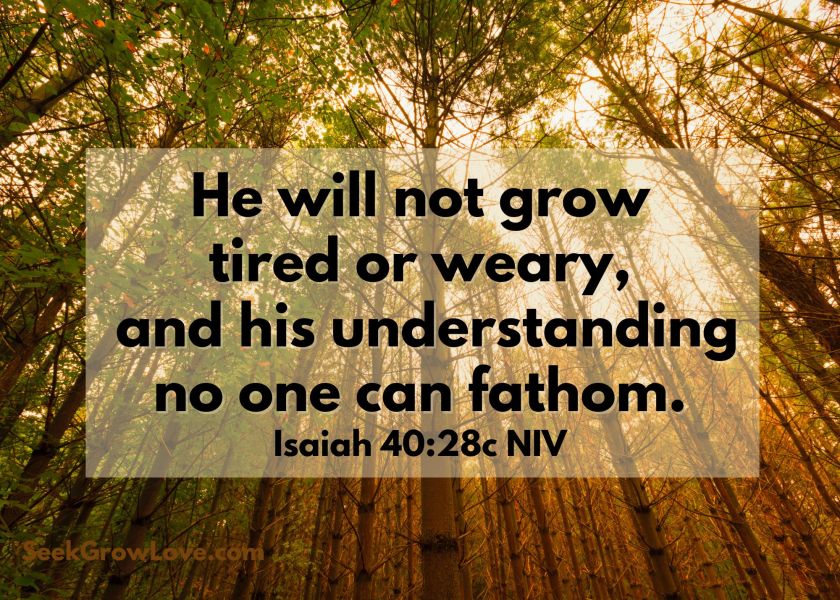
28 Do you not know? Have you not heard? The Lord is the everlasting God, the Creator of the ends of the earth. He will not grow tired or weary, and his understanding no one can fathom. 29 He gives strength to the weary and increases the power of the weak. 30 Even youths grow tired and weary, and young men stumble and fall; 31 but those who hope in the Lord will renew their strength. They will soar on wings like eagles; they will run and not grow weary, they will walk and not be faint.
I don’t have much of a devotion for you, but here is my suggestion.
Read these verses again. Let the amazingness, goodness, incredibleness of God wash over you. Be in awe of Him. And lean into the reminder that those who hope in Him will have their strength renewed.
Sometimes, we read large chunks of chapters or verses, and for me at least, I fall into a traditionally schooled trained pattern of just trying to absorb information to be able to answer questions. But the wonder can pass me by when I do this.
So stop. Read this small section, and be amazed by the Creator.
~Stephanie Fletcher
Reflection Questions
Do you know that the Lord your God is the Creator of the world? What does that mean to you? What does it mean to you that He is everlasting?
What can you not fathom about the Lord God’s understanding? When has He given you strength when you were weary? How would you use His strength today? Pray for it. Thank God for it.
Where do you put your hope?
How many times can you read this passage today? Whatever number you said, can you read it 5-10 additional times beyond what you thought you could.
Our family loves camping and traveling and finding new places to hike or kayak through God’s beautiful world. The variety of his creation is truly amazing! Desert, forest, plains, mountain, ocean. We love them all and the chance to explore a new little corner of His world we haven’t seen yet. And, along the way, trying to capture a photo to remind us of the beauty and creativity we had the privilege to see.
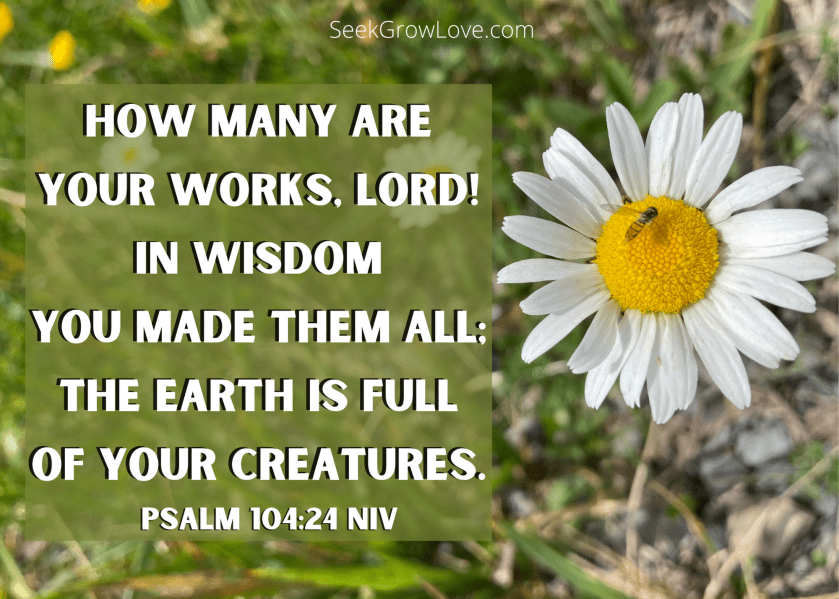
Psalm 104 is a beautiful poem of creation. I would love to make a photo book or photo wall with pictures from our family hikes and travels depicting each verse and phrase.
“he stretches out the heavens like a tent” (vs 2) – expansive blue sky from horizon to horizon
“He makes the clouds his chariot” (vs 3) – white and multi-shades of gray amazing textured rolling clouds with shafts of sunlight shining through with the brilliant blue sky behind
“He makes springs pour water into the ravines” – hot springs bubbling from the ground and flowing down the mountain side
You get the idea. There would be photos of waterfalls, lightening, mountaintops, ocean waves on the shore, rainstorms, the moon, plants and animals, sunrises, sea creatures, and people. Each one accompanied with God’s text.
I recently taught a unit on creation to the adorable children in children’s church. And it was so much fun spending a week (or often more) on each aspect of God’s amazing creation. We brought in shells and rocks and leaves and bird feathers to touch and play with. We matched plant photos to foods we eat and counted plant products in ingredient labels. (Do you know how many plants are in a box of Cheerios or mac’n cheese?) We classified plants and animals and brought in a bird expert. We watched videos and explored books on clouds and planets and sea creatures and the animal kingdom and the incredible human body. And all the things that we take for granted everyday.
Not only is God’s world a beautiful world – but so incredibly functional, too! He thought of EVERYTHING! The more I learn of science and the human body in particular, the more I am amazed at His creation.
I have never made anything nearly as intricate or useful as the smallest, tiniest, most simplistic, most ‘insignificant’ part of God’s creation. But, I do like to create quilts – little scraps of colored fabric (which came from a cotton plant) sewn together in patterns to make a cozy cover to bring comfort and warmth. I can’t imagine how I would feel if I were to meet someone who explained that those quilts just came to be one day – that it grew from nothing and became strings that wove themselves together and the fabrics cut themselves into the perfect shapes and even stitches magically formed just as they were needed to piece the top together and the materials used to create the final layered project appeared at just the right time and space and lined up just so to automatically go through the final steps to create my quilt. Foolishness. It is foolishness that leaves out the thought, intention, desire, creativity, vision, purpose and ability of me, the quilt creator. Or, equally painful – maybe they would give all the credit for the making of the quilt to another.
It makes sense that the Creator of the Heavens and Earth wants us to enjoy and admire His creation – and give Him all the credit He so much deserves. But, what happens when people don’t? What happens when they take away the glory that belongs to God and call it chance instead or give it to another? What happens when they refuse to listen to God’s words – His first recorded words being – “Let there be light”? What happens when they attribute God’s creation to another? We see in the book of Jeremiah. “These wicked people, who refuse to listen to my words, who follow the stubbornness of their hearts and go after other gods to serve and worship them, will be like this belt—completely useless!” Jeremiah goes on in today’s reading to describe the drought, famine and sword that will be used in judgment of those who have stubbornly turned from God. Jeremiah 14 ends with God telling Jeremiah to speak to the people, telling them to acknowledge their guilt and wickedness and sins against Him and ask God to remember His covenant. The final verse of chapter 14 says,
“Do any of the worthless idols of the nations bring rain? Do the skies themselves send down showers? No, it is you, Lord our God. Therefore our hope is in you, for you are the one who does all this.” (vs 22 NIV)
Not only did Our Great God create this world for us – He made a covenant with us – He has power still today – and He holds out a blessed hope for those who acknowledge and worship Him for all He has done, is doing and will do.
Thank you God for your incredible Creation – help me see and appreciate each amazing part!
Thank you God for the rains today – help me see you at work today!
Thank you God for the hope you set before those who believe and worship you alone – a New Heavens and Earth that will be beyond all we can ever dream or imagine!
You are our hope – for you are the one who does all this!
-Marcia Railton
(taken from a devotion originally posted here on Oct 12, 2021)
Reflection Questions
What do you love most about God’s creation? What do you often take for granted in His creation? In your opinion what are some of the most useful things He created? What are some of the most creative things He created?
What have you created? Has anyone ever disregarded your creation or the part you played in its creation? What are the biggest problems with the theory of evolution?
Looking at the final verses of Psalm 104 (verses 31-35), what response to all that God has done does the psalmist have – and also ask for? What response does he expect, ask or look for from God? What response do you have to God’s creation?
Have you ever heard of the saying, “Give credit where credit is due?” It is thought the expression was coined by Samuel Adams in a letter dated Oct. 29th, 1777! That was quite a while ago! Now, almost two and a half centuries later, “giving credit” has become a whole new ballgame.
Today’s generation has always had easy internet access. And with that access, has been seemingly limitless information. But, can a person easily find the original source of an idea, trend, or promoted “fact” on social media platforms, where it can be shared multiple times and morph into a whole different idea or supposed “truth”?
According to a recent survey, only 8% of students always give credit to original creators, 35% of students sometimes do, while 30% never give credit to original trendsetters. (And who knows if this survey is correct—I found it on the internet!)
The Bible tells us there is only One who is due credit for all the world around us, the beauty, and majesty of His Creation.
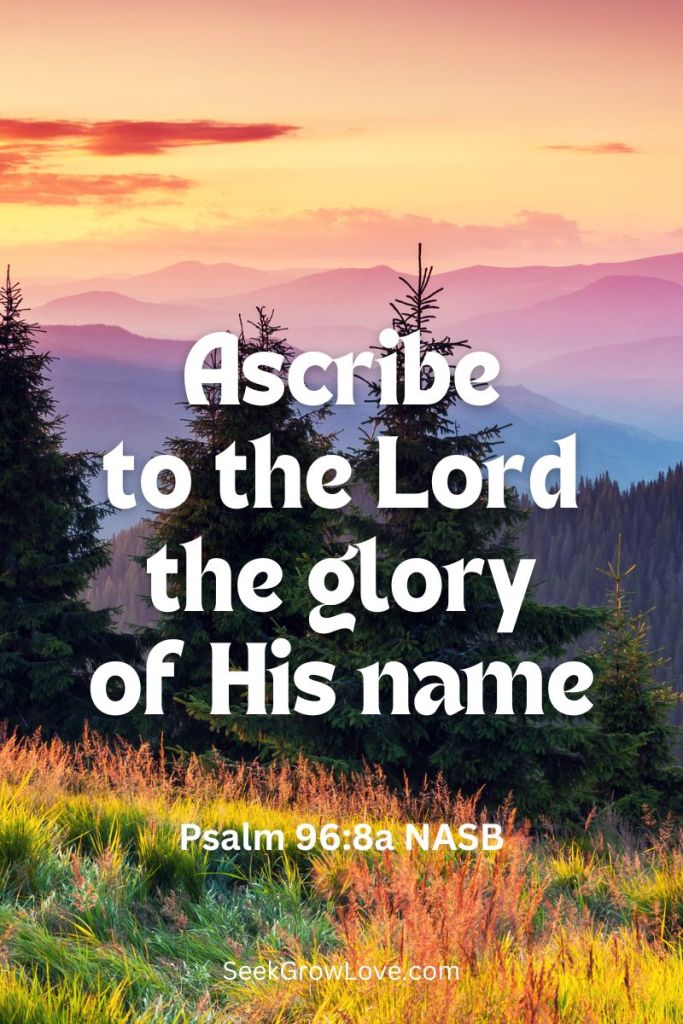
“Ascribe to the Lord, all you families of nations, ascribe to the Lord glory and strength. 8 Ascribe to the Lord the glory due his name; bring an offering and come into his courts. 9 Worship the Lord in the splendor of his holiness; tremble before him, all the earth.” Psalm 96: 7-9
Ascribe is an interesting word. It means acknowledge, attribute, or GIVE CREDIT. All of the earth trembles before Him as all people consider His mighty strength and unmatched splendor.
Our praise leads to this acknowledgement of God’s greatness. In verses 1-3 we are told to sing, proclaim, and tell about His salvation, glory and wonderful deeds.
As our outward praise is heard and shared, it leads to an inward attitude of worship, basking in the Lord’s presence. We adore God for who He is.
Not just His people, but ALL of His Creation sings God’s praises. In verses 11-13, we see this. Have you walked along an ocean beach and HEARD the water’s roar? Have you gazed upon a field of Texas bluebells, multi-colored tulips, or bright yellow sunflowers, their BEAUTY GLORIFYING God’s presence? Have you wandered through a forest of pine trees, and HEARD their joyful song in the breeze? If you have done one or more of these things, lift up your praise in harmony to Creation’s melodies.
Acknowledge His presence in your every waking moment. Savor His warmth and love. Live a life of worship each day. Give credit—ALL CREDIT—where credit is due—to the Lord God Almighty.
-Paula Kirkpatrick
Reflection Questions
Do you dwell in God’s presence each day? How better could you do that?
Are praise and thanksgiving a regular part of your prayer life?
In the final portion of the book, Solomon turns to remind his readers to think often of their Creator early in life before all the “evil days” come. His point is not to just think of God when you are young, but the need to establish the foundation of one’s life in their youth. The phrase “evil days” probably refers to old age (and eventually death). As life goes on, there is more opportunity for trouble and adversity. Old age has its host of difficulties and struggles. One’s youth is often thought of as the best of times, and during that period of life it is good to develop the habit of remembering the Creator before the days of “evil” come. That doesn’t mean that older individuals cannot “remember” the Creator. Solomon is simply asserting that this practice is best formulated and built into the foundation of life at an early age before life’s complications arise and produce much turmoil and frustration.
Verses 1-7 is a whole poem that focuses on the remembrance of one’s youth and the pleasures of life that a young person is able to enjoy in contrast to the gradual decline of physical abilities and the dulling of the senses with age, a relentless progression ultimately toward death. To be “afraid of heights” and the “terrors…in the road” refer to the weakening of the body and the feebleness that accompanies aging to where a person cannot defend themselves. The “almond tree will blossom” is likely a figurative reference to the graying of one’s hair with age, like the white blossoms of the almond tree when it is in season.
The complicated saying that the “grasshopper will be a burden” likely represents small activities and simple tasks; when you are old even the smallest endeavors can seem difficult. Furthermore, when one’s “desire will fail” perhaps refers to sexual desire, but if that is true, by metonymy it refers to the failing of the physical body in general. And the “age-long home” is the place, after the failing of the body, when a person goes to the grave.
Verse 8 is a large inclusion (i.e., bookends) restating the thesis that Solomon presented at the outset of the book in 1:2, ““Utterly pointless,” says the Sage. “Everything is pointless!”
The change in voice to the 3rd person (i.e., “the Sage”) perhaps indicates that a narrator is giving an epilogue to the foregoing discourse (chs. 1:1-12:7). This epilogue functions to frame the previous discourse and Solomon’s investigation.
The summary of what Solomon discovered is that to submit to and obey God is what it means to truly live as a human being. It might be difficult to understand why Solomon asserts the “pointlessness” of life so heavily and exposes it in so many facets of life under the sun. His approach can appear to lean toward doubting everything or concluding that nothing ultimately matters (i.e., nihilism). But the pointlessness of everything he saw has driven him in the end to a deep piety and dependence on God. To understand that everything that happens under the sun has no ultimate significance or meaning only draws out the fact that meaning must reside outside of life under the sun and the work that humans do. In the face of all the oppression, injustice, uncertainty, and death in life, the Sage finds the only true meaning in life is humbling oneself before the Almighty Creator and remembering that he is God, and we are not. Our role as creatures is to worship and obey the one who makes everything and to not try and control or manipulate life, because everything we can try and do on our own is ultimately pointless. The only ultimate meaning is found in relation to the Ultimate Being whose breath fills the world and whose hand spans the universe. It is to him that we are accountable and will be judged for everything we do, whether good or evil.
So, let’s live for Yahweh and trust in him and not in our own understanding. We are weak and finite creatures, and our meaning and purpose in life can only be discovered through an obedient and faithful relationship with our God and Creator. This is the wisdom of the book of Ecclesiastes.
-Jerry Wierwille
Reflection Questions
If you were to write a book of wisdom – what would your conclusion be? Where did you learn this “wisdom” from? Do you think God would agree with your conclusion?
Regardless of your age, what changes have you seen in yourself as you have grown older? How does growing older affect your wisdom? What changes in your relationship with God would you like to see as you keep growing older? What can you do to bring this about?
What challenges do you find in Ecclesiastes 12? Will you rise to these challenges?
I doubt there are too many devotions over the last two chapters of Proverbs that are mostly aimed at the topic of Fathers, but for whatever reason or coincidence, here we are on Father’s Day – and our assigned Bible reading includes the Proverbs 31 superhero – the Wife of Noble Character. But, I was surprised to see how many passages popped out to me regarding dear old dad and our relationship with him.
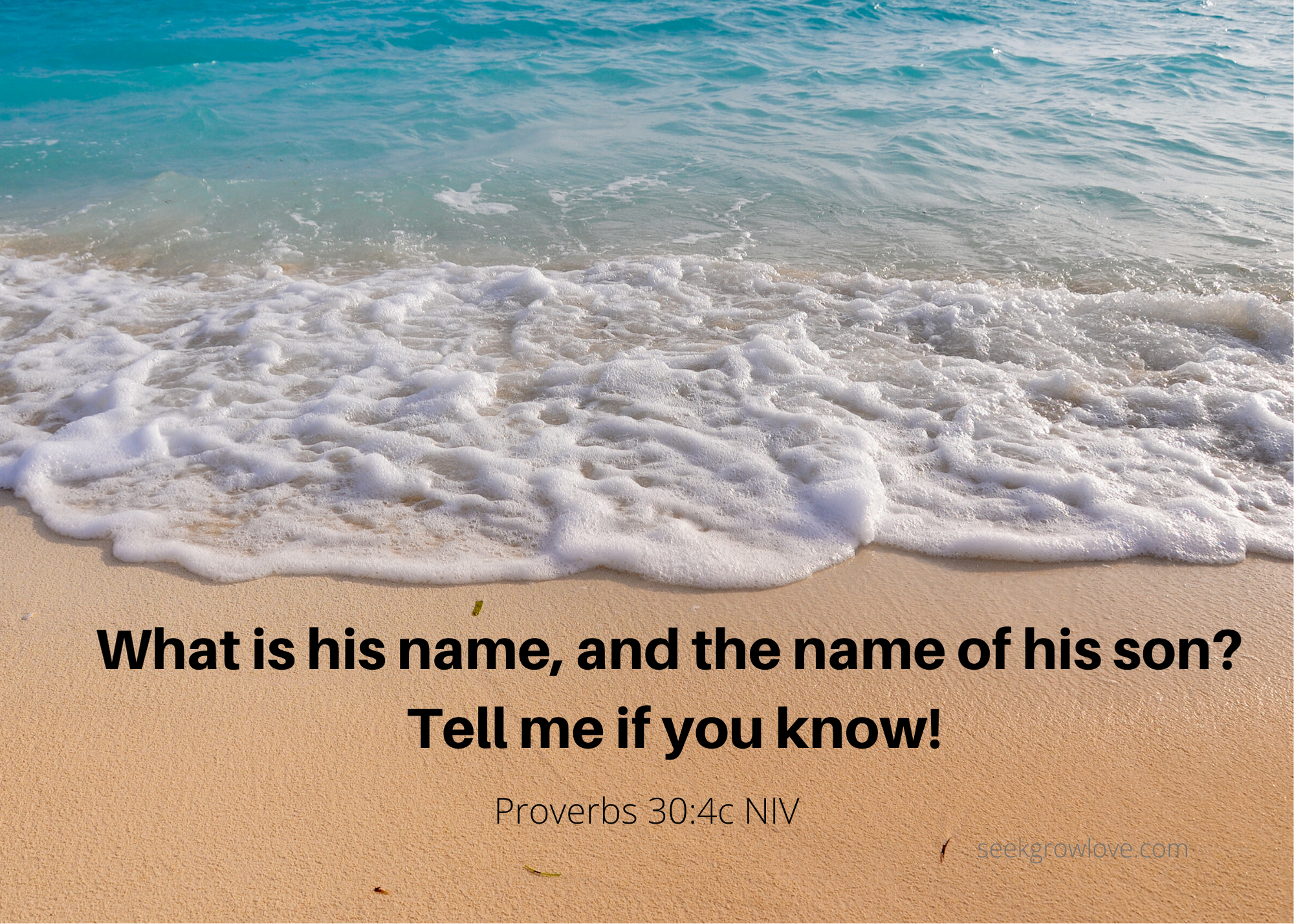
First of all, we run into an interesting passage of rhetorical questions about who can control the wind and water and established the ends of the earth? “What is his name, and the name of his son? Tell me if you know!” (Proverbs 30:4 NIV) I read some very differing commentaries on this passage and I feel a lot like the writer of this proverb, Agur, who confessed, “I am the most ignorant of men,” (Proverbs 30:2 NIV). I do not have a full understanding of the Almighty God. I can’t grasp His eternal greatness and power and all the deeds He has done – and will do. But, I am thankful that I DO know who created this spinning world we call home, the sun that warms it just right, the water cycle that refreshes it, the plants and animals that provide beauty, nourishment, and joy, and the families that inhabit it. I marvel at the power, ingenuity and love of my Heavenly Father and the chance to be called His child. And, I love, love, love, that He has a Son and I know his name is Jesus. And this son Jesus would display his family resemblance to His dad by exerting power over the wind and the waves. He would be given the most difficult but beautiful task of drawing us sinful creatures to His perfect Dad.
Poor Agur lived at a time when this plan of God was not yet revealed, but only hinted at here and there. So, he was left asking – “Tell me if you know?” If you know your Heavenly Father and what His Son has done so that YOU can be called a Child of God – who will you tell today? Make it a Father’s Day that counts by telling someone about your Heavenly Father and His Only Begotten Son and the opportunity opened for them to have a perfect Dad, too.
I am so blessed that my father (and mother and grandparents and church family) on Earth did tell me – and many others. Thanks, Dad! It has been an honor to respect and try to live up to my dad. I had a good one (and doubly blessed with a good father-in-law, too!).
There is a depressing passage of those who are haughty, disdainful, teeth for swords (heard any of that lately), devouring the poor. And the FIRST description of these evil and hurtful people are, “There are those who curse their fathers…” (Proverbs 30:11 NIV) Can you think of any ways our society may have unknowingly become quite expert in cursing our fathers. In so many sitcoms the father figure is stripped of all respect and is a bumbling goofball. In giving women their “rights” we have neglected the responsibility and rights of dad. And, then it sadly happens on a personal level, too. Even in good Christian homes, sometimes. How can we guard against cursing our fathers? How will we show dad the respect God designed them to receive? (Notice I did not say the respect that they have earned).
It appears there is even punishment in store for those who mock dad. Oh be careful little tongue what you say. AND – Agur seems to take it even a step further – be careful little eyes how you roll. You know, the classic eye roll when you don’t agree with dad? Guilty. Proverbs 30:17 says “The eye that mocks a father, that scorns obedience to a mother, will be pecked out by the ravens of the valley, will be eaten by the vultures.” Ouch. This is serious stuff – regardless of what the “funny” sitcoms would have you believe.
Look at your own attitudes, words, actions, and eye rolls. How are you showing respect for your father (and Christian father figures) not cursing or mocking? Thankfulness not disdain?
Throughout these chapters we see surrender, submission, exultation, and countless reasons to put our trust in God. Recognizing God’s glory, David humbly came before God and put his hope and trust in God while praising Him all the way.
By learning about who God is, we can then begin to see why He deserves all our attention. God’s attributes are a great place to start. God is omniscient, he knows everything. There is nothing you can hide from Him, ask Adam and Eve. “You discern my going out and my lying down. You are familiar with all my ways.” (Psalm 139:3) God is omnipresent, he is always present. “Where can I go from your Spirit? Where can I flee from your presence?” (Psalm 139:7) God is omnipotent, all powerful. And therefore worthy of all our praise and worship. In reading Psalms we can see nothing but how Great our God is. God knows me better than my family does, or even my best friend, He knows all the hairs on our head, and even the number of tears we have cried. He knows where we are and is present at all times. These attributes of God should be such a comfort to us because He is such a loving God whose kindness reaches all. “The LORD will vindicate me; your love, endures forever.” (Psalm 138:8) His love endures forever. The same loving God we see throughout the Bible loves us. God loves us so much that we can be certain He has our best interest in mind.
“When I called, you answered me, you greatly embolden me.’ Psalm 138:3
“The LORD is near to all who call on him, to all who call on him in truth.” Psalm 145:18
Many times in the Psalms we can see this similar wording over and over again but I think it is important to point out that it starts with you seeking God first, and once you do and call on Him, He will answer. The fact that God cares about me enough to listen to and even answer me shows how Great a God He is.
We are God’s workmanship, servant, and masterpiece. We are His people, and He is our God. Our creator, He knit us together in our mother’s womb, and because of that we are fearfully and wonderfully made. So find your worth in God and trust in Him, who, unlike the world, will give you the truth.
It is so fitting that David ends Psalm 139 with a beautiful surrender to God. David sets the example of opening your life up to God and letting Him lead you in this walk called life. God deserves all our trust, hope, and praise. “May they sing in the ways of the LORD for the glory of the LORD is great.” (Psalm 138:5) Sometimes it can be easy to forget just how much God is deserving of all our praise because in reality he deserves so much more than we could ever give Him. Follow David’s example. Ask God to teach you His will and His ways. Ask Him to search your heart and thoughts. Then surrender to Him and give him all your praise and worship.
Where are some places you have been that could be described with the word “majestic”? Maybe somewhere like Niagara Falls, the Grand Canyon, Appalachian Mountains, the beach, redwood forests, etc. There are many things about these areas and more that make them majestic; however, there is one thing that links them all together. That is, their creator. God is what makes these scenes and places majestic.
This is what comes to mind when I read the imagery in Revelation chapter 4. All of the thrones and elders with crowns and different animals and faces and a rainbow, four faces and eyes everywhere. Flashes of lightning and thunder going on in the background. It is all just majestic, and for what reason? On the surface of this chapter I would say it is safe to say it is to illustrate the importance and demonstration of worship. To worship our God in a holy way because He is holy. It says in verse 11 that, “He is to receive glory…. for You created all things”. So, we ought to worship God in a holy majestic way as all of creation does as well.
As far as the in-depth meaning of all the imagery in this chapter you must research what each animal represents in that time and worldview of Judaism as well as understanding the importance of the use of certain gems in reference to objects and people.




 Seek Grow Love