1 Timothy 4

Thurs Devo

“But have nothing to do with irreverent and silly myths. Rather, train yourself in godliness, for the training of the body has a limited benefit, but godliness is beneficial in every way, since it holds promise for the present life and also for the life to come.” ~ 1 Timothy 4:7-8

I’ve always had the dream of running a marathon. It’s something that I put on my bucket list in high school. At times, I’ve gotten closer to this dream by keeping up with a running plan and completing 5Ks and 10Ks. Other times, like now, that dream is definitely in the distant future as my running shoes collect dust in the back of my closet. 

As Christians, we have a dream as well. Our dream, or our goal, is to live in the Kingdom of God. This hope should give us the strength to aspire to live righteously. We should be pursuing godliness with our lives with the same passion that an athlete would pursue their sport. However, my pursuit of Kingdom-living can sometimes be like my goal of running a marathon. Instead of inspiring me or causing me to take actions towards that goal, I just add it to the list of things that I might do in the future. This goal doesn’t push me to live in a godly way. It becomes a dream that never affects my reality.

Though running and other sports can have positive benefits, we should be actively training ourselves in godliness. Like Paul says, “Godliness is beneficial in every way, since it holds promise for the present life and also for the life to come” (v. 8). Like running can help me to feel better in my daily life as well as help me to finish a future race, godliness helps us to live abundantly now and in the Kingdom. Importantly though, as Paul describes it in this chapter, godliness isn’t a switch that you can flip on and off. After baptism, you don’t just emerge out of the water a new person who will always make good, godly decisions. Godliness is something that requires training. How do we train in godliness? We follow the example and teachings of Jesus who reveals godliness to us (1 Tim. 3:16, 4:6). So let’s put on our training shoes and get to work! 

~ Cayce Fletcher

***If you would like to read some more about how to train yourself in godliness, check out this article about the topic: https://www.patheos.com/blogs/jimerwin/2018/02/11/train-sport-godliness/ 


1 Timothy 3

“I have written so that you will know how people ought to act in God’s household, which is the church of the living God, the pillar and foundation of the truth.” ~ 1 Timothy 3:15

Yesterday, we read about Paul’s instructions to men and women in church during worship services. The common thread throughout the chapter? We all need to pray in humility. As Paul continues his letter, he talks more about what a church should look like, focusing in particular on church leadership. He describes two different leaders: Pastors (or Elder) and Deacons. The job requirements for both of these positions may seem a little bit overwhelming. Instead of being the usual list of requirements that you might find in a job listing (e.g. must be upbeat and engaging, a team player, bachelor’s degree), these requirements shine a light onto the heart of a leader. 

Wednesday Devo

If we are a new believer, the first step we should take in our faith is to grow in our relationship with God. We do this through daily prayer and Bible reading and through meeting with our church family. However, after we have committed ourselves to the faith and have started to mature in the faith, we need to begin to work in ministry. We may not become a pastor or a deacon, but we may lead a Sunday School class for kindergartners, be on staff at an annual church youth camp, or be involved in a visiting ministry for shut-ins. If we are working in ministry, we are leading some group of people. Even if you feel like you are leading no one, you can look at your family, whether that’s children, younger siblings, or cousins, and see the effects of your influence. 

Though the requirements listed for pastors and deacons were written specifically for them, we can look at this list to judge how well we are filling our leadership role. We are not saved by these characteristics and traits, by having them shows evidence of how God is working in our lives. For instance, we should all strive to not be a bully or quarrelsome and instead be gentle (1 Tim. 3:2-3). Why? Gentleness is one of the fruits of the Spirit (Gal. 5:22-23). If God’s spirit is working in our lives, we should be showing evidence of that. So, as you look through the traits listed, think about how you measure up to the job requirements. If you find that you would not be able to fill these requirements, you should take a look at your life and ask God to help you change those areas. Those that are following you are counting on you to lead them down the right path. They are looking at you to see the way they should act. Where are you leading them? 

~ Cayce Fletcher

1 Timothy 2

Tues devo

“First of all, then, I urge that petitions, prayers, intercessions, and thanksgiving be made for everyone, for kings and all those authority, so that we may lead a tranquil and quiet life in all godliness and dignity.” ~ 1 Timothy 2:1-2

Paul never shies away from hard teachings in his letters. In this chapter, there are some of the most pointed verses towards women in the Bible (1 Timothy 2:11-15). One of my roommates in college hated those verses. In fact, she had taken scissors and cut that passage literally out of her Bible. When we read this chapter though, we shouldn’t read with blinders on. Yes, there are some parts of this passage that we may be resistant to for whatever reason, but we have to lean into that resistance. We can’t pick and choose what parts of the Bible we focus on; that was exactly what Paul was urging Timothy to teach against in 1 Timothy 1. 

In 1 Timothy 2, Paul begins by telling Timothy to let everyone know that prayers should be made for kings and everyone in authority (vv. 1-4). Then, in v. 8, Paul moves to instructing the men to continually pray without anger or argument. Finally, in vv. 9-15, Paul instructs the women to wear modest (not showy) clothes and learn in quietness and submission. When taken in the context of all three parts of this chapter, a common theme runs through these passages that is not just meant for women. 

Paul is instructing all of the church to practice submission to authority. Submission is “the action or fact of accepting or yielding to a superior force or to the will or authority of another person.” It’s the way that we posture our heart so that we are quick to learn and understand the way that God wants to work in our lives. We all need to be submissive to authority, but all too often, we are not. Instead, we are prideful, which is one of the very things that God hates (Prov. 6:16-17). When we have a pride problem, we may buck under the authority of the government, our work, our parents (or husband), and our church. In fact, when we have problems submitting to the earthly authority in our lives, we will have problems submitting to the heavenly authority in our lives. 

So what antidote does Paul give for pride in our hearts? He encourages us to pray. If our goals are (1) to create the best testimony with our lives that we can (v. 2) and (2) to bring everyone into the family of God (v. 3), we should lean on the power of prayer to do so. When we are praying for others, we recognize that we can’t do anything solely on our own power for them. Instead, we can only trust that the ultimate authority, God, will work in their hearts. When we pray, we also can be thankful. Gratitude is another way to curb the pride in our lives. When we are grateful, we recognize it’s not about us and what we deserve. It’s about the graciousness of the other person we are thankful for. 

“It is, perhaps, one of the hardest struggles of the Christian life to learn this sentence – ‘Not unto us, not unto us, but unto Thy name be glory.'” ~ Charles Spurgeon

~ Cayce Fletcher

1 Timothy 1

monday devo

“Timothy, my son, I am giving you this instruction so that by them you may strongly engage in battle, having faith and a good conscience. Some have rejected these and have suffered the shipwreck of their faith.” ~ 1 Timothy 1:18-19

1 Timothy is jam-packed with rich truths that Paul wrote to Timothy, a mentee in the faith. 1 Timothy was written sometime between 62-67 A.D. while Paul was out of prison. He wrote to Timothy, a person who he had known since about 46 A.D. and who was currently ministering in Ephesus, a town in Asia Minor. A majority of this letter focuses on how to ‘do church,’ discussing a range of topics from  worship services to church leadership to interactions between church members. 

1 Timothy begins with an instruction to remind people to not teach different doctrines or pay attention to myths or genealogies (1 Tim. 1:3-4). In doing this, Paul said that the people were promoting “empty speculations rather than God’s plan, which operates by faith.” Wow! That’s a powerful statement. The discussions of the people of the church in Ephesus were not glorifying God. Instead, they were people just carelessly making a prediction about topics related to the concepts Paul taught. The discussions of the people were like junk food instead of a wholesome diet. They tasted good in the moment, but they ultimately produced nothing of value for the people. 

We need to ask ourselves what type of instruction we are filling ourselves with, as well as what types of instruction we are giving others. If are not taking in any instruction or teaching about God’s word, we will starve. God’s word is our daily bread, and we daily have to get into the word to get the nourishment that we need. Once we do, we have to look at the type of teaching we are getting. Are we taking in things that will build us up and draw us closer to God? Or does a majority of our Bible study focus on acquiring knowledge that we could use in a debate or class but ultimately leaves us spiritually unfulfilled? If we are teachers, we also need to ask ourselves these same questions. Is what we are teaching empty speculation, or are we teaching what Paul was teaching? Paul said that his ultimate goal for the instruction he gave was to produce a love that “comes from a pure heart, a good conscience, and sincere faith” (1 Tim. 1:5). If that is not our goal for what instruction we take in and give, then we need to reevaluate our purpose for that instruction. 

Paul recognized the importance of analyzing the purpose for what we do. When we reject producing pure love as our goal, we can lead ourselves and others down a path that leads to the shipwreck of their faith. In other terms, when we are not placing God’s plan first in our lives, we are choosing to not allow God to work in our lives. Let’s all strongly engage in the battle of our faith. This begins with the spiritual food that we take in. Make sure that you are taking in good things, not empty things.

~ Cayce Fletcher 

2 Thessalonians 3

“Brothers, do not grow weary in doing good.” ~ 2 Thess. 3:13

In 2 Thessalonians, Paul is encouraging believers to hold fast to the traditions that was taught to them by his message or letters (2 Thess. 2:15). His final directions to the believers in Thessalonica was to watch how they were living. Paul had first touched on this in 1 Thessalonians 4:9-12 where he says, “We encourage you to seek to lead a quiet life, to mind your own business, and to work with your own hands, as we commanded you, so that you may walk properly in the presence of outsiders and not be dependent on anyone.” In the months that spanned in between the letters, those who were living irresponsibly had not yet changed how they were living. He says in his second letter, “If anyone isn’t willing to work, he should not eat” (2 Thess. 3:10). Though at first this can seem harsh, Paul is not talking about someone who is physically not able to work. In the Thessalonian church, some able-bodied believers were not working for their own food. Instead, they were relying on the church for their food, thus taking away from those who may have actually needed the food because they couldn’t work. They were also using their free time to interfere with the work of others. 

So how does this passage relate to us today? We all have a responsibility to contribute to our community of believers. If you are not regularly meeting with church or body of believers, the first step is to find a church and get involved! Then, we have to evaluate our attitude, actions, and speech about the church. Unlike the irresponsible believers in Thessalonica, we should adopt the attitude in our church of givers not takers. Do we view the church as a place that we go to for a service once or twice a week? Or do we view the church as a community that we are currently building up? If we believe the church is meant to serve us, our attitude will be that of a taker, a selfish attitude that focuses on ‘What does this place do for me?’ A giving attitude focuses on what we can do to help to strengthen the church. Our attitude is directly related to our actions. A taker attitude will be critical, hands-off, and selfish, whereas a giving attitude will be encouraging, supportive, and selfless. A giving attitude will try to build up members of the church through encouraging words, financial support, and tithes of time and resources. When we are focused on giving to the church, our speech will also be focused on building up rather than tearing down. A taker attitude will lead to speech that criticizes without ever contributing solutions. A giver attitude will use wise words so that their speech helps to glorify God. 

The way that we work and contribute to the community of believers is a testimony to the world of our faith. We have to focus on how we can give to glorify God. And when it seems too much, we can remember Paul’s words, “Brothers, don’t grow weary in doing good.” 

Sunday Devo

~ Cayce Fletcher 

Peace

1 Thessalonians 3

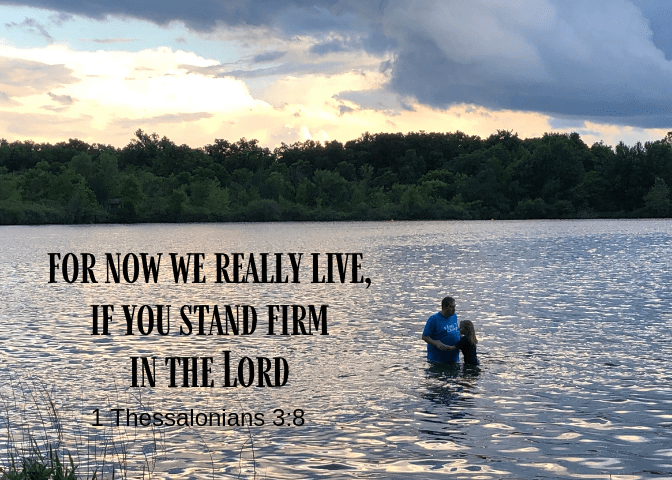
1 Thessalonians 3 8

The big three are faith, hope and love.  Chapter three is all about growing stronger in faith. (vs. 7).  Esther and I have been watching all the very small things God has been doing through each day to show His love to us.  Things such as sending rain after the baptism tonight instead of during.  Things such as God’s gentle spirit blowing the door shut to the tabernacle as we write this devotional.  Things such as the enormous peace in the stone chapel as we prayed very early in the morning.


Application: As Christians, we can endure all persecution, and still have faith God loves us as we obtain perfect peace with both God and other friends.


-Paul & Esther


Roots

Colossians 2

Colossians 2 6 7

 If there was just one thing, I had to point out in my life that has been consistent it would be my faith. With unpredictability being a close second. Ever since I can remember God has always provided me an opportunity to go to church, VBS or camp. These opportunities I believe gave me the idea “church is good”. So, when I was a teenager, I felt it was necessary to return to church and go every week. It is this foundation I am so very thankful God built for me. I became rooted and strong in faith because of those experiences when I was young. Paul in Colossians 2:6,7 says this,

 “Therefore as you have received Christ Jesus the Lord, so walk in Him, having been firmly rooted and now being built up in Him and established in your faith, just as you were instructed, and overflowing with gratitude.”

What things are you rooted in that you are thankful God laid out for you to grow in Christ?

Jesse Allen

If Paul can, You can

Philippians 1 

7

Shipwrecked on an island, stoned, bitten by a snake, beaten, and thrown into prison. It seems that Paul could never catch a break. The letter of Philippians was actually written while Paul was imprisoned in Rome. After a short greeting to the church of Philippi, Paul explains his current predicament:

Now I want you to know, brothers and sisters, that what has happened to me has actually served to advance the gospel. As a result, it has become clear throughout the whole palace guard and to everyone else that I am in chains for Christ. And because of my chains, most of the brothers and sisters have become confident in the Lord and dare all the more to proclaim the gospel without fear.(Philippians 1:12-14)

Paul’s attitude is truly humbling. Instead of grumbling, blaming, or whining, he recognizes that all of his difficulties have “served to advance the gospel.” What a mindset to strive for! By being transparent about his sufferings, Christians at the time were encouraged to be more confident and daring, spreading the gospel without fear. I was shocked to read that the people were more encouraged by Paul’s endurance than petrified by his tribulations.

My sister once brought a box of bacon-cheddar flavored crickets to a family gathering. At first, everybody thought the crickets were an amusing joke, but nobody seriously considered eating one. After staring at the crickets for a long while, my brother-in-law finally ate one as we all goggled and gawked. Then the next person ate one, and the next person, and eventually everyone in the room had eaten a cricket. After witnessing someone else eat the cricket, it was much easier for me to eat a cricket, too. (FYI crickets don’t taste like chicken).

In the same way, early Christians adopted an “If Paul can, I can” kind of faith. Let Paul’s resilience and conviction in the face of obstacles encourage you, too, to proceed boldly in your faith. If Paul can withstand being shipwrecked on an island, stoned, bitten by a snake, beaten, and thrown into prison, you can be daring and bold in your faith, too.

When was the last time you took a risk for your faith? Get your hands dirty, get uncomfortable, and get moving.

I eagerly expect and hope that I will in no way be ashamed, but will have sufficient courage so that now as always Christ will be exalted in my body, whether by life or by death.  For to me, to live is Christ and to die is gain. (Philippians 1:20-21).


-Mackenzie McClain

In Step with the Spirit

Galatians 5

Gal 5 7

Chapter 5 picks up right where 4 left off (if you haven’t already, you might just want to read the whole book straight through to get the most out of it – it’s only 6 chapters).

1 It is for freedom that Christ has set us free. Stand firm, then, and do not let yourselves be burdened again by a yoke of slavery. […] You were running a good race. Who cut in on you to keep you from obeying the truth?

From chapter 4, we know that the Galatians were struggling, falling back to their old ways. Paul is still trying to get to the heart of the why and how.  He wants them to quit trying to be justified by the law – because by doing do, they miss out on Christ’s promise and are once again bound into slavery.

Do you ever get bogged down by doing things exactly by the letter and then realize that you have been missing the point?  Paul is specifically talking to the Galatians about circumcision, but I think the same idea could apply to many things.  This reminds me of Jesus’ teachings about the Sabbath.  The Pharisees were so focused on making sure no work was done, that they wanted to condemn Jesus for healing someone.  Jesus pointed out that if a sheep fell into a hole on the Sabbath, they would pull it out – and how much more valuable is a person!  So Paul’s point is to quit being so focused on the letter of the law – he says in verse 5 “The only thing that counts is faith expressing itself through love.”

So rather than focusing on the law, focus on this:

13 You, my brothers and sisters, were called to be free. But do not use your freedom to indulge the flesh[a]; rather, serve one another humbly in love. 14 For the entire law is fulfilled in keeping this one command: “Love your neighbor as yourself.”

It could be easy to say that if we are not bound by the law that we are free to do whatever we want, but I believe we are called to a standard higher than the law by this freedom.  If we look to Romans 6, Paul clarifies here that we are to offer ourselves to God as an instrument of righteousness and to not let sin reign.

This chapter finishes with the fruit of the Spirit.  You are probably familiar with these, but I usually think about these alone, not in the context of this book.  If we are children of God through Christ, then we have the Spirit to guide us rather than the law.  This list isn’t easy.  They are high standards of living.  I am going to leave you today with these verses as a reminder – let’s try to live in step with the Spirit.

22 But the fruit of the Spirit is love, joy, peace, forbearance, kindness, goodness, faithfulness, 23 gentleness and self-control. Against such things there is no law. 24 Those who belong to Christ Jesus have crucified the flesh with its passions and desires. 25 Since we live by the Spirit, let us keep in step with the Spirit.


~Stephanie Fletcher

Who Deserves Our Faith & Following

1 Corinthians 1

1 Corinthians 1 18 (1)

Hey guys this is Chris and I’m excited to go through 1 Corinthians 1-7 with you this week.  I hope you enjoy this book as much as I do.


In 1 Corinthians 1:10-17 Paul chastises the people in the Church at Corinth for being divided based on the person they were baptized by or whose teachings they followed.  I think that this is a very good message for us today. Many Christians are drawn to a well spoken pastor, or an impassioned speaker, and these are good people to follow, but too often people place too much of their faith in that person.  I have seen it many times, these types of leaders will move away from their church or they will have a scandal, and the faith of the people will be shaken and many will stop going to that church. Hebrews 4:14 says “Therefore, since we have a great high priest who has ascended into heaven, Jesus the Son of God, let us hold firmly to the faith we profess.”  We need to follow Jesus as the head of the Church because he will not fail us, and he is the only one who deserves our faith. Also, in this age of social justice people can get caught up in a certain movement or behind a certain leader and let those ideas influence them, and we need to remember that Christ’s teachings come first. Those other movements may be good things, but we need to check what they are saying against what Christ teaches.


1 Corinthians 1:18-31 tells us that salvation is not attained through wisdom or knowledge that you can gain if you study long enough.  That was the teaching of the Greeks such as Plato and Aristotle, that seeking wisdom was the highest goal. Salvation comes through faith.  In the Church of God we can be very focused on the Word of God and the truth, which is a good thing, but we need to make sure that we do not take pride in our knowledge and somehow think that we are any better than other Christians. We are saved by our faith, not our knowledge or wisdom.  Knowledge and wisdom will come as we seek God and grow, but we should not have pride in our knowledge, only in Christ and his works.


Have a blessed day.

Chris Mattison