So many of the psalms focus on directly worshipping and declaring the goodness of God, which is good, but this psalm takes that knowledge of God and comes in with a missional view: Let God be known and praised by all the people. All the nations. Not just Israel, his covenant people, but by everyone.
The psalmist recognizes the goodness of God and what he has done for his people. In light of this fact, they want the goodness of God to be experienced by all people and for there to be abounding joy for all.
God provides sustenance for all people, the earth yields its produce. It does so because God designed it that way, so may the nations recognize that Yahweh created life and sustains it through his order.
Verse 4 talks about the nations being judged with equity. Equity here is the Hebrew word mishor, which literally means levelness or uprightness. God will not play favorites with his judgment, he will judge with prejudice, but he will judge fairly and give the same outcomes to the faithful of all tongues and tribes. In the same way, destruction comes from rejecting God, regardless of the background of the individual.
We can look at this through the lens of Jesus, but even without a clear picture, the psalmist saw a future where there was no Jew nor Greek, nor slave nor free, but a world where all could bask in and enjoy the glory of God and worship him in spirit and in truth.
Let the nations be glad.
-JJ Fletcher
Reflection Questions
Where does your joy come from?
Do you view your role as a believer to be missional? To bring others into a saving relationship with Jesus and his Father?
Do you have trouble with being equitable in your sharing? Can it be difficult to share with people from different backgrounds?
If you find great hope and strength in the gospel, shouldn’t you share it? Why are we worried about “offending people” with the gospel?
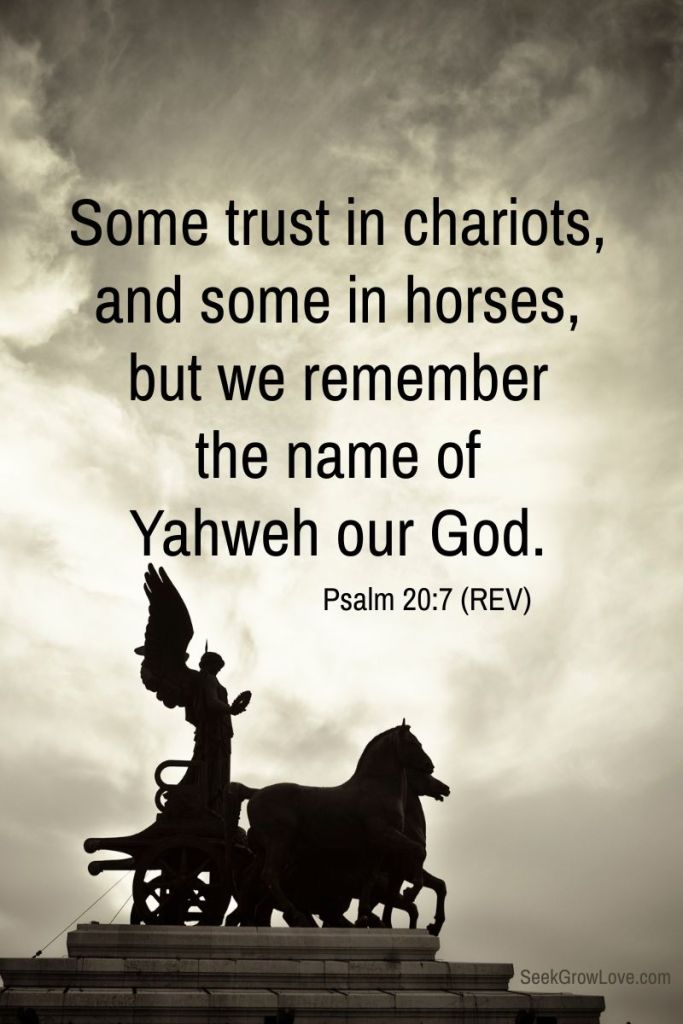
Some trust in chariots, and some in horses, but we remember the name of Yahweh our God. – Psalm 20:7 (REV)
It is very easy to rely on our modern technologies for help. The United States spent around 1 trillion dollars on defense last year, and it is easy to look at that high spending and have some confidence that the US would have an upper hand in any conflicts that it is engaged in, and that soldiers might enjoy a higher level of safety. We can look at medical technologies and pharmaceuticals and have confidence that something out there can diagnose and treat our potential maladies.
Yet despite these great resources, soldiers still die, and people still get sick and do not receive the diagnosis or treatment that they want or need. Confidence can lead to letdowns when placed in earthly things.
In 1 Chronicles 19, we see King David extend kindness to his potential foes, only for it to be repaid with treachery and opposition. When the Ammonites realize that they have put themselves at odds with David, they amass a significant force of chariots to fend off any attacks. They put confidence in the technology of the day to help deliver them from the potential conflict with Israel.
As Psalm 20:7 says, some people put their trust in chariots and horses, but we remember – or put our trust in – Yahweh. David trusted his God to deliver him and his armies from whatever his enemies devised as a means of attack or defense strategy. David recognized God as sovereign and that God is capable of anything. Historically and personally, David knew that God used underdogs and laughably small forces to conquer the enemies of his chosen people.
We do not have promises from God that we will never suffer or experience pain, death, or illness. God does promise us redemption through the blood of his son Jesus. We have a promise of restoration for the earth, which is something that has never been accomplished by human effort, whether governmental or environmental.
-JJ Fletcher
Reflection Questions
What will you put your trust in?
Who will you put your trust in?
Why is God’s provision so much more powerful than earthly promises?
When was the last time you made a truly eternal promise? If you’re married, hopefully, you’ve made an eternal promise of love and commitment. I’m sure if you have children, you’ve vowed to love and cherish them always. Even something as seemingly simple as getting a tattoo is a promise to yourself that you’ll carry that image on your body for the rest of your life.
Today’s scripture, 2 Samuel 7, reveals the profound truth of God’s eternal promises. This passage contains the Davidic Covenant, where God promises that David’s house will rule forever. We know this promise will be fully realized when Jesus returns to establish God’s Kingdom on earth. Think about it: God has been keeping this promise for over 3,000 years! Despite Israel’s occasional disappointments and frustrations, God remains steadfast.
While our most sincere promises can falter due to betrayal, anger, misunderstanding, or irreconcilable differences, a promise from God is unwavering. That’s a reason for a true celebration!
David’s response to this incredible promise is one of humility and awe: “How great you are, Sovereign Lord! There is no one like you, and there is no God but you, as we have heard with our own ears.” Today, may we find ways to celebrate God’s faithfulness that has endured all this time and will continue long past us.
-Hope Fletcher
Reflection Questions
When have you witnessed or experienced God’s enduring faithfulness?
When have you responded to God with humility and awe saying (similar): ““How great you are, Sovereign Lord! There is no one like you…”?
How are you at keeping your promises? Can your word be trusted?
2 Samuel 6 is one of those stories in the Bible that never sat well with me in my youth. Here, we have a scene of a joyful celebration as the ark of the Lord Almighty is brought to its rightful home in Jerusalem. We’re singing, we’re dancing, we’re having a grand time. Suddenly, the oxen stumbles, and the ark begins to fall. Here, we have Uzzah, who reaches out to steady the ark to keep it from falling. See, to me, that seems like a noble thing to do. After all, we’d hate for the ark to fall to the ground, wouldn’t we? Yet, God strikes him dead for this act. Come on…the guy was just doing the best he could do! It always seemed to me that God acted unfairly to someone who seemed like they were trying to do a good thing.
You know, now that I think of it, I tend to have that same attitude toward acts of disobedience in my life. Sure, I know that sometimes I do wrong things, but if my intentions are good, isn’t it ok? I know that God doesn’t want me to lie, but if my lie has a good outcome, wouldn’t God say that’s ok? I know I’m not supposed to touch the ark, but if I keep it from falling, wouldn’t that be ok? Unfortunately, that’s not the way it works.
If you’ve been following along with the Bible readings, you’ll remember that in 1 Samuel 15, we learn that to God, “it is more important to obey than to sacrifice.” God prefers faithful adherence to His commands more than grand gestures performed according to our own understanding. I think God would rather have had Uzzah follow his commands, treating his instructions with respect and reverence than try to do what was right in his own eyes.
And another thing, the disobedience didn’t start with him reaching to steady the ark. Uzzah wasn’t even supposed to be one of the men transporting the ark as he wasn’t a Kohathite (the Levites specifically instructed by God to be in charge of this task). Not only that, but they weren’t even transporting it the right way. They made a cart for the ark, but God gave specific instructions for how to carry this thing around, and a cart was not part of the deal! Things could have been so different if only they had done things the way God said.
What we learn from Uzzah and the mistake that he made is to pursue obedience even when our own understanding leads us a different way. In this life, you will be drawn toward doing things that go against God’s teachings. Even if it doesn’t make sense, God’s way is always the best.
-Hope Fletcher
Reflection Questions
How do we avoid getting caught up in doing things our own way instead of God’s way? How do we learn what God’s way is? What are the differences between my way and God’s way?
How does Uzzah show us our need for a Savior? How important is Jesus’s death – and resurrection?
Today’s reading takes us across several different life experiences many (if not all) Christians also experience in today’s modern world:
Psalm 81 is a reflection of God’s provision for Israel, and a reminder of the good things they could be experiencing if they would only listen to Him.
Psalm 88 is an example of low places so many of us have experienced in our Christian walk. The writer is calling out to God to save them from suffering, to answer their prayers, and to bring them comfort in a place of loneliness. It is a lamentation and pouring out of a soul that is broken and hurting.
Psalm 92 is a psalm of praise and excitement over the wonderful works of God! This author is experiencing joy and astonishment over a Heavenly Father, and being sure to sing it loud and proud!
Psalm 93 is another praiseful psalm that focuses more on the sovereignty of God and His mighty power, recognizing the strength of God and His position over the entire earth.
While each of these Psalms hold different perspectives of a human’s viewpoint of God, we can also see how in each of these, God’s unchanging, steadfast, supreme authority remains. No matter what our current reflection of God is, He has never become anything but God. Whether we are disobedient, hurting, praising, or fully recognizing His power, God is still, and has always been, the Creator, Yahweh, the One True God. The God who formed and controls every aspect of the earth, that pulled the Israelites out of Egypt, and held them accountable to His commands, is the SAME GOD that you and I worship today.
This fact can (and probably should) be both comforting and convicting. Comforting because there is an amazing God who loves us with an everlasting love that will never change from that! Convicting because there is a powerful God, who has high expectations for believers, that won’t change from that either. As Christians today, I believe we must consistently balance these feelings of comfort and conviction in order to best live out our days.
-Sarah Johnson
Reflection Questions
Using the four options listed, what would you classify as your current reflection of God in this season? Are you content to have that reflection?
What verses most stood out to you from the reading? Why do you think those verses impacted you the most today?
I recently had a baby boy, who decided, after about 3.5 weeks of false labor contractions and me walking around 4cm dilated for a week, he would grace us with his appearance 2 days after his due date. For comparison, my firstborn came a week early with only those pesky Braxton Hicks contractions leading up to his debut. Anyone who has known me over the past 9 months knows that I was fully convinced this second baby was coming early. It felt like my entire mind was consumed by thinking about going into labor every moment of every day! I was grouchy, distracted, and mentally exhausted. My yearning brought me no closer to my baby, and really only made me more distant from everything positive going on around me.
The sons of Korah write in Psalm 84:2 “My soul yearns, even faints, for the courts of the LORD; my heart and my flesh cry out for the living God.” (NIV). The NET translation phrases it as “with my whole being, body and soul, I will shout joyfully to the living God”. This verse paints a picture of absolute, consuming, desire for closeness with God. The chapter continues on to describe a blessed happiness that can be found when focused on praising the Almighty, when trusting in the Lord of Hosts! (v. 4, 12).
Psalm 85 continues this picture of desiring closeness with God, but takes a slightly different perspective. In Psalm 84, I get this imagery of excitement, anticipation, energized passion for God, whereas Psalm 85 depicts an image of peace, protection, and righteousness in relationship. There is still a deep longing for a connection, but it’s like comparing the honeymoon, “puppy-love” phase of a new marriage, to a secure, content, lifelong covenant marriage.
Verse 9 describes this type of relationship through salvation by fearing God. This “fear” is derived from the Hebrew word “yare”, which means to revere, or be afraid of because of profound respect . It’s not meant to be a fear that causes us to avoid approaching the throne, but rather a fear that places us in rightful, humble, submission to an awesome God, worthy of being revered, and yearned for. One that should make us say, “my whole source of joy is in you” (Ps. 87:7).
Even though babies are one of the greatest gifts, my yearning to deliver my son began to impact my relationship with God (and others!) as I began to prioritize birth over my spiritual relationship with the One who made life. I wanted to control the timing, and I wanted it to be now! But, when I started to misplace my priorities, I felt less joy, less excitement, and less peace about the whole situation. How often does this happen in our lives? We begin to place closeness to someone or something above our desire for closeness with God… and unsurprisingly, we don’t get the same satisfaction we may have been hoping for. We can become bitter, resentful, stressed, you name it… anything but joyful. Yearning with such intenseness for the wrong things in life, even when they are good things, will never lead to a joy-filled life. BUT, when we keep ourselves yearning intensely for a relationship with God, and when we humble ourselves to Him, we experience true joy, true peace, and true satisfaction, only He can deliver!
(And baby boy arrived healthy and happy, just when God intended him too 🙂)
Sarah (Blanchard) Johnson
Reflection Questions
Evaluate your faith walk right now – would you describe yourself as yearning for a relationship with God? What other aspects in your life might you be misplacing above your relationship with Him?
What steps can you take to practice fearing, or revering, God today?
These are the sons of Israel: Reuben, Simeon, Levi, Judah, Issachar, Zebulun, Dan, Joseph, Benjamin, Naphtali, Gad, and Asher. -1 Chronicles 2:1-2 (ESV)
If you’ve been reading along with me this week, you may have noticed I like lists. In fact, it’s kind of an obsession of mine. I have lists for pretty much everything – grocery lists, daily to-do lists, lists for upcoming birthdays and anniversaries, to-do lists of projects (for me and for my husband), packing lists for trips, lists of nursery helpers and teachers at church, so many lists.
Lists can be great as reminders. Yesterday and today we have read through the first two chapters in 1 Chronicles. I know the headings aren’t actually “Biblical”, but they are helpful. 1 Chronicles 1:1-24 is the genealogy from Adam to Abraham. Verses 28 – 34 is the genealogy from Abraham to Jacob (Israel). 1 Chronicles 2:1-15 is the genealogy of David. Now, I don’t particularly like to read the genealogies in the Bible, or anywhere, really. I usually skim through them and pause at the names of characters in the Bible I recognize.
But God wanted them in the Bible, in His Word, so they must have a purpose. I know God had special tasks for different tribes. I know that prophecies that tell of Jesus’ lineage rely on genealogies to prove he was the Messiah. So, don’t write them off too quickly, even if you don’t read every name.
A short devotion to make up for the long list of names you just waded through!
Amy Blanchard
Reflection Questions
Consider your own genealogy. There are people in your lineage who have shaped your life and your faith. Is there anyone you want to thank? Or thank God for?
I encourage you to read the Psalms for today as well. A great prayer for every moment of every day is Psalm 19:14, “May these words of my mouth and this meditation of my heart be pleasing in your sight, Lord, my Rock and my Redeemer.” In looking back over your day, at what time would you have been happy to say this prayer? When would you have wanted to hide your words and thoughts (meditation) from God? Praise God for His forgiveness!
Like Psalm 34, which we highlighted yesterday, Psalm 56 for today was also written when the Philistines had seized David in Gath. And just like yesterday’s psalm, this one starts with David begging God for help.
Then, in verses 3 and 4, David says this, “When I am afraid, I will trust in you. In God, whose word I praise, in God I trust; I will not be afraid. What can mortal man do to me?”
I see a pattern here that David liked to repeat:
He acknowledged his fear, “When I am afraid.” Fear is a natural reaction when in danger – either real or perceived.
David then made a deliberate decision to trust God. This is not a normal reaction, it is an intentional decision, flying in the face of the natural fear.
David praised God for delivering him – before he had been delivered. (In this case, David praised God’s word, but often, he just praised God.) When David did this, he was stepping out on faith, believing God would answer his prayers.
Finally, in the assurance God would help him, David banished his fear, “I will not be afraid.”. Notice he chose to not fear what mortal man could do to him.
This reminds me of Jesus’ words in Matthew 10:28, “Don’t be afraid of those who want to kill your body; they cannot touch your soul. Fear only God, who can destroy both soul and body in hell.”
This is a pattern I have also tried to follow in my own life. Many times, I have cried out to God, confessing my fear. I have then made a deliberate decision to trust that whatever God has for me is best, whether I know it (or like it) or not. Then praise God for his promise that all things work together for my good – because I love God. Finally, with God’s help, I let Him lift my burden off my shoulders, whether it is fear, or whatever else it is.
With the fears swirling around now, whether Covid-19, or unemployment, or difficulty finding what you want at the grocery store, or … You have a choice. You can succumb to fear, or you can follow David’s example.
I challenge you to try this pattern with whatever makes you fearful today. Then you can say, like David wrote in yesterday’s reading from Psalm 34:8, “Taste and see that the Lord is good; blessed is the man who takes refuge in him.” And from today’s reading in 56:11, “In God I trust; I will not be afraid. What can man do to me?”
–Steve Mattison
(originally posted April 15, 2020 for SeekGrowLove)
Reflection Questions
What have you been afraid about in the past? What has God already successfully brought you through?
When is fear helpful? Do you have a healthy fear of God? Do you fear only God?
What makes you fearful today (besides God)? Would you like to conquer this fear? Write out David’s steps to replace fear with faith and keep them in a place you will see often and practice working through the steps – over and over again.
In today’s reading, we see more examples of Saul’s rebellion against God and his hatred of David. Ahimelech the priest had inquired of the Lord for David. In his rage, Saul ordered that not only Ahimelech, but all the priests must be killed – so Doeg the Edomite, one of Saul’s goons, killed 85 priests, then went to their town and killed every man, woman, and child (and its cattle, donkeys, and sheep). In chapter 23, Saul chased David and tried to kill him multiple times.
In chapter 24, David finally has his opportunity for revenge. Saul was again chasing David. David and his men were hiding in the Desert of En Gedi. Saul and 3000 chosen troops were in hot pursuit. Along the way, Saul needed to go to the bathroom. He wanted a little privacy, so he stepped into a cave to relieve himself. Little did he know that David and his men were hiding further back in that very cave.
If you were David, what would you have done? Would you have eliminated the threat to your life, and ushered in your reign as king? To be perfectly honest, I think that’s exactly what I would have done. David’s men encouraged David to kill Saul, but instead, David crept up to Saul, and cut off the corner of Saul’s robe.
Afterward, David was conscience stricken and said, “The Lord forbid that I should do such a thing to my master, the Lord’s anointed, or lift my hand against him; for he is the anointed of the Lord.”
Wow! Clearly Saul was a scoundrel, but David spared his life because God had made him king. I think we can learn a lesson or two from David’s respect for the office of authority, even when the man in the office wasn’t worthy of respect.
This is exactly what we’re told to do in 1 Peter 2:13-14 – “For the Lord’s sake, submit to all human authority—whether the king as head of state, or the officials he has appointed. For the king has sent them to punish those who do wrong and to honor those who do right.”
David’s actions also remind me of Romans 12:17-18 – “Never pay back evil with more evil. Do things in such a way that everyone can see you are honorable. Do all that you can to live in peace with everyone.”
So too, we need to submit to authority, even when we don’t like the person in authority, or what they are doing. Also, we need to be intentional about never repaying evil for evil.
To finish today’s story, because David had spared Saul’s life, Saul promised to leave David alone, and returned home (for now). David and his men went up to their stronghold. God had protected David yet again.
Steve Mattison
(originally posted April 13, 2020 for SeekGrowLove)
Reflection Questions
What do you admire about David?
When have you found it difficult to pass when given the opportunity for revenge, a cutting comment, or having the last word? What is the world’s position on paying back evil for evil? What is God’s? What is the advantage to leaving it up to God to be the judge, rather than taking out revenge for wrongs done against us?
In what ways do you think God wants to see Christians submit to authority today?
Today’s reading, found in 1 Samuel chapters 18 through 20, highlights how far Saul has fallen from his successes of chapter 14. (Remember from chapter 15, that Saul had deliberately disobeyed a direct command from God, and things have been going from bad to worse for him since.)
In 18:10-11, we read, “The very next day a tormenting spirit from God overwhelmed Saul, and he began to rave in his house like a madman. David was playing the harp, as he did each day. But Saul had a spear in his hand, and he suddenly hurled it at David, intending to pin him to the wall. But David escaped him twice.”
Once Saul decided to abandon God, God not only abandoned Saul, God tormented Saul. This should be a lesson to us – never disobey God – there are always negative consequences.
Saul became jealous of David, after David had killed Goliath, because the women of Israel sang this song, “Saul has killed his thousands, and David his ten thousands.” As a result of his jealousy, Saul tried to kill David with his spear in 18:11 and again in 19:10. Saul also tried to kill David by having the Philistines kill him in 18:17, 21, 25. In 19:1, Saul urged his servants and his son Jonathan to assassinate David. In 19:15, Saul ordered his men to bring David (and his bed) to Saul to be killed, when Saul thought David was sick in bed. In 19:20, 21 and 22 Saul unsuccessfully sent troops to get David three times.
In 20:30, Saul boiled with rage at his own son, Jonathan, who was friends with David, and in 20:33, Saul hurled his spear at Jonathan, intending to kill him.
So much for Saul, what about David?
If you were David, how would you react? What would you do?
Remember that Samuel had anointed David in chapter 16, and declared that David would be the next king over Israel. So what did David do? He wrote some songs about this. Let’s see what he said in those songs…
David wrote Psalm 59 when Saul sent his soldiers to watch David’s house in order to kill him. This psalm starts out, “Rescue me from my enemies, O God. Protect me from those who have come to destroy me. Rescue me from these criminals; save me from these murderers. They have set an ambush for me…”. This makes sense. David was in trouble, so he cried out to God for help. David continues in verse 9, “You are my strength; I wait for you to rescue me, for you, O God, are my fortress.”
Then an astounding thing happens. David starts praising God – in advance of God’s rescuing him. Psalm 59 ends with, “But as for me, I will sing about your power. Each morning, I will sing with joy about your unfailing love. For you have been my refuge, a place of safety when I am in distress. O my strength, to you I sing praises, for you, O God, are my refuge, the God who shows me unfailing love.”
David, the man after God’s own heart was actually praising God when he was literally afraid for his life. This shows his great faith that God will indeed rescue him. Maybe this is one of the reasons he was called a “man after God’s own heart.”
Psalm 11, the other chapter from today’s reading also shows David’s faith through difficulty. It starts out, “I trust in the Lord for protection…”, and ends with “For the righteous Lord loves justice. The virtuous will see his face.”
I believe David’s response is a good example for us. When times are tough, it’s natural to cry out to God for help. We need to move on from just asking for help, and follow David’s example to also have faith and praise God, even before the answer comes. And in the process, we, too, may become people after God’s own heart.
–Steve Mattison
(originally posted April 12, 2020 for SeekGrowLove.com)
Reflection Questions
Compare and contrast Saul and David based upon what we know from 1 Samuel.
What do you see in your own life that is similar to Saul? And David?
What does it look like to show faith in God during the difficulty?
What difficulty (big or small) have you recently found yourself in, in which you can practice giving God praise even before the answer comes?