Chapters of Love

Song of Solomon 1-4

This collection of songs is something that, sadly, is frequently misunderstood and avoided today. At a wedding we celebrate love, yes, but certainly not like this. The beautiful imagery described in these chapters of love, desire and passion are everything we should want in a relationship with our spouse. Unfortunately, discussions of sexual desire and attraction like this are usually either twisted by an immoral society, or avoided by Christians. The world has thrown sex around until it’s dirty, misused, and undervalued. And Christian religion has gone in the complete opposite direction and has made it into something secret and almost shameful. We feel embarrassment.

But desire is not shameful at all when it is within its perfect time and place. Amidst all of this expression of love, there is one important phrase repeated again and again. 

“Do not arouse or awaken love until it so desires.”

There is no rushing here. When we want to be in a relationship or long to fill our sexual desires more than we long for God’s good and perfect plan, this is when everything falls apart. The imagery stops being intimate and beautiful. It becomes cheap and our relationship is no longer the reflection of God’s love for us that it should be. 

But when we acknowledge God first and seek him for our fulfillment, we restore the proper order of things. God created man and everything was good. Adam had God and relied on him completely. And in that complete reliance, God provided the perfect partner. 

God knows our needs far better than we do, and that includes our need for relationships and intimacy. When we seek him first before seeking fulfillment in others, God will provide in his own perfect timing. 

I hope you see the beauty reflected in these chapters! Love and desire within God’s plan is a treasure to be appreciated. 

-Jenn Haynes

Reflection Questions: 

For those who are unmarried: Do you find yourself growing impatient? Are you seeking fulfillment from people rather than God? How can you turn your focus more on your relationship with God and rely more fully on him? 

For those who married: Maybe you’re a newlywed, or you’ve been married for years, or you’re widowed. Take some time to reflect on your love. Read through the descriptions and think about your own beloved. What do you appreciate about your spouse? How did God provide for you by bringing you together? How does your relationship reflect the relationship God desires to have with you? 

My prayer for you today is that you see beauty in this passage. I pray you seek intimacy with God first, and that you rely on him fully. And for those who are/were married, I pray you are able to reflect and appreciate all of the wonderful qualities of your spouse. 

My Hope is in His Word

Psalm 119:89-176

I don’t think that any child would say that they love rules. And yet, they subconsciously crave them. Rules from a loving parent show a child that someone loves them enough to guide them. Structure makes them feel reassured and gives a sense of stability. Without those directions and guidelines, children become stressed and tend to feel out of their depth. 

Even as an adult, I like to have rules and guidelines that make logical sense. Structure eases my mental burden because it removes some of the many options that exist. In fact, research says that too many decisions and too many options are harmful to our mental health and can lead to mental fatigue and anxiety, causing us to either avoid making decisions or make harmful decisions that don’t align with our life goals. 

If I know that by following wise guidelines I will avoid many mistakes, my mind and soul feel more at ease. How blessed are we, then, that we have a loving father who cares so much about us that he has set boundaries for his children to keep us safe? 

The author of Psalm 119 clearly knows the value of God’s laws. His gratitude to God for providing wisdom and guidance is clear. When I first read through this passage my initial thought was, “How can someone go on this long about laws and rules!?” But the truth is that these verses aren’t proclaiming the glory of guidelines. They are testifying to the everlasting love God has for us.

We live in a sinful world that is full of deceit, pitfalls, and endless opportunities for mistakes. But Psalm 119:113-114 offers reassurance that though the world is wicked, our God loves us so much that he has provided all of the guidance we need to navigate life. 

“I hate double-minded people, but I love your law. You are my refuge and my shield; I have put my hope in your word.”

What a beautiful reminder to bury ourselves in God’s commands. I pray that you find love, peace, and reassurance in his words written for you. 

-Jenn Haynes

Reflection Questions

What are some decisions you are facing right now? What would God advise? 

Many people find rules restricting. How do you feel about some of God’s rules for you? If you find them restricting, do some reflection to find out why. Is what God wants for you clashing with what you want? 

Take some time to thank God for some specific rules he has set forth for you that you have found helpful. Revel in his love for you! 

A Discerning Heart

1 Kings 3-4, 2 Chronicles 1, Psalm 72                                   

In these accounts (1 Kings 3 & 2 Chronicles 1), we see Solomon following the LORD and God coming to him in a dream to ask him whatever he wants.

In the start of his reign here, Solomon presents himself with humility before God in his answer.

1 Kings 3:7-9 says

“Now, Lord my God, you have made your servant king in place of my father David. But I am only a little child and do not know how to carry out my duties. Your servant is here among the people you have chosen, a great people, too numerous to count or number. So give your servant a discerning heart to govern your people and to distinguish between right and wrong. For who is able to govern this great people of yours?”

He could have so easily asked for more, yet what he wanted was to be able to do the job that God had appointed to him well.  I really appreciate this and want it to be an example to me to want to do my job(s) well.  I am thankful that for the most part, I enjoy my job, which makes it easier to work hard at it.  But I know that is not always the case.  For those jobs that I am maybe not fully equipped for, or maybe especially in the ones I think I am, I want to be reminded to ask God for wisdom in how I work or lead so that I can do it well.

As we continue reading, we see the wisdom of Solomon here, and we see how he became a great king, but seeing this positive start here also saddens me when we read how he fell and how he turned away from the God who gave him this great wisdom, wealth, and honor.  You’ll read about that later, but I just wanted to note that again (from earlier in the week), we can’t let pride get in the way – even those viewed as some of the “greats” have fallen when led astray.

~Stephanie Fletcher

Reflection Questions

  1. How would you define wisdom?
  2. What is one decision you have made that showed a lot of wisdom? What is one decision you have made that lacked wisdom?
  3. In what jobs/roles/areas of your life should you pray for a more discerning heart to distinguish between right and wrong?
  4. How does pride mess with wisdom?

So Be Strong

1 Kings 1-2 & Psalm 37, 71, 94

As David gets ready to die in 1 Kings 2, the beginning verses as he speaks to Solomon stuck out to me.

“I am about to go the way of all the earth,” he said. “So be strong, act like a man, and observe what the Lord your God requires: Walk in obedience to him, and keep his decrees and commands, his laws and regulations, as written in the Law of Moses. Do this so that you may prosper in all you do and wherever you go and that the Lord may keep his promise to me: ‘If your descendants watch how they live, and if they walk faithfully before me with all their heart and soul, you will never fail to have a successor on the throne of Israel.’”

“So be strong, act like a man” – what does that look like?  I think this statement connects with the next one.  To be strong and act like a man is to observe what the Lord your God requires which is to walk in obedience to him and keep his decrees.  Doing those things takes strength because it opposes the way of the world.

I am not a man, but I am raising a young one, and this is what I desire for him.  I want him to be strong, that is, to stand firm in faith and not give in to pressures from this world, but to instead walk in obedience to God.  I want him to be strong as in to stand up for those who can’t, to defend and protect the weak. 

Our culture puts definitions on what it wants men to be like, and that changes throughout time (for example, I read recently that pink used to be a very masculine color in the past), but those things don’t really matter.  How they follow God matters.  How they care for others matters.

As you continue reading in 1 Kings 2, you see poor examples of men in Adonijah, in Abiathar, in Joab, in Shimei as they tried to usurp the leader God put in place or followed the wrong people or refused to listen.  These aren’t poor examples of men in a cultural sense, they are poor examples of men in the sense that they were not walking in obedience to God.  They were not being strong/faithful to what they were told, but instead were led astray, or were trying to lead others astray.  If we can raise up men who follow God and care for others, we raise up men who are like Jesus and that is the strength that I hope to see.

~Stephanie Fletcher

Reflection Questions

  1. How is God’s definition of what it takes to be a man different from what the world currently says men should be?
  2. While it is not discussed in this text specifically, what do you think God would say to women about how they should act?
  3. Man or woman, how have you showed strength in opposing the way of the world? Is there an area where God would like to see more strength in you – more doing what God requires?
  4. What good examples have you had of men or women who were strong in the Lord?

Praise the Lord!

Psalm 111-118

                  Psalm 111-113 – all start with “Praise the LORD.”

I have started a homeschool journey with my child, and one thing I am enjoying about the curriculum we are using is that it tries to draw things in the lessons back to God, and to remind us to be thankful and grateful in our lives.  I think when we start with “Praise the LORD” it can shift our focus and alter the way we live our lives.

                  115:1 – Not to us, Lord, not to us
    but to your name be the glory,
    because of your love and faithfulness.

As humans, we often crave praise and glory, but when we seek after those things, we create idols (though maybe not the physical ones mentioned in the following verses). 

But our God is great and wonderful, and we need to trust in Him – He blesses people, He gives to us.  And simply because of who God is, we ought to offer Him praise, “both now and forevermore.” (verse 18b). 

I have enjoyed reading the Psalms, and I appreciate how so many of them are focused on praising God.  I think if we re-framed our life to have that much focus on that, we would be better off.

~Stephanie Fletcher

Reflection Questions

  1. What stood out to you most in these Psalms?
  2. What have you praised God for this week?
  3. What happens when we don’t praise God?
  4. How can you be more intentional about praising God more regularly?
  5. What can you praise God for today?

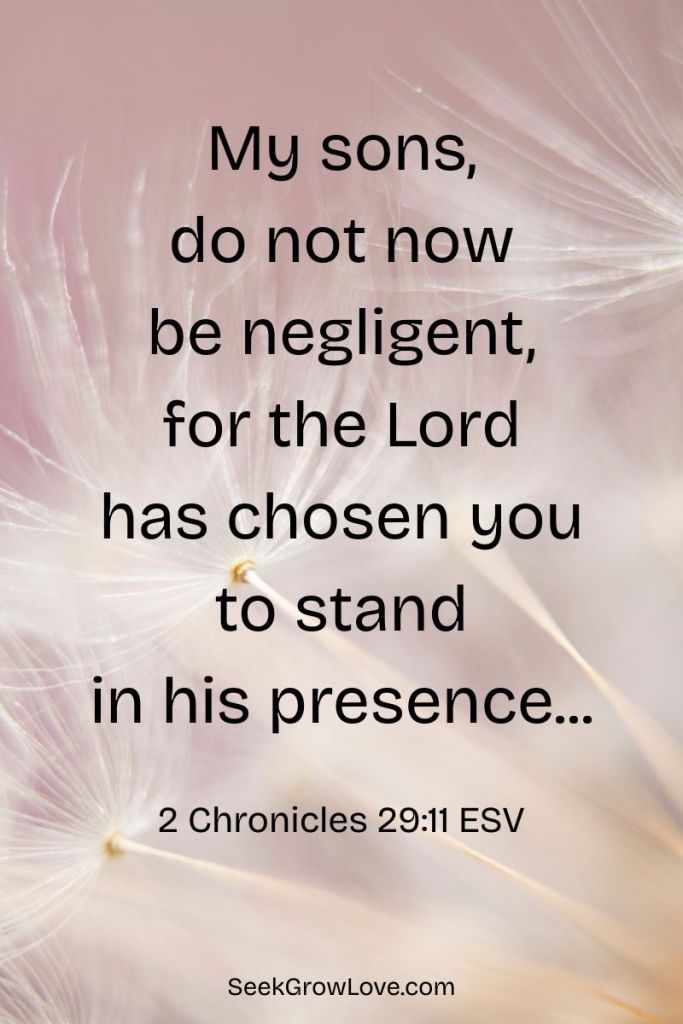
Chosen – for Something

Be Strong and Do It!

1 Chronicles 26-29 & Psalm 127

Have you ever had an idea, or plans for something that you spent time putting together, but were not able to actually carry it out?

It might be because you don’t have the means, the talent, the time, but whatever the case, it can be disheartening, so I appreciate David’s example here on not being downtrodden about it but instead taking an opportunity to guide the nation and his son, directing them to serve God.

I also think it is pretty cool that despite David not being allowed to build the temple, we see an example of God’s Spirit working in David to come up with the plans.  Just because he wasn’t allowed to build, didn’t mean that he wasn’t able to still do something for the LORD.

In this case, David wasn’t allowed to build because of being a warrior who had killed others, but it is also a reminder to me that there isn’t just one thing to do.  God may call us differently or gift us differently to accomplish more things.  God didn’t use David to build the temple because of David’s actions over the past. But in other cases, God is just using people in different ways – not because one thing is better than the other (thinking of Paul describing the body – each part needs the others to properly function), but because multiple things need to be done.  We might sometimes feel saddened by being unable to do what we want, but that shouldn’t stop us from doing something.  We are all able to serve, but that service might look different from how others serve depending on our skills, or physical abilities, or God-given direction.

And then as we continue reading, we see how things are generously donated to the building of the temple, and to keep us all in check, David offers this in 29:14 “But who am I, and who are my people, that we should be able to give as generously as this? Everything comes from you, and we have given you only what comes from your hand.”

In a world/culture that is heavily focused on earning what we have, sometimes we need that reminder that the only reason we have is because God has given us things.  And that can fill us with gratefulness and love and inspire us to give as well.

~Stephanie Fletcher

Reflection Questions

  1. Is there a job that you have wished God would chose you for, but He has not? What can you learn from David? What other jobs do you think God IS asking you to do? In what ways are God’s plans better than ours?
  2. What has God given to you that you can use to serve Him?
  3. Our Psalm today was written by Solomon and he wrote: “Unless the Lord builds the house, those who build it labor in vain.” (Psalm 127:1 ESV). What did Solomon learn from his dad? How can you apply these words to how you are building your house/life/family and how you are building/supporting/growing God’s house/church?

Fully Known

Psalm 138-139, 143-145

I picked just one Psalm today to write about (139), but I think you can grow and find comfort in all of them.

You have searched me, Lord,
    and you know me.

This is both comforting and frightening.  God knows us fully, He knows all that we think and do.  That can be scary when we think about how unruly our minds sometimes are.  But it is also an amazing comfort and blessing to know that there is someone that knows you 100%. 

Though we often try and hide aspects of our lives, I believe that most people do have a desire inside to be fully known.  To have someone you can go to and have no façade and completely let your guard down.  We search for that in people, but it isn’t something that we can find in them, only God. I think that desire can even cause us hurt and frustrations in our relationships with people because we want that other person to fully know us, and when they don’t [can’t], we can feel let down if we aren’t viewing them in the proper light. 

I often wish my husband could read my mind when I say that I want a snack, but I don’t know what I want – I want him to know what I want.  But other people weren’t made to know us fully.  Only God gets to hold that position, and that is a good thing.  People are imperfect, they can let us down by their imperfections, but God never does.  And so thanks be to Him that He is the one that knows us completely.

The following verses continue a similar idea and expand into the fact that there is nowhere we can go that is away from God’s Spirit.  I want to just copy all the verses and paste them here, but you can go read them.

Even when we try and run from God, there is no where we can go that He is not there.  And not only is He there, but He loves you so fully and deeply. 

13 For you created my inmost being;
    you knit me together in my mother’s womb.

16 Your eyes saw my unformed body;
    all the days ordained for me were written in your book
    before one of them came to be.

Before you were even born, God knew you, and He loved you so fully and completely that our human minds cannot understand. But we can trust and know that that is true. 

I’ve had the privilege to carry two children within me, and that concept of loving someone in an inexplicable way before you have even met them connects with me.  And what is crazy to me is to think of how much deeper and wider the love God has for us – stronger than any earthly parent can have for their child, and I know, that love is already deep.  And it humbles me and brings me to tears to know that God loves my children more than I ever could.  And I am so thankful for that, and that He loves us all in that way.

~Stephanie Fletcher

Reflection Questions

  1. What do you find most striking in Psalm 139?
  2. In what ways do you desire to be known by others? How have you been disappointed when they have not met your expectations and desire?
  3. How do you feel knowing God knows everything about you, and always has, and loves you still?

Not God

1 Chronicles 23-25, Psalm 131

We are going to be in the Psalms today.  [Personally, I did not pick either of my children’s names from the Chronicles reading, but if you are looking for some unique names, there are lots of options here!]

I have been reading a book with my small group looking at the concept of how we are not like God, and how that is a good thing.  There have been a variety of topics related to this, but one thing that has been a common theme is how we humans strive after some of God’s attributes, and that when we do so, we inevitably fall short, and often these shortcomings lead to issues when we think we should have been able to do it.  And I think that is pride.  We pride ourselves on being able to take care of ourselves, to know things, to understand things, to create things, to do X, Y, and Z, but we cannot do things to the extent that God does.

1b 
I do not concern myself with great matters
    or things too wonderful for me.
But I have calmed and quieted myself,
[…]

Israel, put your hope in the Lord
    both now and forevermore.

Instead, we can rely on God to lead those things that are too great for us, we can find rest and comfort in Him.  We can be content and thankful of our limitations because we have an amazing Father with no limitations.

I actually wrote a devotion on this Psalm a couple of years ago, and it was interesting to see how my perspective has changed based on what I am going through, what other things I am reading, etc.  Some of my thoughts are similar, but some are focused on another area.  And that reminded me of another thing from the book – how because of God’s limitlessness, we always have more to learn about Him, from Him.  We can keep reading through the Bible over and over and there is always more for us to glean, always room for us to grow closer to God.  We need to view ourselves with humility to realize we aren’t done growing – there is always room for improvement.

And I think you balance that with contentedness of being ok with our place as limited humans while still trying to grow closer to our great God.  We can be content while still seeking to become more Christ-like as Jesus was and is God’s reflection to us.

~Stephanie Fletcher

Reflection Questions

  1. What are some of God’s amazing attributes that you enjoy and strive for in your own life?
  2. Where have you seen your own growth: in learning about God, drawing closer to Him and emulating His attributes? How would you like to grow next? What can you do to help you with that growth?
  3. What contentment do you find knowing you can rely on God to be God and you can’t and don’t have to? Enjoy relying on Him today!

Leaving a Legacy

1 Chr 22; Ps 30, 108-110

There’s nothing quite like the moment when you hold your little newborn baby in your arms. For months, you dreamed of when they would arrive, what they would look like, and the sweetness of that moment. But, your dreaming of the future doesn’t stop once you get home from the hospital. 

With every birthday, we imagine the future self that they will grow into. Some of our dreams are realized, and some are given up as life passes on. 

My husband has always wanted to be a Golf Player (with a capital G, capital P). When we learned we were pregnant with our first, he immediately said, ‘He can grow up and learned to be good at golf.’ Even if we don’t want to admit it, we all do this.

We all have dreams that we pass on to our children. Some of these dreams are our unrealized hopes for our own future. We think, “I can’t do this, but maybe my kids can.” Some of these dreams are our way of passing on our accomplishments. We build a family business and want our kids to continue that legacy. 

David had his own special dream that he wanted to pass down to his children that was a combination of both his unrealized hopes and his hard-won legacy. Since Solomon was young, David knew that his little boy would grow up to do what he wasn’t able to do: Build the temple. So, David spent his lifetime paving the way for Solomon, assembling together all the resources he would need to do something magnificent. 

My son is still young. No, we haven’t done golf lessons – yet. But, he has a few clubs to play with. There is still time for him to become that Golf Player that we dreamed of five years ago. 

But, as I read through David’s story, I’m moved to imagine a different kind of legacy that I want to pass on. I don’t just want to have dreams that center around things that would be ‘cool to do.’ My dreams for him are to build a legacy that would glorify God and impact the world.

How are we launching others to do good work for God? Are you helping those coming after you build a lasting legacy of glorifying God? 

-Cayce Fletcher

Cayce blogs at https://amorebeautifullifecollective.com about faith, family, and life. You’ll find encouragement for how to build intentional lives rooted in faith and beauty. Check out the latest post on the human nature of Jesus here. 

Reflection Questions

  1. What were some hopes and dreams that you wanted for yourself but have passed you by? 
  2. If you have kids, how have you tried to realize those dreams in your children? 
  3. What is the legacy you want to leave? How are you setting up the people who come after you to glorify God? 

SGL.2025.MayFullPageDownload

David’s Costly Mistake

2 Sam 24, 1 Chr 21

When David sinned with Bathsheba, we see him at his lowest point. He is made to confront his sin as Nathan the profit reminds him how God brought him up from being a shepherd boy to king over all of Israel. God humbled him and cut through his swollen pride to remind him of his true heart. 

We would think after such a time as that David would be ‘home free.’ The story was played out, exposition, conflict, resolution, and all. David would be able to live righteously the rest of his life, ‘happily ever after.’ 

But we know that life isn’t like a fairy tale. As we talked about earlier this week, we all experience highs and lows. We have many story arcs throughout the years. And, David did too. 

We don’t know how many years have passed since David and Bathesheba’s sin and the events we read about today. But, today we read about another step off the good and righteous path that David took. This blunder resulted in more than the death of one man and one child. It resulted in the death of 70,000 people. 

In 1 Chr. 21, it says, “Then Satan stood against Israel and incited David to number Israel. So David said to Joab and the commanders of the army, “Go, number Israel, from Beersheba to Dan, and bring me a report, that I may know their number.” 

David’s request seems pretty innocuous. Censuses happened throughout scripture, but generally, they occurred when God commanded them. (The first part of that passage is a whole different theological question… that we are not going to talk about today.) In this case, the people weren’t being numbered because it pleased God. They were being numbered so that David could be puffed up in pride over the strength of the army he had gathered. Even Joab, not a very righteous man, told David he was crazy for wanting to do this. 

David’s guilt left him with a choice: How was he going to atone for his sins? The price of his sin turned out to be a disease against Israel, because of which 70,000 people died. 

Finally, David fell to the ground and pleaded for God to stop for the sake of his ‘sheep’, the people of Israel. David bought an altar that would become the future site of the temple of God. 

From today’s reading, we see: 

  • We should never think that we are ‘too righteous’ to never sin. No matter how long you walk with God, you have the potential to be tempted away from the right path. This does not mean that we live in fear. It means that we need to recognize the importance of relying on God. 
  • Our sins affect our community. When David did this thing, he chose to sin himself. But, his sins affected an entire nation. 70,000 people is more people than the US casualties in the Vietnam war… and every major US conflict since. We think we are doing things in isolation but they have far-reaching consequences for the people around us. 
  • God can use painful things for good. The altar that David sacrificed to end the plague ended up being the future site of the temple. Even evil situations can be redeemed by God and used for good – if we humble ourselves, repent, and ask God to enter into the situation. 

How are you living today?

-Cayce Fletcher

Cayce blogs at https://amorebeautifullifecollective.com about faith, family, and life. You’ll find encouragement for how to build intentional lives rooted in faith and beauty. Check out the latest post on the human nature of Jesus here. 

Reflection Questions

  1. Have you ever felt ‘too big to fail?’ What are some ways that we can cultivate humility in our lives? 
  2. How does sin have far-reaching consequences? How have you seen others affected by sin that seemed like something done in secret and isolation? 
  3. How can God use broken situations for good? Is there a broken situation in your life that you need to invite God into today?

SGL.2025.MayFullPageDownload