On several occasions, I have had the opportunity to witness the changing of the guard at the Tomb of the Unknown Soldier at Arlington National Cemetery. The precision with which this exercise takes place is practically mesmerizing. But what I find even more fascinating are the tales that are told of when those on duty face extraordinary weather events and refuse to take shelter. They hold their ground.
Paul concludes his letter to the Ephesians with more words of wisdom and encouragement. He reminds his readers that they will face the devil’s schemes and that they better be prepared.
Preparation for battle takes many forms: from the physical training to acquiring the best equipment. But the most important thing is to have the mindset of a warrior. What Paul is telling the Ephesian church and you and I is that we HAVE to believe that God is who He says He is. We MUST take heart and have faith that He will do what He says He will do. We CANNOT have ‘Plan B’. We NEED to remain strong and determined regardless of the circumstances.
The enemy will do whatever it takes to try to take us off course. We’ll be faced with trials and temptations; things that challenge our fortitude and things that might distract us from our purpose. Our reputations may be questioned; our relationships threatened; our resources depleted – but we can put on the belt of truth, the breastplate of righteousness, helmet of salvation, and have our feet fitted with the readiness that comes from the gospel of peace. We can pick up the shield of faith and the sword of the Spirit and choose to stand and face whatever comes our way.
You are a mighty warrior of the Most High. It’s time to hold your ground and take a stand.
-Bethany Ligon
Questions for Reflection and Discussion
What is the purpose of each piece of armor described in Ephesians 6?
What do the devil’s attacks and schemes look like for you right now? What attacks have you already faced victoriously?
Which piece do you more often forget to put on? What is the danger of going into battle without this piece of armor?
One of the most important things a teacher does at the beginning of the school year is establish and practice procedures and routines. From how to enter and exit a classroom, to how to hand in paperwork, to technology expectations, and even knowing how to interact with partners and small groups – these procedures, when done with consistency and proficiency, will create a positive and inclusive classroom environment.
One would think that a high school teacher wouldn’t have to spend time on such things, but even sixteen year olds need a reminder every now and then about when it is and when it is not an appropriate time to ask to use the restroom.
But when these kinds of procedures are practiced throughout a school, it builds a culture of excellence. The standards for behavior and academic performance are raised and students find themselves meeting those expectations.
As I read through Ephesians chapter four, I recognize Paul explaining to the Ephesian believers what a holy lifestyle should look like; what kind of behaviors are acceptable and the kinds of behaviors that are not – especially when it comes to their attitudes and speech.
Being a believer in Christ should be reflected in how we think about and present ourselves. We no longer engage in unholy behaviors – that’s the old self. The new self is transformed to be righteous and holy. And this should be evident in our day-to-day interactions with others.
Paul also explains that as a member of God’s family, we each play an important role. When we collaborate with one another amazing things take place for the sake of the Gospel.
It is important to note that living a holy lifestyle takes intentional effort – it doesn’t just happen. We have to work at it. Much like a classroom teacher spends significant time at the beginning of the school year establishing procedures, regular reminders are key to maintaining a smooth-running classroom. Likewise, if we intend on continuing to grow up spiritually, we also need regular reminders of what a mature believer says and does. This is why the study of scripture and community fellowship is so valuable. As we associate with like-minded believers we are encouraged to continue putting on the new self and working towards becoming the person God has designed us to be, righteous and holy.
-Bethany Ligon
Application Questions
Looking at Ephesians 4 again, what “old self” attitudes, actions, or mindsets does Paul tell the believers to get rid of. In your own “old self”, what have you been (or are currently, or ought to be) working on removing?
Describe the “new self”.
Looking at your own life, what percentage are you “New Self” – are you still walking around in “old self” socks? What will it take to boost that “new self” percentage higher?
Ephesians 3:16 – I pray that out of his glorious riches he may strengthen you with power through his Spirit in your inner being…
As a fan of superhero movies, I really like understanding the origins of how regular people acquired their superpowers. Whether it was from a spider bite or from the released energy of a crashed light-speed engine, it’s fun to see how their skills develop over time.
In the book of Ephesians, the author, the apostle Paul, is writing to a church of new Gentile believers. The origin story of these Christians most likely includes a history of idol worship and pagan rituals. Learning to believe in one true God was a new concept for them. Not only that, they were being introduced to a Messiah who made it possible to be in a personal relationship with the God of all heaven and Earth. They were learning that this personal relationship with God meant that they had a job to do: to participate in the sharing of the Gospel. And this participation would require them to rely on the power of God to accomplish all that He was calling them to do.
In my imagination, I think that the experiences of these new believers learning to lean into the power of God is a little similar to superheroes learning to use their powers. New discoveries of what might be possible; determining how and when to use these gifts and for whom; and probably failing every now and again.
For some superheroes, the more that they use their power, the stronger they become.
As believers in Christ, our faith also grows more powerful the more we exercise it. I sometimes wonder what might be possible if I could get out of my own way, completely, and totally rely on the power of God. I wonder if this happened if I might be more like the original disciples who healed, ministered, and preached to hundreds and thousands.
I know that with each passing year my faith in God grows as new and different circumstances require me to lean into the power He offers. I think that is why this particular prayer that Paul prays for the Ephesians is one of my favorite passages of Scripture. In Ephesians chapter 3, verses 16 through 21, I read one of the most encouraging prayers that is offered up to believers. When I read this portion, I am strengthened in my faith and my desire to serve God grows. I want to see what God can do in and through me. I want to put on my super suit and get to work.
So how about it? Will you join me in the adventure of a lifetime?
-Bethany Ligon
Application Questions
How would you tell the story of how you got your power? Where does it come from? How did you get it? What do you do with it? What could you do with it?
Re-read Paul’s prayer in Ephesians 3:14-21. Does this sound like your prayer list for your church, your family and yourself? What do you like best about Paul’s prayer? What could you add to your prayers?
Every time I study the word “grace”, I am led to two other words that are not used in everyday language: unmerited favor. My brain is naggled when I look up the definition of one word, only to be more confused by ‘fancier’ vocabulary. I want it simple.
Another reason, I believe, that the concepts of grace and unmerited favor is sometimes a challenge to wrap my mind around is that it’s not frequently extended in practice – from others to us or even from us to others. There is so often a string attached, an expectation to meet or a limit set. But that’s not how the grace of God works.
God knows every bit of our lives: our thoughts, words, actions; the good, the bad, and the ugly – and decides to freely offer His grace – a gift that we really don’t deserve – to us so that we can be in right standing with Him.
Teachers often have “back to school” dreams where something inevitably goes very wrong. Last night I had a dream that my supervising principal kept finding mistakes in my work. And in my dream, she was getting frustrated and I developed a growing concern for my job. Thankfully, that’s not my reality. My principal is great and trusts me to do my job well.
God isn’t a supervisor who is tracking all of your mistakes and missteps, evaluating your every move, just waiting to see if you’re good enough to keep, or if He needs to remove you from His team.
Yes, He sees our every move and He rejoices in our successes. He also continues to love us and support us as we stumble, fall, and fail. He’s the one who lifts us up, brushes the dust off our knees, wipes away our tears, and tells us that we can do hard things because we can draw our strength from Him.
This is grace: God’s unmerited favor.
-Bethany Ligon
Application Questions
How would you describe God’s grace to someone who has never heard of it before?
What do you love best about God’s grace? How has He picked you up after you have stumbled.
Every year on the 4th of July people in the United States come together to celebrate our freedom. If you are living in another country you might have different ways of celebrating freedom or you may not be particularly focused on freedom. Freedom means different things to different people. For the person who has been in prison, freedom means being able to go where you want to go and do what you want to do. For a student who is on vacation, freedom means not having to go to class and turn in homework. For a person who is single, freedom means being able to date. For the people who originally established the United States freedom meant being able to choose whatever religion or church that your conscience told you was the way to know God. It was also about the freedom to self-govern rather than be governed by a dictator.
Freedom can be a very good thing when it is rightly understood and practiced, but wrongly understood and practiced, freedom can be very dangerous. America is about freedom in some ways, but not every way. I’m not free to drive as fast as I want or in whatever direction I want on the highway. I have to obey traffic laws or else I could cause injury or death to myself and others, or I can be criminally punished and lose the privilege of driving. Freedom has to be rightly understood. What am I free from and what am I free to do?
When Paul talks about freedom here he has a couple of things in mind. We are saved by God’s grace through faith in Jesus Christ. We are not saved by following some law or other legalistic ritual practice. In the Church of Galatia, those who heard Paul preach the Gospel and were baptized into Jesus Christ were set free from the power of sin and death. They were free to allow the spirit of God to transform their lives so that they could do what is most important, love.
Paul is obviously very angry in chapter 5 because he sees that they have chosen to reject the freedom given by the Gospel and have chosen to place themselves under the yoke of slavery to the Jewish Law. Circumcision was the physical act of mutilating part of your body as a way of marking you as different. Jewish boys were circumcised to distinguish them as children of Abraham and followers of the Mosaic Law. One under the Law was required to obey all 611 laws ranging from what foods to eat, to how and where and when to worship, how to properly dispose of human waste, and ceremonially clean mildew. Paul had been raised under that Law and it didn’t make him any closer to God. It made him an enemy of Jesus Christ, and it certainly didn’t make him a more loving person. He found faith in Christ and receiving the Spirit of God to be truly freeing and life-transforming. He could not imagine going back to the slavery of the law. So he cannot understand why the Galatian Christians were choosing to trade their freedom in Christ for enslavement to the law.
Paul’s main emphasis is the Spirit and Love. “The only thing that counts is faith expressing itself through love.” (Galatians 5:6) “For the entire law is fulfilled in keeping this one command: ’Love your neighbor as yourself.’” (5:14) “The fruit of the Spirit is love” (5:22). This is what’s most important for Paul, not the practices that separate Jews from Gentiles (circumcision, food, and observing The Law.)
But Paul also doesn’t want followers of Christ to get the wrong idea about their freedom in Christ. It is the Freedom from the power of sin, not the freedom to do whatever your flesh desires. Some believers take grace and freedom to a place where Paul and God never intended for it to go. The acts of the flesh that Paul lists: “sexual immorality, impurity, and debauchery; idolatry and witchcraft; hatred, discord, jealousy, fits of rage, selfish ambition, dissensions, factions, and envy; drunkenness, orgies, and the like.” He is clear that a life that is given over to the flesh is not the life that results in life in the kingdom of God in the age to come. It’s a freedom from the power of sin, not the freedom to do whatever you want that opposes the life of God.
Receive God’s spirit through faith in Jesus Christ and live a life of love, that is what a life of fruitful and flourishing discipleship to Jesus Christ looks like. Legalism is one extreme to avoid, lawlessness is the opposite extreme to avoid. The goal is faith expressing itself through love.
-Jeff Fletcher
Questions for Discussion:
Which extreme do you find more challenging in your discipleship- legalism or lawlessness?
Why is our freedom in Christ so easily misunderstood?
Parts of the Bible have been around for nearly 4,000 years. Some parts are very clear and transcend time, place, language, and culture. Instructions to not steal or to not murder generally don’t need a lot of contextual background to be understood.
Other parts of the Bible come from contexts that are very different from our context and certain points can be confusing or easily lost in translation. Galatians 4 uses words like slaves, heirs, and sons. Paul wrote this against the backdrop of the Roman Empire so it is helpful to have a background understanding of civic and family life in ancient Rome to more easily understand Paul’s points in this part of his letter to the Christians in Galatia.
Rome had different categories of persons. To be a citizen of Rome was to be a person of privilege. You had a lot of rights as a citizen: to vote, to run for public office, to get married, to make use of the legal system, to not be tortured or whipped. This citizenship status and the accompanying rights were given to certain men. Women had a lesser status as citizens and fewer rights- they could not vote nor run for public office. Children had no rights, but they came under the protection of their fathers until the time when their fathers released them to become full citizens.
There were other categories in the Roman Empire including Freedmen (former slaves, now free) who had some rights but were not automatically granted citizenship. There were also Client States or allies who had some limited rights as citizens but not full citizenship. Slaves had no rights and were not considered to be persons under Roman law.
Because Paul was a Roman citizen and was writing to Christians who were in the Roman Empire, they would have had a basic understanding of these facts. In addition to being a Roman Citizen, Paul was also a Jew and there were elements of the Jewish faith that would also have been well understood by these Galatian Christians, particularly those who themselves were Jews. Paul also utilizes what is known as an allegorical interpretation of the Bible as he argues his case here. An allegorical reading sees beyond the literal meaning of the story to the deeper symbolism found therein.
With this as a background, Paul is showing these Christians that life in Christ is far superior to life under the Jewish Law. Becoming a Christian is like going from being a slave to becoming a son. To be a son is vastly better in terms of the rights given compared to being a slave. Paul uses this to show the stark contrast between living under the law of Judaism vs. being redeemed by God and granted the spirit and the gift of sonship whereby we are now heirs of God’s coming Kingdom. This should be a no-brainer. And yet, Paul has been facing opposition from those who are teaching that Gentile converts to Christianity must live under the Jewish Law. That is like telling an adopted son that he has to live under the rules of the slave. It’s crazy.
Today, it’s not terribly likely that you as a Christian are going to be bombarded by people trying to convince you to live under the Jewish law. When was the last time someone insisted that you get circumcised (if you are an uncircumcised male), eat kosher foods, strictly observe the Jewish Sabbath, make pilgrimages 3 times a year to Jerusalem and offer sacrifices at the temple (when there is no temple anyway)? We’re not likely to be enticed to enter into the “slavery” of law-keeping. However, we very likely are being invited to enter into the slavery of lawlessness or sin. Far more commonly, Paul talks about being a slave to sin and death. As sons of God, we don’t have to become Jews and follow Jewish dietary and ceremonial laws, but we do have to follow Christ and live godly lives. In Galatians 5 Paul will contrast living by the flesh vs. living by the spirit. Paul wants Christians here to understand that in Christ we are not slaves but free. We are not slaves we are sons (and daughters). We should use that freedom wisely and not misuse it to be enslaved again whether it be to the law or to sin/the flesh.
-Jeff Fletcher
Questions for Discussion:
1. How does seeing yourself as a son or daughter rather than as a slave change how you live?
2. How have you misused your freedom? What parts of slavery do you find most tempting?
I don’t know about you, but to me, it feels like the world is really divided right now. More divided than we’ve been in a long time. Liberal vs. Conservative. The liberals call the conservatives Fascists or Nazis, the conservatives call the liberals Communists. We are divided between theists and anti-theists, or some would divide us as racist or anti-racist. Still, others would divide us as binary or non-binary, pro-live or pro-choice. Living in perpetual states of division is stressful, painful, and exhausting. In the words of Rodney King during the L.A. racial riots of the early 1990’s “Can we…can we all get along?”
That’s kind of what Paul was saying to the Galatian Christians. There was division going on in their Church. Paul taught them that we are saved by putting our faith in Jesus Christ as the son of God who died for our sins and whom God raised from the dead. This salvation is open to everyone who believes, young or old, male or female, Jew or Gentile (non-Jew). As Paul was traveling on his mission to other places in Asia and Europe to share the message of Jesus Christ and the Gospel of the Kingdom of God with as many as he could, he received reports that people had come into the Churches in Galatia insisting that Gentile believers must begin practicing Jewish law in order to be saved.
Paul was pretty angry with the Christians there who were being led astray by the teaching of these “Judaizers” (people who insisted that Gentile Christians must practice Jewish Law in order to be saved). Paul calls them fools and victims of witchcraft for allowing themselves to be taught something so clearly contrary to the gospel that he preached to them previously.
Paul goes back and shows from the Hebrew Bible (our Old Testament) that even back in the time of Abraham God made his plan very clear. God always planned to bring salvation not only to the Jews who were descendants of Abraham but also to Gentiles who were not biological descendants of Abraham. Paul shows that God called Abraham long before the Ten Commandments and Ceremonial Laws were given to the Jewish people. As Jews, they were always recipients of God’s grace. The Law was never a precondition to them being chosen as God’s covenant people. Paul wants it to be clearly understood that for the Gentiles they are brought into God’s chosen family not on the basis of observing Jewish ceremonial law or even moral law, but on the basis of faith in Jesus Christ.
In Christ, old barriers and divisions come falling down. We all become a part of the one family of God through Jesus Christ. It doesn’t matter our nationality, our age, our sex, our citizenship status or our righteousness according to the law. What matters is that we come to Jesus Christ and have been clothed in Jesus Christ.
Later in Galatians Paul will talk about what it means to crucify the flesh and to live according to the spirit and produce virtuous actions by the spirit, but the fruit is a result of salvation, not the precondition to being saved.
The only true way to end division in the world is by becoming one with Jesus Christ through faith.
-Jeff Fletcher
Questions for Discussion:
1. What are the kinds of things that divide Christians and Churches today? What action will you take to help remove divisions where you worship and serve?
2. Why is it important to understand virtue as a result of salvation rather than as a precondition to salvation?
The following story is based on a Poem by Loren Eiseley called The Star Thrower:
Once upon a time, there was a man walking along the shore. As he looked down the beach, he saw a human figure moving like a dancer. He smiled to himself to think of someone who would dance to the day. So he began to walk faster to catch up. As he got closer, he saw that it was a young man and the young man wasn’t dancing, but instead, he was reaching down to the shore, picking up something and very gently throwing it into the ocean.
As he got closer, he called out, “Good morning! What are you doing?” The young man paused, looked up and replied, “Throwing starfish into the ocean.”
“I guess I should have asked, “Why are you throwing starfish into the ocean?”
“The sun is up and the tide is going out. And if I don’t throw them in they’ll die.
“But young man, don’t you realize that there are miles and miles of beach and starfish all along it. You can’t possibly make a difference!”
The young man listened politely. Then bent down, picked up another starfish, and threw it into the sea, past the breaking waves. “It made a difference for that one!” https://starthrower.com/pages/the-star-thrower-story
How do you save the world? One starfish at a time. That seems to be how God does it. When you look at the history of salvation as revealed in the Bible, God often begins the work through a single person. When God decided to create one special nation who would enter into a personal, covenant-based relationship with Him, He began with one man, a man named Abram (later Abraham). God entered into a special bond with Abraham and promised to make him into a great nation that would eventually bring blessing to all the earth. Abraham was the father of the nation of Israel, God’s chosen people. Israel’s mission as God’s people was to be a light to all the nations of the world.
Israel struggled to fulfill that calling from God and became very inward-focused. They elevated their unique relationship with God and emphasized their “set apart” status, worn as a badge of superiority. They lost the mission imperative that God first gave to Abraham.
God always had the heart to reach all people, not just descendants of Abraham by birth. When the time came to expand his relationship with all humans and open the doors of salvation to the nations not descended from Abraham, God again started small. Through one man, Jesus of Nazareth, God’s only begotten Son, God would open the doors of salvation to people from every nation.
It was difficult for many of Abraham’s descendants to grasp that in Christ, God was extending his saving hand to all people. One of the issues the early church wrestled with was “what is necessary for one who is not a descendant of Abraham, not from the nation of Israel, to do to become a member of God’s chosen people?” The church agreed that they needed to be baptized into Jesus Christ and be obedient to Christ as their Lord and observe the basic commandments to not worship idols, not steal, kill, commit adultery or misuse the name of the Lord. But still, for many of the descendants of Abraham who had lived separated lives, eaten special kosher food, and not shared meals with Gentiles, it was very difficult for them to imagine embracing those Gentiles, whom they had previously considered to be nothing better than dogs, as equals in the sight of God.
While Peter, James, and the other Apostles continued to make their primary focus on sharing the message of Jesus Christ died and risen and coming again as King with their fellow Israelites, the Apostle Paul was called by God to bring that same message about Jesus to the Gentiles. Through Paul’s preaching and missionary work, God’s kingdom was expanding to include people from every nation, and language on earth. God made it clear to Peter in a vision that the dietary laws that they followed as Jews and the physical act of having all males circumcised were not to be a requirement for Gentiles coming into the Church. You didn’t have to become a Jew in order to become a Christian. But this did not sit well with many Jewish Christians who found it challenging to let go of those old prejudices and barriers.
Paul’s letter to the Galatians was written to correct his fellow Jewish Christian and convince them to change their attitudes and practices in relation to Gentile Converts. When they tried to make the Gentiles become Jews when they became Christians, Paul called this a “different gospel”. They were creating unnecessary barriers to salvation.
Do we today put up unnecessary barriers to salvation for people who are outside of the Church? Sometimes we place our cultural preferences and traditions in the same category as the message of Jesus Christ and require others to jump through those hoops in order to be accepted into the Church. When we create extra requirements beyond the basic teaching of the gospels and expect people to meet our cultural expectations in order to be saved, we are preaching a different gospel and keeping people away from Jesus and his saving love.
-Jeff Fletcher
Questions for Discussion:
1. What can the young man in the Star Thrower teach us about going about the overwhelming task of rescuing the world from sin?
2. What are some unnecessary barriers to salvation that you have observed in church or in your own witness to unbelievers?
Like most people, I enjoy stories about people being rescued. There is a universal appeal to a story where it’s life and death on the line and the hero comes to the rescue. Sometimes, it’s an ordinary person with “a particular set of skills” like the father Liam Neeson played in the movie Taken. Sometimes it’s a group of people who pool their talents to do a heroic deed and defeat evil powers or existential threats. Think, Lord of the Rings, Armageddon, or Independence Day. Sometimes it’s a hero with otherworldly powers who is willing to put his own life and safety on the line, like Superman, the Man of Steel. Many people have noted that Superman can be viewed as a kind of allegory of the greatest hero of all, Jesus.
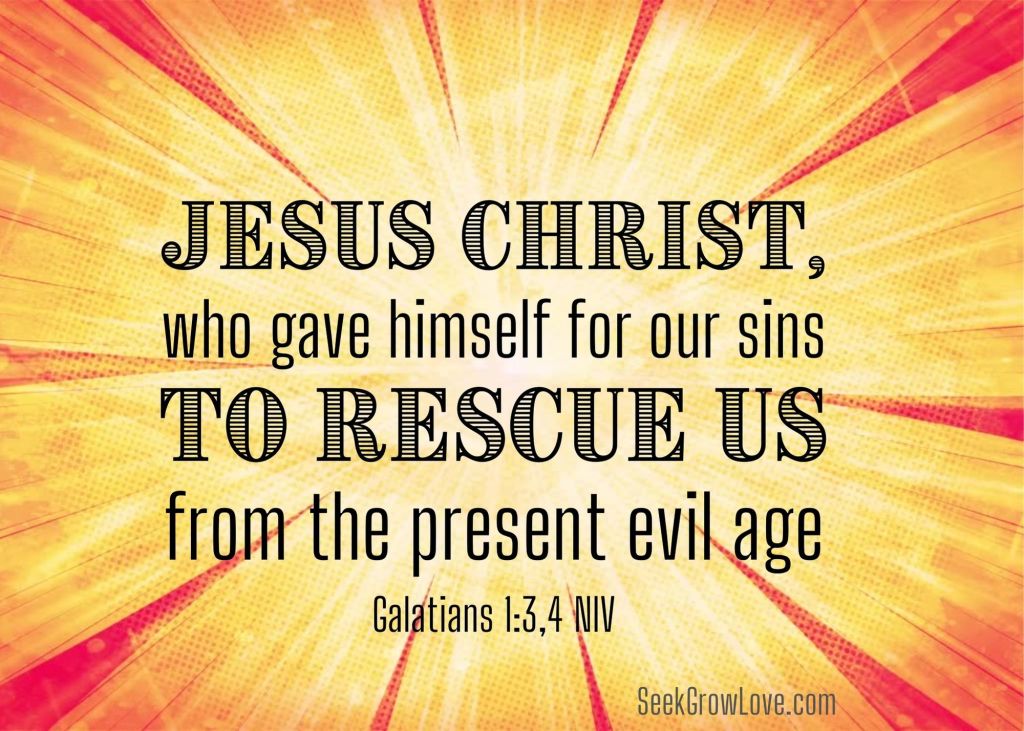
As Paul opens his letter to the Galatians he leads with Jesus Christ, who was raised from the dead by God, the father. God raised Jesus from the dead after Jesus “gave himself for our sins to rescue us from the present evil age.”(Galatians 1:4). There it is, the heart of almost every hero story. This is the story of Jesus, God’s chosen one who gave himself to rescue us from evil. This is not only the overarching story behind Paul’s letter to the Galatians, but it is the big story of the Gospel, the story of the Bible, and the story of life. This is the story that is God’s story, it is history, and we are part of that story. What I just wrote is called a metanarrative. The post-modern worldview which has come to predominate our culture rejects metanarratives which are grand stories that explain the truth in clear terms. There is no place in post-modernism for things like objectivity and universal truth. You have “your truth” and I have “my truth” and “no one should impose their truth on someone else”. Of course, this is not actually practiced by those who preach it and who are working to impose “their truths” on others as if they are right and others are wrong. If you don’t follow “our truth” we will work to get you canceled.
Paul has no patience for those who reject the Truth and listen to the voices of those who are trying to throw the followers of Jesus Christ into confusion by preaching a “different gospel”. I’m sure Paul would have a lot to say about what is happening in our world today. The loss of Truth, of metanarratives or big coherent stories around which we organize our life. As Christians, we are part of God’s Big Story and that story is Truth. Jesus said of himself that he is “the way, the truth, and the life.” The Bible speaks in binary terms: good and evil, right and wrong, light and dark, male and female, lost and found, etc… The evil one has always tried to sow seeds of doubt and contradict such clear thinking. The evil one prefers to operate in the realm of “50 Shades of Gray.” Ever since the serpent tempted Eve by causing her to question and doubt God’s word introducing confusion and chaos into the world, there has been a war on the truth. Jesus told Pontius Pilate “The truth will set you free”. That was true 2000 years ago in Jerusalem, and it is still true today.
Jesus is a True Hero sent by God to rescue us from this “present evil age” which he did by laying down his life for us. That’s a hero worth believing in and following. Let’s not fall for the trendy lies of post-modernism, the lies of the evil one.
-Jeff Fletcher
Questions for Discussion:
1. What is your favorite hero/rescuer story? What is it about that story that you find most appealing/inspiring?
2. How does Jesus as a hero/rescuer stack up against others (fiction or non-fiction)? How can you share the big story about Jesus with others effectively?
After numerous chapters devoted to preparing for the death and subsequent sacrifice of Christ, we finally reach the glorious reward of the Resurrection! Mark chapter 16, compared to the other gospels, is quite sparse in descriptive details of the Resurrection and Ascension of Jesus. However, what it does depict breathes a message of hope and love for the future of the church, as well as a final instruction.
When Mary and Mary were given the message to tell the remaining disciples that Christ had risen, the disciples couldn’t believe it. “When they heard that Jesus was alive and that she had seen him, they did not believe it.” Mark 16:11. In fact, it seems like one of the things the disciples are best at is not believing something until they see it. They did not have faith that the thing they had been listening to Jesus predict for the past several years would come to fruition. Don’t worry because Jesus rebuked them for not believing when he found them again. Do you struggle to believe what Jesus has promised us? Sometimes it’s difficult to imagine a world where we all get along, where there is no longer pain. But without faith, we will never see this world; not because it won’t exist, but because we lack the faith to see it. Have faith!
The final message Jesus gives the disciples is to “Go into all the world and preach the good news to all creation. Whoever believes and is baptized will be saved, but whoever does not believe will be condemned.” Mark 16:15. That is our grand mission! What are you doing today to increase the Kingdom of God? Some of us are not called to verbally preach the word, and some of us are blessed with such a gift. But not being good at public speaking is no excuse to not spread the word.
Actions can speak significantly louder than words. In fact, that’s often the best way to spread the word; by living it out. To speak the message of Christ with empty words whilst living a life completely contrary is almost worse than to have never spoken a word at all. It is by watching the lives of those who follow Christ that we will be living examples of the love he provides us. In your joy, in your struggles, in your sadness, and in your blessings, praise God that you have been given this life to live. Focus on becoming the people that God has instructed us to become and devote your successes to Him. Live your life with the purpose of praising and worshipping Him, and He will reward you. As Christ commands it, do not simply speak the word; live it. Amen
-Mason Kiel
AND
2 witnesses are better than one! Today we have TWO writers for you – so below is your second devotion on Mark 16. Thank you Mason AND Jeff for writing for today. Keep sharing the good good news! Jesus is Alive!
Have you ever been a witness who was called on to testify in court? I have. It was an interesting experience. I had seen a crime committed, I reported it to the police, the criminal was arrested, I was asked to give a written statement to the police and I was later called on to testify at their trial. I will say that when you witness something that causes excitement, gets your heart pounding, and puts you in “fight or flight” mode, it affects your thinking and perspective. Everything seemed to be going faster than it really was. Normally it’s more believable when several people give their eyewitness testimony. Of course, no two witnesses agree on every detail. Each person sees different things from different vantage points. Each person remembers different details. Each person recalls the sequence of events in a slightly different order. These variations in detail are actually normal and good. If every witness testified exactly the same details in the same way the lawyers for the other side would be arguing that they were unreliable because they obviously got together and rehearsed their testimony, which is a big no-no.
When people read the Gospel accounts of Jesus they are seeing the story of Jesus unfold through the eyes of a variety of different witnesses. The Spirit of God is the inspiration behind each of the writers, but God works through human beings and through different witnesses. So it should come as no surprise when we read the four Gospels, Matthew, Mark, Luke, and John, and also the writings of Paul, Peter, James, and others, that while they are telling basically the same story, they do so from different perspectives. The Gospel writers are either reporting what they themselves witnessed or what other eyewitnesses reported to them. They tell the same story with different perspectives and often emphasize different parts of the story or place the events of the story in slightly different orders in keeping with the overall theme of their account. Each story has different audiences in mind, different themes, and is not carbon copies of each other.
One very important rule that is repeated throughout the Bible is that there must be a minimum of two or three witnesses. (See Deuteronomy 19:15, Matthew 18:16, John 8:17, and several other passages). We’ve already noted that there are four Gospel accounts in the New Testament which fulfill that important principle.
It is also interesting to note the background of who is qualified to be a witness. Jewish law has a list of different types of people who are not permitted to be called as witnesses: “women, slaves, minors, lunatics, the deaf, the blind, the wicked, the contemptible, relatives, and the interested parties (Yad, Edut 9:1).” https://www.jewishvirtuallibrary.org/witness . The Talmud, which is a Jewish Commentary from ancient times gives more details about who the “wicked” are who cannot testify. At one point in ancient Jewish history, shepherds were included in the list of people disqualified from witnessing. “As a class, shepherds acquired a bad reputation as being lawless, dishonest, and unreliable, above all because of their habit of trespassing on other people’s lands to graze their flocks.” https://www.churchtimes.co.uk/articles/2015/20-february/regulars/out-of-the-question/shepherds-character-reference.
Here’s what I find very interesting: two categories of people who were not permitted to act as witnesses were shepherds and women. I’m not interested in debating the fairness of those exclusions, but simply note that at the time of Jesus’ birth, life, and death, some of the people who were not accepted as reliable witnesses were shepherds and women. Why is this important? Consider, who were the first eyewitnesses who heard the angelic announcement about the birth of Jesus? Luke says it was “Shepherds living out in the fields keeping watch over their flocks at night” (Luke 2:8). It was to these “unreliable witness” shepherds that the angels appeared. And it was these unreliable witness shepherds who went and reported to Mary and Joseph all that they had seen and then went out and “spread the word” about all that they had seen. (Luke 2:17)
Now, maybe that was just a fluke… but maybe not. In today’s reading, Mark 16, we fast forward to just after the death of Jesus. Who is it who first go to the tomb after Jesus died? Once again, it was to “unreliable witnesses” – this time it was women. To whom did the angel appear announcing that Christ had risen? “Unreliable witness” women. Maybe it wasn’t a fluke after all. Maybe it’s a part of God’s deliberate plan to choose people to be witnesses of these important saving acts of God, which the world normally rejects. Does God choose to reveal His great acts of saving to the lowly people the world rejects? It seems He does. In fact, now that you know to look for it, pay attention when you read the Gospels and notice how many times the witnesses God uses come from the ranks of the supposed “unreliable witnesses.” How many times does God use women, or tax collectors (another category of unreliable witness) or slaves, the blind, the deaf, or just plain sinners to be His witnesses? You’ll find that from beginning to end, the Gospel is filled with “unreliable witnesses” who turn out to be very reliable. And in a giant flip-flop of societal expectations, it is the lawyers and religious professionals from the reliable witness class who are the ones who bring false charges against Jesus.
But the real question that each of us needs to ask ourselves today is, am I a reliable witness for Jesus? Am I willing to tell the truth about what I have seen, heard, and known firsthand about Jesus in my own life? Am I willing to tell “the truth, the whole truth, and nothing but the truth” about Jesus?
-Jeff Fletcher
Questions for Discussion:
Why do you think God chose “unreliable witnesses” to be the witnesses to Jesus’ birth and resurrection and other key events?
When was the last time you told someone else “witnessed” what you have seen, heard, or experienced about Jesus?






 Seek Grow Love