Joy in the City

Nehemiah 11-12 and Psalm 126

(saving Nehemiah 13 for tomorrow)

Devotion by Telva Elwell (SC)

The wall and the gates of Jerusalem had been rebuilt. (Nehemiah 6:15) Leadership and positions of service had been filled. Israelites were moving in to occupy the city of Jerusalem. (Nehemiah 11) The stage was set for a celebration!

It was time!

The dedication of the wall of Jerusalem attracted people to come to Jerusalem to be present for the dedication of the wall of the city.  What a huge crowd that came that day!  The Levites came to celebrate the dedication with gladness, thanksgiving, and singing.  Cymbals, harps, and lyres were played in great celebration.  In addition, singers came from the areas around Jerusalem, and other surrounding areas.  The singers had even built for themselves villages around Jerusalem.  The priests and Levites purified themselves and the people.  All the celebrants were spiritually prepared and excited!  Let the celebration begin! (12:27-30)

Nehemiah then brought the singers and musicians up onto the wall.  What excitement must have stirred through the crowd when they mounted that wall that many thought impossible to rebuild!  The city must have exploded with songs of praise and thanksgiving as Nehemiah instructed one half of the singers to sing songs of praise, accompanied by the blast of trumpets and other instruments created by David, the man of God.   He sent them to march south on the top of the wall, along with Ezra the scribe.  As they marched, they sang loudly with whole hearts overflowing with praise.  Likewise, the second choir was sent to march north on top of the wall, along with Nehemiah.  They sang and worshiped and praised the great God who had done mighty works in Jerusalem.  The two choirs then met at the house of God where they gave thanks and presented sacrifices to their great God. They rejoiced! “For God had made them rejoice with great joy. And the joy of Jerusalem was heard far away.” (v. 43)

One of the Songs of Ascent was probably song.  Psalms 126, one of those songs, has such meaningful words for such an occasion as this:

“When the Lord turned again the captivity of Zion, we were like them that dream. Then was our mouth filled with laughter, and our tongue with singing; then said they among the heathen, The Lord hath done great things for them.  The Lord hath done great things for us; whereof we are glad.  Turn again our captivity, O Lord, as the streams in the south.  They that sow in tears shall reap in joy.  He that goeth forth and weepeth, bearing precious seed, shall doubtless come again with rejoicing, bringing his sheaves with him.”

Yes, the joy of Jerusalem was heard far away, but how that joy must have stung for some.

Throughout the celebration of praise and thanksgiving to God, this message was being seen and heard by those outside the congregation of the Israelites.  There were a few familiar faces and names of people among the foreigners who probably wanted to hide in embarrassment.  And it was all because of the completion of the work at Jerusalem on the 25th day of Elle (6:15).  “All the nations around us were afraid and fell greatly in their own esteem, for they perceived that this work had been accomplished with the help of our God” (6:16).  Even their enemies and naysayers believed that what they were hearing with their ears and seeing with their eyes, was indeed proof positive that God was with Jerusalem and that He had caused the wall and gates of the city of Jerusalem to be restored! (Ps. 126:2)

Flash back several weeks earlier when word spread throughout the region that the wall was being rebuilt. Sanballat and Tobiah were up to their mischief trying to discourage and hinder the work of the Jews in rebuilding the wall.  They teased; can these feeble old Jewish men even build these walls themselves?  Will they sacrifice? They knew it would take more than a few prayers to rebuild the wall.  Could they even finish it?  They laughed at the materials they were using, calling the stones rubbish, because they were broken and burnt.  They jeered, “How could anyone build anything out of trash?” (4:2) And yet, they built it!  There it stood on this great day of dedication after its completion. So, with God even feeble old men can accomplish great things!  Yes, they were able to finish the wall with God’s help!  Even burnt stone dug from the rubble could become a strong wall!  Sanballat and Tobiah probably heard the praise, the trumpet blasts, the loud songs of worship that day and cringed. But what may have been worse was seeing the wall standing strong, and the people standing strong and thankful upon that wall—that very wall that Tobiah declared would fall in a heap if even one fox went up on to the wall. (4:3). This was just what Nehemiah prayed to God to do…to “turn their taunt on their own heads” (4:4). What a testimony to God and the power of prayer!   Now a multitude of people stood upon the wall and sang out praises to the One true God for the whole world to hear!

What are you doing to make sure that your wall stays strong, and that songs of praise to the One true God can be heard in your part of the world?

Reflection Questions

  1. What is praise?  How important is expressing praise in your prayers to God?  What things do you praise God for?  Is there a relationship between expressing praise to God and feeling joy in your life?
  2. What is the difference between praise and thanks?  Or are they the same thing? Do you share your thanksgiving and praise with others?
  3. What did Paul mean when he said, “In all things give thanks?  (1 Thess. 5:18) Does giving thanks remove fear and worry from your life? How do you incorporate giving thanks in your life when you feel overtaken and undone by loss or grief?

God’s Promises are Sure

Ezra 1-3

Devotion by Sherry Alcumbrack (South Carolina)

Isaiah 14:24 says: The Lord Almighty has sworn, “Surely, as I have planned, so it will be, and as I have purposed, so it will happen.”

In the first chapter of Ezra it says that God stirred the heart of King Cyrus to fulfill a prophecy of Jeremiah that they would be exiled for seventy years and after this time they would be allowed to return to Jerusalem. See Jeremiah 25:11-12, 29:10.

In Isaiah 44-45, it names King Cyrus over a century before he was born. It is amazing to see how God chooses to work, here he is using a pagan king to fulfill his prophesies. King Cyrus sent out a proclamation that “the Lord, the God of heaven” had appointed him to rebuild His house in Jerusalem. Ezra Chapter 1 v.3 says “Whoever there is among you of all His people, may his God be with him! Go up to Jerusalem which is in Judah and rebuild the house of the Lord, the God of Israel; He is the God who is in Jerusalem.”

Then, he told all the survivors to support them with silver, gold, or other valuables. Everyone had a part in the rebuilding of the temple even if they were not actually doing the building. We all have a part in ministry, it may be supporting those that are doing the work, but that is an important and much needed part of any ministry. King Cyrus also brought back the vessels from the first temple that Nebuchadnezzar had taken and restored them to their rightful place.

These people had been taken into captivity when Babylon had taken over, now they are given a chance to return and chapter 2 lists the people and the families that they represent who came back. In 2:68-69a “Some of the heads of fathers’ households, when they arrived at the house of the Lord which is in Jerusalem, offered willingly for the house of God to erect it on its site. According to their ability they gave to the treasury…”   The identity of the Jewish people as the people of God was tied up in the temple, where the presence of the Lord dwelt. The Jewish people were devastated by the destruction of the first temple in 586 BC. They were filled with despair and a loss of hope. With the chance to rebuild the temple, the people gained some of their hope back. Their national pride began to come back. In the seventh month after the return, the Levites built an altar to God so that they could offer burnt offerings on it. This was important to them to show obedience to the Law of Moses. It was also an important act of worship to God. They were terrified of the people around them, and they wanted the protection of God to surround them. They reinstated the offerings and the festivals even before the foundation for the temple had been laid, because they wanted to restore their worship to God. The people were excited to build the temple again, to have a place where God would dwell, and where they could go to worship Him.

When the foundation was laid, it says in chap 3 v. 10b-11a “they praised the Lord according to the directions of King David of Israel.”  “And they sang, praising and giving thanks to the Lord, saying, ’God He is good, for His lovingkindness is upon Israel forever.” They shouted and wept in celebration and it says it was heard far away.

Just as God used people in the Old and New Testament to carry out his purposes, he also uses us for His purpose. Ephesians 2:10 “For we are His workmanship, created in Christ Jesus for good works, which God prepared beforehand so that we would walk in them.” Also, Philippians 2:13 “For it is God who is at work in you, both to desire and to work for His good pleasure.” God is working with us and using us to bring about his promises. We can rest in the knowledge that whatever He has planned for us to do, he will give us the means to fulfill it.

Questions for Reflection:

  1. Describe the thoughts and feelings the Jews may have felt as they heard King Cyrus’ proclamation of Ezra 1:2-4. And, also, as they entered Jerusalem?
  2. In what ways have you been a part of a ministry planned by God and much larger than yourself?
  3. “We can rest in the knowledge that whatever He has planned for us to do, he will give us the means to fulfill it.” – How have you already seen this to be true in your own life? What might God have prepared for you to do next? How has He already prepared you for it? What means are being put in place?

Hope in the Middle of the Ruins

Lamentations 3-5

Devotion by Dustin Farr (South Carolina)

The book of Lamentations is heavy. It is a raw, unfiltered look at grief. Jerusalem has fallen, the temple is destroyed, and the people are either dead, exiled, or living in deep suffering. The city walls have been torn down, homes burned, leaders captured, and the streets are empty. Hunger, fear, and loss have touched every household, and the once-proud city is now a place of desolation. Every chapter is filled with heartbreak, and the writer doesn’t shy away from addressing the pain.

But this is more than just a story of destruction. It’s an honest record of what it looks like when life falls apart. When the consequences of sin, both personal and collective, are unavoidable. The people knew God’s commands, and they chose to break them. Now they are living with the fallout, and it’s not pretty.

What stands out is how Lamentations holds both grief and hope at the same time. In chapter 3, right in the middle of all the sorrow, comes this anchor: “The steadfast love of the LORD never ceases; his mercies never come to an end; they are new every morning; great is your faithfulness” (Lamentations 3:22–23). It’s not spoken after things get better. It’s spoken in the middle of the storm. That’s what makes it powerful for us. We all face seasons that feel like ruins, and the truth is, they do not always get better. Our faith cannot rest on whether life is comfortable or whether blessings are obvious. It has to be steady, no matter the circumstances. Like Job, who said, “The LORD gave and the LORD has taken away; may the name of the LORD be praised” (Job 1:21), we are called to worship God whether life is full or stripped bare. The struggle may not lift quickly, but we can rest in the salvation we have through Christ and in knowing that our God is a Redeemer. Even when we cannot yet see it, He is at work.

Lamentations reminds us that it’s okay to be honest about our pain, but it also calls us to cling to God’s character in the middle of it. His faithfulness isn’t proven by how quickly He fixes things, but by His presence and unchanging promises even while we wait.

Reflection Questions

  1. Lamentations shows the people facing the full weight of their choices. How does acknowledging the reality of your own situation, without excuses, change the way you pray?
  2. The writer of Lamentations keeps talking to God even when he feels unheard. How can you practice staying in conversation with God when your prayers seem unanswered? 
  3. The book ends without a neat resolution, yet with eyes still turned toward God. How can you hold on to hope when you have no guarantee of when or how God will act?

(Thank you, Dustin Farr, for writing this week! Dustin is a first-time writer for SeekGrowLove and we look forward to hearing more from him. He is a recent Graphic Design graduate.)

God Shows Us His Love and Mercy

12/15/24

OLD TESTAMENT: Zechariah 1-2

POETRY: Psalm 143

NEW TESTAMENT: John 16:17-33

Zechariah 1:16-17(NLT) “‘Therefore, this is what the LORD says: I have returned to show mercy to Jerusalem. My Temple will be rebuilt, says the LORD of Heaven’s Armies, and measurements will be taken for the reconstruction of Jerusalem.’ 17 “Say this also: ‘This is what the LORD of Heaven’s Armies says: The towns of Israel will again overflow with prosperity, and the LORD will again comfort Zion and choose Jerusalem as his own.’”

Psalms 143:7-11(NLT) Come quickly, LORD, and answer me,
for my depression deepens.
Don’t turn away from me,
or I will die.
8 Let me hear of your unfailing love each morning,
for I am trusting you.
Show me where to walk,
for I give myself to you.
9 Rescue me from my enemies, LORD;
I run to you to hide me.
10 Teach me to do your will,
for you are my God.
May your gracious Spirit lead me forward
on a firm footing.
11 For the glory of your name, O LORD, preserve my life.
Because of your faithfulness, bring me out of this distress.

John 16:17-24 (NLT) Some of the disciples asked each other, “What does he mean when he says, ‘In a little while you won’t see me, but then you will see me,’ and ‘I am going to the Father’? 18 And what does he mean by ‘a little while’? We don’t understand.” 19 Jesus realized they wanted to ask him about it, so he said, “Are you asking yourselves what I meant? I said in a little while you won’t see me, but a little while after that you will see me again. 20 I tell you the truth, you will weep and mourn over what is going to happen to me, but the world will rejoice. You will grieve, but your grief will suddenly turn to wonderful joy. 21 It will be like a woman suffering the pains of labor. When her child is born, her anguish gives way to joy because she has brought a new baby into the world. 22 So you have sorrow now, but I will see you again; then you will rejoice, and no one can rob you of that joy. 23 At that time you won’t need to ask me for anything. I tell you the truth, you will ask the Father directly, and he will grant your request because you use my name. 24 You haven’t done this before. Ask, using my name, and you will receive, and you will have abundant joy.

How many times do we think to ourselves “I wish I could ask Jesus about what he said in a passage?”. Here in John 16 Jesus sees that question in the hearts of his disciples without them even asking.  He then answers that question of their hearts. 

I was able to witness the birth of all four of our children who are now in their 30’s and 40’s.  I was a participant in the event, Lamaze called me a coach, but really the events were all focused on the effort it took my wife Sandy to birth the children.  Labor for her started many hours before the actual birth event.  The start of the contractions was usually strong but the effort and pain at the end when the child is birthed became almost overwhelming for her.  Thanks be to God that she is so tough and resilient that all were born without complications and were beautiful children when born.  The intensity of the birth process is still embedded in my mind forever.

Jesus tells the disciples about the events that are going to occur in the near future for all of them.  God has showed Christ by the Old Testament scriptures and by revelation what he will have to endure.  Jesus compares these events to the birth of a child, where the pain and effort are replaced in the end by the joy of the new child and her or his coming into the world.  My wife and I had great joy at the birth of the children when we were able to hold them in our arms and enjoy the blessing of the new child.

Jesus tells the disciples that in the future they will rejoice about the events of the cross.  Jesus sees and knows what’s coming for him, but they do not yet at this time understand.  But he is getting them ready for the future message of hope that will come from the resurrection and the ascension.  This leads to the day of Pentecost and the founding of the church of the body of Christ. 

Zechariah 1:16-17 (NLT)

Therefore, this is what the LORD says: I have returned to show mercy to Jerusalem. My Temple will be rebuilt, says the LORD of Heaven’s Armies, and measurements will be taken for the reconstruction of Jerusalem.’ 17 “Say this also: ‘This is what the LORD of Heaven’s Armies says: The towns of Israel will again overflow with prosperity, and the LORD will again comfort Zion and choose Jerusalem as his own.’”

As we read through Zechariah it will become clear to us that the visions he sees about the building and construction that God shows him are immediately fulfilled in the physical rebuilding of Jerusalem and the temple. The books of Nehemiah and Ezra give us the history of this rebuilding.  But the really big picture is of the future building of the millennial kingdom and the city of Jerusalem by the Messiah.  As we read through Zechariah try to look at the immediate fulfilling of his prophecies, but more importantly look at how they fit together at the end of the Tribulation and the establishment of the Millennial kingdom.  The judgement of wrath which judges Israel and Judah are turned to the great blessings of all the promises to Israel fulfilled in the righteous kingdom.  Jesus Christ is the head of both government and religion in this future rulership.  Almost all prophecy has a near fulfillment and then a future truth of God’s promises.  As you read Zechariah and the words from Psalms and John this week look for the immediate fulfillment but more importantly see the message that God shows of the future.

-Tom Siderius

Reflection Questions:

What are the great anticipations of your heart for your life?

How does our hope in Christ grow as we live today but look forward to the fulfillment of prophecy?

Jerusalem

OLD TESTAMENT: Ezekiel 18-20

POETRY: Psalm 122

NEW TESTAMENT: John 1:1-18

On October 7, 2023, Hamas launched a sneak attack on Israel.  Nearly 1200 Israelis were killed.  251 Israelis and foreigners were taken captive and held hostage by Hamas.

This was not the first time Israel had been the victim of an attack and taken captive by enemies.  They were enslaved by the Egyptians thousands of years ago.  They were taken into exile by the Babylonians nearly 3000 years ago.  They were attacked and occupied by the Romans and their Temple was destroyed and they went into the diaspora almost 2000 years ago.  They were victims of the Holocaust nearly 100 years ago when nearly 6 million Jews were murdered in gas chambers.

Psalm 122 was one of many Psalms that were prayed by the Jewish people during many of these numerous times of attack and war.   

Psalm 122. A song of ascents. Of David.

I rejoiced with those who said to me,
    “Let us go to the house of the Lord.”

Our feet are standing
    in your gates, Jerusalem.

Jerusalem is built like a city
    that is closely compacted together.

That is where the tribes go up—
    the tribes of the Lord—
to praise the name of the Lord
    according to the statute given to Israel.

There stand the thrones for judgment,
    the thrones of the house of David.

Pray for the peace of Jerusalem:
    “May those who love you be secure.

May there be peace within your walls
    and security within your citadels.”

For the sake of my family and friends,
    I will say, “Peace be within you.”

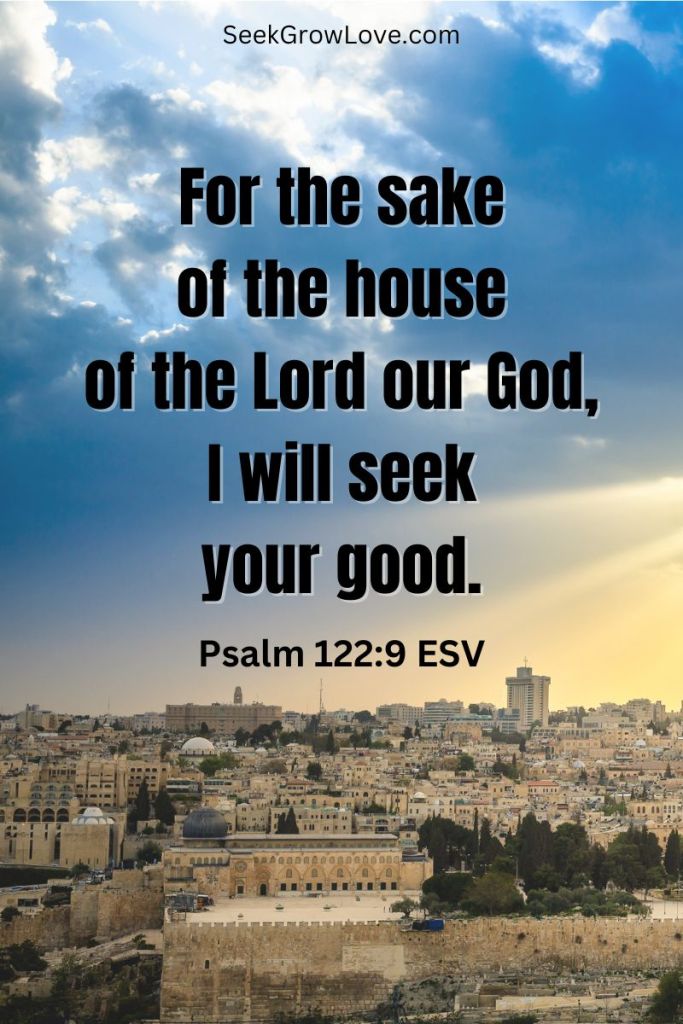
For the sake of the house of the Lord our God,
    I will seek your prosperity.

This Psalm is a prayer for peace in Jerusalem.  It is a prayer that God’s people will live in security and protection.  Today we pray for the Peace of Jerusalem.  True and lasting peace will not come to Jerusalem until the Messiah, God’s anointed King, our savior Jesus Christ returns.  When Jesus returns there will be Peace in Jerusalem and eventually Peace on earth in God’s Kingdom.

Let us continue to pray for the peace of Jerusalem.  Let us pray for the release of those being held captive.

Pastor Jeff Fletcher

Reflection Questions

  1. Compare and contrast Jerusalem, including it’s history and current situation, to that of the New Jerusalem we recently read about in the final chapters of Revelation. What causes the differences and the similarities?
  2. How often do you pray for the peace of Jerusalem? Would adding a visual reminder to your home or device help you remember?
  3. How might you be able to seek the good and prosperity of Jerusalem?
  4. How often do you pray for the coming of the New Jerusalem and pray for its occupants, that those you know will be ready – recognized as the people of God, wearing white and not left outside?

Steadfast

Old Testament: Joshua 15 & 16

Poetry: Psalm 51

New Testament: 1 Corinthians 7

In today’s readings, again we find ourselves in Psalm 51, and while I’m not going to write about it all 6 days we will be reading it, based on some commentaries I’ve read, there are definitely those who could!

It’s hard for me to read Psalm 51:10-11 and not find myself humming the chorus you may also know, “Create in me a clean hea-a-art, o-o-o, God, and renew a right spirit within me. . .”  What I thought was interesting though was that reading along in my ESV, the words matched up exactly to the song I knew so I was absolutely stuck with the music running through my head.  The next time I read it I must have used NASB when I stumbled into “renew a steadfast spirit within me” which is when I realized Keith Green apparently didn’t use that version, it added a syllable, and threw me off! Different versions use different words, fine and dandy. But, I realized I just didn’t equate “steadfast” with “right” in my use of the words. It makes sense reading either one in the Psalm, but it led me to do a bit more of a word study I found interesting.

The word “steadfast” (or “right”) in verse 10 is used approximately 217 times in the Bible, but the only place it is translated steadfast is 6 times in the book of Psalms. Other translations of this word throughout scripture include: made ready, established, set, formed, reliable, trustworthy.  This helped me get a better grasp on the desirable type of spirit David was asking God to renew in him.

I also really liked how David wished to use his experiences of sin/guilt/repentance to help others and bring God glory as we see in verses 13-14. I am grateful David’s testimony lasted the centuries, and grateful for the testimonies I have heard in people throughout my life as well. We know as a society even from a more medical/psychological perspective that guilt and shame are two incredibly destructive emotions for mental and physical health for those of any age. Top of the list kind of emotions selected for those struggling with severe depression, suicidal thoughts, and other health problems. When we are stuck in a pattern of guilt and shame or know others stuck in that pattern, we need a sovereign God with a perfect plan of forgiveness and reconciliation to help just like David did. As we experience life including its mistakes and wrongs, like David, we want to share the mercy and hope we have been given with others in our lives.

As Psalm 51 ends, we see reference to Zion and the walls of Jerusalem prospering. It seems historically there have been some varying interpretations from theologians/commentators on these last two verses. Some hold the belief that just these two verses were added later during the time in exile after Jerusalem had been destroyed, and others suggest they were more prophetic words of David. Regardless of who wrote them and when they were written, I like that the Psalm ends with a tie to Jerusalem. A city that will continue to be in our news it seems throughout our lifetimes, and a hope of a New Jerusalem one day where there will not be sin, tears, pain, sorrow.  Until then, may we seek to be restored and upheld like Psalm 51 so beautifully describes.

Create in me a clean heart, O God,

and renew a right spirit within me.

                Cast me not away from your presence,

and take not your Holy Spirit from me.

                Restore to me the joy of your salvation,

and uphold me with a willing spirit.

 The Holy Bible: English Standard Version (Wheaton, IL: Crossway Bibles, 2016), Ps 51:10

-Jennifer Hall

Reflection Questions

  1. What can you learn from David’s Psalm 51 about sin, confession and repentance?
  2. What effects have you seen, including in your own life, of guilt and shame?
  3. How has David’s example helped you? How can you be an example to others in the way you respond to sin in your own life?

Who is Like the Lord?

Micah 1-2

Have you ever wondered, “what’s so special about Jerusalem?”

I mean, think about it. Maybe look at a map. That area has been hotly contested by kingdoms, empires, nations, world religions, and people groups since the dawn of time. Why? The reason for each group is a little different, but practically speaking, it’s the only strip of land that connects Europe, Asia, and Africa all together. Everything around it is pure desert. 

So Israel, since the days of Moses, has been an impossibly small tribe in an ocean of military conquests and empires. Over and over again, though, God had protected Israel and preserved their residence in the top real estate of the ancient world.

Until the days of Micah.

During the time of the Old Testament minor prophets, Israel had walked away from God and His protection. The northern half of the kingdom (which split off from Judah, the southern half)) was about to be destroyed by the kingdom of Assyria. Micah was pleading with his countrymen to return back to God and His protection before they fell to a similar fate.

Micah means “Who is like the LORD?” and his name fits the theme of his message perfectly. Chapter 1 is a call for Judah to start mourning for the fate that is sure to befall them. It’s also a reminder that all of this will happen because they turned away from their covenant to God (see our discussion on Amos 5 earlier this week). 

In chapter 2, Micah goes on and on about the many ways that his country has totally forgotten about their God. My favorite verse in this section is 2:7b: “Do not my words do good to him who walks uprightly?” In other words, God asks Judah, “if you were following my Word, wouldn’t you be so much better off?” And this is the lesson for the reader today: God’s Word is beautiful and practical. We don’t just learn about God in His words! We also find life, love and contentment in God’s words!

-Levi Salyers

Read or listen to today’s Bible Reading Plan passages at BibleGateway.com here – Micah 1-2 and Revelation 8

Just One

Jeremiah 5-6;  Psalm 94-95

          There’s a story in Genesis 18 that is kind of amusing to me (and also tragic).  After God promised Abraham that he and Sarah would have a son in their old age he basically tells Abraham, “I’m going to go destroy Sodom and Gomorrah because of their great sin.”  That’s not the part that’s amusing.  Abraham knows that his nephew Lot and his family are living in Sodom and Gomorrah and he’s trying to persuade God not to destroy the whole city.  “What about the good people in Sodom? Are you going to kill them along with all the bad people?  What if there are 50 good people in Sodom, will you spare the city?”  God agrees with Abraham’s request, “If you can find 50 good people in Sodom I won’t destroy it.”  This is the part that I find amusing… Abraham starts to negotiate with God in the way someone might try to negotiate buying a used car. “What about 45 good people?”  God says “Ok, I won’t destroy it for 45 good people.”  Abraham keeps negotiating until he talks God down to 10.  If there are only 10 good people to be found in Sodom, God will not destroy it.  (Abraham is one fine negotiator)

          Sodom is so bad it can’t even reach that low bar.  God rescues Lot and his 2 daughters and everyone else dies (including Lot’s wife who turned back and became a pillar of salt.)

          In today’s reading we’re not in Sodom, we’re in Jerusalem.  Jerusalem, the city of God where the Temple and all its priests and religious leaders worked.  Jerusalem, where the King and all his government served.  You would think that with all of these important leaders of religion and government there would be lots of good people in Jerusalem, and you would be wrong.  In Jeremiah 5 God says:

          “Go up and down the streets of Jerusalem,
    look around and consider,
    search through her squares.
If you can find but one person
    who deals honestly and seeks the truth,
    I will forgive this city.”

          When I was a kid, back when music was great, Three Dog Night had a song called “One is the Loneliest Number”.  (Go ahead, if you’re under 50 go check out the song on You Tube, I’ll wait).

          Welcome back!  God is making an offer even better than the one he made to Abraham about Sodom.  1.  If you can find just one person in Jerusalem that is honest and seeks the truth, he will forgive the whole city.  That would be like today God saying “Go to Washington DC.  If you can find one honest person in the whole city, I’ll spare the city.”  Well, maybe we can imagine that.  So apparently Jerusalem was Washington DC level corrupt.  Now, with politicians we can kind of get it.  But this was also the religious leaders, the priests and heads of religion.  Surely they were all honest seekers of truth, right? (No, I’m not biased even though I’ve been a professional clergy for the entirety of my adult life, over 35 years).  Come to think of it…. “Houston, we have a problem.”

          There was not a king nor a priest nor anyone else who was righteous or cared about the truth.  And so Jerusalem was toast.

          But here’s the good news.  God sent His son, Jesus, to Jerusalem.  He was the one true and righteous king.  He was the one priest who cared about truth.  Of course, they killed him, but God raised him.  And Jesus is the only way that we can find salvation. He is our righteous messiah and holy high priest. (See Hebrews).

          Jeremiah paints a painful but honest picture of the brokenness of human beings.  It helps set the stage for Jesus as the true and only one able to save us.  Keep this in mind as you read Jeremiah 5-6 today.  It was bad, it may get badder, but one day all will be well again.

          I will end with a portion of Psalm 95 “Today, if only you would hear his voice, Do not harden your hearts…”  Seriously, don’t harden your heart, let Jesus in.

Jeff Fletcher

Today’s Bible reading passages can be read or listened to at BibleGateway.com hereJeremiah 5-6 and Psalm 94-95

Which Will You Be?

Isaiah 21-22 and Colossians 4

Today we are going to look at two different groups of God’s people: those in Jerusalem at the time of Isaiah’s writing and those in Colosse at the time of Paul’s writing. Which will you be?

In many of the previous chapters of the book of Isaiah we read about God’s coming judgments on Israel and Judah’s neighbors and sometimes her enemies. It’s not all bad reading what disasters are coming to your wicked neighbors. Yay, God! Go get em! Show em who’s boss! But, it gets downright personal in chapter 22 as the prophecies of judgment and doom now center on Jerusalem, God’s Holy City. What did they do to deserve this? Well, much. Other scriptures tell of Jerusalem’s idol worship and shedding of innocent blood and even sacrificing their own children. But specifically in Isaiah 22 we are told of their pride and arrogance, their celebrations and their disregard for God. When they saw danger on the horizon they did everything in their own power to protect themselves, including tearing down houses to strengthen the wall and building reservoirs. “But, you did not look to the One who made it, or have regard for the One who planned it long ago” (Isaiah 22:11 NIV). What would have changed if they had only called out to God for help?

God was waiting for His people to seek Him, to turn to Him, to cry out to Him, to confess and mourn and repent. But, instead, they were too busy. Busy with their preparations to save themselves. Busy with their sins. Busy with their celebrations and feasting and misplaced joy. Busy in their “town full of commotion…city of tumult and revelry.” (Isaiah 22:2 NIV).

They had abandoned God first. He was still calling out to them on that day (Isaiah 22:12). But, they were busy. They drowned out the sound of God’s voice with their sinful busy-ness and celebrations. So, His holy and righteous judgement was coming.

Contrast this tragic picture with what we read in Colossians 4 as Paul is closing out his letter to the church in Colosse with his final instructions and greetings. He urges the church, “Devote yourselves to prayer, being watchful and thankful” (Colossians 4:2 NIV). And, while he’s got the people praying – he says pray for me, too. Paul requests prayers for open doors (not to physically get out of house arrests, but open doors to reach more people), for opportunities to proclaim Christ and for clear communication in his ministry. And further on, I love his description of Epaphras, “a servant of Jesus Christ…He is always wrestling in prayer for you, that you may stand firm in all the will of God, mature and and fully assured” (Colossians 4:12 NIV). These people are busy, too – in prayer – in seeking God and in ministry . They are praying for their spiritual leaders and churches and those who will hear God’s message, and asking for prayer. Rather than ignoring God and drowning out His voice, they are seeking God regularly and whole-heartedly, coming to Him in prayer, always desiring to do more for Him and His Son.

Which group are you more like today?

Do you have see any similarities between yourself and God’s people in Jerusalem? Are you surrounded with so much commotion that you miss God’s voice calling out to you? Is he asking you to mourn when you are busy celebrating and feasting? Are you so caught up in your self-preservation preparations that you have neglected to call out to God? Do you rely on yourself instead of on God? When you see trouble coming do you invest time in creating a longer to-do list, throw a party, or fall to your knees before God? What would be different in your life and in your community if you called on Him in prayer instead of trying to do it your own way?

Do you see any similarities between yourself and God’s people in Colosse? Are you devoted to prayer, being watchful and thankful? Are you praying for open doors – not to get ahead or out of a jam – but to advance God’s gospel message? Are you busy praying for your Christian brothers and sisters and leaders and missionaries? Are you asking others to pray for your ministry? What would it look like if you spent time today wrestling in prayer?

Praying for you today – to Stand Firm in God’s Will, mature and fully assured

-Marcia Railton

Read or listen to today’s Bible reading plan passages at BibleGateway here – Isaiah 21-22 and Colossians 4

Be A Witness

Acts 1-3

If you have been following along with the SeekGrowLove devotions for the past 1.5 months, we have been able to take a look at the life and ministry of Jesus through the four gospels.  What a crazy, action-packed time during Jesus’ ministry on earth.  Today, we transition into the book of Acts, and we get to see how Jesus’ disciples will respond to these couple crazy years with Jesus.  As we near the end of 2020, we are all too familiar of what it looks like to live through some crazy events.  As we read through the book of Acts, we can take some notes of how Peter, Paul, and others responded to the crazy events revolving around Jesus.

Before Jesus ever ascended to heaven (yep, not even Jesus went to heaven right after his death), he spent 40 days preaching about the Kingdom of God.  Right before Jesus’ ascension, he told his disciples to, “Witness in Jerusalem and in all Judea and Samaria, and to the end of the earth,” (Acts 1:8). 

The order of locations that Jesus provides is important.  He starts off with Jerusalem; Jerusalem was basically the home base for the Jews and early Christians.  They first needed to witness to their home base of Jerusalem.  Then, they needed to witness in Judea and Samaria; that consists of the land surrounding the city of Jerusalem.  After they have witnessed to the surrounding area, then they had a calling to witness to the ends of the earth.  The book of Acts follows this exact blueprint, which I find to be so fascinating.  Chapters 1-7 are all witnessing in Jerusalem.  Chapters 8-9 consists of them witnessing in Judea and Samaria.  Then, chapters 10-28 cover the disciples, Paul, and others witnessing to the ends of the earth: Caesarea, Antioch, Asia Minor, Greece, and Rome.

We can learn a lot from this blueprint that Jesus provided for his disciples.  We have a calling to witness to those right around us, whether that be your family, friends, coworkers, etc.  Studies show that the most effective mode of evangelism is relational evangelism.  We are best able to spread the news to people we have a relationship with.  Are you using your relationships with nonbelievers, as an instrument to spread the gospel message of the Kingdom?  When you have spread the gospel message to those around you, are you helping that message be spread throughout the ends of the earth?  We have better capabilities now than ever to spread the gospel message to the ends of the earth.  Let’s take advantage of those capabilities.

We can’t go through Acts 1-3 and not mention Peter’s killer sermon in chapter 2.  It is truly one of my favorite sermons ever recorded.  Peter absolutely brings it to the Jews.  You can feel his passion for his Lord and Savior in this message, and he shares this passion with the Jews, the same people who had him crucified (as Peter so gracefully informs them)!  If you want to see someone who is on fire for God and his son, Jesus, then look no further than Peter’s message here in Acts chapter 2.  I hope and pray that we can reflect this passion in our lives today.

I look forward to covering the first half of Acts with you all.  It’s my prayer that we can all learn from the wonderful examples of Peter, Paul, and others throughout this wonderful book.  Witness to those around you, and then help spread that message to the ends of the earth!

-Kyle McClain

Today’s Bible reading passage can be read or listened to at BibleGateway here – Acts 1-3.

Tomorrow we continue this exciting book, with Acts 4-6. Now’s a great time to jump on board and finish 2020 strong with a daily reading of God’s Word as we watch to see how the world responds to the life, teaching, death and resurrection of God’s Son, Jesus. Let’s get ready for his return!