The Eternal Rock

Isaiah 13-17

Isaiah 13-17 is a series of prophetic messages of judgment and warning given to the nations surrounding Judah. These chapters out of Isaiah are fairly harsh at first glance, filled with pronouncements of destruction and wrath. However, there’s a deeper trend running through them: God is not just the God of Israel. He is the God of all nations and all the Earth. 

In Isaiah 13-14, Babylon, a powerful and arrogant empire, is judged for its pride and cruelty. God promises to bring it low. In Isaiah 15-16, Moab weeps and wails as its strength fails. In Isaiah 17, Damascus and Ephraim (the northern kingdom of Israel) face ruin because they have forgotten their God in turn for idols. 

Over and over, Isaiah reveals that every nation, every empire, and every people group is accountable to God. No political power, cultural tradition, or military strength can protect a nation from the consequences of pride, injustice, and idolatry.

But there’s hope, too. Mixed into the warnings is the idea that God’s justice is not random or cruel-it’s righteous and serves a purpose. His discipline often carries a redemptive purpose. Nations fall, but God remains. Pride crumbles, but God’s kingdom stands. We must then reflect on our own senses of self. Are we keeping the statutes of the Lord instead of those of the world? Do we carry ourselves in humility? Do we anchor ourselves with the Eternal Rock and the fortress of God? In the end the control belongs not with us, but with God. He is our refuge. 

I close today’s devotion with Isaiah 16:5, a verse that reminds us what will one day replace a world so wicked and so unjust:

“In love a throne will be established; in faithfulness a man will sit on it— one from the house of David— one who in judging seeks justice and speeds the cause of righteousness.” (‭‭Isaiah‬ ‭16‬:‭5‬ ‭NIV‬‬)

-Colby Leggitt

Reflection Questions

  1. After reading the chapters (Isaiah 13-17), what stood out to you most from Isaiah’s prophecies to the nations?
  2. Why do you think pride is such a significant theme in God’s judgment of nations like Babylon and Moab?
  3. In what ways are you tempted to rely on your own strength instead of relying on the Eternal Rock?

Warning, Mourning and a Whisper of Grace

Micah 1-3

Like many times in history, Israel had to be confronted by a prophet who had a message from God that wasn’t savory. That is, in times of comfort, complacency, and wickedness they would find that they were not walking with the Lord. In Micah 1-3, Micah speaks for the Lord and completely rebukes the state of Israel and the leaders that allow for it to be in the state it is. Their morals have been corrupted, their path is unjust, and they have implemented idols again into their nation. 

The themes from previous days’ devotions persist here. Violent imagery and a great lament is detailed in Micah 1-3 as he warns and mourns the judgement that is to come. The imagery from Micah 3:1-4 is especially fiery and vivid to the imagination as Micah rebukes the leaders of Israel. To pile onto the agony being described, Micah also details that God will be separated from those in religious authority in Israel in Micah 3:7:

“The seers will be ashamed

    and the diviners disgraced.

They will all cover their faces

    because there is no answer from God.”

With this, we must reflect on our own lives. In a position of leadership, we must set an example. James 3 echoes this idea of the judgement that will be faced by those who teach and lead those astray. If we are to act as examples for others, we must also walk in the ways of the Lord. Micah is clear with this striking message: where in our lives have we settled for religiosity without righteousness? Comfort without compassion?

God’s heart breaks over injustice. He doesn’t just call it out. He promises to act. That’s a sobering reminder: God cares too much to remain silent in the face of oppression. However, tucked inside Micah’s warnings is a whisper of grace: “I will surely gather the remnant…” (Micah 2:12). God’s judgment is never the end of the story. Even as He tears down, He is preparing to build again. On that foundation, with that remnant, he will build on principles of humility, justice, and faith.

-Colby Leggitt

Discussion Questions

1. Where in your life or community do you see injustice that needs to be addressed?

2.Are there areas where you’ve grown comfortable with compromise or overlooked truth?

3. How can you walk more humbly and live more justly today?

Order Your Way

2 Chronicles 27, Isaiah 9-12

“Jotham grew powerful because he walked steadfastly before the Lord his God” (2 Chronicles 27:6). 

Jotham could be considered to be an overlooked person in the Bible, but his accomplishments and example were great. He was young when he ascended to his position as a king: only 25 years old! However, at that point he had the spiritual maturity to humble himself before God unlike those around him. Because of that, he made a quiet yet profound impact on Israel during his reign (not to mention conquering the Ammonites). 

We will take this example and then examine Isaiah 9-11. Here, we find once again that wrath will be upon the wicked in the form of judgement from God. The language in these chapters do not spare us from imagery of fire and death. These seem to allude to a judgement of the wicked that has not come completely to pass just yet. 

Speaking of not coming to pass yet, prophet Isaiah in Isaiah 11 makes allusions to the (then) coming messiah: Jesus Christ. “In that day the Root of Jesse will stand as a banner for the peoples; the nations will rally to him, and his resting place will be glorious” (Isaiah 11:10). The root of Jesse spoken in this chapter is Jesus as he is in fact a descendant of Jesse according to the genealogy found in Luke 3. Here, we have a much more hopeful note to look to after the judgement that must pass. Importantly, that remnant that he will gather up is foretold in Isaiah 10:20.

 “In that day the remnant of Israel,

    the survivors of Jacob,

will no longer rely on him

    who struck them down

but will truly rely on the Lord,

    the Holy One of Israel.”

This “remnant of Israel” speaks of those who truly rely and trust in the Lord.

This brings us back to Jotham from 2 Chronicles 27. He sets an example for us as he walked steadfastly before the Lord, humbled himself, and put his trust in Him. Jotham overcame the war with the Ammonites with God on his side. Furthermore, the “remnants of Israel” were relented of the judgement that passed on the wicked, as they also walked with the Lord. If trusting in the Lord and setting your spiritual anchor with him allows for you to weather a calamity that only God can create, imagine what else you weather in your life if you put your trust in him! 

Therefore, we must live like Jotham. Stay faithful, even when the world around you is falling apart. Order your life before God. Strength grows in obedience. Hold on to Isaiah’s vision. Jesus has come, and He’s coming again. In Him, we find light in our darkest moments. With that, we will only begin to understand the praise that adorns the short chapter of Isaiah 12:

“Surely God is my salvation;

    I will trust and not be afraid.

The Lord, the Lord himself, is my strength and my defense;

    he has become my salvation.” (Isaiah 12:2)

-Colby Leggitt

Discussion Questions

  1. What does it look like for you to “order your ways before the Lord” in your current season?
  2. Are there areas in your life where you’re tempted to compromise instead of staying faithful?
  3. What does it mean to be still before the Lord?

Woe to the Complacent…

Amos 6-9

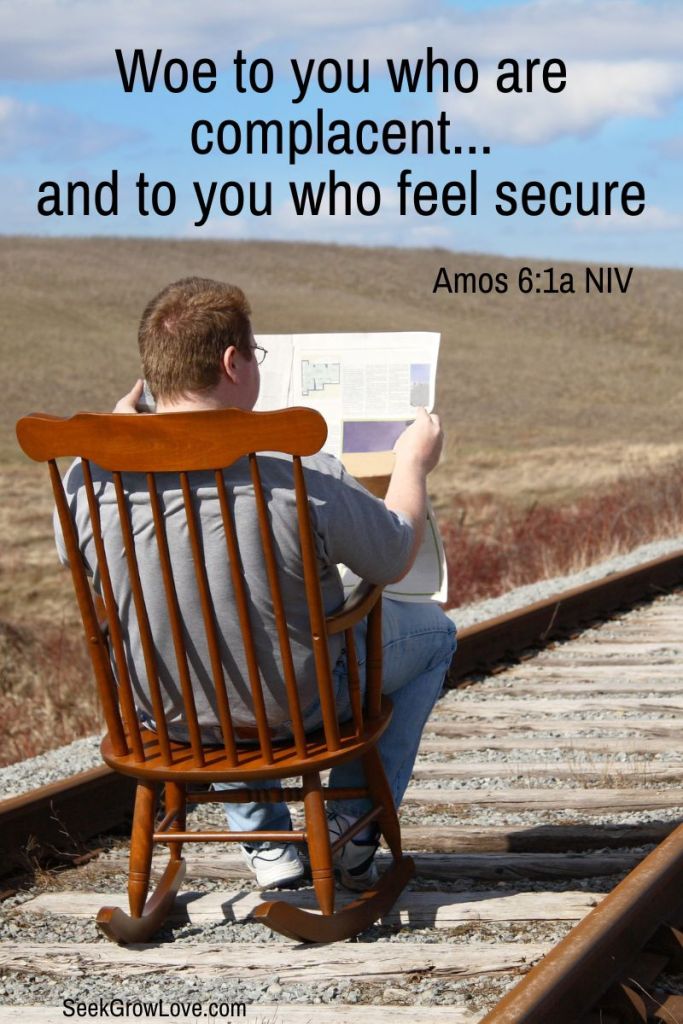
Today we are reading out of the third of the minor prophets, Amos. However, if the first three chapters make you feel a little uneasy: that’s entirely the point! Amos 6 starts with “Woe to you who are complacent in Zion,

    and to you who feel secure on Mount Samaria,

you notable men of the foremost nation,

    to whom the people of Israel come!”

Amos is speaking on behalf of God to the people of Israel in a time of prosperity. However, in a time of complacency, the people of Israel have once again allowed for themselves to become spiritually corrupt. They “lie on beds adorned with ivory,” and “lounge on (your) couches,” but they “will be among the first to go into exile.” (Amos 6:4-7). This is because they “do not grieve over the ruin of Joseph.” Because the people of Israel have become so complacent and uncaring of those in need lest it take away from their pleasure, God seeks to divide and destroy the nation as it currently stands. 

Amos 7-8 essentially goes into vivid imagery of how Israel’s destruction will be met. First, the locusts. However, Amos convinces God to relent to an impending famine. Then, the fire. However, yet again Amos convinces God not to destroy the land. Then, God showed Amos a vision of him holding a plumb line, which is a device used to measure the straightness of a vertical drop. However, when God was “setting a plumb line among my people Israel,” he was measuring their righteousness to his standard. And for this, he must judge them and divide them. 

Surely this should serve as a MASSIVE wakeup call for Israel. Unfortunately, the priest of Bethel (Amaziah) was not wanting Amos to prophesy against Israel in the city of the king. That didn’t end too well for him. Read Amos 7:17 for more on that. Ouch.

We must use this time when Israel was judged as a reflection on our own lives. What does it mean to be complacent? Does God despise complacency? Is it not okay to be comfortable? Although it almost certainly looks to be that way, I would argue that the grave mistake that Israel was making was their complete ignorance of righteousness and their spiritual lives. Are we more concerned with our personal comfort than with the brokenness around us? Do we avoid lamenting over sin and injustice because it disrupts our peace? Although we must always strive for times of peace, we must be aware of our own sin and also make active attempts to comfort those around us who are not at peace. 

Furthermore, God says that a famine will fall upon Israel after all. However, it’s a little different than the usual famine. It’s “Not a famine of bread… but of hearing the words of the LORD” (Amos 8:11). Are we listening for God’s voice or have we tuned Him out in our own prosperity and ignorance? The greatest famine we could ever face is not material, but spiritual when we no longer hunger for God’s Word or even notice when it’s absent. With that said, we must heed the words of Amos and continue to hunger and thirst for the righteousness that God offers us through his words. 

Although most of this sounds like a dire warning and a time for lamenting to come, we actually don’t get to end off our devotion with a bad note! As God promises in Amos 9 that there will be a restoration. “The days are coming… when the reaper will be overtaken by the plowman and the planter by the one treading grapes. New wine will drip from the mountains and flow from all the hills, and I will bring my people Israel back from exile” (Amos 9:13-14). Therefore, if we apply this message to our own spiritual journey, we can know that even if we are burdened by the weight of our own complacency and sin, that it is not too late to act. There is hope for our own restoration, just as God promised that there will be a restoration for the people of Israel. 

-Colby Leggitt

Discussion Questions: 

  1. Where in my life have I grown complacent or overly comfortable?
  2. What injustices am I ignoring or avoiding?
  3. Am I listening for God’s Word daily or has it become background noise?
  4. How can I live today with urgency for hope in restoration through repentance?

Two Kinds of Eternity

OLD TESTAMENT: Daniel 12

POETRY: Psalm 139

NEW TESTAMENT: John 12:12-19

Jesus says, in the gospel of John, “God loved the world in this way: He gave his unique, one and only Son, that whoever believes in him should not perish but have everlasting life.” (3:16) Later, in the Revelation of Jesus, we read that anyone whose name is not written in the book of life shall be judged, but that those who conquer will never have their name blotted out of the book of life. (3:5)

As we come to a close in Daniel, we are struck with weird, disconsonant numbers. Yesterday, I gave you a giant history lesson; maybe today you are worried about a deep dive into math! Let me give you some hope, we aren’t doing math. (I can hear the sigh of relief from here.) 

Instead, I am going to get very personal and very honest: eternity awaits you. This is not an “infinity-and-beyond” kind of aspiration. While the New Testament is very explicit in the book and verses we looked at above, it is what permeates the teaching and focus of Jesus. Eternity is coming. Whether at his return or at the end of our lives and our resurrection into the next, there is something coming. In Daniel 12 (and most places in the Bible) there is one resurrection at the end of the world. Daniel is full of metaphor and numbers, but here, the language is bolstered by the literal teachings of Jesus, and also other places in the New Testament. Daniel 12 tells us there will be a real, literal resurrection. Those who sleep will rise. But with one resurrection, there are two outcomes. One is everlasting life. One is shame and everlasting contempt. The gospel of John repeats as much: “Do not marvel at this, for an hour is coming when all who are in the tombs will hear his voice and come out, those who have done good to the resurrection of life, and those who have done evil to the resurrection of judgment.” (John 5:28-29 ESV) What does everlasting shame and contempt mean? Humans are not, in and of themselves, immortal. We die, the dead know nothing (Ecc. 9:5), the dead do not praise God (Psalm 115:17); instead the dead are, metaphorically, asleep, unaware of the passing of time. This matters because what is offered in Revelation is eternal life or the second death. Not torture forever, but the finality of hope, and the end of existence. 

I am not a fire-and-brimstone kind of guy, and I won’t want to scare you. I want you to think through your options. Today, you have set before you life and death. More than that, you have eternal life or eternal death. I beg you, choose life! Jesus, the sacrifice for our sins, the ruler of God’s kingdom, the lamb slain from the foundation of the world, he desires to write your name down in his book of life. He, like his father, does not desire that any should perish, but all, whoever calls upon him, should live and live eternally. 

My friends, may you call upon the name of the Lord Jesus. 

May your name be found in the Lamb’s book of life. 

May you spend eternity with all those who have called upon Jesus.

May you be blessed so that you may see God in his kingdom. 

Remember, one day, we will all go on our way. We will all rest in death. 

May we stand side by side in our allotted places at the end, covered in the grace of Jesus. 

Amen. 

-Jake Ballard

Questions:

  1. It’s your turn to study! What are the connections between 1290, 1335, and “time, times and half a time”? Reading Revelation may make some of it clear, but you should ask your pastor. Be really specific and make your pastor think! 
  2. Some of our Christian brothers and sisters think that judgement means an eternity of pain and suffering. Can you understand why they might believe that? Can you see why it is wrong? List out some reasons in the Bible or in theology or philosophy that it might be wrong and explain them: “Human mortality” or “God’s love and justice” are good starting places, but think about going deeper. 
  3. Beyond numbers and judgement, I encourage you, during this time of Advent, to trust in what God has done in and through Jesus, our savior. I encourage you to trust him with your life and with your resurrection. I encourage you to talk to your pastor, youth pastor, or caregivers about becoming baptized, and finding forgiveness so that your name may never be blotted out of the book of life. God bless you as you seek him. 

A New Name

OLD TESTAMENT: Ezekiel 4 & 5

POETRY: Psalm 121

*NEW TESTAMENT: Revelation 19

    At the start of Revelation 19 heaven rejoices over God’s actions regarding Babylon the great. Soon we hear about the coming of the marriage supper of the lamb, and John is informed that the bride is clothed in fine linen which “is the righteous acts of the saints” (v. 8). He is also told to write that those who are invited to the wedding supper are blessed. This feels a bit like when Jesus commented in 16:15 “I am coming like a thief,” drawing our attention forward to coming attractions rather than remaining in sequence with events.

     The voice which spoke about the marriage supper came from God’s throne, and hearing it speak caused John to fall and want to offer worship. John is corrected for this and told that only God is to be worshipped (v. 10). But it seems like in this case he made an understandable error. Throughout Revelation voices come from a variety of exalted sources, among them angels, strong angels, mighty angels, an angel standing in the sun, the Temple, the altar, and the horns of the altar. For John it may have been like experiencing holy surround sound, never knowing where the next proclamation would emerge from. Maybe degrees of grandeur are indicated by who spoke from where, giving different impacts to their statements. It wasn’t always clear to John what the intention was.

     The message of the chapter proceeds, announcing the arrival of Christ, and of the armies of the world gathered for Armageddon. In fact, the word “Armageddon” is only named back in 16:16 where its origin is explained. Here the battle is previewed as “the great supper of God” – a supper for the birds, to eat the carrion it will provide, in contrast to the wedding supper of the lamb (v. 17‑18). With Jesus on the move there is no contest (2 Thessalonians 2:8). Jesus seems to be given credit for the entire victory: the gathered forces “were killed with the sword which came from the mouth of Him who sat on the horse.” That is, except for the beast and the false prophet. Those two are removed from the scene and dropped into the lake of fire, receiving their punishment for serving the dragon and for deceiving the nations.

     The description of Christ includes having “a name written on Him which no one knows except Himself” (v. 12). Note that this mirrors part of Christ’s letter to the third church, Pergamum. There Christ said he would give overcomers a white stone with a new name written on it, which only the recipient would know (2:17). (That same letter identifies Christ with the sharp two-edged sword, shown in John’s opening vision sticking from Christ’s mouth, much as in chapter 19; 1:16; 2:12.) I like the idea of these names which are known only to oneself. I wonder if I am being fanciful in thinking this new name involves having a sense of your own identity. You won’t need to share that with anyone else. There will be no need to. There will no longer be self-doubt, rivalry, jealousy, any of the potential bitterness that plagues our current lives. It will be a wonderful time. I hope to see you then.

     Lord, I look forward to the day when your kingdom has come on earth as you now reign in heaven. You have been waiting for a long time, allowing more people to be saved through the grace of your son. May your glory and your majesty be shown in my life while I wait for that day. Let me be empowered and enthused to perform righteous actions that will please you. Let me set my mind on the things of the Spirit, live as your humble servant, and exalt you. Let my light so shine before men that they will glorify you. Let me present my body as a living and holy sacrifice, acceptable to you. Renew my mind, so I may prove what your will is. Thank you, my God. In Jesus’ name I pray these things, Amen.

-Daniel Smead

(Originally posted November 15, 2023 for SeekGrowLove)

Reflection Questions

  1. Do you ever think about the fact that it is our opportunity, and honor, to clothe the bride of Christ in righteous acts?
  2. Who are some of the people you want to sit with at the wedding supper of the lamb? What do you think you will talk about there?

God Holds You Accountable for Their Blood

OLD TESTAMENT: Ezekiel 1-3

POETRY: Psalm 121 (all week)

NEW TESTAMENT: Revelation 18

The prophet Ezekiel was among the Jewish exiles taken to Babylon.  While there, he had amazing visions of God, which are recorded numerous times throughout the book of Ezekiel.  In chapter 1, we read about his first vision.  He started by describing four cherubim inside a fire in great detail, including each of the four faces per cherub, and what their feet looked like (not what you might expect), he went on to describe in detail what their wheels looked like. And that was just the introduction.  He then went on to describe God’s throne, sitting on a platform above the cherubim, and then he went on to describe the glory of God that he saw sitting on the throne.  If you want the details, you’ll have to read Ezekiel chapter 1.

During this encounter, God told Ezekiel that He was sending Ezekiel as a prophet to the people of Israel.  God told Ezekiel in 2:7, “You must speak my words to them, whether they listen or fail to listen, for they are rebellious.”

Then, in 3:18-19, we read this, “17 “Son of man, I have made you a watchman for the people of Israel; so hear the word I speak and give them warning from me. 18 When I say to a wicked person, ‘You will surely die,’ and you do not warn them or speak out to dissuade them from their evil ways in order to save their life, that wicked person will die for their sin, and I will hold you accountable for their blood. 19 But if you do warn the wicked person and they do not turn from their wickedness or from their evil ways, they will die for their sin; but you will have saved yourself.”

Wait a minute.  Does verse 18 really say that God will hold Ezekiel accountable for the blood of the wicked if he doesn’t warn them?  Yes it does.

God demands obedience.  And there is always punishment for disobedience.  That disobedience can range from eating forbidden fruit in a garden, to doing things He prohibited, to not doing things He requires.  In this case Ezekiel is commanded explicitly to warn Israel to return to the Lord, and he is warned that if he disobeys, there will be consequences.  As we read throughout the rest of the book, we will find that Ezekiel obeyed faithfully, but it cost him dearly.

We have been given some similar commands.  Jesus told his followers to, “Go into all the world and preach the gospel.”  In 1 Peter 2:9, we find, “But you are a chosen people, a royal priesthood, a holy nation, a people belonging to God, that you may declare the praises of him who called you out of darkness into his wonderful light.”

Remember, as we’re told in 1 John 2:4, “The man who says, ‘I know him,’ but does not do what he commands is a liar, and the truth is not in him.

Will you obey?

Steve Mattison

(originally posted August 26, 2020 for SeekGrowLove)

Reflection Questions

  1. How do you view the role of watchman?
  2. How does God view the role of watchman?
  3. Who do you know who needs to be warned of God’s judgment?

Who Will Not Fear You?

OLD TESTAMENT: Zephaniah 1

POETRY: Psalm 119:169-176

NEW TESTAMENT: Revelation 15

Zephaniah 1:14-16 (LEB):

“The great day of Yahweh is near,

near and coming very quickly.

The sound of the day of Yahweh is bitter;

the mighty man cries aloud there.

A day of wrath is that day,

a day of distress and anguish,

a day of ruin and devastation,

a day of darkness and gloom,

a day of clouds and thick darkness,

a day of trumpet blast and battle cry

against the fortified cities and against the lofty battlements.”

Psalm 119:169-176 (LEB):

“Let my cry come before you, O Yahweh;

give me understanding according to your word.

Let my supplication come before you;

deliver me according to your word.

My lips will pour forth praise,

for you teach me your statutes.

My tongue will sing of your word,

for all your commandments are right.

Let your hand be ready to help me,

for I have chosen your precepts.

I long for your salvation, O Yahweh,

and your law is my delight.

Let my soul live and praise you,

and let your rules help me.

I have gone astray like a lost sheep;

seek your servant,

for I do not forget your commandments.”

Revelation 15:3-4 (LEB):

“And they sing the song of Moses, the servant of God,

and the song of the Lamb, saying,

‘Great and amazing are your deeds,

O Lord God the Almighty!

Just and true are your ways,

O King of the nations!

Who will not fear, O Lord,

and glorify your name?

For you alone are holy.

All nations will come and worship you,

for your righteous acts have been revealed.'”

The prophet Zephaniah opens with a solemn warning of the coming Day of Yahweh, a day characterized by divine judgment. The imagery of darkness, anguish, and distress serves as a powerful reminder of the seriousness of God’s justice. For those who reject His ways, this day brings fear and despair.

Yet, within this stark portrayal lies a call to repentance and an invitation to seek refuge in God. While Zephaniah emphasizes God’s wrath, it is important to remember that His justice is always intertwined with His mercy. In moments of turmoil and judgment, we are reminded of our need for God’s grace and guidance. This day of reckoning compels us to reflect on our own lives, ensuring that we align our hearts with God’s will.

In Psalm 119, the psalmist expresses a deep longing for God’s guidance and salvation. His heartfelt cry for understanding echoes the sentiment of Zephaniah—a recognition of human frailty and the need for divine intervention. The psalmist’s desire to follow God’s commandments illustrates the importance of aligning our lives with His truth.

As he pleads for deliverance and praises God’s statutes, we see the relationship between our obedience and God’s faithfulness. In our own lives, we are invited to seek God’s understanding and mercy, especially when we feel lost or astray. This passage reassures us that, even in our wandering, God is attentive to our cries, ready to respond with love and grace.

Revelation 15 presents a scene of worship in heaven, where the redeemed sing the song of Moses and the Lamb. This song celebrates God’s greatness, justice, and holiness. The acknowledgment of His righteous acts inspires awe and reverence, uniting all nations in worship.

In the midst of judgment, the song of the Lamb reminds us that God’s mercy prevails. The ultimate act of redemption through Christ is the source of our hope and assurance. As we reflect on our journey, we are invited to join in this eternal song, declaring God’s majesty and righteousness. The assurance of His salvation empowers us to face the trials of this world with faith and courage.

-Jeff Ransom

Reflection Questions:

How does the imagery of the Day of Yahweh in Zephaniah challenge your understanding of God’s justice and mercy?

In what ways can you seek God’s understanding and guidance in your daily life, especially during challenging times?

Reflect on the psalmist’s desire for salvation and obedience. How can you cultivate a deeper love for God’s commandments in your life?

What does it mean for you to sing the song of the Lamb in your everyday life? How can you express your worship and gratitude for His redemption?

Past, Present and Future

OLD TESTAMENT: Nahum 1-3

POETRY: Psalm 119:137-144

NEW TESTAMENT: Revelation 11

Nahum 1:2-3 (LEB):

“A jealous and avenging God is Yahweh;

Yahweh is avenging and has wrath.

Yahweh takes vengeance on his adversaries

and reserves wrath for his enemies.

Yahweh is slow to anger and great in power,

and he will not leave the guilty unpunished.

In whirlwind and storm is his way,

and clouds are the dust of his feet.”

Psalm 119:137-144 (LEB):

“Righteous are you, O Yahweh,

and upright are your judgments.

You have commanded your testimonies

in righteousness and exceeding faithfulness.

My zeal has consumed me,

because my enemies have forgotten your words.

Your word is very pure,

and your servant loves it.

I am small and despised,

yet I do not forget your precepts.

Your righteousness is an everlasting righteousness,

and your law is true.

Trouble and anguish have found me out,

but your commandments are my delight.

Your testimonies are righteous forever;

give me understanding, and I will live.”

Revelation 11:15-16 (LEB):

“And the seventh angel sounded the trumpet,

and there were loud voices in heaven, saying,

‘The kingdom of the world has become the kingdom of our Lord and of his Christ,

and he will reign forever and ever!’

And the twenty-four elders who were seated before God on their thrones

fell on their faces and worshiped God.”

The book of Nahum reveals God’s sovereignty over the nations and His fierce justice against those who oppose Him. Specifically, it proclaims God’s impending judgment against Nineveh, a city known for its wickedness and cruelty. The opening verses declare God as a “jealous and avenging God,” emphasizing His commitment to righteousness and the protection of His people. God’s slowness to anger highlights His patience, but His ultimate justice is assured; the guilty will not escape unpunished.

Nahum reminds us that while God is loving and merciful, He is also just. His judgment against Nineveh serves as a reminder that evil cannot persist forever without consequence. This gives us hope, especially in a world where injustice and oppression often seem rampant. As we witness suffering and wrongdoing, we can trust in God’s righteous judgment and His commitment to setting things right in His perfect timing.

In Psalm 119, the psalmist expresses a deep love and reverence for God’s law and testimonies. The declaration of God’s righteousness sets the foundation for understanding His judgments. The psalmist’s zealous love for God’s word is driven by the reality of his enemies and the challenges he faces. Despite being small and despised, he finds delight and strength in God’s commandments.

This passage encourages us to anchor ourselves in God’s word, especially during trials. The psalmist recognizes that while trouble and anguish are inevitable, God’s commandments are a source of delight and guidance. When we immerse ourselves in Scripture, we find wisdom, comfort, and a reminder of God’s faithfulness. The law becomes a light in our darkness, guiding us toward a path of righteousness and understanding.

Revelation 11 culminates in the triumphant announcement of God’s kingdom. The seventh trumpet sounds, proclaiming that the kingdom of the world has become the kingdom of our Lord and of His Christ. This proclamation signifies a pivotal moment in redemptive history—where God’s reign is fully established, and the powers of darkness are defeated.

The response of the twenty-four elders, who fall on their faces in worship, reflects the rightful reaction to God’s sovereignty and majesty. In this vision, we see the culmination of God’s justice and the fulfillment of His promises. As believers, we are invited to participate in this celebration, anticipating the day when God’s kingdom is established forever.

-Jeff Ransom

Reflection Questions:

How does the concept of God’s jealousy and justice in Nahum impact your understanding of His character? In what ways does this knowledge provide comfort during difficult times?

Reflect on the importance of God’s word in your life. How can you cultivate a deeper love and delight for Scripture, especially when facing challenges or opposition?

How does the promise of God’s kingdom in Revelation encourage you in your daily walk with Christ? In what ways can you live in anticipation of the kingdom?

Consider the response of the twenty-four elders in Revelation 11. How can you incorporate worship into your daily life, acknowledging God’s sovereignty and majesty?

Vengeance is the Lord’s

OLD TESTAMENT: Jeremiah 51 & 52

POETRY: Psalm 119:97-104

NEW TESTAMENT: Revelation 6

In Jeremiah 51-52, we continue to read about the rise and fall of one of Israel and Judah’s greatest adversaries – Babylon. Most would think they had it coming; after the ruthless destruction of Judah and years of the children of God being held in captivity, how else would Yahweh react? One might even wonder why it took so long for Him to free His people from these evil, power-hungry conquerors. As we’ve seen throughout the Old Testament, (particularly Judges, 1st and 2nd Kings, and Isaiah) the Israelites had their own series of mishaps and repeated sin. As a result, God – in His perfect timing – used Babylon to bring retribution to His people. However, He did not let Babylon’s wickedness go unpunished. Eventually, their arrogance and sin led to their ruin. Through Jeremiah, God declared that Babylon would be punished for its pride and cruelty. This was not just a political event, but a fulfillment of God’s divine justice and plan.

Our God’s ways are not to be challenged, nor is His wrath to be evoked. Vivid imagery is painted throughout the 64 verses of chapter 51, which follows the previous 46 verses in chapter 50 (in which the proclamation of Babylon’s grim downfall was only getting started). The LORD our God has a fierce vengeance, one that nobody should desire to face. Our God is a God of love, but as seen in these chapters, He does indeed declare enemies. And to be an enemy of the one true God is pretty much the worst place you could possibly find yourself in. These scriptures serve as a powerful reminder of God’s complex and perfect character. He is surely abounding in love, kindness, and mercy, but He is also a God of justice, holiness, and righteous wrath. This understanding brings to mind two important truths:

1. We can rest assured that justice is ultimately in the hands of God, and punishment will be bestowed upon His enemies on the day of judgment. We don’t carry the burden of deciding who is worthy of God’s love, and instead have freedom in Christ to love everyone God places in our lives – choosing to love the person and not the sin. In a world filled with brokenness and division, we can be a light of grace, knowing that God’s justice will prevail.

2. I do not want to be an enemy of God, and I know you don’t either. These chapters challenge us to examine our own hearts and lives. Live each day knowing fully that you are fearfully and wonderfully made, you are a servant of Christ, you are the beating heart of the church, you are the hands and feet of God, and you are His beloved child. In a fervent endeavor to avoid ever being known as an enemy of God, anchor your identity instead in these things, and place your trust in the unshakable Kingdom of God. For the empires of this world will fall, but His is everlasting.

To be a part of God’s everlasting kingdom means surrendering our own desires and aligning ourselves with His greater purposes. It means that we are called to walk in obedience, trusting that His plans are far beyond our comprehension. Babylon fell because it was built on the shaky ground of pride, greed, and corruption. But as followers of Christ, we stand firm on the solid foundation of God’s eternal kingdom—a kingdom defined by love, justice, mercy, and truth.

-Isabella Osborn

Reflection Questions

  1. Are there areas in my life where I am relying on my own strength or worldly systems instead of trusting in God’s good and perfect ways?
  2. How can I actively align my daily choices and actions with God’s kingdom values?
  3. In what ways can I guard my heart against pride and self-reliance, ensuring that my foundation is rooted in Christ rather than the fleeting things of this world?