
– Devotion by Tom Siderius (MI)
Mark 6:45-52 Immediately after this, Jesus insisted that his disciples get back into the boat and head across the lake to Bethsaida, while he sent the people home. 46 After telling everyone good-bye, he went up into the hills by himself to pray.
47 Late that night, the disciples were in their boat in the middle of the lake, and Jesus was alone on land. 48 He saw that they were in serious trouble, rowing hard and struggling against the wind and waves. About three o’clock in the morning Jesus came toward them, walking on the water. He intended to go past them, 49 but when they saw him walking on the water, they cried out in terror, thinking he was a ghost. 50 They were all terrified when they saw him.
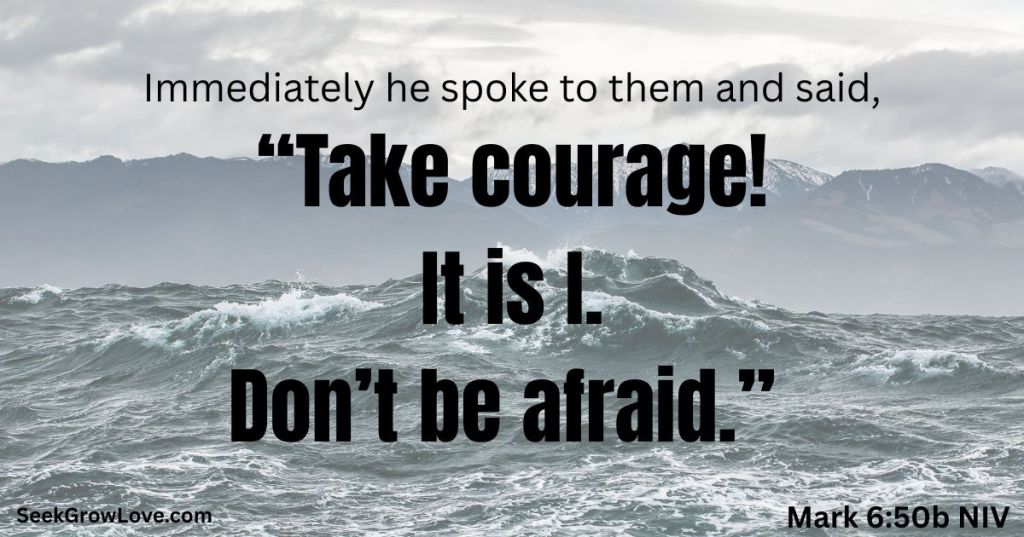
But Jesus spoke to them at once. “Don’t be afraid,” he said. “Take courage! I am here!” 51 Then he climbed into the boat, and the wind stopped. They were totally amazed, 52 for they still didn’t understand the significance of the miracle of the loaves. Their hearts were too hard to take it in.
Mark! What’s the deal with saying our hearts were too hard??? Why would God have you write that in your gospel??
The official line about the gospel of Mark is that Peter and other original apostles are the source of the material he writes from. They tell him what happened and then he writes it down. We need to ask ourselves so many times when reading these records about what was Jesus trying to teach his apostles and disciples? Then what is the lesson for us in the recalling of them?
The trip on the sea of Galilee that includes another walk on the water by Jesus comes after feeding 5000 men plus women and children (maybe 15-20K people). He uses such the small amount of food to start with. So many questions come to my feeble mind. How did Jesus ever break up that much bread or fish? How did God multiply the food to fill baskets full? Where did the baskets come from? Who ate the leftovers and for how long? So many questions on these records.
What was the apostle’s reactions to helping to break and hand out the food to that many people? Jesus says “you feed them” to the apostles. Which is exactly what they proceed to do. What should they and we learn from the experience besides astonishment at the event?
I believe that the lesson for us and those disciples there is that God is the source of all blessing and sufficiency. God alone is the giver of all that is good and fruitful, the only source of true food and health for all the people of the world. Our very food we eat is only because of the grace and mercy of God to give it to us. Jesus looks to God and then blesses this small amount of food, making it sufficient to do the humanly impossible. What great power of God is at work in Jesus’ life and is still available to us today.
Christians must bring their lives to God in an attitude of obedience and sacrifice. When we do this, we need to expect God to do far beyond what can be imagined. We should trust that God not only wants to meet our needs, but that He wants to give to us with overflowing spiritual blessings.
Are our hearts too hard to believe our God’s promises? “Hardened” here is to be “petrified” or maybe should mean “calloused”. Our habits of life that don’t believe the promises of God cause our hearts by repetition to become calloused to the truth. We develop a lifetime set of beliefs that doesn’t believe that God can do anything very miraculous. We start to believe miracles and all that Jesus stuff died out with the apostles and isn’t that important today.
We say we have faith but prove that we don’t by our actions and speech. “You feed them” is what Jesus tells us to do, but we say, “OK we will, but here’s our few loaves and fishes. Don’t blame me when it really doesn’t work out. I’ll do it but I don’t really believe that it will work with my resources.” When we pray for someone to be delivered or healed are we really standing in our confidence of God’s help or do we just go through the motions?
I know that one of my lazy habits is to excuse my prayers by telling God that I will pray for people, but because I really don’t know what to pray for, I will just put them up before God and then go on with my life. Ever been confronted with a specific situation that is right there in front of you with no apparent answers to it? How did you react? Our first habit needs to become the truth of God’s Word for us, not the calloused habit of our hearts to give Him our excuses.
So, I thought we were going to look at the walking on the water event. More questions come to mind. Why does Jesus send them off across the lake without him and just go pray by himself? What happens that changes their hearts so much from this experience of the waves and wind? Here they are again in a situation that faces them head on and close in. No amount of rowing or sail handling will get them out of it. Remember that they were experienced fisherman with a great deal of boat handling and weather experience. “Jesus don’t worry about us we have it handled, have some confidence we are the experts”. But once again we and they don’t really have it. For the apostles it is that if God can feed the five thousand then He does have the answers for every situation.
What is the lesson of the waves? Once again that God has our care in place, and we need to put our trust in His promises. Jesus says he will ever be with us to the end of the earth. This is his church and he is building it and taking care of it. We are not really in charge of what we think we are. We are confident every minute until the wind and waves are overwhelming. How many times God saves us from disaster and even death.
Ephesians 3:20(NLT) Now all glory to God, who is able, through his mighty power at work within us, to accomplish infinitely more than we might ask or think.
Psalms 22:22-24(NLT) I will proclaim your name to my brothers and sisters.
I will praise you among your assembled people.
23 Praise the LORD, all you who fear him!
Honor him, all you descendants of Jacob!
Show him reverence, all you descendants of Israel!
24 For he has not ignored or belittled the suffering of the needy.
He has not turned his back on them,
but has listened to their cries for help.
Questions:
See bold questions above
Prayer:
Father God, come to us with your promises and give us the heart that hears them and will believe You. Thank you for the records of Your Word to give us confidence to do Your will. Help us to see the Christ-in -us that will give us strength to act and speak. Thank you that Your will is still to feed and save people from destruction. Be with us this day as we hear you with our hearts. In Jesus’ name we pray.



 Seek Grow Love