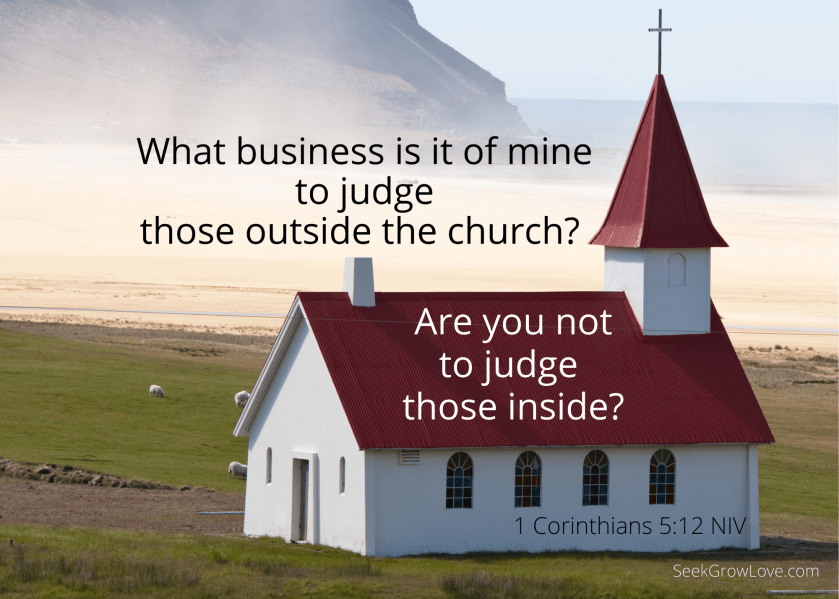
In today’s passage in Galatians, 5:23, we read of the rest of the fruits of the spirit: gentleness, self-control; against such things there is no law. (NASB 1995) The spirit of self-control is a quality that would have served David well in today’s passage in 2 Samuel 11. What can we learn from the story of David? Sin can have a domino effect. One sin can easily lead to another. David’s first sin was probably just looking at Bathsheba longingly while she was bathing. Jesus tells us that for a married person to even look upon someone else with lust is equivalent to adultery. Ideally, David should have looked away immediately once he realized she was not clothed. We can probably safely assume his self-control did not kick in at that moment to prompt him to quickly avert his gaze, which then led to feelings of lust multiplying in him. Then, as the story goes on, we see David actively pursuing her, impregnating her and then frantically trying to figure out how to clean up his mess. David’s struggle with temptation is obviously not unique. We only have to look around to see we have many temptations competing for our attention. Pornography is more accessible than it has ever been and has been named as a major public health crisis due to the impact on individuals and their marriages and families.
Abiding in the living vine is our best defense against the onslaught of temptation that we face on a daily basis. Self-control is not easy to come by naturally because temptations are considered to be temptations because they are powerful and tap into our carnal desires and stimulate our senses. Whether it’s overindulging in alcohol or food, taking drugs that aren’t prescribed to us or abusing prescription drugs, sexual sin, etc., temptation comes in many forms. Thankfully we don’t have to rely on our own strength to resist them. Abiding in Christ helps us to cultivate that fruit of the spirit that includes self-control. Of course, like any plant, a vine must be tended to. We cannot ignore it and expect it to thrive. It is a choice that must be made daily, sometimes hourly, at times even minute by minute, to abide in Christ.
-Kristy Cisneros
Reflection Questions
Besides in this chapter, where else have you seen sin’s domino effect in action?
What temptation grabs your attention and pulls you away from where you should be? Where does it lead to next?
What does it look like when your temptation wins over your lack of self-control? What does it look like when your self-control wins over temptation? How do you feel in each instance? How are others affected in each case? What do you imagine God is thinking or feeling in each scenario?
What specific actions can you take this week to abide in Christ more and more? What will it cost you? What will the benefits be?
Sometime in the Advent season, my family gathers round and we read out these words. There is a familiarity to this “scary ghost story”; who hasn’t seen, or watched, or read, or heard some version of *A Christmas Carol*. There are dozens, scores, of different versions: stages plays, to ballets, to movies, to the MUPPETS. Seriously, if you haven’t seen a Muppet’s Christmas Carol, what are you doing in the Holiday season?
As I was saying, my family reads these words every year, and I particularly love Dickens’s dry humor and wit, which is somewhat lessened by the theatrical productions of his creation.
But he also makes very clear why he begins his illustrious novel with a death of a character we know nothing about : “The mention of Marley’s Funeral brings me back to the point I started from. There is no doubt that Marley was dead. This must be distinctly understood, or nothing wonderful can come of the story I am going to relate.”
It is in the exact same vein that the author of 1 Samuel 28 reminds us, “Now Samuel was dead, and all Israel had mourned for him and buried him in his own town of Ramah.” We already knew that from 25:1, but the author wants to be really sure. Absolutely positive that we get it.
Saul is going to attack the Philistines but the Lord doesn’t answer him. And so Saul, in stupidity and desperation, decides to go to Endor, looking for a witch. The witch, in fear and trepidation, speaks as and for Samuel whom she “brought up”. Up from the dead, speaking to Saul. “Samuel was dead to begin with.” This was a big deal. This was massive. We are expecting something wonderful, or maybe in this case, something awful to come of the story which the author is going to relate.
There are some great questions that come to mind when we read this story (see below), but I want us to pick up on what Samuel says to Saul : “Why do you consult me, now that the Lord has departed from you and become your enemy?”
When Saul drags him up, Samuel says “What do you want me to do about it?” Like I said, I expected wonderful or awful; I did not expect grumpy and sassy.
Sometimes, when we find ourselves in sin, and our lives start going poorly, we think, in stupidity and desperation, “more sin will fix this.” Of course, we never say those exact words. Saul didn’t either, but he also didn’t listen to the commands of the Lord. A little compromise here, a little not following the will of God there. “I didn’t kill the sheep so they could be sacrificed!” God stops listening to his prayers, and so he turns his inward sin of rebellion into the outward sin of divination. He does fulfill the prophecy of Samuel in 1 Samuel 15:23.
We tend to do the same. We tell a lie, and to cover up that lie we have to tell more. (Like Junior Asparagus covering up breaking the Art Bigotti Plate.) Instead of dealing with our lust and desires of the flesh head on, we heap false prophecy onto it and say “God told me we should be together.” We lump pride onto sloth: “Sure I was mentally checked out when I was physically clocked in on the job, but I just need some self care. I deserve it! Treat yo self!”
You might think the words used (pride, sloth, lust) in those examples (“stuff that everybody does”) is a bit extreme. Maybe, but sin is usually insidious. Saul didn’t start off thinking he was going to be cavorting with witches in the middle of the night. David didn’t think that avoiding his duty of going to war would end up with him murdering his companion.
Maybe, through you reading the story, you can begin to see that nothing good comes from heaping one sin on top of another. If you find yourself walking down the road of sin, I know how hard it is to change; still, confess your sins, seek the help of pastors and friends who want the best for you, change your ways. Only in turning from sin to the God who wants the best for us will we be able to seek his forgiveness, and not find him as an enemy, but relate to him as a Father who loves his children. Christ will empower us, advocate for us, give us his spirit and put us in a place where God can change us and bless us.
“And so, as Tiny Tim observed, God Bless Us, Every One!”
-Jake Ballard
Reflection Questions
Do you need to confess and stop sinning?: Start off by focusing on the thrust of the devotion; are there any sins in your life that need confession? Where you need help to get out of addictive patterns or habits that are hard to break? Stop the sin as soon as possible so the healing can begin. Only then should we think about the rest of these questions.
Did the magic work?: I have heard some people say the witch was scared *because the magic worked.* As in, she wasn’t expecting a real appearing. But the text indicates that she was scared because she recognized Saul while doing her magic. Saul had killed all the diviners. Why was she scared? The ancient people believed magic worked : The witch in Endor, like the slave girl of Acts 16, make us ask do *we* believe that magic works? Should we be more afraid of participating in the occult and magic than merely saying “that’s make believe”?
Are ghosts real?: Samuel seems to be a ghost. Are ghosts real? What is the Biblical picture of the afterlife? Jesus compared it to sleep, Ecclesiastes talks about the dead knowing nothing and not praising God, but the disciples thought Jesus was a ghost. Does the Bible teach that people can become ghosts? If it doesn’t (and I think it doesn’t), then why did the disciples think people could become ghosts?
Coming *up*?: Where was Samuel coming from? It says Samuel was coming up? If the dead keep on living, we should expect him coming down out of heaven; Samuel seems grumpy, like a man awoken untimely from his sleep. What did the Israelites believe about Sheol?
As is frequent with God’s word, we see connections, themes, and promises fulfilled which transcend centuries, and today’s readings are an example of this. From our Old Testament reading of Joshua we see a thorough purging and annihilation of pagan people who were not followers of God in the land God wanted inhabited by his chosen people. Terms like “captured”, “struck every person”, “no survivor”, and “utterly destroyed” used more than once paint a pretty clear picture of what Joshua and the Israelites were busy doing. But, why? That is also repeated throughout, and while it could be summed up as “God said so”, it seems more beautifully stated in Joshua 11:15,
“Just as the Lord had commanded His servant Moses, so Moses commanded Joshua, and so Joshua did; he left nothing undone of all that the Lord had commanded Moses.” New American Standard Bible (La Habra, CA: The Lockman Foundation, 2020), Jos 11:15.
Over a thousand years later, our New Testament reading in 1 Corinthians written to the church in Corinth also references instructions on purging out the evil. And just like the pagan people and cultures surrounding and within the promised land in the time of Joshua, Corinth was certainly a place full of evil. A city known for immorality (not immortality as I just accidentally typed!), for all varieties of sexual sins and deviance, statues and idols of lovely false gods like Aphrodite and none other than a thousand prostitutes kept busy at the temple. One could imagine as new converts came out of this culture to Christianity, and for the existing church functioning within that society, there were some things that needed cleaned up. And then there were some things that just straight up needed called out, purged, and done away with. Finding ourselves progressed another couple thousand years from there, I think we can relate.
Tomorrow, the Jewish people and those celebrating Passover will be starting their remembrances and celebrations. I really like that the Jewish holidays have Biblical and spiritual meanings, and Passover is directly mentioned in our New Testament reading today. One instruction the Hebrews were given for the Passover was to remove the yeast/leaven from their homes on the first day. Today, there are all sorts of traditions on how to do this for Passover including varieties of special cutlery and cleaning to remove every speck of potential leaven from cookware to corners of homes and cabinets. Even the kids are apparently often helpful at finding those hard to reach remnants. As Christians according to 1 Corinthians 5, we know Jesus is our Passover lamb, which brought about a huge culture change, and one I am incredibly thankful for because I absolutely do not want to be doing anything with the blood of lambs or goats! But, while Jesus’s sacrificial life and death is a tremendous gift and blessing that reconciles us with God, scripture also tells us we can’t just be thankful for Jesus and leave whatever filth we have in our lives, homes, and churches. Leaven is often correlated to sin in scripture, and today’s reading is very clear. Leaven is not good in this case. It will creep into every corner of the loaf. It contaminates. If we tolerate evil, we will contaminate ourselves and the body of Christ if we are a member of it. If we ignore it and don’t even look for the small hidden pieces of leaven in our lives, the leaven is very efficient at growing, attracting bugs, and all the rest.
We are forgiven and cleansed through our Messiah who took the place of the Old Testament sacrifices. We also know we are human beings living in another Corinth, and it is easy to be deceived when society is screaming “that’s not leaven, that’s just fine”. May we all prayerfully consider the internal, spiritual leaven within ourselves along with any other things we might be cleaning up this spring. While smudges on windows, crumbs under the stove, and dead leaves in landscaping simply do not matter in the big picture, the spiritual stuff is a life and death matter. I love these verses in Psalm 19: 12-14 which talk about intently looking for the hidden pieces of leaven in our hearts.
But who can discern their own errors?
Forgive my hidden faults.
Keep your servant also from willful sins;
may they not rule over me.
Then I will be blameless,
innocent of great transgression.
May these words of my mouth and this meditation of my heart
be pleasing in your sight,
Lord, my Rock and my Redeemer.
-Jennifer Hall
Questions:
1. What similarities do you see between the culture in Joshua’s day, the city of Corinth, and today?
2. Have you ever seen someone’s sin in the body of Christ negatively impact others in the church family?
3. What challenges do you and the church face in identifying sin and right/pure actions from a Biblical worldview in today’s society?
Today, we get to say hi to the same hypothetical objector that Paul seems to address in the first handful of chapters in the book of Romans. Paul opens up chapter six with the question, “Are we to continue in sin that grace may abound?” (Romans 6:1 ESV). He asks the same question in verse 15 as well. In chapter 5, Paul talked about the great work that God and Jesus were able to accomplish through the cross. The cross is only needed because of sin in the first place. If there was no sin, then there would be no need for Jesus to die on the cross. Therefore, in a sense, our sin led to the incredible, world-altering power that was experienced on the cross of Jesus. Should we continue in that sin then to show the incredible power and grace of God? Paul’s answer is quite clear both times this question is raised: “By no means!” (Romans 6:2,15).
Paul goes on to talk about the baptized believer being united with Christ Jesus in his death and resurrection. While being united with Jesus in his death, “our old self was crucified with him in order that the body of sin might be brought to nothing, so that we would no longer be enslaved to sin. For one who has died has been set free from sin… Let not sin therefore reign in your mortal body,” (Romans 6:6,7,12).
We live in a broken world that is cursed and broken by sin. It seems everywhere we turn we can see sin. Since we live in a world that is broken by sin, sin is to be expected in the life of a Christian, right? Well, that’s what many may expect, but that is not what Paul seems to indicate in chapter six. Paul states on multiple occasions in chapter six that we are both set free from sin and that we are dead to sin. This does not sound like someone who just expects a Christian to keep on with their sinful ways. Paul expects the Christ follower to no longer be enslaved to the great enemy of sin. Christ Jesus has set us free from that strong entanglement!
For too long, too many Christians have had a lax stance towards sin. When we expect a Christian to continue in sin, I believe that we are belittling the work that was accomplished on that cross. Before chapter 6, Paul has showed us that Christ’s death enabled us to experience forgiveness, justification, and reconciliation with God. From my personal experience, these seem to be the central focus of the church when discussing the salvation that is offered to us through the cross. However, it does not stop there. Christ didn’t die just so that we could be forgiven of our sins; it’s bigger than that. Christ didn’t die just so that we could be justified; it’s bigger than that. Christ didn’t die just so that we could be reconciled to God; it’s bigger than that.
I appreciate the work of Alva Huffer in his book Systematic Theology. In his book, he details the “Seven Doctrines of Salvation”. Huffer advocates for the fact that through Christ’s death, we have been saved seven-fold from the consequences of our sin. On top of forgiveness, justification, and reconciliation, we also experience sanctification, adoption, redemption, and newness of life. It is the newness of life that Paul describes here in chapter six. Because Christ died, we can experience new life as Christians – a life that is free from sin and dead to sin. As followers of Christ, let’s cherish this new life that we have access to. Let’s show the world what it looks like to live a new life that is free and dead to sin! That’s exactly what this world needs.
-Kyle McClain
Reflection Questions
What does God’s grace mean to you?
What is your stance on sin? And on sinners?
Have you accepted the salvation God has made available through the death of His Son? If so, thank God for each of the seven doctrines of salvation! If not, what questions do you have?
I remember it like it was yesterday – okay maybe more like a couple days ago. While attending the Atlanta Bible College, I had the privilege of studying God’s word and living with “the guys”. We got along great, and to this day they are some of my closest friends. While we got along great, we would often be confronted with our strong, opposing opinions on various topics – most of which would have little to no bearing on our quality of life. One such topic was what we would do if we were in a situation where our child and wife’s lives were in danger and we could only save one of them. Mind you, this was coming from a handful of guys who at the time had no wife or any children. Regardless, we had pretty strong thoughts and feelings on what we would do in such a situation. We spoke as men with a lot of conviction in what we were saying.
I’m guessing you have had similar discussions or thoughts. What would you do if a loved one of yours was on the cusp of death? Would you give up your own life for the life of someone else? Maybe you too speak on similar topics with such conviction. We may talk a big game, but when it comes down to it, it would be so hard to pinpoint how exactly we would respond in a life-or-death scenario.
Not many people would die for a good person. On top of that, fewer people would die for their enemies – that is almost unheard of. I can only think of one example of someone willingly dying for their enemies. Paul sheds light on this one example in Romans 5:6-11. That one example is Christ dying for the ungodly, the sinners, and the enemies of God. Paul is talking about you and I! Christ died for us while we were enemies. In addition to Christ dying for the ungodly, the sinners, and the enemies of God, contemplate the fact that God sent his son to die for the ungodly, the sinners, and his enemies.
If it came down to it, I’m not sure the number of people I would be willing to die for. That’s a hard scenario to consider. What I can guarantee you is the number of people I would send my child to die for is incredibly smaller. We could go on and on about the love that God has for us by sending his own son to die for the ungodly, the sinners, and the enemies of God – you and I!
Now, we have to be careful pointing out that while Paul is essentially talking about you and I when discussing who Christ died for, Paul identifies us by our former identities. We WERE ungodly. We WERE sinners. We WERE enemies of God. Paul seems to imply that all of this changes through Christ Jesus. No longer are we identified as ungodly sinners who are enemies of God. Instead, we are identified by our right standing with God through the works of Christ Jesus. We WERE sinners, but Paul states, “we HAVE BEEN justified,” (Romans 5:1).
Paul continues along these same lines near the end of chapter five, as he compares and contrasts the likes of Adam and Jesus. When talking about these two, Paul states, “For as by the one man’s (Adam) disobedience the many were made sinners, so by the one man’s (Jesus) obedience the many will be made righteous,” (Romans 5:19). You and I are now justified and redeemed all because there is a God who sent his son to die for us while we were ungodly, sinners, and his enemies. Through this one act of love, everything changed for us.
-Kyle McClain
Reflection Questions
What does Paul teach us about God and Jesus and the relationship between these two?
How have you been an enemy of God? Are you still an enemy of God? Have you accepted the gift of God’s salvation that was made possible by the death of His son?
How would you try to describe God’s love to someone who has never read Romans 5? Who does God want you to tell about His love?
Remember that time that you held an imaginary debate or argument in your mind with either an imaginary figure or your spouse, coworker, boss, or friend? We have all been there before. Evidently, Paul has been there before as well. Except this time, Paul records this imaginary debate in Romans 3. How exciting!
Romans 3:1-8 gives the impression that Paul is debating an imaginary figure on how the Jews fit into the bigger picture. Paul’s conclusion to this mini debate is that the Jews are not better off, “For we have already charged that all, both Jews and Greeks, are under sin,” (Romans 1:9 ESV). There we have it. All of mankind is under sin. This conjoins the Jews and the Greeks together. If you don’t believe Paul, no need to worry. Paul has plenty of ammunition to help prove this point. Paul quotes a number of scriptures from the Old Testament in the following verses to bring home this point.
After Paul’s introduction, his letter to the saints at Rome has been rather gloomy thus far. However, verse 21 is where we start to see a shift. Paul recognizes that we are all under sin… “BUT NOW…”. This is where it gets fun! This passage in Romans 3:21-31 can preach! Essentially, this is a teaching on the doctrine of salvation, as the righteousness of God is revealed through faith in Christ Jesus for all who believe.
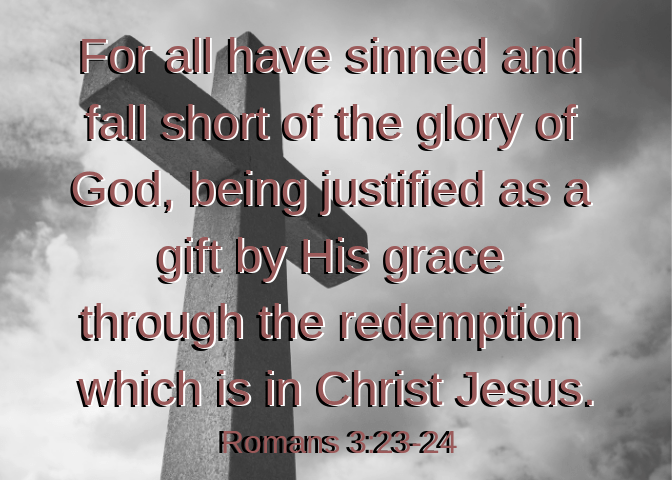
Many are able to quote Romans 3:23: “for all have sinned and fall short of the glory of God.” Paul is only halfway through his sentence when we have a verse break. Don’t forget about verse 24: “And are justified by his grace as a gift, through the redemption that is in Christ Jesus.” Paul compares God’s grace to a gift. Whenever you are given a gift from someone, you have two choices: you can receive it and open it or you can deny the gift. I have many memories as a child of receiving gifts from my parents for Christmas, my birthday, or other special occasions. Not once did I ever reject a gift that my parents gave me; I openly received the gifts every single time. Nearly every child receives the gifts they are given without a second thought. We need to mimic the attitude of a child here and gladly receive God’s gift of grace with open arms. How do we receive God’s grace? Well, fortunately for us, Paul tells us exactly how to receive that grace in the following verse. Paul tells us that it is “to be received by faith,” (Romans 3:25).
Paul crams a lot in this short passage to conclude chapter three, as he talks about our salvation. You can sum up Paul’s discussion in the following formula: sin + grace + faith = justification. Paul will later reveal to his audience that the justification leads to eternal salvation. For you math nerds out there, that’s a pretty awesome formula. For those of you not interested in math, trust me, that’s still a pretty awesome formula.
As we go through our lives, let’s remember to keep our arms open wide ready to receive God’s free gift of salvation.
-Kyle McClain
Reflection Questions
Have you ever rejected a gift given to you? Have you rejected or gladly received God’s free gift of salvation? Who do you know who might need some more information or encouragement to receive this gift?
How would you define and describe each of the words in the following formula: Sin + Grace + Faith = Justification. What is the importance of each one?
In the gloomy moments of your life, how can Romans 3 lift your spirits and bring joy, hope and peace?
Have you noticed how much easier it is to condemn others for their actions than to condemn ourselves, and our own actions? Too often, we become critics of everyone around us – judging the way they live their lives, the words they say, the things they do – critics of everyone except ourselves. For this particular sin, a trap we all probably fall into from time to time, Romans 2 really hits hard. Paul over-emphasizes repeatedly that wrong is always wrong, and sin is always sin, no matter who does it, no matter your intentions or your justification. Yes, our God is a loving God, forgiving and merciful forever and always. But our God is also a just God, and He will judge each and every person accordingly. As Romans 2:3-4 expresses, just because we serve a God who is kind, patient and forgiving does NOT mean that you can get away with any evil deed, continuing to live in unrighteousness relying only on the idea that all will be forgiven.
“Do you suppose, O man – you who judge those who practice such things and yet do them yourself – that you will escape the judgement of God? Or do you presume on the riches of his kindness and forbearance and patience, not knowing that God’s kindness is meant to lead you to repentance?” Romans 2:3-4
God’s abounding love and kindness is not a means to live however we desire, it’s a call to repentance, because He so wants us to live with Him in eternity, and if we truly want it as well, we would not continue living in sin, but repent and grow and strive to reach the very highest of our potential. We would strive to be just the tiniest bit worthy of His love and mercy. Because in all God’s perfection and all our imperfection, we are utterly incompatible. And yet He still loves us and desires a relationship with us, a relationship that lasts for all eternity.
As we continue throughout this week, whenever we catch ourselves judging the actions of others, let us remember to instead look within ourselves. I pray that we may see through God’s eyes how we can improve and grow closer to who God made us to be, and ask forgiveness for our own sins, rather than judging the people around us for theirs. Let us obey the truth today for the sake of eternity, and not obey unrighteousness for the sake of today. “For those who are self-seeking and do not obey the truth, but obey unrighteousness, there will be wrath and fury… but glory and honor and peace for everyone who does good” (Romans 2:9-10).
-Isabella Osborn
(originally posted May 18, 2022 for SeekGrowLove)
DISCUSSION QUESTIONS:
If God has instilled in us a conscience, allowing us to discern right from wrong, (which according to Romans 2:15, He has) then why do we persistently live in sin?
How should we move forward after acting in an unrighteous, ungodly manner, in order to continue seeking everlasting life with God- living for Him and not for ourselves?
He is risen indeed! I write this devotion to you on the heels of celebrating Resurrection Sunday with our church family. What a joyous celebration, as we celebrate the victory that Jesus had over death and what that means for us today. The first people who heard that Jesus has risen from the grave were the ladies present when the angel rolled the stone away. The angel told them that Jesus “is not here, for he has risen” (ESV Matthew 28:6). The angel then gave the ladies simple instructions: “go quickly and tell his disciples that he has risen from the dead” (Matthew 28:7). Go and tell. That’s what the ladies were to do; they were to go and tell others that Jesus is alive. If there has ever been a bona fide star of someone who simply goes and tells others about Jesus, it would have to be the apostle Paul.
From the moment that Paul placed his faith in Christ Jesus, his whole life seemed to revolve around spreading the gospel message of the king and the kingdom. He took a few missionary journeys and wrote many letters seeking to advance the gospel message of the king and the kingdom. What we have here in Romans is another example of Paul’s innate desire to go and tell others about Jesus and what was important to him.
Romans 1:1 identifies Paul as the author of this letter: “Paul, a servant of Christ Jesus, called to be an apostle, set apart for the gospel of God.” I would say that is a pretty good summary of who Paul is. Paul served Jesus from the moment that Jesus appeared to him on the road to Damascus, and Paul was sent off to advance the gospel message of God. Romans 1:7 identifies the target audience of this letter: “To all those in Rome who are loved by God and called to be saints.” Paul was writing to all of the saints in the city of Rome. A saint is simply someone who, like Paul, is set apart from the world around them. Paul is writing to those in Rome who have set themselves apart from the world by putting their faith in Christ Jesus.
It is believed that Paul wrote this letter around 56-58 AD – less than 30 years after the death, burial, and resurrection of Jesus. The Roman Empire is nearing its peak in power. In 49 AD, the Roman emperor Claudius banished all Jews from the city of Rome. This decree lasted until Claudius’ death 5 years later. Thus, at the time of the writing, the Jews were just able to reenter the city of Rome. Around 56-58 AD, Nero would have just become the emperor. He would eventually wreak havoc on the Christians in the city of Rome, but this would not have come until after Paul’s letter to the saints in Rome. The saints in Rome would have consisted of both Jewish Christians and Gentile Christians. I am sure they experienced similar tension that other groups of Christians experienced as well.
Paul would eventually find his way to the city of Rome in chains, but at the time of his writing, he had not yet been to Rome. Verses 8-15 detail Paul’s desire to go to Rome. We learn that Paul was “eager to preach the gospel to you also who are in Rome,” (Romans 1:15). Paul wanted to go preach the gospel to them in person, but in the meantime, he would write a unifying letter to them about the gospel message. That is largely what the letter of Romans is – Paul’s presentation of the gospel message. I like to break down Paul’s presentation of the gospel message in Romans into three parts: 1. Our sin and need of salvation. 2. God’s plan of salvation for us. 3. How to live a Christian life.
After Paul’s introduction in the first 17 verses or so, Paul transitions into the topic of our sin and our need of salvation. It is not a fun section to read though, but it is needed to get to the fun sections. Why talk about salvation if we have no need of being saved? There would be no point! However, as we will see in the next couple of chapters, Paul does a pretty stand-up job of expressing mankind’s desperate need of salvation.
I look forward to progressing through this letter with you. In the meantime, I encourage you to consider Paul’s task and desire of going and telling others about the risen savior. Just as the ladies present at the tomb of Jesus and the apostle Paul himself, I implore you to go and tell!
-Kyle McClain
Reflection Questions
Where and to whom might God be directing you to Go and Tell? Paul used both letters and visits to tell the gospel message of the king and kingdom. How could you share the message with those you know – and those you have yet to meet?
What is the importance of each part of Paul’s message: 1. Our sin and need of salvation. 2. God’s plan of salvation for us. 3. How to live a Christian life? What happens when any one of those are not shared and taught?
Pray for the God’s wisdom, words and direction as you follow Paul’s example. Then Go and Tell!
In Jesus’ time, crucifixion was reserved for the worst of criminals. The torture a person endured on a cross would last for hours, and killing Jesus in this manner likely appealed to the religious leaders who hated Him so deeply. In an effort to hide their move against Jesus from His many supporters, the Jewish leaders arrested and tried Jesus in the middle of the night. When Jesus was brought before Pontius Pilate—the only one with authority to order a crucifixion—it was still early in the morning (Matthew 27:1–2). When Pilate presented Jesus and Barabbas to the people, the chief priests whipped the crowd into a frenzy, encouraging them to call for Barabbas’s release (Mark 15:11). When Pilate asked what they wanted done to Jesus, the crowd, again influenced by the chief priests, shouted, “Crucify Him!” Pilate, the people-pleaser, gave them what they demanded. He had Jesus flogged and then turned Him over for crucifixion. After the scourging, the entire battalion of soldiers gathered around this faint and bleeding man, put a scarlet robe on him, pressed the weight of a scarlet robe onto his torn shoulders, set a reed in his right hand, knelt down before him, and mocked him, “Hail, King of the Jews.” They struck him with their hands. They spit on him. They wove a crown out of thorns—probably not the kind of thorns you see on rose bushes, but the longer kind that are more like needles. Then they not only put the crown on his head, but hit him over the head—to drive the thorns into his skull (Mark 15:17-19).
At the beginning of the week, there was a crowd in Jerusalem celebrating Jesus as the Messiah; by Friday, there was a crowd crying, “Crucify Him!” The incredible change of the people naturally causes some confusion. It’s good to remember that not everyone at the Triumphal Entry was celebrating Jesus. Most of the city was puzzled: “When Jesus entered Jerusalem, the whole city was stirred and asked, ‘Who is this?’” (Matthew 21:10), and the Jewish leaders were resentful (verse 15). Some of the same crowd who shouted, “Hosanna!” may also have been part of the crowd shouting “Crucify Him!” but we can’t be sure. If some people did join both crowds, it may be because they had grown disillusioned with Jesus when they discovered he was not going to set up the kingdom immediately—or perhaps they disliked Jesus’ insistence that they repent. Also, it’s quite possible that the crowd gathered before Pilate at that early hour had been assembled secretly to do an unlawful thing by the Jewish leaders.
In the end, it wasn’t the crowd’s cries of “Crucify Him!” that put Jesus on the cross. Our sin did that. From the very beginning, when Adam and Eve disobeyed God, the Lord had promised to send a Savior who would crush the reign of sin and death (Genesis 3:15). Throughout the ages God worked His plan to send a Savior, and that plan culminated in Jesus Christ: God’s own Son who became the perfect offering so he could take upon himself the punishment for sin. Although wicked men were involved in Jesus’ death on the cross, His sacrifice was ultimately the will of God (Isaiah 53:10; John 10:18). The shedding of Jesus’ blood fulfilled God’s promise to mankind to provide a Savior and sealed the New Covenant (Luke 22:20). Jesus would then defeat the power of death and the grave by rising again three days later and ascending to His Father’s right hand in heaven.
Do you feel the heaviness of his death? Do you understand that he died for you so you may have a chance at a new life? My hope and prayer for you this morning is that you have accepted Jesus Christ as your Lord and Savior. That because of his death you live for him. Your sin killed Jesus. But his righteousness saves you. May that truth motivate you and give you peace of mind knowing that God loves you so much that he gave his son to die for you. What will you do with this information?
-Andy Cisneros
Reflection Questions
Do you feel the heaviness of his death? Do you understand that he died for you so you may have a chance at a new life?
Have you accepted Jesus as your Savior?
What questions do you have for God? What praise and thanks to Him and His Son? Spend some time in prayer today.
After receiving instructions from Moses in Leviticus 18 and 19, instructions about how to live a holy life continue in Leviticus 20 and 21. Not only are the children of Israel warned and instructed about sexual sins and moral conduct, then a law of consequence is set forth to them. The penalty for killing babies, consulting familiar spirits (devil spirits, mediums, wizards and such like) and sexual sins is death! The death penalty was necessary because the blood offerings of animals can not cover for these sins. God has been very generous with his chosen people in communicating these consequences. Wanting to please Almighty God and live a holy life requires submission to his ways and his justice. So what does one do when the laws of land permit such abominations and atrocities?
In Leviticus 20:4-5: “And if the people of the land do any ways hide their eyes from the man, when he gives of his seed (offspring) unto Molech, and kill him not; then I will set my face against that man, and against his family, and will cut him off, and all that go a whoring after him, to commit whoredom after him, to commit whoredom with Molech, from among the people.” It is not good to be cut off from God and his precious covenants. It is not good to have God’s face set against you. We are not to just shut our eyes to these kinds of sins. The people of Ammon had a god named Molech whom they worshipped by sacrificing their children. Apparently, this way of sacrificing children, killing your own offspring was after the doings of the land. The penalty for this kind of sin and also the ignoring of the sin by the people has serious consequences. Eternal life for some is on the line.
Only because of Jesus Christ and his holy sacrifice could these sexual sins and moral sins be forgiven. Acts 13:38-39: “Be it known unto you therefore, men and brethren, that through this man is preached unto you the forgiveness of sins: and by him all that believe are justified from all things, from which you could not be justified by the law of Moses.” Now’s the time to preach forgiveness of these sins and to draw men to Christ. If they do not submit to God’s way of redemption, they most surely will die from these sins and perish forever. For it is written in Revelations 21:8: “But the fearful, and unbelieving, and the abominable, and murderers, and whoremongers, and sorcerers, and idolaters, and all liars, shall have their part in the lake which burns with fire and brimstone: which is the second death.”
It is important that we take a stand and teach people how to draw to a Holy God. It’s also important for us to instruct those who oppose themselves. “God would have all men saved and come unto a (full) knowledge of the truth.”(1 Timothy 2:4).Now is the time to plead with people and invite them to know the only true God so they can see his love and why he knows what is best for mankind. If we can show people that God loves them and sent his son so they could be forgiven of these types of sins because of Jesus Christ, then at least they will have a choice. That is the real pro-choice issue. Many do not understand, because they have not been shown God’s love. We are here to be that love and to give them the real choice.
-Cindy Abbott
Reflection Questions
Is there someone you could help to see the error of their way by loving them enough to show them the truth?
Have you ever hidden your eyes from someone committing these sins, instead of lovingly imploring them with true knowledge of life and death decisions?
In what ways do you pray and ask for strength to “withstand in the evil day, and having done all, to stand.” (Eph 6:13)?