
-Devotion by Jeremy Martin (TN)
Today’s reading is one of those instances where digging deeper into the scripture really pays off, when you should really be rooting around in the original languages because if you like easter eggs, here are some juicy ones. I don’t want to spoil all of the surprises, as some of these things will also be covered tomorrow in the devotion in greater detail.
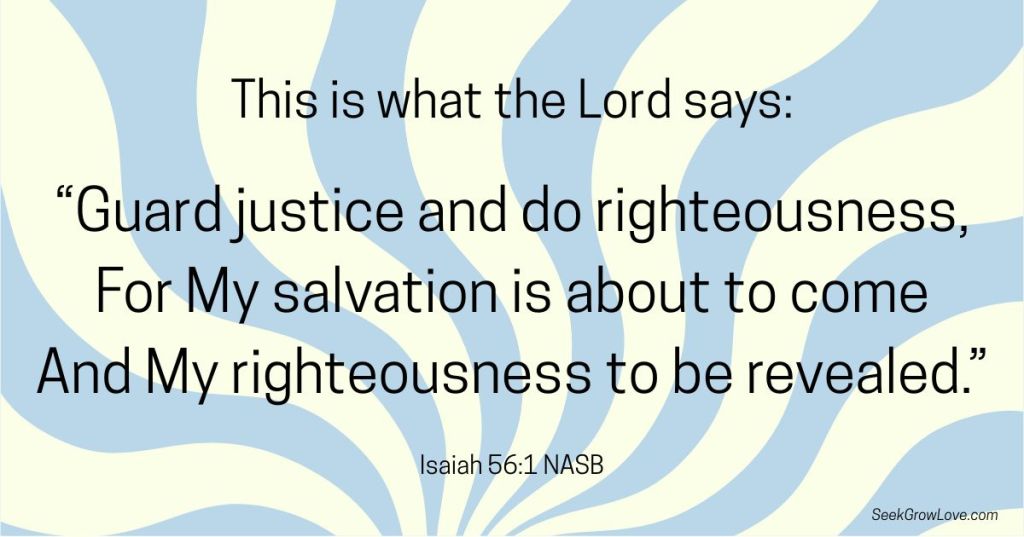
First off, let me clarify: “easter eggs” is the term that is used to describe a hidden surprise, usually in a video game, movie, tv show, etc. The term was coined in 1979 by Steve Wright of Atari, who named hidden surprises in the game Adventure after the holiday tradition of hunting for eggs. There are a couple in today’s scripture that are huge. It starts immediately in Isaiah 56:1 “This is what Yahweh says: ‘Maintain justice and do righteousness, for my salvation is soon to come and my righteousness is soon to be revealed.‘” (REV).
In the above verse, the word that is translated as “righteousness” is tzedekah. You’re going to hear me a lot talking about “sedeq” or “tzedakah”, the word that is normally translated as “righteousness” or “justice” and sometimes “charity” throughout scripture. This is because it is SO PREVALENT throughout scripture (it or it’s root word occurs over 500 times) and yet almost no practicing Christian understands it, or the concept. To translate it simply as “righteousness” is truly a disservice.
Simply put, tzedakah is the understanding that our extremely generous God is the creator of all things and all people, and that as his representative you are to reflect that generosity as a form of religious obedience to the rest of his creation. This is the heart of what Jesus calls the second greatest commandment “loving your neighbor as yourself”, and it also is a way to perform the greatest commandment of loving God with all of your heart (See Mark 12, starting at verse 29). It can be translated as righteousness, justice, or charity. All are applicable, and all at the same time.
I like to translate this verse in Isaiah like this: “Maintain divine law (mitzpah) and do tzedakah, for Yeshua is soon to come, and MY tzedakah is soon to be revealed”. To put this another way; the reason that we should obey God’s word and to be obediently charitable, is because Jesus is coming soon, and then God will show us HIS charity. The word charity here falls short of the full meaning of the word tzedakah, which will be an intense focus for tomorrow’s study, but I feel like it most accurately reflects a good portion of the meaning.
When Jesus was asked what to do to gain eternal life in the age to come, he answered the man and told him to keep the commandments (this is told in multiple accounts, and can be found in Matt 19:16-22, Mark 10:17-22, and Luke 18:18-23). The “mitzpah”, justice or divine law, as it can also be translated, are necessary and critical components to pleasing God. The root of all growth as a servant of God is to do this: maintain divine law (also translated as “justice”), that is, obey God’s word. If you don’t start there, you don’t have life.
I’m not going to belabor tzedakah, because tomorrow’s devotion focuses on that very thing, but I will say I think it is one of the most important, and one of the most overlooked, aspects of Christian obedience in scripture, and one that we fail at consistently. Look it up on wikipedia for a full “flavorful” understanding of the word, and know that there are a huge number of teachings in the Jewish faith on specifically that term which I’ve found extremely enlightening. It’s a critical aspect of salvation, it shows your trust in God.
Here’s the coolest thing: the reason that you should be maintaining divine law and being justly charitable is that JESUS (Yeshua) is coming soon and then the just charity of God will be revealed. If that doesn’t make your toes tingle it should. Most of the time when you see “salvation” in the bible, it’s probably an easter egg, and Yeshua (Jesus) is probably inside. Yeshua, Jesus’ actual name in Hebrew, means “the salvation of God”. You can determine if this is the root word used by digging in to the original language, any time you see “salvation” in the old testament. It’s all over, once you start digging, lots of folks would call that “foreshadowing”.
Isaiah 56:2-7 “Blessed is the man who does this, and the son of man who holds it fast: who keeps the Sabbath, not profaning it, and keeps his hand from doing any evil.” Let not the foreigner who has joined himself to Yahweh speak, saying, “Yahweh will surely separate me from his people,” nor let the eunuch say, “Behold, I am a dry tree.” For this is what Yahweh says, “To the eunuchs who keep my Sabbaths and choose the things that please me and hold fast to my covenant, to them I will give in my house and inside my walls a memorial and a name better than that of sons and of daughters; I will give them an everlasting name that will not be cut off. Also the foreigners who join themselves to Yahweh, to minister to him and to love the name of Yahweh, to be his servants, everyone who keeps the Sabbath without desecrating it and holds firmly to my covenant—even those I will bring to my holy mountain and make them joyful in my house of prayer. Their burnt offerings and their sacrifices will be accepted on my altar, for my house will be called a house of prayer for all peoples.”
Scripture is full of clever word plays that sound even better in the original tongue. Did you catch some of them just now? “Let not the foreigner who has joined say Yahweh will separate me…”. Did you catch the assurance to the faithful eunuch who will be given an everlasting name that will “not be cut off”? That’s probably pretty reassuring to a recently made eunuch. Another thing I notice in the above portion of scripture is that the Sabbath seems to be a prevalent and recurring theme of importance, even for the foreigners. Interesting, isn’t it? Just something to think about.
Here is the heart of the matter: to be effective servants of God, there are just a few things we need to do, and to do fully. We need to follow the commandments (mitzpah). We need to represent God to the rest of His creation, and be righteous, just, and charitable (do tzedekah). We need to love the Lord God with our whole heart, and love our neighbor as ourself, and commit ourselves to obeying God wholeheartedly. These are the things that please God.
REFLECTION QUESTIONS
- The commandments are listed as a critical aspect toward attaining salvation, according to Jesus. Have you got them all memorized, and do you follow them all specifically as stated in scripture? Why, or why not? (the “letter” of the law)
- How effective are you at loving God with your whole heart, and loving your neighbor as much as you do yourself? What can be done to increase either? (the “heart” of the law)
- If you were to give yourself an honest exam, based on the criteria of scripture, how well are you obediently doing the things that lead back to God and to redemption? (the “purpose” or “intent” of the law)
PRAYER
Father God, I need you. Please keep me from getting distracted, and fill my heart with your purpose. Please let me see and hear clearly when you speak to me. Teach me with hidden wisdom. Speak to my heart, and write your laws within it so that I can please you. Help me, Father. Thank you, in Jesus name, Amen.

