Don’t Love with Words?

1 John 3

Monday, October 17, 2022

If you have never heard of G.T. and the Halo Express, 1) you are missing out on quality kids music/plays and 2) sorry, you won’t be able to sing along with my devotions for the next few days.

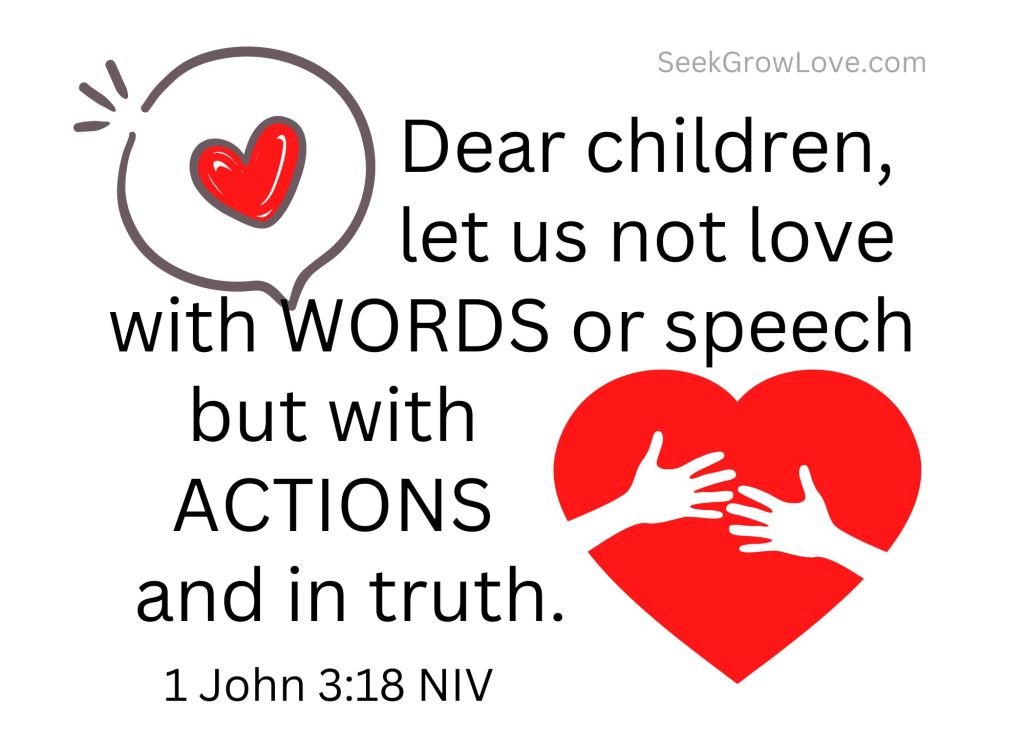
I encourage you to read the whole chapter of 1 John 3, but I am just going to focus on one verse, my favorite – 18, (thanks to memorizing it in this kids play growing up).  The translation I learned was “Dear children, let us not love with words or tongue but with actions and in truth.” 

I have been listening to this one with my daughter, and it has sparked some discussion.  The song breaks it up a little bit, and the line that is sung together is “let us not love with words or tongue.”  When we look at the whole verse, it is easy to know that we shouldn’t stop there.  But for a 4 year old who doesn’t quite understand all the subtleties of language yet, that was confusing.  Why should we not love with words?

This isn’t saying we shouldn’t use our words to be loving, but rather that it shouldn’t stop at that.  If all we do is say that we love someone, it really means nothing.  We need to show people that we love them in how we act, and by being truthful.

It reminds me of James 2:17 “In the same way, faith by itself, if it is not accompanied by action, is dead.”

My dad taught a memorable object lesson to our class when I was growing up.  He took us for a car ride in one of the many winter months (it’s Minnesota – they all blend together) with the windows rolled down.  As he drove, he asked us, “Are you cold?”  When we of course said yes, his response was, “I’m really sorry you’re cold!  I wish you were warm.”  And he kept on driving.  His point was that even if you say the right things, when you can make a difference in the situation (such as putting the windows up) but do nothing, what you say doesn’t matter.

Jesus truly showed his love in action by his sacrifice for us.  We ought to show others that we love them, not just tell them.

It is a good reminder for a 4-year-old to be loving in her actions toward her little brother and a good reminder for everyone to be loving in their actions towards anyone they interact with.

~Stephanie Fletcher

Reflection Questions

  1. When have you found yourself saying the loving thing – but not showing love with your actions? What problem is created here? How can you fix this?
  2. According to the rest of the chapter what else do our actions show?

Continue in Him

1 John 2

Sunday, October 16, 2022   

“My dear children, I write this to you so that you will not sin.”

That is how this chapter starts off.  Good plan, more easily said than done.  Thankfully, John doesn’t stop writing here.

“But if anybody does sin, we have an advocate with the Father—Jesus Christ, the Righteous One. He is the atoning sacrifice for our sins, and not only for ours but also for the sins of the whole world.”

If you are reading this, you probably already know it.  You have read it before – in this chapter, or elsewhere in the Bible.  But isn’t that a good reminder?  We are not perfect, but thankfully, we have an advocate. 

This whole chapter is full of “good reminders.”  And John presents them in little different ways.

In verses 12-14 he went about it in a positive way.  Instead of saying don’t forget this, don’t slip back into your old ways, he turns it to the positive and says “you are strong” and “you have overcome the evil one.”

He approaches it from the other side too in the next verse saying “Do not love the world…”

But throughout the chapter, I am drawn back to the positive affirmations that he writes to his audience.

20 But you have an anointing from the Holy One, and all of you know the truth

24 As for you, see that what you have heard from the beginning remains in you. If it does, you also will remain in the Son and in the Father. 25 And this is what he promised us—eternal life.

28 And now, dear children, continue in him, so that when he appears we may be confident and unashamed before him at his coming.

Good instruction can come from both telling people what not to do, but also telling people what to do, and telling them to keep doing the good they are doing.  It is an encouragement as well as a reminder, and that sticks with me today as I write this.

~Stephanie Fletcher

Reflection Questions

  1. Reread 1 John 2 looking specifically for the things John tells us to do, as well as those things we are not to do. Which instructions do you find easiest to follow? Where do you need a little push in the right direction to keep yourself on the right path – or off of the wrong path?
  2. What do you think our “advocate with the Father—Jesus Christ, the Righteous One” sees you doing and would tell you to keep doing? What will you do today to keep doing that! How will you ‘continue in him’?

Spiritual Darkness – and Light

1 John 1

Saturday, October 15, 2022

It is impossible for me to read this opening statement in 1 John 1:1 without immediately thinking of its strong parallel to John 1:1. John 1:1 says in the beginning was the word and 1 John 1:1 says that all they have seen and heard and touched – that was from the beginning (what beginning?) concerning the word of life. John was with Jesus from the beginning of his ministry, so he may be referring to the beginning of Jesus’ ministry. There is a lot to unpack here, so I will leave that for another day, but you can think about some of these correlations.

John says that they are proclaiming the word so that his readers may have fellowship with John and his community, as well as fellowship with God and Jesus through the ministry of the word (that is an implication of having true fellowship with John et. al.). Also, John emphasizes that he is writing these things so that joy may be made complete. True joy, that transcends all circumstances, is a direct result of having fellowship with God and Jesus in a life of faith (see also James 1 for insight into the relationship between authentic faith and joy).

John then gets into a dichotomy between light and darkness. God is light and in him there is no darkness, therefore if we are walking in darkness (not in the midst of darkness but having elements of darkness ingrained into our life) we do not have fellowship with God. We are deceiving ourselves if we think that we can live a dualistic life embracing both God’s will and abiding in the ways of the world. Purity of heart precludes us from walking in darkness. If we’re doing this (walking in darkness), the implication is that we are liars and live a life that is antithetical to the truth.

Conversely, if we walk in the light (i.e., the truth, abide in the word), we have true fellowship with one another and we have our sins cleansed by the blood of Jesus. Walking in light does not mean that we have no sin, that would be a ridiculous assertion, but it means that we do not live lives defined by sin. We all stumble, but there is a difference between falling short and living in sinful pursuit. Our self-deception can come from being double-minded, or from a false notion that being forgiven makes us sinless. We are free from the bondage of sin through Christ, but we still fall short of perfection. In confessing our sin (and repenting of it), we are cleansed and through our faith are counted as righteous. If we don’t acknowledge our sinfulness, how can we confess (we can’t!)? Worse than deceiving ourselves, if we deny that we sin, we make God out to be a liar!

It’s not a good look to make God out to be a liar, so I would strongly encourage each of us to take into consideration our behaviors and not try to explain them in a way that denies the authority of scripture to call out wicked behavior and attempt to justify our (sinful) behavior as acceptable. Sin is offensive to God, so we should not attempt to explain it away as inoffensive. Confession is a powerful tool, and we should be quick to utilize this, rather than explain away or double down on any sinful elements that encroach on our lives. It is better to suffer for doing what is right now (deny our sinful desires) than to embrace sin and deception now and miss out on the amazing Kingdom of God (which will trump all imaginable satisfaction in this life).

-J.J. Fletcher

Reflection:

1. Do I regularly confess my sin to God? Do I confess my sin to other believers (1 or 2 people who you can trust) and reap the benefits of having accountability in brothers or sisters (who likely have had similar struggles) that can speak truth into my life?

2. What am I doing that could constitute self-deception? How might you assess and address this?

3. What relationships do I have that allow people to speak truth into my life? Do I surround myself with yes men? Do I live in an echo chamber? What changes can I make in my life that can help me more effectively eliminate sinful habits?

What is Love?

I John 5

Our parents are a very important part of our lives, and it is a blessing to have earthly parents who are godly and care for us. But not everyone has such parents. Nevertheless, John says that everyone who “believes that Jesus is the Christ has been born of God” (v. 1). The greatness of that reality cannot fully be expressed in word. Figuratively, God has “given birth” to us as a parent gives birth to children. God is now our parent! And he is unlike any earthly parent. And since we have been born into God’s family, we are to love all of God’s children, for they are our brothers and sisters.

But what does it mean to love our brothers and sisters in the Lord? As John states, it is “when we love God and obey his commandments” (v. 2). What this means is that our expression of love within God’s family stems first and foremost from our love for God and our willingness to submit to his authority and obey his commandments. That might not be the way that some of us look at what it means to “love” one another perhaps because we have contrived an idea of what love means from our culture rather than from Scripture.

There’s no question about it, John gives us a clear definition: the love of God is that “we keep his commandments, and his commandments are not burdensome” (v. 3). Certainly, to love God entails many of the things we conceive of when we think about what it means to “love.” In his letter to the Colossians, Paul gives us a list of the commandments of God that we are to obey as his children:

…but now you too must put away all these things: anger, rage, malice, defaming speech, obscene talk out of your mouth. 9Do not lie to one another, since you have stripped off the old self with its practices….12Therefore, as God’s holy and beloved chosen ones, put on bowels of compassion, kindness, humility, meekness, patience; 13bearing with one another and forgiving each other, if anyone has a complaint against another. Just as the Lord forgave you, so you also must forgive.” (Col 3:8-9, 12-13)

Many of these behaviors probably fit into our box of what “love” looks like, but our world is filled with contradictions and disagreements about how to practice it.

But John reassures us that we need not succumb to the pressures of the world when it comes to how to love, for as God’s children, we have overcome the world through our faith in Jesus, the Son of God (v. 5). Let us live with love that comes from a heart of obedience that is willing to surrender our desires to the Creator, knowing that if we love him properly, then we will love each other as well.

-Jerry Wierwille

Today’s Bible reading passages can be read or listened to at BibleGateway.com here – Hosea 7-8 and 1 John 5

The Real Love Chapter

1 John 4

This chapter starts out with an admonition to “test the spirits to see whether they are of God.” Not every teaching or spirit is true. There is a very important test which can be used to know if a spirit is from God, or not. “By this you know the spirit of God: Every spirit that confesses that Jesus Christ has come in the flesh is of God” (4:2).  The test does NOT say:

  • that Jesus Christ has come in the flesh and yet is fully God
  • that God has come in the flesh as Jesus Christ, taking on a human nature
  • that Jesus Christ came from some pre-existent state into the flesh.

We must be very careful to read the text for what it says and not read into it what it doesn’t say! The phrase “come in the flesh” means that Jesus the Christ (Messiah) is a real human being, not just dressed up like one.

1 John 4 is actually the “love chapter” in the Bible as love is mentioned 26 times, almost three times as many times as in 1 Corinthians 13 (9 times). A friend once read this chapter as a devotional thought on Valentine’s Day, and it stuck with me as the “love chapter.” So much so that when I read it last February 14th, I thought that maybe the children’s song could also go “Yes, God loves me, yes, God loves me… the Bible tells me so.”  Ultimately, it’s God’s love that ignites our love for others through His Son, Jesus the Messiah. A key verse that summarizes this chapter of love showing how love is of God is verse 9.  “In this is love, not that we loved God, but that He loved us and sent His Son to bethe propitiation for our sins.”

God took the initiative, motivated by love, to remedy our sin problem.

Knowing that “God is love” (4:8,16) should motivate us to love others. But the author is not calling for a hippie kind of “All you need is love, love”. He is admonishing us to a love of other “brothers” who believe that Jesus, the human Jesus, is the Messiah/Christ (5:1). This admonition to love is a call for unity among like-minded believers, because they are family as the children of God. The way we love other like-minded believers whom we can see demonstrates how much we love God, whom we can’t see. And this commandment we have from Him, that the one who loves God should love his brother also (4:21).

Beloved, let us love one another, for love is from God, and whoever loves has been born of God and knows God. (4:7)

Bill & Stephanie Schlegel

(Originally posted for SeekGrowLove on Sept 17, 2019 – good enough to share again! Thank you Bill and Stephanie.)

Read or listen to today’s Bible reading plan chapters at BibleGateway.com here – Hosea 5-6 and 1 John 4

What We Will Be

1 John 3

I John 3:2 reads in part, “Beloved, now we are children of God, and It has not appeared as yet what we will be….”   It has not appeared as yet what we will be.  I am now in my 50’s.  If you are my age or older, you have had the pleasure to watch the kids around you grow up.  When they were little, it was hard to imagine what they would become as adults.  Some of those little kids that I knew many years ago have grown into wonderful adults.  Even some of those irresponsible teenagers have done well for themselves.  Some have become doctors, nurses, professionals, experts in their field, responsible caring parents, teachers and business owners.  All I can say is “Wow.”  This was hard to imagine when they were very young.  “It has not appeared as yet what we will be…”  We can’t yet imagine what we will become. 

Of course, the 1 John 3:2 also adds, “…we know that when He appears , we will be like Him, because we will see Him just as He is.”  This describes the transformation that we will experience at the return of Christ.  One day we will find ourselves in the very image of Christ. 

However, in the meantime, what will you become?  How will you change and grow?  John’s words here are hopeful and optimistic.  It has not appeared as yet what we will be…  The possibilities are great.  God, in Christ, has put you on a road to growth and transformation and new discoveries.  You will face joys and sorrows.  You will suffer.  You will be challenged.  You will be tempted.  You will have victories and defeats.  Yet, the Lord is leading you to Him.  It has not appeared as yet what we will be.  So, go out and discover and find that very thing.  Become the person that God has created you to be.  Grow into the image of Jesus Christ.

-Pastor Scott Deane

You can read or listen to today’s Bible reading plan passages at BibleGateway.com here – Hosea 3-4 and 1 John 3

Merry Christmas

1st John

On Christmas, it’s appropriate that we read 1 John. It may seem better that we read Matthew or Luke, but 1 John distills the life and teaching of Jesus from the perspective of an old man. If we want to hear an old, inspired teacher dispensing his wisdom, John (and the books attributed to that name) are books to which to turn. 


John is old and he is concerned with the most important things in life. He testifies about Jesus, the light who comes into the world, to fulfill the joy of himself and his readers. Joy is a chief concern of the old man. Jesus doesn’t turn us into a curmudgeon. That’s because Jesus brings us to a God who is greater. 
A God who is light.  A God who is love.  That’s a God of Joy. 

If we want to be in Christ, to have this God who fulfills joy, to be counted among the children of light and love, we must keep the commands of Christ. We must walk as Jesus walked. But what is the command. When John says the old command they have heard from the beginning, he is not referring to the law. He is referring to the command from the beginning of the teaching of Jesus. The message which we have heard from the beginning, that we should love one another.(3:11) Just as Christ laid down his life for us, we should be willing to lay down our life for our brothers and sisters in love (3:16). We believe in the name of Jesus and love one another, just as Christ commanded us (3:23). More verses that tell us to love one another because of the love of God : 4:7-8, 4:10-12, 4:19-21.


The command is to love our brothers and sisters. 

But we are also commanded to NOT love the world. Of course, this doesn’t mean to not love people. The “world” according to John, are all the things that are not of God: sin, power, money, control, hate. We so easily love sin, which gives us momentary pleasure, usually at another’s pain. We love power and money and control, so that we can continue to sin without consequence in this world. And hate allows us to have superiority to others even as we hurt them, because we think we are better. 


AVOID THAT. Avoid those idols!

Know that if you keep the command to love, if you believe in the name of Jesus, and allow him to guide you in light and love, the God of joy is going to give you a joy that lasts forever. We are promised eternal life. 


May you, my brothers and sisters, experience the JOY that God gives. 

May you LOVE one another, as is the command of Christ. 

May you avoid sin and the love of the world, and have PEACE in yourself.

May you experience eternal life, both now and forevermore, and have HOPE. 

And with that HOPE, PEACE, JOY, and LOVE, may you have a very, very…


Merry Christmas!

-Jake Ballard

Today’s Bible passage can be read or listened to at BibleGateway here – 1 John.

Tomorrow we read 2nd & 3rd John.

The Love Chapter

1 John 4

i John 4 11

This chapter starts out with an admonition to “test the spirits to see whether they are of God.” Not every teaching or spirit is true. There is a very important test which can be used to know if a spirit is from God, or not. “By this you know the spirit of God: Every spirit that confesses that Jesus Christ has come in the flesh is of God” (4:2).  The test does NOT say:

  • that Jesus Christ has come in the flesh and yet is fully God
  • that God has come in the flesh as Jesus Christ, taking on a human nature
  • that Jesus Christ came from some pre-existent state into the flesh.

We must be very careful to read the text for what it says and not read into it what it doesn’t say! The phrase “come in the flesh” means that Jesus the Christ (Messiah) is a real human being, not just dressed up like one.

1 John 4 is actually the “love chapter” in the Bible as love is mentioned 26 times, almost three times as many times as in 1 Corinthians 13 (9 times). A friend once read this chapter as a devotional thought on Valentine’s Day, and it stuck with me as the “love chapter.” So much so that when I read it last February 14th, I thought that maybe the children’s song could also go “Yes, God loves me, yes, God loves me… the Bible tells me so.”  Ultimately, it’s God’s love that ignites our love for others through His Son, Jesus the Messiah. A key verse that summarizes this chapter of love showing how love is of God is verse 9.  “In this is love, not that we loved God, but that He loved us and sent His Son to be the propitiation for our sins.”

God took the initiative, motivated by love, to remedy our sin problem.

Knowing that “God is love” (4:8,16) should motivate us to love others. But the author is not calling for a hippie kind of “All you need is love, love”. He is admonishing us to a love of other “brothers” who believe that Jesus, the human Jesus, is the Messiah/Christ (5:1). This admonition to love is a call for unity among like-minded believers, because they are family as the children of God. The way we love other like-minded believers whom we can see demonstrates how much we love God, whom we can’t see. And this commandment we have from Him, that the one who loves God should love his brother also (4:21).

Beloved, let us love one another, for love is from God, and whoever loves has been born of God and knows God. (4:7)


Bill & Stephanie Schlegel

His Commandment

1 John 3

IMG_0009

The World’s Relation to God’s Children

This chapter mentions two ways in which the non-believing world reacts to the children of God:
1. The world does not know us (that we are God’s children) just as it did not know Jesus, that Jesus is God’s Son (3:1).
2. The world hates us (3:13). The world is like Cain, who hated and even murdered his brother.
Especially in 3:11-18, the author instructs us not to be like the world and hate our brothers, our fellow believers in Messiah Jesus.
Knowing what Love is, I John 3:16, the parallel to John 3:16

“By this we know love, because he laid down his life for us. And we also ought to lay down our lives for the brethren.”
This verse encouraged me (Stephanie), so much during the hardest time of my life, which was just after my husband came to the understanding of the one true God and His Messiah Jesus – and the mistreatment that followed in result of his faith. The verse really helped me to focus on what real love is – to think how Jesus humbled himself to death on a cross. He was mistreated and ill spoken of; they even took his clothes away from him. That is how I know what love is, and I could take courage because of what Jesus went through and lay down my life for the brethren, disregarding the shame.

Jesus didn’t come to give a license to sin, but to remove sin, 2:4-10
At first glance the author may seem to contradict himself. In 1:8-9 he says we sin, but in 3:6 he says “no one who abides in him (Jesus) sins”. I think what the author is saying is that believing in Jesus does not give people a license to sin. Believers may sin (and there is a way to forgiveness, 1:8-9) but a life characterized by continual sin is not one in step with abiding in Jesus. Jesus didn’t come to give a license to sin. On the contrary, the writer gives two reasons why Jesus “appeared”:
1. To take away sin.
2. To destroy the works of the devil
Jesus and a believers life in Jesus does not give license to sin, but rather removes and destroys sin.
Theme Verse
1 John 3:23 could perhaps be considered a good theme for the entire epistle:
“And this is his commandment, that we should believe in the name of his Son Jesus Christ and love one another, just as he has commanded us.”

Bill and Stephanie Schlegel

Some observations from 1 John, chapter 2

1 John 2 1

“From the beginning…”


The phrase “from the beginning” which was used in the first verse of the book (1 John 1:1), is used 5 more times in chapter 2. In John 1:1 “that which was from the beginning” was that which they had heard, seen and touched, “the word of life”. This “beginning” refers to Jesus the Messiah and his ministry on earth communicating God’s word, not to the beginning at creation. The occurrences of “from the beginning” in chapter 2 are verses 7, 13, 14, and 24 (two times). It is important to keep in mind that “from/in the beginning” in the Scriptures does not always refer to the Genesis creation.


Context must help determine which “beginning” is meant. For instance, in the Gospel of John, the phrase “from the beginning” does not usually refer to the creation, but to Jesus ministry on earth. Note these references:

  • “For Jesus knew from the beginning who those were who did not believe, and who it was who would betray him” (John 6:65)
  • “So they said to him, ‘Who are you?’ Jesus said to them, ‘Just what I have been telling you from the beginning’” (John 8:25).
  • “I did not say these things to you from the beginning, because I was with you” (John 16:24).
  • “And you also will bear witness, because you have been with me from the beginning” (15:27).

In each case mentioned above, from the beginning means the beginning of Jesus’ ministry.

With only two exceptions (John 8:44 and 1 John 3:8 which refer to the devil) “from the beginning” in the Gospel of John and in the Epistles of John (1 John 1:1; 2:7, 13, 14, 24; 3:11 and 2 John 1:5-6) refers to the beginning of Jesus’s ministry. This may help us understand “In the beginning…” of John 1:1. Some One God believers see John 1:1 as a reference to the beginning of Jesus’ ministry. Similarly, Luke mentioned “those who from the beginning were eyewitnesses and ministers of the word” (Luke 1:2). Mark 1:1 mentions “the beginning of the Gospel of Jesus the Messiah.”


“My little children”


Several times the writer refers to those whom he writes as “my little children” or “children” (2:1, 12, 18, 28). This should not be understood as if the writer is derogatorily chastising his listeners for being immature. Rather, these references should be understood as a terms of endearment and care, just as when he calls his listeners “beloved” (1 John 2:7, 3:2, 21, 4:1, 7, 11). As children of God (3:1-2), those that believe that Jesus is the Christ are a family, brothers and sisters, who must love one another (5:1).


An Advocate with the Father


The writer explains that we do sin, but there is a path to forgiveness (1 John 1:8-10). He writes to us “so that we may not sin, but if anyone does sin, we have an advocate with the Father, Jesus Christ the righteous.” Jesus is our advocate, like a lawyer on our side. This should give us great encouragement. Jesus is the honest, righteous lawyer on our side. He is for us. As an expert lawyer, Jesus knows the rules. He knows how to take our case before the Father. He has access to the Father and successfully intercedes for us (cf. 1 Tim. 2:5 and Hebrews 8:1).


We lived in Israel and all our children were born there. Most countries do not grant citizenship to foreign children by virtue of being born in the country. Two of our young adult children applied to become citizens in Israel. They were denied several times over three years. However, not long ago a lawyer, an advocate, took up their case and presto, my children received their citizenship. The lawyer knew the rules, had the connections, authority and knowledge on how to present my children’s case, and succeeded. Jesus is our expert, righteous, successful advocate before the Father.


“Do not love the world…”


The author’s admonition to “not love the world or things of the world” are perhaps the best known verses of chapter 2 (vs. 15-17). He defines what “loving the world” is: the lust of the flesh, the lust of the eyes, the pride of life. It is a love of the way of the world, or of this world’s system. This doesn’t mean that we shouldn’t have an appreciation for the beauty and grandeur of God’s creation, the work of God’s hands, which is “very good” (Gen. 1:31). After all we wait for the regeneration of this world, and indeed the regeneration of this world’s system (Matt. 19:28, Heb. 2:5).


“The last hour”  and “anti-christs”

The author says it is the last hour. What a long hour it has been! He knows that it is the last hour since many anti-christs had already come. Specifically, here he says that the anti-Christ (anti-Messiah) is anyone who denies that Jesus is the Christ (the Messiah). The text does not say, as many traditional trinitarian Christians say, that the anti-Messiah is anyone who denies that God is the Messiah, or that the Messiah pre-existed as God. Rather, the text says that the anti-Messiah is anyone who denies that Jesus, the man Jesus, is the Messiah. “Christ” (Messiah) is never a title for God himself.


Of these anti-christs, the author says: “They went out from us, but they were not of us; for if they had been of us, they would have continued with us…” (1 John 2:19). It is easy to see how a text like this could be mis-interpreted and mis-applied. Especially as centuries passed, anyone could use the text to condemn any kind of a reformer. For instance, Catholics could apply it against Protestants.  Today it is leveled against anyone who denies that Jesus is God. But in its original context it was directed against anyone who denied that the man Jesus is the Christ (Messiah).


The promise of God – eternal life

1 John 2:25 says that God has promised us eternal life (immortal life in the age to come). We can take comfort and joy that God is pretty good at keeping His promises.


Having confidence, and not shrinking back in shame


1 John 2:28 says that if we abide in Jesus, that is, live according to knowledge of who he is, we can have confidence so that when he appears, at his coming, we won’t shrink back in shame. Since we know who Jesus is — the Messiah of God the Father, risen from the dead, exalted to God’s right hand, appointed to rule the world, we can look forward to his return. There is a similar admonition in Hebrews 10:39: “But we are not of those who shrink back and are destroyed, but of those who have faith and keep their souls.”

-Bill Schlegel