One Bad Woman

Old Testament: Ezekiel 27 & 28

Poetry: Psalm 102

New Testament: Revelation 17

     Revelation 17 begins a section about “the great harlot,” or Babylon the great (17:1) which finishes in chapter 18. One of the seven angels from the seven bowls introduces the topic, and later John is shown the bride of Christ, meaning the new Jerusalem (21:9‑10, perhaps by the same angel). So, in these chapters John sees two cities portrayed as women, one a pure bride partnered with Christ, and the other an immoral prostitute partnered with the antichrist. God is making the sides in the conflict clear and wants us to be clear about our choice.

     Babylon’s fall had been announced in 14:8 and 16:19 – from those verses alone we know that it made nations drunk on the wine of its immorality and was given the wine of God’s wrath to drink. Revelation is picking up from Old Testament texts about Babylon with a somewhat different feel, there Babylon brought punishment on countries for God in war. Babylon was described as itself being the cup of God’s wrath which those nations drank from, maddening them. But after its work was done God turned against Babylon, and the city was also defeated (Jeremiah 25:15ff; 51:7, 11). With Revelation Babylon the great’s immorality is key, and it brings destruction to others by association; it is then destroyed for what it did to God’s servants, and the destruction comes at the hands of its allies.

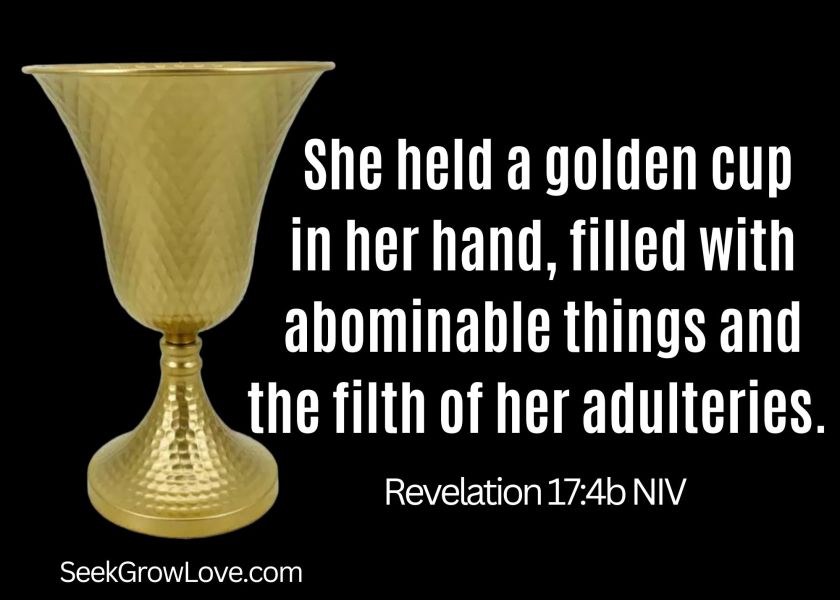
     The vision shows Babylon as a wealthy, richly dressed prostitute, drunk on the blood of God’s servants and offering her immorality from a valuable cup. She is sitting on “a scarlet beast, full of blasphemous names, having seven heads and ten horns,” which is a simple depiction of the Beast from Revelation 13:1. We may be meant to see Babylon as trying to use the Beast, in riding on it, but the Beast uses Babylon, gaining influence from it. In 17:18 we are told that Babylon is the “great city” that reigns (or “has a kingdom”) over the kings of the earth. The identity of the city remains in dispute, but like so much about Revelation it should become much clearer later. The city is presented like an imperial capital, though some authors want to treat it as a culturally unifying site important for its influence in other ways.

     People often question how ‘literally’ to take things in scripture, particularly if they don’t see how events favor a near-term fulfillment. The reestablishment of Israel in 1948, for example, was highly significant for earlier generations in the Church of God but many other groups doubted it would ever take place. As another example, when the two witnesses die their bodies are seen by “the peoples and tribes and tongues and nations” and “those who dwell on the earth rejoice over them” (11:9, 10). In 1962 the communications satellite Telestar I launched, and it was hailed as allowing live broadcasts to be relayed around the world. A few years earlier people would have thought in terms of the witnesses’ photos being published in newspapers. And technology keeps advancing, along with the speed at which changes increase. The iPhone was introduced in 2007, and it is thought that already over two‑thirds of the world’s population has a smartphone – a much simpler way for ‘everyone’ to be shown events happening anywhere in the world. I’ve begun to wonder if the fact that those devices permit use of translation services, which at least partially undo God’s choice to confuse the languages at Babel/Babylon (the name through Hebrew and Greek) could end up relevant to the fact of Babylon the great being the name given for the city, and an aspect of its influence. What is a global false religion without the ability to communicate globally, after all? It’s just a thought.

     I find it disturbing to think that the corruption pictured in Revelation 17 with Babylon the great could come to pass through human failings. But I think that may be part of what God wanted us to recognize, that even before any supernatural power got involved the situation was awful. And that could be why the end of the age comes when it does, because things reach the point that it is time for change.

     Lord, I do not feel endangered today, where I am, but I know you have servants who face risks in many countries around the world today. Please strengthen the hearts of your people, and protect them. They are faithful, help them to remain faithful. Let them trust you and stand firm. Keep them from the evil one, and sanctify them in the truth. And Lord, as I do not feel endangered, let me be bold for you. Let me not forget what your son has done for me. In his name I pray this, Amen.

-Daniel Smead

Reflection Questions

  1. Do you ever struggle over whether a scripture ought to be seen as literal or figurative? What helps you to make up your mind about that?
  2. Is there a Christian or a ministry that you regularly pray on behalf of? If so, consider writing them a note today to share your appreciation for them. If not, consider saying a prayer today for someone whose ministry matters to you who you haven’t seen in a while.

7 Bowls

Old Testament: Ezekiel 25 & 26

Poetry: Psalm 101

New Testament: Revelation 16

     I tend to think of the seals, trumpets, and bowls of God’s wrath as a sequence, but when I’m away from reading Revelation for a while I can lose track of how late in the book the bowls appear. Way back at the sixth seal we are told of God’s wrath, and that people would try to hide from it in caves and beneath rocks (6:15-17). Now, in chapter 16, that wrath comes. Its targets, as Paul stated, are not Christ’s followers (1 Thessalonians 5:9); they are people who served the Beast, killed God’s servants, and would not repent. Considering the nature of some of the bowls, it may be hard to imagine how anyone is protected from their impact – but during years of drought God made sure that Elijah ate and drank.

     Several bowls seem to build on earlier parts of Revelation. While the second and third trumpets affected just a fraction of the sea and rivers, they are fully affected by the pouring of the second and third bowls. With the fifth seal a vision came to John of those who died for the word of God, crying out for judgment (6:9‑10), the angel of the third bowl declares that such judgment is happening and is fully justified (16:6). Those with only blood to drink had poured out the blood of the righteous. The comment “they are worthy” is ambiguous, it may describe the martyrs as worthy of being avenged, or their killers as worthy of this punishment. Either interpretation may feel different than how “worthiness” was discussed in chapters 3-5. There worthy believers were dressed in white. There also a great search took place for one worthy to open the seals on God’s scroll, and the lamb was found. But God does not just watch over the righteous, He also does not leave the guilty unpunished (Exodus 34:7).

     Part of the effect of the fourth trumpet was to bring darkness in a third of each day. The fourth and fifth bowls of wrath initially scorched with the sun those who defy God, and then plunged them into darkness. In both cases the people chose to blaspheme God, rather than repent. (I bypassed the first bowl, and the sores it brought; those sores remind me of Job. I see these people as anti-Jobs, beyond trust or accepting help, who simply lash out.)

     The sixth bowl involves the river Euphrates drying up, as preparation for eastern armies to reach the site of Armageddon (in the north of Israel). That is as opposed to the sixth trumpet when an army tied to the Euphrates killed a third of the population (9:15). Also, evil spirits come from the dragon and the two beasts to gather the kings of the world to Armageddon. When the seven seals and seven trumpets were listed there was a lengthy pause after each of the sixth entries, and there is also a pause after the sixth bowl, but this one is fairly short, just a brief comment from Jesus about his coming like a thief.

     With the seventh bowl the fall of Babylon begins (see chapter 18). The worst earthquake in history occurs, and Jerusalem splits in three. Language about the islands and mountains moving (Revelation 16:20; 6:14) suggests there is overlap between the seventh bowl and the sixth seal. Overlap of language also seems to link the seventh bowl with the seventh trumpet (16:18, 21; 11:19). Even if we can tie the timing together for those two moments we can’t say much about the overall chronology of the seals and trumpets. Some of those events are stated to take months or years, and God may just want us to know about all of them but not to understand interconnections.

     The famous four horsemen from the first four seals collectively tie to the devastation of humanity. Whatever it is the “victors” of such conflict may think they have gained, they do not possess the wisdom to avoid fighting the army of Christ. The battle of Armageddon will be massive and destructive, but it will at least be decisive, and it launches a time of peace and restoration on earth.

     Also mentioned with the seventh bowl is hail the weight of a talent (v. 21), which may mean it is a hundred pounds. The heaviest recorded hailstone so far is 2.25 pounds. A bit lighter case, 1.9375 pounds and the size of a softball, left a ten-inch pit where it struck. Why will God use such large hailstones? If the goal is to impress, why not just have a lot of hail? But that has been done. The hail accumulation record is from 1959, when a 54-square-mile section of Kansas received a 19-inch covering of hailstones. I find that much hail difficult to envision already. Amassing a hundred pounds of ice layer by layer in the clouds may only be feasible with a miracle of air pressure. Penny-sized hail requires 40-mile-per-hour updrafts. Grapefruit-sized hail requires 98-mile-per-hour updrafts. Tornadoes do achieve winds over 300-miles-per-hour, but anyway I think you see the issue. Just referring to the weight of the hail may lead us to underplay in our minds the significance of the storm itself.

     But still, why 100-pound hailstones? Perhaps because God will be dealing with people who would seek to hide from judgment beneath rocks, and in caves. And at least some portion of those refusing to acknowledge their sins will be the world’s most powerful and haughty, those who were content with their actions and amassed huge wealth in service of the Beast and Babylon. Some of them might even be sealed in bunkers when the bowls of God’s wrath are tipped out. Perhaps they will check in on events through video, and then just turn off the screens. But God does not intend for anyone to remain comfortably oblivious to the truth, or even comparatively so, in whatever hideaways they find for themselves. A hundred pounds of ice will put a hole in quite a lot of concrete, steel, and pretension. And God has excellent aim (Joshua 10:11).

     Lord, let me not be complacent, comparing myself to those who will one day go far astray. Truly, without your grace, I would be quite different. But no one sets out to be deceived and destroyed. Please help me be observant of others’ needs, not inattentive. The world is a less distressing place than it will be, but even now there are issues I feel I can only bring to you in prayer. Let me pray, but also show me where I should act. Please help me to trust in you, and to keep my compassion and hope. You are a great God, and you continue to work powerfully. In Jesus’ name I pray, Amen.

-Daniel Smead

Reflection Questions

  1. Revelation 16 describes the last plagues God enacts in this age, which finish His wrath (15:1). What do you think it shows us about how God views wickedness? How do you think it might have affected people over the centuries?
  2. Are you sometimes comforted by considering God’s promises to bring judgment on the wicked? Maybe, like you see a rainbow and remember God’s mercy, you can see hail and recognize that He won’t just let things go on forever.
  3. Revelation 6:16-17 refers to people who wished to hide from “the presence of Him who sits on the throne, and from the wrath of the Lamb; for the great day of their wrath has come.” (Revelation 15 and 16 don’t refer to matters that way.) Do you find it jarring to think of Jesus expressing the wrath shown in the chapter?

God’s Two Witnesses

Old Testament: Ezekiel 15 & 16

Poetry: Psalm 96

*New Testament: Revelation 11

Following our strange detail about John eating the Scroll that God gave to him, we are finally going to learn about what the Scroll says through what John tells us! Unfortunately, it is very detailed, also strange in some ways, and has been the cause of many interpretations over the past 2,000 years. However, we are going to do our best to humbly try and understand what John says in this passage, while focusing on his main point. I don’t assume that my interpretation is 100% correct, so I invite all of you to critique it by looking at the text itself and speaking with other Christian teachers that you trust.

We are introduced to two Witnesses, or two Martyrs, who are proclaiming to people “their testimony”. Now, throughout Revelation, we see that John testified to “the testimony of Jesus Christ” (1:2, 9) and that the Christian martyrs from chapter six also had a “testimony” that they proclaimed (6:9). We will learn later that Christians are able to overcome Satan using “their testimony” as well (12:11). Narratively speaking, it is likely that these two Witnesses have the same testimony as John and the Christians. That testimony is the gospel message about Jesus’ death, resurrection and eventual return to establish God’s kingdom, as can be seen throughout the whole letter. In other words, the two Witnesses are two individuals that are faithfully preaching the gospel to those around them.

There has been speculation as to whether these are literally two individual people that are to come in the future, or whether they represent what the churches are supposed to be doing, since they are described as lampstands like the churches (compare 1:20 and 11:4). I assume that these are representatives for what the churches, and us, are supposed to be doing, but also don’t believe that John’s main point is in their identity; John’s main point to this vision is what is produced by their faithful preaching of the gospel.

After the two Witnesses are killed, resurrected, and exalted to God’s space, the people actually repent of their evils! In 11:13, it states that people “gave glory to the God of heaven”, which is repentance language. As we saw in the previous seven seals and seven trumpets, and will see in the later seven bowls, God’s judgment actions are not enough to bring about repentance; but the faithful preaching of the gospel message is enough, even if Christians die for it!

My encouragement to you today is to behave like these two Witnesses; faithfully preach the gospel, even at the expense of your own life. Whatever the cost may be for you, the reward is going to be more than you ever imagined! And just like the story of Revelation states, that reward is coming soon, after the Church does her job of faithfully preaching to the nations. Are you ready for that day to come?

Talon Paul

(originally posted for SeekGrowLove on Nov 13, 2019)

Reflection Questions

  1. As Talon asked, “Are you ready for that day to come?” That’s the most important question.
  2. Whatever your age or occupation, how can you help preach the gospel?
  3. What is your testimony of Jesus Christ and his Father and God? Who needs to hear it?

Your Role in Revelation

Old Testament: Ezekiel 4-6
Poetry: Psalm 92
New Testament: Revelation 7


My apologies, I messed up the schedule and talked about Revelation 5 rather than 6 yesterday, so today we’ll get a lot of Revelation! I am writing this from somewhere in the middle of Indiana with about 27 of my brothers and sisters in Christ. Please pray for all those going to ReFuel South. Please pray for our safety and great blessings to those hosting it! I also pray the worship and preaching will glorify God and encourage the walk of faith for all attendees!


Most little girls love horses. Horses are beautiful, graceful, and strong. I, however, have a healthy fear/respect for horses. A long time ago, I volunteered with a program that matched horses with kids with disabilities. I loved the kids. However, I spent most of the time grooming a horse that knew I feared him and took every advantage of that… including releasing some methane every single time I brushed his backside. Ugh. So you can imagine I find the visions of the four horses of the apocalypse especially disturbing. In fact, most of yesterday and today’s reading was pretty gruesome. Ezekiel starts out eating scrolls that taste like honey but ends the reading with foretelling about the great destruction of Israel. One third is killed by fire, one third is killed by the sword, and one third will be saved but scattered across the nations. Keep this in
mind for tomorrow’s reading in Revelation. Revelation starts with the horses representing the conqueror, death, famine, and war along with the seals representing the martyrs and terror.


Thankfully, we move on to the 144.000 chosen from the tribes of Israel. But then, THEN, WE are mentioned!!! Starting in verse 9, WE are “ the every nation, tribe and tongue,” wearing white robes shouting, “Salvation to our God who sits on the throne, and to the Lamb!”


When the reading of the Old Testament and Revelation gets a little frightening, It is these promises of God to which I cling… Much like on the few occasions I ride a retired horse on a worn park trail!

-Maria Knowlton

And the editor apologizes for yesterday missing that we are starting Ezekiel with 3 chapters for the first few days in order to get the rest of the Old Testament to squeeze into the rest of the year. So you might need to play a little catch-up to get in Ezekiel 3. Sorry. But, while we are talking schedules, I am starting to put together the Bible reading plan for next year. If you have a preference on what that might look like (chronological, 1-3 readings a day, etc…), leave a comment or let Marcia know. Thank you for Seeking, Growing & Loving with us!

Reflection Questions

  1. Are you prepared for your role in Revelation? Do you know and confess the ones who hold Salvation?
  2. How can you practice for your part today?
  3. Why do you think God gave both Ezekiel and Revelation to the audiences they were originally written for, as well as saved for you and I?
  4. What do we learn about God in our reading today?

Visions of God

Old Testament: Ezekiel 1 & 2

Poetry: Psalm 91

New Testament: Revelation 6


There are so many reasons I am so thankful for the Holy Word of God. I don’t really have enough time to tell you all about them right now but there was one I just thought of while reading today’s scriptures…

Revelation describes some fairly scary creatures and situations. I am very glad that I get to read about it and know what is going to happen first!


Both Ezekiel and Revelation reveal visions that are wild, brilliant, and fascinating….. But lead to very different ramifications for the people to whom God revealed it.


Ezekiel was given the vision because of the oncoming punishment He would send to the rebellious people of Israel (thankfully God gave them hope for the future as well but that is in a future reading).


Revelation is very different… the visions and prophecies are for those who love the Lord and follow the teachings of Christ. Revelation 5 is a beautiful vision of introducing the only one who is worthy of opening the seals of the scrolls, Jesus Christ, the lamb who was slain.


I’ve been a little too busy this week, working my job and preparing to go to ReFuel South (Whoo Hoo) so I didn’t do a lot of research on the meanings of all the visions I read about today. I cannot even pretend to understand it all, but I do know this one thing. I want to be on the receiving end of the Revelation vision… not the Ezekiel vision. Sadly, there is a vision of the future for those who do not want to be with Jesus in the coming kingdom. There is no coming
back from the second death. Not only do I not want to die that second death, I want to be with Christ! I hope to see you there!

-Maria Knowlton

Reflection Questions

  1. What similarities and differences do you find between Ezekiel and Revelation?
  2. What hope do you find in God’s Word for the future?
  3. What do you learn about God from His Word today?

The Throne of Him who Lives Forever and Ever

Old Testament: Lamentations 3-5

Poetry: Proverbs 31

New Testament: Revelation 4


When I was a little girl, I thought God looked something like the pictures I had seen of Jesus but with short hair. So the first time I met Greg Demmitt, I might have stared at him a little longer than socially acceptable. Obviously, I was a bit silly, but Greg was definitely a godly man and a faithful representative of Christ. I was so blessed to have known him and shared a few waffles at Waffle House with him and my family. My heart hurts that he and my uncle, Dan Kizer, both
great, godly men, both died of pancreatic cancer within four months of each other. In my earthly perspective, it was way too soon. Not because it’s from our reading, but because I need it;


Revelation 21: 1-5
1 Then I saw “a new heaven and a new earth,”[a] for the first heaven and the first earth had passed away, and there was no longer any sea. 2 I saw the Holy City, the new Jerusalem, coming down out of heaven from God, prepared as a bride beautifully dressed for her husband. 3 And I heard a loud voice from the throne saying, “Look! God’s dwelling place is now among the people, and he will dwell with them. They will be his people, and God himself will be with them and be their God. 4 ‘He will wipe every tear from their eyes. There will be no more death’[b] or mourning or crying or pain, for the old order of things has passed away.”
5 He who was seated on the throne said, “I am making everything new!” Then he said, “Write this down, for these words are trustworthy and true.”


What a balm for the grieving soul! I can’t get through reading without tearing up with joy…every.single.time.


As far as today’s reading…I got a little emotional whiplash! Lamentations was hard and gruesome to read… One of the commentaries I read said it was a book of sorrow and hope..I must have missed the hope part…except that it does seem God’s people FINALLY realize that they were being punished for their disobedience. But we aren’t told about their deliverance quite
yet. That is a story for another book of the Bible.


After all that sorrow, I read Proverbs 31….which contains the story of so many women I have been blessed to know throughout my life. I alway feel convicted that I don’t quite live up to this description. I alway feel like I can only be good at about a verse or two at a time 😀If you are a girl or woman, look to the women around you to find someone who emulates Proverbs 31. If you’ve been to FUEL you know quite a few! As I have talked about before, we all need good mentors who love the Lord, no matter what our age.


And finally, Revelation 4, our first peak at the throne of God! There is no description of God here (though I’m sure my perception is close) but a splendid description of the throne room and all those worshiping there. I used to think all that singing would be so boring, but then I heard Carrie Underwood sing All Is Well and decided if God gave us that kind of emotion stirring song now, imagine what the Kingdom will be like! But as beautiful as the Kingdom will be, and I am looking forward to seeing it, I really can’t wait to see God’s face, Jesus’s arms and all of those who will be resurrected, my mom, my grandparents, Dan, and Greg.

-Maria Knowlton

Reflection Questions

  1. Who has been a godly mentor for you? What have you learned from them? If no one comes to mind – pray and find one. And even if you don’t know everything and do everything right – you can be a mentor to someone who could use a good example, encouragement and accountability. Pray for an opportunity. And seize it.
  2. How does Proverbs 31 challenge you?
  3. What do you like most about the description of God’s throne room in heaven in Revelation 4? What do you look forward to in God’s Coming Kingdom?

Old Testament: Lamentations Intro – see below

Poetry: Proverbs 29

New Testament: Revelation 2

Disclaimer: I know Proverbs 27:2 says not to brag about yourself, but I’m about to brag about my kids so it’s ok!


Today my husband, daughter and I met our son at a car dealership where my son wanted to purchase a car. He wanted our opinion on the car and it was a great excuse to meet him halfway between our home and his college. He had done quite a bit of research on the car and made all the financial arrangements himself. Between watching his interactions with the sales people and his new haircut, it just hit me how much he looks and acts like…an adult! Our daughter also seems to make a habit of making good choices. She always helps me around the house, is a leader on her cheer squad, and is very kind.. Both of my kids are the light of my life and I am so proud of them.


I would love to say that they are doing well because Dan and I are such awesome parents, but they have always been just easy to parent with teachable hearts. Even the times that I reprimanded them for a mistake or something I didn’t agree with, they made corrections and that was, usually, the end of that issue. Now, just because we haven’t had to be strict does not mean we forewent discipline. We spent a lot of time educating our kids on proper behavior,
respect, and morality based on the Word of God.


I like how the Message translates Proverbs 29:15. “Wise discipline imparts wisdom: spoiled adolescents embarrass their parents.” Now I don’t worry too much that my kids’ behavior will embarrass me, I worry that misbehavior will bring pain to them… which brings pain to me.


The entire book of Lamentations is a statement about this effect. The sins of Israel affected Jeremiah mentally and physically. He suffered right along with them even though he listened to God. God, of course, listens to him, and eases his suffering. However, I do think this points out the pain a parent/teacher/mentor feels when they have tried to disciple someone in the Lord and that person decides to reject it. When that person faces a consequence of a bad choice, it hurts the one who tried to help them.


Revelation 2 is a chapter full of both praise and discipline for the 4 churches mentioned. Jesus, through John, praises the churches for their good works but also disciplines the churches against some of their current practices to save them from destruction. The church at Thyatira was warned about a woman teaching “cross-denying, self indulging religion”(The Message). In my previous devotion, I mentioned a modern day “preacher” who is doing this and I am sure she is not alone, preaching a gospel of “your truth.” Later, I was reading through the comments of this Not the Bee article about this preacher. One gentleman wrote the best response to those who teach the power of self over the power of Christ:


“This is why you never flip the order of the First and Second Commands of Christ. Love the Lord your God first. Then love your neighbor as yourself. This heretic probably didn’t set out to blasphemy like this. She just saw Christianity as a means to care for people. But that’s not the primary end of Christianity. It’s to love, glorify and obey God. Loving people rest within that directive, but never above it. Cut enough corners to “love” people and soon you’re affirming sinful behavior. Before you know it, you’re a blasphemous heretic, parading your own made-up religion, never having understood Christ in the first place. The irony is that none of this was ever loving at all. These false doctrines literally hurt and kill people. So far from what Christ ever wanted.” Andy Sheehan – Random guy on the internet


All of our readings today relay the importance of discipline amongst our children, ourselves, our nation, and our churches. Pray we will identify the opportunities to educate and discipline in the name of the Lord.

-Maria Knowlton

Reflection Questions

  1. In keeping loving God first, what ought our response be to someone who is living outside of God’s laws? When have you seen this order (love God first, and secondly, love your neighbor as yourself) disrupted? What is the result?
  2. What should the first goal of Christian parenting be?

Lamentations Introduction

The book of Lamentations was almost certainly written by the prophet Jeremiah shortly after the fall of Jerusalem to Babylon in 586 BC.  The title, “lamentations”, means “loud cries”.  The historical record of the fall of Jerusalem is detailed in Jeremiah 39, 2 Kings 24-25, and 2 Chronicles 36.  The book of Lamentations contains the author’s grief over the fall of Jerusalem because of her sins.  

The book of Lamentations reminds us that sin always brings sorrow, grief, and pain; no matter how alluring and exciting the sin looks initially – it is never worth it.

Despite the overwhelming grief expressed, there is also hope, as we see in 3:19-24, “I remember my affliction and my wandering, the bitterness, and the gall. I well remember them, and my soul is downcast within me. Yet this I call to mind and therefore I have hope: Because of the Lord’s great love we are not consumed, for his compassions never fail. They are new every morning; great is your faithfulness. I say to myself, ‘The Lord is my portion; therefore I will wait for him.’ ”

An interesting point of historical trivia, according to this website, according to Jewish tradition, the original temple was destroyed on the 9th of Av 586 BC.  The second temple (Herod’s temple) was also destroyed on the 9th of Av 70 AD.

-Steve Mattison

Trusting in Yourself?

Old Testament: Jeremiah 51-52
Poetry: Proverbs 28
New Testament: Revelation 1


So, I spent most of today on a ladder. Not to sound too pompous, but I recently purchased “The Little Giant.” I was very excited. I tried to make it into a shape that would fit on our stairs, but I wasn’t having much luck. Finally, I let the ladder be and watched a few videos about how to use it. I then swallowed my pride and asked my husband for assistance. With some wrangling and a
few terse comments (I’m sorry Daniel!) we got the ladder into a position in which I could reach the areas I intend to paint. Later, we had a good laugh when Dan sent me the meme of a guy falling off a ladder saying, “When I lean on my own understanding (Proverbs 3:5). I do feel so bad for that guy and I am very glad I didn’t follow in his direction. We see a very similar verse in Proverbs 28:26. “He who follows his own heart is a fool.” In both verses, when we do not
seek out wise counsel and mentorship as I have mentioned before, we will lead ourselves astray.


While standing on the ladder, I mulled over the verses in Jeremiah, I wondered why kings did not listen to Jeremiah. They didn’t even have to seek him out. He was right there at their beck and call. They knew he was wise and sent from the Lord. I just don’t understand. Jeremiah 51 recaps what was going to happen to Babylon; Jeremiah even notes that there was opportunity for repentance but the Babylonian king was not interested. Jeremiah 52 recaps all that had happened to Zedekiah, Jehoiachin, and the people of Judah. Zedekiah never does turn things
around. I am unclear as to when or if Jehoiachin turned to the Lord but his story does end nicely. It is believed by many scholars that he did repent and that is why he did have a descendant return to the throne despite the Lord’s initial punishment denying descendants the throne. But it just seems to me that every story would have had a better outcome if they had just listened to the Lord.


Luckily for us, John did exactly what he was told and recorded what he saw in the vision he had seen and sent it to the seven churches in Asia, which is modern day Turkey. As frightening as Revelation can be, I love that in chapter 1, Christ starts with assuring John and us that HE is in control. We don’t have to lean on our understanding, make decisions without Godly counsel, or live lives without a future hope. Not to give away the ending, but Christ wins it all and if we believe in him, we will win too.


Had I not followed the directions in the videos for my new fancy ladder, I might not be writing this tonight as I might be in a cast. I know I sound like a broken record at this point (have someone over 50 explain what that means if you don’t know) but scripture repeats this too. Trust the Lord, follow His commands, give Him control of your life. It will not lead to a perfect life, but it will be a life tested and approved.

-Maria Knowlton

Questions for Reflection

  1. When have you tried to do things (regarding ladders or life) your own way and what was the result?
  2. When have you walked in wisdom instead – and what was the result?
  3. Who has shared wise counsel with you when you needed it? How did they do so?
  4. How does it help reading Revelation – and going through life – knowing how the story ends? Who do you know who might not have heard yet how the story ends? How can you share the story and wise counsel with them?

My Favorite Verses

Revelation 21

Tuesday, December 6, 2022

I am very much into reading the Bible literately; that is, as the literature of the book dictates. The Gospels demand to be read literally: Jesus did not convince people to share their food, but multiplied the fish and the loaves on two separate occasions. However, poems and parables are full of symbolic imagery; no one should say that Jesus meant the rocks would ACTUALLY sing (though he could make them) or that the trees have hands or that the mountains have throats. (Isaiah 55:12) 

Revelation is Apocalyptic literature, meaning it is full of metaphor and symbolism. A dragon chases a woman into the wilderness when the women instantly grows wings and flies off to safety… we aren’t seeing something that will play out *literally*. Be assured, poetic imagery is just as true as “literal history”. God wins… that’s not a metaphor nor a feeling, but a fact. But there won’t be a woman on a beast, but a city full of imperial power eaten by her own pride,  gluttony, lust, and sin.

We can see the metaphor and symbolism in the last 2/3 of the chapter this morning. The city has twelve gates, twelves angels, twelve tribes, twelve foundation stones, each a different costly stone, twelve apostles. The city is a cube, 1200 stadia (in the Greek) long, wide, and tall. The walls are 144 cubits thick. Notice how often twelve is used! Even the length is 12*1000 and the thickness is 12*12! How should we read and interpret the clear metaphor and symbolism we see in the last part of Revelation 21 could be an interesting puzzle. 

However, that’s not the most important thing. Moreover, it’s not my favorite verse in the Bible. 

Revelation 21:1-8 does not produce in me a desire to pick apart metaphor and symbolism. I readily admit that I am constantly trying to understand the Bible based on genre, but I can’t help but read 21:1-8, as not only a literal description of the beginning of forever, but I lose any “objectivity” and place myself in the text. I see the brilliant shining holy city of God, the promised home for all believers, big enough to fit us all, dead and living, coming down from heaven. A loud voice calls out that we are promised that God will be with us, be our God, we his people, and he will dwell among us. I watch as God himself, with something like the hands of a father who has worked in a field, radiating strength, calloused from work, yet gentle to touch his child, reaches out, and he cups my head in his hands. He uses his thumb to wipe the tears (of joy? Sorrow? Relief?) from my eyes. He pulls me into a hug.

I am home at long last. 

While I encourage you to study and understand the Bible always, to question it and pull at it, because it is strong enough for our hardest probing because the truth has nothing to fear… I want you to believe it’s true. It is true that God will take the time to wipe our tears away. Mine, yours, and all those who believed, from the distant past to the far future. The resurrection will lead to life eternal, and we will drink from the spring of the water of life. I will be with my Father, because God will be my God and I will be his son. But I will also be with my father, my mother, my grandparents, those who have been with me along this journey of life but have died. And the entire family of God will be raised to life, all those who have been faithful. One day, death, mourning, crying, and pain will be no more. There is a new order of things; all is life, joy, shouting, and pleasure!

“East Wall, Middle Gate.” 

I have a good friend whose family and friends know that this is the meeting place in the New Jerusalem. What a powerful way to believe in the truth of Revelation. That’s the kind of faith my favorite verses in the Bible should engender in us. We are so confident in the love, power, and promises of God we have a plan to meet as a family (all of us brothers and sisters) in the new Jerusalem. 

May your faith never waver, may your hope never falter, and may you stand among those who have overcome in the new heavens and new earth. 

See you at the East Wall, Middle Gate.

-Jake Ballard

Reflection Questions

  1. Revelation is a hard book. Sometimes, when trying to figure a book out, we can forget to read the message. How can you live into the truth of Revelation today? Instead of trying to figure it out, how can you rest secure in the knowledge that one day God will fulfill all his promises and all things will be made new?
  2. Do you have a favorite verse of the Bible? How does it help you grow in faith? Ask God to put someone in your path who needs the message in your favorite Bible verse and then share it with them when God puts them in your path. 

God wins.

Revelation 20

Monday, December 5, 2022

The title of this post is unassuming. Two words: a noun, the subject, and a verb in the future tense. 

I am in the business of speaking, teaching, training, sermonizing. And sometimes (less often than I’d like to admit) I may have a sermon that God uses in spite of all my failures and faults. But if I were to have all the power of the greatest speakers, the powerful conviction of Billy Graham, the clarity and precision of Andy Stanley, the dedication of pastors from Martin Luther to Martin Luther King Jr. and beyond, more than a thousand eloquent sermons could not compare to the truth of the future of the world summed up in these two words. 

God wins. 

I don’t want to take away from that truth, but I do want to flesh it out a bit. 

In the earlier parts of Revelation, the beheaded souls have been calling out from beyond the grave to the God who will give them justice (Rev. 6:9-11). God promised the victors that they would have reward upon reward (Rev. 2:7, 11, 17, 26-28; 3:5, 12, 21). When God wins, those who placed faith in God above even their own lives have the incredible promises. For time out of mind (1000 years) they will reign with Christ, they will not be hurt by the second death. While the language of two resurrections is not common in the rest of the NT*, the truth is that they are SO ASSURED of their salvation its as if they cannot possibly be brought to judgment. The joy of this resurrection is that we who are powerless, weak, poor, and oppressed will one day win, be victorious and live forever with God and his Christ, because God wins. 

And Satan can’t win. The dragon’s wings are clipped, and the serpentine body is prepared for the flames. In this world, God has power to throw the serpent of old, the devil and Satan, and bind him for 1000 years. During that time, his temptation and power are cast down. In the end, the devil who deceived the world was thrown into the lake of fire and brimstone. This is a threat and a promise. Moreover, Satan KNOWS this is his end. The battle between God and Satan is not a cinematic, climactic masterpiece. There is no worry about who will win. Satan is not trying to win, because he can’t. He IS trying to make YOU LOSE, because that is a possibility. But God will help you overcome sin, fight temptation, and come through faithful. God can protect you from the defanged, declawed, clipped-wing dragon, because God wins. 

In some sense, part of the glory of God, part of his winning, is allowing humans to choose their outcomes. God allows people to determine their final state. While we are only and forever able to be saved by the glory and grace of God, God both does not force his salvific will upon us and does not preclude us from choosing him. God gives people what they desire. The books are opened; the dead are judged. Christ is our hope (Col. 1:27), our peace (Eph. 2:14), our resurrection and life (John 11:25). If any person has rejected Christ, what have they done but rejected peace with God and people? Rejected hope of eternal life? Rejected the resurrection and the life? God gives them exactly what they demanded. God doesn’t put up with those who were rebellious against him in this life. Because…

God wins.

No ifs, ands, buts. 

No amount of persuasive words will make it less true. 

No force of hell can stop Him, not a dragon or an atheist. 

The promise is true:

God wins. 

– Jake Ballard.

* There are hints of two resurrections in the rest of the NT, but nowhere is it explicitly stated like here in the apocalyptic work of Revelation. 

Reflection Questions

  1. How significant is the phrase “God wins” to you? To elaborate, in what areas of your life are you losing? Temptation and sin? Suffering and pain? Anxiety, depression, stress? What would it mean for you to stop trying to fix it all yourself, and let God win, allowing him to be victorious where you haven’t been yourself?
  2. In the ultimate sense, Satan is powerless. While we might be attacked, tormented, and tempted by evil today, that is not the way the world will be forever. How does it make you feel to know that all evil and wickedness are going to be overcome by the power of God? Will you allow God to protect you, so the battle is one-sided in your favor today?
  3. There is no peace, hope, resurrection or life without Christ. Have you given him control of your life, allowing him to be your savior and lord?