As I write these words to you now, I am sitting in the kitchen of my house on a pleasant morning. My wife is playing music in the background, and I am hearing all kinds of crazy sounds from my two cats who are chasing each other around the house. This is a great day, and God has blessed me so richly.
For me to get to this blessed moment in my life there was a cost – I had to leave a series of previous modes of life. I once lived with my parents and I had to leave their loving care to gain my education at the Atlanta Bible College. Eventually I had to leave college and close contact with some of my closest friends to marry my lovely wife.
In the same, but much grander way, humanity is promised a wonderful mode of life in God’s care, but to get there, the old way of life has to come to an end. We can’t enter into an age of life where there is no more sickness, death, or sin until those things are gone.
These chapters of Revelation teach us that before God can bring about His perfect salvation, He first needs to do away with this current age. This is why God is just, this is why God is devoting so much effort and energy into enacting His wrath against wickedness – so that the New Jerusalem can truly be ushered in for eternity:
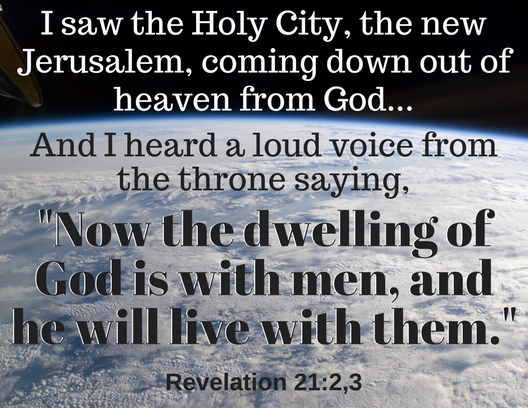
“Then I saw a new heaven and a new earth, for the first heaven and the first earth had passed away, and the sea was no more. And I saw the holy city, new Jerusalem, coming down out of heaven from God, prepared as a bride adorned for her husband.” (Revelation 21:1-2 ESV)
We humans like to live in the known and are uncomfortable with giving up what we know for what we don’t. This is so true that we humans are even willing to remain in an unfavorable situation if it means not having to leave it behind and wander into uncertainty. But for us as Christians, we need to overcome this and completely forsake this age and any sin that we are holding onto and embrace what God has to offer us instead. Besides, God has even blessed us with letting us know ahead of time where we are going and what we are getting ourselves into, and it is perfect.
In this life we only have a taste of the goodness to come in God’s kingdom. Imagine every single moment of your life you are literally perfect, everyone you come across is also perfect in their own unique way. You have no need for medicines, hospitals, cemeteries, or even locks to your house. You can walk right up to the tree of life, which is everywhere you go. But most importantly, you can have communion with God Himself and His Son Jesus! This reality is what we are enduring and waiting for, and thank God He is one day going to cast away the trials, burdens, and hardships we suffer in this life and is walking us towards a future that is partially known, but is waiting to be better understood.
Reflection Questions
What are ways you can maintain God’s future hope in the forefront of your mind and heart?
In what ways should reading these chapters of Revelation motivate us to share the gospel with those around us?
I’m certain that there were many times in my childhood that I cried about things that I have no memory of anymore. Perhaps I lost a hot-wheel that I really liked? Maybe I got vanilla ice cream when I was really hoping for chocolate? I am sure that in the moment, they felt like the worst things ever – but they really weren’t. Eventually I grew up enough to realize that those things that threatened to break my heart were trivial and not worth prioritizing as highly as I once had. However, for the rest of my life I will certainly remember the heart break, sadness, and grief I felt from my grandfather, Rex Cain, passing several years ago. My heartbreak over his loss, and the lasting memory of him, reveal that my heart highly honors and loved my relationship and memories I had with him
Sometimes the most tangible and revealing way to discern what you truly love is to observe what breaks your heart. If you mourn over the loss or corruption of things that are holy, honorable, good, and live-giving – it shows what your heart loves to see and help sustain. If you mourn over the loss or corruption of things that are profane, dishonorable, evil, and exclusively self-serving – it shows what your heart loves to see and help sustain. We should want our hearts to break over that which breaks God’s heart because it reveals that our hearts are aligned with His. This is what Jesus teaches us in his famous sermon on the mount, “Blessed are those who mourn, for they shall be comforted.” (Matthew 5:4 ESV).
In these chapters of Revelation, John is taught about the rebellious and great city Babylon, depicted as a prostitute riding the wicked beast (read chapters 13-16). We also learn how Babylon’s judgment will come swiftly and full of irony, the very methods of prosperity and rulership with the beast will be its own ruin. The angel speaking to John also touches on all the various kings and merchants who built up their life of luxury by communing with Babylon and its wickedness. Naturally, all of the kings and merchants who benefited from Babylon wail and mourn over the loss of their beloved city:
All the kings of the earth…will stand far off, in fear of her [Babylon’s] torment, and say ‘Alas! Alas! You great city, you mighty city, Babylon! For in a single hour your judgment has come.” (Revelation 18:9a & 10 ESV)
Their own heartbreak is a song of condemnation. The fact that their heartbreak is due to losing the epitome of human wickedness and evil illustrates what their hearts truly loved – and it was certainly not God or His salvation. So in the end, God will let them have what they claimed to want, and allow them to experience the self-destructive ends it brings. Their mourning will prove fruitless as God will not comfort them.
Meanwhile, chapter 19 contains the praises and redeeming joy of all of God’s people whose hearts were breaking all throughout the tyrannical and wicked reign of Babylon. Their mourning will prove fruitful as God will comfort them.
These chapters serve as an opportunity to see the cosmos and our place in it at a lofty height and decide what our hearts truly love and care about. Whatever we choose to love, inherently means we also choose what to mourn. I urge you, as do these chapters, to not be like the kid who’s so fixated on the momentary and shallow pleasures of this life only to mourn over them when they are gone. Instead, make the presently painful and eternally blessed choice of having our hearts break over the corruption of this age. Our momentary heartbreak will turn into eternal joy one day.
Reflection Questions
Is there anything that you are mourning the loss of, or perhaps the lack of, that God does not mourn?
What are things you can do to help “rewire” your heart to love what God loves?
Growing up in the midwest it was common for part of the “goodbye” routine to someone who’s about to drive away is to say “and watch for the deer”. Deer suddenly running out in front of a car is a common enough occurrence where it has become a regional culture to always remind one another of the potential threat. I personally have had many nights driving slowly with corn fields on either side vigilantly watching to make a response.
This readiness is exactly what God or Jesus (it’s not exactly clear) calls for us to do as his followers.
“Behold, I am coming like a thief! Blessed is the one who stays awake, keeping his garments on, that he may not go about naked and be seen exposed!” (Revelation 16:15)
This reading section has all kinds of significant moments of judgment from God against all who have rebelled against Him – and you do not want to be on the receiving end of any of them. We read of painful sores, rivers of blood, the world’s largest earthquake (literally chapter 16 states it is the world’s largest earthquake!), and hail weighing up to 100 pounds falling onto God’s enemies! Therefore, we are given a loving warning to keep true to the faith and allegiance to Jesus.
Our watching, vigilance, daily process of dying to ourselves and living for Christ daily is not in vain. We not only evade the intense wrath of God, but we also receive the intense salvation and life from God. These peeks into the future are not serving as a trivial knowledge that does not serve much utility to our daily lives now. Instead, they serve as a tangible vision for what direction each of our daily steps needs to be headed.
We currently are like the midwest driver at night surrounded by cornfields. At any point, the deer that we know is coming, is going to jump out in front of us, we will miss it, but the non-attentive driver will not be as fortunate. Not only that, but being a vigilant driver serves to our benefit throughout the drive anyway. There are far more things to consider when driving than simply not hitting the deer like staying in your lane, not running into other cars, going out into the ditch, or the countless other bad scenarios my mom concerned herself with when I first went behind the wheel! Staying awake and ready not only avoids the dreaded end and receives the blessed end, but it also helps us avoid the avoidable pains of this life.
So let us heed the warning from Revelation today as we navigate through this life to always remember to “watch for the deer” to worship God, receive salvation, and experience God’s goodness in this life.
Reflection Questions
What is the difference between being a vigilant Christian and a paranoid one?
How does God seem to balance His love and His justice against wickedness in these chapters?
I have always wanted to witness the majesty of the Redwood and Sequoia trees in California. They have always captured my imagination and even their pictures blow me away. It’s amazing to do research on how they utilize the same good and life-giving sunlight, water, and soil that every plant needs. Yet, one thing that distinguishes them from almost any other plant life is how both trees have thick bark, high water content, and the ability to resprout from dormant buds. In other words, they are highly resistant to fire. When there’s a fire, it burns away a lot of other growth but not them, and the fire helps make the soil nutrient rich and ready for these giants to begin their long life.
These trees can relish in the peaceful times of God’s gifts of sunlight, water, and nutrients in the soil, and they can even thrive when the chaos of fire runs rampant in the forest. In a way these trees and their interaction with the environment are a perfect symbol for how you and I can imagine ourselves and our interaction with God and our world. We are like the trees, our current time is like the peaceful time with all of its normal troubles, and the forest fire is like the events we read here in Revelation eleven through thirteen.
God in His brilliant goodness and wisdom can use all things in a way that fulfills His good and perfect will. Even if Satan, the enemy of both man and God, is running rampant, God can play him like a master chess player who not only wins using His own chess moves, but even using his opponent’s plays. The consuming fire that Satan starts to eliminate his opponents ends God uses to consume him and bring about a rich new start for his children.
This truth should be clear to us as we read Revelation and particularly these chapters as well. The two witnesses, the pregnant woman, the messianic child, Michael and his angels, and believers who are marked by God rather than the beast are all like the Redwoods who grow taller and stronger than everything else under God’s loving and wise provision. Even though the fire is chaotic, hot, and effective at consuming everything else in the forest, the trees remain. Even though we read of the horrifying workings of the dragon and his beasts, every being under God’s care is rescued.
It is easy to read through Revelation and its “forest fires” and assume this is a book meant to warn us of an impending doom that we wish not to see. However, John wrote this book, under the instruction of God and Jesus, to give encouragement and hope. The dragon is fierce, but God is even more so, and we will bask in God’s victory one day. So prepare to endure the fire to come, because it will produce a rich soil for the sprouting of a new and perfect kingdom where we can grow taller than ever before.
Reflection Questions
How can these future revelations provide wisdom for the fires in our own lives today? How should our prayer lives be impacted by seeing how God uses even the fires to produce goodness?
Devotion by Daniel Smead (MN) – originally posted for SGL on Nov 25, 2022 on Revelation 10
After the sixth trumpet we have a break when John is prepared for what comes next, which mirrors the break after the sixth seal when the 144,000 were sealed. We are reminded that all through this vision John has been writing what he sees, as Jesus told him to do back in 1:19 (10:4). I wonder if he started the vision in front of a blank scroll and finished with a completed work. Or was the writing part of his vision, and he needed to rewrite it all afterward? And I wonder, again, how often what he wrote came to him as part of the vision and how often his words are his efforts to convey what he experienced. For example, did John make the distinction of a “strong angel” himself, based on experience in this vision looking at different angels?
It wasn’t pointed out at the time, but in chapter 5 it was a “strong angel” that proclaimed the question about whether anyone could open the seals of the book in God’s hand. And now a “strong angel” holds the small book John will eat. Perhaps this is setting up transitions in the vision for us, as the book John eats seems to establish his personal involvement in the next part of the vision. (There is one more “strong angel” reference, in 18:21, punctuating and concluding the section on Babylon.)
When our strong angel in chapter 10 cries out like a lion roars, seven peals of thunder respond – these may refer to the peals of thunder that come from God’s throne (4:5). But John is told by a voice from heaven not to write down what the thunders said. Among all the details in Revelation this lack of information can be one of the most interesting things for us. What secret is left out here? I have sometimes suggested it might have been a self-unfulfilling prophecy (my own phrase), something we can’t be allowed to know because knowing it in advance would make it awkward for it to still take place. Like “tomorrow [fill in the blank date] king [fill in the blank name] falls.” In the context it is hard to expect a minor statement – the strong angel is just about to swear an oath by God that the mystery of God is on the verge of being completed.
The same voice from heaven tells John to get the book and eat it, which he does, but first he is warned by the strong angel that it will be sweet in his mouth but bitter in his stomach. This is interesting, because in Ezekiel 2:8–3:3 we get a similar story of eating a scroll that tastes sweet but there is no mention of bitterness. This is more like comments in Jeremiah 15:16-17 about him eating God’s words and finding them a joy and delight, but then being filled with indignation. What John ate was easy to take in but would result in him needing to “prophesy again concerning many people and nations and tongues and kings.” The phrase “prophesy again” is sometimes taken to mean that the next part of the vision will revisit ground, duplicating some parts of the story to get at new aspects of it. And not all of that prophecy would be a joy and a delight. But God will be revealing what He recognizes needs to be shown.
It may be worth recalling that John is in exile when he sees this vision. He will emerge from it to send his letters, his warnings and encouragements and predictions, and continue in exile. We don’t really know how bringing more attention to himself this way during a time of persecution affected his situation. Maybe not positively. But John was God’s worker and working for God isn’t always pleasant for the one working, at the time. But I trust that John absolutely knew the job was worth it, and I hope that he found the experience of his vision encouraging.
Lord, forgive me the foolishness I sometimes experience of wanting to know what you aren’t interested in telling me, and showing too little interest in what you have made plain for me. You have shown me things that are good, help me to act on that awareness. You have shown me things that are not good, help me to act on that awareness as well. If at times I have found your words bitter in my stomach I have little right to claim I have been cheated, for they were sweet on my tongue. And I acknowledge you have given me far more than I ever can give you. Help me to serve you as I ought to, even if I feel I am in the valley of the shadow of death. Your light can never be overcome. I will trust in you. Amen.
Reflection Questions
What are your thoughts and feelings when you read verse 7, “But in the days when the seventh angel is about to sound his trumpet, the mystery of God will be accomplished, just as he announced to his servants the prophets.”
What words of God might be sweet in the mouth, but sour in the stomach?
Devotion by Aaron Winner (originally posted for SGL on Dec 28, 2020)
There is much to take in with today’s reading as John describes the throne room of heaven and the events that unfold, marking the Kingdom of God being set into motion. There are angels, horsemen, and elders, each executing and exacting the will of God. If you are a bit overwhelmed by today’s reading, you are not alone. John, who spent more time with Jesus than most, is still awestruck by the worship of God happening before him, and he is doing his best to describe heavenly things for which there is no earthly vocabulary (something important to keep in mind as we examine the remainder of this book and prophecy). With a resounding question, John’s attention is drawn to the hand of God:
“And I saw a mighty angel proclaiming in a loud voice, “Who is worthy to break the seals and open the scroll?” But no one in heaven or on earth or under the earth could open the scroll or even look inside it. I wept and wept because no one was found who was worthy to open the scroll or look inside.” Rev 5:2-4
John weeps, for the content of the scroll could very well never be known. Salvation’s plan locked inside this scroll with no one on heaven or earth who is worthy of removing the seven seals that keep it shut. This is seemingly the end of the road. Without a Savior, life on earth has no redemption. This is most definitely worth a weep, knowing that for some, their story stops here. They have put everything in what they alone can achieve, yet they are like every other creature in heaven and on earth. Without the hope delivered in the next verses, all that would remain is remorse and regret (Luke 13:27,28).
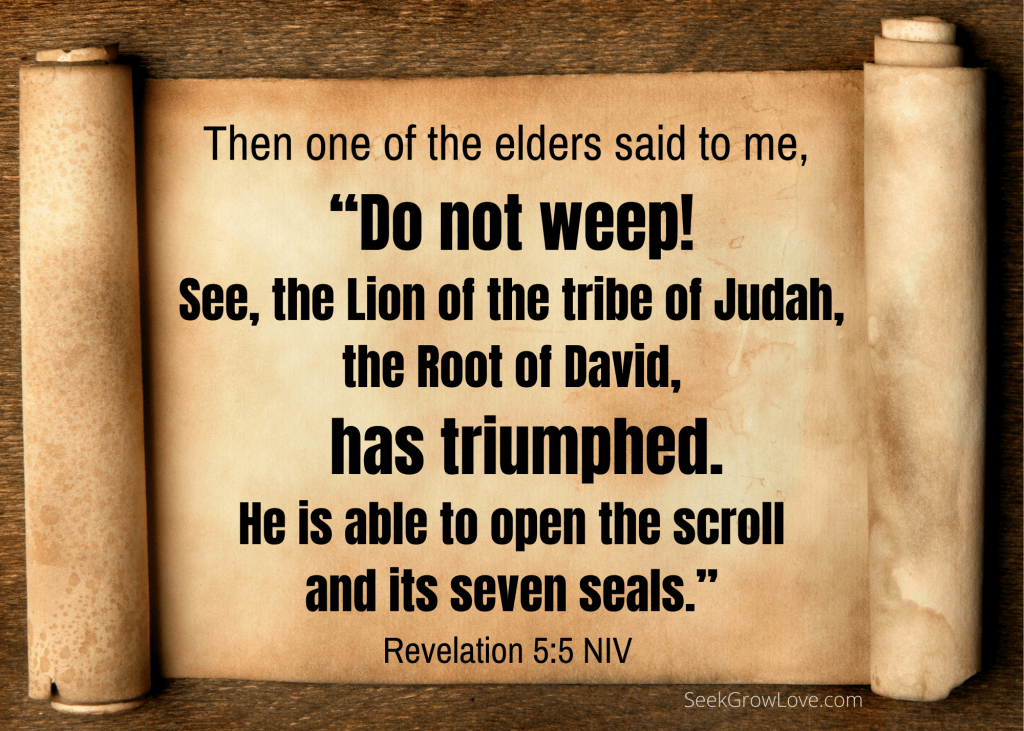
Then one of the elders said to me, “Do not weep! See, the Lion of the tribe of Judah, the Root of David, has triumphed. He is able to open the scroll and its seven seals.” Rev 5:5
Salvation is a gift of God, paid for by the blood of Jesus Christ (Eph 2:8,9). In the moments when we are overcome with great grief, sense the defeating drift of sin, are lost or lonely, feel pressed or persecuted, let Jesus Christ step forward. Do not reach deeper into empty stores, pour out of a broken vessel, or pick up the shattered pieces; let him do what we cannot. We need only lift our heads – to pray, to seek, to take heart – as we listen to the words of the elder that Jesus Christ, the Lamb of God, has triumphed. He will step forward and unfurl a new banner, renewing and restoring the purpose of our life. He alone is worthy to open the scroll, yet we are indeed the beneficiaries of the prize of his propitiation.
And they sang a new song, saying: “You are worthy to take the scroll and to open its seals,because you were slain, and with your blood you purchased for God persons from every tribe and language and people and nation.” Rev 5:9
Reflection Questions
What do you find especially memorable, powerful or awe-inspiring in John’s description of God’s heavenly throne room in Revelation 4? How is God described? What is he praised for?
What makes Jesus worthy and able to do what no one else could or can do? What has he triumphed over? What will he triumph over? How is Jesus described? What is he praised for?
What is the problem if no one could be found to open the scroll? When was the last time you really considered or even wept over the fate of those without salvation? You can not unseal the scroll. But you can introduce the one who can and will to those who do not know the Savior.
Merry Christmas to all. This is the season to remember and celebrate the birth, the advent, the first coming of Jesus, who is the Christ, the Son of the living God! It’s fitting that we today begin reading and pondering the last book of the Bible, Revelation. This is the book that reveals amazing things about the second advent, the return of Jesus to this earth to establish the perfect age, the kingdom of God. This is a book of revelations, though at times it’s challenging, seems mysterious, difficult to understand and apply. In these first three chapters we find John’s opening comments, identification of the source and succession of the word and testimony he’s passing on, and then a letter from the Lord himself to seven churches in Asia Minor. The general flow of the letters is commendation of the church, any complaint that may need to be addressed, and the correction that’s then necessary. Anytime the Lord indicates a complaint, or really anytime anyone indicates a complaint against us, the hope and goal is always correction. We all have flaws, and should always seek to grow, to improve, to walk in truth, obedience, and love, as John stressed in the postcards we pondered the last couple days.
We’ll begin here with the introduction the author, the Apostle John shared. “The revelation of Jesus Christ. which God gave him to show his servants what must soon take place. He made it known by sending his angel to his servant John, who testifies to everything he saw – that is the word of God and the testimony of Jesus Christ. Blessed is the one who reads the words of this prophecy, and blessed are those who hear it and take to heart what is written in it, because the time is near.” Note that there’s a blessing for those who read, hear, and take to heart these words, whether we quickly understand it or not. It’s good to be familiar with it. Understanding will come as events unfold, if we’re familiar with the writings.
1:7 specifically makes reference to Jesus’ return, “Look, he is coming with the clouds, and every eye will see him, even those who pierced him, and all the peoples of the earth will mourn because of him!” This is a sure thing. Jesus is coming. I hope to see him with joy in my heart, rather than mourning that I’m not ready, not a believer, not prepared, not all in!
The rest of these first three chapters include letters the Lord sent to seven specific churches, with specific commendation, complaints, and correction. Read them devotionally, and with application. In other words, ponder such commendation, complaint, and correction. Do any of these apply to you? To your church? In fact, you might write a letter, as though from Jesus to you. What would he say? What would he commend? What complaints would he have? What corrections would he expect? How would you respond? Would you do as he says?
Reflection Questions
What are your thoughts and feelings about the book of Revelation? What do you think God wants us to think and feel about the book? Why was the book as a whole given to Christians?
How often do you think of Jesus’ return? How do you imagine you will respond when he does return? If you are celebrating Christmas today (and also, if you are not), how can you remember and share the words of Revelation and the great hope of the 2nd Coming of Christ the Messiah, the Son of God?
How do you typically give or receive complaints? Work through the great questions from John in the last paragraph above. And spend some time with God in prayer with the Son of God interceding on your behalf.
II and III John are certainly the shortest of the Apostle John’s writings, often called letters, but perhaps more accurately referred to as postcards. Though they are short, they each pack a lot of applicable teaching, even for us today. John doesn’t name anyone in particular in II John, referring to himself as the elder, and to his recipients as the chosen lady and her children. Some have thought this may be because of ongoing persecution at the time, and not wanting to put a target on anyone’s back. On the other hand, he does address III John specifically to his dear friend Gaius.
John uses the word truth around 55 times in the five writings attributed to him, depending on the version you use. That would suggest God wanted John to give a great deal of emphasis to truth! Jesus also had placed a great deal of emphasis on truth. I’m convinced that we should value truth as did Jesus and the Apostle John. In II John verse 2 he refers to “the truth which lives in us and will be with us forever.” Our methods and ways have certainly changed over the ages, but the truth will never change. We must never allow the truth to be watered down or perverted in any way. There will always be varying opinions and ideas as to what the Bible says here or there, but the good news of the Kingdom of God and the name of Jesus is the glue that holds the Church of God together. That is the gospel we preach.
Walk this way! John reminds us in II John of three essential ways that we are to walk. He had great joy in V. 4 because he had heard of those who were walking in truth. Then in V. 6 he expects that we would walk in obedience to the Father’s commands. Later in V. 6 he reminds us of the command to walk in love. As we age, our gait sometimes changes. As believers we would do well to check our spiritual gait. Am I walking in truth? Am I walking in obedience? Am I walking in love?
John emphasizes the truth of the humanity of Jesus, calling those who deny his humanity deceivers.
He further cautions us in V. 10, “If anyone comes to you and does not bring this teaching (the teaching of Christ), do not take him into your house or welcome him. Anyone who welcomes him shares in his wicked work!” We should be careful to never endorse, support, or otherwise participate in spiritual teaching that’s inconsistent with the teachings of Christ! Discernment is a must.
III John continues with John’s emphasis on truth. He encourages hospitality and support for those who continue in the teachings of Jesus, He calls out an arrogant man by the name of Diotrephes who had a major problem with his walk. He neither walked in truth, in obedience to the commands, nor in love. John promised to confront him if he was able to be with them in person. In the same paragraph he commended Demetrius for his walk, his reputation, spoken well of by everyone. John had much more to say, but saved it for when he would see them in person. I kind of wish he had written more for our sake, but it is what it is. These are the words God knew we would need today.
Reflection Questions
What value do you place on the truths of God as handed down to us in the 66 books of the Bible? What would John say about watered down truth in your life or in your church?
How is your walk doing? In Truth? In Obedience? In Love? Is one limping along more than the others? What could be an effective spiritual fix for this limp?
If the apostle John knew you and were able to come and see you in person, what do you think he would tell you to work on in your own life?
I John is a really interesting book to read and study. The author is the Apostle John, who authored the gospel of John, I, II, and III John, and the book of Revelation. Each of his books/letters were likely written late in the first century. I John is addressed to believers, perhaps in general, not any particularly named believer. I John 2:12-14 help us see the broad target for these teachings.
12 I am writing to you who are God’s children because your sins have been forgiven through Jesus.[f] 13 I am writing to you who are mature in the faith[g] because you know Christ, who existed from the beginning. I am writing to you who are young in the faith because you have won your battle with the evil one. 14 I have written to you who are God’s children because you know the Father. I have written to you who are mature in the faith because you know Christ, who existed from the beginning. I have written to you who are young in the faith because you are strong. God’s word lives in your hearts, and you have won your battle with the evil one.
Some highlights about the Apostle John – He was all in when Jesus called him to follow and to be a fisher of men. He was one of the three mentioned most often as being close to Jesus. He’s described as the disciple whom Jesus loved. He was often distinguished from the other disciples. He’s one who was closer to Jesus when they were asked to watch and pray in the Garden of Gethsemane. He was asked by Jesus to look after his mother Mary as Jesus suffered on the cross. He ran to and looked into the tomb when it was reported that Jesus had been raised. He had great vision and revelation of the future as his writings reveal in the book of Revelation.
John had explained his purpose for writing the gospel of John in 20:30,31, “Jesus did many other miraculous signs in the presence of his disciples which are not recorded in this book, but these (seven miracles) are written that you may believe that Jesus is the Christ, the Son of God, and that by believing you may have life in his name!” The emphasis there is some of the truth that must be believed. It’s interesting that then in I John 5:13 he says, “I write these things to you who believe in the name of the Son of God so that you may know that you have eternal life.” He apparently wants those who believe to have a level of confidence, to know that they have eternal life. We shouldn’t be over confident, of course, especially if we’re not living the faith, if we’re not walking in truth, which John also addresses in I John.
John does emphasize knowing numerous things in this letter. In fact, you’ll find the word know at least thirty times in this letter, depending on the version you use. An interesting exercise would be to read through the book and underline the word know each time you find it. It really wouldn’t take that long to do this. Contemplate then those teachings John is wanting his readers to know, and I think, to understand.
I’ll just name a few of my favorite passages in I John. I John 1:9; I John 2:3-6; I John 2:15; I John 2:22.23; I John 3:11,12; I John 4:1-3; I John 4:19-21; I John 5:13; I John 5:18. What are yours?
Reflection Questions
Do people know you are a follower of Jesus? Would they call you “all in” in the way you live your faith and follow Jesus? What has Jesus entrusted to you?
Find the “know” verses in 1 John. Which ones do you already know and are ready to share? How will you share and to whom? Which ones might take a little more study/seeking to more fully know/understand? How will you seek to know more?
Why do you think John wants God’s children to be confident of their coming eternal life? What are you confident of? What are you not confident of? Is there anything (perhaps in the area of living your faith or walking in truth or knowing more of what John wants you to know) that would boost your confidence? What is the danger of TOO much confidence?
Yesterday we reposted a devotion on 2 Timothy about Guarding the Faith and Fanning it into Flame by Jeff Fletcher. One way Pastor Jeff did this (and his wife Karen continues to), is with their 11 children. Today we will be reposting not one, but two devotions from not one, but two of Jeff and Karen’s sons who are both ministering in Minnesota. Thank you, Fletchers, for sharing lessons from God’s Word with us through SeekGrowLove!
Devotion on 2 Peter 1
by JJ Fletcher – originally posted on October 12, 2022 for SGL
We have great and precious promises that have been made that will enable us to become partakers of the divine nature! As Jesus put on a new nature in his resurrection from the dead, so shall we when through faith, we endure through life’s many challenges and inherit the promise of the coming Kingdom of God.
Hebrews 11:1 says that “…faith is the assurance of things hoped for, the conviction of things not seen.” As we have faith that God will restore all things (Acts 3:21), upon our faith we must add virtue: meaning good quality of life or uprightness – not simply believing but living out our lives as something that reflects the nature of God’s goodness, justness, and righteousness. After believing and living a changed life, we are to add knowledge to that; we should always be striving to learn from God’s inspired word and learn from his spirit as it is active in us… And more than that, seek after his spirit that we might become more in line with his will and come to a greater understanding of its importance and how beneficial it is to us to walk in his ways.
Following the call to add knowledge, we encounter again the call to be self-controlled! It really does seem that much of what we read in scripture hinges on self-control and that circles back to our need to not stifle the spirit in our lives. If one of the elements that the fruit of the spirit brings forth in our lives is self-control, then we ought to do whatever it takes to drive away any behaviors that might cause God’s spirit to depart from us (Judges 16, 1 Samuel 16). Self-control allows us to endure – to stay on the course – as Paul might say, “to run the race”. We have to endure through all of the challenges and temptations that life throws at us, and we must allow the motivation of our hope, our uprightness, and the self-control that we are enabled to have through God’s spirit carry us through.
As we endure, we ought to have a reverential feeling or devotion to God, that’s what the Greek work translated godliness indicates. As we experience God’s goodness and see how His spirit works in us, we should feel more and more awe and reverence to our creator… After all, He put the plan into place that leads us into a life that transcends the brokenness that sin imparts on our lives – even though we sin and are affected by sin, God’s directives lead us onto a path that (through Jesus) casts that sin aside and draws us into community with him.
And as all these things are ingrained into our life, the part that affects others the most is the cherry on top… We are to have brotherly affection (love) as a defining characteristic in our lives! Love and care for one another as believers will lead us to speak into one another’s lives and help us when we hit rough patches. Even the most spiritually minded people hit dark periods in their lives (google the dark night of the soul). If we love our brothers and sisters in Christ, we will take the time to come alongside them, to care for them, to call them out, to admonish and encourage – brotherly affection means being intimately involved in the lives of our faith family – not being apathetic or half-hearted. We need to invest in each other as Christ has invested in us through his sacrifice (sometimes we must be self-sacrificial).
These qualities keep us from being ineffective witnesses and fruitless workers. We must be bearing the fruit of the word implanted in us (James 1) and strive to be effective ministers to the lives of those who are hurting and struggling. Peter says that whoever lacks these qualities is so nearsighted that he is blind! Yikes… lacking these qualities as I read this means that we cannot see beyond ourselves, and that it a tremendous problem when one of our chief goals is to preach the gospel to all creation.
If we take these qualities to head and practice them diligently it says we confirm our election (or being chosen out) into beneficiaries of the grace of God. Also, it says if we practice these things we will never fall. So, practice these things so that you may have entrance into the eternal kingdom of our Lord and Savior Jesus Christ (v11).
J.J. Fletcher lives in Minnesota with his wife and four children. He is the pastor at Pine Grove Bible Church.
Reflection:
1. Think about how Jesus exemplified all these characteristics listed in verses 5-7. If he had not exemplified all these things, would he have had the wherewithal to endure through his father’s plan of salvation through him? How can we expect to live exemplary lives if we do not take these characteristics to heart.
2. Think about the first 6 items listed (faith, virtue, knowledge, self-control, steadfastness, and godliness) and the final one: brotherly affection/love. What do the first 6 produce without the 7th? We’re designed (as individuals and as a church body) to be in community, how might we be rendered fruitless and ineffective if we excel at the 6, but lack the 7th?
AND – A Devotion on 2 Peter 2
by Joel Fletcher – originally posted Oct 15, 2023 for SGL.
“For it would have been better for them never to have known the way of righteousness than after knowing it to turn back from the holy commandment delivered to them.” 2 Peter 2:21 (ESV)
An idea stitched through today’s readings is that the God of Heaven prefers human behavior that is good and has an aversion to human behavior that is bad (to put it mildly). The Maker of mankind pays attention to both the wicked and the righteous (Proverbs 15:3). God sees all that happens on earth and, although all bad is wrong from His perspective, there seems to be a certain kind of action that uniquely draws His ire: people, who “speak on behalf of God”, using their influence to persuade others to evil–such people are called false prophets and false teachers (Jeremiah 23:16-17, 2 Peter 2:1). How do we avoid becoming like these people and live in a way that pleases our Maker?
Looking through the whole of scripture, one will discover that nearly all the people God employed for His purposes displayed humility (or were first humbled), while those whom God rejected or stopped using were dragged down by pride. When Jesus ministered in Judea and the surrounding regions, he embraced people who were stereotypically seen as bad (or, unrighteous) and opposed those who were known (and self-described) as good (or, righteous). While it is true that those whom Jesus befriended did bad things and those whom Jesus antagonized did good things, the defining distinction between the two was humility (in the former) and pride (in the latter).
The religious leaders of first-century Jerusalem saw themselves as righteous men who had things figured out–they needed no one to save them. The outcasts, meanwhile, longed for salvation–both from the Roman overlords and their own sinfulness. In other words, the people who embraced Jesus saw him as a doctor and themselves as the sick, while those who rejected him, saw Jesus as an instigator and themselves as the people preserving the peace. If one denies they have a problem, one cannot get the help needed.
There is a conundrum for the Christian: we are called to do good works (Ephesians 2:10) and to represent Christ on God’s behalf (2 Corinthians 5:10), but we are also warned that one who has claimed to be a Christian (maybe even one who has been an effective evangelist) can come to a place where, because of their pride, it would have been better if they had “never known the way of righteousness” (2 Peter 2:21). How do we avoid this state, while being faithful to our calling?
From what I see from scripture, the best antidote to getting on God’s bad side is to live in, with, and by humility. First, by fearing, above all (with reverence, awe, and worship) Yahweh. Second, by recognizing Jesus as the only way to the Father, to life eternal, and to the good life. Third, by recognizing that, while this knowledge radically changes lives, it doesn’t make one superior to anyone else.
You can, with great fervor, study your Bible for countless hours every day, and do all the spiritual practices prescribed or implied by the text, but it won’t make you any better off…unless you are aware and live as though you need a doctor and view Jesus as that doctor. The religious leaders of Jesus’ day didn’t recognize the great physician because they didn’t acknowledge their sickness. If we want to make sure we don’t go down that same dead-end road, if we don’t want to get scolded or labeled as a false teacher, we must take our humble medicine every day.
Joel Fletcher lives in Minnesota with his wife and two small children. He is involved with youth group and worship music at Pine Grove Bible Church.
Reflection Questions
Do you realize your need for a doctor and Savior? How does Jesus provide what you need?
What happens to those who once knew they needed Jesus, but then are puffed up with pride and go their own way?
What steps can you take to stay humble (or first become humble)? In what areas of your life do you most frequently run into the problem of pride? How can knowing this help you in the future?






 Seek Grow Love