Best Day Ever

Luke 24

Saturday, December 31, 2022

            It was frustrating writing about the way Jesus was tortured and killed, but I get to end the year by writing about the number one very best day in human history.  No other day could have been more exciting, felt so good, and impacted so many people, including you and me.

            Sorry, but I need to start off by dissing a bit on those who loved and supported Jesus throughout his ministry.  Were they not paying attention to what he said?  He told them he was going to die and be raised in three days.  Did nobody remember that fairly critical piece of information?  I could understand them being a bit skeptical and not totally believing that he was going to come back to life until they saw it with their own eyes, but it seems like the ladies that were going to visit the tomb should have been going there to see if it really happened on the third day.  Instead, they were convinced that he was still dead; moreover, they were perplexed when they didn’t find his body there.  Suddenly, two dazzlingly dressed dudes appeared to them and reminded them about the three-day thing.  They did remember at that point they had been told he was coming back to life, so they went back and reported what they had seen to the eleven apostles and others.

            Certainly, the apostles, of all people, would remember what was going to happen.  They had seen many amazing miracles with their own eyes, so of course, they would have enough faith to believe it could have happened, but no; they thought the story was nonsense and didn’t believe the women.  Peter does get some credit, though, because he bounced up, ran to the tomb, and marveled at what had happened.  He believed Jesus was alive before he actually saw him with his own eyes.

            Strangely enough, their sad state of mind made the day that much sweeter for them when they finally saw it was true that he was alive.  They had believed that Jesus was the Messiah, but when he was killed, their hope of him saving the day vanished.  They incorrectly thought he was there to redeem Israel during that time.  They assumed he would get rid of the Roman government and save the world then – not later.  They were truly heartbroken and depressed when they saw Jesus die.

            Think about someone you loved dearly that died.  Perhaps, you saw them laying in the casket and then buried.  A few days have passed, and you are still raw with emotions, experiencing the sting of death.  Then picture the doorbell rings, you answer the door, and that person is standing there with a big smile on their face.  Whoa!!  How doubly incredibly happy you would be!  I think that’s how people felt when they saw Jesus alive again.  It had to be the best day ever!

            You may think it was a bit cruel for me to have you dwell on one of your loved ones that has died.  I am sure you are still missing them.  It still hurts.  However, the fact that Jesus was resurrected on that day a couple thousand years ago can be a promise about the future of your loved one.  If they accepted salvation in their lifetime, they too will come back to life and greet you with a big smile if you also are saved.  What an amazing day that will be – like the amazing day Jesus came back to life.  Jesus was the first to come back to life forevermore, but you or any of your loved ones that die before his return can be next up.

-Rick McClain

Time to ponder:

Do you agree that the resurrection of Jesus was the best day ever?  Can you think of a better day?

Most of Jesus’ closest followers soaked up every word he spoke and were convinced he was the Messiah, but their faith faded fast when something seemed to go very wrong.  Is your faith strong enough to make it through the tough times?

Jesus’ resurrection can give people great hope about the future, but only if they believe.  The story is absolutely meaningless to those who haven’t made the decision to follow God.  Is there a loved one in your life that needs to hear about the good news?
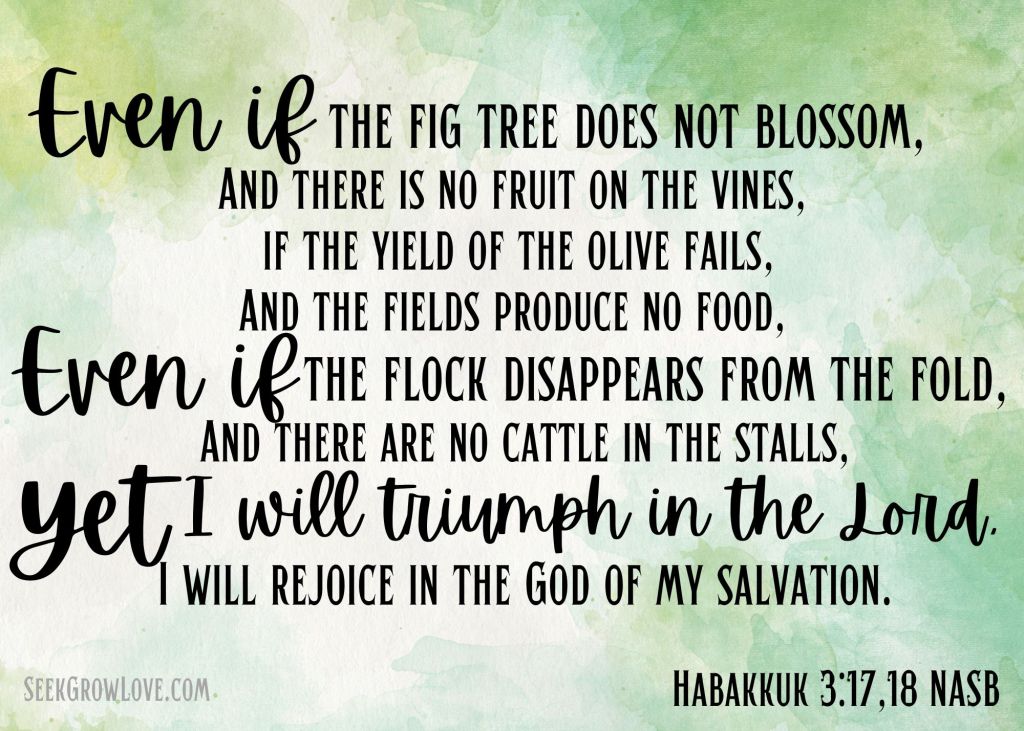
Even If

Habakkuk 3

Friday, November 11, 2022

I want to use this devotion today as a part confession, part devotion to share. At multiple times in my faith I have doubted God. The most common question I ask is “Why does so much bad happen in the world if we have a powerful God?”

And that’s the question Habakkuk asks when communicating with God. The minor prophets before him continuously condemned the corrupted Israelites, but all Habakkuk does is ask God that same question.

The main reason I share that about my life is so that even if one reader out there has asked that question, they know they’re not alone. The cool thing about it? It’s not a new or unusual question! Luckily the answer to the question, that eventually brought me peace, lies within this book.

To really focus on what Habakkuk three is all about we have to look at the set up of the previous two chapters. In the first chapter, he’s complaining to God about the corrupt Israelites. God then responds by saying that’s why he is raising Babylon. Habakkuk then flips to backtracking and telling God to slow down, Babylon is WAY worse than Israel. God teaches Habakkuk that all of the nations will have to answer eventually and that he’s not with Babylon, simply God’s not bringing them down just yet. These sins of Babylon aren’t exclusive to Babylon, there will always be a Babylon. Will God let this cycle continue?

So this back and forth is developed through the first two chapters to lead us to the third and final chapter. Habakkuk implores God to renew them in their days, not wanting to wait any longer. In verses three through fifteen Habakkuk then goes on in prayer, starting with God’s mighty appearance to the world, “radiance Like the sunlight”, a lot like the appearance of God to the Israelites way back in Exodus. He then produces in this prayer/poem that God will indeed crush evil.

“In indignation You marched through the earth; In anger You trampled the nations. You went forth for the salvation of Your people, For the salvation of Your anointed.

You struck the head of the house of the evil To lay him open from thigh to neck.” (Habakkuk 3:12-13)

This is Habakkuk eventually coming to realize the truth. God will come around to having evil vanquished from our world and our lives, and he will do it by our side.

In the last three verses of the chapter, Habakkuk choses faith. He chooses that whether in war or peace, or famine or harvest, he will choose triumph in the Lord. To rejoice in the God of his salvation.

Understanding what went on in the whole book of Habakkuk draws very clear parallels to the lives of any and all who, at one time or currently, have doubted God. Take extra time to pray today but structure it differently. Pray to have your faith increased, and to be strengthened in submitting yourself to the timing of our God.

-John Evans

As a new writer for SeekGrowLove, I was asked to include a short bio about myself, so here goes...Currently attending McGintytown Church of God of Abrahamic faith, and serving as a youth leader, deacon, and assisting with worship. At Twenty-One years of age I have a lot to learn, but was once told I don’t have to know everything to be a great teacher, I just have to know something you don’t. Thanks for reading, have a blessed day.

Application

  1. Have you ever doubted God? What can you learn from Habakkuk?
  2. If you were to write a personal version of Habakkuk 3:17-19 what are some “Even if..” statements you would include? Consider hardships God has already seen you through, hardships you are currently in, as well as what the future may hold. How would you describe God’s strength and benefits for you (verses 18 & 19). Share your new poem with God as you pray for your faith to be increased.

Excuse Me, Could You Move Your Golden Image?

Daniel 3

Tuesday, November 1, 2022

You would think that King Nebuchadnezzar would have set aside his pride after he witnessed a miracle. He was astonished that God could give Daniel ability to recount his own dream and reveal the mysteries of that prophetic dream. The King even stated, “Surely your God is a God of gods and a Lord of kings and a revealer of mysteries, since you have been able to reveal this mystery.” The king gave Daniel a promotion and honored Daniel’s request by appointing  Shadrach, Meshach and Abed-nego over the administration of the province of Babylon.

But a surprising part of this story is that King Nebuchadnezzar does not seem to have a change of character from the experience. He had received the true interpretation from Daniel that “the God of heaven will set up a kingdom which will never be destroyed, and that kingdom will not be left for another people; it will crush and put an end to all these kingdoms, but it will itself endure forever.” We would think that news would be a life changer for the king, but it isn’t. In fact, we find him setting up a ninety-foot image of gold so people can practice idol worship. If they refuse, he will quickly have them killed. What in the world is wrong with this guy? A lot, but first his pride. He refuses to take his focus off himself and his kingdom so he could acknowledge God and the everlasting Kingdom.  I must admit that it is so easy in this life to get so caught up in what we are doing and what others are thinking or saying about us that we find that we have lost our focus of what God is wanting us to do for His Kingdom. It is so easy to let the temporary things of life remove the eternal.

Let’s take some time today and examine where we are spiritually. Are we wasting our time polishing up an idol or are we living in a close relationship with God? The Lord wants to guide us through every area of our lives. Thankfully Shadrach, Meshach and Abed-nego were ready for the king’s challenge. As we see, God delivers these faithful men from the fiery furnace. They were walking closely with the One True God so He sent His angel to walk with them through that fire. Let’s toss out any idols that try to surface in our lives so there is only room for Our God.

-Rebecca Dauksas

Reflection Questions

  1. Are you wasting your time polishing up an idol or are you living in a close relationship with God? Consider carefully. What are you focused on?
  2. Look at how Shadrach, Meshach and Abednego answered the King in Daniel 3:16-18. What can you learn from them? How will you put it into practice?

Imitate Those Who Inherit the Promises

Hebrews 6

Saturday, September 24, 2022

Do you have any Christians that you look up to? Lately I’ve been learning about a pastor named Tim Keller who has really inspired me. Much of his teaching is sound, and he is a great preacher. He is also incredibly successful at bringing Jesus to new people. He has grown his church in New York City (a rather hostile environment for Christianity) and has helped plant over 700 new churches in 75 cities all over the world through a church planting organization that he founded called Redeemer City to City. This to me is exactly what Jesus wants to see his church doing. When he said, “Go and make disciples of all nations,” he meant it, and this is what it can look like.

If you tried to take Tim Keller, or your local church’s pastor, and teach him about how to baptize, repent or pray for people, you would look silly. These guys have been around the block a time or two and they shouldn’t be relearning these basics of the faith. I think that is what is being said in Hebrews 6. It’s just inappropriate to take the first step of the faith and then keep taking it repeatedly, walking in a circle. Jesus has a mission, and once you have come to believe in him, your next steps should always be towards the fulfillment of that mission. That isn’t to say that these topics shouldn’t be taught, but rather they should be taught as a foundation for a new Christian and other beliefs should be built on top of them. However, strong condemnation is given to those who witness the works of the Holy Spirit and yet fall away from the faith. It says it is impossible to restore again to repentance. It also says that if land bears thorns and thistles then it is worthless and will be burned. Beware of people like this, who have seen the power of God and yet never take the next step, never bear fruit and don’t help further the mission of Christ.

Instead, be an imitator of those who inherit the promises through faith and patience. Imitate people like Jesus, who taught, healed and loved. Imitate people like those Christians whom you look up to. Imitate people who never cease spreading the gospel. These people have seen the promises of God and make every effort to give back to the one who loved them first. God has been making promises to mankind for a long, long time, and his promises are true. We see the promise that he made to Abraham to multiply him, and we see the fulfillment too, albeit long after Abraham may have thought it possible. That’s where patience comes into play. God’s timeline isn’t your timeline, but his promises are true just the same. Continue to imitate Christ in all things, since he is our forerunner, the one who goes out before us. Learn his ways and walk in them. He, after having suffered, entered into the Holy of Holies, the place where God resides, and there he prepares a place for us, too.

-Nathaniel Johnson

Questions for Reflection and Discussion

  1. Who has been a great role model for you in displaying faith and patience while waiting for what God has promised?
  2. What can you do today, and this week, to practice showing “diligence to the very end” (vs 11).

Enter His Rest

Hebrews 4

Thursday, September 22, 2022

Rest is such a basic need of every living thing. When it comes to people, we need to rest and sleep every day. If we neglect sleep for more than a handful of days, we will die the same as if we are starving or dehydrated. In the animal world, horses are used for their speed and stamina for racing these days and in the past they were used for travel. Despite their endurance, it is possible to run them so hard that they will die. Horses need rest the same as a human does. No living thing can survive without proper rest. So when you hear that God swore in his wrath that some will not enter into his rest, you should be very scared. This consequence is equivalent to a death sentence.

When God created the world, he labored over his work for six days straight and finally rested once his work was finished (Genesis 2:2,3). I think of how satisfying it is to have a good night’s sleep after completing a very hard workout at the gym the day before. The effect of experiencing rest after hard work is like a glass of water on a hot summer day. The converse is also true, if I spend all day laying on the couch and don’t get any work done, I feel terrible. Being that I’m not Jewish, I don’t have a good frame of reference for what the Sabbath is like, but it makes a lot of sense in concept to me. Working non-stop just isn’t healthy, but neither is resting without working. God’s rest is the right kind, the kind that is satisfying and comes after hard work. So the Sabbath was supposed to be God’s way of telling his people to work hard, but not too hard. Everything after that was just legalistic nonsense. We see this in Jesus’ teaching about the Sabbath. The rest of the Sabbath is supposed to be for the benefit of mankind, not for its detriment. It’s in this context that Jesus claims to be Lord of the Sabbath (Mark 2:27, 28).

Jesus, the Lord of the Sabbath, promises to give rest to all who come to him (Matthew 11:28). I believe that the rest that Jesus promises is like the rest in Hebrews 4, but it is different, a precursor to the ultimate rest that we will enter into in God’s presence. The rest that Jesus talks about is the rest that you can have in your soul today. Jesus is our high priest, the one who speaks on our behalf to the God most high. Jesus lived on earth and experienced the weariness that comes from hard work. He knows all of the struggles and burdens that we carry and he wants us to enter into God’s rest. Here in Hebrews we have so many promises that we should take heart. “We who have believed are entering that rest” (Hebrews 4:3). In our belief, we have a piece of that rest for today, and the totality of that rest tomorrow.

-Nathaniel Johnson

Questions for Reflection

  1. How is your work-rest balance? Do you more often have too much rest, or too much work?
  2. What do you think is the best thing about God’s rest available now? Do you feel like you are receiving it?
  3. Reading through the chapter, what are some reasons given for not receiving God’s rest?

Today, If You Hear His Voice

Hebrews 3

Wednesday, September 21, 2022

Having read the first two chapters of Hebrews, we have seen the author building up this case for belief and hope in Jesus as the Son of God. Now in chapter 3, the author is trying to bring us back to an example that the readers would have been familiar with to help us understand the necessity of our faith. He calls back to Moses, the prophet who first heard the name of YHWH, delivered the Hebrews from enslavement in Israel and performed many signs and wonders in the midst of the Jews (Exodus 14:31). This Moses that the Hebrews are so familiar with, who brought the law that they hold in such reverence, was faithful in God’s house. However, his faithfulness was to testify of the Prophet to come (Deuteronomy 18:18, 19), namely Jesus.

By conjuring up this image of the Old Testament prophet, Moses, we are reminded of the rebellion of the Hebrew people after they were delivered from Egypt. In only a matter of years, the people hardened their hearts and they were filled with unbelief even though they had seen the signs of God in their own lifetimes. Can you imagine witnessing the parting of the Red Sea, the pillar of Cloud and Fire or the radiant face of Moses and yet still turn your back on the God who freed you from slavery? It doesn’t make sense to me at all. For some reason, the peoples’ hearts were hardened so that they couldn’t believe in God, even though they heard the voice of God.

Now this story isn’t just an example from the past, it is a story that represented the people to which this book is written. Many Jews believed that Jesus was the Son of God and the Messiah, but others refused to believe. Their hearts were hardened even though they saw all the signs and healings that Jesus performed. It is their unbelief that is their downfall.

I want to apply this story to today as well, while it is still called “today.” If I hear God’s voice, what will I do? Will I believe or will I harden my heart? I believe there are signs and works being performed today through the power of the Holy Spirit as it was promised by Jesus (John 14:12). If you don’t believe that there are still signs being performed to this day, ask a believer in your congregation if they have ever witnessed or performed a work through the Holy Spirit. More have than I think we realize.

The other part of hearing God’s voice today, is that the author of this book is re-presenting the words of God, the words of the Holy Spirit, words spoken Prophetically through David. This is the voice of God that you hear today. Encourage each other every day as long as it is called “today” (Hebrews 3:13). This should be your main takeaway from this passage. If you want to ensure that no one is hardened by the deceitfulness of sin so that they will enter into God’s rest (Hebrews 3:18), then tell someone the word of God today, while it is still called “today.” Speak the word of God in power, for there is certainly power in the word of God. We are given a message of hope that we can boast in (Hebrews 3:6). Pick up your phone and text a brother or sister in Christ and remind them of this hope. Get up and visit your brother and sister to tell them of this hope. If you believe in this hope, then let the whole world know and be a partner of Christ in his work of proclaiming the Kingdom of God (Hebrews 3:14).

-Nathaniel Johnson

APPLICATION QUESTIONS

  1. Who can I tell today about the hope that is found in Jesus?
  2. How often do I think about the hope that is found in Jesus?
  3. Ask a Christian, have you ever seen a sign or a work of the Holy Spirit?

A Reason to Believe and a Reason to Hope

Hebrews 2

Tuesday, September 20, 2022

I love this chapter in Hebrews! It outlines the very reason that I am a Christian, the reason that I believe in Jesus and follow his teachings. It says in verse 2, that the Lord first declared himself. When Jesus was on earth, he taught in the synagogues and proclaimed to be the Messiah spoken of in the prophecies of Isaiah. He proclaimed himself to be the Son of Man spoken of in the prophecies of Ezekiel. We know that he did because we have the firsthand, eyewitness accounts in the first four books of the New Testament. Here again, the author of Hebrews is adding his account (Hebrews 2:4). More importantly than all of this, God adds his own testimony by performing signs and wonders through the apostles, and even among disciples of Jesus today. It’s for this reason that I believe.

Remember yesterday’s passage that proclaimed the great glory and exaltation of the Son of God. The author tells us to pay attention to what we have heard, so that we do not drift away. Keep that picture that he painted in your mind. The greatness of God himself has been given to Jesus. You have heard what has been said of Jesus from your friends, your pastor, from the gospels and from the Holy Spirit. Hold on to these things; cling to the faith.

In the next section, the author draws our attention to another psalm like in the first chapter, but this time, he uses it to speak of all mankind more broadly, not just the man, Jesus. God is so much higher than we are. We can’t even wrap our minds around what it means to be Spirit and dwell in heaven. And yet, God cares for us mere mortals. We are lower than angels in that the angels are in the presence of God, but it says that all things have been subjected under man’s feet. It’s clear that this isn’t talking about the current state of the world. There are countless things that aren’t subject to man’s authority: disease, death, hunger, poverty and all kinds of injustices. This is just what the author says in Hebrews 2:8. But we do see Jesus. And just like we read yesterday, everything was given to Jesus. He is the heir of all things and is made higher than all the angels. While Jesus was here, he appeared lower than angels, a man mocked and rejected, but now he is exalted with a crown of glory.

Though Jesus was the first to be glorified, he was the pioneer of salvation, he is not alone since salvation is available for all who believe in his name and we all can become sons of God, brothers and sisters of Christ (Hebrews 2:10-13).

This final section of the chapter is poetic and beautiful, but its real beauty comes through the deep truth and hope that it can bring to our lives. Jesus, though he was perfect and blameless, was put to death. In doing so, he destroyed death itself and freed all of us from the slavery of the fear of death. When you believe in Jesus, you are made free because you don’t need to fear death because there is life for all who are sons of God. We saw it first in Jesus. We saw him raised from the dead and ascend into heaven. This is the fate that awaits us as well. We can relate to Jesus in every way even though he is so highly exalted. He suffered temptation, suffering and death, just as we all will, but we have a hope for life that is to come, a hope that is true, because it was attested to us by God, through his son.

-Nathaniel Johnson

Questions for Reflection

  1. What is the meaning of verse 1? What do they need to pay more careful attention to? Why? Is it still true today? Is it still true for you?
  2. How would you explain Hebrews 2 to someone who has never heard of Jesus before?

The End of Division

Galatians 3

Wednesday, August 10, 2022

            I don’t know about you, but to me, it feels like the world is really divided right now.  More divided than we’ve been in a long time.  Liberal vs. Conservative.  The liberals call the conservatives Fascists or Nazis, the conservatives call the liberals Communists.  We are divided between theists and anti-theists, or some would divide us as racist or anti-racist.  Still, others would divide us as binary or non-binary, pro-live or pro-choice.  Living in perpetual states of division is stressful, painful, and exhausting.  In the words of Rodney King during the L.A. racial riots of the early 1990’s “Can we…can we all get along?”

            That’s kind of what Paul was saying to the Galatian Christians.  There was division going on in their Church.  Paul taught them that we are saved by putting our faith in Jesus Christ as the son of God who died for our sins and whom God raised from the dead.  This salvation is open to everyone who believes, young or old, male or female, Jew or Gentile (non-Jew).  As Paul was traveling on his mission to other places in Asia and Europe to share the message of Jesus Christ and the Gospel of the Kingdom of God with as many as he could, he received reports that people had come into the Churches in Galatia insisting that Gentile believers must begin practicing Jewish law in order to be saved.

            Paul was pretty angry with the Christians there who were being led astray by the teaching of these “Judaizers”  (people who insisted that Gentile Christians must practice Jewish Law in order to be saved).  Paul calls them fools and victims of witchcraft for allowing themselves to be taught something so clearly contrary to the gospel that he preached to them previously.

            Paul goes back and shows from the Hebrew Bible (our Old Testament) that even back in the time of Abraham God made his plan very clear.  God always planned to bring salvation not only to the Jews who were descendants of Abraham but also to Gentiles who were not biological descendants of Abraham.  Paul shows that God called Abraham long before the Ten Commandments and Ceremonial Laws were given to the Jewish people.  As Jews, they were always recipients of God’s grace.  The Law was never a precondition to them being chosen as God’s covenant people.  Paul wants it to be clearly understood that for the Gentiles they are brought into God’s chosen family not on the basis of observing Jewish ceremonial law or even moral law, but on the basis of faith in Jesus Christ.

            In Christ, old barriers and divisions come falling down.  We all become a part of the one family of God through Jesus Christ. It doesn’t matter our nationality, our age, our sex, our citizenship status or our righteousness according to the law.  What matters is that we come to Jesus Christ and have been clothed in Jesus Christ.

            Later in Galatians Paul will talk about what it means to crucify the flesh and to live according to the spirit and produce virtuous actions by the spirit, but the fruit is a result of salvation, not the precondition to being saved.

            The only true way to end division in the world is by becoming one with Jesus Christ through faith.

-Jeff Fletcher

Questions for Discussion:

1.  What are the kinds of things that divide Christians and Churches today?  What action will you take to help remove divisions where you worship and serve?

2.  Why is it important to understand virtue as a result of salvation rather than as a precondition to salvation?

Faith in God

Mark 11

Tuesday, August 2, 2022

Chapter 11 of Mark is so saturated in beautiful parables and stories that it can be difficult to draw one single lesson from each separate part. The chapter contains Jesus riding into Jerusalem on the colt, him cursing a fig tree, driving heretics out of the temple, and providing a puzzling dilemma to those who wish to destroy him. From this, however, we’ll try to draw something coherent.

The story begins with Jesus and the disciples entering the city of Jerusalem. Like the confusing things Jesus asked the disciples to do that we were discussing yesterday, He asks several of the disciples to go into town and mysteriously grab a tied-up colt. What could the meaning of this possibly be? Why would Jesus have them specifically say that the Lord needs it, and it will be back shortly? My best assumption is that this was partially meant to draw the attention of the townspeople that the Christ was coming. Additionally, simply because he called for it to happen, it was so. This is a very similar archetype to what Jesus does with a fig tree the next morning. But just keep in mind, Jesus said for it to be so, and it was.

The next morning “Jesus was hungry” (Mark 11:12) and went to find figs on a fig tree he had seen. As it wasn’t the season for the fruit to bear, there were no figs. Because of this, Jesus curses the tree itself: “[May] no one ever eat fruit from you again.” Mark 11:14. This made me audibly laugh out loud when I read it because it seemed so out of place and random for Jesus to get mad that he was hungry and then curse a tree. It is not explained at first but keep this in the back of your mind for later; it’s foreshadowing.

Jesus then entered the temple and saw that people were committing heathenish and blasphemous acts in the temple of God. “He overturned the tables of the money changers and the benches of those selling doves and would not allow anyone to carry merchandise through the temple courts. And as he taught them, he said, ‘Is it not written: My house will be called a house of prayer for all nations? But you have made it a den of robbers.’” Mark 11:15-17. This is one of the few instances that makes me believe that anger as an emotion is not a sin, but unrightfully acting upon your anger trespasses into the bounds of sin. It has been referenced as ‘righteous anger.’ In his letter to the Ephesians, Paul writes “In your anger do not sin.” Ephesians 4:26. In this circumstance, Jesus became rightfully angry at the desecration of his Father’s home and rightfully drove the sinners out who were blaspheming the house of God.

After doing this, as they were leaving the city, they saw that the fig tree Jesus had cursed the day before had wilted and effectively died. They were astonished by this, and Jesus replied, “Have faith in God, I tell you the truth, if anyone says to this mountain, ‘Go, throw yourself into the sea,’ and does not doubt in his heart but believes that what he says will happen, it will be done for him. Therefore, I tell you, whatever you ask for in prayer, believe that you have received it, and it will be yours.” Mark 11:22-24. I’m sure it would be hard to believe at first when Jesus cursed the tree that anything would happen so suddenly, but because Jesus said so in total belief and had patience, the tree wilted as He commanded. When you are praying for something that God would ordain to happen, do you believe in your heart without doubt that it will be given to you? If not, you have not the faith that is required for any reward to be manifested. Have faith that God wants the best for you and be ready to see the answer that God gives you.

Just as Jesus had faith in what he ordered and committed himself to an effort to do what is right (protect the house of God), he was rewarded. It is our goal to emulate this pattern of faith, prayer, and work to glorify God in the belief that He will reward us for our good efforts.

-Mason Kiel

Application Questions

  1. As Jesus entered Jerusalem what did the people expect? The disciples? Jesus? Have you ever misunderstood God’s plan or Jesus’ purpose? What were you focusing on? What is Jesus focused on?
  2. Have you ever been angry enough about sin and unrighteousness to do something about it? Did you sin while doing it? How do we ensure that in our anger we do not sin?
  3. Not having enough faith is indeed one reason your prayers may not be answered. How would you go about boosting your faith? What are other Biblical reasons for prayer not being answered?

Don’t Tell

Mark 9

Sunday, July 31, 2022

Have you ever felt like you’ve been burdened with a task that doesn’t make any sense at all, and yet you have to do it anyway? A completely unreasonable duty that requires you lend trust that you may not be ready to give? I know I sure have, in fact just about every day. Through life, there are so many times that we’re required to give our trust over to God and have faith that He will take control. This can be really difficult to do, and Mark, chapter 9 can help give some insight into why we need to be prepared to do so.

It’s not every chapter that we’re blessed with multiple examples of both proverbial teachings and unfathomable biblical spectacles. In Mark 9, however, we see exactly that—there’s the transfiguration of Christ, holy expulsion of a demonic spirit, and, of course, wise parables from Jesus. It can be difficult to lump so many fantastical and seemingly unrelated events into one central theme, but as is always the case, there’s a lesson to be learned through all of it. Let’s travel through this chapter through the eyes of the disciples.

The disciples, although justifiably righteous, are still humans and still feel the same emotions that we feel—both good and bad. It can be difficult to relate to some of the things that happen in the Bible, especially when they come from the mind or mouth of a literally perfect person (Christ), so trying to see the events of the Bible as the disciples would have seen it can provide a unique lens of interpretation.

The chapter begins with the transfiguration of Christ, where he takes Peter, James, and John on top of a mountain. There, he is mystically clothed in the brightest white on earth, and his face becomes like the sun. He’s accompanied by Moses and Elijah, before the voice of God comes from a cloud proclaiming “This is my Son, whom I love. Listen to Him!” – Mark 9:7. The disciples are of course terrified by this experience, because that’s a pretty terrifying thing to experience! But as they’re coming down the mountain, Jesus gives them the super cryptic message “not to tell anyone what they had seen until the Son of Man had risen from the dead. “– Mark 9:9.

Firstly, that’s a very difficult thing to ask of anyone; not to speak of literally hearing the voice of God and visions of prophets. Secondly, that’s a very ominous thing to say to people whom you love. It not only means they’d have to wait to share what they’d seen until Jesus dies, but also until He comes back to life. Would you be able to heed the requests of Jesus when they, at the moment, seem so unreasonable?

After this, in verses 14-27, Jesus expels a demonic spirit from a boy who had been plagued by this spirit from birth. He then takes the disciples away and tells them that “The Son of Man is going to be betrayed into the hands of men. They will kill Him, and after three days He will rise.”—Mark 9:31. Again, we get a cryptic message prophesying the death and resurrection of Christ. Imagine what the disciples must have been thinking when they heard this, knowing that even they were afraid to ask Him about it (Mark 9:32).

Ultimately, the disciples were too afraid, and denied Christ, thus not putting their trust in Him. They were not able to abandon their understanding of what they thought would or should happen—opting instead to their own paths away from Jesus. It is up to us, as believers, to learn from their humanly mistakes and recognize that what we want, or what we think should happen, is not always what’s best for us, or simply may not be in the plans God has for you, and that we need to put our whole faith and trust in the only constant in life—God. 

-Mason Kiel

Application Questions

  1. If you had been one of the 3 disciples who witnessed the Transfiguration, and then were told not to tell what they had seen until Jesus rose from the dead do you think you would be trustworthy to follow Jesus’ instructions?
  2. What instructions of Jesus do you have a hard time following? Why?
  3. When have your plans not matched God’s? What did you learn?
  4. Reading through Mark 9 what do we learn about Jesus’ view of children?