All New!

Wednesday, August 17, 2022

Ephesians 4

One of the most important things a teacher does at the beginning of the school year is establish and practice procedures and routines. From how to enter and exit a classroom, to how to hand in paperwork, to technology expectations, and even knowing how to interact with partners and small groups – these procedures, when done with consistency and proficiency, will create a positive and inclusive classroom environment. 

One would think that a high school teacher wouldn’t have to spend time on such things, but even sixteen year olds need a reminder every now and then about when it is and when it is not an appropriate time to ask to use the restroom. 

But when these kinds of procedures are practiced throughout a school, it builds a culture of excellence. The standards for behavior and academic performance are raised and students find themselves meeting those expectations. 

As I read through Ephesians chapter four, I recognize Paul explaining to the Ephesian believers what a holy lifestyle should look like; what kind of behaviors are acceptable and the kinds of behaviors that are not – especially when it comes to their attitudes and speech. 

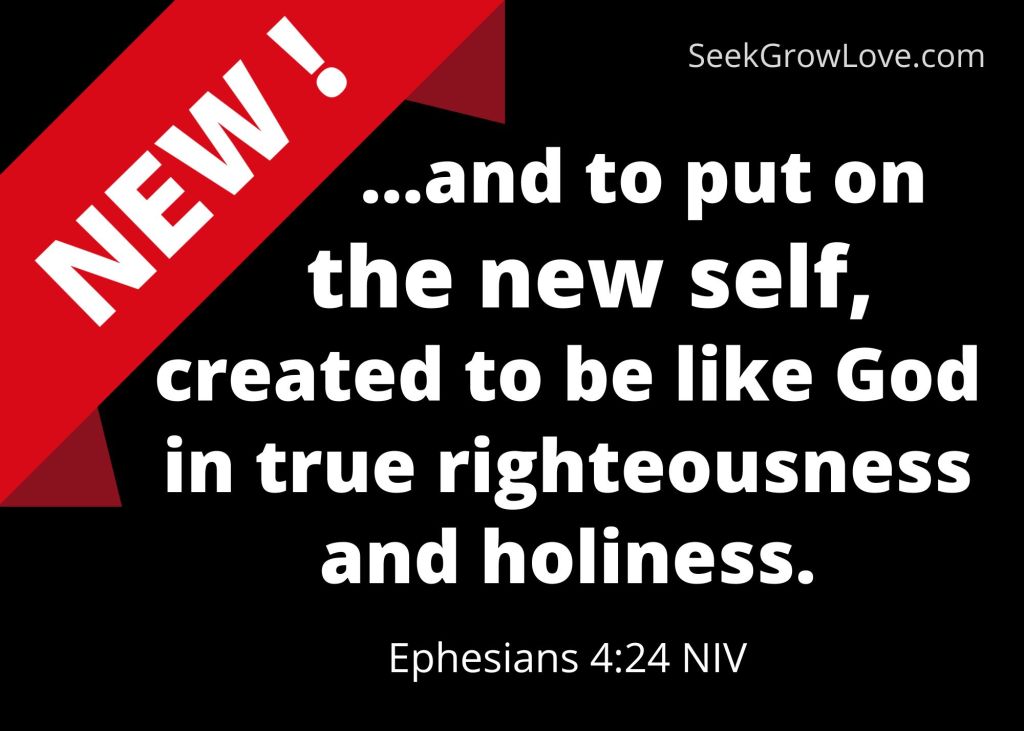
Being a believer in Christ should be reflected in how we think about and present ourselves. We no longer engage in unholy behaviors – that’s the old self. The new self is transformed to be righteous and holy. And this should be evident in our day-to-day interactions with others. 

Paul also explains that as a member of God’s family, we each play an important role. When we collaborate with one another amazing things take place for the sake of the Gospel. 

It is important to note that living a holy lifestyle takes intentional effort – it doesn’t just happen. We have to work at it. Much like a classroom teacher spends significant time at the beginning of the school year establishing procedures, regular reminders are key to maintaining a smooth-running classroom. Likewise, if we intend on continuing to grow up spiritually, we also need regular reminders of what a mature believer says and does. This is why the study of scripture and community fellowship is so valuable. As we associate with like-minded believers we are encouraged to continue putting on the new self and working towards becoming the person God has designed us to be, righteous and holy.

-Bethany Ligon

Application Questions

  1. Looking at Ephesians 4 again, what “old self” attitudes, actions, or mindsets does Paul tell the believers to get rid of. In your own “old self”, what have you been (or are currently, or ought to be) working on removing?
  2. Describe the “new self”.
  3. Looking at your own life, what percentage are you “New Self” – are you still walking around in “old self” socks? What will it take to boost that “new self” percentage higher?

Order in the Church

1 Corinthians 14

June 15

“for God is not a God of confusion, but of peace. As in all the churches of the saints,” 1 Corinthians 14:33 NASB

In our house, we narrate the dog’s thoughts.  Somebody will see Zippers make a funny expression and they’ll say “She’s like: “Umm guys I’d like to go to the park too.  Is that okay? Or if not, I guess I’ll just stay here.” Then somebody else will chime in… “No, Zippers is like I really like to ride in the car…” and it goes on like that for a while.  Then somebody will miss-hear what one of the previous dog interpreters said and will ask “Did you just say, ‘She said she wants to use a fork too?’” And everyone will bust out laughing.   It’s not quite the same as speaking in tongues or sharing a revelation of prophecy, but it helps me imagine what it may be like to be in a church where more than one person is trying to do those things at once.  With a family of six people plus a big dog, when everybody wants to talk at once, it gets a little overwhelming. 

We have grown accustomed to our kids’ speech patterns and can usually understand what they are saying.  For quite a while EmmaGrace could only say “ahhhhhh” with subtly different inflections to indicate if she was asking a question or affirming that she wanted milk to drink.  As she got a little older she would tell you her favorite color was “lello”- which most people can probably figure out by context.  But if she was just pointing out something that was yellow, you might need an interpreter. 

When Weston was smaller he drooled more than our English Mastiff.  So much so that he earned the nick names “Puddles” and “Weston the wet one”.  When he spoke with a mouth full of slobber he sounded a lot like Sylvester from the Bugs Bunny Cartoons.  When we make smoothies, they are “poovees” to him.  When he had a little tummy bug, he told my mom that he had “buffered in the hall way.”  That needed a little interpretation.  (It’s the word that rhymes with scarf and when kids did it in school the janitor had to get those funny smelling wood chips). 

Carter is all about airplanes.  So he loves to talk in acronyms that he learned in his ground school for pilot training.  From time to time he talks about MSL, VNO or VNE.  I went to most of the classes with him but my 40 year old brain has less RAM (Random Access Memory) than his does.  So I can get MSL- Mean Sea Level.  I can remember that VNE is one that varies from plane to plane but basically it is the speed at which your wings will probably fall off if you continue to accelerate or hit any kind of turbulence. It is the Velocity to Never Exceed.  Sometimes I have to ask him though “What does VNO stand for again?  Oh yeah, velocity of normal operation.”

Communication is a two way street.  When speaking we have to use words that the audience can understand.  We also have to listen to the person that is speaking.  I fear I am developing the multigenerational genetic gift of hearing loss, so sometimes I wish life had closed captioning. 

1 Corinthians 14 tells us that these unique abilities to receive and deliver messages from God are pretty cool but they really only work if we have some order in the church.  We can’t have everybody talking at once. 

-Brian Froehlich

Application questions:

  1. Paul seems to assume that the Corinthian church will have more than one person at a time that wants to speak in a tongue or deliver a prophetic word.  It is almost like how he assumed they would be practicing communion.  Are these gifts practiced in your church today?
  2. If not, should they be?
  3. If so, are they practiced as directed by Paul in this chapter?

A Brother in Sin

1 Corinthians 5

June 6

As we continue past the previous chapters of 1 Corinthians, that of leadership in the church and the nature of true apostleship, we enter a new section that is initially and seemingly unrelated to the current mood of Paul’s letter. It feels kind of awkward to talk about certain sins and topics, today’s being incest, because it is so obviously horrendous that it almost feels like a waste of breath to talk about. However, this negligence is precisely why we need to discuss such things, so that they do not become the normative culture. (As is seen with a plethora of “hot-button” issues the modern church has just accepted due to ignorant doctrine.) Additionally, as we’ll see with what Paul wrote, these topics are also excellent gateways for further understanding other applications of the word: true faith in action.

Paul begins by calling out the sin of incest between two members of the Corinthian church, fixating the blame on the man responsible, and seems to be most uproarious about how proud the offenders are in their sin. Verse 2 reads, “And you are proud! Shouldn’t you rather have gone into mourning and have put out of your fellowship the man who has been doing this?” It appears as though, while the act of incest itself is an egregious sin, being boastful in it simply exacerbates its severity. This claim is supported by the next six verses and subsequent pseudo-parable. Verses 6-7 read, “Your boasting is not good. Don’t you know that a little yeast leavens the whole batch of dough? Get rid of the old yeast, so that you may be a new unleavened batch – as you really are. For Christ, our Passover lamb, has been sacrificed.” A little yeast, the parabolic equivalence of humility (i.e., the absence of excessive boasting), is sufficient to make useful bread. Old yeast is to be thrown out, as it makes bad bread and is useful for nothing; just as we need not boast at all, Jesus is our supplement for humility. We are called not to boast in our accomplishment or our sins, but to attribute all that we have done that is good to God.

Returning to Paul’s initial command to extradite the man from the church, does that not seem antithetical to the accepting nature of faith? Perhaps upon an initial reading it may, but Paul acknowledges this and says in verses 9-11, “I wrote to you in my letter not to associate with sexually immoral people – not at all meaning the people of this world who are immoral, or the greedy and swindlers, or idolaters. In that case you would have to leave this world. But now I am writing to you that you must not associate with anyone who claims to be a brother or sister but is sexually immoral or greedy, an idolator or slanderer, a drunkard or swindler. Do not even eat with such people.” Paul is entirely aware that man is a sinful being, and that there was only one man to walk the earth who was blameless: Christ. Instead, in this passage, he makes the clarification that the people we are to not associate ourselves with are those who claim to be brothers and sisters in the faith, and STILL are boastful in their sin, unapologetic about their openly sinful life, perhaps even going as far as claiming that their actions are biblically justifiable. These are the people we are to lovingly rebuke, as they claim to live by the word and yet blatantly do not. So often, Christians are seen as judgmental toward outsiders. Unfortunately, this is not wholly unreasonable. Our issue is that we judge those who do not live by the law for not living by the law, while simultaneously turning a blind eye to those who CLAIM to live by the law and openly do not. Paul writes in verses 12 and 13, “What business is it of mine to judge those outside the church? Are you not to judge those inside? God will judge those outside. ‘Expel the wicked person from among you’.” Our responsibility is to spread the good news to those who do not have it, and to lovingly keep ourselves accountable.

-Mason Kiel

Questions for Reflection and Discussion

  1. Sin is sin. Why is there a difference between how we view, judge or treat various sinners?
  2. Are you personally more apt to spread more judgment to those outside the church or load on the mercy to those inside than Paul would recommend? What is the danger in each of these?
  3. What is the purpose of expelling a brother in sin?

God Gives the Growth

1 Corinthians 3

June 4

One of the greatest examples of humble service in the Bible is that of John the Baptist. John knew that his role was not to be the savior of the world, but to point people to the savior of the world. John’s vocation was to make a clear and unhindered path that leads to Jesus Christ. We now share in the same work as John the Baptist. Our job in this life is to point people to the Lord of glory and to show the magnitude of having a personal relationship with him. John said it best in the phrase “He must increase, but I must decrease” (John 3:30). John knew that he was simply to give the world more of Jesus and less of himself.


This ideal of leading people to Jesus and not to ourselves is something we always have to keep in the forefront of our mind. Paul addresses this very issue in 1 Corinthians 3. The church at Corinth was interested in making divisions by which person they were following.


“For when one says, “I follow Paul,” and another, “I follow Apollos,” are you not being merely human?” (1 Corinthians 3:4).


Paul and Apollos, for all intents and purposes, were celebrity pastors in the first century. People were bragging about following Paul or Apollos, and they lost sight of what both Paul and Apollos were doing and their roles in the church. The roles of both Paul and Apollos were to share the gospel message and to realize that it was God that was working through them.


Paul makes it clear by saying: “What then is Apollos? What is Paul? Servants through whom you believed, as the Lord assigned to each. I planted, Apollos watered, but God gave the growth. So neither he who plants nor he who waters is anything, but only God who gives the growth” (1 Corinthians 3:5-7).


Whatever our work and role is in the church, we should not be asking people to follow us, but rather we should lead them to God. What we do in the church and for the church is nothing without God providing the growth. Our job is not to change hearts and save lives, but to lead people to the one who can. Our role is not to draw attention to ourselves or lift ourselves high, but rather exalt the Lord Jesus. We must decrease and he must increase. We must plant and water, but remember that God causes the growth.


Let us not fall into the trap of saying we follow this person or this person. Let us follow Christ and lead people to him. Let us make sure that we realize all the work that we do is supplemented by the growth that can only be caused by God. Let’s live our lives in such a way where we always point towards God and never to ourselves.

-Nathan Massie


Application:

  1. Realize that our job is to point to Christ and to the work that he is doing and not to ourselves.
  2. Realize that our work in the church is important, but it is ultimately God that causes the growth to occur in the church.
  3. To make sure we are following Christ and his teachings and to not get caught up by the earthly people that we follow.

Watch Out!

Romans 16

June 1

One of the best ways to say “I love you” in the midwest without using those words specifically is to say, “Watch out for deer” when someone is leaving your house in the evening. This is a phrase that is so common, especially in the summer months when deer are more willing to wander further distances before there are plenty of crops to munch on. Ask anyone who has ever hit a deer: the damages to any vehicle can be severe. It is devastating. So, although it is obvious that it is not ideal to hit a deer, nor would anyone want that, we still remind one another to watch out for them. It’s a simple way to show concern to something that is an all too common experience.


The Apostle Paul does just this when he is closing out his letter to the Romans. In Romans 16 he says to the church, “I urge you, brothers and sisters, to watch out for those who cause divisions and put obstacles in your way that are contrary to the teaching you have learned. Keep away from them. For such people are not serving our Lord Christ, but their own appetites” (Romans 16:17-18). We all know instinctively that division is not a good thing. Division causes pain and strife in any family, but we see this specifically in the family of God. Just like in the summer months we ought to watch out for deer, so we need to be on guard against people whose goals are to cause divisions and create obstacles. This type of behavior is found in a person who is not interested in growing God’s kingdom by sharing the gospel. Rather, this type of person is interested in dividing God’s kingdom into different sections. Paul further explains the type of people who are always dividing: they are interested in serving themselves and not the Lord Jesus.


We live in a time where politics and culture are always in the forefront of people’s minds. It is hard to take in any form of media without having some type of political statement attached to it. The division that is caused by the polarizing view of politics is something that can be avoided in the church almost altogether. I say almost altogether because there are issues that Christians should vocally stand for such as being pro-life. A majority of political issues fall under the category of “opinion” however. I heard it said well recently that the Apostle Paul could have filled his letters with news concerning the Roman empire. But he didn’t. He spent his time and efforts sharing the good news of the kingdom of God and the Lord Jesus. We need to be on guard from anything that divides the body of Christ, and to seek unity in the body of Christ. Especially when the divisions are created over opinions, and not because of a dissent in sound doctrine. Division should be avoided as best as we can. We should never roll over because it is easier, nor should we have a church split because it would be easier. We should make every effort to keep the family of God in a unified stance. We are stronger and better together. The kingdom grows because of our common faith. Let’s grow God’s kingdom together and not divide it into smaller pieces.

-Nathan Massie


Application:

  1. Seek to build in unity with those around you and don’t become divided away from other people on the basis of opinions.
  2. Watch out for people who seek to make divisions in the church for their own gain.
  3. To remember Christ wants us to be unified in his body and to rejoice in the unity
    in faith that we all share.

No Stumbling Blocks

Romans 14

May 30

One of my all time favorite movies from childhood is Finding Nemo. One of my favorite scenes is when Marlin and Dory meet the group of three sharks who vow not to eat fish anymore. The line that is continually repeated by the sharks is “Fish are friends not food”. The three sharks are attempting to help Marlin and Dory on their quest to find Nemo. Marlin and Dory have a moment where they are arguing over the diving mask that has the address to where Nemo could be. They are pulling the mask to and fro and it snaps against Dory’s nose and she bleeds. The largest of the three sharks, Bruce the Great White, catches a whiff of her blood and he forgets the new motto that he’s trying to live by. A wild chase ensues with one of the most intense scenes from the movie, while the shark who vowed to help lost his way with his desire to eat them.


There are times in our lives where we forget who we have become in Jesus. There are moments where we forget the new life that comes from having a relationship with God and we are tempted to sink back to our old ways. After getting a faint scent of blood Bruce was ready to turn back to his natural shark ways.


In Romans 14 the term that Paul uses is “stumbling block” to refer to areas of temptation in a believer’s life that might not be a hindrance to our siblings in Christ. In fact Paul says to “not pass judgment on one another any longer, but rather decide never to put a stumbling block or hindrance in the way of a brother…so then let us pursue what makes for peace and for mutual upbuilding” (Romans 14:13-19). The blood that came from Dory’s nose was not a temptation that everyone fell for in that scene. Bruce was the weak one who was struggling the most with his new life. The blood was a hindrance and stumbling block that sent him in a frenzy in which he fell into his natural temptation.


If there’s an area that really tempts a brother or sister in Christ, but does not tempt us, we must go out of our way to help our siblings not fall into temptation. Our job is to be our brother’s keeper and to come alongside one another so as to not allow ourselves to fall into sin. Paul implores us and shows the seriousness of bringing temptation to our siblings in Christ by making the statement: “Do not…destroy the one for whom Christ died.” (Romans 14:15). The context of this passage is concerning food and drink that might be a hindrance in the lives of ancient Christians, but the wider application encompasses all temptation that we might face for all time. The greater rule here is that temptation, no matter how insignificant it seems for us, is a big deal to someone who struggles in that area. We must be sensitive to the areas of temptation for our brothers and sisters and make diligent efforts to pursue peace for the mutual upbuilding of the body of Christ.


One of the most practical ways we can limit temptation for those around us is to practice modesty. Modesty is not some old out of date stuffy ideology. Modesty is the pursuit of holiness in Christ through our dress, speech and conduct. Choosing modest clothes, words and actions is something that is so foreign to our world today. God desires us to be set apart and one way we can do that is to make sure that we are honoring God and one another through our appearance, our choice of language and the way we live our lives. This is a way to bring peace to those around us and to make sure that we are not being a stumbling block and a hindrance to those who see us, hear us and live their lives in proximity to us.


Sin and temptation are both extremely serious. They are also both difficult to deal with. But with the help of God and the help of one another we can remove the stumbling blocks from each other’s paths. We can also make sure that we are not hindering one another’s walk with God, but rather enhancing our walks with God by building up one another in Christ.

-Nathan Massie


Application:

  1. Have intentional conversations with your friends about what temptations they struggle with and how you can help them.
  2. Identify your own weaknesses and struggles and ask for help from a trusted and mature Christian friend and/or mentor if you keep falling into the same temptations.
  3. Ask God for guidance on what steps you should take to help your friends with their walks with God.
  4. Build up one another in Christ through accountability. It is nearly impossible to deal with temptation and sin without the help and accountability from mature Christian friends and/or mentors.

Traveling Encouragers

Acts 11

April 29

Acts 11:23 – When he arrived and saw the evidence of the grace of God, he was glad and encouraged them all to remain true to the Lord with all their hearts.

The second half of Acts chapter 11 emphasizes the importance of fellowship; and not just with other believers who are in our local communities, but with those who are separated by a significant distance. 

Living in Arizona, our state hosts thousands of retirees who migrate south for the winter. Being a member of Lakeshore Bible Church of God, I often see a small fraction of that migration as other members of the General Conference travel south during this season as they spend a few weeks or perhaps months escaping the brutal cold. It is always an encouragement to see them, talk with them, and of course exchange a hug or two. 

Our Conference offers multiple opportunities to gather with fellow COGgers throughout the year; Christian Workers Seminar (happening next week), to the Young Adult Getaway, Family Camp, other state and conference camps (happening in June), FUEL (in July) and the annual General Conference (in August). And I can’t forget to mention the reFUEL and Refuge events that take place in the fall and winter. 

At any one of these events, we have the opportunity to be like Barnabas and Saul, visiting out of state with one another, catching up with friends, meeting new acquaintances, studying God’s Word together, worshiping side by side, praying for and with each other, and of course…sharing meals! 😉

It is so important to invest in your local church. But just as valuable is investing your time and energy gathering with other like-minded believers who live a significant distance away. We are family and family needs one another. 

Because I live in the southwest, I do not have the opportunities to visit with you all on a regular basis, so maybe this devotional message is more for me than it is for you. But I LOVE seeing you all whenever I get the chance. YOU inspire me. YOU challenge me. YOU teach me. YOU accept me. And that is what family is all about. 

I hope that you have the chance to take advantage of one or more of our summer events this year. You WILL find yourself encouraged in the presence of fellow believers. And more than likely, you will be the smiling face that your brothers and sisters in Christ long to see.

-Bethany Ligon

Questions for Reflection and Discussion

  1. How have you benefited from the encouragement of a brother or sister in Christ?
  2. How do you encourage others in your local church body? What connections have you made to believers beyond your local community – and how do you find ways to encourage and be the body of Christ to them?
  3. After reading Acts 11, how would you describe Barnabas? What qualities or actions of his would you like to grow in your own life? How will you work on that?

Not Alone

Acts 6

April 24

Helen Keller is quoted as saying, “Alone we can do so little; together we can do so much.”

As I read through Act 6 today, I am reminded that we were never meant to do ministry, serving others, all on our own might. We have been designed to be ministerial alongside others. 

The number of followers of The Way was increasing daily. In fact, the size had reached a critical juncture. 

In ecological terms, it’s referred to as “carrying capacity”. A habitat can only support a certain number of any kind of species depending on the natural resources available. 

Likewise, we read in Acts, that the number of believers was becoming so great, and including a wonderful mixture of cultural backgrounds, that peoples’ needs, specifically widows, were not being met. 

The leadership knew that people had basic physical needs as well as spiritual needs that needed to be provided for. They had to ask themselves, “What’s the best use of our time”? They realized that they could not forsake one for the other.

Once they determined the best course of action, even more people were ministered to, both physically and spiritually.

As we go about the Lord’s business serving others, we need to first ask ourselves, am I attempting to go it alone, or am I willing to work alongside others? The next question to consider is are you serving in a way that not only meets the needs of others, but that will have the greatest impact?

What I am NOT saying is that if a task isn’t one of your spiritual gifts that you can excuse yourself…however, we are informed in multiple passages within the New Testament that we all have a part to play and some individuals are better suited for some areas of ministry over others. 

When everyone is working collaboratively, and doing it in such a way that suits how God has uniquely designed us, we can have an exponential impact on the growth of God’s kingdom. 

How can you serve others, with others, for the Kingdom?

-Bethany Ligon

Questions for Reflection and Discussion

  1. Consider who you do ministry with? Thank them for this partnership.
  2. Do you too often try to go it alone? What is the dangers of working alone? What is the blessing in working with a partner or team?
  3. Are there jobs caring for the physical or spiritual needs in your church or community that aren’t getting done? How can you, with a partner or team, help meet those needs?

Living for Christ and Each Other

Acts 4

April 22

After the events of the day of Pentecost, the healing of the lame man, and the great response of multitudes in Jerusalem, the church faced life in the world of that day. A world of darkness, and difficulty. And yet met it with a flowing out of the life of Jesus Christ. This is ideal Christianity, true, genuine Christianity. Unfortunately, there is also a counterfeit Christianity. It came in shortly after this in the early church, and evidence of it will be seen throughout the book of Acts. Wherever the true church has gone throughout the world, counterfeit Christianity has gone right along with it. How can you tell true Christianity from counterfeit?

Counterfeit Christianity can be recognized externally as a kind of religious club where people, largely of the same social status or class, and bound together by a mutual interest in some religious project or program, meet to advance that particular cause. That is part of Christianity and let’s face it every group that gets together. But that is a far cry from all that true Christianity is. True fellowship consists of individuals who share the same divine life, who are made up of all ages, backgrounds, classes, and status-levels of society, and who, when meeting together, regard themselves as what they really are, brothers and sisters in one family. With that mutual background of love and fellowship they manifest the life of Jesus Christ.

That is what we have here. The key idea is community, commonness, everything in common. They were of one heart and mind. Here were people who, by the Holy Spirit, had been united into one life. They were of one heart. At the very deepest level of their lives they belonged to each other, and that is only possible by means of the Holy Spirit. They did not need to have met someone before to recognize that if he or she is a believer they belong to each other, they are of the same family and they always have the most important thing in common. This was true of these people.

Not only did they have it, but it also manifested itself in the fact that everyone had a new attitude toward the material life. This is not a forced distribution of goods. It is not an attempt to make everyone give up their material things and redistribute them to others. No, it is a change of attitude, saying, nothing that I possess is mine, but everything that I possess is God’s, and therefore it is available to anyone who needs it. So here were these early Christians, one in heart and mind and body, united together. That is the church as it ought to be.

-Andy Cisneros

Questions for Reflection and Discussion

  1. Don’t point the finger at others – but look at yourself. How authentic, true and genuine is your Christianity? Are there any areas where you slip into a counterfeit Christianity? What would the fix be?
  2. How will you practice unity of the church body this week? And next week?
  3. What do you “possess” that is God’s? (Hint: it should be a pretty long list – but go for it – no one word answers here.). How can you show that these belong to God and make them available to anyone in need?

Devote Yourselves

Acts 2

April 20

“They devoted themselves to the apostles’ teaching and to fellowship, to the breaking of bread and to prayer.” Acts 2:42

One of the things the very first churches did was devote themselves to fellowship. Fellowship means holding all things in common. They would share everything. They began to know and to love one another. Here are 3,000 people suddenly added to a little band of twenty. Most of them probably were strangers before this time. Many of them had come from other parts of the world into Jerusalem for that occasion. They did not know each other. But now they are one in Christ, and they begin to love each other and start to talk to each other, to find out what each other has been thinking and how each has been reacting, and to share their problems and burdens and needs, to talk about these together and pray together about them. There was a wonderful sense of community, of commonality, of belonging to each other. That is the fellowship which is the intended life for the body of Christ.

If the body is not operating, then the life is not manifest. That means there is no power because the life of God is always power. The reason the church has been so powerless lately is that it has been so fragmented and broken. We have estranged ourselves from each other. In Ephesians, the Apostle Paul says, and do not grieve the Holy Spirit of God… (Ephesians 4:30). Then he lists the things that grieve the Holy Spirit: Get rid of all bitterness, rage and anger, brawling and slander, along with every form of malice. Be kind and compassionate to one another, forgiving each other, just as in Christ God forgave you. (Ephesians 4:31-32)

If that is not happening, then the Spirit of God is grieved. When the Holy Spirit is grieved, it does not act. There is no life. The church becomes dull and dead and sterile and mediocre. All this is manifest in an empty ritual, with no vitality in it. God intends that Christians should have fellowship, should share one another’s lives and thoughts and problems — bear one another’s burdens and so fulfill the law of Christ. It is not an option; it is an essential. Therefore, when the Holy Spirit of God begins to move in any congregation, or in any assembly of believers, he starts at this point. He begins to heal the brokenness of their lives and their relationships one with another, to get them to admit to each other their malice and their anger and their frustration and their grudges, and to forgive one another. This is when life begins to flow once again through the body of the Lord Jesus Christ.

What can you do to have more fellowship with fellow believers?

-Andy Cisneros

Questions for Reflection and Discussion

  1. Look again at the list of things that grieve the Holy Spirit, as well as the positives we are to do instead. Slow down and prayerfully consider each one, searching your own heart, words, attitudes and actions. What do you need to ask forgiveness for? Who do you need to forgive?
  2. How can you use fellowship to then bear one another’s burdens?
  3. How devoted are you to fellowship with the body of believers? What can you do to have more? With whom? When? Where? How? And, of course, remind yourself why?