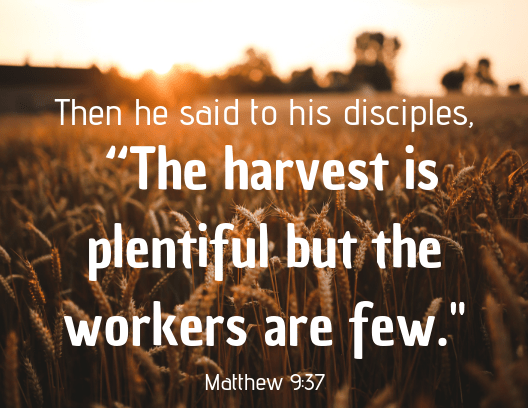
In this chapter (Matthew 9) we see that Jesus and the disciples are continuing an active pace proclaiming the good news of the kingdom and healing every disease and sickness. This lively passage not only records 6 healing incidents, but also shows 3 incidents where the teachers of the law are becoming rattled by the actions and rising popularity of Jesus.
Ready for anything and everything, the action rolls out as follows for Jesus and the disciples: 1) heals a paralyzed man, 2) calls Matthew the tax collector, 3) stops a hemorrhage in a woman, 4) raises a dead girl, 5) gives sight to 2 blind men, 6) and loosens the tongue of a mute man
Not only was Christ seemingly running a mobile emergency room, he was “hiring” new workers, contending with naysayers, and stopping to notice the big picture of the work ahead.
Verse 36 takes my breath away. “He saw the crowds and had compassion on them.” We are not lost in a crowd to Him. He knows our name and our needs. There is no end to His goodness. No bottom to the well. You can’t wear Jesus out. He’s not running on low. He’s not in a bad mood because it’s you again. “For from His fullness we have all received, grace upon grace.” John 1:16
The biggest problem in these 38 verses is that Jesus needed assistance to support the needs of the “harassed & helpless.” Nothing’s changed. May God stir your heart and mine this day to be a worker fit and ready to support the hurting. Let God’s “grace upon grace” compel us to action to not overthink but DO!
-Julie Driskill
(originally posted for SeekGrowLove January 14, 2019)
Reflection Questions
What do you learn about Jesus in Matthew 9? In what ways does he give?
Who do you see who are harassed and helpless? What can you give to them?
In what ways have you received “grace upon grace”? How can you share that with others?
“Out of the depths I cry to you, Lord; Lord, hear my voice. Let your ears be attentive to my cry for mercy.” Psalm 130:1-2
At the beginning of Ephesians 2, Paul terms the forces at work that draw us away and towards gratifying ourselves as the “Kingdom of the Air.” We hear the wind blowing from this kingdom as we see the work of countless groups that have formed today that are in direct opposition to God. While these groups follow different threads, they each perpetuate this idea that gratifying your desire is a higher form of living and leads to a more fulfilled life. This type of living isn’t enlightened; it is carnal. The “air” is hot and it stinks, so it’s no wonder that this advice leads to a lake of burning sulfur. Yet at some point, we all were residents here. However, with the waters of baptism, Christ moves us, sending an Uber (not a U-haul because our junk stays behind) and we have made our way out.
“If you, Lord, kept a record of sins, Lord, who could stand? But with you there is forgiveness, so that we can, with reverence, serve you.” – Psalm 130:3,4
“For it is by grace you have been saved, through faith—and this is not from yourselves, it is the gift of God— not by works, so that no one can boast. For we are God’s handiwork, created in Christ Jesus to do good works, which God prepared in advance for us to do.” – Ephesians 2:8-10
God doesn’t see our rap sheet, whether it extends feet or miles. He doesn’t care if we visited sin on the weekend, or if we had set up a mansion in the city center of a false kingdom. Those who declare Jesus as the Lord of their life are covered in marvelous grace that hides the stain of sin. This is not a one time deal, but a perpetual gift that will always outweigh our folly. Grace isn’t earned through righteous acts, but it is the free gift of God received when we acknowledge the trespass, transgression, and unrighteousness. We put to death the selfishness, and we become alive in Christ, ready to take on the mission which has been prepared by a loving Father.
“Israel, put your hope in the Lord for with the Lord is unfailing love and with him is full redemption.” – Psalm 130:7
Moreover, we are called to show grace to others. While we don’t live in the past, we should remind ourselves of where we once lived. We do so, not as a comparison, but to remind ourselves that we desperately need the grace of God, and additionally, have benefited from the grace extended by those who follow Him. Jesus addresses the issue of grace in the Parable of the Unforgiving Servant, as a response to Peter’s inquiry about how many times we should offer forgiveness (Matt 18:21-35). We cannot out love God. We cannot out forgive God. We cannot out grace God. Like our Heavenly Father, let the stories we tell not be about the trespass, but let it be about the grace that is greater than sin.
“In him the whole building is joined together and rises to become a holy temple in the Lord. And in him you too are being built together to become a dwelling in which God lives by his Spirit.” Ephesians 2:21-22
-Aaron Winner
Reflection Questions
Make a little comparison chart – Old Life of Sin vs. New Life in Christ. Use Ephesians 2 and your own personal experience. What does each look like? Characteristics of each? Ruler of each? Future of each?
If you haven’t personally experienced new life in Christ yet, what is holding you back?
What does God’s gift of grace mean to you? Today, how will you thank God for this gift? How will you show God’s grace to another?
(and I forgot to include Judges 21 yesterday, so you can finish that up today)
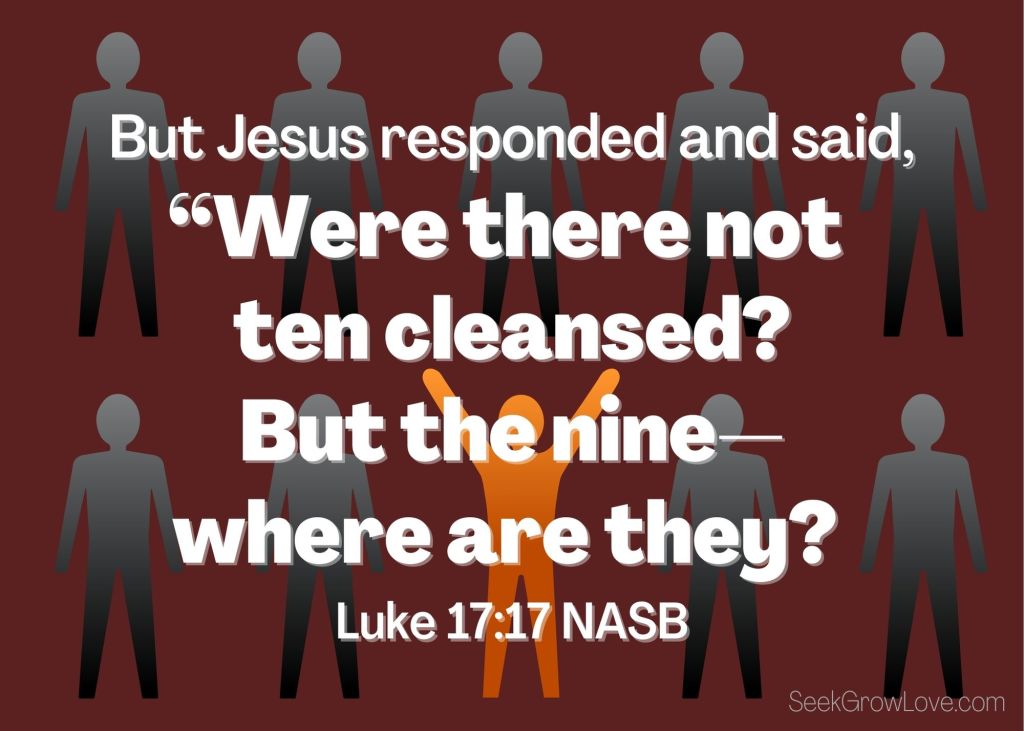
The story of the ten lepers is familiar to many of us. Luke 17:11-21 is often included in youth Sunday School lessons as a powerful tale of healing and to give thanksgiving. In the parable, we read about the ten men who were cleansed but learn that only one returned to give thanks to Jesus. Often, we use this parable to teach young children about the importance of giving thanks.
Though like many, I learned this tale in my youth, it wasn’t until my adulthood that I more fully understood the need for thanksgiving. Verses 15-16 of this parable are what jump out at me as an adult. “Now one of them, when he saw that he had been healed, turned back, glorifying God with a loud voice, and he fell on his face at His feet, giving thanks to Him. And he was a Samaritan.”
It’s interesting to me that it’s specifically pointed out that the man who returned to give thanks was a Samaritan. This man had a double whammy in society! First, he had leprosy and would have been kept apart from others. Secondly, he was a Samaritan, considered less than desirable among people of Jesus’ time. In that simple phrase at the end of verse 16, we see yet again that Jesus’ ministry sought out and served the marginalized people. Healing and grace was for all people, not just an elite few.
That phrase jumps out to me, because at heart, I am a Samaritan. I’m one of the less desirable that Jesus came to save. As a youth, I didn’t have life experience to fully appreciate and understand the gift of God’s grace or the need for thanksgiving. As an adult, I have both the education of life and Bible study to have a full awareness of God’s grace and mercy. Just like the marginalized people that Jesus served in His day, I am in great need of healing and grace due to my sin.
Verses 15-16 also strike a chord in me because of the manner in which the leper gave thanks. Look at the way he praised Jesus! He used a loud voice and he fell on his face before Christ. He did not shrink in giving praise and thanksgiving because he understood the power of the healing bestowed upon him. He had a true gratitude to Jesus. Do we have a true gratitude for the way in which we have also been saved?
Oh, how I want to praise Jesus just like the leper who fell at his feet! He has given me much, so let me praise him much! In our lives, can we live out Psalm 117? “Praise the Lord, all nations; Laud Him, all peoples! For his lovingkindness is great toward us, And the truth of the Lord is everlasting. Praise the Lord!”
Today, can you offer true gratitude for the mercy and loving kindness that God has offered to us through the gift of Jesus’ life on the cross? Can you share that mercy with others? As a church, can we seek out the marginalized people of our society and offer them the same love that Jesus lived in His ministry?
~Jen Siderius
Reflection Questions
How can you (will you) offer true gratitude for the mercy and loving kindness that God has offered to us through the gift of Jesus’ life on the cross?
How can you (will you) share that mercy with others?
As a church, how can we (will we) seek out the marginalized people of our society and offer them the same love that Jesus lived in His ministry?
In our Bible reading today what do we learn about God? What do we learn about Jesus? Why do you think it says that as the cleansed leper was throwing himself at Jesus’ feet he was praising God?
Ruth Introduction
The Book of Ruth is one of only two books of the Bible named after a woman. It takes place during the time of the Judges in Israel. It is named after the main character in the story, a Moabite woman by the name of Ruth, who became a believer in God, and followed her mother-in-law back to Israel. Because it mentions Ruth’s great-grandson, King David, the book of Ruth must have been written after David became King.
One of the most familiar passages is Ruth 1:16-17, which says, “…Where you go I will go, and where you stay I will stay. Your people will be my people and your God my God. Where you die I will die, and there I will be buried. May the Lord deal with me, be it ever so severely, if anything but death separates you and me.”
The Book tells about a woman, Ruth, a foreigner, born to a people with no relationship to God, who became a believer, and was richly blessed by God. Ultimately, she was listed in Matthew 1:5 in the ancestry of Jesus.
The Book of Ruth shows the incredible loyalty of Ruth to Naomi. It also shows the kindness of Ruth to her mother-in-law, Naomi, as well as the kindness of Boaz to Ruth. These remind us of God’s kindness toward us. We are also introduced to the concept of a “kinsman redeemer” – a relative who will redeem someone when they can’t pay their own way. This reminds us of Jesus, our relative, who paid for our sins, because we couldn’t pay for them ourselves.
As you read the Book of Ruth, consider how God watches over and blesses those who follow Him.
The next few days of readings will be centered around Jesus’s crucifixion. Luke’s account tells us of the interaction that Jesus had with the thieves on the crosses next to Christ, which is what I’m focusing my attention on today.
Jesus has been arrested and has appeared before Pilate, the highest Roman official in the area, and been found guilty of nothing more than inciting a spiritual revolution. Yet he was punished and tortured and hung up on a cross with criminals to die an agonizing death.
The criminals were guilty. They knew that they were being punished for wrongs they had committed. Still one mocked Jesus, telling him to save himself and them. The other, however, knows that he has sinned. He knows that he deserves punishment and that Jesus does not. And rather than asking Jesus to remove him from the cross and death, he has his focus on something far more important. He asked Jesus to remember him when he comes into his kingdom.
How remarkable. Honestly, when I’m in trouble I’m not thinking of whether or not I deserve that trouble. I’m not focused on what is ultimately important. I should be acknowledging that I’ve done wrong and that I likely deserve whatever mess I’m in. I should acknowledge that whatever battle I’m in the midst of, I can continue to fight because God has already won the war. Instead, I’m just looking for God to rescue me from my current situation. I’m looking for an easy way out. I have lost sight of the end game, which is an everlasting kingdom that can be had by accepting the gift of grace offered to us when Jesus was punished and killed for our transgressions.
The thief had his priorities straight, and Jesus acknowledged it by promising him a place in his everlasting Kingdom. How beautiful.
Take some time with me today to prepare yourself by realigning your priorities. Ask yourself:
When I am struggling, is my focus on myself or on God’s plan?
Have I accepted the free (for me) gift of salvation, or am I still trying to earn my way into God’s kingdom?
Have I truly acknowledged and accepted that no matter what I have done or said to redeem myself, I cannot?
How can I better reflect my joy and gratitude for this gift of eternal life? How can I express it to others so that they can accept it as well?
My prayer for you and myself today is that we each accept with a humble heart the gift of salvation, acknowledging that it is only by grace that we are saved. I pray that we accept that grace with extreme joy, because it is truly something to celebrate. I pray that our priorities are not focused on anything in this world, but on God’s coming kingdom.
People have been messing up by accident (or on purpose) for our entire existence… in Deuteronomy, we see a few different ways that God helped set up processes for when people are people and mess up.
In Deuteronomy 19 God has already established laws to follow, but He knows people will still mess up unintentionally, and so He takes the time to establish ways of showing justice and grace in those random, accidental sins. Killing people will always equal sin, yet God creates a safe haven to run to for those who commit this sin unintentionally (v. 4). Put yourself in that world and think of the magnitude of this gracious retreat to a neighboring city instead of facing death… in a culture where the governing law is “life for life” (v.21), having the opportunity to flee to a nearby city shows just how loving our God truly is. No murder (or sin) is exempt, but God makes a way out of the death penalty that someone should be subject to… sound familiar?
In Deuteronomy 20 we get a GREAT “refrigerator” verse: “…for the LORD your God is the one who goes with you, to fight for you against your enemies, to save you. (v.4)”. God knew the Israelites weren’t strong enough to defeat their enemies on their own, He knew He had to go with them and fight FOR them. God uses the priests to weed out those who are not confident in His power, because He knows that a smaller, faithful army is stronger than a larger, cowardly one. And He knows that there are plenty of cowards and uncommitted people in His people! God knew that His people were easily influenced, which is why He tells them to utterly destroy their enemies, so that there is zero chance His people can be pulled away from Him in that way (v.17-18). God also knew that His people would get rid of good things when they shouldn’t, which is why He clearly states to leave the trees that can feed His people (v.19). He covered everything the Israelites needed, just because He is a Good God, who loves His people. Again… sound familiar?
-Sarah Blanchard Johnson
Questions:
Where do you feel in your life God has covered you like He covered the Israelites?
These chapters give us several examples of God revealing His character. How many words can you come up with using just these passages that describe God? I came up with 6…
Prayer:
Lord, we praise you because you are a Good God. Thank you for the way you have always covered your people even when we mess up. God, thank you for the gift of your son and the safe haven he is for our sins. I pray that today we all feel your grace covering us, and that we show everyone around us that same grace – ultimately, being a light for you and for your glory. Amen.
Paul’s letters always offer great lessons, and his letter to the Galatians is no different. In this letter, to fully understand the lesson or example Paul has for us, we have to dig into the context and understand why Paul is writing in the first place.
In this letter, especially in the introduction, Paul is not impressed with how quickly the Galatians have fallen away from his message of truth and started to doubt his “credentials” as an apostle. Despite this, Paul still greets these believers with grace, peace, and truth about Jesus (v. 3-4). I don’t know about you, but if I have been abandoned, disowned, and essentially ignored, I don’t know that I would have the same gracious greeting… Think of all the energy, effort, and overall dedication Paul poured into this group of people when he was traveling, only to find out that someone came along shortly after and messed with everything he built. You would feel so betrayed by this group! You would maybe even want to give up on them and just focus elsewhere, but Paul writes to rebuild and refocus the Galatians.
While Paul does go into a defense for his apostleship, you’ll notice that he isn’t defending himself or his character, but rather he is defending his story that brings glory to God and explains the importance of Jesus. Paul is not interested in being seen as a popular guy; he specifically has no interest in that (v. 10)! He is passionate about making sure the churches of Galatia know the truth about Christ, and that is all! In fact, in some areas he didn’t even want people knowing his name, only his story of redemption and God’s grace, as a way to glorify God (v. 22).
Without explicitly telling us how to live in this chapter, Paul’s response to Galatia churches models several things about living the life of a Christian:
1. We should greet and treat others with grace, and speak truth, no matter what our relationship with them may be.
2. Proclaiming the gospel can be lonely and there will probably be people working against us at times, but our purpose is not related to gaining favor or status with people; it is focused on sharing Jesus.
3. God wants to be glorified in our life, no matter what path we started on, and God has the ability to use our bad history for his glory.
-Sarah Johnson
Questions for reflection:
Who in your life needs to be greeted with grace, peace, and truth by you?
Where do you see yourself proclaiming the gospel in your life? If you aren’t sure, try starting with the person that came to mind from the previous question.
Paul says God set him apart from birth (v. 15); what does this reveal to you about God’s character?
Prayer:
God, thank you for the amazing gift of your son, Jesus Christ. Please help us to share this gift with everyone we meet – but today I pray that you reveal to each one of us exactly who you want us to share your truth with. Give us strength and courage when we get lonely, help us remain focused on you and not our own status, and above all, let our lives be glorifying to you. In your son’s name, Amen.