When Solomon became king, God gave him an incredible opportunity.
He could ask for anything.
Power. Riches. Military victory. Long life.
Instead, Solomon asked for wisdom.
That request pleased God because Solomon recognized something many people never do: leadership without wisdom is dangerous.
1 Kings chapter 3 shows a young king who understood his own limitations. Solomon did not pretend to know everything. He admitted that he needed God’s help to govern rightly.
And that humility mattered.
One of the most famous moments in Solomon’s life came shortly afterward when two women came before him, both claiming the same baby as their own. Solomon’s shocking proposal revealed the true mother because real love was willing to sacrifice personal rights to preserve life.
True wisdom does more than impress people. It reveals the heart.
That is still true today.
Our world often confuses wisdom with education, confidence, or internet knowledge. But biblical wisdom is deeper than information. Wisdom is the ability to see situations through God’s perspective and respond in ways that reflect His character.
A person can be highly educated and still make foolish decisions. A person can speak confidently and still be spiritually blind.
Wisdom begins with recognizing our dependence upon God.
But there is also a warning quietly woven into these chapters.
Even while Solomon loved God, cracks were already forming beneath the surface. The text mentions that he married Pharaoh’s daughter and that the people were still sacrificing at the high places.
At first glance, those details may seem minor. But small compromises often become major disasters later.
Very few people wake up one morning and decide to destroy their lives. Usually, hearts drift slowly.
One tolerated compromise at a time. One rationalization at a time. One neglected prayer at a time.
That is why wisdom is not merely knowing what is right. Wisdom is continually choosing what is right.
Solomon’s kingdom experienced peace, prosperity, and influence unlike almost anything Israel had ever seen. Yet even the greatest earthly kingdom could not fully satisfy the human heart or permanently solve the problem of sin and death.
Like David before him, Solomon’s story ultimately points beyond himself.
The Bible’s hope is not merely that humanity would someday produce a wise king. The hope is that God would provide the perfect King — one greater than Solomon — who would rule with complete righteousness forever.
And that future kingdom still lies ahead.
Three Things to Remember
Wisdom begins with humility.
Solomon became wise when he admitted he needed God’s help.
Small compromises matter.
The seeds of future failure are often planted long before anyone notices them.
Earthly success is never the final answer.
Even Solomon’s glorious kingdom could not replace humanity’s need for resurrection, restoration, and God’s coming Kingdom.
We live in a world overflowing with information but starving for wisdom.
So before asking God for more influence, more money, or more success, perhaps we should begin where Solomon did:
“Lord, give me wisdom.”
Reflection Questions
Are you humble enough to seek and ask for wisdom?
Consider this definition – “Wisdom is the ability to see situations through God’s perspective and respond in ways that reflect His character.” Choose a situation you have been in recently. What might wisdom see? How might wisdom respond?
How can we learn more about God’s perspective and His character so we can more often follow in God’s wise way rather than our own often foolish way?
What should we do, where should we be, who should we be with, while asking God for wisdom?
What do you think is a wise judgment/decision/action you made? What is a foolish one ? What made it foolish? Were there any small compromises that led up to this foolishness?
Prayer
Dear God – I pray for wisdom. You are the wise and all-knowing, always righteous God and I need You. Help me see Your perspective and reflect Your character in both big and small decisions, judgments and actions in my life. Show me what is right and what is wrong and give me perseverance to do, think, say, choose what is right. Show me where small compromises are leading me astray.
The rebellion has been stopped. The army has won. David’s throne has been preserved. But the king is weeping over the son who tried to take his kingdom from him.
“O my son Absalom! O Absalom, my son, my son!” (2 Samuel 19:4)
To Joab and the army, Absalom was a traitor. He had stolen the hearts of the people, taken Jerusalem, and forced David to flee for his life. He was dangerous and his rebellion had to be stopped. But David did not see Absalom only as a rebel. He saw him as his son.
We cannot say exactly what was in David’s mind, but we do know what was in David’s past. In 2 Samuel 12, Nathan had told David that his sin with Bathsheba and Uriah would bring consequences into his house. The sword would not depart from his house, calamity would come out of his own household, his wives would be given to someone close to him in broad daylight, and the child born to Bathsheba would die.
David repented and was forgiven. Nathan told him plainly, “The LORD has taken away your sin.” But forgiveness didn’t mean that every consequence disappeared.
By 2 Samuel 19, David is mourning the death of another son. The child born to Bathsheba had died. Amnon had been murdered by his brother, Absalom. Now Absalom has been killed by Joab. (Later, Adonijah would also die during the struggle surrounding Solomon’s throne.) The calamity in David’s household was no longer a warning. It had become a painful reality.
David had replied to the prophet Nathan’s parable that the guilty man should pay “four times over.” Whether we count the consequences by Nathan’s words or by the sons David lost, the shadow over David’s house is hard to miss. This is what makes David’s grief so complicated. He was not just grieving a son. He was grieving as a father, as a king, and as a man who knew that his own sin helped bring sorrow into his house.
David had already shown a humbled spirit when he fled Jerusalem. When Zadok brought the ark of God, David sent it back. He would not presume that God would go with him. Then Shimei came out cursing him and throwing stones. Abishai wanted to kill him, but David stopped him. David wondered if perhaps the Lord had allowed even that humiliation.
This is not the attitude of a man who thinks he has done nothing wrong. David knows he has been forgiven, but he also knows he is living in the wreckage of his own failure. Can we relate to this struggle?
We believe God forgives sin. We believe the blood of Christ is enough. We believe God removes guilt from the repentant heart. But what happens when the consequences remain?
What happens when the relationship is still damaged? What happens when the trust is still broken? What happens when the family still feels the effects? What happens when we are forgiven before God, but still have to walk through the results of what we did?
Sometimes guilt and grief can make us passive. We do not know when to speak, when to act, when to defend ourselves, or when to accept the humiliation. David seems almost frozen at times. He wants Absalom spared. He mourns so deeply that the men who saved him feel ashamed. He forgives Shimei. He appoints Amasa, the commander of Absalom’s army, over his own army. He is trying to heal the kingdom, but everything is still unstable and such a mess.
There is humility and mercy in David, but there is also hesitation.
Joab saw the danger in David sitting too long in his grief and hesitation. He was a man of action who saw a threat and dealt with it quickly. He killed Absalom even though David didn’t want this to happen. He murdered his cousin Amasa after Amasa delayed in gathering the army against Sheba’s rebellion. Then he took charge of David’s army and pursued Sheba until the rebellion was crushed. Joab may have helped preserve David’s kingdom, but he did it with blood on his hands. And because he was David’s nephew, Joab’s violence was another painful reminder that this trouble, too, was coming from close to home.
David and Joab show two different dangers. David’s guilt and grief made it hard for him to act decisively. Joab had no such hesitation, but his boldness was not always righteous. One man hesitated under the weight of sorrow. The other pushed forward without enough fear of God.
Forgiveness does not mean we will always know exactly how to act when consequences stand in front of us. Sometimes we will feel humbled. Sometimes ashamed. Sometimes unsure whether to speak or stay silent. Sometimes we will want to fix everything quickly, but the damage will take longer than we hoped.
When the consequences of sin remain, we still have to do the next right thing. We humble ourselves. We accept what God allows. We make peace where peace can be made. We lead where we are called to lead. We refuse revenge. We refuse despair. We refuse to believe that because the storm is still blowing, God is no longer with us. And even while we are grieving, we keep moving.
David had once prayed in Psalm 57:1, “Have mercy on me, O God, have mercy on me, for in you my soul takes refuge. I will take refuge in the shadow of your wings until the disaster has passed.” That psalm came from another season of trouble, but the words fit David’s life here too. He needed mercy while the storm was still raging. He needed God while the consequences were still unfolding.
And so do we.
Reflection Questions
Do shame and guilt sometimes grip your heart and make it hard for you to know what to do?
Do you feel lost to the consequences of sin and like an outsider watching your life with no power to control it?
Does grief keep you frozen and feeling unable to act as a faithful follower of God?
If so, these are all feelings that David probably experienced too. Most likely, many Christians feel this way at times. David is a great example for us because no matter how bad things got for him, he always put his trust in God. He shows us how to turn our focus from ourselves back to the God who loves us. David said, “Be exalted, O God, above the heavens; let your glory be over all the earth.” Psalm 57:11
Prayer
Dear Great & Mighty God of Mercy and Justice – help me to fear You, and love and adore You to keep me from evil and serve You well. When I fail You, thank You for Your forgiveness. In humility, help me seek to do the next right thing and trust You more and more.
There are a number of cautionary tales in the bible. Whenever I see a few specific characters, I mentally always add “The cautionary tale of….” and that character’s name to remind me that while every single one of us has a purpose, sometimes that purpose is just to be an example to others of what not to do. The cautionary tale of Queen Vashti is one of my favorites (See the book of Esther), about privilege and responsibility. Today’s reading is one of those, “The cautionary tale of Nadab and Abihu”, and it’s always intrigued me as well, primarily because I’ve always wondered what “strange fire” was.
First, a little background. Aaron and his descendants were designated (by God, see Leviticus 8 for details on their ordaining) to be the priests of Israel, the men who would stand before God and offer propitiation for the sins of the nation. Aaron had 4 sons by his wife Elisheba (Ex 6:23), and Nadab and Abihu were the two oldest. Aaron was the “High Priest”, and had some specific duties that only he was supposed to carry out, and his sons were all priests. All of his descendants are priests as well, but it should be noted that Nadab and Abihu did not have any children so their younger brothers stepped up to fill their role after the events in today’s reading (Eleazar and Ithamar, as noted in Num 4:4 and later in Lev 10).
Keep in mind also that these newly appointed priests were just freshly put in the position, back in Lev 8. We then have to go back a chapter from today’s reading to get the pattern of what a normal ritual should look like, going back and reading from Lev 9:1-23 for the particulars, and culminating in Lev 9:24 when “Then fire came out from before Yahweh and consumed the portions of fat on the altar. And all the people saw it and shouted out and fell on their faces.” (LSB) . I think I’d fall on my face too, it’s a pretty amazing scene. It’s also pretty important to note that Aaron as the high priest was the one who was supposed to offer the sacrifices for the nation, as noted in Lev 9:6-10 and Ex 30:7-8.
So, seemingly immediately after the miraculous fire coming out from before Yahweh and all of the people falling on their face, enter Nadab and Abihu, who “took their respective firepans and put fire in them. Then they placed incense on it and offered strange fire before Yahweh, which He had not commanded.” (Lev 10:1, LSB).. Then, as before, “fire came out from before Yahweh” but instead of burning up the offering, it burned up Nadab and Abihu.
So what is strange fire? I’ve honestly always wondered. Carefully dissecting today’s reading, there were probably a couple factors in their unfortunate demise. First off, it was presumptuous of Nadab and Abihu to offer the incense before God, since that was the job of the High Priest. Secondly, they used their own fire on the incense (Lev 10:1) instead of the “fire which came forth from Yahweh”. The word that we translate as “strange” fire could also be equally accurately translated as “profane” fire, by the way. This seems like a pretty cavalier attitude from a couple guys who just spent an entire week (Lev 8) preparing spiritually to enter the priesthood. Then Moses says to Aaron “It is what Yahweh spoke, saying, by those who come near Me I will be treated as holy, and before all the people I will be glorified.” (Lev 10:3, LSB).
While this was a bit presumptuous on Nadab and Abihu’s part, read on in Lev 10:8-11: “Yahweh then spoke…saying, “do not drink wine or strong drink…when you come into the tent of meeting, so that you will not die…so as to separate between the holy and the profane…” (LSB). It doesn’t seem likely that this was a random statement given the circumstances, but more likely a bit of preventative education from God for future priests. This seems to indicate that maybe they were impaired with alcohol as well, which might help to explain the (extremely poor) decision to offer “strange fire” on their own. There was more than one thing going on, it looks like.
What’s strangest to me in this story is that just prior to these events, both Nadab and Abihu were present with the 70 elders when God appeared to them in Ex 24:3-8. These are men that should have had an extremely healthy respect for the most high God. These are men that should have known with every fiber of their being that the Lord God Almighty is Qodesh (Holy, Set Apart, Seperated), and had seen with their own eyes the awesome and fearful power of the living God. These are men that were likely in line to be High Priests themselves, but because they did not separate in their minds and actions between the holy and the profane, the clean and the unclean, they died in a fire. They should have known better.
When we approach our God, we need to make sure that we are not offering strange fire. We should be sober (1 Pet 1:13) and focused. We need to separate in our mind between the clean and the unclean, the holy and the profane, before we approach the altar. We need to purify ourselves. Consider for a moment a tiny ant, and your relationship with it comparatively. Our role before our Creator is infinitesmally smaller than that, comparatively. When we pray, when we seek God, we need to understand that this is the most important and critical moment in our existence, every time, and not a casual conversation: we are approaching the Lord God Almighty, the Creator of heaven and earth, the master of all life who sustains us with His breath (Job 34:14-15) and we should tremble. Approaching the Lord God Most High is not something that is to be taken casually or lightly, but with awe and reverence.
Since God has sent us his Christ, we no longer need to make ritual sacrifices, the sacrifice has been made once and for all. The sacrifices that we need to make, the sacrifices that our God desires from us are righteousness (which can also be translated as “equity”), and obedience (1 Sam 15:22). We need to reflect the amazing and awesome character of our God, and love Him with our whole heart, as well as loving the rest of His creation as much as we do ourselves (Mark 12:29-31), just like He has loved us. Jer 29:13 says “You will seek me and find me when you search for me with all your heart.” (LSB). If you go seeking inappropriately and offering strange fire, be very aware that instead of finding God, God might find you. Don’t become a cautionary tale.
REFLECTION QUESTIONS
Lots of times when we pray, we basically just present God with our “to do” list. Do you pause for a few moments and consider the level of interaction between a single tiny human and the omnipotent Creator of all things in the universe before you pray? Every time?
When you open your Bible to read it, do you pause for a few moments to wonder at the amazing grace and love of the Lord God most high who has given you His words as a guide, tiny human?
Do you seek fully to know your God with the attitude of an unworthy servant seeking their hardest to please their master? All the time, or just on church days?
Consider for just a moment, every day, what am amazing God we have. It should melt your heart. He sent His own son as a sin offering, to cut a covenant with us. What are you going to do to show God how much you love Him back, today?
PRAYER
Father God, my Master and my Creator, forgive me, heal me, and teach me. I am an unworthy servant. You are wonderful and beautiful, and greater than all. Help me to be a servant who pleases his master. I was not worth the price You paid for me, have mercy on me Lord God. Help me to love as You love. Grant me your spirit, and teach me wisdom so that I can please you. Thank you heavenly Father, in Jesus’ name, Amen.
Religious practice is exactly what is said. It is our habitual practices that we bring to our walk with God and make rules for our lives. These practices are not necessarily good or evil but become the habits that we follow as people in our daily life. We also build habits that govern our time together as the body of Christ at church or fellowship. Once again, these practices are neither good or evil but are the way that we have decided to fellowship together.
The law of Moses covered almost every aspect of life for the nation of Israel and gave instruction in how to do righteous actions and have righteous thoughts. As we read in Leviticus these instructions can be very complex and to our culture maybe not very understandable.
In our reading in Matthew, we are at almost the end of Jesus’ life here on earth and he is at the temple. He has many debates with the leaders there and also spends time teaching the people. He throws out the moneychangers and vendors and then has many interactions with them that are maybe not the most decorous from their viewpoint.
Matthew 23:1-13(NLT) Then Jesus said to the crowds and to his disciples, 2 “The teachers of religious law and the Pharisees are the official interpreters of the law of Moses. 3 So practice and obey whatever they tell you, but don’t follow their example. For they don’t practice what they teach. 4 They crush people with unbearable religious demands and never lift a finger to ease the burden. 5 “Everything they do is for show. On their arms they wear extra wide prayer boxes with Scripture verses inside, and they wear robes with extra long tassels. 6 And they love to sit at the head table at banquets and in the seats of honor in the synagogues. 7 They love to receive respectful greetings as they walk in the marketplaces, and to be called ‘Rabbi.’ 8 “Don’t let anyone call you ‘Rabbi,’ for you have only one teacher, and all of you are equal as brothers and sisters. 9 And don’t address anyone here on earth as ‘Father,’ for only God in heaven is your Father. 10 And don’t let anyone call you ‘Teacher,’ for you have only one teacher, the Messiah. 11 The greatest among you must be a servant. 12 But those who exalt themselves will be humbled, and those who humble themselves will be exalted. 13 “What sorrow awaits you teachers of religious law and you Pharisees. Hypocrites! For you shut the door of the Kingdom of Heaven in people’s faces. You won’t go in yourselves, and you don’t let others enter either.
Jesus gives us a compact instruction on how we are to practice our religious life in these short verses.
We are to obey the true Word of God which does not fall
We should not add rules and conditions of man to the Word of God
We need to worship and practice with humility to God and His instructions to us.
Bring people into the kingdom of God not draw lines to exclude them
In Micah God reminds us of what is important to Him and what we really need to do to live out the life of compassion and grace that He has called us to.
Micah 6:6-8)NLT) What can we bring to the LORD? Should we bring him burnt offerings? Should we bow before God Most High with offerings of yearling calves? 7 Should we offer him thousands of rams and ten thousand rivers of olive oil? Should we sacrifice our firstborn children to pay for our sins? 8 No, O people, the LORD has told you what is good, and this is what he requires of you: to do what is right, to love mercy, and to walk humbly with your God.
Why does this judge our hearts so well?
We must be careful every day not to start to exalt our minds against God by patting ourselves on our backs for the great works of righteousness for Him that we do. Just doing religious practices and ignoring the grace that God has given us is the way to go down the wrong road (that’s when the pat on the back needs to be down lower). If our religious practices bring us closer to God through prayer, praise, love for others, and Christian service then we are building our relationship with God.
This is what He truly desires from us, not a showy religious practice. Contrast this with what so much of Christianity does today and the consequences of religious practice become immediately evident. Our God wants us to have the heart of grace and mercy towards this fallen world and people that He has. He has built the way to life through His Son Jesus Christ, and he is who we are to become like.
Galatians 2:16(NLT) Yet we know that a person is made right with God by faith in Jesus Christ, not by obeying the law. And we have believed in Christ Jesus, so that we might be made right with God because of our faith in Christ, not because we have obeyed the law. For no one will ever be made right with God by obeying the law.”
God’s grace is the important thing to bring to every part of life and practice. It is so human and wrong to be judgmental of people based on how I think they should act or think. I am offended in my mind by their lack of doing of the things that I think they ought to be doing.
Is this the mind of Christ towards others?
Titus 2:11-15a (NLT) For the grace of God has been revealed, bringing salvation to all people. 12 And we are instructed to turn from godless living and sinful pleasures. We should live in this evil world with wisdom, righteousness, and devotion to God, 13 while we look forward with hope to that wonderful day when the glory of our great God and Savior, Jesus Christ, will be revealed. 14 He gave his life to free us from every kind of sin, to cleanse us, and to make us his very own people, totally committed to doing good deeds. 15 You must teach these things and encourage the believers to do them
Hope of life with God and Christ in the kingdom to come is the guiding light for everything that we should be doing. When our motivations and intents of our hearts towards others is right with God then our actions will be godly and good. Our religious practices will become pleasing to God.
How can we examine our hearts in light of this understanding?
Romans 14:10-11(NLT) So why do you condemn another believer? Why do you look down on another believer? Remember, we will all stand before the judgment seat of God. 11 For the Scriptures say, “‘As surely as I live,’ says the LORD, ‘every knee will bend to me, and every tongue will declare allegiance to God.’”
Ultimately the motives of our hearts will be examined before all the creation and we will be judged at the “bema” for our actions and thoughts. It is not in the actions but our hearts that God sees as important to Him. To renew our minds is to change to become like Christ and do the true instruction of God in this world.
Matthew 23:37-39(NLT) “O Jerusalem, Jerusalem, the city that kills the prophets and stones God’s messengers! How often I have wanted to gather your children together as a hen protects her chicks beneath her wings, but you wouldn’t let me. 38 And now, look, your house is abandoned and desolate. 39 For I tell you this, you will never see me again until you say, ‘Blessings on the one who comes in the name of the LORD!’”
Reflection Questions
See questions in bold above.
Prayer:
Dear God, Thank you for the gifts of Your Word and Your Son where we see what You desire and the perfect example of loving and pleasing You. Forgive me for the times I have had a Pharisee’s heart. I want instead the mind of Christ. Help me see myself and others with Your eyes and remembering Your grace humbly respond as You want me to.
Have you ever been stuck in a difficult place? Feeling forgotten? Waiting for justice that doesn’t come?
That’s where Joseph was – again. The favored, pampered son of Jacob had been thrown into a pit by his brothers. Then sold by same said brothers. He becomes a slave in Egypt, far from home. Then falsely accused and thrown into prison. He had received a glimmer of hope of being remembered and saved, but two years later he was still a prisoner. Stuck. Forgotten. Unfair.
And then comes the call. Pharaoh is calling for the prisoner! Quick. Clean-up. Shave. Change clothes. Enter – Joseph.
I wonder if Joseph had played a similar scene in his mind many times over as he was waiting. Did he have dreams of being remembered? Was he still remembering his childhood dreams of his family bowing down to him, and wondering? Was this now finally his long awaited chance to shine? Would he be angry and resentful over the way he had been mistreated again and again? Would he lash out at the world?
Pharaoh explains to Joseph why he was called up out of prison. Can Joseph interpret the dream that no one else can? I love his reply: “So Joseph answered Pharaoh, saying, ‘It is not in me; God will give Pharaoh an answer of peace.'” (Genesis 41:16 NKJV) I don’t hear even a hint of anger, self-righteousness, resentment or giving up. Just humble truth. Not me, but God. Still relying on God. Not me, but God.
God was with him in his father’s house. God was with him in the pit. God was with him in his master’s home. God was with him in the prison. God was with him in the Pharaoh’s palace. God was with Joseph. Joseph was not forgotten. And Joseph did not forget God.
When you are stuck and feeling forgotten. Don’t forget God. It might take some time. Your circumstances might not change how or when you want or expect. You might face the pit or prison or both, and it won’t be fair. But you won’t be alone. It is recorded that just before Joseph was thrown into the pit he was 17 years old. When he stood before Pharaoh he was 30 years old. Those weren’t lost times in between. God was with Joseph. And Joseph did not forget God.
Reflection Questions
What characteristics do you see in Joseph that you would like to see in yourself?
In what difficult times have you experienced God with you?
When and how can you respond, “Not me, but God will…”?
Prayer
Dear Almighty, I thank you for not forgetting me. Thank you for being with me – on what looks like great days and what looks like difficult days. Help me to see You and Your loving care through each and every day. Thank you for using people to do things they could never do without you. Show me what you want me to say and do with Your knowledge, wisdom and words. Give me a faithful, patient, humble, true heart that gives all honor and credit and praise to You.
Yesterday we discussed the wisdom found in the idea of “Think Again” – to be willing to question your opinions, thoughts and even feelings in order to bring them more and more inline with God’s way of thinking. We are wise to realize we are not always right and neither are our opinions, thoughts and feelings always right. When our thinking is not lined up with God, our feelings, attitudes and actions will also swerve away from what is pleasing to God.
Sometimes we can adjust our thinking on our own. Sometimes it might take a little help from outside ourselves. Sometimes, we don’t take too kindly to those helpers. Too often, we take offense at hearing we might be wrong. We prefer staying in our comfortable me-ness rather than do the work of honestly and humbly evaluating incoming feedback and doing the work of courageously thinking again. Today in our Proverbs reading there are a couple excellent verses about correction. Proverbs 12:1 starts right out with a powerful punch:
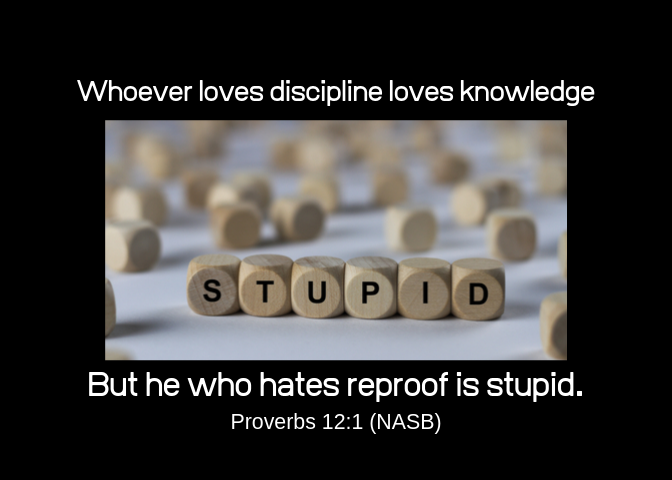
“One who loves discipline loves knowledge, But one who hates rebuke is stupid.”
When our kids were growing up we did not allow them to use the word ‘stupid’ because it’s just not nice. But, I won’t tell God He can’t use the word. These Proverbs can be hard. Loving discipline is hard. Not hating rebuke is hard.
But they are a tad easier when I remember and accept that I am not right all the time, nor do I do right all the time. And it’s really not a secret or surprise to anyone that I am an imperfect human being. I know that. God knows that. My husband knows that. My kids know that. My church family knows that. My neighbors know that. Even my little daycare friends know that. Marcia messes up. So, do I prefer to stay in my messiness, or do I accept a little help, a little discipline, a little rebuke, knowing I can be better and cleaner for it.
While we are at it, Proverbs 12:15 is another great one.
The way of a fool is right in his own eyes, But a person who listens to advice is wise.
It makes me think of an adorable little one with a very messy face, though they often don’t know it, or care. When I take the warm wet washcloth to the lunch left on their face there can be some loud protest and struggle. They would much prefer I just leave them alone and they would happily smear that goo all over me and my clothes and the couch and on one another. Our messiness never stays on ourself, which is another good reason to attack it, and not the hand with the washcloth.
These verses from Proverbs are great ones to keep in mind and memory and heart, even before someone comes to us with a warm wet washcloth. Correction, advice, rebuke, discipline isn’t to be avoided. It is for our good, even when it rubs a little. It doesn’t have to feel good in order for it to be good. It is to help clean us up. It is to jump-start our Think Again process. No reason to be a stupid fool (God’s words not mine) – just let them help you wash your face. 🙂
Reflection Questions
Sometimes we neglect looking in the mirror to see our messiness and what needs to be cleaned up. Take some time to humbly and honestly prayerfully consider what a look in the mirror will reveal. What do you see in yourself that is worthy of a washcloth?
When have you grown from an experience when you accepted correction well and adjusted accordingly? Can you also think of a time you protested and struggled against the wet warm washcloth?
There are probably times when you will see the opportunity to help someone else with some words of correction or advice. Knowing that there can be some resistance , especially when done harshly, what are some things to keep in mind as the warm wet washcloth holder?
Today is the first of 3 days reading Matthew 6. What do you find in this chapter that could be useful for thinking again?
PRAYER
Dear Father, Thank you for your wisdom passed on to us through the words of Proverbs. Help me listen well and put them into practice in my life. I do not want to be a stupid fool who is blind to my own messiness and fights against correction. I want to let go of pride so that I can humbly learn from the wisdom and helpful insight of others, even when it hurts a bit, so I can think again, clean up, and grow closer and closer to You and what You want to see in me. In your Son’s name I pray. Amen.
Devotion by Steve Mattison (IN) – originally posted for SeekGrowLove on July 18, 2022
In Proverbs 10, we see several contrasts between a person with Godly wisdom who lives a Godly life versus someone who doesn’t. I thought it might be nice to summarize those contrasts here.
A person with Godly wisdom and who lives a Godly life:
Brings joy to their father (v1)
God doesn’t let this person go hungry (v3)
Hard-working (v4, 5)
The memory of this person will be a blessing (v7)
Accepts commands (v8)
Their mouth is a fountain of life (v11)
Love covers wrongs (v12)
Wise and discerning (v13)
Receives life (v16)
Holds their tongue (v19)
Delights in wisdom (v23)
Desires will be granted (v24)
Stand firm forever (v25)
Adds length of life (v27)
Has joy (v28)
Will not be uprooted (v30)
Mouth brings forth wisdom (v31)
Knows what is fitting (v32)
A person who doesn’t:
Brings grief to their mother (v1)
God thwarts this person’s cravings (v3)
Lazy (v4, 5)
Violent (v6, 11)
Name will be cursed (v7)
Fool comes to ruin (v8)
Hatred stirs up dissension (v12)
Punished (v13, 16)
Conceals hatred (v18)
Spreads slander (v18)
Their heart is of little value (v20)
Finds pleasure in evil conduct (v23)
What they dread will overtake them (v24)
Swept away (v25)
Their life is cut short (v27)
Hopes come to nothing (v28)
Will not remain in the land (v30)
Only knows what is perverse (v32)
Which list would you like to describe you? If you see some attributes in the second list that may be used to describe you, you can change.
Hebrews 3:8 says, “Today if you hear his voice, do not harden your hearts”. If something here got your attention, take action. Don’t let this moment pass.
2 Corinthians 6:2 says, “I tell you, now is the time of God’s favor, now is the day of salvation.” Now is the time to act.
James 4:4-10 says, “You adulterous people, don’t you know that friendship with the world means enmity against God? Therefore, anyone who chooses to be a friend of the world becomes an enemy of God. … That is why Scripture says: ‘God opposes the proud but shows favor to the humble.’
Submit yourselves, then, to God. Resist the devil, and he will flee from you. Come near to God and he will come near to you. … purify your hearts, you double-minded. Grieve, mourn and wail. Change your laughter to mourning and your joy to gloom. Humble yourselves before the Lord, and he will lift you up.”
You can be a friend of the world, and fall into the second list, or be a friend of God and fall into the first list. But in order to be a friend of God, you first must submit to God, resist the devil, and draw near to God. You must humble yourself before God, only then He will lift you up. Only then will the first list fully describe you.
Application Questions
What 2-3 points do you find most appealing from the first list for the Godly life?
What 2-3 points do you find most distasteful or disturbing from the second list?
Both lists include some actions/attitudes as well as consequences. How do your choices now determine your future? How often do you remember this?
If you choose to humble yourself before God and submit to Him, what will that look like for you today? How will you work to remove something from the second list and then also replace it with something from the first?
Prayer
Dear God, We praise you for your wisdom and thank you for the book of Proverbs. I confess the times that I have not applied your wisdom to my life but have chosen instead the foolish friendship with the world path. Help me be fully committed to You and living the life You want for me in all the little daily decisions I make as well as the big ones. Help me see these two lists clearly in the decisions that I make today and every day and give me the discernment and discipline to choose what is wise and right. Lord, I want to humble myself, resist the devil and submit to You more and more, over and over again. In Jesus’ name I pray, Amen.
Yesterday we reposted a devotion on 2 Timothy about Guarding the Faith and Fanning it into Flame by Jeff Fletcher. One way Pastor Jeff did this (and his wife Karen continues to), is with their 11 children. Today we will be reposting not one, but two devotions from not one, but two of Jeff and Karen’s sons who are both ministering in Minnesota. Thank you, Fletchers, for sharing lessons from God’s Word with us through SeekGrowLove!
Devotion on 2 Peter 1
by JJ Fletcher – originally posted on October 12, 2022 for SGL
We have great and precious promises that have been made that will enable us to become partakers of the divine nature! As Jesus put on a new nature in his resurrection from the dead, so shall we when through faith, we endure through life’s many challenges and inherit the promise of the coming Kingdom of God.
Hebrews 11:1 says that “…faith is the assurance of things hoped for, the conviction of things not seen.” As we have faith that God will restore all things (Acts 3:21), upon our faith we must add virtue: meaning good quality of life or uprightness – not simply believing but living out our lives as something that reflects the nature of God’s goodness, justness, and righteousness. After believing and living a changed life, we are to add knowledge to that; we should always be striving to learn from God’s inspired word and learn from his spirit as it is active in us… And more than that, seek after his spirit that we might become more in line with his will and come to a greater understanding of its importance and how beneficial it is to us to walk in his ways.
Following the call to add knowledge, we encounter again the call to be self-controlled! It really does seem that much of what we read in scripture hinges on self-control and that circles back to our need to not stifle the spirit in our lives. If one of the elements that the fruit of the spirit brings forth in our lives is self-control, then we ought to do whatever it takes to drive away any behaviors that might cause God’s spirit to depart from us (Judges 16, 1 Samuel 16). Self-control allows us to endure – to stay on the course – as Paul might say, “to run the race”. We have to endure through all of the challenges and temptations that life throws at us, and we must allow the motivation of our hope, our uprightness, and the self-control that we are enabled to have through God’s spirit carry us through.
As we endure, we ought to have a reverential feeling or devotion to God, that’s what the Greek work translated godliness indicates. As we experience God’s goodness and see how His spirit works in us, we should feel more and more awe and reverence to our creator… After all, He put the plan into place that leads us into a life that transcends the brokenness that sin imparts on our lives – even though we sin and are affected by sin, God’s directives lead us onto a path that (through Jesus) casts that sin aside and draws us into community with him.
And as all these things are ingrained into our life, the part that affects others the most is the cherry on top… We are to have brotherly affection (love) as a defining characteristic in our lives! Love and care for one another as believers will lead us to speak into one another’s lives and help us when we hit rough patches. Even the most spiritually minded people hit dark periods in their lives (google the dark night of the soul). If we love our brothers and sisters in Christ, we will take the time to come alongside them, to care for them, to call them out, to admonish and encourage – brotherly affection means being intimately involved in the lives of our faith family – not being apathetic or half-hearted. We need to invest in each other as Christ has invested in us through his sacrifice (sometimes we must be self-sacrificial).
These qualities keep us from being ineffective witnesses and fruitless workers. We must be bearing the fruit of the word implanted in us (James 1) and strive to be effective ministers to the lives of those who are hurting and struggling. Peter says that whoever lacks these qualities is so nearsighted that he is blind! Yikes… lacking these qualities as I read this means that we cannot see beyond ourselves, and that it a tremendous problem when one of our chief goals is to preach the gospel to all creation.
If we take these qualities to head and practice them diligently it says we confirm our election (or being chosen out) into beneficiaries of the grace of God. Also, it says if we practice these things we will never fall. So, practice these things so that you may have entrance into the eternal kingdom of our Lord and Savior Jesus Christ (v11).
J.J. Fletcher lives in Minnesota with his wife and four children. He is the pastor at Pine Grove Bible Church.
Reflection:
1. Think about how Jesus exemplified all these characteristics listed in verses 5-7. If he had not exemplified all these things, would he have had the wherewithal to endure through his father’s plan of salvation through him? How can we expect to live exemplary lives if we do not take these characteristics to heart.
2. Think about the first 6 items listed (faith, virtue, knowledge, self-control, steadfastness, and godliness) and the final one: brotherly affection/love. What do the first 6 produce without the 7th? We’re designed (as individuals and as a church body) to be in community, how might we be rendered fruitless and ineffective if we excel at the 6, but lack the 7th?
AND – A Devotion on 2 Peter 2
by Joel Fletcher – originally posted Oct 15, 2023 for SGL.
“For it would have been better for them never to have known the way of righteousness than after knowing it to turn back from the holy commandment delivered to them.” 2 Peter 2:21 (ESV)
An idea stitched through today’s readings is that the God of Heaven prefers human behavior that is good and has an aversion to human behavior that is bad (to put it mildly). The Maker of mankind pays attention to both the wicked and the righteous (Proverbs 15:3). God sees all that happens on earth and, although all bad is wrong from His perspective, there seems to be a certain kind of action that uniquely draws His ire: people, who “speak on behalf of God”, using their influence to persuade others to evil–such people are called false prophets and false teachers (Jeremiah 23:16-17, 2 Peter 2:1). How do we avoid becoming like these people and live in a way that pleases our Maker?
Looking through the whole of scripture, one will discover that nearly all the people God employed for His purposes displayed humility (or were first humbled), while those whom God rejected or stopped using were dragged down by pride. When Jesus ministered in Judea and the surrounding regions, he embraced people who were stereotypically seen as bad (or, unrighteous) and opposed those who were known (and self-described) as good (or, righteous). While it is true that those whom Jesus befriended did bad things and those whom Jesus antagonized did good things, the defining distinction between the two was humility (in the former) and pride (in the latter).
The religious leaders of first-century Jerusalem saw themselves as righteous men who had things figured out–they needed no one to save them. The outcasts, meanwhile, longed for salvation–both from the Roman overlords and their own sinfulness. In other words, the people who embraced Jesus saw him as a doctor and themselves as the sick, while those who rejected him, saw Jesus as an instigator and themselves as the people preserving the peace. If one denies they have a problem, one cannot get the help needed.
There is a conundrum for the Christian: we are called to do good works (Ephesians 2:10) and to represent Christ on God’s behalf (2 Corinthians 5:10), but we are also warned that one who has claimed to be a Christian (maybe even one who has been an effective evangelist) can come to a place where, because of their pride, it would have been better if they had “never known the way of righteousness” (2 Peter 2:21). How do we avoid this state, while being faithful to our calling?
From what I see from scripture, the best antidote to getting on God’s bad side is to live in, with, and by humility. First, by fearing, above all (with reverence, awe, and worship) Yahweh. Second, by recognizing Jesus as the only way to the Father, to life eternal, and to the good life. Third, by recognizing that, while this knowledge radically changes lives, it doesn’t make one superior to anyone else.
You can, with great fervor, study your Bible for countless hours every day, and do all the spiritual practices prescribed or implied by the text, but it won’t make you any better off…unless you are aware and live as though you need a doctor and view Jesus as that doctor. The religious leaders of Jesus’ day didn’t recognize the great physician because they didn’t acknowledge their sickness. If we want to make sure we don’t go down that same dead-end road, if we don’t want to get scolded or labeled as a false teacher, we must take our humble medicine every day.
Joel Fletcher lives in Minnesota with his wife and two small children. He is involved with youth group and worship music at Pine Grove Bible Church.
Reflection Questions
Do you realize your need for a doctor and Savior? How does Jesus provide what you need?
What happens to those who once knew they needed Jesus, but then are puffed up with pride and go their own way?
What steps can you take to stay humble (or first become humble)? In what areas of your life do you most frequently run into the problem of pride? How can knowing this help you in the future?
One of the sins that always frightens me most is the sin of pride. It’s slippery and hard to recognize because one of the symptoms of this particular sin is the inability to see a fault in ourselves. I’ve seen many people who claim humility – they are quick to point out their easily recognized flaws and will readily acknowledge when someone else is better than them at something that they are terrible at. I think of that as easy humility. It’s a quick reassurance to ourselves that we are not guilty of the terrible sin of pride. It makes us feel better about ourselves and our attitudes.
But pride doesn’t have to show up in every aspect of our lives. You can be humble about your skills playing an instrument, while still being enmeshed in pride in some other area. Sometimes pride disguises itself. For example, not seeking counsel because you believe you already have the answers? Pride. Insisting on things being done a certain way because you think it is the RIGHT way, when really it’s just the way you PREFER? Pride.
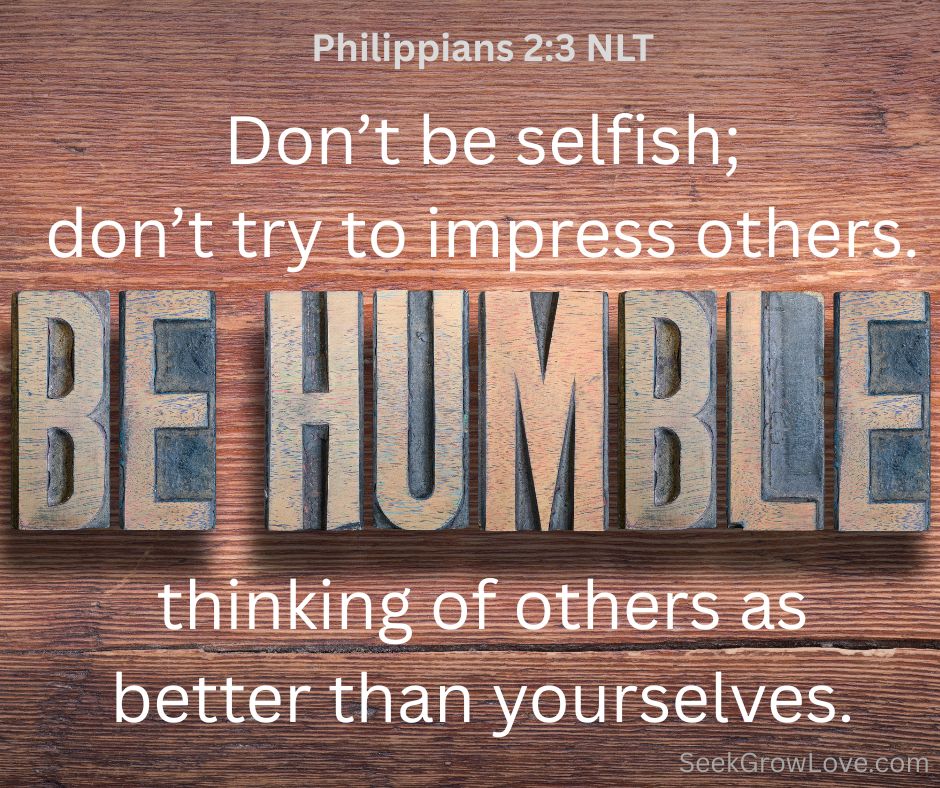
Philippians 2:3-4 says:
Do nothing out of selfish ambition or vain conceit. Rather, in humility value others above yourselves, not looking to your own interests but each of you to the interests of the others.
It’s an easy thing to say. I bet most of us think we already place others before us. We serve others, we give of our time and resources, we pray over their needs. But Paul calls us to do more than this. He says do NOTHING out of selfish ambition or conceit.
We all have agendas. We all have goals. Do every single one of our agendas and goals look out for the interest of others? I know mine don’t always. I struggle with shopping for gifts for others because I keep seeing things I would like to get myself! We are trained by the world to look out for ourselves! We must do what is best for ourselves!
Let’s be clear – God wants you to take care of yourself and do good things for yourself as well. But in this letter Paul is talking to the church as a whole and to the people working within that church. We, as a body of Christ, are to be working together in complete humility, putting others before ourselves. I’ve had to say many times, both to myself and to others, “This isn’t about you.”
Because it’s not. None of this is about you. The types of songs we sing in worship. How we conduct meetings. How the furniture is arranged. How we do prayer requests or announcements. What type of public events we hold. I could go on. None of those things are about you.
We have one mission as a church. We are to live and serve like Christ. We are to go and make disciples, baptize, teach, serve, and love. We are to do Christ’s work, and not once did Jesus ever put his own agenda before God’s agenda. He was the ultimate example of what it looks like to put God’s will before our own.
Reflection Questions:
Where are you guilty of pride? Don’t stop at the easy answers either. Look deep. Do you find yourself getting frustrated over people in church doing things “the wrong way” when really it’s just not the way you would do them? Do you find yourself not asking for counsel in an issue because you think you already have the answer? Do you find yourself not praying over decisions?
What areas of your life would look different if you put others before yourself? What areas of your church would look different if you put others before yourself? (Note that I didn’t ask what areas would look different if OTHERS were more humble or selfless. We are looking just at ourselves, so don’t start down that dangerous path.)
Prayer:
My prayer for you is that our church bodies be united in humility to do Jesus’ work. I pray that we are able to keep the slippery sin of pride far away from us. I pray that others are able to see Jesus Christ in us because we are continually showing them love and putting them first above ourselves.
When Marcia initially asked me to write the devotions for this week, I briefly glanced at what the daily passages would be. When I saw some Corinthians, I remember thinking, Cool, I like Corinthians – it’s got some good stuff like the love chapter and resurrection chapter. Oh golly, did I underestimate the book of 1 Corinthians. I mean, I know Paul wrote some “hard to understand” things (2 Peter 3:16 NLT). I just didn’t realize, until today, I would have to write a response to some of these things.
Teaching, wisdom, and humility are some overarching themes in today’s text from 1 Corinthians chapters 1-4. Upon my first read through, I was stumped, and really wishing someone smarter than me had these chapters. I longed to search through my old notes from Bible college to see what my professor had to say. I have all my old notes – and Bob Jones, if you’re reading this, I have my handouts organized by theme in TWO collapsible file portfolios. 🙂 Unfortunately, everything is labeled somewhere in a box that has yet to be unearthed since my getting married and moving from Nebraska to Missouri. It then occurred to me I could spend hours diving deeper into the complexity of these four chapters with the aid of the internet. Seeing as it was 2pm Wednesday afternoon, Marcia needs my devotion tonight, and I’ve got a Thanksgiving Bible Study dinner at 5:30, I decided that wasn’t the way to go. So, I got out my interlinear Greek New Testament and started reading again, this time briefly summarizing the main ideas as I went. What I came up with was the Emilee Christian Simplified Version of 1 Corinthians 1-4. Doing this helped me better understand what Paul meant. I will share with you what I came up with, in hopes it does the same for you. This may be more informal than what you are used to reading – bear with me, please!
1:1-3: Paul and Sosthenes are writing a letter to the Corinthian church.
1:4-9: Speaking as Paul: I thank God for you. God loves you. God wants to use your church.
1:10-17: I hear you’ve been fighting – knock it off!
1:18-20: Earthly wisdom has no power against the cross.
1:21-31: God likes to use the weak and unexpected things of this world to further show His power. Side note – I particularly like this section and immediately thought of these four seemingly unexpected things God has used: a manger, shepherds, fishermen, and women as first witnesses to the resurrection.
2:1-5: When I came to you, I spoke in plain simple terms so you would understand that Gospel message.
2:6-11: I use more complex language while speaking to spiritually mature believers. This is different from worldly wisdom. Perhaps people were accusing Paul of using worldly ideas to explain the Gospel and this is his defense.
2:12-15: I’m talking about spiritual matters that do not make sense to those attempting to understand with worldly wisdom.
3: 1-3: Remember when I came to you I simplified things. I am still having to simplify things because your arguing and disagreeing is preventing you from understanding more complex spiritual thought.
3: 4-9: Summarizes what they’ve been arguing about. Explains that it doesn’t matter who brought you to the faith in Christ, what’s important is that you now have faith in Christ.
3:10-15: Christ is the foundation of our faith. Anyone may build upon this foundation by spreading the Good News. God’s judgment will reveal if one has done a good or bad job at expanding the foundation. We mere humans don’t need to burden ourselves with making those judgments.
3:16-17: The Church is God’s holy temple so behave and be holy – get your act together Corinthians!
3:18: Sounds like Paul saying he hopes the proud get knocked down a few pegs so they will in turn learn true wisdom.
3:19-20: Again there is a difference between God’s wisdom and the world’s understanding.
3:21-22: Don’t be boastful, don’t be prideful – all things belong to Christ who belongs to God.
4:1-5: It’s God’s place to judge.
4:6-7: So quit arguing about who is better – it’s not your job, it’s God’s.
4:8-13: Seriously, quit bickering over us Apostles! It’s rough enough out here spreading the Gospel we don’t need to deal with your infighting, too.
4:14:I’m not trying to shame you in saying these things, but you need to be disciplined because you are acting like children.
4:15-16:I feel responsible for your faith because I was the one who first told you about Christ – so I’ve got a right to call you out when you’re acting like children. Shape up. Do better.
4:17: I’m sending Timothy to help you.
4:18-21: I hear you want me to come visit, but is that what you really want? Because if I came to visit you now I would be mad and disappointed. Get your act together so that when I do come, we can have a good visit.
Food for Thought: I have to wonder if writing in lengthy complex statements was sort of Paul’s point. In trying to put spiritual things into the context and words of men, it seemed to me to make less sense. Is that a part of Paul’s argument? Perhaps Paul is demonstrating that to have complete understanding of God is foolish and what we should seek is to have faith.
Reflection Questions
What are some examples of what the world says is wise that God says is foolishness? When have you found yourself switching over from worldly wisdom to Godly wisdom?
If Paul came to your church, or wrote a letter to you, what might he say?
What arguments have you allowed to come between you and your brothers and sisters at church? What can you do to fix the problem?