An Offer of Life

Ezekiel 32-35

Devotion by Rebecca Dauksas (South Carolina)

The LORD explains so much of His perfect character in Ezekiel. He is merciful, loving, caring and He is just. We continue to see that each person is judged by their conduct and actions. The LORD declares that He takes no pleasure in the death of the wicked, but wants the wicked to turn from their evil ways and live. He warns to “turn back, turn from your evil ways!” The LORD offers life. The LORD sends the message that true repentance brings forgiveness. Ezekiel gives good news to the one that repents and lives for God. “None of his sins that he has committed will be remembered against him. He has practiced justice and righteousness; he shall surely live” (33:16).

Not only does the LORD offer life, but life with Him.  In chapter 34, He gives us this beautiful description of a caring shepherd. The LORD cares for and gathers His sheep. “I will feed them in a good pasture, and their grazing ground will be on the mountain heights of Israel. There they will lie down on good grazing ground and feed in rich pasture on the mountains of Israel. I will feed My flock and I will lead them to rest,” declares the Lord God. “I will seek the lost, bring back the scattered, bind up the broken and strengthen the sick” (verses 14-16a). What a wonderful description of our Good Shepherd.

So why didn’t the people listen to their watchman, Ezekiel? He was giving them the warning against their evil practices and the instructions to turn to the LORD for life. Instead of hearing God’s message, they acted as if Ezekiel were some kind of entertainer. They encouraged each other to come and hear what God’s message was, but just showing up was not enough. The people heard the words, but they did not put them into practice. We are told that they did the lustful desires expressed by their mouth, and their hearts went after their own gain. The LORD told Ezekiel, “Indeed, to them you are nothing more than one who sings love songs with a beautiful voice and plays an instrument well, for they hear your words, but do not put them into practice.” (33:32)

I hope that is never said of us. We want to take in the LORD’s message. We will heed the watchman’s warnings and receive the blessings that God offers. The greatest is to always be in His presence. In the presence of our Good Shepherd there will be showers of blessing. (34:26)

Reflection Questions

  1. How have you responded to the LORD’s offer of life? Are you hearing the words but not putting them into practice?
  2. What warnings do you think Ezekiel (or any modern messenger for the LORD) would have for you today? What role does repentance play?
  3. Is there a time/place God is asking you to be a watchman?
  4. Do you spend time in the presence of the Good Shepherd? How? How could you remain in His presence more? What are some of the blessings found there?

Consequences for Evil Overflow

Ezekiel 18-20

Devotion by Pastor Jeff Fletcher – originally posted for SeekGrowLove on March 24, 2017, for Ezekiel 20-21.

In Ezekiel 20 God reviews Israel’s history.  Over and over God provided for His people, over and over He warned them to get rid of their idols, keep His commands and observe His Sabbaths.  Over and over Israel failed to obey God and experienced the consequences.  Over and over God was compassionate and loving and forgave His people and restored them to blessings.

Israel has repeated this history again.  They failed to get rid of idols, they failed to keep his commands and observe his Sabbaths, and now they were about to experience the consequences of their sins.  God would once again treat them with mercy, not as their sins deserved and restore them to their land.

Ezekiel juxtaposes God’s promise to be merciful and restore His people with the threat that His judgment is coming and that both the evil and the good will be cut off from the land and the city and the temple.  Yes, everyone will suffer the consequences of the evil behavior of some.

There is tension throughout Ezekiel.  The wicked will suffer for their sins and the righteous will not suffer, except that at first they will suffer for the sins of others.  Sometimes when God brings his judgment designed to bring people to repentance there is collateral damage.  Good people suffer when bad people sin.  It’s how it was then, it’s still how it is today.  God’s salvation is coming, earth will one day be restored and made whole and good, but in the meantime, good people will suffer alongside the wicked.  Christians are martyred in places like Pakistan and Syria.  Christians sometimes suffer persecution in the United States.  Trials may come to God’s people during times of judgment, but those who trust God and repent of their sins will be saved.

Reflection Questions

  1. How often do we fall into the same cycle of disobedience that the Israelites followed for generations? What can be done to help break the cycle for you personally?
  2. How does God’s mercy and justice coexist throughout Ezekiel and today?
  3. What trials are you willing to persevere to avoid disobedience to God?

The Final Word

FRIDAY DEVOTION Jeremiah 51:24–64

(if you read that yesterday you could re-read it – and then also get a start on Jeremiah’s next book, Lamentations – Lamentations 1-2)

Devotion by Dustin Farr (South Carolina)

All week, we have seen God speak against nations. We have read about judgment on neighbors, warnings to the proud, and promises of restoration for His people. Again and again, the theme has been clear, God humbles the exalted and lifts up those who seek Him. Today’s passage brings that story to a close with the final word on Babylon.

Babylon was not just another nation on the list. It was the empire that crushed Jerusalem, burned the temple, and carried God’s people into exile. To Judah, Babylon’s power must have felt like an unmovable wall. Yet in today’s reading, that wall crumbles. God declares that Babylon’s destruction will be complete and final. “When you finish reading this scroll, tie a stone to it and throw it into the Euphrates. Then say, ‘So will Babylon sink to rise no more because of the disaster I will bring on her. And her people will fall.” This is what will happen to the city that once seemed untouchable.

But this isn’t just about Babylon. It’s about the God who keeps His word. The God who, decades earlier, through the prophet Habakkuk, promised that Babylon’s reign would end. The same God who disciplined His people was also the one who defended and redeemed them. 

So when we are in the places where we feel stuck, powerless, or forgotten, we know that we can rest assured in the justice and redemption of God. There may be “Babylons” in our lives.  Health struggles that weigh us down, broken relationships that leave us hurting, financial pressures that keep us up at night, or just the struggles of life. Things that feel too strong to ever fall, and It can be easy to believe that nothing will change. But our God has the final word. His justice may take time, but it is certain. His restoration may not come when or how we want it, but it will come, and we can rest assured in that. 

If we can trust Him with the big stories of nations and empires, then surely we can trust Him with the smaller but deeply personal battles we face. The same God who threw down Babylon is the one who lifts up His people, heals what is broken, and keeps every promise He makes. Our call is to remain faithful, not letting what we see in the moment shake our confidence in the One who rules over it all.

Reflection Questions:

  1. Where have you experienced a “Babylon” in your life that God eventually brought down?
  2. Looking back over this week’s readings, what is the biggest truth about God’s character or His promises that you want to carry with you?

No Strength Can Stand Against the LORD

Jeremiah 46-48

Devotion by Dustin Farr (South Carolina)

In Jeremiah 46–48 the focus is shifted outward, showing that God’s rule is not limited to Israel alone. He is sovereign over every nation, and His justice reaches far beyond Judah’s borders. In these chapters, God speaks to Egypt, Philistia, and Moab, nations confident in their own strength, secure in their own plans, and certain of their own futures. Yet in each case, the LORD declares that their confidence is an illusion. Egypt’s pride was in its armies and alliances. To human eyes, they seemed unstoppable. But God declares that they will be defeated at Carchemish, their power lost and their strategies useless before Him. Next Philistia’s fate is pictured in chapter 47 as an unstoppable flood, with the Babylonian forces sweeping across the land, leaving cities silenced and grief in their wake. Finally, In chapter 48, God addresses Moab, whose downfall comes not from a lack of defenses, but from a heart of pride. They trusted in their wealth, their fortified cities, and their false gods, but even they could not stand against the living God. However, God ends with a promise that in the latter days, Moab will be restored. This spoke to me as proof that despite his justice being sure, God is always capable of restoration.

What also stood out to me is how easily pride can blind us to the truth. Egypt, Philistia, and Moab all felt secure in what they had built, yet none of it could stand when the LORD came with judgement. Strength apart from God is only just an illusion. I think this calls us to examine what we’re leaning on. Is it our abilities, relationships, resources, or position? If it’s not God Himself, it will eventually fail us. The God who brought nations low is the same God who offers Himself as a stronghold to those who take refuge in Him. Psalm 27:1 “The LORD is my light and my salvation; whom shall I fear? The LORD is the stronghold of my life; of whom shall I be afraid?”

Reflection Questions:

  1. Which false securities do you most see most in our world today?
  2. Where might pride or misplaced confidence be keeping you from full dependence on God?
  3. How does God’s promise of restoration to His people encourage you in a season of uncertainty?

Warning, Mourning and a Whisper of Grace

Micah 1-3

Like many times in history, Israel had to be confronted by a prophet who had a message from God that wasn’t savory. That is, in times of comfort, complacency, and wickedness they would find that they were not walking with the Lord. In Micah 1-3, Micah speaks for the Lord and completely rebukes the state of Israel and the leaders that allow for it to be in the state it is. Their morals have been corrupted, their path is unjust, and they have implemented idols again into their nation. 

The themes from previous days’ devotions persist here. Violent imagery and a great lament is detailed in Micah 1-3 as he warns and mourns the judgement that is to come. The imagery from Micah 3:1-4 is especially fiery and vivid to the imagination as Micah rebukes the leaders of Israel. To pile onto the agony being described, Micah also details that God will be separated from those in religious authority in Israel in Micah 3:7:

“The seers will be ashamed

    and the diviners disgraced.

They will all cover their faces

    because there is no answer from God.”

With this, we must reflect on our own lives. In a position of leadership, we must set an example. James 3 echoes this idea of the judgement that will be faced by those who teach and lead those astray. If we are to act as examples for others, we must also walk in the ways of the Lord. Micah is clear with this striking message: where in our lives have we settled for religiosity without righteousness? Comfort without compassion?

God’s heart breaks over injustice. He doesn’t just call it out. He promises to act. That’s a sobering reminder: God cares too much to remain silent in the face of oppression. However, tucked inside Micah’s warnings is a whisper of grace: “I will surely gather the remnant…” (Micah 2:12). God’s judgment is never the end of the story. Even as He tears down, He is preparing to build again. On that foundation, with that remnant, he will build on principles of humility, justice, and faith.

-Colby Leggitt

Discussion Questions

1. Where in your life or community do you see injustice that needs to be addressed?

2.Are there areas where you’ve grown comfortable with compromise or overlooked truth?

3. How can you walk more humbly and live more justly today?

Helping Those in Need

Obadiah
Psalm 82-83

Many of the Psalms point to our hearts and minds bringing praise, glory, and honor to God.  Some also provide instruction for living, as we find in Psalm 82.  Psalm 82:3-4 says, “Defend the cause of the weak and fatherless; maintain the rights of the poor and oppressed.  Rescue the weak and needy; deliver them from the hand of the wicked.”

Providing help and justice for those in need is a theme we find throughout the Bible.  The Mosaic law supports this (Deuteronomy 10, 15, 22), the prophets support this (Isaiah 58), the gospels support this (Matthew 25, Luke 10), and the New Testament letters support this (James 1, I John 3).  As we see this theme come up in Psalm 82, we should recognize this does not stand alone within Scripture, but fits within the context of the whole.

Psalm 82 verses 3 and 4 stand in stark contrast to verse 2.  Verse 2 asks, “How long will you defend the unjust and show partiality to the wicked?”  We have a propensity to long after our own gain, which sometimes causes us to support the unjust and wicked.  This should not be the case.  Instead, we should defend the weak and fatherless, maintain the rights of the poor and oppressed, and rescue the weak and needy.

The underdog story makes for great sports.   The 1980 “Miracle on Ice” when the USA beat the Soviet Union in Olympic Men’s Ice Hockey.  The 1983 upset of North Carolina State over Houston for the NCAA Men’s College Basketball Championship.  Rulon Gardner, who won gold in wrestling in the 2000 Olympics over heavily favored Aleksandr Karelin of Russia.  These underdog stories are easy to spot, since each team or individual was clearly not favored to win.  However, in our lives, I believe it is much more challenging to spot the underdogs in life around us.

Who are the people we should be working so hard to defend, rescue, and maintain their justice?  Are they as easy to spot as the sports underdogs?  Maybe it is easy to see they are poor, or weak, or needy.  Maybe they are the people who are clearly ‘outcasts’ within our social settings because they don’t match the norms of interaction.  However, maybe they are a little harder to see, but we are still called to defend, rescue, and maintain their justice.  I think of our friends who are close talkers, who interrupt when others are speaking, or who struggle with social interactions.  Do we provide for them defense and rescue, or do we relegate them to solitude and the outskirts of our attention?  Sometimes it’s easy to see the needs of those we can help and other times it is far more challenging.

Putting Psalm 82:3-4 in action is more than giving money to a service ministry.  We can give out of our abundance but we can also show kindness to those in need around us every day.  Be encouraged to look for those in need in more diverse places around you, or in more diverse people around you!

-Michael Cisler

Reflection Questions

Who is someone you see regularly who may be weak, oppressed, or needy in ways other than financial or physical?

How can we provide support and defense for those who are socially awkward around us?

Mustering Up Moxie

Judges 4-5 – Deborah and Jael 


Whenever I think of girl power, I envision caricatures of Deborah and Jael posing Rosie-the-Riveter-style in front of a tent, bloody peg in fist. Though this Bible story is a bit morbid, it is also bold and counter-cultural evidence of the power of God and his desire to use everyone for His glory. 

After Ehud died, the Israelites turned away from God, and they were oppressed by Jabin, the king of Canaan, for 20 years. Deborah became the Israelite leader during a time period in which not many women held high positions; she was not only a female judge in the same way other men in this book, like Othniel and Ehud, were judges/leaders, but she was also a prophetess and a judicial expert. God gave Deborah a message for military general Barak, guaranteeing him a victory against Sisera, the Canaanite army commander. Barak refused to go without Deborah, which could be a tribute to his faith in Deborah, a testimony to his lack of faith in God, and/or a confirmation of his general cowardice. Whichever it may be, Deborah agreed to go with the army, warning Barak that the victory for this battle in the historical record would forever be credited to a woman. 

Barak’s army managed to fatally defeat every one of Sisera’s troops – except Sisera himself, who fled on foot to the home of Heber and Jael of the Kenite tribe (which was supposedly a neutral party, friendly to both Israelites and Canaanites). Jael greeted Sisera with exceptionally devious hospitality: when Sisera asked for water, she instead gave him a skin of comforting milk to help him rest well. Once Sisera was fast asleep, she sneaked in as stealthily as a prowling cat and drove a tent peg through his head into the ground, thus practically emancipating the Israelite people from King Jabin. 

But really though, shouldn’t Jael have just stayed in her lane? Why would she rock the boat when her tribe was at peace with both sides? I mean, it was probably common knowledge that the Canaanites were oppressing the Israelites, but since she was neither, it didn’t really affect her, right? Why should she do anything to help one side or hurt the other? 

Perhaps Jael had heard rumors of the power of the Israelites’ God and didn’t want to be on their bad side. Or maybe she just had a sense that the Israelite/Canaanite relationship wasn’t right, and if she were in the position of the Israelites, she would hope that someone would come to the rescue, too. 

We aren’t privy to Jael’s thoughts, but when Sisera sought refuge in her abode, Jael was thrust into a rather precarious position that forced her to choose sides. She was granted a unique opportunity to impact great change, an opportunity that literally fell into her tent. The stakes were high (pun intended)! So Jael chose to be brave, even though it could have repercussions for her family and tribe once Jabin got wind of her actions. She had witnessed injustice and chose not to turn a blind eye when it was within her power to do something. Jael deceptively entertained the tyrannical army leader in order to gain an advantage and help the Israelites. 

Would I be like Jael, always ready to stand for what’s right even if I’m standing alone, even if it would cost me something? Or would I just mind my own beeswax and not get involved in things that don’t directly concern me, even though others are being hurt? As Christians in a first-world country, often we would rather spend energy complaining about minor inconveniences like Starbucks messing up our overpriced coffee than about serious issues that are going on in the world. Did you know that there are still people in the world suffering from starvation, lack of clean water or medical care, poverty further worsened by illiteracy, and political unrest that makes even simple daily living dangerous? Did you know that today there are more slaves than ever before? We envision all of that as happening across the ocean, but so much of it is right here under our noses. I live about 20 minutes from the intersection of two significant US highways, rendering it a major drug- and sex-trafficking hub. So much of this slavery and injustice is happening in our own backyards, and we all have a duty to do something about it. (I’m speaking to myself here too; I’ve been considering how I can get involved in the local movement to help this trafficking injustice.) We as collective Christians have neglected this duty to be involved in the world around us and contribute to change. It is so easy for us to stay in our comfy little church bubbles. But think back to the gospels for a minute… who did Jesus criticize the most – the biggest sinners or the religious leaders? Pharisees. Sadducees. The “most religious” people who ultimately cared more about their image than the One in Whose image they were created. Being Christians doesn’t give us permission to “look up at God” and away from the needs; it gives us all the more reason to see the world through “Jesus goggles” and intervene in practical ways (which James calls us to do). We can’t do everything, but we can do something. 

In Deborah’s song of praise after this victory that led to 40 years of peace for her people, she sang a line that I have adopted as a personal mantra: “March on, my soul, with courage!” (Judges 5:21). Another term for courage and determination is moxie. Deborah and Jael were definitely women of moxie! I long to become a person of righteous moxie who fights the battles God calls me to fight, always depending on His strength. 

“Deborah, the mother of Israel, and Jael, most blessed of tent-dwelling women. Did they ever even meet? Would they have been friends? This is beside the point, but still, I wonder. Living in a world where it seems like no one with any differences can get along, I wonder how two women, from such different worlds, ever came together to accomplish the same goal…. God uses the unlikely, the unexpected, and sometimes even the unsavory to deliver us and to crush the heads of his enemies. While his means of rescue may change, his promises remain permanent. So whether it’s by means of tent pegs through the head of an oppressor or nails through the hands of his son, we see yet again that we serve a God who never ceases to defeat his enemies so that his people, just like the sun, may rise in his might (Judg. 5:31).” (source)

-Rachel Cain

Reflections:

Listen to this song about being brave for God and consider how He might be calling you to be brave for Him. 


Would you, like Jael, have risked everything to stand up to an oppressor? What are some situations today in which God might be calling you to be brave and stand up for someone else?

Look for opportunities to get involved with local organizations to help with needs in your area and with the work of our international missions organization, Lord’s Harvest International, at lhicog.com. 

Pray for God to help you muster up moxie to initiate change with the injustices in the world. 

A Just God. A Merciful God.

Deuteronomy 17-20

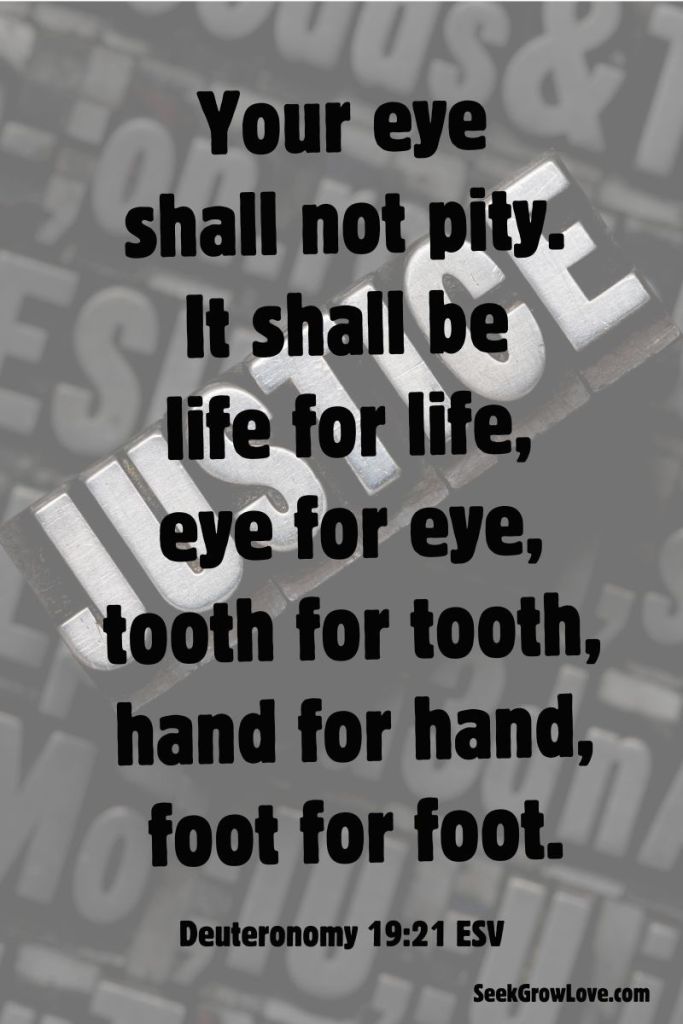
Your eye shall not pity. It shall be life for life, eye for eye, tooth for tooth, hand for hand, foot for foot. – Deut 19:21

We serve a just God. Since the very beginning, He has worked to keep His justice system in place, while still pouring out His love and upholding His commitment to bring humanity back to Him. In Genesis, it was impossible for Adam and Eve to remain in the good and perfect world that God created for them, for they were no longer good and perfect. They were tainted with sin and death. But it broke His heart to lose His children, so He made a way for them to live out full and meaningful lives, and to someday be eternally reunited with Him in a renewed good and perfect world. 

When Abraham’s descendants were established into the nation of Israel, they found themselves tugged toward sin and disorder, godlessness and false-god worship. And so God gave them a nice set of very thorough, very just laws, such as the ones we read about today. Israel served a God of order and righteousness, and was to be a nation of order and righteousness—a beacon among the lawlessness that surrounded them. Some of the laws found within these chapters seem harsh to us today, but this was before Jesus was sent to justify us freely. There had to be a system in place to bring God’s people back to Him when chaos ensued, and to discourage such chaos from coming about in the first place.

The Rock, His work is perfect, for all His ways are justice. A God of faithfulness and without iniquity, just and upright is He. – Deut 32:4

Fortunately, our God of justice and order is also a God of love and mercy. By making His Son Jesus our sacrificial lamb, we are saved. We need not impose justice upon our neighbor by repaying an eye for an eye, a tooth for a tooth, a hand for a hand, or a foot for a foot. We, the guilty, have been justified—our debt paid. Jesus, the innocent, took our full punishment. He is our city of refuge, where even the most stained by sin can find rest and grace. 

In Jesus, justice and mercy collide. The weight of the law, which once demanded life for life, was satisfied on the cross. Because of his sacrifice, we no longer stand condemned, but redeemed. Let us walk in the freedom he purchased for us, extending to others the same mercy we have received, and living as a reflection of God’s righteousness in a chaotic world.

-Isabella Osborn

Reflection Questions:

  1. God’s justice required that sin be dealt with, yet His love moved Him to make a way for redemption. How does understanding both His justice and mercy deepen your relationship with Him?
  2. In what ways can you extend the same grace and forgiveness to others that God has given to you?
  3. Israel was called to be a nation of righteousness and order, standing apart from the lawlessness around them. How can you live as a reflection of God’s righteousness in a world that often rejects His order and truth?

Who Will Not Fear You?

OLD TESTAMENT: Zephaniah 1

POETRY: Psalm 119:169-176

NEW TESTAMENT: Revelation 15

Zephaniah 1:14-16 (LEB):

“The great day of Yahweh is near,

near and coming very quickly.

The sound of the day of Yahweh is bitter;

the mighty man cries aloud there.

A day of wrath is that day,

a day of distress and anguish,

a day of ruin and devastation,

a day of darkness and gloom,

a day of clouds and thick darkness,

a day of trumpet blast and battle cry

against the fortified cities and against the lofty battlements.”

Psalm 119:169-176 (LEB):

“Let my cry come before you, O Yahweh;

give me understanding according to your word.

Let my supplication come before you;

deliver me according to your word.

My lips will pour forth praise,

for you teach me your statutes.

My tongue will sing of your word,

for all your commandments are right.

Let your hand be ready to help me,

for I have chosen your precepts.

I long for your salvation, O Yahweh,

and your law is my delight.

Let my soul live and praise you,

and let your rules help me.

I have gone astray like a lost sheep;

seek your servant,

for I do not forget your commandments.”

Revelation 15:3-4 (LEB):

“And they sing the song of Moses, the servant of God,

and the song of the Lamb, saying,

‘Great and amazing are your deeds,

O Lord God the Almighty!

Just and true are your ways,

O King of the nations!

Who will not fear, O Lord,

and glorify your name?

For you alone are holy.

All nations will come and worship you,

for your righteous acts have been revealed.'”

The prophet Zephaniah opens with a solemn warning of the coming Day of Yahweh, a day characterized by divine judgment. The imagery of darkness, anguish, and distress serves as a powerful reminder of the seriousness of God’s justice. For those who reject His ways, this day brings fear and despair.

Yet, within this stark portrayal lies a call to repentance and an invitation to seek refuge in God. While Zephaniah emphasizes God’s wrath, it is important to remember that His justice is always intertwined with His mercy. In moments of turmoil and judgment, we are reminded of our need for God’s grace and guidance. This day of reckoning compels us to reflect on our own lives, ensuring that we align our hearts with God’s will.

In Psalm 119, the psalmist expresses a deep longing for God’s guidance and salvation. His heartfelt cry for understanding echoes the sentiment of Zephaniah—a recognition of human frailty and the need for divine intervention. The psalmist’s desire to follow God’s commandments illustrates the importance of aligning our lives with His truth.

As he pleads for deliverance and praises God’s statutes, we see the relationship between our obedience and God’s faithfulness. In our own lives, we are invited to seek God’s understanding and mercy, especially when we feel lost or astray. This passage reassures us that, even in our wandering, God is attentive to our cries, ready to respond with love and grace.

Revelation 15 presents a scene of worship in heaven, where the redeemed sing the song of Moses and the Lamb. This song celebrates God’s greatness, justice, and holiness. The acknowledgment of His righteous acts inspires awe and reverence, uniting all nations in worship.

In the midst of judgment, the song of the Lamb reminds us that God’s mercy prevails. The ultimate act of redemption through Christ is the source of our hope and assurance. As we reflect on our journey, we are invited to join in this eternal song, declaring God’s majesty and righteousness. The assurance of His salvation empowers us to face the trials of this world with faith and courage.

-Jeff Ransom

Reflection Questions:

How does the imagery of the Day of Yahweh in Zephaniah challenge your understanding of God’s justice and mercy?

In what ways can you seek God’s understanding and guidance in your daily life, especially during challenging times?

Reflect on the psalmist’s desire for salvation and obedience. How can you cultivate a deeper love for God’s commandments in your life?

What does it mean for you to sing the song of the Lamb in your everyday life? How can you express your worship and gratitude for His redemption?

Seeking God, His Justice and His Victory

OLD TESTAMENT: Habakkuk 1

POETRY: Psalm 119:145-152

NEW TESTAMENT: Revelation 12

Habakkuk 1:2-4 (LEB):

“How long, O Yahweh, must I cry for help,

and you do not listen?

I cry out to you, ‘Violence!’

and you do not save.

Why do you make me see iniquity,

and why do you look idly at wrongdoing?

Destruction and violence are before me;

strife and contention arise.

Therefore the law is paralyzed,

and justice never goes forth;

for the wicked surround the righteous;

therefore justice comes out perverted.”

Psalm 119:145-152 (LEB):

“I cry out with my whole heart; answer me, O Yahweh!

I will observe your statutes.

I cry out to you; save me,

that I may keep your testimonies.

I rise before dawn and cry for help;

I hope in your words.

My eyes are awake before the watches of the night,

that I may meditate on your promise.

Hear my voice according to your steadfast love;

O Yahweh, according to your justice give me life.

They draw near who persecute me with evil purpose;

they are far from your law.

But you are near, O Yahweh,

and all your commandments are true.

Long have I known from your testimonies

that you have founded them forever.”

Revelation 12:10-11 (LEB):

“And I heard a loud voice in heaven saying,

‘Now the salvation and the power

and the kingdom of our God and the authority of his Christ have come,

for the accuser of our brothers has been thrown down,

who accuses them day and night before our God.

And they have conquered him by the blood of the Lamb

and by the word of their testimony,

for they loved not their lives even unto death.'”

The book of Habakkuk begins with a profound sense of lament and confusion. The prophet cries out to God, questioning why He seems silent in the face of injustice and violence. Habakkuk’s raw honesty reflects the struggles many of us face when we encounter suffering, evil, and a lack of justice in the world. He sees the wicked prospering while the righteous suffer, and he cannot understand why God allows this.

In our own lives, we may find ourselves in similar situations—crying out to God for answers, feeling like our prayers go unheard as we witness injustice. Yet, Habakkuk’s cry serves as a reminder that it is okay to bring our questions and struggles before God. He desires honesty in our relationship with Him.

In Psalm 119, the psalmist embodies a similar urgency in seeking God. He cries out with his whole heart for God to answer him, showing a deep reliance on God’s word and a yearning for His guidance. The psalmist acknowledges the darkness around him and the threat from those who persecute him, but he clings to the truth that God’s commandments are near and true.

This passage emphasizes the importance of persistent prayer and meditation on God’s promises, especially when we face trials. The psalmist rises early and stays awake at night, seeking the Lord’s assurance and strength. It is in these moments of desperation that we must remember God’s steadfast love and justice. The psalmist’s faith is rooted in the belief that God is near, and His promises endure forever.

Revelation 12 offers a powerful proclamation of victory amid the spiritual battle that believers face. The voice from heaven announces the establishment of God’s kingdom and the defeat of the accuser, the one who brings charges against God’s people. Through the blood of the Lamb and the word of their testimony, believers conquer the enemy, demonstrating that faith in Christ triumphs over every accusation and hardship.

This passage assures us that even in the face of persecution and struggle, we have the victory through Christ. The acknowledgment that the accuser has been thrown down is a reminder that God’s justice prevails. As we navigate our own trials, we can hold on to the assurance that Christ has already won the battle for us.

-Jeff Ransom

Reflection Questions:

In what areas of your life do you feel like God is silent in the face of injustice? How can you bring these concerns to Him honestly?

How does the psalmist’s commitment to prayer and meditation inspire you to seek God more fervently in your own life?

What does it mean for you to conquer through the blood of the Lamb and the word of your testimony? How can you share your story of God’s faithfulness with others?

Reflect on the assurance that God’s kingdom is established and that the accuser has been defeated. How does this truth impact your daily walk with Christ?