Photoreceptors

Old Testament: 2 Samuel 22

Poetry: Proverbs 7

New Testament: Ephesians 5

A few weeks back my children were very excited to have me read a new book they checked-out from the library.  Not yet mastering the alphabet, their choices are often from the featured book table, typically the flashiest cover; however, the book they chose did not meet my expectation. Their choice: The Worm.  The title wasn’t a metaphor. Not a how-to on dance moves. Not a fictional story of a kid-turned-wrestler.  It was literally a picture book just about worms, and so we began to learn everything I never wanted to know about these three phylums of the animal kingdom.  Did you know that worms can be over 100 feet long? And there are people around the world who eat worms? Or that worms are hermaphrodites? Probably the most relevant fact to today’s devotion is that most worms, including the earthworm, don’t have eyes. This doesn’t stop them from knowing when they are exposed to light. Built into the skin of earthworms are photoreceptors which work as light detectors. These creatures of darkness cannot exist in the light. Being caught above the surface trying to do your same wormy thing equals starvation, dehydration, or becoming prey.

Looking at today’s Proverb, we can see that the speaker is specifically warning his son about infidelity and adultery.  If we use a broader brush with this wisdom, and extend the metaphors and figures of these proverbs as is often done, we can bring our own struggle with sin into the picture.  “Do not let your heart turn to her ways or stray into her paths.  Many are the victims she has brought down; her slain are a mighty throng. Her house is a highway to the grave, leading down to the chambers of death. (Prov. 7:25-27).” Don’t stray into the path of lust, pride, greed,or being obscene (Eph 5:1-3).  A knock on the door soon becomes a visit. A visit becomes a stay.  When you stay long enough, it is where you live (James 1:14-15). Like a worm, deeper and deeper you dig yourself into the ground, making your bed and lying in the grave.

You may not have heeded the warning up to this point, so here is the wake-up call to all of us worms trying to hide from the light, whether it be for a day or decades,“But everything exposed by the light becomes visible—and everything that is illuminated becomes a light.  This is why it is said, “Wake up, sleeper, rise from the dead, and Christ will shine on you (Eph 5:13-14).’” When we are exposed by the light of God, we shrivel up and die.  This can be tremendous or tragic. Waking up today means we die unto ourselves and become a new creation in Christ.  We are covered, cleansed, and made pure through God’s grace given to us through the blood of the Lamb.  If our dry bones do not rattle and we die in our darkness, there is no rebirth. Only an eternal separation, a scorching from the Light, because, “For of this you can be sure: No immoral, impure or greedy person—such a person is an idolater—has any inheritance in the kingdom of Christ and of God.  Let no one deceive you with empty words, for because of such things God’s wrath comes on those who are disobedient. Therefore do not be partners with them (Eph 5:5-7).” 

You may have fallen victim to a snare, directly disobeying the commands of God. Don’t sleep on this. Restore your relationship with the One True God, and in the midst of the distress, ask for help and He will answer, not letting you become a victim to the grave (2 Sam 22:5-7). God has given us a path to repentance and an amazing grace. It is time to put your photoreceptors to work, find the surface, and enter again into His marvelous light.

-Aaron Winner

Reflection Questions

  1. What sins have seduced you? What was enticing about this sin? Have you gone in for a visit, or a stay, or is that where you live now?
  2. What do you know about God’s wrath? What do you know about God’s grace? How does God decide which worm gets the grace and which worm gets the wrath? Which worm are you right now?
  3. How active have your photoreceptors been? Do you recognize the difference between light and dark? Unlike the worm, do you seek the light? How?

All-Surpassing Power

Old Testament: Ruth 4

Poetry: Psalms 62

New Testament: 2 Corinthians 4

2 Corinthians 4 teaches us that we have the ability to endure hardship. We are able to endure hardships because we have God’s help. As Christians we have to remember that since God has the ability to raise the dead, he also has the ability to give us the strength to handle hard situations or remove us from those situations altogether. 2 Corinthians 4:7 states:

“But we have this treasure in jars of clay to show that this all-surpassing power is from God and not from us.”

Paul refers to the power that can save us as “treasure in jars of clay”. This treasure cannot be found from worldly things. There is no amount of podcasts or self-help books that will save you the way only God’s power can save us. Paul goes on to remind us that even when we feel the pressure of our problems, we are not broken.

“We are hard pressed on every side, but not crushed; perplexed, but not in despair; persecuted, but not abandoned; struck down, but not destroyed.” (2 Corinthians 4:8-9).

2 Corinthians 4 leaves us with an important reminder. The problems we have to deal with now are only temporary and it is an opportunity for God to work within us. If we remain faithful, we will one day live eternally without worldly troubles.

“For our light and momentary troubles are achieving for us an eternal glory that far outweighs them all. So we fix our eyes not on what is seen, but on what is unseen, since what is seen is temporary, but what is unseen is eternal” (2 Corinthians 4:17-18)

-Brooke Cisneros

Reflection Questions

  1. What have you done that could only be done with God’s power? Are you using God’s power to the fullest?
  2. When have you felt “hard pressed…but not crushed; perplexed, but not in despair; persecuted, but not abandoned; struck down, but not destroyed”? What makes the difference and gives you hope even in difficult situations?
  3. What temporary or “light and momentary” troubles has God already seen you through?

By No Means!

Old Testament: Deuteronomy 21 & 22

Poetry: Job 38

New Testament: Romans 6

Today, we get to say hi to the same hypothetical objector that Paul seems to address in the first handful of chapters in the book of Romans.  Paul opens up chapter six with the question, “Are we to continue in sin that grace may abound?” (Romans 6:1 ESV).  He asks the same question in verse 15 as well.  In chapter 5, Paul talked about the great work that God and Jesus were able to accomplish through the cross.  The cross is only needed because of sin in the first place.  If there was no sin, then there would be no need for Jesus to die on the cross.  Therefore, in a sense, our sin led to the incredible, world-altering power that was experienced on the cross of Jesus.  Should we continue in that sin then to show the incredible power and grace of God?  Paul’s answer is quite clear both times this question is raised: “By no means!” (Romans 6:2,15). 

Paul goes on to talk about the baptized believer being united with Christ Jesus in his death and resurrection.  While being united with Jesus in his death, “our old self was crucified with him in order that the body of sin might be brought to nothing, so that we would no longer be enslaved to sin.  For one who has died has been set free from sin… Let not sin therefore reign in your mortal body,” (Romans 6:6,7,12).

We live in a broken world that is cursed and broken by sin.  It seems everywhere we turn we can see sin.  Since we live in a world that is broken by sin, sin is to be expected in the life of a Christian, right?  Well, that’s what many may expect, but that is not what Paul seems to indicate in chapter six.  Paul states on multiple occasions in chapter six that we are both set free from sin and that we are dead to sin.  This does not sound like someone who just expects a Christian to keep on with their sinful ways.  Paul expects the Christ follower to no longer be enslaved to the great enemy of sin.  Christ Jesus has set us free from that strong entanglement!

For too long, too many Christians have had a lax stance towards sin.  When we expect a Christian to continue in sin, I believe that we are belittling the work that was accomplished on that cross.  Before chapter 6, Paul has showed us that Christ’s death enabled us to experience forgiveness, justification, and reconciliation with God.  From my personal experience, these seem to be the central focus of the church when discussing the salvation that is offered to us through the cross.  However, it does not stop there.  Christ didn’t die just so that we could be forgiven of our sins; it’s bigger than that.  Christ didn’t die just so that we could be justified; it’s bigger than that.  Christ didn’t die just so that we could be reconciled to God; it’s bigger than that. 

I appreciate the work of Alva Huffer in his book Systematic Theology.  In his book, he details the “Seven Doctrines of Salvation”.  Huffer advocates for the fact that through Christ’s death, we have been saved seven-fold from the consequences of our sin.  On top of forgiveness, justification, and reconciliation, we also experience sanctification, adoption, redemption, and newness of life.  It is the newness of life that Paul describes here in chapter six.  Because Christ died, we can experience new life as Christians – a life that is free from sin and dead to sin.  As followers of Christ, let’s cherish this new life that we have access to.  Let’s show the world what it looks like to live a new life that is free and dead to sin!  That’s exactly what this world needs.

-Kyle McClain

Reflection Questions

  1. What does God’s grace mean to you?
  2. What is your stance on sin? And on sinners?
  3. Have you accepted the salvation God has made available through the death of His Son? If so, thank God for each of the seven doctrines of salvation! If not, what questions do you have?

A Pretty Awesome Formula

Old Testament: Deuteronomy 15 & 16

Poetry: Job 35

New Testament: Romans 3

Remember that time that you held an imaginary debate or argument in your mind with either an imaginary figure or your spouse, coworker, boss, or friend?  We have all been there before.  Evidently, Paul has been there before as well.  Except this time, Paul records this imaginary debate in Romans 3.  How exciting! 

Romans 3:1-8 gives the impression that Paul is debating an imaginary figure on how the Jews fit into the bigger picture.  Paul’s conclusion to this mini debate is that the Jews are not better off, “For we have already charged that all, both Jews and Greeks, are under sin,” (Romans 1:9 ESV).  There we have it.  All of mankind is under sin.  This conjoins the Jews and the Greeks together.  If you don’t believe Paul, no need to worry.  Paul has plenty of ammunition to help prove this point.  Paul quotes a number of scriptures from the Old Testament in the following verses to bring home this point.

After Paul’s introduction, his letter to the saints at Rome has been rather gloomy thus far.  However, verse 21 is where we start to see a shift.  Paul recognizes that we are all under sin… “BUT NOW…”.  This is where it gets fun!  This passage in Romans 3:21-31 can preach!  Essentially, this is a teaching on the doctrine of salvation, as the righteousness of God is revealed through faith in Christ Jesus for all who believe.

Many are able to quote Romans 3:23: “for all have sinned and fall short of the glory of God.”  Paul is only halfway through his sentence when we have a verse break.  Don’t forget about verse 24: “And are justified by his grace as a gift, through the redemption that is in Christ Jesus.”    Paul compares God’s grace to a gift.  Whenever you are given a gift from someone, you have two choices: you can receive it and open it or you can deny the gift.  I have many memories as a child of receiving gifts from my parents for Christmas, my birthday, or other special occasions.  Not once did I ever reject a gift that my parents gave me; I openly received the gifts every single time.  Nearly every child receives the gifts they are given without a second thought.  We need to mimic the attitude of a child here and gladly receive God’s gift of grace with open arms.  How do we receive God’s grace?  Well, fortunately for us, Paul tells us exactly how to receive that grace in the following verse.  Paul tells us that it is “to be received by faith,” (Romans 3:25).

Paul crams a lot in this short passage to conclude chapter three, as he talks about our salvation.  You can sum up Paul’s discussion in the following formula: sin + grace + faith = justification.  Paul will later reveal to his audience that the justification leads to eternal salvation. For you math nerds out there, that’s a pretty awesome formula.  For those of you not interested in math, trust me, that’s still a pretty awesome formula.

As we go through our lives, let’s remember to keep our arms open wide ready to receive God’s free gift of salvation.

-Kyle McClain

Reflection Questions

  1. Have you ever rejected a gift given to you? Have you rejected or gladly received God’s free gift of salvation? Who do you know who might need some more information or encouragement to receive this gift?
  2. How would you define and describe each of the words in the following formula: Sin + Grace + Faith = Justification. What is the importance of each one?
  3. In the gloomy moments of your life, how can Romans 3 lift your spirits and bring joy, hope and peace?

Go and Tell

Old Testament: Deuteronomy 11 & 12

Poetry: Job 33

New Testament: Romans 1

He is risen indeed!  I write this devotion to you on the heels of celebrating Resurrection Sunday with our church family.  What a joyous celebration, as we celebrate the victory that Jesus had over death and what that means for us today.  The first people who heard that Jesus has risen from the grave were the ladies present when the angel rolled the stone away.  The angel told them that Jesus “is not here, for he has risen” (ESV Matthew 28:6).  The angel then gave the ladies simple instructions: “go quickly and tell his disciples that he has risen from the dead” (Matthew 28:7). Go and tell.  That’s what the ladies were to do; they were to go and tell others that Jesus is alive.  If there has ever been a bona fide star of someone who simply goes and tells others about Jesus, it would have to be the apostle Paul.

From the moment that Paul placed his faith in Christ Jesus, his whole life seemed to revolve around spreading the gospel message of the king and the kingdom.  He took a few missionary journeys and wrote many letters seeking to advance the gospel message of the king and the kingdom.  What we have here in Romans is another example of Paul’s innate desire to go and tell others about Jesus and what was important to him.

Romans 1:1 identifies Paul as the author of this letter: “Paul, a servant of Christ Jesus, called to be an apostle, set apart for the gospel of God.”  I would say that is a pretty good summary of who Paul is.  Paul served Jesus from the moment that Jesus appeared to him on the road to Damascus, and Paul was sent off to advance the gospel message of God.  Romans 1:7 identifies the target audience of this letter: “To all those in Rome who are loved by God and called to be saints.”  Paul was writing to all of the saints in the city of Rome.  A saint is simply someone who, like Paul, is set apart from the world around them.  Paul is writing to those in Rome who have set themselves apart from the world by putting their faith in Christ Jesus.

It is believed that Paul wrote this letter around 56-58 AD – less than 30 years after the death, burial, and resurrection of Jesus.  The Roman Empire is nearing its peak in power.  In 49 AD, the Roman emperor Claudius banished all Jews from the city of Rome.  This decree lasted until Claudius’ death 5 years later.  Thus, at the time of the writing, the Jews were just able to reenter the city of Rome.  Around 56-58 AD, Nero would have just become the emperor.  He would eventually wreak havoc on the Christians in the city of Rome, but this would not have come until after Paul’s letter to the saints in Rome.  The saints in Rome would have consisted of both Jewish Christians and Gentile Christians.  I am sure they experienced similar tension that other groups of Christians experienced as well.

Paul would eventually find his way to the city of Rome in chains, but at the time of his writing, he had not yet been to Rome.  Verses 8-15 detail Paul’s desire to go to Rome.  We learn that Paul was “eager to preach the gospel to you also who are in Rome,” (Romans 1:15).  Paul wanted to go preach the gospel to them in person, but in the meantime, he would write a unifying letter to them about the gospel message.  That is largely what the letter of Romans is – Paul’s presentation of the gospel message.  I like to break down Paul’s presentation of the gospel message in Romans into three parts: 1. Our sin and need of salvation. 2. God’s plan of salvation for us. 3. How to live a Christian life.

After Paul’s introduction in the first 17 verses or so, Paul transitions into the topic of our sin and our need of salvation.  It is not a fun section to read though, but it is needed to get to the fun sections.  Why talk about salvation if we have no need of being saved?  There would be no point!  However, as we will see in the next couple of chapters, Paul does a pretty stand-up job of expressing mankind’s desperate need of salvation.

I look forward to progressing through this letter with you.  In the meantime, I encourage you to consider Paul’s task and desire of going and telling others about the risen savior. Just as the ladies present at the tomb of Jesus and the apostle Paul himself, I implore you to go and tell!

-Kyle McClain

Reflection Questions

  1. Where and to whom might God be directing you to Go and Tell? Paul used both letters and visits to tell the gospel message of the king and kingdom. How could you share the message with those you know – and those you have yet to meet?
  2. What is the importance of each part of Paul’s message: 1. Our sin and need of salvation. 2. God’s plan of salvation for us. 3. How to live a Christian life? What happens when any one of those are not shared and taught?
  3. Pray for the God’s wisdom, words and direction as you follow Paul’s example. Then Go and Tell!

Save Us!

Old Testament: Deuteronomy 2

Poetry: Job 26

New Testament: Mark 11

As we just celebrated the triumphal entry it got me thinking about 1 aspect of Palm Sunday. The hosannas that the people yelled out to Jesus. What does that mean?

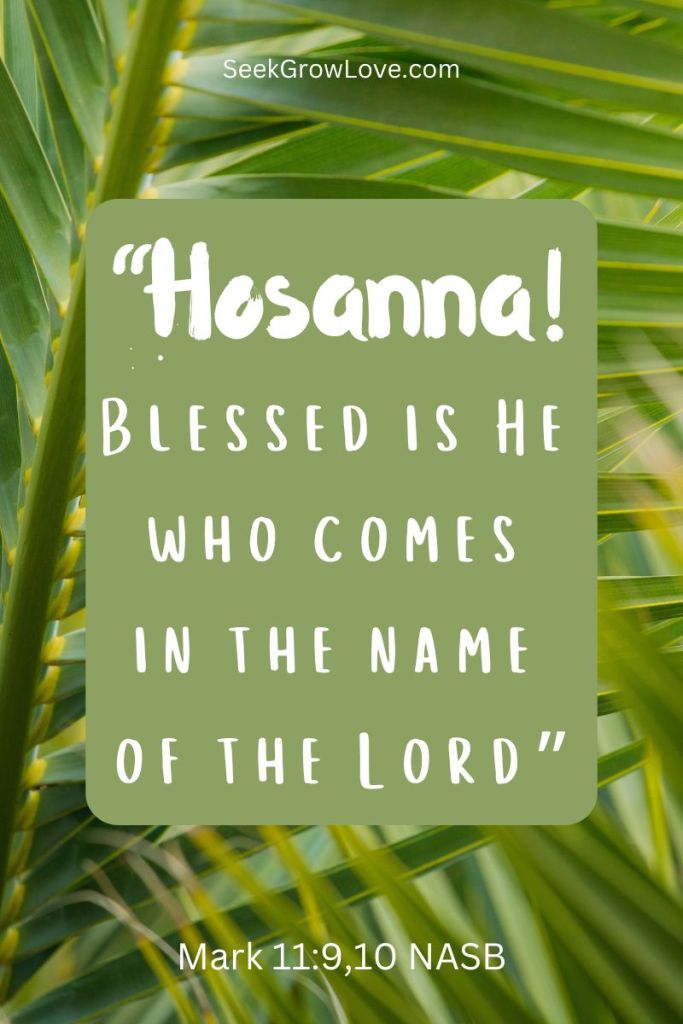
Hosanna is a word used in some songs of praise, especially on Palm Sunday. It is of Hebrew origin: “Hosanna to the Son of David! Blessed is he who comes in the name of the Lord! Hosanna in the highest heaven!” (Mark 11).

Hosanna is often thought of as a declaration of praise, similar to hallelujah, but it is actually a plea for salvation. The Hebrew root words are found in Psalm 118:25, which says, “Save us, we pray, O LORD!”. The Hebrew words yasha (“deliver, save”) and anna (“beg, beseech”) combine to form the word that, in English, is “hosanna.” Hosanna means “I beg you to save!” or “please deliver us!”

So, as Jesus rode the donkey into Jerusalem, the crowds were perfectly right to shout “Hosanna!” They were acknowledging Jesus as their Messiah, as shown in their address “Son of David.” Theirs was a cry for salvation and a recognition that Jesus is able to save.

When is the last time that you have yelled out to Jesus to save you? It’s an important question, and one that needs to be on our lips all the time.

There is nothing more satisfying in all the world than to be followers of a king like Jesus. Picture him riding toward Jerusalem, the rebellious city. A multitude praising him: “Hosanna, blessed, is the king who comes in the name of the Lord.” He knows the praise is shallow. In a few days it will fade away. But does he rebuke them? No. He defends them against the criticism of the Pharisees: “‘Teacher, rebuke your disciples!’ . . . ‘I tell you, if these were silent, the very stones would cry out.'” He knew his days were numbered. He knew their cries were not completely sincere.

The praise the people gave was not because they recognized Him as their Savior from sin. They welcomed Him out of their desire for a messianic deliverer, someone who would lead them in a revolt against Rome. These are the ones who hailed Him as King with their many hosannas, recognizing Him as the Son of David who came in the name of the Lord. But when He failed their expectations, when He refused to lead them in a massive revolt against Rome, the crowds quickly turned on Him.

Within just a few days, their hosannas would change to  Crucify Him.

Those who hailed Him as a hero would soon reject and abandon Him.

The story of the triumphal entry is one of contrasts, and those contrasts contain applications to us. It is the story of the King who came as a:

servant on a donkey, not on a white horse.

not in royal robes, but on the clothes of the poor and humble.

Jesus Christ comes not to conquer by force but by love, grace, mercy, and His own sacrifice for His people.

 His is not a kingdom of armies and splendor but of lowliness and servanthood.

He doesn’t conquer nations but hearts and minds. His message is one of peace with God.

If Jesus has made a triumphal entry into our hearts, He reigns there in peace and love. As His followers, we exhibit those same qualities, and the world sees the true King living and reigning in triumph in us.

If he lives in us today, we sing Hosanna. With a true and right heart. We don’t crucify him again and again with our sin.

We cry out to save us, not we can save ourselves. What do you cry out to Jesus for? Is it sincere? Is it true? Ask God to give you a sincere heart, so that your worship to God through Jesus is a saving worship. 

-Andy Cisneros

Reflection Questions

  1. What can you learn from the King who came on a donkey?
  2. Where else in Scripture do you find humility honored? Are you more known for your humility or pride?
  3. In what ways, at what times, have you tried saving yourself? When have you cried out for Jesus to save you?

God’s Gift

xr:d:DAF89inTsJs:5,j:1094793584200766214,t:24021614

Old Testament: Exodus 37 & 38

Poetry: Psalm 35

New Testament: Acts 2

In yesterday’s reading of Exodus 35 God filled the tabernacle craftsmen (Bezalel, Oholiab and others) with his Spirit providing them with the skill, ability and knowledge to do the work the Lord desired them to do for Him. In today’s reading of Acts 2 God pours out His Holy Spirit on Jesus’ followers and they, too, are enabled to do the work the Lord desired them to do for Him. This time the Spirit was not delivering the ability to create beautiful gold cherubim and lampstands or embroidered curtains. God had a different job in mind for these workers.

In the Old Testament we see the Spirit given, or described as “in” various leaders so they are able to carry out the work that God wants them to do. Joshua is chosen to succeed Moses due to “the spirit” in him (Numbers 27:18). Gideon receives the Spirit of the Lord, and he blows a trumpet to assemble an army to go up against the Midianites (Judges 6:34). Ezekiel records that the Spirit came into him as he heard God call him to be a prophet to carry God’s words to the rebellious and obstinate nation of Israel (Ezekiel 2:1-4). And there are other instances found in the Old Testament. Sometimes the spirit was given to provide gifts of leadership and skills (including but definitely not limited to craftsmanship). Sometimes the spirit was given to embolden and provide power and strength to overcome the enemy. Sometimes the spirit was given to the one chosen to carry God’s precious words and warnings of His judgment to God’s people, whether they listen or not. The Spirit was a special gift to those leaders willing to do what He says and do His work.

Fast forward to the beginning of Acts and we find Jesus’ followers who had witnessed Jesus’ death and the empty tomb now get the privilege of 40 days with the risen Christ as he tells them all about the kingdom of God. He also tells them his Father has a gift for them – but they can’t have it quite yet – they have to wait for it in Jerusalem (Acts 1:4). Can you imagine their excitement! They are ready to see this kingdom start. They are ready for their gift. They might even be thinking the hard part was now behind them. They had followed Jesus for 3 years. They had watched him die. But now Jesus is alive and by their side and the kingdom is around the corner. Little kink in their plan, Jesus tells them only the Father knows when it will begin; but he encourages them with these words: “You will receive power when the Holy Spirit comes on you; and you will be my witnesses…” (Acts 1:8). THEN, Jesus leaves, again! He isn’t dead, he is very much alive this time, raised in the clouds to heaven and the men in white assure them that this same Jesus will return the same way. What should the disciples do next? Probably obey. Go to Jerusalem and wait for that gift Jesus mentioned.

They do what Jesus told them to do and in Acts 2 they are waiting in Jerusalem. Perhaps receiving the gift requires obedience first. Approximately ten days later, on the Day of Pentecost, the gift was delivered – and what a delivery it was. Much more dramatic than a singing telegram or balloon delivery, the gift was accompanied with the sound of a violent blowing wind. I have never heard a tornado myself, but it is often described as the sound of a freight train getting closer and coming at you. Imagine hearing these violent winds coming into the room you are in. And what you hear is only surpassed by what you see: a ball of fire suspended in the air which then separates as a tongue of fire comes to rest on each one of you! God was definitely getting their attention with this gift delivery! I think He wanted them to always remember this moment and never doubt that He had indeed delivered what Jesus had promised his Father would deliver.

In fact, Jesus was not the first one to promise the delivery of this gift. Many years earlier the prophet Joel had foretold of a time when God would, “Pour out my Spirit on all people. Your sons and daughters will prophesy…even on my servants, both men and women, I will pour out my Spirit in those days and they will prophesy.” (Joel 2:28-32 and Acts 2:17-21). This was now a pouring out of God’s Spirit! It was not just for a few select leaders who had a job to do. Now everyone seems to have a job to do! The sons and daughters, young and old, even on my servants, both men and women, Joel says God says. So pour that Spirit on – they are going to need it! They are going to prophesy and speak for God. Prophecy is sometimes thought of as just foretelling the future but it actually includes hearing and speaking for God whatever message He sends.

And this time He sent His message in many foreign languages, all at once, to the disciples who had previously not known or understood or spoke these foreign languages, but now their words were heard and understood by the Jews gathered from many foreign lands and tongues. “All of them (the Jesus followers gathered in Jerusalem who had just heard the wind and saw the tongues of fire land on each of them) were filled with the Holy Spirit and began to speak in other tongues as the Spirit enabled them” (Acts 2:4). Turns out God not only wanted to get the disciples’ attention – but also the attention of all the Jews from many foreign lands and tongues who were in Jerusalem for the Day of Pentecost celebration. The people each hear their own language from these Galileans and they are amazed and perplexed – and listening!

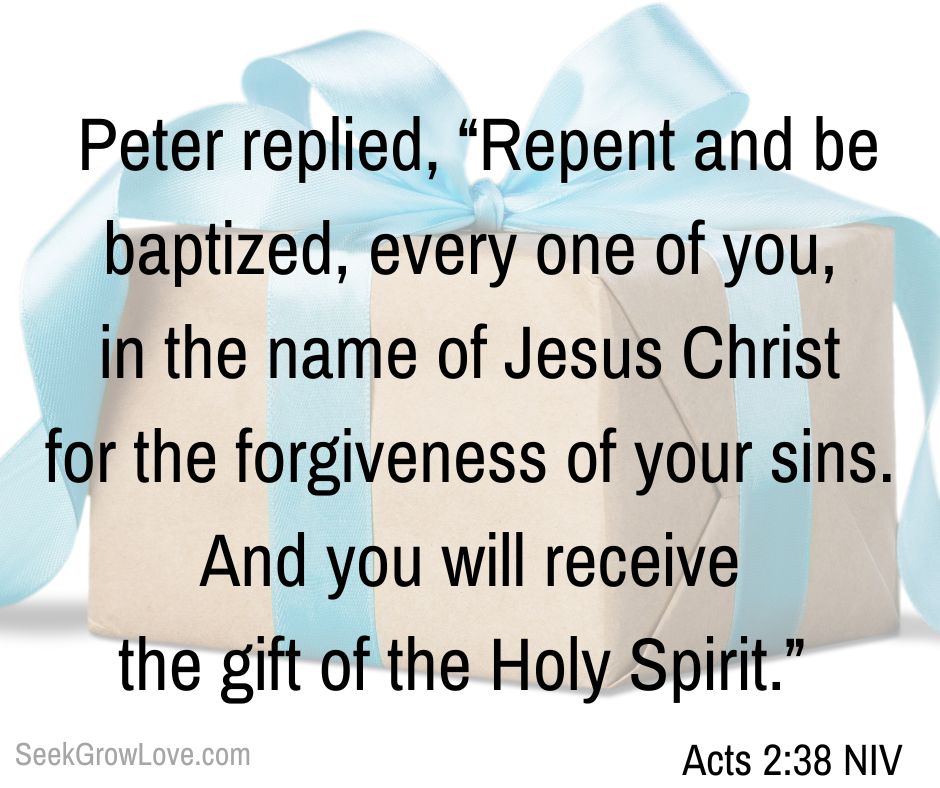
So Peter stands up and speaks for God – with an amazing sermon in Acts 2 you don’t want to miss! This is the same Peter who approximately 53 days earlier denied Jesus three times. He wouldn’t even admit to the servant girl that he had been with Jesus. This is the same Peter who wept at his weakness. Now he is preaching to the multitude to tell the Jews of every nation about Jesus whom God has made both Lord and Christ. The Spirit makes a difference -a big difference. Peter explains from Joel, to the man Jesus. He explains to the Jews how they put Jesus to death and God raised him to life, freeing him from death. He explains how David is in the grave, but Jesus is not. When the people hear, understand and are convicted they ask what they must do. Peter replies, “Repent and be baptized, every one of you, in the name of Jesus Christ for the forgiveness of your sins. And you will receive the gift of the Holy Spirit” (Acts 2:38). Obey these steps – and the gift is ready for you.

God’s gift of His Spirit is no longer just for the Bezalels, Joshuas, Gideons, and Peters. It is no longer just for the disciples who physically walked with Jesus. Now, if you repent and are baptized, this gift is for you! Are your ready to obey and do the work God has for you? You, too, can receive the gift of God’s Holy Spirit to do the work that God has for you to do. The gift is not always delivered with the sound of violent winds and tongues of fire. What the gift enables you to do still depends on what job the Lord has for you to do. Without it, you are weak. With it, comes power, words, skills, and energy you are not capable of on your own. Are you ready to receive God’s gift?

-Marcia Railton

Reflection Questions

  1. What are your thoughts on God’s Spirit? What does Scripture teach about God’s Spirit?
  2. What work do you think God has for you to do? Are you already using His Spirit to do this work?
  3. What does one have to do to receive God’s gift of His Spirit?

Ready for the Day. And Ready for the Night.

Old Testament: Exodus 23 & 24

Poetry: Psalm 29

New Testament: Matthew 25:1-13

Are you ready for the day? Do you have clean clothes to wear, you have your keys, phone and wallet, your homework is done, you have prepared for the meeting or test, and you remembered to brush your teeth before leaving the house. It’s a good feeling to be ready. 

When was the last time you were caught unprepared? You scrambled to put together a clean (maybe matching) outfit because the dirty hamper was overflowing, the teacher gave a pop quiz, visitors found a messy house, you didn’t have the project complete when the boss wanted it, the bill wasn’t paid by the due date, and in the rush to get out the door you forgot to brush your teeth. It’s no fun not being ready. 

In Matthew 25 today we read of the Parable of the Ten Virgins, or Bridesmaids, depending on which version you read. They are all anxiously waiting for the bridegroom’s arrival and they all have a lamp/torch/light with them as it is day now but they don’t know when he might come, so they (seem) prepared to wait even if it grows dark. And it does. 

Jesus tells us five of the virgins (typically referring to purity) were wise and five (still, pure virgins) were foolish. And since they all had their lamps with them and were anxiously awaiting the bridegroom’s (Jesus’) arrival I feel it is safe to say that all ten would call themselves “Christians” or Jesus followers. The five foolish aren’t chasing after the world and doing immoral, evil things. They have their lights and are waiting, right along with the five wise.  I think they are even sitting in the church pew and doing all the right things right along with the wise, all day long.

And then it grows dark. BOTH the wise and foolish get drowsy and even begin to sleep. BOTH are wakened with the great news, “The Bridegroom is coming!” But now we run into trouble. Well – half of them/us do. 

Five of them didn’t bring oil to keep their lamps burning, their lights are going out, and they haven’t seen the bridegroom yet. They desperately demand to get some oil from the five wise who brought oil with them, but the wise know they don’t have enough oil for both their light and another light. In the final moments the foolish run off scrambling to go buy more oil. And it is in those final moments that the long anticipated arrival of the bridegroom takes place. He finds the five wise waiting with their lights burning bright and he ushers them into the wedding feast. The door is shut and the party begins. 

In the previous chapter Jesus had just warned of the darkness that would proceed his second coming: increased wickedness, love of most growing cold, many deceived by false prophets and false christs, war, famine, earthquakes, and persecution. He warned that during that time of darkness many Jesus followers will fall away. They are the 5 foolish. They are the ones who won’t have enough fuel to keep their light burning through the darkness. They are the ones who will miss the party and be left out in the dark and will hear the Savior say, “I don’t know you.” 

Each person needs to be prepared – and stay prepared – even in the final dark days/moments/hours. Just having a light in the daytime is not enough. Just walking with the wise, right crowd is not enough. It won’t work to get into the Kingdom with a spouse, parent, grandparent, pastor, or friend who is prepared. You need your own light – AND the oil to keep it burning bright all night long if needed. 

Which half will you be a part of? Are you prepared? Are you ready? Do you have your light with you? That’s a good first step! But are you also prepared for the coming darkness that will indeed come before the Savior arrives? Do you have enough fuel to keep your light burning bright until you are ushered into the great wedding feast? Are your ready for the day? Are you ready for the night?

-Marcia Railton

Reflection Questions

  1. First off, are you a Jesus follower, waiting for his return, prepared with a light?
  2. Are you prepared to keep your light burning in the darkness?
  3. What part of the darkness scares you most (wickedness, deception, natural disasters, famine, persecution)? How can you work on strengthening your stand now and preparing for the darkness so you won’t fall away in the darkness? 

The Beginning of Birth Pains

xr:d:DAF8NF_5EZI:9,j:2796027509192958279,t:24020812

Old Testament: Exodus 21 & 22

Poetry: Psalm 28

New Testament: Matthew 24

            I have never had a baby.  Shocker, I know!  As a male member of the human race the act of childbirth has and will forever elude my lived experience.  However, as a father of eleven Fletchers, I have spent many years of my adult life in the company of pregnant women, or more precisely, a pregnant woman.  I was there for all eleven births and I caught most of them (the last one came so quickly that I caught him solo).  All this is to offer to you my credentials that, although never directly experiencing labor, I have been present for enough births to recognize the various stages that women go through in childbirth.  Fun fact, for women who have more than one baby the Braxton Hicks contractions (otherwise known as false labor) can come several weeks or even months before the baby is actually born.  Braxton Hicks contractions are one way that the body prepares itself for labor.  It’s like an athlete doing warm up exercises before the actual event.   Muscles tighten and relax as they practice for the real thing when it comes. 

                Today’s devotion isn’t really about childbirth, it’s about being prepared for the return of Jesus Christ, the end of this present age and the preparation for the age to come, the Kingdom of God.  Matthew 24 is known as the “little apocalypse”.  Apocalypse is another term for Revelation.  In the Bible the book of Revelation is 22 chapters long and goes into a lot of detail about the end of this age and the coming of Jesus.  Matthew 24 is a condensed version, kind of a mini-sermon Jesus preached to his followers shortly before he went to the cross.  (You will run across parallel or “synoptic” passages when we get to Mark 13 and Luke 21).

                Jesus’ purpose here is to prepare his followers to be ready for times of great tribulation or distress that would come immediately prior to his return.  If you’ve ever read or heard a sermon about the apocalypse or the end of the world or Armageddon you probably are aware that Jesus warned that before things get amazingly better- ie. The New Heavens and the New Earth, Christ returning to rule over all the world bringing a final end to all sin and death and setting free the whole earth from the “curse” of death… before things get amazingly better, there will be a time when they become incredibly hard.

                A brief study of the history of the Church for the last 2000 years will show that Christians have gone through hard times a lot.  In the first 2 centuries the problem was the Roman Empire.  Followers of Jesus were often told that they had to renounce their loyalty to Jesus and declare their loyalty to Caesar alone.  When they refused, some of them were thrown to the lions or burned at the stake.

                Since Christianity was legalized in the Roman Empire it has faced challenges in many parts of the world at different times.  In the 17th century Christian missionaries in Japan were killed for their faith.  In the 1930’s Christians in Germany who failed to support Hitler faced severe persecution and some, most notably Dietrich Bonhoeffer, were executed for resisting Nazism.  Christians in Communist China and the Soviet Union experienced incredible persecution during most of the 20th century.  There are places in the Islamic world today where Christians who attempt to proselytize Muslims face the threat of execution.

                Every generation of Christians since the first century could look at what was happening in the world and see the potential for the end of the world.  Jesus’ own disciples asked him right after his resurrection, before he ascended to God, “Is it NOW, Lord?” (Acts 1:6).

                2020 was a really challenging year with Covid, racial division, murder hornets, wildfires and hurricanes.  I had a lot of people asking me if I thought the end of the world was coming.  Perhaps you’ve wondered that yourselves.

                Matthew 24 is a great place to go when you start wondering if this is the end.  Like a woman who is going to have a baby, she may have “birth pangs” for a long time before the baby is actually ready to be born.  The same is true with the coming Kingdom of God.  I think every generation of Christians experience some amount of persecution or “natural” disasters or other tragedies that leave them wondering if the end could be near.  Just as Braxton Hicks contractions are God’s way of preparing a woman to give birth by having her muscles practice for the big event, God permits every generation to experience a certain amount of trials and tribulations to help prepare God’s people for the final “great push” that will occur right before Jesus returns.

                Jesus himself said that no one knows exactly when he will return.  He said that even he doesn’t know.  That is something that only God knows.  What Jesus does say to his disciples then and to us today is that we need to stay ready, we shouldn’t fall asleep in our faith.  He warns that as troubles and persecution increase and as the world becomes a less loving and more violent place that many of his followers would fall away:

                “At that time many will turn away from the faith and will betray and hate each other, and many false prophets will appear and deceive many people. Because of the increase of wickedness, the love of most will grow cold, but the one who stands firm to the end will be saved.” (Matthew 24:10-12).

                Jesus might come very soon. I can’t predict when.  All I can do is make sure that I’m ready whenever he does come.  I must make sure that I stay faithful and don’t turn away even if the persecution gets really bad.  I think Christians living in the United States are getting ready to face some real persecution in the near future.  In fact, I think we already are.  There is a lot of pressure to conform to the changing norms of society.  Cancel culture will not have any respect for Christianity.  Some of the things that the Bible teaches about how we are supposed to live, particularly in areas of morality, sexuality and gender norms are considered anathema by the current progressive climate.  As people place more value on becoming “woke” more followers of Jesus, young and old will be persecuted if they fail to change their values.  Remember, Caesar doesn’t like to be rejected as God, neither does the devil, and neither do the progressive elites.  In the wake of the coming persecution Jesus our Lord tells us to “stand firm.”

-Pastor Jeff Fletcher

(originally posted January 24, 2021 for SeekGrowLove)

Reflection Questions

  1. Make a list of what Jesus warns us of in Matthew 24. How does it help to know what to expect?
  2. How can you guard against the deception of false christs and false prophets?
  3. Have you already seen a bit of the increase of wickedness and the love of most growing cold? Has it affected you personally? What temperature is your love? 
  4. What can you do today to help prepare yourself to stand firm to the end? What can you do today to help prepare others to stand firm to the end? 

Your Royal Wedding Banquet Invite

Old Testament: Exodus 15 & 16

Poetry: Psalm 25

New Testament: Matthew 22:1-14

What was the best party you have ever been to? How did you get invited? What was your relationship with the host? With the guest of honor? Who else was there? What did you wear?

Or, maybe there was a party you were invited to that you didn’t make time for? Perhaps you didn’t really know the guest of honor that well so you weren’t too interested. Or maybe you were mad at the host so you stayed away? Or you figured it would be boring since they didn’t have (insert hobby/entertainment/person of interest). But then, come to find out – you missed out on the party of the century.

Jesus knew we like to talk about parties. Wedding receptions are particularly exciting – and royal wedding parties top the charts. So what a perfect parable and analogy for the Kingdom God is preparing. God is the King – and as host of the party he decides who to invite to this event of all events which will honor His Son – Jesus.

The guest list starts out somewhat small and elite which is very fitting for a royal party. The Jews were the first to be invited to the party. They could trace their heritage back to Abraham, Isaac and Jacob – the fathers of the faith. But, they ignore their invite and the God who sent it. They don’t even RSVP. God sends his servants out as messengers (the prophets and those who speak for God) to remind God’s people of the graciousness of their host and the splendor of the party. But, the potential guests of the party are too deep into other things – their fields, their businesses, their homes, their selfish pursuits, their false gods. Most just ignore God’s messengers – but some decide the best way to decline the invite is through violence. In rage they attack God’s messengers, even killing some. For a time they may have thought they got away with it. But, God knows and delivers judgment.

The guests didn’t show but the party isn’t cancelled. God sends his messengers again. They hit the streets with new invitations. “Invite them all,” says the host. It no longer matters who your great great great grandfather was. It doesn’t matter who you were or what you did. Old, young, rich, poor, men, women, children, black, white, and every color in between. You are invited! And all your neighbors in the world are invited! Let the party begin.

But, wait – that’s not yet the end of the parable or God’s expectations. The host has indeed invited all and is ready to receive all into His Kingdom Party. But, you must come dressed appropriately for the party so you aren’t tossed out. No, God won’t check to see if you have a designer label – but He will check to make sure you have clothed yourself with salvation. To accept your invitation accept God’s Son as the only way to salvation. And then put on the robes of righteousness – seek to live the life that will bring glory to the Father and the Son. There are many passages that continue the analogy of being properly clothed with righteousness, not stained with sin (some are Job 29:14, Isaiah 61:10, Jude 23, Revelation 3:4 and 19:8).

The greatest party ever to come is about to begin and you and all your neighbors are invited. Don’t turn down the invite because you are mad at God or don’t know Jesus well or are busy at home and work. Accept His invitation. Come to the party. But don’t make the fatal error of trying to sneak in unprepared. Accept His Son and clothe yourself with righteousness. Make sure your neighbors know they are invited and help them select their proper attire.

And then – let the party begin!

-Marcia Railton

(originally posted for SeekGrowLove on January 22, 2021)

Reflection Questions

  1. Some of the people invited to the wedding banquet in Matthew 22 paid no attention because they were too busy with other pursuits. In your own life what vies for the time and attention it will take to accept the wedding banquet invitation? What do you value most? Are you making plans and preparations now to attend the wedding banquet? 
  2. Are you already clothed in the proper garments? Have you accepted Jesus as the only way to salvation from the Father? Are your deeds, words and attitudes reflecting your desire to live a righteous life? What are you still lacking?