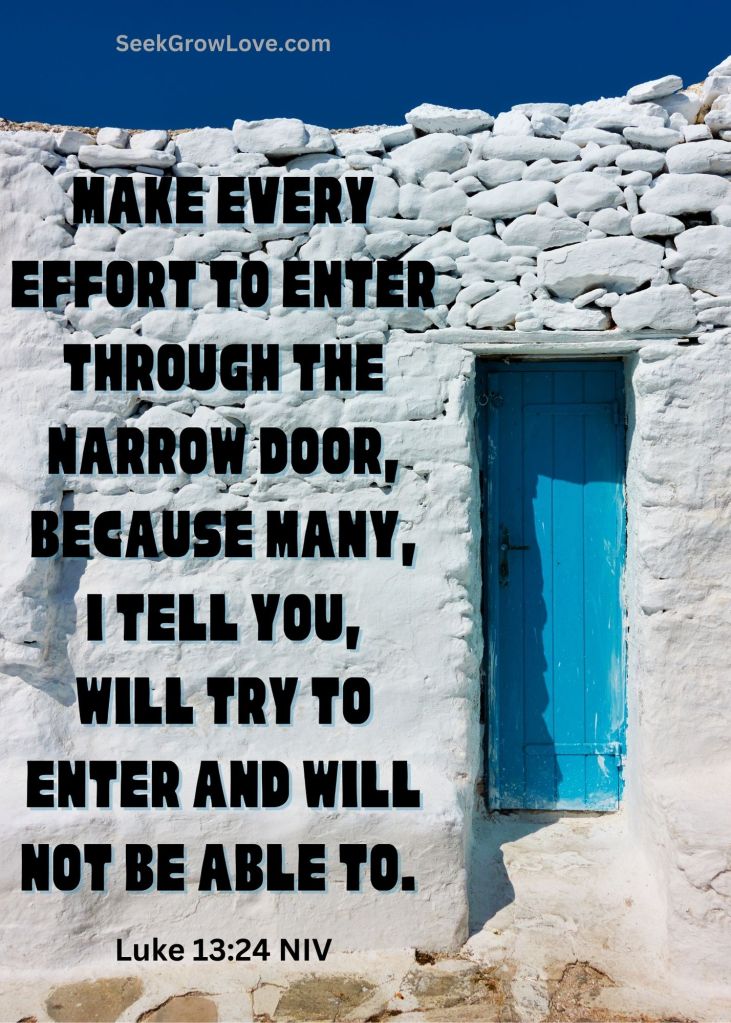
“Make every effort to enter through the narrow door, because many, I tell you, will try to enter and will not be able to.”
In thinking about one’s faith, how easy is it to get caught up in the motions of religion. “I go to church every week, I attend Sunday school, I make food for the potlucks, I give an occasional offering, I went to church camp as a child, etc…when the kingdom comes, surely I will be known and in relationship with the Lord.”
Luke 13:25-27
“Once the owner of the house gets up and closes the door, you will stand outside knocking and pleading, ‘Sir, open the door for us.’ But he will answer, ‘I don’t know you or where you come from.’ Then you will say, ‘We ate and drank with you, and you taught in our streets.’ But he will reply, ‘I don’t know you or where you come from. Away from me, all you evildoers!’”
Thinking about where your heart is and what kind of faith you have takes courage, honesty, and oftentimes real change within our daily habits.
Today is a perfect day to renew or strengthen your relationship with God and his son Jesus Christ. This looks different for all in many ways. When I picture a narrow door, I think of a door that not many choose to enter through. This “door” may not be the popular choice, the easy choice, or the fun choice. However, choosing to live a life that is pleasing to God is more rewarding than any earthly desire or temporary pleasure. I encourage you to take a moment today and consider one tangible way that you could get to know God on a deeper level this week. This may be through prayer, worship through song, spending time in nature, reading your Bible, serving others, etc.
May we be a people who stand outside the door and are fully known as our hearts align to God through his son Jesus Christ.
-Kayla Elwell
Reflection Questions
Choose at least one way you could get to know God on a deeper level this week? When will you do it? Where? How? Why?
How does “Make every effort to enter through the narrow door” work with Ephesians 2:8&9. Do you think Jesus would say that there are some people who rely too much on their works? Do you think Jesus would say there are some people who rely too much on God’s grace? How do you keep from being in either camp?
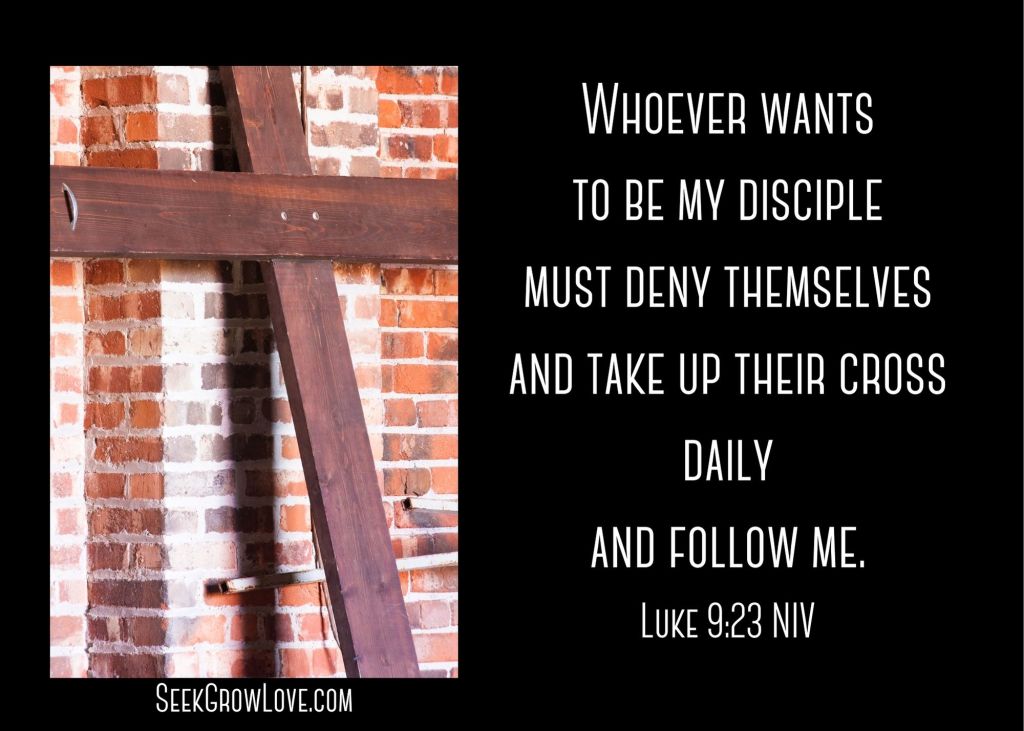
“Then he said to them all: ‘Whoever wants to be my disciple must deny themselves and take up their cross daily and follow me. For whoever wants to save their life will lose it, but whoever loses their life for me will save it. What good is it for someone to gain the whole world, and yet lose or forfeit their very self? Whoever is ashamed of me and my words, the Son of Man will be ashamed of them when he comes in his glory and in the glory of the Father and of the holy angels.” – Luke 9:23-26
What does the cross mean to you? Today, it is often seen around us as a symbol of Christianity, a beacon of hope, and a reminder of God’s love. Sometimes in our culture, it is even used in fashion and design outside the church for its aesthetic appeal. It’s “cool.”
But in ancient times, under the Roman Empire, it was feared. The cross was a means of torture and death. To hear their Lord say, “Take up your cross daily” was a terrifying concept. Early Christians died for the cross; for what it meant. Sometimes they even took up their cross literally. They denied themselves at all costs to take up their cross and be a true disciple.
To take up your cross is the noblest thing you can do. Jesus was a cross-bearer, leading the way for all who wish to follow him. He took up the ultimate cross, and denied himself in the ultimate way, giving up his entire life for a world of undeserving people. Following in his footsteps doesn’t mean giving oneself up for crucifixion, but being willing to deny your own wants and desires and follow God’s calling for your life daily, no matter what that is.
-Isabella Osborn
Reflection Questions:
What cross are you being called to bear? Will you make the decision to answer that call today?
Even if you are in a season of unknowns, what is the universal cross we are all called to bear?
Bearing a cross, while unimaginably fulfilling, can definitely come with difficulty and be a huge burden. In what ways can you find joy in taking up your cross, even when the endeavor you’ve been charged with is a challenging one?
In today’s reading, the last portion has a major theme : “the son of.” The author guides us from Jesus all the way back to the earliest days of history with “the son of Adam, the son of God.” The names and numbers of generations here differ from the names and numbers in Matthew 1. It seems Matthew was proving a point about the care and concern of God. Luke is being historically accurate. But this really isn’t the point. What’s interesting about Luke 3 is that this theme doesn’t begin in verse 23. Instead, it begins in verse 2, and grows throughout the passage.
John is the son of Zechariah. (V.2) We all know this. Why does the author repeat it? Because we need to have sons in mind. We know who John’s parents are and where he comes from. In preaching a baptism of repentance, John is calling for a radical life change. A change in both action and status. More on that in a moment.
In verse 7, John says to his listeners “you brood of vipers.” That is a claim of THEIR parentage, and not a nice one. They were “sons of snakes.” For those who desire to follow John, he calls us to account in how they live. Moreover, John basically explains that he isn’t talking about our physical, biological parents. Having Abraham as your biological ancestor, no matter how good Abraham was, does not mean that a person can escape condemnation. Instead, there needs to be a change in every person’s life. It seems our parentage is determined by how we share our abundance with the less fortunate. Who our “fathers” are is determined by whether we play fairly, by the rules of life and the laws of the land and by finding contentment in our lives.
In verse 21, Jesus goes to “fulfill all righteousness” by being baptized. In that moment, the Holy Spirit descends and a cloud says “You are my beloved Son; with you I am well pleased.”
A couple thoughts to pull you through the day :
Jesus is a real man, with a real family, a real history, who lived in a real time and place. A bunch of names (like at the beginning of the chapter) and a genealogy (like at the end) shouldn’t make us glaze over, but perk up. Luke isn’t trying to confuse his audience. He is situating this story in time and place. This is decidedly not the fairy tale “once upon a time” but something much more like “December 8th, 7pm, in Granger, IN, at Jake’s home, while he types in his pajamas.” These names should ground the story in the real world more.
John calls out his hearers and says “Don’t trust in your parentage.” For me, that hits home. I had believing grandparents on both sides, and a mom and dad who raised me in the church and encouraged me to love God. I can’t ride their coattails. It’s not about what they did, but what I do. But maybe, John’s warning for you could be a word of comfort: nothing that came before holds you back. Did your family not pass on morals, or pass on morals that were detrimental? Did you not know the state of your parents’ souls because you didn’t really know your parents? Do you love your parents but couldn’t imagine living the way they do? Then you are not bound to be like them. We are all called to cast aside our parentage as a source of confidence or weakness, and come before God as ourselves.
John talks about repentance and changing our actions. When we do so, we no longer have snakes for parents. But who is our parent then? I think the hope is what we are introduced to in John 1:12-13 “12 Yet to all who did receive him, to those who believed in his name, he gave the right to become children of God— 13 children born not of natural descent, nor of human decision or a husband’s will, but born of God.” Those who believe in the name of Jesus are able to call God their father. John’s talk of righteousness must be understood in light of Jesus. You are a sinner saved only by grace, and you cannot save yourself. But if you trust in the name of Jesus, you can be saved. This Christmas season, we are reminded of the great and awesome gift of Jesus the Messiah. Do you trust in Jesus as your Lord and Savior? If you have, then in response to HIM making you a child of God, you can and must live a righteous life.
In some sense, every human is a children of God. If Adam is “the father of us all”, and he is “the son of God” we are in a sense, children of God. This however, does not mean that every person is saved. If we live like children of the devil, we truly are children of the devil. These are not my words, but the words of Jesus in John 8. This does truly mean that when we hear the statements this time of year about the “brotherhood of man” and “we are all one”, those statements are true. Instead of filling us with warm fuzzies, let it move us to speak to our brothers and sisters about salvation from dead actions, harm and pain to love, grace and hope that can only be found in Christ Jesus.
May you today, see the reality of Jesus in this Christmas time.
May you let go of familial pride or shame and come to God only and forever through Jesus.
May you become what you were meant to be, a son or daughter of God through righteous action and salvation in Jesus, and may you share your salvation with the world.
So for one final time this season from me :
Merry Christmas!
– Jake Ballard
Jake Ballard is pastor at Timberland Bible Church. If you’d like to hear more from him, you can find Timberland on Facebook (https://www.facebook.com/TimberlandBibleChurch/ ) and on Instagram (https://instagram.com/timberlandbiblechurch?igshid=t52xoq9esc7e). The church streams the Worship Gathering every Sunday at 10:30. Besides studying and teaching God’s word, he is raising three beautiful children with the love of his life, loves Christmas, Harry Potter, Christmas, Board Games, and Christmas. He is also going to be teaching New Testament Survey II, which is available from Atlanta Bible College with their ABC4U program (https://www.atlantabiblecollege.com). If you’d like to reach out to talk Bible, talk faith, or talk about your favorite Christmas Song (and why Mariah Carey sings it), look Jacob Ballard up on Facebook (https://www.facebook.com/jacob.ballard.336 ) or email him at jakea.ballard@yahoo.com. God bless you all!
Reflection Questions
What do you think John may have learned from his father Zechariah, whom we met back in Luke 1?
Look again at John’s message in Luke 3, what do you think he might tell you if you asked him the same question the crowd, tax collectors and soldiers asked, “What shall we do?”
Do you see yourself as a child of God? Why or why not? What does it mean to be a child of God? What privileges and responsibilities come with the position?
The title of this post is unassuming. Two words: a noun, the subject, and a verb in the future tense.
I am in the business of speaking, teaching, training, sermonizing. And sometimes (less often than I’d like to admit) I may have a sermon that God uses in spite of all my failures and faults. But if I were to have all the power of the greatest speakers, the powerful conviction of Billy Graham, the clarity and precision of Andy Stanley, the dedication of pastors from Martin Luther to Martin Luther King Jr. and beyond, more than a thousand eloquent sermons could not compare to the truth of the future of the world summed up in these two words.
God wins.
I don’t want to take away from that truth, but I do want to flesh it out a bit.
In the earlier parts of Revelation, the beheaded souls have been calling out from beyond the grave to the God who will give them justice (Rev. 6:9-11). God promised the victors that they would have reward upon reward (Rev. 2:7, 11, 17, 26-28; 3:5, 12, 21). When God wins, those who placed faith in God above even their own lives have the incredible promises. For time out of mind (1000 years) they will reign with Christ, they will not be hurt by the second death. While the language of two resurrections is not common in the rest of the NT*, the truth is that they are SO ASSURED of their salvation its as if they cannot possibly be brought to judgment. The joy of this resurrection is that we who are powerless, weak, poor, and oppressed will one day win, be victorious and live forever with God and his Christ, because God wins.
And Satan can’t win. The dragon’s wings are clipped, and the serpentine body is prepared for the flames. In this world, God has power to throw the serpent of old, the devil and Satan, and bind him for 1000 years. During that time, his temptation and power are cast down. In the end, the devil who deceived the world was thrown into the lake of fire and brimstone. This is a threat and a promise. Moreover, Satan KNOWS this is his end. The battle between God and Satan is not a cinematic, climactic masterpiece. There is no worry about who will win. Satan is not trying to win, because he can’t. He IS trying to make YOU LOSE, because that is a possibility. But God will help you overcome sin, fight temptation, and come through faithful. God can protect you from the defanged, declawed, clipped-wing dragon, because God wins.
In some sense, part of the glory of God, part of his winning, is allowing humans to choose their outcomes. God allows people to determine their final state. While we are only and forever able to be saved by the glory and grace of God, God both does not force his salvific will upon us and does not preclude us from choosing him. God gives people what they desire. The books are opened; the dead are judged. Christ is our hope (Col. 1:27), our peace (Eph. 2:14), our resurrection and life (John 11:25). If any person has rejected Christ, what have they done but rejected peace with God and people? Rejected hope of eternal life? Rejected the resurrection and the life? God gives them exactly what they demanded. God doesn’t put up with those who were rebellious against him in this life. Because…
God wins.
No ifs, ands, buts.
No amount of persuasive words will make it less true.
No force of hell can stop Him, not a dragon or an atheist.
The promise is true:
God wins.
– Jake Ballard.
* There are hints of two resurrections in the rest of the NT, but nowhere is it explicitly stated like here in the apocalyptic work of Revelation.
Reflection Questions
How significant is the phrase “God wins” to you? To elaborate, in what areas of your life are you losing? Temptation and sin? Suffering and pain? Anxiety, depression, stress? What would it mean for you to stop trying to fix it all yourself, and let God win, allowing him to be victorious where you haven’t been yourself?
In the ultimate sense, Satan is powerless. While we might be attacked, tormented, and tempted by evil today, that is not the way the world will be forever. How does it make you feel to know that all evil and wickedness are going to be overcome by the power of God? Will you allow God to protect you, so the battle is one-sided in your favor today?
There is no peace, hope, resurrection or life without Christ. Have you given him control of your life, allowing him to be your savior and lord?
“My dear children, I write this to you so that you will not sin.”
That is how this chapter starts off. Good plan, more easily said than done. Thankfully, John doesn’t stop writing here.
“But if anybody does sin, we have an advocate with the Father—Jesus Christ, the Righteous One. 2 He is the atoning sacrifice for our sins, and not only for ours but also for the sins of the whole world.”
If you are reading this, you probably already know it. You have read it before – in this chapter, or elsewhere in the Bible. But isn’t that a good reminder? We are not perfect, but thankfully, we have an advocate.
This whole chapter is full of “good reminders.” And John presents them in little different ways.
In verses 12-14 he went about it in a positive way. Instead of saying don’t forget this, don’t slip back into your old ways, he turns it to the positive and says “you are strong” and “you have overcome the evil one.”
He approaches it from the other side too in the next verse saying “Do not love the world…”
But throughout the chapter, I am drawn back to the positive affirmations that he writes to his audience.
20 But you have an anointing from the Holy One, and all of you know the truth
24 As for you, see that what you have heard from the beginning remains in you. If it does, you also will remain in the Son and in the Father. 25 And this is what he promised us—eternal life.
28 And now, dear children, continue in him, so that when he appears we may be confident and unashamed before him at his coming.
Good instruction can come from both telling people what not to do, but also telling people what to do, and telling them to keep doing the good they are doing. It is an encouragement as well as a reminder, and that sticks with me today as I write this.
~Stephanie Fletcher
Reflection Questions
Reread 1 John 2 looking specifically for the things John tells us to do, as well as those things we are not to do. Which instructions do you find easiest to follow? Where do you need a little push in the right direction to keep yourself on the right path – or off of the wrong path?
What do you think our “advocate with the Father—Jesus Christ, the Righteous One” sees you doing and would tell you to keep doing? What will you do today to keep doing that! How will you ‘continue in him’?
In the second chapter of his letter, James continues with his onslaught of practical but difficult advice.
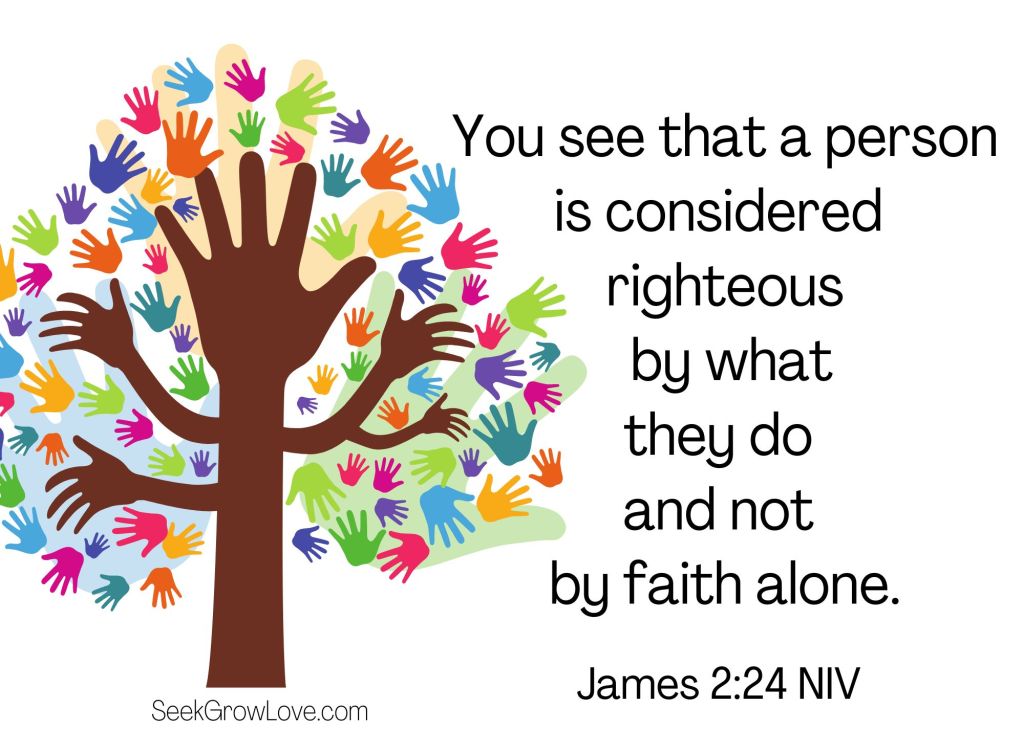
“What good is it, my brothers and sisters, if you say you have faith but do not have works? Can faith save you? If a brother or sister is naked and lacks daily food, and one of you says to them, ‘Go in peace; keep warm and eat your fill,’ and yet you do not supply their bodily needs, what is the good of that? So faith by itself, if it has no works, is dead. But someone will say, ‘You have faith and I have works.’ Show me your faith apart from your works, and I by my works will show you my faith. You believe that God is one; you do well. Even the demons believe—and shudder.” (James 2:14-19 NRSV)
It would seem from this section that just believing things is no good. If my interpretation of James is correct, that means it’s not enough to go around quoting John 3:16 and telling people they only need to believe in Jesus and they will be saved. There is no checklist of beliefs where you can just tick all the boxes and receive salvation. No single belief will save you, and neither will any magical combination of beliefs.
James is asserting that action must accompany faith in order for it to be the real thing. Doing good works is the evidence of your faith. Faith and good works don’t live isolated lives, but are coupled together. To decouple faith and works is to reveal an inconsistency.
Imagine that someone claims to believe in the value of human life as the image of God, yet they go around hurting or killing people. Or maybe they just neglect to help someone else they know is in need. You would notice the inconsistency in that. They must not truly believe in the value of human life since their actions show they don’t value it. James is telling us that actions are louder than words. He cuts right through the nonsense and says, “Hey, don’t just tell me what you believe. Show me.”
When we talk about this passage, it’s likely that we’ll also think of a passage from Ephesians that seems to be in tension with it.
“For by grace you have been saved through faith, and this is not your own doing; it is the gift of God—not the result of works, so that no one may boast. For we are what he has made us, created in Christ Jesus for good works, which God prepared beforehand to be our way of life.” (Ephesians 2:8-10 NRSV)
Paul here is saying that works can’t save you; it’s a gift you accept through faith. James is saying faith alone doesn’t save or justify you; you need works too. Is there a conflict between what James and Paul are saying?
Part of the beauty of this collection of writings we call the Bible is that different authors often have different perspectives on things. We have four different gospel accounts, each with their own angle and emphasis. The general story and message are the same, but some of the finer details differ. This is exactly what you would expect if you asked four different people to describe something they witnessed years ago. This is not a problem at all for the gospels, and in actuality, bolsters the case for their authenticity. It shows that four people didn’t get together in a room for a weekend and collude to produce the exact same fairy tale. Four real people wanted to pass on what they witnessed, and they did so under the inspiration of God.
We see the world with two eyes, each from a slightly different angle. This allows us to perceive depth, in other words, to see things in 3-D. Your brain does some kind of trigonometry with the signals from your eyes to give you an idea of how far away something is. If you had only one eye, it would be much harder to judge depth.
We can regard James and Paul as two eyes looking at the topic of salvation from two different angles, and the result is seeing it in 3-D. It’s the same core truth with different emphases. James sees something Paul doesn’t see, and Paul sees something James doesn’t see. At great risk of oversimplification, I’ll try to bring their viewpoints together. They would agree that faith and works go hand-in-hand. James is saying faith alone is not enough, and Paul is saying works alone are not enough. Neither would say that you can earn salvation by works, but would agree that the works are evidence of a saving faith. Well, I took a stab at it. My only hope is that they can get together sometime to discuss this topic and release it as a long-form podcast.
-Jay Laurent
Question Time
1. Why do you think it is so hard to really live out what you believe?
2. What small steps could you take this week to put your faith in action?
The opening verse of this chapter sets forth the premise of what is to follow: “Now faith is the reality of what is hoped for, the proof of what is not seen” (v. 1). The author will go through no less than 10 explicit individuals, and mentioning a list of several more, who exhibited faith in their life. And then the chapter concludes by saying “All these were approved through their faith, but they did not receive what was promised, since God had provided something better for us, so that they would not be made perfect without us” (vv. 39-40).
The chapter’s conclusion draws together the litany of exemplary witnesses by tying it to the faith that they share with the audience. And while the exemplars of old had not received the promise, it was by no fault of their own, but it was determined beforehand by God that in his grace, he planned for “something better” to be available to the readers that was not available in the past to all those faithful witnesses that were mentioned. And that “something better” was “to be made perfect” (v. 40).
Now, to modern readers the idea of being made perfect might not be the same as the biblical idea of being made perfect. In Hebrews, the idea of “perfection” entails the definitive forgiveness and putting away of sin, purification and consecration to God, and glorification (i.e., resurrection). And so, to be “made perfect” refers ultimately to eschatological salvation that is bestowed on the worshiper through the high priestly ministry of Christ (cf. 10:14).
But let’s think for a moment, why does the author need to go to such a great length throughout the chapter to simply demonstrate that believers prior to the new covenant did not receive what was promised? Why make the emphasis so extravagant?
One reason for the author’s inclusion of such a long description of exemplars of the faith is to celebrate those who stood with faith looking forward to the promise, but yet not receiving it in their lifetime. The testimony of all these witnesses is that “Faith holds onto the promise, even when the evidence of harsh reality impugns its integrity, because the one who promised is himself faithful” (William Lane, Hebrews [WBC], 395).
I think we have all probably dealt with times when we are holding on to faith, but it doesn’t seem like anything is happening or changing, and we didn’t actually get to see the outcome of our faith. This is what it was like for the believers in the old covenant who looked forward to the coming Messiah and the fulfillment of God’s promise. But we don’t have to look forward since Messiah has already come and has begun to fulfill what God promised.
Therefore, while we have not been “made perfect” yet to the fullest extent of what God has planned for those who trust in him, in Christ we have the definitive sacrifice for sin, the cleansing of our conscience, and a taste of the powers of the age to come. Let us continue to hold fast to our faith in hope of what God has promised that is yet to come: resurrection and final victory over the power of death, so that those who stood by faith before us can also be made perfect with us in God’s coming kingdom.
-Jerry Wierwille
Questions
What encouragement do you gain from reading of the heroes of the faith in Hebrews 11?
Which heroes of the faith are you most looking forward to being with when we together receive God’s promise and reward at the resurrection and coming Kingdom? Why?
I love this chapter in Hebrews! It outlines the very reason that I am a Christian, the reason that I believe in Jesus and follow his teachings. It says in verse 2, that the Lord first declared himself. When Jesus was on earth, he taught in the synagogues and proclaimed to be the Messiah spoken of in the prophecies of Isaiah. He proclaimed himself to be the Son of Man spoken of in the prophecies of Ezekiel. We know that he did because we have the firsthand, eyewitness accounts in the first four books of the New Testament. Here again, the author of Hebrews is adding his account (Hebrews 2:4). More importantly than all of this, God adds his own testimony by performing signs and wonders through the apostles, and even among disciples of Jesus today. It’s for this reason that I believe.
Remember yesterday’s passage that proclaimed the great glory and exaltation of the Son of God. The author tells us to pay attention to what we have heard, so that we do not drift away. Keep that picture that he painted in your mind. The greatness of God himself has been given to Jesus. You have heard what has been said of Jesus from your friends, your pastor, from the gospels and from the Holy Spirit. Hold on to these things; cling to the faith.
In the next section, the author draws our attention to another psalm like in the first chapter, but this time, he uses it to speak of all mankind more broadly, not just the man, Jesus. God is so much higher than we are. We can’t even wrap our minds around what it means to be Spirit and dwell in heaven. And yet, God cares for us mere mortals. We are lower than angels in that the angels are in the presence of God, but it says that all things have been subjected under man’s feet. It’s clear that this isn’t talking about the current state of the world. There are countless things that aren’t subject to man’s authority: disease, death, hunger, poverty and all kinds of injustices. This is just what the author says in Hebrews 2:8. But we do see Jesus. And just like we read yesterday, everything was given to Jesus. He is the heir of all things and is made higher than all the angels. While Jesus was here, he appeared lower than angels, a man mocked and rejected, but now he is exalted with a crown of glory.
Though Jesus was the first to be glorified, he was the pioneer of salvation, he is not alone since salvation is available for all who believe in his name and we all can become sons of God, brothers and sisters of Christ (Hebrews 2:10-13).
This final section of the chapter is poetic and beautiful, but its real beauty comes through the deep truth and hope that it can bring to our lives. Jesus, though he was perfect and blameless, was put to death. In doing so, he destroyed death itself and freed all of us from the slavery of the fear of death. When you believe in Jesus, you are made free because you don’t need to fear death because there is life for all who are sons of God. We saw it first in Jesus. We saw him raised from the dead and ascend into heaven. This is the fate that awaits us as well. We can relate to Jesus in every way even though he is so highly exalted. He suffered temptation, suffering and death, just as we all will, but we have a hope for life that is to come, a hope that is true, because it was attested to us by God, through his son.
-Nathaniel Johnson
Questions for Reflection
What is the meaning of verse 1? What do they need to pay more careful attention to? Why? Is it still true today? Is it still true for you?
How would you explain Hebrews 2 to someone who has never heard of Jesus before?
Though I had never met the woman in person, I was pretty certain it was her. I’d seen many photos of this wellness coach, and I had always been stunned at her story: she lost nearly 200 pounds by following the Trim Healthy Mama (THM) plan, which I try to also follow for health reasons, and was now a weightlifter as well. Something about her smile was distinctive and very recognizable. I knew she lived in this general area, so it wasn’t too far-fetched to think it could be her. As we got off the hotel elevator together, I summoned up the courage to ask: “Excuse me, are you a THM coach?” She looked stunned, but kindly replied, “Yes, I am…” I explained that I recognized her from the social media pages and was awed by her story. She gave all the glory to God for helping her become healthy. We said a few more words and then parted ways. Later that night, she posted humorously on the group page that she was now a B-List celebrity because she had been recognized in public looking a bit disheveled on her way back from the hotel waterpark, and then I formally introduced myself on social media as well.
“Before-and-after” posts almost always entice me to stop scrolling and read into the story. Whether it is a weight loss, home makeover, cake decorating challenge, hairstyle tutorial, or hoarder-to-minimalist success story, I feel so thrilled watching a transformation take place. I think we all love a good change for the better, yes? Perhaps that’s why I’m fascinated with the metamorphosis of butterflies too!
Paul tells us how our “before-and-after” should look, beginning in Titus 3:3: “At one time we too were foolish, disobedient, deceived and enslaved by all kinds of passions and pleasures. We lived in malice and envy, being hated and hating one another.” That is who we used to be, but that is not who we are now! He continues, “But when the kindness and love of God our Savior appeared,he saved us, not because of righteous things we had done, but because of his mercy. He saved us through the washing of rebirth and renewal by the Holy Spirit,whom he poured out on us generously through Jesus Christ our Savior, so that, having been justified by his grace, we might become heirs having the hope of eternal life.” So, what do we do now instead of all those behaviors we used to do before we were saved? Paul says, “I want you to stress these things, so that those who have trusted in God may be careful to devote themselves to doing what is good.”
Before God saved us, we were overcome by all sorts of sinful behaviors. But now that we have experienced the kindness and love and mercy and grace of God that we did not deserve, we need to devote ourselves to doing what is good.
We have known since we were children sitting on Santa’s lap that we were supposed to be good! But what exactly does that mean in a biblical kind of way? Hop back up to verse 1 to find a bit more guidance. “Remind the people to be subject to rulers and authorities, to be obedient, to be ready to do whatever is good, to slander no one, to be peaceable and considerate, and always to be gentle toward everyone.” This list seems to be at least a partial, but still challenging, description of “doing what is good”, don’t you think?
Paul urges yet again – it must have been such a problem in their society as it is in ours! – to avoid foolish talk (verse 9). I’ve noticed this theme throughout 2 Timothy and Titus; it is a good reminder that we need to pay careful attention to watch what we say, making sure our words are edifying. We are called to be representatives of Jesus in everything we say and do.
-Rachel Cain
Reflection Questions:
What does your “before-and-after” look like? Maybe, like me, you were raised a Christian and don’t have a dramatic story to tell. But God has still saved you by his grace! Write out your salvation story and testimony, so that you will always be ready to give an answer for the hope that you have. (I Peter 3:15)
In this scripture, Paul calls believers to “do what is good”. What are some specific good things you think God is calling you to do in this season?
The pale princess cowered in the corner of her frigid room. Though she had been living a solitary life for many years for fear of people discovering her secret, Elsa was now summoned from her self-imposed prison for her coronation.
“Conceal; don’t feel. Put on a show. Make one wrong move and everyone will know…”
If you’ve seen the movie Frozen, you know that Elsa had some sort of mystical power that could create and manipulate snow and ice. She had hidden it for a long time, but a stressful situation at the coronation event caused her to lose self-control, divulging her secret to her entire kingdom and initiating an eternal winter in her kingdom. Afraid that people might turn on her, Elsa abdicated her right to the throne by escaping to the mountains to “let it go”, seemingly embracing newfound freedom resulting from the revelation of her secret. The story continues with ups and downs, laughter and sadness; however, at the end of the movie, Elsa discovers that the way to control her powers is not fear, but rather love!
What does this have to do with 2 Timothy 1, you ask? Well, in this letter (which is believed by many scholars to be the last correspondence that Paul penned before his death), Paul is reaching out to his young protege, Timothy. He wants to remind Timothy of the gift of his salvation, and give him some warning and encouragement for the trials that are yet to come as a follower of Jesus.
Paul begins by reminding Timothy where his salvation journey began, being taught by his grandmother and mother. Paul then reminds Timothy to “fan into flame the gift of God” (verse 6). Elsa squelched her gift, but that is not the way God wants us to live in regards to our salvation. God gave Timothy, and us, a free gift of salvation, and He desires for us to fan it into flame! God longs for us to embrace His gift, to share it with others. What happens to a fire when you fan it, blow on it, nurture it? The fire grows! If you want to have a fire to keep you warm while you’re camping, you have to tend to the fire: replenishing wood as it burns down, blowing oxygen into it to get the fire rolling again, etc. Likewise, we need to actively be nurturing our gift of salvation, tending to our relationship with God each day, and sharing that gift with others, rather than hiding our gift like Elsa did.
At the conclusion of the movie, Elsa is elated to learn that love, rather than fear, is the best way to manage her powers. Verse 7 continues, “For God gave us a spirit not of fear, but of power and love and self-control.” God’s design does not include us living in a constant state of fear. When we accept His gift, we receive the power of the Holy Spirit to work in and through us. In fact, we normally think of hate being the opposite of love (and sometimes it is), but scripture also indicates that fear and love are opposites (“There is no fear in love, but perfect love casts out fear.” I John 4:18). Paul wanted to remind Timothy to not focus on fear in the difficult times ahead, as God’s gift does not include fear; rather, focus on power (the Holy Spirit), love (God IS love – see I John 4:8), and self control (a fruit of the Spirit, along with love, that is produced in our lives when we are seeking Him).
In verse 8, Paul advises Timothy to not be ashamed to be a follower of Jesus, but to be ready to suffer for the gospel “by the power of God.” God’s power is promised to us even through the suffering, because we were saved and “called to a holy calling”. Just like Elsa’s powers had a purpose (which was further revealed in the sequel), God has a purpose for us, and He wants us to be strengthened and willing to partner with Him – through good times and bad – to fulfill our calling to His purpose.
I’ll close with this 1883 hymn by Daniel Whittle that some of you might remember, which is based on verse 12:
I know not why God’s wondrous grace To me He hath made known, Nor why, unworthy, Christ in love Redeemed me for His own.
But “I know Whom I have believed, And am persuaded that He is able To keep that which I’ve committed Unto Him against that day.”
I know not how this saving faith To me He did impart, Nor how believing in His Word Wrought peace within my heart.
I know not how the Spirit moves, Convincing men of sin, Revealing Jesus through the Word, Creating faith in Him.
I know not what of good or ill May be reserved for me, Of weary ways or golden days, Before His face I see.
I know not when my Lord may come,
At night or noonday fair,
Nor if I walk the vale with Him,
Or meet Him in the air.
-Rachel Cain
Reflection questions:
– What are some practical steps you can take to “fan into flame the gift of God” in your life?
– Reflect on some events in your life that led you to following Jesus. How can you use those experiences to encourage others to walk in faith and love instead of in fear?




 Seek Grow Love