Preparing Your Heart: Acceptance

*Theme Week – Jesus: Mark 15

Old Testament Reading: Joshua 5 & 6

Psalms Reading: Psalm 97

Jesus is dead and sealed in a tomb. And Barabbas is free. 

Can you imagine waking up on the day after you were to die a deservedly horrific and public death? Waking up free? The sun is shining. Birds sing. Life continues around you. You should be dead, but you’re not. 

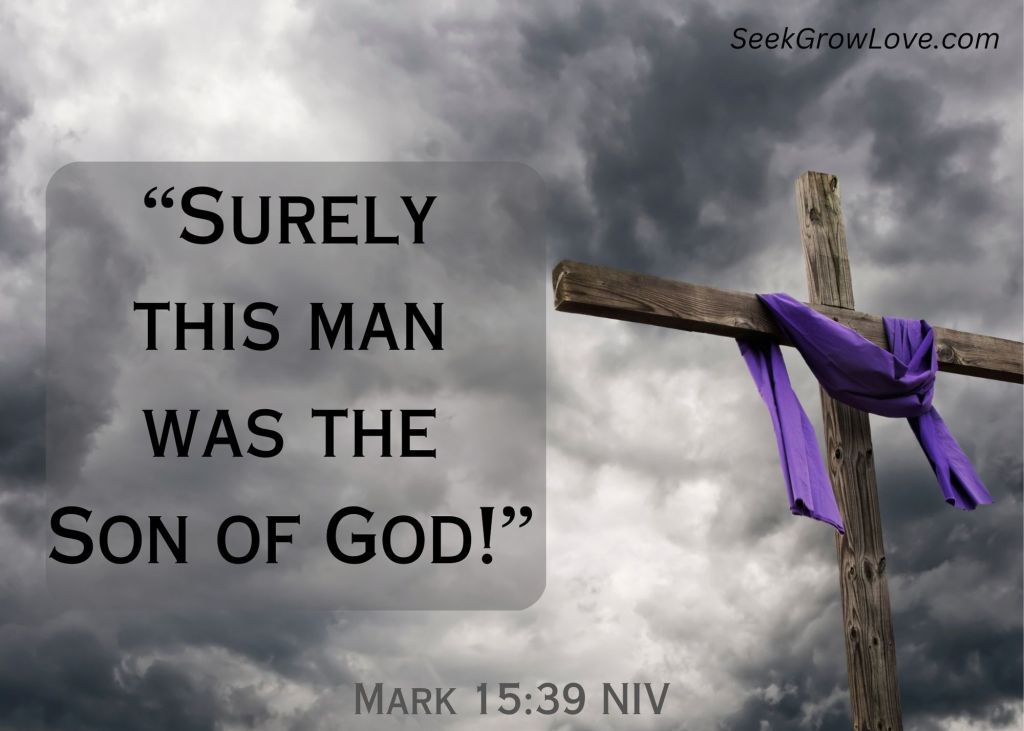
Mark’s account of our Messiah’s death here mentions the centurion standing guard over Jesus. This Roman witnesses something he probably didn’t know much about. Even those raised with the prophecies of the savior didn’t comprehend what was happening. But this Roman soldier sees all that happened during Jesus’ death and he says, “Surely this man was the Son of God!”

I wonder what he did with that information. I wonder what you will do with it. 

Upon Jesus’ death, the heavy curtain separating God’s presence from the rest of the world was torn in two. You are no longer separated from our heavenly father. Christ is now your way to Him. And Christ was the only sacrifice significant enough to truly allow salvation. 

It’s Saturday. Barabbas is guilty but free. The centurion is ignorant of God’s plan but knows exactly who Jesus is. And Jesus is innocent but dead. 

Where are you this day? The way to God is now open. You are free. You know who Jesus Christ is. And better still, you know what happens next. So what will you do with this information?

Take some time with me today to prepare yourself by opening your heart and accepting the gift that has been given. Ask yourself:

How am I like Barrabas? I’m living today, and can be free from my sin, but am I behaving like someone who has been given another chance? 

How can I better know Jesus Christ, the Son of God? Am I spending enough time in Scripture? 

My way to God is clear, but am I seeking Him? How can I do a better job of recognizing God and acknowledging Him in everything?

Have I truly accepted the gift of salvation? And am I showing that in my words and actions and choices?

My prayer for us today is that we recognize Jesus’ crucifixion for what it was: a sacrifice that was made so that we can live free of sin, so that we could be reunited again with our God. Reflect on this today, and accept the gift that has been given. He’s in the tomb and we are not. Today we remember the sacrifice. Tomorrow we celebrate!

Jenn Haynes

(Editor’s Note: Jenn has done a great job this week preparing us for a celebration of the Resurrection! If you haven’t yet had a chance to attend or view a Good Friday service of reflection you might also find benefit in that. Here is a link to one that 3 churches in northern Indiana did last night which was set up as a memorial Celebration of Life service after the death of Jesus.)
Preparing Your Conscience: Seeking Forgiveness

*Theme Week – Jesus: Matthew 27

Old Testament: Joshua 3 & 4

Psalms Reading: Psalm 96

Let’s face it. We’ve all done things we have felt guilt over. Accepting responsibility for our actions is one of the most difficult lessons to learn. 

We see in this account of Jesus’ arrest and subsequent torture and death a few different takes on acknowledging wrong done and accepting, or denying, blame. 

Judas’ guilt is overwhelming. So much so, that he no longer knows how he can go on living. We don’t know what Judas said to God in his final moments or whether he sought forgiveness. But rather than trying to find repentance in living a Godly life, he decides to take his own. 

The Jewish leaders who paid Judas to betray his rabbi and Christ acknowledged that the money Judas returned to them was blood money. If that isn’t a confession of some form of guilt, I’m not sure what is. And yet they, too, choose not to repent. Instead they continue on with their mission. 

Pilate, warned by his wife, knows that the man before him is not guilty of any crime worthy of death. He gives the people several outs, including offering over a known, terrible criminal. But rather than stand up to the crowd, he proclaims himself guiltless and allows them to take away to torture and kill a man he knows is innocent. 

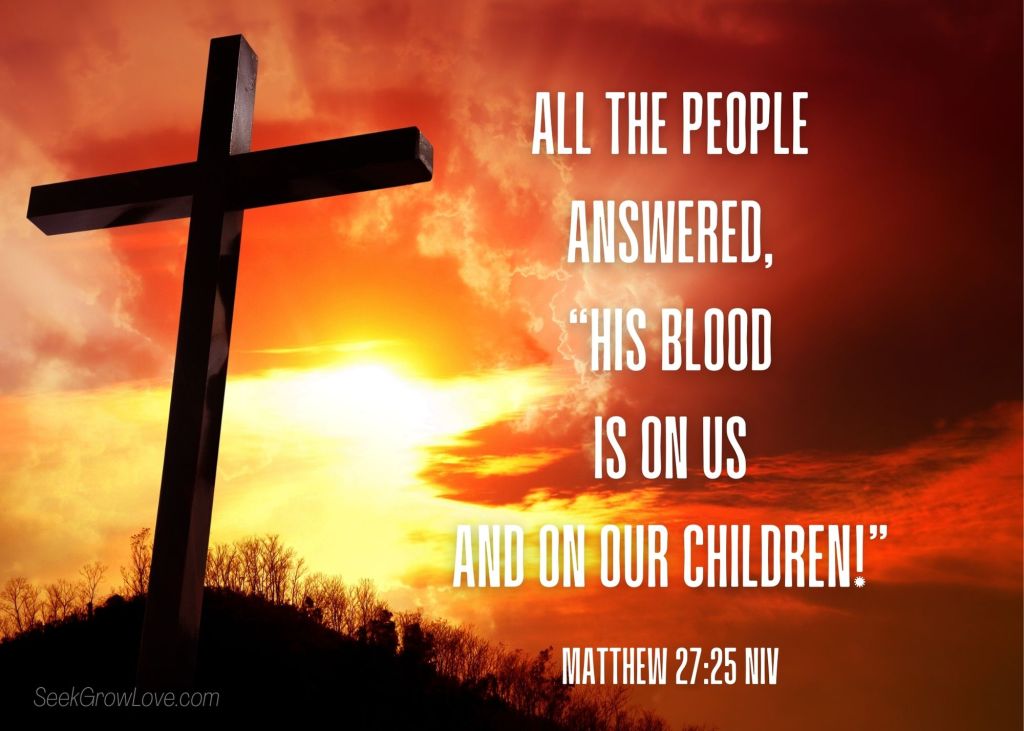
And the Jewish crowd. This one hurts me most of all, because in true mob mentality, they flippantly ignore their consciences, ignore God’s presence, and accept all guilt of Jesus’ death. And they do it without second thought, it seems. They accept the blame not only on themselves, but on their children as well! 

Our savior stood before all these people, blameless and betrayed, and said not a word of condemnation or defense. How many sins have we committed that have been laid upon his shoulders? 

Isaiah 53:6-8 says: 

We all, like sheep, have gone astray,
    each of us has turned to our own way;
and the Lord has laid on him
    the iniquity of us all.

He was oppressed and afflicted,
    yet he did not open his mouth;
he was led like a lamb to the slaughter,
    and as a sheep before its shearers is silent,
    so he did not open his mouth.

By oppression and judgment he was taken away.
    Yet who of his generation protested?
For he was cut off from the land of the living;
    for the transgression of my people he was punished.

For our transgressions, to take care of our guilt, he was punished and died. 

Today is Good Friday, the day we remember Christ’s sacrifice. Take some time with me today to prepare yourself by seeking forgiveness. Ask yourself:

What sins have I committed that I have laid on my Messiah’s shoulders? There are so many, but which have I not sought forgiveness for? 

Are there sins that I’m not sure how to handle, and that seem hopeless, like Judas’? How can I turn them over?

Are there sins that I’m choosing to ignore, like the Jewish leaders? How can I repent and turn the other way?

Are there sins that I could avoid or turn a blind eye to like Pilate? How can I call them out for what they are and act against them?

Are there sins that I’m willingly accepting blame for but I’m determining them inconsequential so I can continue doing them like the angry mob? How can I fully realize and accept how they are affecting my life in a negative way?

I pray that today as you meditate with me and observe Jesus’ sacrifice for all our sins, we are able to call out our sins for what they are and spend time with God seeking forgiveness and redemption. His son suffered and died for us, to cleanse us of those sins. Today is a day for reflection and repentance, so please take the opportunity for it. 

We mourn the suffering of our savior today and the fact that we, and our sins, are the cause of it. But because our God is good, we know that our sin and that cross are not the end of the story. 

Jenn Haynes

Preparing Your Mind: Recognizing Priorities

*Theme Week – Jesus: Luke 23

Old Testament Reading: Joshua 1 & 2

Psalms Reading: Psalm 95

The next few days of readings will be centered around Jesus’s crucifixion. Luke’s account tells us of the interaction that Jesus had with the thieves on the crosses next to Christ, which is what I’m focusing my attention on today. 

Jesus has been arrested and has appeared before Pilate, the highest Roman official in the area, and been found guilty of nothing more than inciting a spiritual revolution. Yet he was punished and tortured and hung up on a cross with criminals to die an agonizing death. 

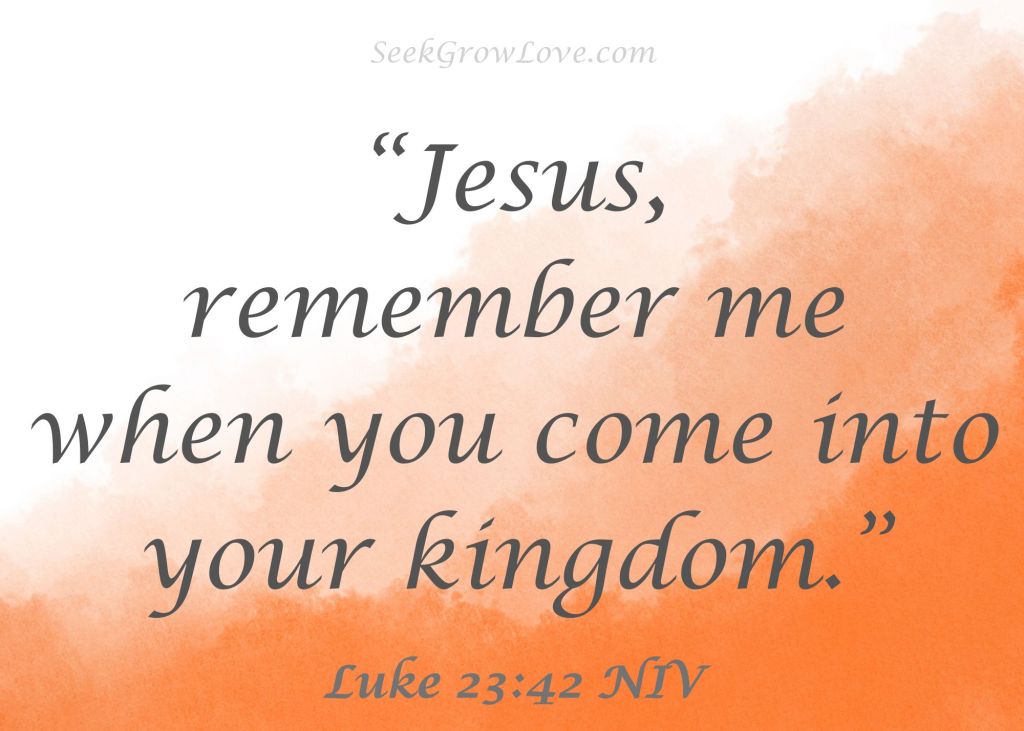
The criminals were guilty. They knew that they were being punished for wrongs they had committed. Still one mocked Jesus, telling him to save himself and them. The other, however, knows that he has sinned. He knows that he deserves punishment and that Jesus does not. And rather than asking Jesus to remove him from the cross and death, he has his focus on something far more important. He asked Jesus to remember him when he comes into his kingdom. 

How remarkable. Honestly, when I’m in trouble I’m not thinking of whether or not I deserve that trouble. I’m not focused on what is ultimately important. I should be acknowledging that I’ve done wrong and that I likely deserve whatever mess I’m in. I should acknowledge that whatever battle I’m in the midst of, I can continue to fight because God has already won the war. Instead, I’m just looking for God to rescue me from my current situation. I’m looking for an easy way out. I have lost sight of the end game, which is an everlasting kingdom that can be had by accepting the gift of grace offered to us when Jesus was punished and killed for our transgressions. 

The thief had his priorities straight, and Jesus acknowledged it by promising him a place in his everlasting Kingdom. How beautiful. 

Take some time with me today to prepare yourself by realigning your priorities. Ask yourself: 

When I am struggling, is my focus on myself or on God’s plan? 

Have I accepted the free (for me) gift of salvation, or am I still trying to earn my way into God’s kingdom? 

Have I truly acknowledged and accepted that no matter what I have done or said to redeem myself, I cannot?

How can I better reflect my joy and gratitude for this gift of eternal life? How can I express it to others so that they can accept it as well? 

My prayer for you and myself today is that we each accept with a humble heart the gift of salvation, acknowledging that it is only by grace that we are saved. I pray that we accept that grace with extreme joy, because it is truly something to celebrate. I pray that our priorities are not focused on anything in this world, but on God’s coming kingdom. 

Jenn Haynes

Preparing with Your Actions

* Theme Week – Jesus: Mark 14

Old Testament: Joshua Intro below

Psalms Reading: Psalm 94

This entire chapter is full of various preparations for the crucifixion of our Savior. 

It starts with a simple act of pure love and devotion. Jesus was in Bethany, eating with Lazarus and his sisters. And after this meal, a woman (John’s account tells us that it was Lazarus’ sister Mary) comes in with an expensive alabaster jar of fragrant oil and anoints Jesus. She has brought Jesus only the best and has complete disregard for its monetary value. Jesus tells us that what she is actually doing is anointing him for his burial. She isn’t giving to Christ for her sake, or out of guilt or in a rush of emotion. She prepared an offering of the best of what she had and gave. Jesus says that “She did what she could,” and she did it without direction or suggestion. She thought and found a way to serve her Lord and Savior whom she loved. 

In a different act of preparation we see the disciples taking direction from Jesus to go and prepare the passover meal. Jesus gives them all the direction they need, and when they follow those directions all is provided for them. They were given a mission, and all they had to do was follow – the means to complete it was supplied. 

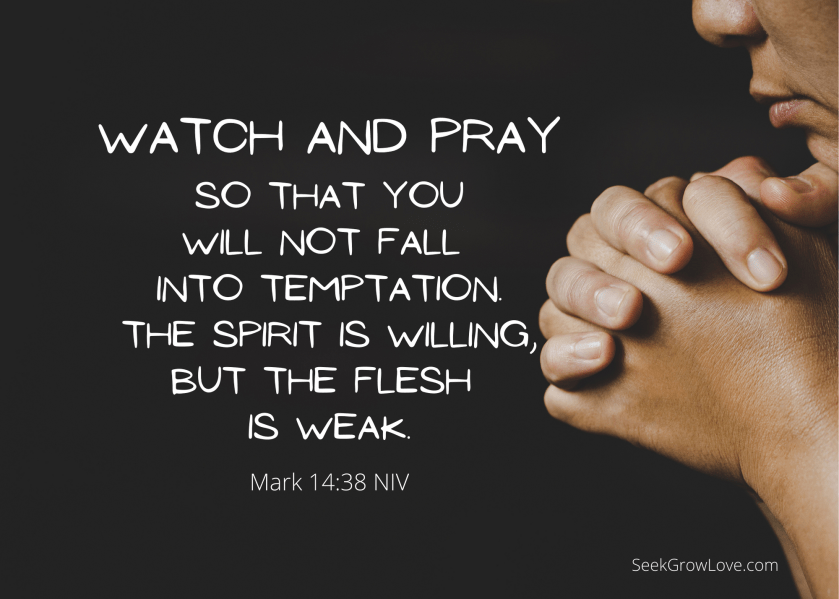
And yet after the supper, when Christ asked a few of them to go with him and help him prepare for his coming death through prayer and fellowship, they couldn’t follow through. They fell asleep time and again. They fell short three times. Three times he checked on them, and reminded Peter to pray because the flesh is weak. Three times he came back and woke them and asked them to stay watchful and pray. Three times they proved themselves weak. Just as Peter would deny him three times. 

Take some time to prepare yourself with me by examining your actions and intentions today. Ask yourself: 

What can I do to show my love and appreciation for my savior? Am I too concerned with how others see my devotion to Jesus? How can I show my devotion as purely as Mary did?

When I’m given a task by God, do I follow through? Do I have faith that he will provide for my needs and give me a way to complete any task he gives me? 

My spirit is willing and like Peter I refuse to believe that I could ever deny or disobey my savior. But is my flesh weak? In what areas of my life am I sleeping rather than remaining watchful?

My prayer for you today is that you are able to look over your life and the decisions you’re making and analyze your motives and intentions. Take stock of how you are serving. Are you able to serve in faith and without worrying about whether or not you’ll be given what you need? Are you able to serve with the purest of intentions? I pray that you find a way to serve and follow and do it in a way that is pure and devoted. 

Jenn Haynes

Having finished Deuteronomy yesterday in our Old Testament reading, here is our introduction to the book of Joshua which we will begin reading tomorrow.

Joshua Introduction

The book of Joshua details the time from immediately following Moses’ death through the conquest of the land of Canaan.  We’re not told, but it is likely that Joshua himself wrote most of the book, since it sounds like a first-hand account of the events that happened and were recorded at the time.  At least the end of the book that records Joshua’s death had to have been written by someone else.

This book details the fulfillment of God’s promise to Abraham that his descendants would be slaves in Egypt, but afterward would return to the promised land – the land of Canaan.  A promise God repeated to Moses.  We see this from the very beginning of the book, where in Joshua 1:2-3, God told Joshua, “Moses my servant is dead.  Now then, you and all these people, get ready to cross the Jordan River into the land I am about to give them – to the Israelites.  I will give you every place where you set your foot, as I promised Moses.”

The first 12 chapters detail the miraculous crossing of the Jordan River, the battle of Jericho, the sun standing still over Gibeon for about a whole day during the battle with the Amorites, and the conquest of all of the land of Canaan.  Chapters 13-22 discuss the division of the land among the tribes of Israel.  Chapters 23-24 close with a challenge to worship God alone.

Some well-known verses in Joshua include:

Joshua 1:7-8, “Be strong and very courageous.  Be careful to obey all the law my servant Moses gave you; do not turn from it to the right or to the left, that you may be successful wherever you go.  Do not let this Book of the Law depart from your mouth; meditate on it day and night, so that you may be careful to do everything written in it.  Then you will be prosperous and successful.”

Joshua 23:14, “…You know with all your heart and soul that not one of all the good promises the Lord your God gave you has failed.  Every promise has been fulfilled; not one has failed.”

Joshua 24:14, “But if serving the Lord seems undesirable to you, then choose for yourselves this day whom you will serve, whether the gods your forefathers served beyond the River, or the gods of the Amorites in whose land you are living. But as for me and my house, we will serve the Lord.”

This is an exciting book.  As you read it, consider the blessing and successes of Joshua, who faithfully followed God, contrasted with the punishment of people like Achan for disobedience.

Interestingly, the Hebrew name Joshua is the same as the new testament name Jesus.

-Steve Mattison

Preparing with Prayer

*Theme Week – Jesus: John 17

Old Testament Reading: Deuteronomy 33 & 34

Psalms Reading: Psalm 93

This prayer. Oh if only we all prayed like this. 

Jesus has been speaking with his disciples, trying to impart some final wisdom and direction before his death, leaving them with words of comfort for the trying days ahead that they can’t even comprehend yet. And then he follows that by praying with them and over them. 

He starts off his prayer by glorifying God and asking that God be glorified through him. He’s requesting that everything he’s about to say and do be done for God’s glory, for his plan that he had from the very beginning of the world. From the very start of our existence God planned for his son to save us all. And Christ is recognizing that here, acknowledging that God’s plan and God’s glory come first. 

Then he prays over his disciples, his closest of friends and followers. He has been pouring into them all that God has given him, and he’s praying that it all takes root, that his disciples take the message of salvation and spread it everywhere. He’s praying out his hopes for them, his love for them, his joy in them. How beautiful to see his love and passion for the people God has placed into his care and for his purpose. He prays not that they have it easy, not that they will live perfect lives, but that God will protect them so that they can do his good and perfect will. He prays they are in the world but protected, different from society and so like Christ. 

And then, my favorite part. He prays for us! Jesus Christ prayed for each of us. He prayed for all believers, all those that would hear the message of salvation. He prayed that we, as believers, would be unified. 

This is beautiful and also a little disheartening when I read it. Because I see how little we are unified sometimes. I see how we lose focus. Jesus spent this entire prayer to God focused on God’s plan and God’s glory. He wanted us to be unified in that. But how unified are we? Churches and Christians are so frequently distracted by the little arguments, the differences of opinions, that we lose sight of what Jesus’s greatest hope for us was. He wanted us to be unified in our faith, actively working to show God to others. 

Personal confession time. I have some major personal issues with some people in my church. Some bitterness. Some anger. Some hurt. And I asked myself a few months ago how I was supposed to keep dealing with these people over and over again if all they were going to do was insult me and hurt me? And one Sunday morning, before I was supposed to be leading others before God in worship and adoration, I asked God. “How do I do this? I’m so tired of coming into church Sunday after Sunday and feeling like this. What should I do?” And I had the very clear image of Jesus smiling and welcoming Judas into his disciples. He walked and talked and worshiped and interacted with that man for months. And I thought, “Did he know? He knew he would be betrayed, but had God revealed to him who it would be even from first meeting? And if he knew, how did he do it!?”

 But if Jesus could love Judas and interact with him on a near-daily basis, then I could love this person who angers and hurts me so. 

Don’t get me wrong. I’m still bitter, probably more often than I should be. But it’s something I’m dealing with and learning to set aside. Usually. It’s going to take more prayer I think. But maybe you have something in your life, or someone, that is keeping you from being unified with your fellow believers as well. 

Take some time today and prepare yourself in prayer with me. Ask yourself: 

What kind of prayer life do I have? Do I have a healthy practice of placing everything before God?

Am I putting God’s plan first in my prayers and in my actions? 

How can I better pray for those around me? For the message of salvation to be spread through me?

Am I so focused on the tiny disagreements that I have with other believers that I lose sight of how I should be working alongside them? 

What should be my specific prayer to God that would help unite me in his great purpose with other members of our church body? 

My prayer for you today is that you spend time deep in prayer with God. Be specific. Analyze your heart and align your plans with God’s plan so that you can better show God’s love and glory to others. Pray that God’s plan be first. Pray over your family and friends that they show his glory and put God’s plan first. And pray over other believers, that they all be unified in spreading the gospel message of salvation to all nations. 

Jenn Haynes

Preparing our Attitude

*Theme WEek – Jesus: John 13

Old Testament Reading: Deuteronomy 31 & 32

Psalms Reading: Psalm 92

I used to read the Gospels and try and compare myself with various characters. And I never wanted to see myself in Peter, and yet here we are. I never wanted to compare myself to the man who seemed to so frequently fly off the handle or get things wrong. I didn’t want to be like the one who sunk in the waves and denied his Christ three times in one night. But I most definitely feel a kinship with him, especially when I read this passage. 

Poor Peter. His Rabbi, who he has been so close to and loved so much, is humbling himself to wash Peter’s feet and he’s clearly mortified. This was something only the lowliest of servants did. And here was Christ, washing his feet, when none of his disciples had thought to do the same for him. And then when Christ says his disciple can’t be clean unless his feet are washed, he insists Christ wash his hands and head as well. He’s so desperate and proud that it’s a little heartbreaking. Because he has it all wrong. 

Jesus is about to die. He’s about to suffer and die for each of them, and for each of us. And they all have to humble themselves enough to accept that sacrifice. They cannot save themselves. They cannot fully cleanse themselves. Only by accepting Christ and his act of servitude for us can we be clean. 

And not only that, but we have to follow Christ’s example and humble ourselves to serve others. We are not too good to be served, and we are not too good to serve either. 

Peter is fighting this internal battle with himself. He wants to serve Christ, but can’t accept with grace the gift of service that has been given to him. He wants to serve Christ, but perhaps not humble himself so low to serve others in this manner as well. 

Jesus loved his followers dearly. In the beginning of the passage it says that he loved them to the end. This means he loved them to the fullest of capacity and without end. And here he has poured out every bit of himself into complete humility and served them in the basest of ways. 

Our savior did that for us when he was tortured and crucified. This is the attitude of love and service we should have for others. 

Take some time today and prepare your attitude with me. Ask yourself: 

Have I truly acknowledged the deep, humbling act of service that Jesus has done for me? 

In what areas of my life am I still too proud? 

Am I focusing too much on the fact that my feet climbed out of the boat and walked on water, rather than the fact that my feet also sank beneath the waves and I had to be pulled out? 

How can I serve someone else in humility as well this week? 

Am I showing others a deep love and a servant’s heart? 

My prayer for each of us today is that we truly and fully recognize the gift that has been given to us and accept it with full humility, acknowledging our great need for it. I also pray that as we acknowledge our need for salvation and cleansing, we turn and offer grace and service to others as well, so that they can see Christ serving in us. 

Jenn Haynes

Preparing the Path: Allowing him Entrance

*Theme Week – Jesus: Matthew 21

Old Testament Reading: Deuteronomy 29 & 30

Psalms Reading: Psalm 91

I love celebrating. Who doesn’t!? But my two favorite holidays are Christmas and Easter, and honestly the time leading up to those celebrations is as precious to me as the holidays themselves. The Advent of Christmas is all about preparing for the birth of the Messiah and the remembrance of that birth. And the only thing better than the birth of our Messiah, in my opinion, was his resurrection from death. This week we’ll be looking at Scriptures in the Gospels that tell the story of Christ and his followers and their days leading up to Christ’s resurrection. 

And as we read along, we can prepare together for this special celebration. 

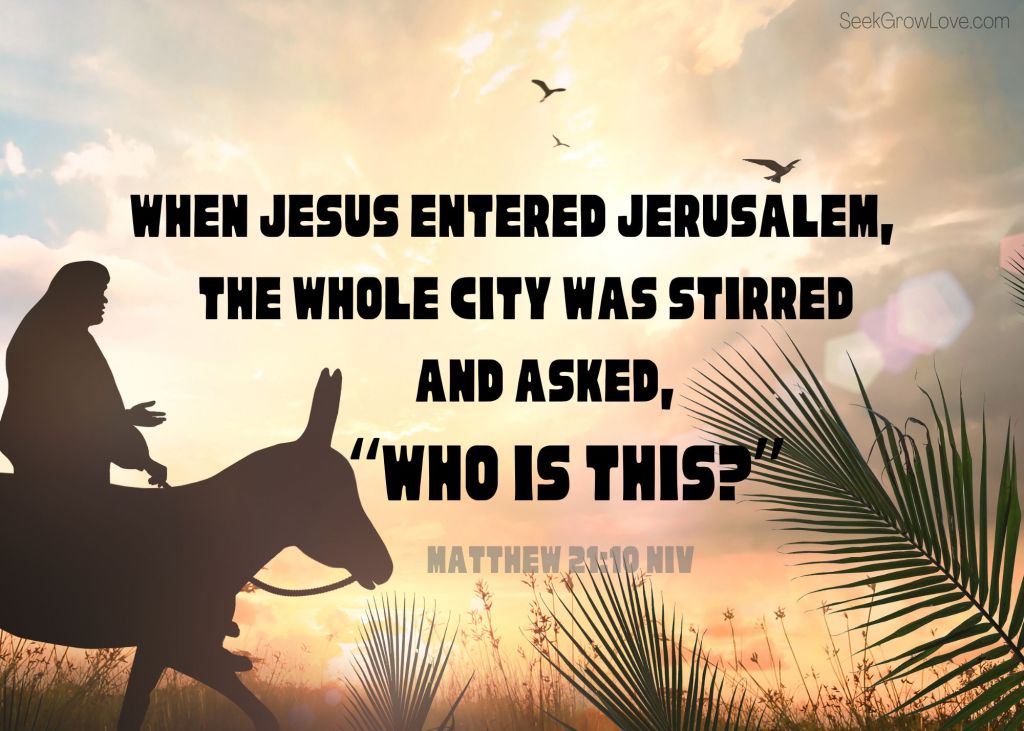
Our first passage is Matthew 21. We see Christ and his disciples returning to Jerusalem. It’s packed with those who have traveled there to worship and partake in Passover, and Jesus is coming in on a colt that has never been ridden, fulfilling prophecy. And the people are celebrating! They are preparing the way for him, throwing cloaks and garments and palm branches down to create a path. Can you imagine being there? It’s packed with people and you are taking off your cloak and throwing it on the ground so donkeys can walk over them. It sounds so strange yet this was a sign of amazing respect and admiration. They were singing praises for this man who was entering in such a public, and yet very humble, fashion. 

And the first thing Jesus does is ride right up to the temple and enter God’s Holy Place. And what does he find there? A market. A “den of robbers.” Have you ever been to a public, open air market? It’s loud. People are yelling to advertise, chattering, bargaining. It’s overwhelming and busy, full of animal noises and feces. This is what they have made out of God’s house. How can anyone come in prayer and worship and reverence in such a place? And Jesus cleans up in another very public display. 

I love this entry. It’s full of this contrast of humility and power. It’s full of passion, from both the crowds as well as Jesus. And it’s such a perfect reflection of how I want to see Jesus coming into my life this week. 

Take some time today and prepare yourself with me. Ask yourself: 

How can I prepare my life and clear a path for Christ to enter into it this week? 

What do I need to lay before him to honor him? My time? My focus? My attention? 

How can I celebrate and praise him this week? 

What, like that noisy marketplace in the temple, is creating noise and distraction in my life and in my mind? 

What is dirtying up my faith and my prayer life? What do I need to oust and overturn? 

My hope and prayer for you today is that Jesus enters your life in spectacular fashion and causes a stir in your heart just as he caused a stir in Jerusalem so long ago. Happy Palm Sunday! 

Jenn Haynes

Reflection Questions

  1. Take some time with the questions in today’s devotion.
  2. Throughout the week continue reading the Scriptures asking yourself, “Who is this Jesus?” and what is he teaching us about himself, his purpose and his Father?

What Will You Carry?

Old Testament Reading: Deuteronomy 27 & 28

Psalms Reading: Psalm 90

*New Testament Reading: Galatians 6

In the beginning of this chapter, it seems Paul is almost contradicting himself, telling believers to carry one another’s burdens (v.2) but also to carry their own load (v.5 -HCSB).  When comparing translations, the NLT changes verse 5 to each being ‘responsible for their own conduct’, which really removes the discrepancy, especially when in context with the previous verse about focusing on oneself and not comparing.  Essentially Paul is writing: support other believers while doing your best and be responsible for your own behaviors. 

Paul is also sure to caution and encourage these believers; he reminds them that satisfying their sinful nature now will ultimately lead to death, but that living to please God will result in everlasting life (v.8).   In verse 1 he describes humbly and gently bringing believers from that sinful life back on the right path – and this of course makes sense when you know that the wrong path leads to death!  And Paul must know that living in this way will be challenging at times, as he immediately follows it with words of encouragement to not get tired of doing good, and a reminder of the blessing to be reaped to those who don’t give up (v.9).  But my favorite part is verse 10, where Paul says THEREFORE, do good to everyone, especially those in the family of faith!  Because living the life of a Christian is tiring at times, because it is challenging, and because there are temptations to give up, BE KIND TO ONE ANOTHER.  

As fellow believers we know how hard it is to be a Christian, so it is up to us to share one another’s burdens, not create more obstacles and hardships through shallow competition of who “looks better” in the law.  Paul is telling the Galatians that their responsibility in the church is to support and build one another up, not comparing themselves, but working together to live a life that is called to be more than just following a law. 

You are part of a church, and, if you have made the commitment to be baptized and follow Christ, you are part of the Church!  You have a responsibility to fellowship, to support, to love and to live alongside your body of believers.  In today’s day of technology, you can meet this responsibility through online connections or in person.  There are church services you can stream, summer camps you can attend, online devotionals you can participate in… If you have not yet taken up that responsibility, this is your sign… get connected, because life is hard to do on your own! 

Questions:

Where do you feel connected in the church?  Are you satisfied with this level of connection?

Who in your church can you think of that may need their burdens shared?  Reach out to them!

Based on Paul’s writing today, what does his message tell you about who God is and what His expectations are for believers?

Prayer:

God, thank you for giving us a Church to be part of.  Today we pray that we find strength and support within our local body of believers, and we ask that you show us which believers are in need of a lighter load to bear on their own.  Thank you for making us new through your son, and allowing us the opportunity to reap a harvest of blessings.  In your son’s name, Amen.

Sarah Johnson

Freedom

Old Testament Reading: Deuteronomy 25 & 26

Psalms Reading: Psalm 89

*New Testament Reading: Galatians 5

What does freedom look like to you?  You may visualize prisoners being set free from their jail sentence, dogs off of broken chains, large, open spaces outdoors, maybe even a child who snuck away from the crowd and is exploring their world all on their own (while parents panic…).   

Paul is describing here in Galatians freedom from living life following a strict law.  In our passage in Deuteronomy, we read about some of the punishments (flogging, losing credibility with the whole nation, having a hand cut off…) for not following the laws, or accidentally breaking them.  With that in mind, this makes the concept of freedom that Paul is reminding people of that much more dramatic.  Before Jesus, the only way to be right with God was to follow these strict laws, it was only meant for a certain group of individuals set apart from the rest, and it was nearly impossible to achieve as an outsider, let alone someone born and raised as a Jew. 

In verse 13 Paul tells the Galatians they have been called to be free.  Imagine being told your whole life that there is nothing more for you, and suddenly having hope and opportunity through a man that loved enough to die for strangers.  This concept would be (and still is) life-altering!  Paul is reminding the people of this church that they have freedom, they are no longer bound by the previous laws that kept them from God! 

In this reminder Paul also cautions them to be wise in their freedom, and to use this freedom to serve one another.  It is crazy to see the statistics on the number of children that grow up in a Christian household, maybe isolated or sheltered, and go to college and drastically change their lifestyles by going overboard with poor life choices with their newfound ‘freedom’.  That is our human nature!  And that same mentality must have existed with the Galatians as Paul warns them to not use this freedom or this gift of grace to indulge in the flesh, but rather to serve one another humbly in love (v.13). 

Our freedom was bought with a price, and yet we are not in debt.  We no longer have to live under a strict law, rather, we can keep the entire law by loving our neighbor as ourselves (v.14).  And while our freedom could create opportunity for sin, we are told that we walk by the Spirit to avoid desires of the flesh(v.16) and that through that Spirit we can experience the good fruit such as love, joy, and peace (v.22).  Knowing all that, it’s hard to imagine freedom any other way besides the cross.

Questions:

What does “walking by the Spirit” look like to you?  Do you see the fruits of the Spirit come from that walk?

How do you use your freedom?  Do you meet the commands of loving your neighbors?

Paul writes in verse 6 “the only thing that counts is faith expressing itself through love” (rather than appearance of ‘righteousness’ through circumcision).  How do you express your faith?

Prayer:

Lord, thank you for the freedom you give us through Christ.  Thank you for his sacrifice that paid our debt and moved us out from under the strict law.  God, we pray that we would walk by your Spirit each day, that our faith would be expressed in our love, and that we would experience those good fruits.  Amen. 

-Sarah (Blanchard) Johnson

Life is Hard

Old Testament Reading: Deuteronomy 23 & 24

Psalms Reading: Psalm 88

New Testament Reading: Galatians 4

Life is hard.  There are terrible things that all people, even Christians, experience simply because we live in a fallen and sinful world.  Some of the hard things people experience are because of their own poor choices, others are because of someone else’s poor choices, and still others are simply things that cannot be controlled.  Financial stress comes to those who are unwise with their money, car accidents happen when people are paying attention to their phone instead of the road, sickness such as cancer can occur in the healthiest and best people.  Life is hard.

This Psalm (88) is written by Heman the Ezrahite, and unlike most other laments in Psalms, it doesn’t end on a positive, hopeful, note.  Instead, it concludes with darkness.  This psalmist equates his life’s troubles to nearing Sheol (v.3).  He feels weak, overwhelmed, desperate, rejected, and lonely.  Heman writes that his eyes are worn out from crying out all day long (v.9). 

If you’re like me, you may be wondering why in the world this Psalm is included in Scripture… it offers no hope and seemingly no connection to an amazing God.  Why would this be allowed in the Bible??  Doesn’t it turn others off our faith to have someone just writing about how hard life is, even after worshiping God?  How does this chapter bring me anything for my faith walk if it’s just about sadness?

Well, despite being credited as one of the saddest psalms, after some prayerful consideration I also see how important this psalm can be.  Throughout the psalm Heman writes about coming to God, crying out to Him, raising his hands to the Lord, and continually praying (vv.1, 9, 13).  It seems that even with his world crashing down around him and when he feels like he is drowning, his first reaction is to reach out to God.  What an example of faithful living!  

The life of a Christian is never stated to be easy.   In fact, there are times in everyone’s life that I would expect them to be in a similar place as Heman was when writing this psalm.  Overwhelmed, exhausted, alone, in the dark.  If God ‘allowed’ this psalm to be part of his God-breathed Scriptures, then we have to believe it holds value for our lives.  There must be value in the pain and hardship that Heman describes, and the pain we still go through in the modern day.  The lesson we can take away from Heman’s writing is that in all the pain, we can always come to God.  Whether it’s through prayer or simply crying out, God is there to hear us no matter where we are in our life. 

Questions:

Heman wrote this psalm long before Christ came around.  While he had hope of a coming Savior, our hope resides in a Savior who came, and is coming again.  How does this change our laments or prayers to God?

Balancing hopeful positivity and the real difficulty of life is truly an art.  How does what we know about God impact this balance in your life?

What did God reveal to you about his character in this passage?

Prayer:

Lord, we live in a broken, sinful world.  This life is hard.  Today we pray for you to comfort those who are struggling, to give strength and hope to those who need it.  But we also pray that no matter what life circumstances they are in, they ultimately know that they can go to you in any form.  God, thank you for the hope we have in Christ Jesus.  We are excited for your Kingdom to be brought to earth where there will be no more suffering.  We longingly look to that day.  Amen.

-Sarah (Blanchard) Johnson