When God says Go

When God Says Stop

Acts 9

April 27

Acts 9:17 – Then Ananias went to the house and entered it. Placing his hands on Saul, he said, “Brother Saul, the Lord – Jesus, who appeared to you on the road as you were coming here – has sent me so that you may see again and be filled with the Holy Spirit.”

A few days ago, I shared thoughts on becoming sensitive to the Holy Spirit, instead of clinging tight to traditions of the Law.

And yesterday, I shared my thoughts on evangelizing. 

In Acts chapter nine we have an example of a new believer being asked to do what some might describe as a dangerous mission – go visit the Jewish leader who is known to breath out murderous threats against followers of Jesus. 

May I be honest? If I had been Ananias, I would have been second guessing this new gospel message and all that God was asking me to do. I may have even been tempted to just flat out disobey and tell God “no”. 

Thank goodness Ananias chose to believe God and responded in obedience. Thank goodness Ananias trusted in God’s faithfulness, even when it didn’t make any sense. Thank goodness Ananias is an example we can turn to when we are also asked to do things that take us way out of our comfort zone. 

Ananias is called a disciple – so it’s not too much of a stretch to think that he was a devoted man of prayer and scripture study. Ananias was most likely in a spiritual posture to notice when the Lord was speaking to him. He wasn’t so wrapped up in his daily routines that he didn’t know when the Lord called to him in a vision. 

On the other hand, Saul, one who was devoted to the Law, had to be struck with blindness in order for the Lord to get his attention. 

The dichotomy of how the Lord spoke to these two men is striking, but both were startling. One was approached in a vision, the other lost his vision. One was told “go”, the other was told “stop”. One had to overcome doubt and act in faith, the other had to be humbled and overcome pride. 

This story of Saul’s conversion and Ananias’ part in it, shows us that God will use whatever method necessary to get us to stop and listen in order to make an impact for His Kingdom. 

-Bethany Ligon

Questions for Reflection and Discussion

  1. Have you ever done something for God that was a reach out of your comfort zone? What was the result? Would you do it again? Would you do something even more daring – for God?
  2. When was a time God probably wanted you to GO? When was a time God probably wanted you to STOP? Ask God if He is currently calling you to GO or to STOP. Then do it.
Scatter and Preach It

Acts 8

April 26

Acts 8:4 – Those who had been scattered preached the word wherever they went.

I once went on a mission trip that included an evening of street evangelism. It was one of the most overwhelming and intimidating experiences I’ve had. For some people, walking up to strangers and asking them “How’s your relationship with God?” is exciting and effortless. For me, it was incredibly awkward – I stumbled over my words, I felt panicked and I just wanted to run back to our bus. 

As I read through Acts chapter eight, verse four caught my attention. My imagination runs wild with scenes of the disciples speaking with random people at the market, or attending a synagogue to share the radical gospel of Jesus Christ, or even standing at the center of the town square and preaching to anyone and everyone who passes by. 

I don’t think that I would employ similar evangelism tactics as the disciples did back in the day or even as some continue today in our modern culture. 

For me, it’s about building authentic relationships with others. Getting to know others and letting others get to know me. And while this is much more in my zone of comfort, I still sometimes get hung up on how much I share with others about my faith. I greatly admire people who seamlessly weave the gospel into their daily conversations with others. It’s an area of growth for me, I know. But if I genuinely care about others, I must get over my own insecurities in order to share the best news of all – the gospel of Jesus Christ and the kingdom of God! 

We have been scattered into the workplace, schools, community organizations, as well as our online associations with others for a purpose. Let’s not waste the opportunity to preach the word wherever we are!

-Bethany Ligon

Questions for Reflection and Discussion

  1. Why share the gospel? Is that just a preacher’s job?
  2. How would you rate yourself when it comes to how often or how well you share the gospel? If you want to improve in this area, what 2-3 specific steps can you take?
  3. Consider your circles (work, school, family, church, community & online). How can you share God’s love, what Jesus means to you and your kingdom hope in each of these circles?

Stiff-Necked Stubborn People

Acts 7

April 25

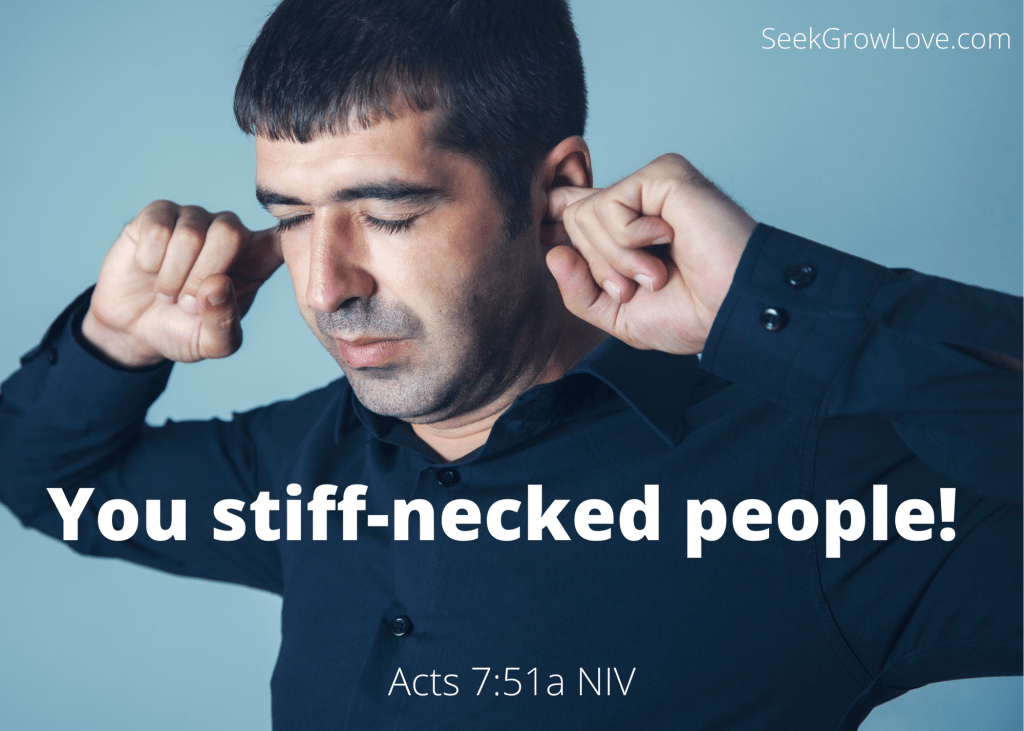
Acts 7:51 – You stiff-necked people, with uncircumcised hearts and ears! You are just like your fathers: You always resist the Holy Spirit! (NIV)

Stiff-necked…bull-headed…stubborn…headstrong…obstinate…when we use these kinds of words to describe someone’s mindset, it’s never a compliment. 

For a brief moment, let’s put ourselves in the sandals of the Jewish leaders that Stephen is speaking to in Acts 7. They had the strongest of convictions. They truly believed that what they stood for, what they expected others to conform to, was to follow the Law given to Moses, rather than to submit to the teachings of Jesus. 

As believers we are also called to hold fast. To stand firm. To believe and not doubt. So what’s the problem?

The Jewish leaders were putting their faith in a system, rather than the Spirit of God. They believed that by following all the rules set forth in the Law, that they would be saved. Stephen is trying to convince them that instead, they need to submit to the Holy Spirit in order to be saved. 

Changing the way that you think about something, especially about a conviction you have, is not easy to do. But that’s exactly why we need to rely on God’s power instead of our own wills. The Holy Spirit is a gift given to us to soften our hearts; to transform our minds, to reveal truth. If we can be more committed to being sensitive to the messages God places in our inner beings, than we are dedicated to a system of rules and regulations, we can finally live the lives that God calls us to experience.     

It’s time to put aside your own system of beliefs. The abundant life starts with seeking God with all your heart.

-Bethany Ligon

Questions for Reflection and Discussion

  1. How would you describe the difference between being stubborn and standing firm?
  2. Can you think of a time when your convictions made you stiff-necked, and you missed (or nearly missed) an opportunity to be led by the Holy Spirit? If you can’t think of a specific time, what might it look like?
  3. What do we learn about Stephen in Acts 7? What do we learn about God in Acts 7? How can what we read in this chapter change our mindset and actions this week?

Not Alone

Acts 6

April 24

Helen Keller is quoted as saying, “Alone we can do so little; together we can do so much.”

As I read through Act 6 today, I am reminded that we were never meant to do ministry, serving others, all on our own might. We have been designed to be ministerial alongside others. 

The number of followers of The Way was increasing daily. In fact, the size had reached a critical juncture. 

In ecological terms, it’s referred to as “carrying capacity”. A habitat can only support a certain number of any kind of species depending on the natural resources available. 

Likewise, we read in Acts, that the number of believers was becoming so great, and including a wonderful mixture of cultural backgrounds, that peoples’ needs, specifically widows, were not being met. 

The leadership knew that people had basic physical needs as well as spiritual needs that needed to be provided for. They had to ask themselves, “What’s the best use of our time”? They realized that they could not forsake one for the other.

Once they determined the best course of action, even more people were ministered to, both physically and spiritually.

As we go about the Lord’s business serving others, we need to first ask ourselves, am I attempting to go it alone, or am I willing to work alongside others? The next question to consider is are you serving in a way that not only meets the needs of others, but that will have the greatest impact?

What I am NOT saying is that if a task isn’t one of your spiritual gifts that you can excuse yourself…however, we are informed in multiple passages within the New Testament that we all have a part to play and some individuals are better suited for some areas of ministry over others. 

When everyone is working collaboratively, and doing it in such a way that suits how God has uniquely designed us, we can have an exponential impact on the growth of God’s kingdom. 

How can you serve others, with others, for the Kingdom?

-Bethany Ligon

Questions for Reflection and Discussion

  1. Consider who you do ministry with? Thank them for this partnership.
  2. Do you too often try to go it alone? What is the dangers of working alone? What is the blessing in working with a partner or team?
  3. Are there jobs caring for the physical or spiritual needs in your church or community that aren’t getting done? How can you, with a partner or team, help meet those needs?

From God

Acts 5

April 23

The early church leaders were starting to experience the same persecution that Jesus faced. In Acts 5, we find the “religious” Pharisees objecting to the preaching that was going on, again. Evil men will always try to stop the truth.

The Pharisees wanted to stop the preaching of the truth by killing Christ’s followers. One of the pharisaical leaders had more wisdom than the others in spiritual matters. That Pharisee was Gamaliel, a doctor of the law (Acts 5: 34). Gamaliel stood up and advised the mob of blood-thirsty Pharisees, “… Therefore, in the present case I advise you: Leave these men alone! Let them go! For if their purpose or activity is of human origin, it will fail. 39 But if it is from God, you will not be able to stop these men; you will only find yourselves fighting against God.” (Acts 5:38-39).

What a good point to keep in mind for a Christian. If something is of man, it probably will not last. Often, we have ideas about what we can do for God or even ourselves. We try. We plan. We spend, but the idea does not flourish. The effort is wasted, and the goal never materializes. Often it does not succeed because the effort was not of God, and it flopped. Ministries, relationships, business enterprises, and other endeavors have not succeeded because God was not in them.

However, when God is in the matter, nothing on this Earth can stop it from succeeding. Businesses had thrived when all odds were against them because the founders sought God about the matter and were convinced, He was in it. Ministries, with all the critics prophesying doom and gloom, were baffled when it turned out to be a flourishing outreach because God was in it. Men and women have looked back on long marriages because before dating had even gotten started, they sought God’s will and way for their lives. Even when we look at how the Bible is still around despite men trying to destroy and remove it from existence. Yet here it is in every city and available to everyone. You probably have a couple in your home alone. Amazing!

How few failures and disappointments we would have if we did the wise thing first. Seek God’s direction in all of life’s endeavors. If God is for it, who could possibly stop it?

What would it look like if you preached like the apostles did? Do you believe that God can use your faithfulness? Your willingness to speak the truth even if it meant that you might be ridiculed, mocked. If God is for you who can be against you? Maybe give it a shot this week and see what speaking the truth in love to others might do.

-Andy Cisneros

Questions for Reflection & Discussion

  1. Can you recall an effort you were involved in that flopped because God was not in it? What did you learn from this experience? How will you (or did you) proceed differently next time?
  2. What have the apostles endured so far in Acts? Why? What is their attitude now? (5:41)
  3. What do you do day after day? What are you known for talking about? How does that compare with the apostles in Acts 5:42? Any changes you would like to make (or God would like you to make)?

Living for Christ and Each Other

Acts 4

April 22

After the events of the day of Pentecost, the healing of the lame man, and the great response of multitudes in Jerusalem, the church faced life in the world of that day. A world of darkness, and difficulty. And yet met it with a flowing out of the life of Jesus Christ. This is ideal Christianity, true, genuine Christianity. Unfortunately, there is also a counterfeit Christianity. It came in shortly after this in the early church, and evidence of it will be seen throughout the book of Acts. Wherever the true church has gone throughout the world, counterfeit Christianity has gone right along with it. How can you tell true Christianity from counterfeit?

Counterfeit Christianity can be recognized externally as a kind of religious club where people, largely of the same social status or class, and bound together by a mutual interest in some religious project or program, meet to advance that particular cause. That is part of Christianity and let’s face it every group that gets together. But that is a far cry from all that true Christianity is. True fellowship consists of individuals who share the same divine life, who are made up of all ages, backgrounds, classes, and status-levels of society, and who, when meeting together, regard themselves as what they really are, brothers and sisters in one family. With that mutual background of love and fellowship they manifest the life of Jesus Christ.

That is what we have here. The key idea is community, commonness, everything in common. They were of one heart and mind. Here were people who, by the Holy Spirit, had been united into one life. They were of one heart. At the very deepest level of their lives they belonged to each other, and that is only possible by means of the Holy Spirit. They did not need to have met someone before to recognize that if he or she is a believer they belong to each other, they are of the same family and they always have the most important thing in common. This was true of these people.

Not only did they have it, but it also manifested itself in the fact that everyone had a new attitude toward the material life. This is not a forced distribution of goods. It is not an attempt to make everyone give up their material things and redistribute them to others. No, it is a change of attitude, saying, nothing that I possess is mine, but everything that I possess is God’s, and therefore it is available to anyone who needs it. So here were these early Christians, one in heart and mind and body, united together. That is the church as it ought to be.

-Andy Cisneros

Questions for Reflection and Discussion

  1. Don’t point the finger at others – but look at yourself. How authentic, true and genuine is your Christianity? Are there any areas where you slip into a counterfeit Christianity? What would the fix be?
  2. How will you practice unity of the church body this week? And next week?
  3. What do you “possess” that is God’s? (Hint: it should be a pretty long list – but go for it – no one word answers here.). How can you show that these belong to God and make them available to anyone in need?

To God be the Glory

Acts 3

April 21

At the beginning of Acts 3, we find two disciples (Peter and John) endowed with the Holy Spirit perform a miracle. John and Peter told a lame man (Acts 3:2-8), who had been unable to walk since birth, to get up and walk…and the man did! Unused and weak legs were instantly transformed, and the man was healed. Not only was he able to walk, but his gratefulness could not be contained, and he leaped into the air and praised the LORD. That is why most miracles are performed so that God will get the glory.

Soon, however, the word of the supernatural occurrence got around. According to what Peter said, the crowd gave the two men credit for the healing. Instantly Peter corrected their error, “… When Peter saw this, he said to them: “Fellow Israelites, why does this surprise you? Why do you stare at us as if by our own power or godliness we had made this man walk?”

God is still in the miracle performing business. While we no longer have apostles with us today (those who physically walked with and were taught by Christ) we do have followers of Christ. Righteous men and women who believe God works miracles even today. When God does the impossible, it is always He that should be honored, never a man. The person used to do God’s will is simply that, one that God used.

Unfortunately, the Healer and the Changer of the impossible often gets forgotten. God seldom gets the glory for doing the incredible. People pray for healing or a bad situation to change.  It is changed, but God does not get the credit. Others believe that a certain “man of God” can change the situation. The preacher’s prayers are honored, and the man is sometimes revered as being responsible. Often little credit is given to God. The man, medicine, or objects are just the vehicles God uses. God is the only one that can change anything.

“When in doubt, give God the glory.”

-Andy Cisneros

Questions for Reflection and Discussion

  1. Does God do miracles today? How do you know?
  2. Do we still pray to Him expecting to be heard? Has God answered prayer in your life? As little as the answer to a prayer or request may be, it still is a miracle. Did you thank God for answering your request?
  3. How will you give God the glory?

Devote Yourselves

Acts 2

April 20

“They devoted themselves to the apostles’ teaching and to fellowship, to the breaking of bread and to prayer.” Acts 2:42

One of the things the very first churches did was devote themselves to fellowship. Fellowship means holding all things in common. They would share everything. They began to know and to love one another. Here are 3,000 people suddenly added to a little band of twenty. Most of them probably were strangers before this time. Many of them had come from other parts of the world into Jerusalem for that occasion. They did not know each other. But now they are one in Christ, and they begin to love each other and start to talk to each other, to find out what each other has been thinking and how each has been reacting, and to share their problems and burdens and needs, to talk about these together and pray together about them. There was a wonderful sense of community, of commonality, of belonging to each other. That is the fellowship which is the intended life for the body of Christ.

If the body is not operating, then the life is not manifest. That means there is no power because the life of God is always power. The reason the church has been so powerless lately is that it has been so fragmented and broken. We have estranged ourselves from each other. In Ephesians, the Apostle Paul says, and do not grieve the Holy Spirit of God… (Ephesians 4:30). Then he lists the things that grieve the Holy Spirit: Get rid of all bitterness, rage and anger, brawling and slander, along with every form of malice. Be kind and compassionate to one another, forgiving each other, just as in Christ God forgave you. (Ephesians 4:31-32)

If that is not happening, then the Spirit of God is grieved. When the Holy Spirit is grieved, it does not act. There is no life. The church becomes dull and dead and sterile and mediocre. All this is manifest in an empty ritual, with no vitality in it. God intends that Christians should have fellowship, should share one another’s lives and thoughts and problems — bear one another’s burdens and so fulfill the law of Christ. It is not an option; it is an essential. Therefore, when the Holy Spirit of God begins to move in any congregation, or in any assembly of believers, he starts at this point. He begins to heal the brokenness of their lives and their relationships one with another, to get them to admit to each other their malice and their anger and their frustration and their grudges, and to forgive one another. This is when life begins to flow once again through the body of the Lord Jesus Christ.

What can you do to have more fellowship with fellow believers?

-Andy Cisneros

Questions for Reflection and Discussion

  1. Look again at the list of things that grieve the Holy Spirit, as well as the positives we are to do instead. Slow down and prayerfully consider each one, searching your own heart, words, attitudes and actions. What do you need to ask forgiveness for? Who do you need to forgive?
  2. How can you use fellowship to then bear one another’s burdens?
  3. How devoted are you to fellowship with the body of believers? What can you do to have more? With whom? When? Where? How? And, of course, remind yourself why?

What is Your Act?

Acts 1

April 19

The first few verses of chapter one constitutes an introduction to the book of Acts, giving us the key to the book. Here we have revealed the essential strategy by which Jesus Christ proposes to change the world, a strategy which is the secret of the character of the church when it is operating as it was intended to operate. I strongly suspect that most Christians suffer from a terrible inferiority complex when we confront the world around us. We have bought the idea of many around that the church is quite irrelevant, an archaic group that is irrelevant today. That view is false. The church is the most important body in the world today because whatever happens in the world happens because of something that is, or is not, happening in the church.

Now, in his first statement here, Luke gives us the great strategy by which the Lord works among mankind. He says, “In my former book…I wrote about all that Jesus began to do and to teach… ” The Gospel of Luke is the record of the Son of God. Jesus, the man, came to begin something, to do and to teach, and the record of that beginning is in the Gospels. But this second book is the continuation of what Jesus began to do. In a very real sense, Acts is not the acts of believers, but the continuing acts of Jesus. It is an account of what Jesus continues to do and to teach. In the Gospels he did it in his physical body of flesh. In the book of Acts he is doing it through the bodies of men and women who are followers of him and endowed by the power of the Holy Spirit.

Whenever God wants to get a message across to men, he does not simply send someone to announce it; his final way of driving it home is to express the message in flesh and blood. He takes a life and aims it in a certain direction and, by the manifestation of his own life through the blood and flesh of a human being, he makes clear what he has to say. That is the strategy of the book of Acts. It is the record of followers of Christ endowed in the Holy Spirit; men and women,  owned by him, and thus manifesting his life. That is the secret of authentic Christianity. Anytime you find a Christianity that is not doing that, it is false Christianity. No matter how much it may adapt the garb and language of Christianity, if it is not the activity of human beings possessed and indwelt by the life of Jesus Christ it is not authentic Christianity. That is the true power of the church, as we shall see in this book.

The book of Acts therefore is an unfinished book. It is not finished but is still being written. The book abruptly closes with an account of Paul in the city of Rome, living in his own hired house. It just ends there as though you might turn over the next page and begin the next adventure. What is your act?

-Andy Cisneros

Questions for Reflection and Discussion

  1. What is your act?
  2. How would you rate yourself as a follower of Christ? What role does the Holy Spirit have in your life?
  3. Looking at Acts 1 what do you find the disciples of Jesus doing? What is their mission? What is their hope? Is this an appealing group to be a part of? Explain.

You Follow Me!

John 21

April 18

After his resurrection from the dead, Jesus asked Peter three times if he loved him. He answered yes three times. Then Jesus told Peter how he would die—apparently by crucifixion. Peter wondered about how it would go with John. So he asked Jesus, “What about this man?” Jesus brushed off the question and said, “What is that to you? You follow me!” Here’s the whole exchange.

“Truly, truly, I say to you, when you were young, you used to dress yourself and walk wherever you wanted, but when you are old, you will stretch out your hands, and another will dress you and carry you where you do not want to go.” (This he said to show by what kind of death he was to glorify God.) And after saying this he said to him, “Follow me.” Peter turned and saw the disciple whom Jesus loved following them, the one who had been reclining at the table close to him and had said, “Lord, who is it that is going to betray you?” When Peter saw him, he said to Jesus, “Lord, what about this man?” Jesus said to him, “If it is my will that he remain until I come, what is that to you? You follow me!” (John 21:18-22)

Jesus words “None of your business, follow me” are sweet to my ears. They are liberating from the depressing bondage of fatal comparing. Of looking at someone else’s life and feeling inadequate.

I was encouraged by Jesus’ word to me (and you): “What is that to you? You follow me!” Peter had just heard a very hard word. You will die…painfully. His first thought was comparison. What about John? If I have to suffer, will he have to suffer? If my ministry ends like that, will his end like that? If I don’t get to live a long life, will he get to?

That’s the way we sinners are wired. Compare. Compare. Compare. We crave to know how we stack up in comparison to others.

That word landed on me with great joy. Jesus will not judge me according to my superiority or inferiority over anybody. No sibling. No friend. No ministry. These are not the standard. Jesus has a work for me to do (and a different one for you). It is not what he has given anyone else to do. There is a grace to do it. Will I trust him for that grace and do what he has given me to do? That is the question.

I hope you find encouragement and freedom today when you hear Jesus say to all your comparisons: “What is that to you? You follow me!”

Learning to walk in freedom with you.

-Andy Cisneros

Questions for Reflection and Discussion

  1. In what areas do you most often fall into the trap of comparing yourself to others? When you compare yourself to others, do you more often see yourself on the shorter end of the stick or above others? What is the danger in either direction?
  2. How can we remember and put in action Jesus words: “What is that to you? You follow me!”
  3. What adjectives would you use to describe Jesus in this chapter? What are his priorities? Page through the previous chapters of John asking the same questions? How can you seek to be Christ-like this week? What work does Jesus have for you to do?