Jesus Talks with a Samaritan Woman

John 2-4

You may be familiar with the story of the “Good Samaritan”.  But do you know the story of the “Bad Samaritan”?  You might know this better as the story of the woman at the well.

In Jesus’ day, Jews thought very little of Samaritans.  It may not be an overstatement to say the Jews hated the Samaritans.  The origin of this animosity dated back to the Assyrian invasion of Israel around 721 BC.  The Samaritans were of mixed race, partially Jewish, and partially who-knows-what.  They weren’t welcome in the Temple in Jerusalem, so they worshiped in their own temple in Samaria.  And, as Jesus pointed out, they worshiped what they didn’t even understand.

In John 4, we find Jesus arriving at a well near Sychar around noon.  Jesus waited at the well, while his disciples went into town to buy some food.  As Jesus waited, a woman came up to draw water.  I’ve heard this would have been a very unusual time to draw water – and she probably came then to avoid having to interact with others – because even the people in town would have looked down on her.

Anyway, Jesus started up a conversation with the woman, asking her for water.  In doing this, Jesus cut across all the social norms of his day.  First, Jesus was a Jew, and the woman was an “inferior” Samaritan.  Second, as I understand it, men of the day felt superior to women, and again, wouldn’t typically strike up a conversation.  Finally, Jesus was holy and the Samaritan woman wasn’t.  And religious leaders of his day felt superior to common sinners, and wouldn’t associate with them.  Jesus cut through all of those norms to interact with this woman.  The obvious reason given was because Jesus was thirsty, and the woman could draw water from the well.  I believe the ulterior motive was to share salvation with this woman and ultimately with the whole city.

Right from the beginning of the conversation, the woman was surprised that Jesus would even talk with her, since he was a Jew.  Jesus pointed out that if she understood who it was she was talking with, He could offer her something amazing – water welling up to eternal life.  Jesus told her to get her husband, to which she replied, “I don’t have a husband.”  When Jesus told her that she had had 5 husbands and that she wasn’t married to the man she was living with then – she recognized Jesus was a prophet. She said, “I know that Messiah is coming.  When he comes, he will explain everything to us.”  Jesus told her directly, “I who speak to you am he.”  The woman left her water jug and immediately went into town to tell everyone that she had found the Messiah.  The whole town came out and ultimately believed – first, because of the testimony of the woman, then eventually because of their experience with Jesus.

Often, when we read a story like this, we associate with Jesus.  We may think, “I should follow Jesus’ example, break social norms, and associate with those who are “inferior” to me.”  

While this may be true, I’d like to focus on the woman, and see what we can learn from her.  Although presumably “unworthy”, and probably a social outcast, Jesus revealed Himself to her – little by little.  She first recognized he was a Jew, then a prophet, and finally the messiah.  Once she recognized that Jesus was the messiah, the savior, she immediately dropped what she was doing to go tell everyone about her experience with Jesus. Then she literally led the people of the town to meet Jesus.  Think of how little theology she knew – how few spiritual truths.  But she had found the Lord, and she wanted to tell everyone. Her enthusiasm and eagerness to tell others of her experience with the Lord puts us to shame. 

When you were introduced to Jesus, what was your reaction?  Did you tell everyone you knew about Jesus, and what he had done for you?  Did you do everything you could to bring as many people as possible to encounter Jesus?

Jesus pointed out to his disciples, “Open your eyes and look at the fields!  They are ripe for harvest.”  He wasn’t talking about agriculture, he was talking about a crop for eternal life – people needing to come into a saving relationship with the Lord.

I challenge you to first, truly develop a relationship with Jesus.  And once you do, tell everyone you know about the good news, so they can be saved too.  The consequences are literally life and death – for eternity.  What are you waiting for?

–Steve Mattison

Today’s Bible passage can be read or listened to at BibleGateway here – John 2-4

Tomorrow we will read Mark 2 as we continue Seeking God, Growing our Faith, and Increasing our Love on our 2020 Bible reading plan.
Jesus’ Early Ministry

Matthew 4, Luke 4-5, and John 1:15-51

In Luke 5, we find the story of Jesus calling his first disciples. Jesus was at the Lake of Gennesaret (better known as the Sea of Galilee) teaching large crowds.  Peter had been fishing all night, without catching anything, and was washing his nets while Jesus was teaching.  In order to help the crowds hear better, Jesus got into Peter’s boat and asked Peter to push out from shore.  After Jesus finished teaching, he asked Peter to go into deeper water and let down his net.

Let’s think of this from Peter’s perspective. He was a professional fisherman and knew how to fish – fish at night in shallow water.  What did this stranger know about fishing?  And Peter had fished all night, and hadn’t caught anything.  If I had been Peter, I think I might have pointed out these facts and then might have dropped this uninvited guest at the shore.  Fortunately for Peter, and ultimately for us, Peter didn’t argue (much), he just obeyed – and caught so many fish the nets began to break.  After Peter called his partners in another boat, they loaded all the fish into both boats – but there were so many fish, both boats began to sink.

Peter finally recognized he was in the presence of a great prophet of God, and ashamed by his own sinfulness, asked Jesus to leave. Instead of leaving Peter, Jesus invited Peter to follow Him.  So Peter did something else irrational.  He pulled his boat up to shore, left everything, and followed Jesus.

You might be thinking, “This is an interesting story, but how could this apply to me?”  I’m glad you asked.  

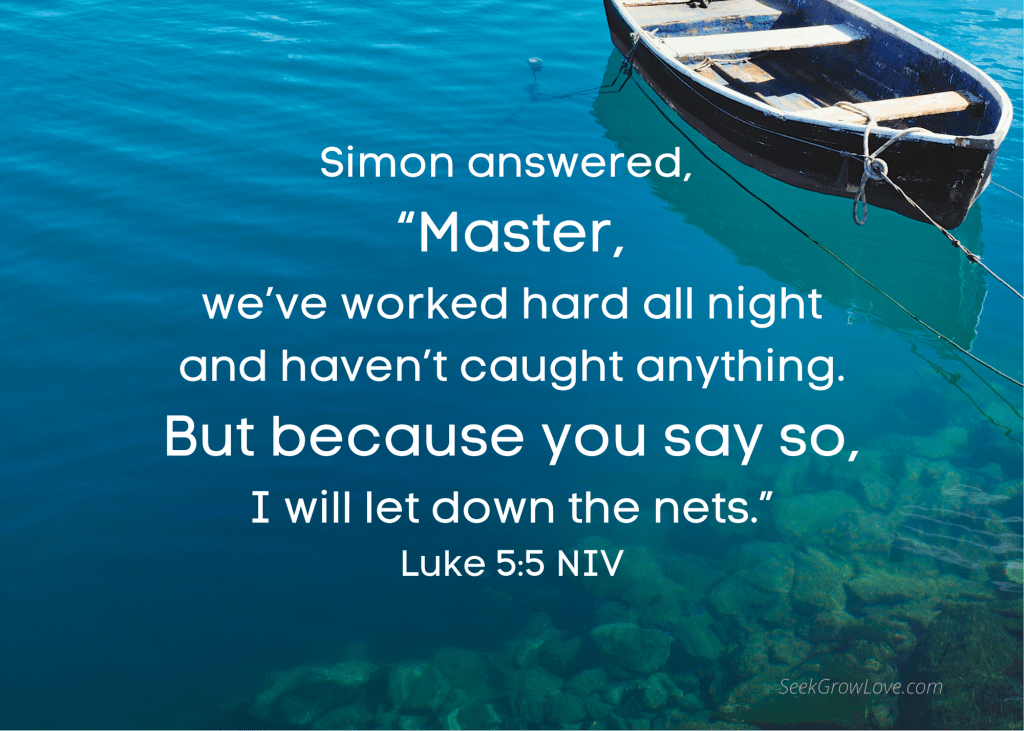
First, we see that Peter obeyed Jesus in a very little thing – taking Jesus out a little from shore.  If Peter hadn’t obeyed this tiny command, he never would have witnessed a spectacular miracle.  Later, when Jesus asked Peter to do something that totally defied reason, Peter also obeyed.  I love the reason he gave in Luke 5:5, “but because you say so, I will let down the nets.”  Peter was willing to submit to authority, even though he didn’t understand the rationale – and remember, there may still have been a crowd watching from shore.  Because of his obedience, Peter was then able to witness an incredible miracle.  Finally, when Peter acknowledged he wasn’t worthy, Jesus invited Peter to join Him.  So, Peter left everything and followed Jesus.

I have found that God often builds our faith little by little.  It’s important to obey God in even the smallest of things.  God will then build on those experiences and obedience for the future.  Sometimes, this may take the form of trials.  1 Corinthians 10:13 tells us, “No temptation has seized you except what is common to man.  And God is faithful; he will not let you be tempted beyond what you can bear.  But when you are tempted, he will also provide a way out so that you can stand up under it.”

I believe no one starts as a giant in the faith.  We obey little by little.  We face trials little by little.  And at some point, you can look back on your life and realize, “Wow, God and I have come a long way together.”

So I challenge you to get into God’s word.  As you do, God will prick your conscience and guide your thoughts.  Follow God’s direction, even in the little things.  At some point, you will recognize, like Peter – “I’m not worthy.”  But the good news is, Jesus is still calling people to leave their former life behind and completely follow Him.  This includes me.  This includes you.

— Steve Mattison

Today’s Bible passage can be read or listened to at BibleGateway here – Matthew 4, Luke 4-5, and John 1:15-51

Tomorrow we will read John 2-4 as we continue to SeekGrowLove on our 2020 reading plan.

John the Baptizer, a baptism for the repentance of sin

Matthew 3, Mark 1, Luke 3

We mentioned on Wednesday (John 1 and Luke 1) why and how John the Baptizer played such a key role in announcing the coming of Jesus the Messiah. John the Baptizer was such an influential figure in 1st century Israel that many people thought he may be the Messiah. But the Baptizer and the authors of the New Testament made it clear: this prophet of God was not the Messiah, but came to bear witness that Jesus of Nazareth was the Messiah and the Lamb and Son of God.

Mark 1:2 and Luke 1:17 tie the coming of John the Baptizer to a declaration of the last prophet of the Old Testament, Malachi (Mal. 4:46; cf. Matt.17:12, Mark 9:12). But all four of the Gospels quote a passage from Isaiah 40 in connection to the ministry of John the Baptizer (John 1:23 is the Baptizer’s own testimony).

“The voice of one crying in the wilderness;

Prepare the way of the Lord, make his paths straight”

Did the Prophets Isaiah or John the Baptizer think and proclaim that the LORD, Yahweh was literally to come to earth as a human being? This is the way much of traditional Christianity interprets this verse. However, it is clear that both prophets understood that the LORD Yahweh would come, and His glory be revealed, through the circumstances of events that were about to unfold. In Isaiah’s case the restoration of Israel from Babylon would be a second Exodus in which Yahweh the LORD is understood to come and lead Israel, displaying His glory.

For the prophet John the Baptizer, Yahweh, the LORD, would break into human history and reveal his glory by sending the Messiah, the one who “comes in the name of the LORD Yahweh” (Psa. 118:26, John 12:13). The Messiah is Yahweh the LORD’s messenger, Yahweh’s agent. To receive Yahweh’s messenger was to receive Yahweh.

And how were the people to prepare for the one who was to come after John the Baptizer, to whom John testified “I’m not worthy to carry his sandal”?

Repentance. Both John the Baptizer and Jesus preached a baptism of repentance for the forgiveness of sin. “The time is fulfilled, and the king of God is at hand; repent, and believe the good news of the kingdom” (Mark 1:4, 14-15, Matt. 4:17, 23).

-Bill Schlegel

Bill Schlegel is the author of the Satellite Bible Atlas and general editor of the One God Report podcast.

Today’s Bible passage can be read or listened to at BibleGateway here – Matthew 3, Mark 1, Luke 3

Tomorrow we will read John 2-4 on our way through our Bible reading plan.

Jesus as a Child

Matthew 2, Luke 2:39-52

The Gospels describe only a few events associated with the childhood of Jesus. Considering the Greek word for “child” in Matthew 2:8, 11, and the fact that Herod sent to murder all the male children in Bethlehem that were 2 years old and younger, Jesus was months or even a year-old child when Gentile wise men came from the east to acknowledge the arrival of the King of the Jews.

What stands out in Matthew chapter 2 is the different reactions to the birth of the Messiah. The wise men asked, “Where is he who has been born king of the Jews?” They came to honor the king. Most English translations have “worship” – but the word is often used in the Bible to designate proper respect and honor toward other human beings. These wise men represent Gentiles who acknowledge that Jesus is the Messiah, the King of the Jews, and by extension, their own king.

Herod “the Great”, on the other hand, when he heard that these Gentile wise men thought the king of the Jews had been born – Herod was troubled. Ironically enough, Herod was called the “King of Jews” at the time. But he had been given that title by the Imperial Roman Government. He wasn’t born as a descendent of David and given the title by God. His anti-Christ murderous deed is emblematic of the high and mighty humans who refuse to acknowledge that Jesus is God’s chosen king.

The persecution and attempted murder of the King Messiah by Herod also is a parallel to the persecution of God’s chosen people Israel. Matthew quotes a passage from the prophet Jeremiah to illustrate the parallel. The nations opposed God’s work through God’s firstborn servant-son Israel. Even so they opposed God’s work through God’s ideal Israel, God’s servant-son Jesus.

And like Israel God’s son, Jesus God’s Son went to Egypt and was brought out of Egypt by God into the land of Israel. Note that the land was called “Israel” in Jesus’s day, not Palestine (Matt. 2:20, 21). Evoking the ancient name “Philistine”, Palestine was the name given to the land by the Romans 100 years later.

When Joseph, Mary and Jesus returned from Egypt, they originally intended to return to Judea (Bethlehem) since Jesus was technically a Judean of the line of David. But because of the murderous nature of the new ruler in Judea, they went to Galilee instead (cf. Matt. 2:22-23 and Luke 2:39. Luke doesn’t record Herod’s murders or Jesus’s travel to and from Egypt).

Luke describes one other event in the childhood of Jesus. When Jesus was 12 years old, he stayed behind in Jerusalem after the Passover festival. We can see that by this time Jesus knew he was the Messiah, who would relate to God as Father, according to the promise of God to David (2 Sam. 7:14, Psalm 2:7, 89:26).

The humanity of Jesus stands out in these events. There is no declaration, as traditional Christianity claims, of God who was born a human. Rather, “the child grew and became strong, filled with wisdom. And the favor of God was upon him” (Luke 2:40). Jesus “increased in wisdom and stature, and in favor with God and man” (Luke 2:52).

-Bill Schlegel

Bill Schlegel is the author of the Satellite Bible Atlas and general editor of the One God Report podcast.

Bethlehem in Judah

Today’s Bible passage can be read or listened to at BibleGateway here – Matthew 2 & Luke 2:39-52

Tomorrow we will read Matthew 3, Mark 1 & Luke 3 as we continue on our Bible reading plan.

The Birth of the Messiah

Matthew 1 and Luke 2:1-38

The coming of the Messiah is one of the greatest desires of pious Jewish people. The desire for the Messiah to come is encapsulated in modern times by a statement of the 12th century Jewish teacher, Moses ben Maimon (Rambam): “I believe in perfect faith in the coming of the Messiah”. By the promise of God, the Messiah would be a descendant of King David.

Two Gospels, Matthew and Luke, record the birth of the Messiah (in Greek translation, “Christ”). As we saw in Luke 1, the birth of Messiah was proceeded by a visit from the angel Gabriel to a Jewish maiden, Mary (Miriam in Hebrew) in the Galilean town of Nazareth. Gabriel announced to Mary that her child would be the one to inherit the throne of David. Like Solomon, he would be called the Son of God. After the child was born, Mary was to name him Jesus, which is in Hebrew, Yeshua or Joshua, which means “Yahweh saves”.

The child was given this name on the day of his circumcision, the eighth day after his birth. The name Jesus is the name of the human being, the “man Christ Jesus”. “Jesus” is never the name of a pre-human divine being.

Matthew begins his Gospel by describing the genealogy, or in Greek the genesis or beginning or origin of Jesus the Messiah. Matthew traces Jesus’s origin especially to David and Abraham.

God had promised to Abraham that he would have many descendants, and that his descendants would inherit the Land of Canaan, that kings would come from him, and that he and his descendant(s) would be a blessing to all peoples on earth. God’s plan of redemption for the world was to come through a physical descendant of Abraham.

Some 800 years after Abraham, and 1000 years before Jesus was born, God chose a descendant of Abraham, David, and established the only perpetual divinely ordained monarchy on earth. God promised that one of David’s descendants would rule forever over God’s ordained monarchy. The genealogy of Jesus as recorded in Matthew’s Gospel declares that Jesus is descendent of Abraham and David in whom God fulfills His promise.

The birth of the Messiah Jesus was accompanied with miraculous signs that were evidence that Jesus is indeed the Messiah of God. Somewhat parallel to the first man Adam, who had no earthly father but whom God formed from the dust, the “second Adam” Jesus was formed by direct divine activity. Angelic beings appeared both before and after Jesus’s birth, to announce the coming of this divinely appointed human king.

Jesus’ mother came to the temple 40 days after Jesus’ birth for purification according to the Law of Moses (Luke 2:22, Lev. 12:2-6). His parents brought the baby Jesus along. There was a righteous man in Jerusalem, Simeon, to whom God revealed that he “would not see death until he had seen the LORD’s Messiah. Simeon took Jesus up in his arms and uttered a blessing and praise. He knew the child Jesus was the fulfillment of God’s promise to both Abraham and David:

“A light for revelation to the Gentiles, and glory for your people Israel” (Luke 2:32).

-Bill Schlegel

Bill Schlegel is the author of the Satellite Bible Atlas and general editor of the One God Report podcast.

Bethlehem in Judah

Today’s Bible passage can be read or listened to at BibleGateway here – Matthew 1 & Luke 2:1-38

Tomorrow we will read the rest of Luke 2 and Matthew 2 as we SeekGrowLove and follow along on our 2020 Chronological Bible Reading Plan. Print your own copy, read along and finish out the year 2020 strong!

Jesus and John the Baptist, a New Beginning

John 1 and Luke 1

The first chapters in the Gospels all describe a new beginning. There had been some 400 years of silence, prophetically speaking, since the days of Malachi the last prophet of the Old Testament. The beginning of the Gospel of Jesus Christ has continuity with Old Testament sacred history (compare for instance Malachi 4:5-6 with Luke 1:17). Indeed, the Gospels claim that this new beginning is a fulfillment of Old Testament hopes (Matt. 5:17). All the Gospels culminate with the resurrection of Jesus the Messiah from the dead, who is the ultimate new beginning, the first born of God’s new creation (cf. Col. 1:15, 18; Rev. 1:5).

A main emphasis in the early chapters of all of the Gospels is the relationship between Jesus and John the Baptizer.

Luke described the amazing births of both John the Baptizer and Jesus.

Matthew described the birth of Jesus, and then skipped to the adult ministry of John the Baptizer.

Mark and John do not describe either birth, but start their Gospels with the adult ministries of John the Baptizer and Jesus.

Why would the relationship between the two men, John the Baptizer and Jesus, be such an important issue? Because John the Baptizer was a very significant individual at the time. Many Jews in 1st century Israel believed John to be a prophet sent by God (John 1:6, Matt. 21:6 “all held John to be a prophet”).  We know from the Gospels and also from the 1st century Jewish historian Josephus Flavius that John the Baptizer had thousands, probably tens of thousands of followers (see here for Josephus’ description of John). Some people thought John the Baptizer might even be the Messiah (John 1:20). The Gospels clarify John the Baptizer’s role and make it clear that Jesus is the Messiah, of higher rank than John the Baptist.

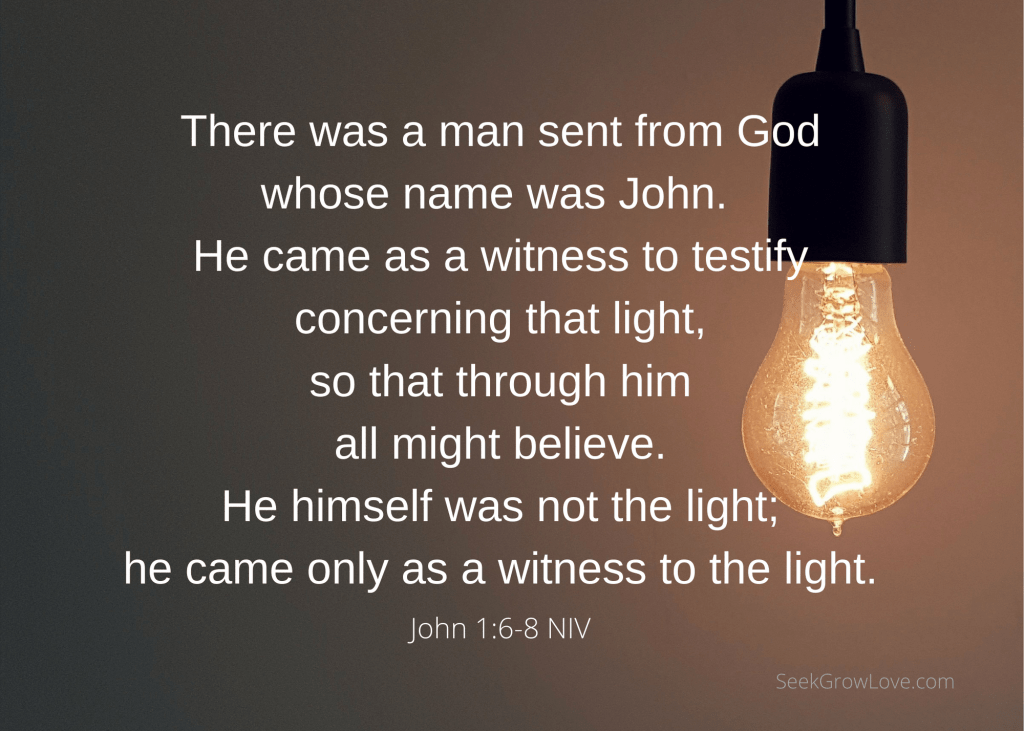
John’s Gospel’s specifically introduces the ministry of John the Baptizer already with three verses in 1:6-8, and then again in 1:15 and 1:19-35 (cf. 3:25-30). The appearance of John the Baptizer so early in John’s Gospel, the sixth verse of the Gospel, is evidence that “the beginning” of John 1:1, and all of these verses at the beginning of John’s Gospel refer not to the Genesis creation but to the same beginning that the Gospels of Matthew, Mark and Luke describe, “the beginning of the Gospel of Jesus Christ” (Mark 1:1, cf. Luke 1:1-2, Matt. 1:1, John 8:25, 16:4).

In other words, John the Baptizer is so quickly and prominently introduced at the beginning of all the Gospels, including John’s Gospel because the Baptizer has a key role in this new beginning. The Baptizer’s key role was to bear witness to the coming of the Messiah: “After me comes a man who ranks above me…behold the lamb of God…this one is the Son of God” (John 1:15, 29, 34).

One other aspect of the new beginning that the Gospel of Jesus Christ inaugurates was declared by Mary the mother of Jesus when she visited Elizabeth the mother of John. The coming of the Christ was to initiate a “reversal of fortune”. In language that echoes the prayer of Hannah (the first person in the Bible to mention the coming of God’s king messiah, 1 Sam. 2:10), Mary knew that the new beginning would turn the world upside down (Luke 1:47-56). Those of low estate would be exalted, the proud would be scattered, and the mighty brought down from their thrones. As Jesus promised, “the meek will inherit the earth”.

-Bill Schlegel

Bill Schlegel is the author of the Satellite Bible Atlas and general editor of the One God Report podcast.

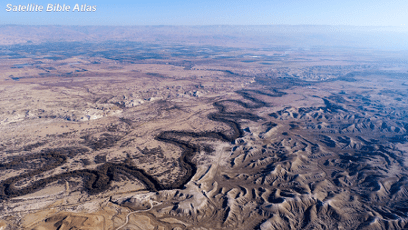
Jordan River near Jericho

Today’s Bible passage can be read or listened to at BibleGateway here – Luke 1 and John 1:1-14

Tomorrow we will read Matthew 1 and Luke 2:1-38 as we continue seeking God, growing our faith and increasing our love. Come follow along and see what God as in store for you!

From Beginning to End

Malachi 1-4

            In the English Bible we’ve come to the last book of the Old Testament, but not for the Hebrew Bible. It’s the end of the Prophets and now the Writings start. In my Hebrew/English Bible the next page starts the Psalms then Proverbs…. The book of Malachi is filled with warnings and exhortations and many familiar and excellent verses for such a small book. He’s a contemporary of Ezra and Nehemiah.

            “The LORD is magnified beyond the border of Israel.” (1:5) Amen!  That’s for sure these days from those days.  Look how far from the borders of Israel He’s magnified. “If then I am the Father, where is my honor? And if I am Lord, where is my reverence?” (1:6) “For from the rising of the sun, even to its going down, my name shall be great among the Gentiles.” (1:11) “Have we not all one Father? Has not one God created us?” (2:10) Amen.

            “The LORD God of Israel says that He hates divorce. For it covers one’s garment with violence, says the LORD of hosts.” (2:16) “Behold I send my messenger, and he will prepare the way before me.” (3:1) “For I am the LORD, I do not change.” (3:6) Those are very simple and yet clear verses.

            “Will a man rob God? Yet you have robbed me. But you say, ‘In what way have we robbed you? In tithe and offerings.” (3:8) This is a good question to ask children. I’ve asked some of our older kids before, and now I’m going to ask our younger children and see what response I get. 

            “For behold, the day is coming, burning like an oven, and all the proud, yes, all who do wickedly will be stubble, and the day which is coming shall burn them up,” says the LORD of hosts.” (4:1) This is certainly true, and, in some ways, THIS is the ultimate climate change and global warming some are talking about now that will one day take place.  God will purify and purge, and it won’t be by a flood the next time like he promised.

            The last two verses of Malachi 4:5,6 are quoted in Luke 1:17, when the angel told Zacharias about his son, “He will also go before him in the spirit and power of Elijah, to turn the hearts of the fathers to the children.” So even though it’s not the end of the Hebrew Bible it still fits going into the English New Testament.  So does the end 2 Chronicles in Hebrew that goes into the New Testament, when Cyrus king of Persia was stirred by the LORD which says, “May the LORD his God be with him, and let him go up!” (36:23) That also goes nicely with Matthew 1:23, which says, “the virgin will bear a son and call his name Immanuel, God is with us.” Same idea, God is with us and helping us (not God the flesh). “The LORD is magnified beyond the border of Israel.” (1:5) Amen! 

Stephanie Schlegel

Today’s Bible passage can be read or listened to at Bible Gateway here – Malachi 1-4

Tomorrow we begin the NEW Testament, with Luke 1 and John 1:1-14. If you haven’t already, now would be a great time to commit to reading the New Testament before the New Year begins. Finish off 2020 strong in God’s Word. Below is the Bible reading plan we will be following with our daily devotions. Let’s seek God together!

With Great Joy

Nehemiah 11-13 & Psalm 126

Now that the wall’s been built, the city secured, and they’ve read from the Book of the Law to relearn God’s ways, it’s time to dwell in Jerusalem and the

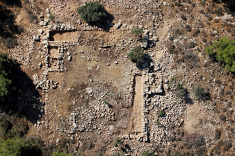
cities.  The leaders were designated to live in Jerusalem and the people cast lots to see which one out of every 10 would dwell in Jerusalem.  The rest would dwell in cities surrounding Jerusalem.  I lived in Israel 25 years and for most of the time we lived in a little village 10 miles west of Jerusalem.  It’s a mountainy and rocky area forested with some trees.  Most villages and Jerusalem were built around a water source, perhaps some type of spring.  Pictured is a photo of ruins of a Nehemiah period fortress in the hills of Judah near Jerusalem. (This photo courtesy of Israel Department of Antiquities.)

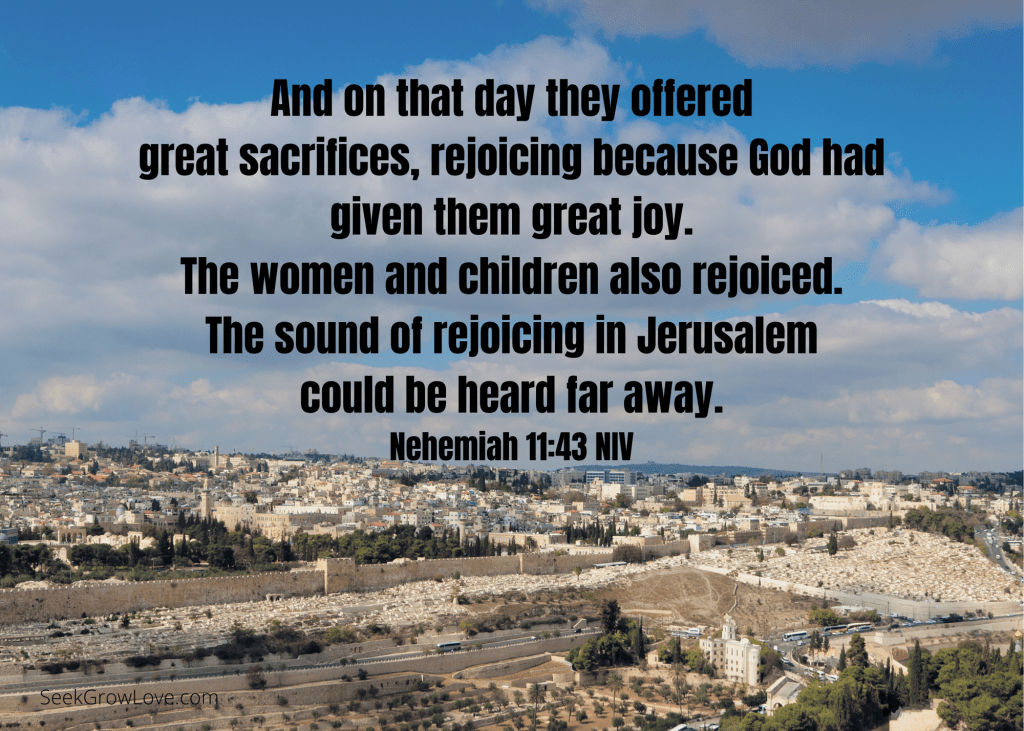
            It was a time of rejoicing.  Singers had built themselves villages all around Jerusalem (12:29). Also, two large Thanksgiving choirs with specific names and place locations are listed.  It’s amazing the record we still have today of the detailed descriptions of their locations. Also, great sacrifices were offered for God had made them rejoice with great joy.  The joy of Jerusalem could be heard from afar.  It’s amazing on the quiet of a shabbat or holiday when places are closed the noise that can be heard from a greater distance.  Psalm 126 says with singing they returned from captivity.  There must have been a joy to be back in the land of Israel again after being exiled. Though they “sow in tears, they’ll reap in joy.” At our oldest daughter’s wedding I told this to people as I wept, that I sowed in tears (such hard work raising kids overseas) and now I was reaping and weeping in joy, not out of sorrow but gladness that we made it to that day!! 😊


        Nehemiah returned after some time to Jerusalem and like a good parent had three firm corrections to make.  First, Eliashib, the priest, allowed Tobiah (Ammonite official) to have a large storeroom for himself, where articles and supplies for the Levites, singers, gatekeepers, were to be kept.  Thus, he threw out Tobiah’s things and cleansed the storeroom for proper use.  Then he asked God to remember him. (13:14) Secondly, he contended with the people for buying and selling on Shabbat and commanded the gates be shut and not open until after the Shabbat.  In current the state of Israel, every Friday afternoon stores, including all the malls shut down all over the country and remain closed until after sundown on Shabbat (Saturday), once two stars are visible.  Some weeks with holidays, the malls are closed for THREE full days!… Nehemiah prayed that God remember him. (13:22) Lastly, he contended with some of them, cursed them, struck some of them, and pulled out their hair, and made them swear not to give their children to foreigners!  That’s quite aggressive and zealous. Imagine the uproar he’d receive from all kinds of people and media today for those actions! But he prayed and asked God remember him for good. (13:29,30)

-Stephanie Schlegel

Today’s Bible passage can be read or listened to at BibleGateway here – Nehemiah 11-13 & Psalm 126

Tomorrow’s reading will be our last book of the Old Testament – Malachi – as we continue on our 2020 Reading Plan. God has great things in store! Come follow along!

Feasting on His Word

Nehemiah 8-10

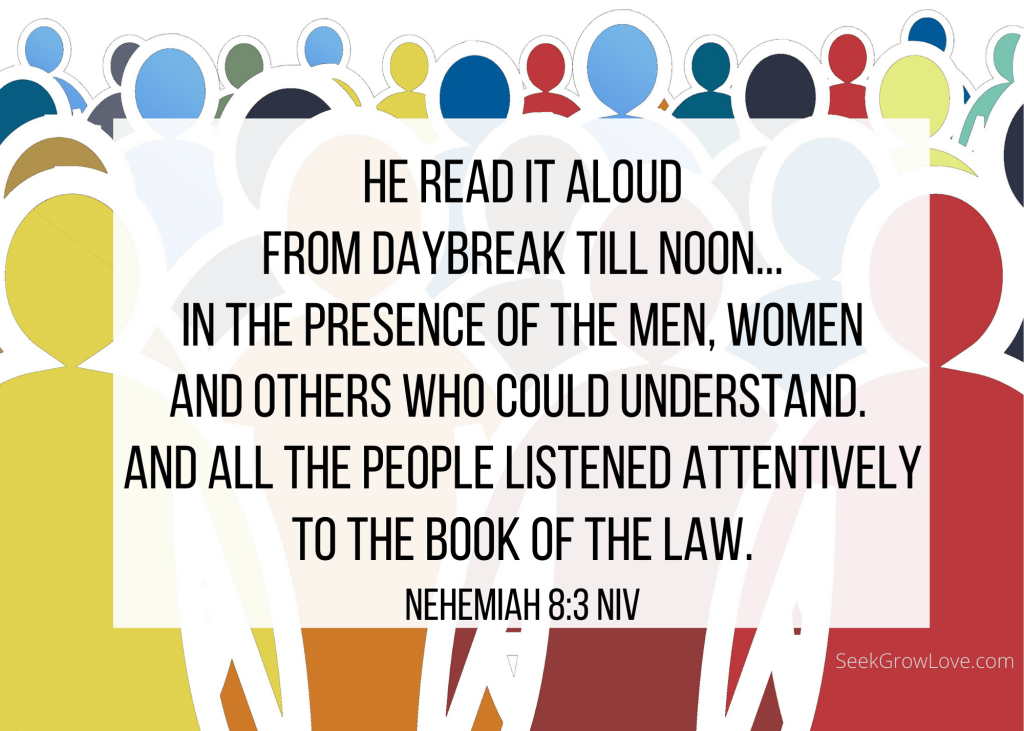
Now that the wall of Jerusalem was completed the people gathered together at the Water Gate to have Ezra read from the Book of the Law of Moses on the first day of the seventh month (which was actually last weekend on the Jewish calendar and the Feast of Trumpets. It’s not really the Jewish New Year, that was adapted from a later time in exile. The first month of the Jewish year is Passover). It states NINE times that “all the people” are included in the events happening in chapter 8.  The priests even helped the people to understand the readings, (8:8) and the people responded with WEEPING (8:9). Nehemiah encouraged them to go and “eat fat and drink sweet” for this day is holy to the Lord. They weren’t to be sad, for “the joy of the LORD is your strength.” (8:10) They knew the words were declared to them.

 The second day they gathered again to hear the Law and learned that in the seventh month they were to dwell in booths for a week.  They were to go to the mountains and gather olive branches, myrtle, palm, and leafy branches to make a booth.  The other day on my fast walk in the neighborhood I plucked various leafy bushes to add to the pop-up booth card I’m making to send to our grandson next week. 😊   I’m going to also include some fruit snacks he can enjoy by his “booth” as a celebration of the end of the harvest season. In Israel today, where we lived for many years, they still make and “dwell” in booths during this weeklong holiday.  They’re on rooftops, balconies, and yards.  They’re decorated with paper chains, lights, and pictures. Our kids liked to sleep in them some nights with their friends.  The people in Nehemiah’s time hadn’t celebrated the Feast of Booths/Tabernacles since the time of Joshua, so it was a time of “great gladness” (8:17), and still is to this day. Although, this year might be different as they’re on a full lockdown in Israel during these holiday times because of Covid.   

            They continued to read the Book of the Law for a ¼ of the day and for another ¼ of the day they confessed their sins and worshipped the LORD their God. (9:3) Some of the Levites stood up and recalled God’s work through Moses, Egypt, Wilderness, and how He brought them into a good land.  However, they “cast His Law behind their backs and killed prophets sent to them.” (9:26) So God “gave them saviors” when they cried out for help and many times delivered them. (9:27) “For many years You had patience with them and testified against them by Your Spirit in Your prophets, yet they would not listen.” (9:30)

Now therefore, our God, the great, the mighty, and awesome God, who keeps covenants and mercy… (9:32) You are just in all that has befallen us.” (9:33) How patient God was and is with His peopleIt says not the kings, princes, priests, or fathers have kept God’s Law.( 9:34)  How important it was for all the people to gather together and recall God’s work over time and their own lack of commitment, and thus to refocus their love and service for the LORD their God for the future.  Now that the wall of Jerusalem had been rebuilt, they needed God’s protection over them. Instead of blaming God for failures, it’s good they acknowledged they were wrong and refocus on Him as they move forward.  We too, can learn from their example in our lives today.

Stephanie Schlegel

Today’s Bible passage can be read or listened to at BibleGateway here – Nehemiah 8-10

Tomorrow we will finish the book of Nehemiah and read Psalm 126 as we continue seeing God’s faithfulness in our

Overcoming the Opposition

Nehemiah 6-7

So much work had already been done – the walls of Jerusalem had been rebuilt – now they just needed to finish the gates. Surely this project was God-ordained and he picked the right leader for the job – Nehemiah. He was able to get everyone motivated and working together, and despite the opposition they were able to finish their job on the 25th of Elul (which appears to correspond to somewhere between Sept 15 and October 2). So, this week is a super time to celebrate the work that is accomplished when working for God.

So much good had been done already – but the work did not end and neither did the opposition!

Nehemiah was under attack. Satan (along with Tobia, Sanballat, Geshem and the rest of those fighting against God) were using every weapon at their disposal to bring this righteous leader down: lies, fear, wolves in sheep’s clothing, attempting to distract him from his work with other business, spreading gossip and accusations of sedition to either silence him or get him in serious trouble with the authorities, even hiring a false “prophet” to scare him into sinning.

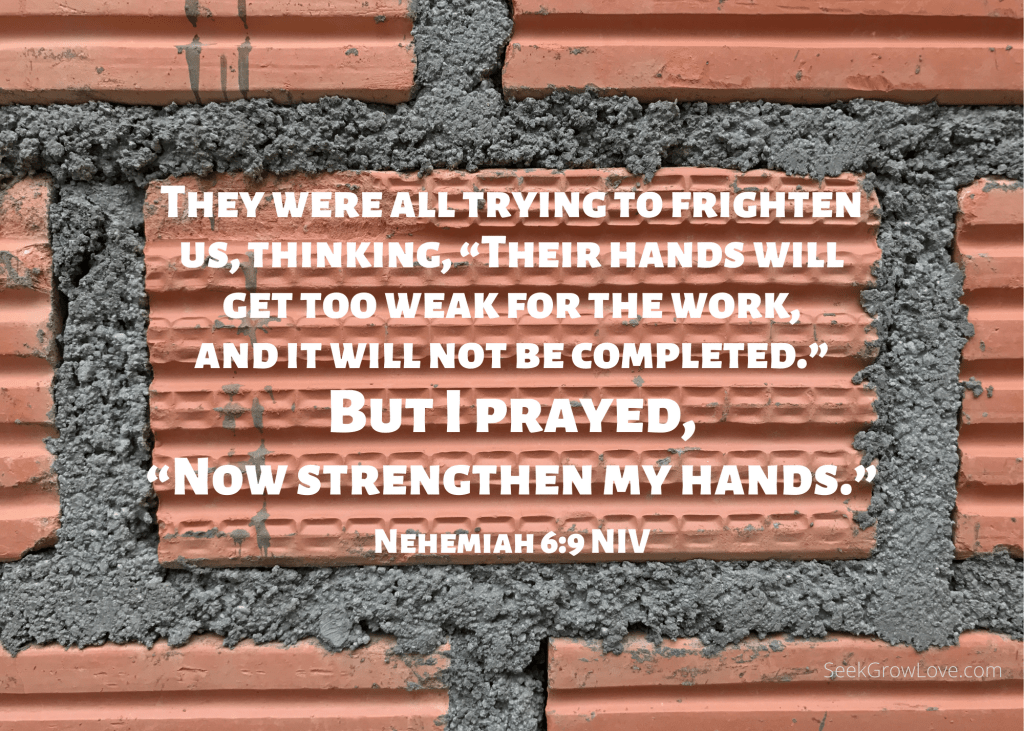
But Nehemiah stood strong. We continue to see him turn to God in prayer. Asking for strong hands and asking for God to take care of those getting in the way of the Lord’s work. He obviously had a strong knowledge of God’s law to not be tricked into sinning. This gave him wise discernment in knowing who to listen to and what to do, and not do. And, he knew to fear God not men.

We can learn a lot from Nehemiah today because Satan keeps using the same ploys. Adolf Hitler wrote, “Mental confusion, contradiction of feeling, indecisiveness, panic; these are our weapons.” Evil men seeking to destroy God’s work have come and gone and yet remain today. It is indeed a vivid reminder that, “Our struggle is not against flesh and blood, but against the rulers, against the authorities, against the powers of this dark world and against the spiritual forces of evil in the heavenly realms.” (Ephesians 6:12 NIV). They love nothing more than trying to interrupt God’s work and if they can bring down a godly leader at the same time they probably get bonus points.

We see so much of this evil and oppression today. But like Nehemiah, we must not give up! We must turn to God again and again when faced with the lies and fears and Satan’s strong man tactics that would love to have us throw in the towel and take the easy way instead. Pray, fast, seek His word and His way, don’t fear man, resist sin, use discernment in knowing who to trust, what to say and do. Pray, too, for our leaders that they will have the wisdom and strong hands of Nehemiah

Satan has been running rampant and the result is a broken world. Keep at God’s rebuilding work – one brick at a time.

Marcia Railton

Speaking of our opposition, mental confusion, lies, panic, and pleasing man not God, reminds me of the life and death fight for the most innocent of God’s creations. Tonight would be a great time to watch See Life 2020 and #LoveEveryHeartbeat. And pray for strong hands – and hearts – to do the work God wants you to do.

Today’s Bible passage can be read or listened to at BibleGateway here – Nehemiah 6-7

Tomorrow we will read Nehemiah 8-10 as we continue seeking God on our