The Voice of Wisdom

Proverbs 7-9

Do you ever find yourself looking at someone else’s situation or decisions and think, “I would have done that completely differently”? Of course you have. We all have. The world is full of armchair quarterbacks and side seat drivers. It’s so much easier to look at someone else’s situation and evaluate it as an outsider without the pressures of personal consequence. 

In the heat of the moment, standing at our own crossroads, however, we get wrapped up in the “what ifs” and the worries about whether or not we are making huge mistakes. So how do you know when you’re doing something wise or foolish? 

Chapters 7 and 8 of Proverbs personify danger/foolishness and wisdom as two women. The first woman is the strange or adulterous woman, luring in a simple youth. She uses “smooth talk” and “persuasive words” to seduce him. I feel it’s worthy to note that sexual sin is being used in this personification, probably because it’s the most common and most dangerous. And her opposite is wisdom, who doesn’t use tricks or wordplay, but speaks plainly. She promises no shortcuts, but offers instruction, knowledge, and truth. 

Both women have some similarities though. They are both crying out to those around them, trying to persuade others to follow them. They are both offering up benefits to listening to their words. So how do we know which to listen to? 

It seems obvious when we read the chapters, right? It’s less obvious in our own realities, though. Less obvious, but it’s still possible to make the correct choice. As in all decisions, we should test our options against scripture. If you want to know if your actions are wise or dangerous, test them against God’s word. Discernment, the ability to judge well, is a skill that everyone can, and should, develop through practice. The more we know of God’s word, the better equipped we will be to look at the paths before us and choose the wise one, the one that aligns best with scripture. 

When wisdom calls out to you, don’t you want to be familiar with her voice? 

My prayer for you is that you become so familiar with the voice of wisdom, the words of God, that you are not easily fooled or led astray. I hope you will love instruction so that you will continue to grow in wisdom and righteousness. I pray that you find the benefits of wisdom listed in chapter 9: “For through wisdom your days will be many, and years will be added to your life. If you are wise, your wisdom will reward you.”

-Jenn Haynes

Reflection Questions: 

What decisions do you face right now? Have you placed your options up against scripture? 

How is your scripture study? In what ways can you make yourself more familiar with God’s word, and the voice of wisdom, so that you can easily recognize it?

Are there any voices of temptation in your life right now that are trying to call out to you? Take a moment to honestly analyze and reflect. Often we want to shy away from facing the hard truth that there are likely things in our lives that we enjoy but that we should give up because they are unwise. Does that hold true for you? 
An Exhausting Book

Old Testament: Numbers 10

Poetry: Job 9

New Testament: Acts 23

I don’t know about you, but I find reading the book of Job to be a bit (or downright) exhausting. I’m not saying I don’t like the book, but it takes some work. This year might be the first year I have tried reading just one chapter of Job a day. Perhaps it is not as tiring when taken in small chunks. Though I also am considering finding a chunk of time (estimates say about 3 hours) to read the book as a whole to more clearly see the big picture, including the progression of thought and the conversational back and forth between Job and his friends which takes up so much of the book.

I think I have decided what makes the book of Job more exhausting for me than any of the other 65 books of Scripture. Partly, sorrow is hard, whether it is your own or someone else’s. And Job has a lot of good reasons to be sorrowful. In the first two chapters Job was struck with monstrous trials: the loss of his material goods and livelihood, the death of all of his 10 children at once, a painful disease that affects his entire body with sores from his head to his toes, and a wife who tells him to curse God and die.  We know that these ordeals were not a result of God’s judgment on Job for some large, grievous, hidden sin because in Job 1:8 we heard God’s own description of Job – “he Is blameless and upright, a man who fears God and shuns evil.”

I admire his friends, Eliphaz, Bildad and Zophar, for coming alongside their suffering friend.  Job 2:11-13 says when they heard of Job’s distress they made a plan to meet together to visit Job to sympathize and comfort.  When they saw him they wept – and then they sat with him in silence for seven days and seven nights.  To think, how often do I have trouble making the time to just send a card to a hurting friend?  And here they are starting out with spending 7 days hurting with their grieving friend. These friends had the best intentions and were certainly giving of themselves in a time of crisis.  But, good intentions are not always enough. We will hear many conversations between Job and his friends who came to console him, but then turned to some questionable counseling instead.

Along with their good intentions, they also were armed with some very true and accurate knowledge of God.  Throughout the passages of Job there will be many times when Job’s friends – and Job himself – will share solid truths about God, His majesty, sovereignty, power, love, justice and faithfulness.  In today’s chapter 9 Job is speaking (wisely and correctly) of the truth of God’s majesty and power.  Some of my favorites from this chapter are:

vs 4 – “His wisdom is profound, his power is vast.”

vs. 8-10 – “He alone stretches out the heavens
    and treads on the waves of the sea.
He is the Maker of the Bear and Orion,
    the Pleiades and the constellations of the south.
10 He performs wonders that cannot be fathomed,
    miracles that cannot be counted.”

I can learn a lot from Job and his friends as they relay to one another the awesome qualities of God that we sometimes casually dismiss or even forget. He is the Maker of Heaven and Earth! Nothing compares to His wisdom and power! He is in control of nature, and wonders and miracles. We can not understand all He is and all He can do. Our God is greater than anything. He is the Greatest!

But sometimes, even starting with good intentions and a knowledge of the truth (or some truth), is not enough. Sometimes we can start with a true view of God and still come up with false conclusions.  And I think that is the biggest reason the book of Job is mentally exhausting for me. It’s a little bit like playing a game of two truths and a lie – always questioning where the lie might slip in. As I read beautiful descriptions of God’s power and love I nod, smile and agree. I have the same big God. But then, sometimes in the very next verse or stanza the same speaker continues saying, “He would crush me with a storm and multiply my wounds for no reason” (9:17). Wait. No. I do not agree. I shake my head as my brows furrow. YES, God is powerful, that is true. But NO, God does not use His power to crush and wound for no reason.

As we read through Job let’s look for instances where his friends (and Job) begin with their good intentions and a truth about God and mankind – but come up with false conclusions. One example repeated many times over will be – God is just – so if you are suffering you must have done a terrible sin for which He is paying you back with trouble. 

Also, while we search for those truths that were then twisted in the ancient book of Job, let us also search our society, our community, our church, ourselves. Where do we find true descriptions of God (such as, God is love) leading to false, twisted conclusions (so His love for sinners means He won’t punish sin)? What songs do we sing, books do we read, people we listen to, that we agree with the first verse/page/post/thought, but then find untruth in the next? It can be exhausting keeping our guard up. The lies can be hard to discern when they are buried amongst truth. Stay on your guard. Don’t buy the lies and untrue conclusions the world has accepted about God. Keep seeking Him and the truth of who He is and what He does.

-Marcia Railton

(parts of today’s devotion were originally posted on January 5, 2020 for SeekGrowLove)

Reflection Questions

  1. Sometimes people start with complete untruths about God (He doesn’t exist, He exists but has no power, etc…). Those can be easier to spot as false. Where have you seen a true description of God but then a false conclusion?
  2. One thing that bothers me about the book of Job is the large part Satan plays in chapters 1 & 2, but Job and his friends seem completely unaware of Satan’s presence and power and responsibility. Are we as clueless, too? What role do you think Satan plays today?
  3. Don’t miss out on the wonderful foreshadowing found in Job 9:32 & 33. Who is able to “lay his hand upon us both” (vs 33 original NIV)? What difference could that have made for Job? What difference can it, or has it, made for you?

Fads Come to Church

Theme Week: Review of Paul – 2 Corinthians 11

Old Testament: Ecclesiastes 7-9

Poetry: Psalm 52

Tik Tok.  It’s a fad.  Fads are nothing new.  My grandparents probably said “23 skidoo”.  (I have not verified the spelling).  The generation right before me were really into hula hoops and they danced “the twist” and the “watoosi”.  My generation had pet rocks and mood rings.

Fads come to church too.  Anybody still have a WWJD wristband?  Are there any Prayer of Jabez plaques in your house. (Ask your parents about these fads).  Many religious fads can be innocuous.  Some fads can be pretty significant for good or for bad.  The Late Great Planet Earth promoted a view of the rapture that had vast societal and political implications.  A resurgence of Calvinism is impacting the way many Christians view the church’s role in society.  The recent trend of doing church online and eschewing in person worship which began during the Covid lockdown has continued for many and may be weakening many congregations. (Who needs to spend an hour or two at church when you can watch a 45 second tik tok sermon in your pajamas?)  But I digress.

What exactly do we mean by the term “fad”?  “Sociologists classify fads as a form of ‘collective preoccupations’  where many people over a relatively broad social spectrum engage in a similar behavior and interpret it in similar ways in order to identify their place in society” (See Pop Culture Christianity: What fad would Jesus follow” by Jim White). Another definition is: “An intense and widely shared enthusiasm for something, especially one that is short-lived and without basis in the object’s qualities; a craze.”  Fads are not a modern phenomenon.  It appears that even the Apostle Paul had to deal with the religious “flavor of the month” in his first century ministry.

As we have been reviewing Paul’s life and teachings this week we have seen how he was specifically met by and called by Jesus Christ to bring the good news of the Kingdom and the name of Jesus Christ to the Gentiles (everyone that wasn’t a Jew).  Paul traveled extensively presenting the Gospel to new groups of people and then following up to see how they were doing in the faith.  In today’s reading in 2 Corinthians 11 Paul is writing to the Church to offer correction to their following a new religious fad.  New teachers came in behind Paul who apparently were more slick and polished than Paul was and who had packaged a different message that was appealing and persuasive and was drawing the Corinthian disciples away from their “sincere and pure devotion to Christ” (vs. 3).

Paul goes on to use some very strong language to warn the Church against blindly following these fancy new teachers and their faddish preaching.  He uses words like: deceived, led astray, another Jesus, a different spirit, a different gospel, false apostles, disguised as preachers of righteousness just as Satan is disguised as an angel of light.  That’s a lot of clear, hard teaching.  It’s not always easy to hear clear, hard teaching, but it’s sometimes needed.  7 years ago I had a doctor who gave me some clear, hard teaching.  He diagnosed me with cancer.  The cancer needed treatment. I needed surgery or radiation or both (it ended up being both).  If I chose to ignore the doctor’s warning I probably wouldn’t still be around today.  Fortunately, he cared enough to tell me the hard truth and fortunately I received it and acted upon it, had the surgery and radiation along with a lot of prayers, and I’m still around.

I’m not sure how the Christians in the first century Church of Corinth responded to Paul’s hard teaching.  Did they accept it and act accordingly or did they ignore it and keep on doing what they were doing, following the latest fad instead of returning to their pure devotion to Christ?

Paul tried to appeal to his listeners by laying out his resume, his credentials.  He talked about his background and the foundation he received.  He talked about how his dedication to Christ was evident in his actions and his willingness to keep going amid so much opposition.  Paul recognized that when he went around preaching the gospel and telling people about God’s Kingdom and God’s chosen King, Jesus, he was involved in spiritual warfare.  The enemy or evil one tried to stop him wherever he went – that’s why he had so much opposition.

Do you ever run into opposition or challenges when you are trying to do what God told you to do?  500 years ago a teacher named Ignatius helped his students practice discernment of spirits.  I think he had some helpful teaching.  He said, rightly I believe, that when we are doing morally bad or sinful things, the evil spirit or enemy of God makes them look and feel pretty good.  I’m not going to lie, sometimes doing bad or sinful things feels good in the moment.  The devil wants you to feel good about doing bad so he “rewards” you with those temporary good feelings.  Meanwhile, God comes along and drops bad feelings like guilt or shame (what a buzz kill).  Just like my doctor- I’m enjoying life and he has to ruin my fun by telling me I have cancer.  But guess what, listening to him saved my life.  And listening to the guilt when we are doing things that bring us away from God can save our spiritual life by turning us away from sin back to God’s path for our lives.

Here’s the flip side to discernment.  When we are sold out on following Jesus Christ, when we are on fire for the Lord and willing to take up our cross and follow Jesus, the evil one comes along and tries to throw as many challenges and obstacles in our way to trip us up and get us to give up our faithful commitment to God.  But while the enemy is trying to destroy us, God will come along with his spirit and offer us his love, comfort and the promise that he is with us.  He might use a song, a scripture, a sermon, another Christian, a beautiful sunrise, a rainbow in the sky, who knows what God will do to let us know that he is with us?

For me, when I was diagnosed with cancer one of the things that helped get me through it was my Church family.  When I was going through 6 weeks of daily radiation every Sunday my Church prayed for me in worship.  When I was going in for surgery, my church filled the sanctuary with happy face balloons and signs of encouragement.  I was surrounded with love and encouragement.  That kept me going.  Now I try to return the favor and show love and encouragement to others when I sense the evil one is trying to trip them up.  Maybe someone reading this today has been under attack from the evil one.  Be encouraged!  God is with you.  Turn to Him, keep the faith.  And be sure to use good discernment when a new fad comes along.  Some may be harmless, but others might be a tactic that the enemy is using that might appear innocent but is actually turning your heart away from it’s sincere devotion of Christ.  The enemy has been doing this a long time and he’s pretty skilled… don’t let him trick you.

-Jeff Fletcher

Reflection Questions

  1. Can you think of examples of religious fads that might appear innocent but can be potentially dangerous?
  2. How might you use the tools of discernment to better evaluate things in your life, good and bad?
  3. How might God use you to lovingly warn or share hard truth with someone who might be on a path that’s leading them away from Christ?

Discerning

When and Where God Just Wants You to Stand

*Old Testament: Esther 5-7

Poetry: Psalm 28

New Testament: John 8

Esther’s boldness is often written about… If I perish, I perish.

Kind of melodramatic.

The real story here, although not presented with as much flourish, is Esther’s discernment. When Mordecai tells her what she needs to do, she doesn’t just swoon the ‘if I perish’ line and exit stage left to appeal to the king. She asks for time to pray and fast herself, and asks for others to join her.

Go, gather all the Jews to be found in Susa, and hold a fast on my behalf, and do not eat or drink for three days, night or day. I and my young women will also fast as you do. Then I will go to the king…   4:16

After this, Esther still doesn’t march into the king’s presence and boldly present her ask. What she does is be intentional with each and every action and word. She chooses what to wear, and she puts herself in the right place. And she stands there.

Esther put on her royal robes and stood in the inner court of the king’s palace.  5:1

Even after the king receives her and asks for her request, all but assuring her that the answer will be yes, she continues to act with discernment.

And the king said to her, “What is it, Queen Esther? What is your request? It shall be given you, even to the half of my kingdom.” And Esther said, “If it please the king, let the king and Haman come today to a feast that I have prepared for the king.”   5:3-4

At the feast, the king repeats his promise to give her what she desires, but still she doesn’t ask. We can’t really explain why she does what she does, but what can explain it is that she is being led by a wise and knowing God because she has taken the time to listen to him.

And as they were drinking wine after the feast, the king said to Esther, “What is your wish? It shall be granted you. And what is your request? Even to the half of my kingdom, it shall be fulfilled.” Then Esther answered, “My wish and my request is: If I have found favor in the sight of the king, and if it please the king to grant my wish and fulfill my request, let the king and Haman come to the feast that I will prepare for them, and tomorrow I will do as the king has said.”   5:6-8

And then this happens…

On that night the king could not sleep.  6:1

A-ha! His sleepless night led to him doing a little light reading which opened a door for God to speak directly into him. God didn’t put Esther in this place so she could convince the king, he put her there simply to ask. And she did, the next day…

And on the second day, as they were drinking wine after the feast, the king again said to Esther, “What is your wish, Queen Esther? It shall be granted you. And what is your request? Even to the half of my kingdom, it shall be fulfilled.”Then Queen Esther answered, “If I have found favor in your sight, O king, and if it please the king, let my life be granted me for my wish, and my people for my request. For we have been sold, I and my people, to be destroyed, to be killed, and to be annihilated. If we had been sold merely as slaves, men and women, I would have been silent, for our affliction is not to be compared with the loss to the king.” Then King Ahasuerus said to Queen Esther, “Who is he, and where is he, who has dared to do this?” And Esther said, “A foe and enemy! This wicked Haman!”   7:1-6

Far too often, I think we inflate just how much God needs us. He truly does the heavy lifting far more effectively than we can. Our job is to learn to tune in to when it’s time to speak and when it’s time to put on the royal robes and just stand.

How often do we think we’re helping God, or are certain that we’re on the path to do the most good (both positive intentions, by the way) but we’re not doing an awful lot of praying or fasting before we move, speak, or bulldoze ahead?

Maybe God’s thinking, ‘It’s great that you’re willing to perish, but all I really need you to do is just stand there today.’

-Susan Landry

Reflection Questions

  1. Have you tried praying and fasting before making a large decision or bold action? If so, did you find it beneficial? Whether you have done it before or not, what might God want you to spend time praying and fasting about?
  2. Can you think of a time you may have been to0 quick to act – not acting within God’s perfect timing?
  3. When have you seen examples of God’s perfect timing?

Believe the Works

John 10

If I am not doing the works of my Father, then do not believe me. But if I do them, even though you do not believe me, believe the works, so that you may know and understand that the Father is in me and I am in the Father.

John 10:37-38

In chapter 10 we get to see Jesus once again being challenged by the Pharisees. His reply here reminds us that our actions matter more than our words. He tells them that since they don’t believe his words, to judge him by his actions.

This mirrors what Jesus said in Matthew 7:

Thus, by their fruit you will recognize them.

And also what we read in Proverbs 20:

Even a child makes himself known by his acts, by whether his conduct is pure and upright.

It also reminds me of this saying a friend shared with me several years ago:

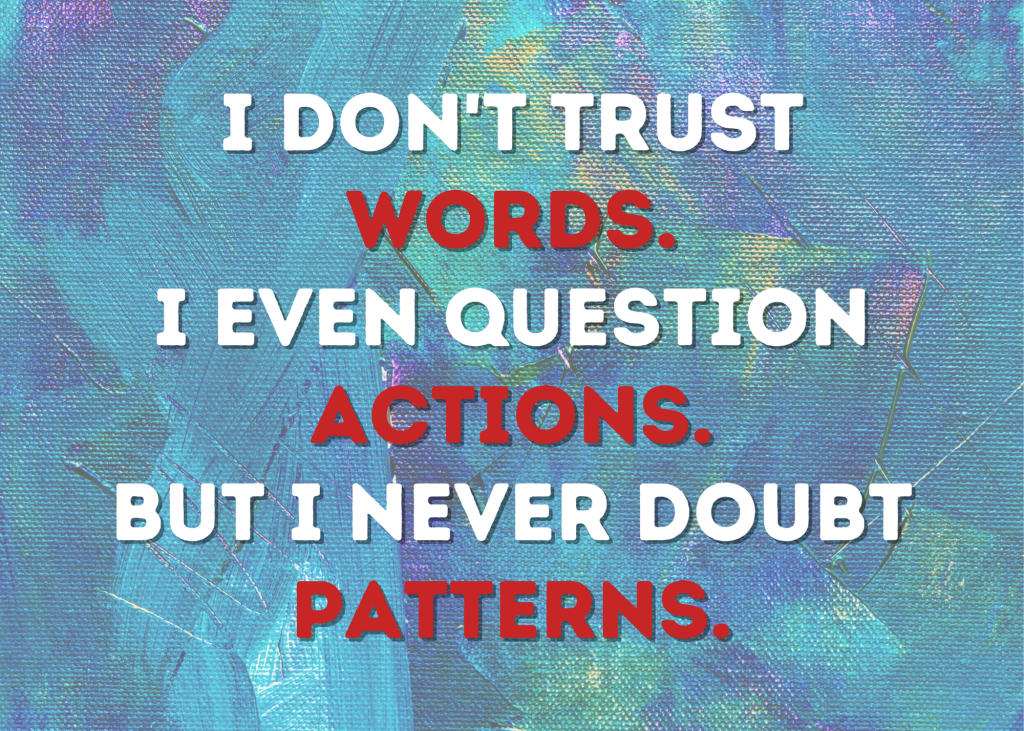
I don’t trust words. I even question actions. But I never doubt patterns.

You see, people can lie with their words. They can even act in the ‘right’ way and mislead you…for awhile. Eventually, if we are looking for them, patterns reveal themselves.

Not only is this something we should be aware of and be watching for in others in order to live a discerning life; but also something that we should be aware of in our own life. I’m wondering if we could confidently say, “Even if you don’t believe my words, watch my actions. That will convince you.” Paul said something like that to the church in Corinth when he wrote:

Follow my example, as I follow the example of Christ.

After Jesus issues his challenge to the Pharisees and the others listening, we’re told that he goes away from them, but many people followed him to where he went. Then we’re told that:

And many believed in him there.

I guess his actions spoke for themselves.

-Susan Landry

Questions for Reflection and Discussion:

  1. Discuss the idea of not trusting words, even actions, but watching for patterns. Why is this important?
  2. Why is it so scary to think about telling people they could ignore our words and just watch our actions? Why do you think Paul was confident enough to say that?
  3. Take some time to look for patterns in your own life.
    1. Look for patterns that may reveal things you want to change.
    2. Look for patterns that show positive traits that could point someone to Christ.

Gird up now thy loins like a man

Job 37-38 and Psalm 85-86

There is an idea called the “retribution principle” that you can find woven into much of scripture. If you think that being good and righteous means that you will be rewarded, and that being wicked means you will be punished, you think that the retribution principle is true on some level. It seems to make sense as a general rule. What goes around comes around; you reap what you sow.

For most of the book of Job, we’ve been immersed in a debate between Job and his friends about whether this principle holds up. Job’s friends insist that Job must have done something wrong to bring on this suffering. Job insists he’s righteous and that his suffering makes no sense, bringing God’s justice into question. Elihu shows up, defending God’s majesty and justice, and condemning Job for being too self-righteous.

Sometimes Job’s friends seem like they have a grasp on the truth, but other times what they say seems misguided, and in the times left over, we just aren’t sure what to think. They all have worthwhile things to say, but at the core are still flawed humans. When reading anything in Job, we have to use some discernment to decide if what is being said is really true. After all, in the last chapter of the book, Job’s friends are criticized by God for not speaking of him what is right. 

At this point we have read a large chunk of Job, yet we are not sure who to believe or how to make sense of all the things that are being said. Suddenly in chapter 38, God rejoins the conversation from a whirlwind, signaling that this should be the dramatic moment when all our questions are answered.

We get no answers. In fact, God says he is going to ask the questions now.

If Job is man enough to challenge God, then he’d better be man enough to be challenged back. He’d better brace himself like a warrior. Job, were you there when I put down the foundation of the earth and gave the chaotic waters their boundaries? Do you have intimate knowledge of how all of creation works? Have you explored the highest highs and the deepest and darkest chasms? Do you have control over light, rain, snow, lightning, stars, or animals? Where does wisdom come from?

What would you say back? Really, what could you say back?

Does this frustrate you? It frustrates me. We call out to God in our deepest despair and questions but then feel like we just have more questions. It is not any fun to be humbled and put in our place. It’s disheartening to follow God and still go through hard times; we think it isn’t supposed to work that way. It’s natural to ask why we even bother serving God when we can’t seem to find the benefits, and yet the troubles have no trouble finding us. This all hurls us back to the question posed in Job chapter 1: If all the benefits were stripped away, would Job still serve God? Would you?

Through the story, the author of Job is asking us to question the retribution principle. Apparently, being good doesn’t mean you’ll expect only good things in your life. And being bad doesn’t mean getting a lump of coal. Reality is just more complex than that. It rains on the righteous as well as the wicked, and even in a desert land where nobody lives.

I’ll close with prayers of hope from the other part of our reading today:

“Let me hear what God the LORD will speak, for he will speak peace to his people, to his faithful, to those who turn to him in their hearts. Surely his salvation is at hand for those who fear him, that his glory may dwell in our land.” (Psalm 85:8-9)

“But you, O Lord, are a God merciful and gracious, slow to anger and abounding in steadfast love and faithfulness.” (Psalm 86:15)

-Jay Laurent

Some of you may know Jay as the really tall bass player in the FUEL worship band. We welcome his deep thoughts on God’s Scriptures this week.

Today’s Bible reading passages can be read or listened to at BibleGateway here – Job 37-38 and Psalm 85-86

A Seemingly Small Part

of God’s work,

1 Corinthians 12

When we think of the ear, we most likely are thinking about those lumpy, peculiar bits of cartilage just on the outside of our head.  While their shape helps us to ping the location of the sound, the majority of the work is being done on the inside.  The eardrum is vibrating, creating the analog beating that is then turned to electronic impulses that our brain interprets.  But even just beyond the eardrum, there is great work happening that is equally important to the overall function and health of the body, although this is assuming you are not hearing alarming noises at the present. Enter the eustachian tube.  It is the gravity-driven country road between the other side of your ear and the top of your throat.  This little pathway is responsible for a couple of very key functions, which you may never be aware of if all is going according to plan.  It sends any junk the ear makes down and out.  It prevents bacteria and any other intruders from creeping up.  But finally, its primary function might just sweep you off your feet, literally.  The regulation of gas and pressure behind our eardrum is important to hearing, but even more important to balance.  If this is the slightest bit off, we may be experiencing a case of vertigo, an internal roller coaster that never leaves the station. The room will spin.  Sweat forms on our brow.  Our eyes jitter.  Our head pounds.  Nausea fills our belly until our body cannot take it any longer and we “blow chunks” as one might put it more indelicately. Oh, and yes, you may lose your hearing too.  All because a space less than a quarter of a square inch doesn’t have the right amount of pressurized gas.

In Chapter 12 of 1 Corinthians, Paul speaks of the ear, but also hands, feet, and eyes.  The metaphors for the functions of each part of our body are endless.  Physically, we can “survive” without some parts, but we recognize that functioning as a whole is disabled because something, or to Paul’s analogy, someone, is missing.  While it may be more obvious when a man or woman is missing an eye or a digit, it is equally important to recognize when we are missing the kidneys and a liver which are removing the poison, or the amygdala which is controlling our rage and lashing out, and yes, the eustachian tube which is providing a steady balance.  These parts are easily overlooked, and many times, the people fulfilling these roles are not only disregarded, but are themselves unaware they are doing them.  These aren’t the folks performing miracles, preaching in the street, or speaking in tongues.  These are the ones who watchfully discern, the ones who are unflinchingly faithful, who make and show perfect peace, and those who have an infinite amount of helping hands to extend.  These are of special modesty, but of equal concern (v.25).

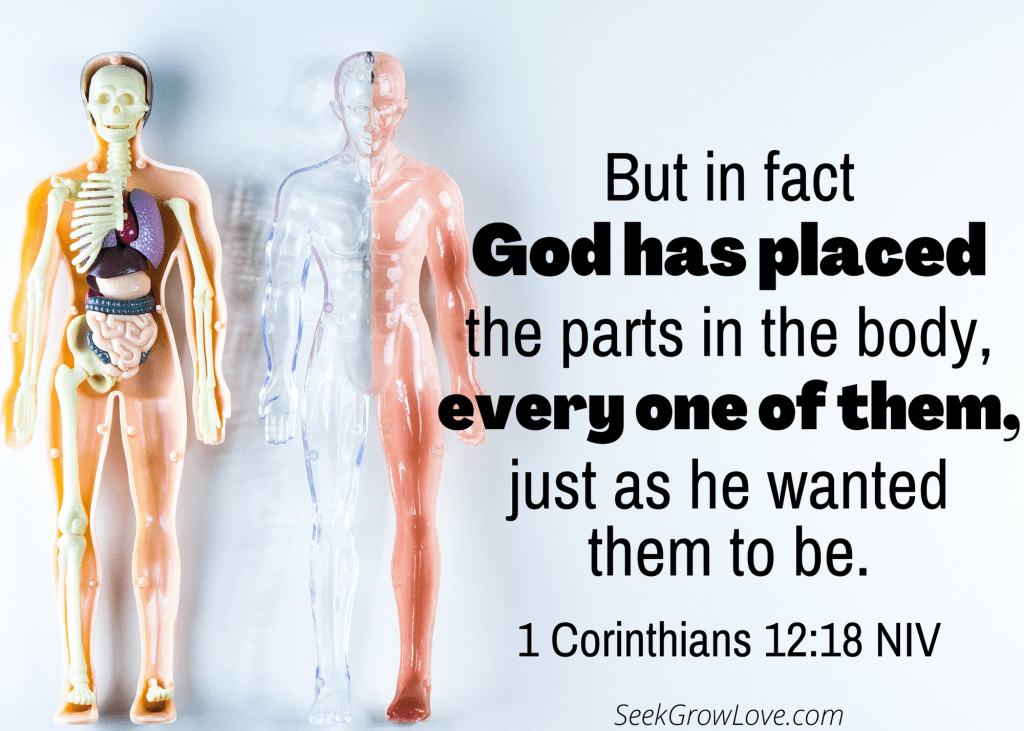
“But in fact God has placed the parts in the body, every one of them, just as he wanted them to be.” – 1 Corinthians 12:18

Now, for the bit with application.  We often give much love to the “showier” bits.  Those who take on a responsibility during a worship service or teach a class, but for a moment, think about the hidden parts among your church body.  Who stands watch (physically or emotionally) at the door of your church?  Who finds a way to create harmony between a foot and a hand vying for the same attention? Who shares their faith when doubt is beginning to spread among the believers?  It is time to take notice.  To recognize. Find a way to show this part of the body some love today. A call, a text, a card, a small token, or a chore done.  It is a very important bit of “self” care. Chances are they will be modest.  They will say they aren’t really doing anything important.  The truth is, they might be the very part keeping the church on their feet, preventing potential headaches, heading off a building rejection of the stomach, or simply lending a listening ear.  If they suffer, so do we, BUT if they rejoice, so do we.  We absolutely need all the parts to be the church we are called to be.

“On the contrary, those parts of the body that seem to be weaker are indispensable, and the parts that we think are less honorable we treat with special honor. And the parts that are unpresentable are treated with special modesty, while our presentable parts need no special treatment.” – 1 Corinthians 12:22-24a

–Aaron Winner

Today’s Bible reading passages can be read or listened to at BibleGateway here – Nehemiah 11-13 and 1 Corinthians 12

All Night Long

Matthew 12:1-21, Mark 3 & Luke 6

There were so many good topics from today’s reading, it was hard for me to pick just one for today’s devotion.  But I finally settled on discussing what Jesus did immediately before calling the 12 apostles.

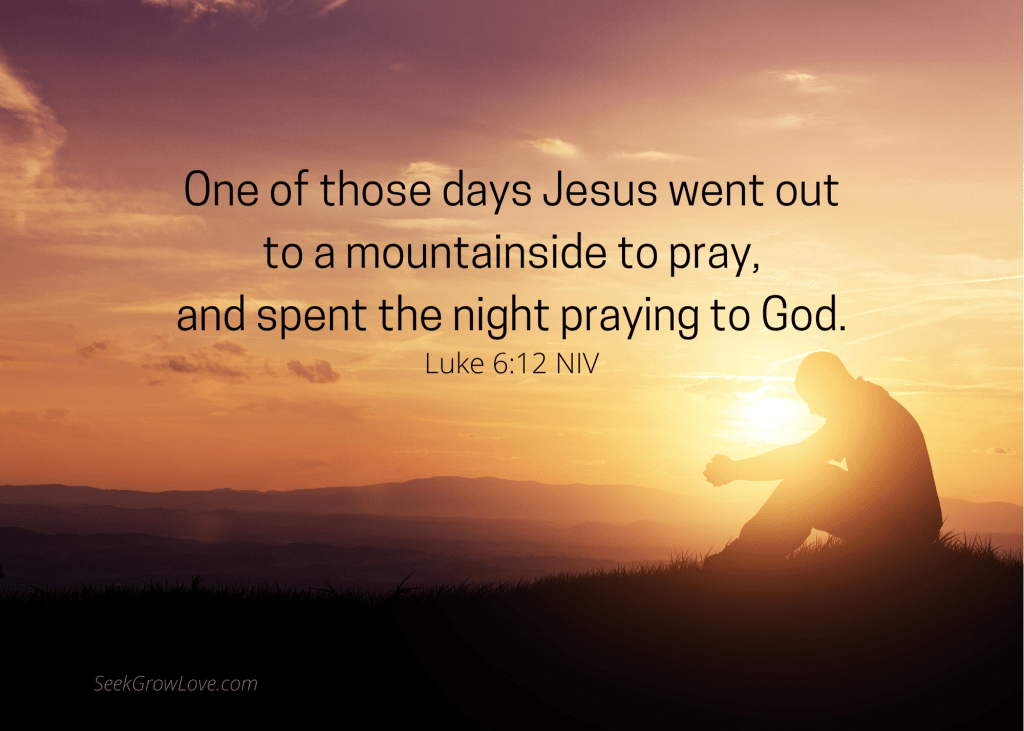
Jesus had many disciples following him.  A disciple is a follower, an apprentice, someone who is learning.  From among these followers, Jesus was going to choose his apostles – his chosen messengers with a special commission. We’re told in Luke 6:12, that before choosing his 12 apostles, Jesus spent the whole night in prayer.  Did you catch that?  Jesus spent the whole night praying.

Why would Jesus need to spend the whole night praying? First, opposition to him was growing – immediately before this story, we’re told the religious leaders wanted to kill Jesus.  He knew this would eventually end in his crucifixion.  I’m guessing he was praying for strength for the task that lay before him.  Second, this was a turning point in his ministry.  Until how, he had just been a one man show – a traveling preacher and healer.  Now he was picking the men who would be the foundation of the church after he was gone.  I’m guessing he was praying for discernment.  Finally, according to John 6:64, Jesus knew from the beginning who was going to betray him, and He was going to pick him as one of His apostles.  I’m guessing Jesus was struggling with emotions at that prospect; it was through prayer that He made this difficult choice.

We find many instances of Jesus devoting lots of time to prayer.  Whether it was getting up before dawn to pray, or sending the apostles away in a boat so he could pray, or … You get the idea.  But wait, Jesus was the Son of GOD!  In John 3:34, we’re told that Jesus was given the Holy Spirit without measure.  And He still spent a tremendous amount of time in prayer!

What should this mean for me?  

For starters, I suspect I need God’s help far more than Jesus did.  For one thing, I’m a wretched sinner, and Jesus was perfectly sinless.  Also, Jesus had the Holy Spirit without measure, me – not so much.  

From Jesus’ example, I see that I need to spend far more time in prayer, whether asking for strength, or for discernment, or struggling with emotions, or… for dealing with everything life throws at me.  And that’s just the requests for my needs.  Then, there are prayers for confessing and asking forgiveness.  Then, all the prayer requests for people I care about.  Then, there is honoring, praising, and magnifying God in prayer.  And the list goes on.  Bottom line – I need to spend more time in prayer.

What about you?  Will you join me in committing to spending more time in prayer?

This will not only benefit me and you, it may benefit the whole nation.  I’m reminded of one of my many favorite Bible verses, 2 Chronicles 7:14, “If my people, who are called by my name, will humble themselves and pray and seek my face and turn from their wicked ways, then I will hear from heaven, and I will forgive their sin and will heal their land.”

And God knows our nation needs healing.

— Steve Mattison

Today’s Bible passage can be read or listened to at BibleGateway here – Matthew 12:1-21, Mark 3 and Luke 6

Tomorrow’s reading will be Matthew 14, Mark 6 and Luke 9:1-17 as we continue on our Bible reading plan.

2 Chronicles 28 & 2 Kings 16-17

Storing up treasures in heaven is greater than receiving momentary glory and recognition.

Wishing blessings to everyone this week and all the time. Watching quizzing at FUEL on Tuesday was always a joy, and I always would feel the adrenaline on the edge of my seat watching many friends compete for the championships. At the end of the night watching brothers and sisters in Christ hoist up their trophies and see their hard work come full circle inspired me to want to know the word better and to celebrate them in their accomplishments.  


Looking at 2 Chronicles and King Ahaz, we see a young man become king when he came into a place of power. He angered the Lord because his deeds were for his own self and never gave glory to God nor sought the Lord’s guidance in his actions. Ahaz wanted glory for himself and provoked the Lord. He built alters and offered sacrifices that disgraced the Lord.

As humans we want to be known and want some of our deeds to bring us our own glory and recognition. Ahaz came to power when he was only twenty. He did not follow in the steps of his father, David. Sometimes we want to do things that honor us and get us recognized in front of our friends and others. It feels good, makes us feel worthy. Even when Ahaz tried to make amends, the Lord gave Judah over to those lands surrounding it. It continued with Hoshea as his deeds were evil in the sight of the Lord (2 Kings 17). God calls us to rely on him and give the glory to him for through him we accomplish all good deeds. God gives and he can also take away. God gave the Israelites what he promised them in the promised land. However, because of their disobedience and pride, God took it away.  2 Kings 17:12–13 explains why God let Israel fall as they turned from him. God wishes for us to seek and give glory to him and perform services in his honor. Doing such deeds brings more delight to him and feels you with spiritual delight than any earthly recognition. Storing up treasures in heaven is greater than receiving momentary glory and recognition. God has called you; do not forget these things as we read about others who forgot who their deliverer was. 

Right now, even though we aren’t close to one another, we can still celebrate the accomplishments and the deeds of our friends scattered around the US. This isn’t normal for us right now, but I want you to know I cannot wait for the time to celebrate, laugh, worship and hug everyone glorifying the Lord once again in the future and especially when the kingdom comes. 

“For all things are for your sakes, so that the grace which is spreading to more and more people may cause the giving of thanks to abound to the glory of God.” ~ ‭‭2 Corinthians‬ ‭4:15‬ ‭NASB‬‬

~ Evan Grant


Today’s Bible passage can be read or listened to on Bible Gateway – 2 Chronicles 28 & 2 Kings 16-17.

Tomorrow, we continue reading more about the history of Israel in Isaiah 13-17 – as we continue the 2020 Chronological Bible Reading Plan


Beware of the Buttkissers

1 Kings 22 & 2 Chronicles 18

1 Kings 22 5 NIV sgl

Yes, I know, a bit of a sensational title. In fact, I can hear my mom reaching for the Irish Spring to place in my mouth because “butt” is not a church word. Please give me grace just a few sentences longer as I am someone who spends a great deal of time at school with 11 and 12-year olds. I often use a bit of high-brow potty humor for the connection and to make sure that I have your attention.  From here on out, I promise <crossing heart> I will use yes-men, suck-ups, sycophants, or something similar, but we’ll both know that I truly mean <in a whisper> “the ones who kiss b-u-t-t.”

Scattered throughout the last couple of weeks, we have read about the life of King Ahab. Today we will finish off Ahab [spoilers ahead] in more ways than one.  Ahab has grown unhappy that a previously Israeli owned-city, Ramoth Gilead, is now occupied by the Syrian (Aram) people, the very nation that was given over to him by God (1 Kings 20).  No doubt that Ahab’s misintentioned mercy to the Syrian nation (Again 1 Kings 20) has become less than advantageous, contemptuous, or is now, simply biting him in the…rear.  Ahab forms an alliance with Judah’s king, Jehoshaphat, who says he will fight with Ahab to take back Ramoth Gilead if he consults the LORD first.  Ahab thinks, “No problem; I have plenty of prophets.”. Enter the yes-men.

‘So the king of Israel brought together the prophets—about four hundred men—and asked them, “Shall I go to war against Ramoth Gilead, or shall I refrain?”  “Go,” they answered, “for the Lord will give it into the king’s hand.” – 1 Kings 22:6

Jehoshaphat isn’t convinced by the mass of soothsaying suck-ups for a simple reason: they do not mention God, YHWH, which prompts his head-scratching statement “Is there no longer a prophet of the LORD here whom we can inquire of?” “But didn’t the prophets say ‘the Lord will give <Ramoth Gilead> into the king’s hand?’” You may have heard it before, but it is worth reminding, that not all “lords” are equal in most English translations of the Old Testament.  L-o-r-d means master, which is often used for God, but L-O-R-D is the indisputable proper name of God, the Father, YHWH.  The sycophantic seers have not consulted with the Almighty, but have most likely consulted one another, telling the king whatever they think he wanted to hear.    Ahab confesses there is still ONE prophet of the LORD, Micaiah, but he doesn’t like to use him because he doesn’t like to kiss-up like the others. In fact, Ahab’s reluctance shows that he most likely already knew the truth. Micaiah lives up to his reputation, delivering a Word from the LORD that was unfavorable to what Ahab had already set upon his heart to do.

Is Ahab’s folly not our own? As I read about his fatal flaw, I can feel my own groan, lurch, and tumult described by Paul in Romans 7:15-20, between what I have intentioned in my heart and what the LORD wants of me.  What makes it worse is the body of booty smoochers ready to tell me that fulfilling my desires are what will ultimately make me happy.  In 2020, it doesn’t take much searching to find 400 people that agree with you.  Just because a crowd has formed in agreement with you, it doesn’t mean they (or you) know what’s best.  There are well-established organizations, conferences, websites, movements, forums, etc. that have opposing views to God’s desire for your life.  No matter how convincing the mob, there is only one way to get the truth: The Word of the LORD.  Yet the fact of the matter is as I wrestle with my desire, my pride, and my sin, I’d rather hear comforting, confirming, justifying lies from hundreds than hear a truth from a single person that would convict me and cause me to change. This would mean that the problem doesn’t externally exist in the world I live in, but within me, which is the hardest thing to hear (and the reason why we don’t invite challenging scriptures or a truth-telling Christian friend to the party, i.e. Micaiah)

“The word of God is quick, and powerful, and sharper than any two edged sword, piercing even to the dividing asunder of soul and spirit, and of the joints and marrow, and is a discerner of the thoughts and intents of the heart.” – Hebrew 4:12

There is great advice in the word of Jehoshaphat, “First seek the counsel of the LORD.”  Before taking any course of action, no matter how great or small, let me stop consulting my social circle of “yes people” and search the Word of the LORD for discernment.  Almost always, our only reluctance is because we already know the answer that is buried not-so-deep within our heart. Let’s pray that God will bring his convicting truth to our aspirations and challenge us to listen to His voice only as He guides us to His way.


Aaron Winner


Today’s Bible passage can be read or listened to at https://www.biblegateway.com/passage/?search=1+Kings+22%2C+2+Chronicles+18&version=NIV

Tomorrow’s reading will be 2 Chronicles 19-23 as we continue the 2020 Chronological Bible Reading Plan