For such a short letter, John really packs a lot into it. The greeting, which, if I am being honest, often gets skimmed, offers some insight into what the letter contains. He mentions truth or the truth four times in the greeting alone. I think his point is that truth matters. So, what is the truth that he is talking about? Verse 9 talks about abiding in the teaching of Christ. This is the truth that is empathized in his greeting. Verse 7 says that a deceiver is one who does not confess (believe) that Jesus Christ came in the flesh – that he was a real man who lived on this earth. No one likes to find out they were deceived, tricked, or made to look foolish because they believed a lie. The truth is that Jesus is the Son of God, he did live on the earth, he did preach a message of the coming kingdom, he did die for our sins, he was raised up, and he will come back. We are to abide in that teaching, in that truth.
I looked up abide and was surprised at the many definitions it has. Here are a few:
to accept or act in accordance with
to remain in a stable or fixed state
to continue in a particular condition, attitude, or relationship
to be able to live with or put up with
Not only are we to abide in this truth, but to NOT abide in it is to NOT have God. That is a scary thought!
John provides a warning to us in verse 8 to “Watch yourselves, so that you may not lose what we have worked for, but may win a full reward”. He warns us because there will be “many deceivers” – many people who won’t be abiding in the truth about Jesus. The only way to know if you are being told the truth or if you are being deceived is to “test everything” (I Thessalonians 5:21). In order to do that, we need to know the truth ourselves. We need to “test” what we are being taught against what is in God’s word, the Bible.
Todd & Amy Blanchard
Questions:
Have you ever been deceived by someone? How did you learn about the truth and what steps have you taken so you aren’t deceived in that way again?
How can you apply that to being watchful with regard to your faith walk (walking in the truth)?
Being aware that knowledge of the truth prevents deception, how can you share your knowledge to help keep others from being deceived?
It is impossible for me to read this opening statement in 1 John 1:1 without immediately thinking of its strong parallel to John 1:1. John 1:1 says in the beginning was the word and 1 John 1:1 says that all they have seen and heard and touched – that was from the beginning (what beginning?) concerning the word of life. John was with Jesus from the beginning of his ministry, so he may be referring to the beginning of Jesus’ ministry. There is a lot to unpack here, so I will leave that for another day, but you can think about some of these correlations.
John says that they are proclaiming the word so that his readers may have fellowship with John and his community, as well as fellowship with God and Jesus through the ministry of the word (that is an implication of having true fellowship with John et. al.). Also, John emphasizes that he is writing these things so that joy may be made complete. True joy, that transcends all circumstances, is a direct result of having fellowship with God and Jesus in a life of faith (see also James 1 for insight into the relationship between authentic faith and joy).
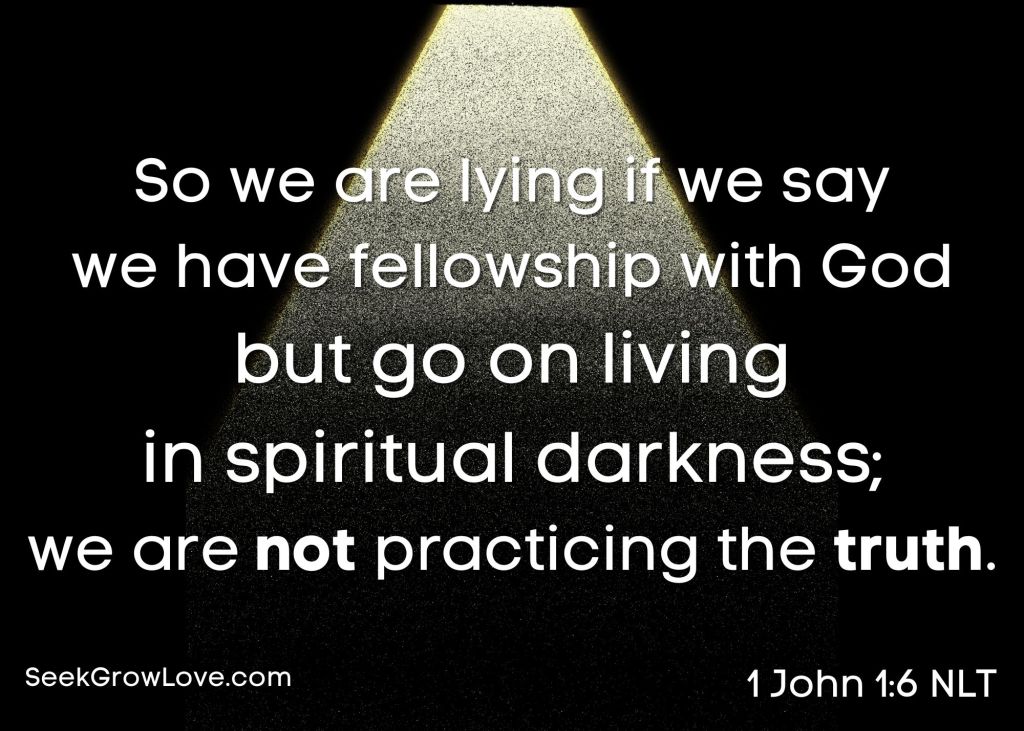
John then gets into a dichotomy between light and darkness. God is light and in him there is no darkness, therefore if we are walking in darkness (not in the midst of darkness but having elements of darkness ingrained into our life) we do not have fellowship with God. We are deceiving ourselves if we think that we can live a dualistic life embracing both God’s will and abiding in the ways of the world. Purity of heart precludes us from walking in darkness. If we’re doing this (walking in darkness), the implication is that we are liars and live a life that is antithetical to the truth.
Conversely, if we walk in the light (i.e., the truth, abide in the word), we have true fellowship with one another and we have our sins cleansed by the blood of Jesus. Walking in light does not mean that we have no sin, that would be a ridiculous assertion, but it means that we do not live lives defined by sin. We all stumble, but there is a difference between falling short and living in sinful pursuit. Our self-deception can come from being double-minded, or from a false notion that being forgiven makes us sinless. We are free from the bondage of sin through Christ, but we still fall short of perfection. In confessing our sin (and repenting of it), we are cleansed and through our faith are counted as righteous. If we don’t acknowledge our sinfulness, how can we confess (we can’t!)? Worse than deceiving ourselves, if we deny that we sin, we make God out to be a liar!
It’s not a good look to make God out to be a liar, so I would strongly encourage each of us to take into consideration our behaviors and not try to explain them in a way that denies the authority of scripture to call out wicked behavior and attempt to justify our (sinful) behavior as acceptable. Sin is offensive to God, so we should not attempt to explain it away as inoffensive. Confession is a powerful tool, and we should be quick to utilize this, rather than explain away or double down on any sinful elements that encroach on our lives. It is better to suffer for doing what is right now (deny our sinful desires) than to embrace sin and deception now and miss out on the amazing Kingdom of God (which will trump all imaginable satisfaction in this life).
-J.J. Fletcher
Reflection:
1. Do I regularly confess my sin to God? Do I confess my sin to other believers (1 or 2 people who you can trust) and reap the benefits of having accountability in brothers or sisters (who likely have had similar struggles) that can speak truth into my life?
2. What am I doing that could constitute self-deception? How might you assess and address this?
3. What relationships do I have that allow people to speak truth into my life? Do I surround myself with yes men? Do I live in an echo chamber? What changes can I make in my life that can help me more effectively eliminate sinful habits?
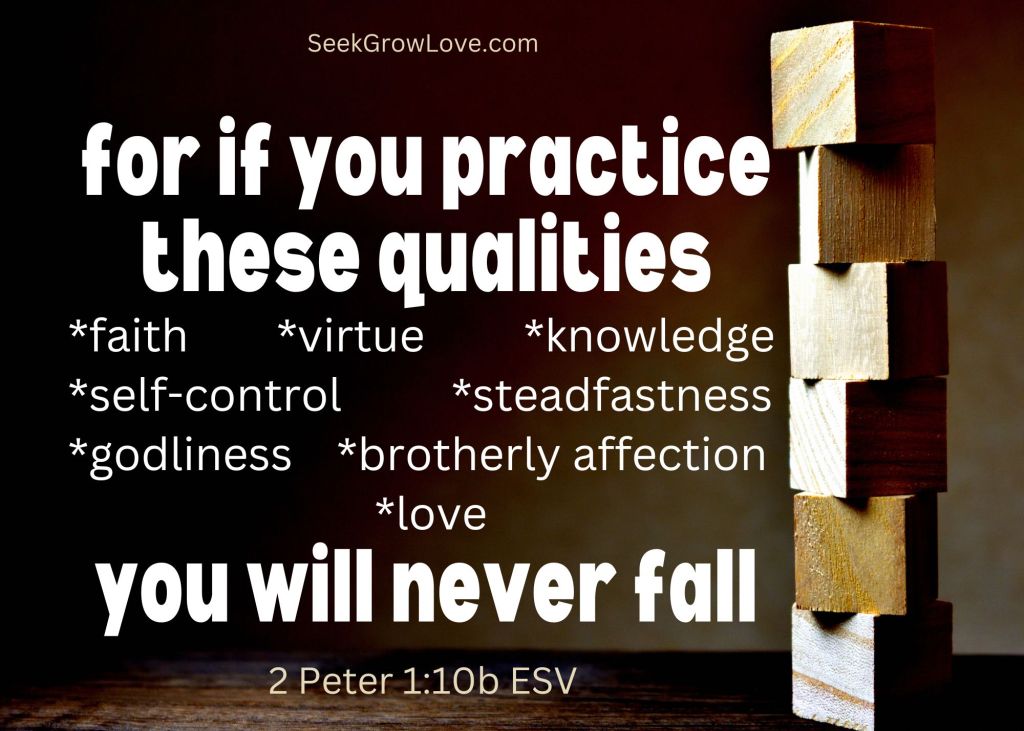
“His divine power has granted to us all things that pertain to life and godliness, through the knowledge of him who called us to his own glory and excellence, by which he has granted to us his precious and very great promises, so that through them you may become partakers of the divine nature, having escaped from the corruption that is in the world because of sinful desire. For this very reason, make every effort to supplement your faith with virtue, and virtue with knowledge, and knowledge with self-control, and self-control with steadfastness, and steadfastness with godliness, and godliness with brotherly affection, and brotherly affection with love. For if these qualities are yours and are increasing, they keep you from being ineffective or unfruitful in the knowledge of our Lord Jesus Christ. For whoever lacks these qualities is so nearsighted that he is blind, having forgotten that he was cleansed from his former sins. Therefore, brothers, be all the more diligent to confirm your calling and election, for if you practice these qualities, you will never fall. For in this way there will be richly provided for you an entrance into the eternal kingdom of our Lord and Savior Jesus Christ.” (2 Peter 1:3–11 ESV)
We have great and precious promises that have been made that will enable us to become partakers of the divine nature! As Jesus put on a new nature in his resurrection from the dead, so shall we when through faith, we endure through life’s many challenges and inherit the promise of the coming Kingdom of God.
Hebrews 11:1 says that “…faith is the assurance of things hoped for, the conviction of things not seen.” As we have faith that God will restore all things (Acts 3:21), upon our faith we must add virtue: meaning good quality of life or uprightness – not simply believing but living out our lives as something that reflects the nature of God’s goodness, justness, and righteousness. After believing and living a changed life, we are to add knowledge to that; we should always be striving to learn from God’s inspired word and learn from his spirit as it is active in us… And more than that, seek after his spirit that we might become more in line with his will and come to a greater understanding of its importance and how beneficial it is to us to walk in his ways.
Following the call to add knowledge, we encounter again the call to be self-controlled! It really does seem that much of what we read in scripture hinges on self-control and that circles back to our need to not stifle the spirit in our lives. If one of the elements that the fruit of the spirit brings forth in our lives is self-control, then we ought to do whatever it takes to drive away any behaviors that might cause God’s spirit to depart from us (Judges 16, 1 Samuel 16). Self-control allows us to endure – to stay on the course – as Paul might say, “to run the race”. We have to endure through all of the challenges and temptations that life throws at us, and we must allow the motivation of our hope, our uprightness, and the self-control that we are enabled to have through God’s spirit carry us through.
As we endure, we ought to have a reverential feeling or devotion to God, that’s what the Greek work translated godliness indicates. As we experience God’s goodness and see how His spirit works in us, we should feel more and more awe and reverence to our creator… After all, He put the plan into place that leads us into a life that transcends the brokenness that sin imparts on our lives – even though we sin and are affected by sin, God’s directives lead us onto a path that (through Jesus) casts that sin aside and draws us into community with him.
And as all these things are ingrained into our life, the part that affects others the most is the cherry on top… We are to have brotherly affection (love) as a defining characteristic in our lives! Love and care for one another as believers will lead us to speak into one another’s lives and help us when we hit rough patches. Even the most spiritually minded people hit dark periods in their lives (google the dark night of the soul). If we love our brothers and sisters in Christ, we will take the time to come alongside them, to care for them, to call them out, to admonish and encourage – brotherly affection means being intimately involved in the lives of our faith family – not being apathetic or half-hearted. We need to invest in each other as Christ has invested in us through his sacrifice (sometimes we must be self-sacrificial).
These qualities keep us from being ineffective witnesses and fruitless workers. We must be bearing the fruit of the word implanted in us (James 1) and strive to be effective ministers to the lives of those who are hurting and struggling. Peter says that whoever lacks these qualities is so nearsighted that he is blind! Yikes… lacking these qualities as I read this means that we cannot see beyond ourselves, and that it a tremendous problem when one of our chief goals is to preach the gospel to all creation.
If we take these qualities to head and practice them diligently it says we confirm our election (or being chosen out) into beneficiaries of the grace of God. Also, it says if we practice these things we will never fall. So, practice these things so that you may have entrance into the eternal kingdom of our Lord and Savior Jesus Christ (v11).
-J.J. Fletcher
Reflection:
1. Think about how Jesus exemplified all these characteristics listed in verses 5-7. If he had not exemplified all these things, would he have had the wherewithal to endure through his father’s plan of salvation through him? How can we expect to live exemplary lives if we do not take these characteristics to heart.
2. Think about the first 6 items listed (faith, virtue, knowledge, self-control, steadfastness, and godliness) and the final one: brotherly affection/love. What do the first 6 produce without the 7th? We’re designed (as individuals and as a church body) to be in community, how might we be rendered fruitless and ineffective if we excel at the 6, but lack the 7th?
At the beginning of chapter four Peter says to “arm yourself with the same way of thinking” aligning this directive with Jesus suffering in the flesh. While Jesus’ suffering was likely to exceed what these Christians endured, they were still facing a culture that might ostracize, if not outright persecute or kill them.
Peter points out distinctions in how the gentiles live according to the flesh (perverting many things that God intended for good), and how we as believers are to pursue the will of God – this means among other things giving up things that might feel good or make us feel like we belong.
We’ll home in on what Peter writes in verses 7-11:
“The end of all things is at hand; therefore be self-controlled and sober-minded for the sake of your prayers. Above all, keep loving one another earnestly, since love covers a multitude of sins. Show hospitality to one another without grumbling. As each has received a gift, use it to serve one another, as good stewards of God’s varied grace: whoever speaks, as one who speaks oracles of God; whoever serves, as one who serves by the strength that God supplies—in order that in everything God may be glorified through Jesus Christ. To him belong glory and dominion forever and ever. Amen.” (1 Peter 4:7–11 ESV)
Considering the coming kingdom (which is immanent, but we don’t know when it will come): Exert Self-Control! Many times, we see this attribute called for in the life of believers (at least 18 times in the ESV). Looking in the letter of James (which I preached from yesterday), lack of self-control can lead to self-deception. When we allow our thoughts to be clouded by worldly things or self-centered behaviors, we are going to miss what God would have us do. By being sober (or clear) minded we can think critically, and we need to think clearly so that we can be effective in our prayers. Jesus gave us a model by which to structure our prayers, but our prayers are not meant to be mindless or rote… We need to be looking at things through the lens of God’s spirit, which allows us to see things that our physical eyes cannot see. Think back to 1 Peter 3 where it says a man should live with his wife in an understanding way as not to have his prayers hindered – the way that we think, live, and act has a direct impact on how we pray and the effectiveness of our prayers.
We’re instructed to love one another earnestly, because love covers a multitude of sins. (Greater love has no one than this, that someone lay down his life for his friends. John 15:13). “…in the face of extreme social hostility, love will be necessary for spiritual survival. For Peter the primacy of love is accompanied by a qualification, and this qualification is a partial citation of Proverbs 10:12 similar to James 5:20—’love covers over a multitude of sins,’ rather than magnifying the faults of others. After all, love is patient and doesn’t keep a record of wrongs (1 Corinthians 13:4, 5)” (J. Daryl Charles, “1 Peter,” in Hebrews–Revelation, vol. 13 of The Expositor’s Bible Commentary Revised Edition).
How does the Church expect to thrive if we let piddly little things (or even larger disagreements) get in the way of caring for each other? How are we to expect to overcome the world through Jesus if we don’t exercise with others the grace that we have been shown (we all kind of stink at times, to put it mildly)?
We need to show hospitality in a world that that is oft inhospitable to Jesus’ way of living. If we’re inhospitable to other believers, they might find hospitality in places that will draw them away from the grace of God. We shouldn’t grumble when we have an opportunity to be hospitable, but rather see it as an opportunity to be the hands and feet of Jesus (Genesis 12 says Abraham was blessed to be a blessing, and through grace and mercy we’ve also been blessed to be a blessing as well).
In everything we do we need to do so viewing ourselves as representatives of God, as ambassadors of the kingdom, and imitators of Christ Jesus (Philippians 2:3-8).
-JJ Fletcher
Reflection Questions
How does my life look like the life of Jesus and how does it look different?
How does hospitality with fellow believers prime me to be hospitable to those who I disagree with?
Am I doing well at being self-controlled? What are my biggest obstacles to living in this way? Who can I ask for help or be accountable to help me in this endeavor?
Let’s pretend I’m going to build a house with stones.
First, I’d need a bunch of stones dumped in my yard. Then I would need to expertly stack them, making sure to pick the right stones that fit together and that don’t fall over in the breeze. I’d also need some kind of mortar or clay to hold them together. I can imagine some of the stones would be a bit too big to be lifting and moving around, so I’d need a tractor with a bucket, or even better, a crane. There’s a lot that would go into this.
Now let’s pretend I actually completed my stone house. I still have a giant pile of rocks that I didn’t use. Some are just weird shapes, or cracked, or plain ugly. There is one stone in particular that was my least favorite because I kept tripping over it. I don’t want anything to do with these stones anymore.
Now I throw a little stone house-warming party, and my neighbor comes over. He says, “Hey, I want to build a stone house, too. Can I use the stones you didn’t want? I’ve got just the spot for each of them, especially that one you kept tripping over.”
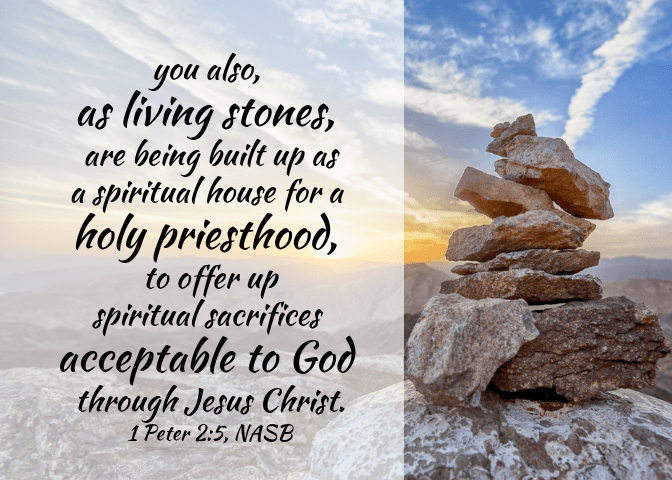
“Come to him, a living stone, though rejected by mortals yet chosen and precious in God’s sight, and like living stones, let yourselves be built into a spiritual house, to be a holy priesthood, to offer spiritual sacrifices acceptable to God through Jesus Christ.” (1 Peter 2:4-5 NRSV)
Now that we’ve heard and accepted the good news (remember yesterday’s reading?), we’ve become “living stones” to God. The world will look at us and scoff because we’re weirdly shaped and of no use to them, but God has a special use for all of us. He especially chose each of us for his project.
God is building us together into what Peter calls a “spiritual house” to be a “royal priesthood” to “offer spiritual sacrifices.” Peter is using this imagery to prompt us to imagine ourselves as the temple of God. The temple is a sacred space where the divine lives, just as we are to be sacred spaces where God’s spirit dwells.
The priests are like mediators between the divine realm and the world, helping to make connections between the two. For us to be a royal priesthood means that we have access to God that we are to share with others. We are to connect God and people. We are to bring people into the experience of who God is.
The last part of that is that we are to make “spiritual sacrifices.” Naturally, when we think of sacrifices in the context of a temple, images of bloody animals appear in our head. If not, then I just made you think of bloody animals, and you’re welcome. Peter’s not suggesting that we do the kind of sacrifice that requires killing animals, but the kind that requires doing the right thing even if (or especially if) it costs us something.
The perfect example we have of this, of course, is Jesus. In the face of suffering and rejection, he chose to do the right thing and offer his life on our behalf. Doing the right thing didn’t just cost him something—it cost him everything. God notices and responds to our sacrifices. In Jesus’ case, he was resurrected and exalted to God’s right hand. He was rejected by the world but made into the stone holding the whole house together.
We’re to follow Jesus’ example and be willing to put ourselves in God’s hands as we do the right things, knowing we could very well lose something in the process. Just as God saw Jesus’ sacrifices, he will acknowledge and respond to ours. That doesn’t mean that we should do good things expecting a reward, but that God is just, and will remember the trouble we went through while pursuing His purposes.
We know the world is going to be skeptical of our stone house. One hope is that through being God’s servants and living blamelessly (doing the right thing), the world may look at us and see honor in what we do. We are witnesses and priests to them, representing God to them as Christ did to us. We can hope that the fruit of our sacrifice is that God can gather even more living stones to make the stone house bigger and stronger.
Thanks for coming along with me this week on our journey through the book of James and the beginning of 1 Peter.
-Jay Laurent
Internal Inquiries
1. How does it make you feel knowing that God chose you to be one of his living stones?
2. What kinds of spiritual sacrifices have you made? What did it cost you?
Everything is dying. Your phone’s battery is draining and will need to be recharged. Your phone itself will someday give out or become so slow or outdated that you’ll need a new and shiny one. But that one will die too. Your car will get you places…until it doesn’t. Your body itself will eventually lose its ability to sustain the delicate balance known as life, and will stop functioning altogether. This will happen to you, everyone you know, and everyone you don’t know.
The human race and life on earth are in deep trouble if the wrong supervolcano decides to erupt or if a very large random rock hurtling through space collides with earth. Our existence is a very delicate thing.
Even the sun as we know it is dying. It’s said that in somewhere around 4 to 5 billion years, our sun will eventually begin to die as its hydrogen fuel runs out. It will swell to a red giant and swallow at least Mercury, Venus, and our own planet before becoming a white dwarf.
It’s predicted that eventually the universe itself will expand hopelessly into a cold and dark nothingness of no usable energy. It’s called “heat death” and is a lot like winter, but much worse.
That’s a lot to take in all at once. The realization that everything we know is fading away can lead us to a dark place. It may remind you of Nietzsche’s caution that “if you gaze long enough into an abyss, the abyss will gaze back into you.” What gives? Is there anything that lasts?
“For ‘All flesh is like grass and all its glory like the flower of grass. The grass withers, and the flower falls, but the word of the Lord endures forever.’ That word is the good news that was announced to you.” (1 Peter 1:24-25 NRSV)
Not everything dies and fades away. Peter is telling us that the good news you were given—the word of God—endures forever. To us, the phrase “word of God” can often mean the Bible, but the way the Bible uses it is so much more broad and rich. I tend to think of it as something like God’s life-giving wisdom, through which he created everything. In John 1 we can read about how Jesus, through his life and ministry, became the perfect embodiment of that word among us, carrying on another chapter of something that was always there.
That chapter seemed to come to a close when Jesus was executed. To his followers, it must have felt like all hope was lost. But we know how that story ends up! We are shown there is more to come when Jesus is resurrected. It’s another chapter of this everlasting word.
As there was more to come for Jesus, there will be more to come for us. Because of Jesus’ resurrection, we are given hope and an inheritance that won’t fade away. Jesus is said to be the “firstfruits” of the resurrection, meaning his was the first resurrection, and we’re given confidence ours will be yet to come.
Paul tells us in 1 Corinthians 15 that through resurrection, the dead are “sown” perishable, but raised imperishable. Resurrection transforms things that have perished (or would perish) into things that can’t perish. It transforms the dust of the ground into something new and alive and beautiful. Remembering that Jesus was transformed from a dead man into some kind of mysterious, eternal, resurrected being, we embrace the living hope that someday we’ll experience the same transformation.
As we reflect on how resurrection will transform us, there are hopeful rumblings that it will transform all of creation into a new heaven and a new earth. How mind-blowing is it to think of an entire universe raised imperishable? What does that even look like? That’s such an amazing mystery to think about!
There’s no way for me to know how long I’m going to live, or how long there will be an earth or sun or universe. I do, however, know that God outlives all of those things! If God is around, there is always more to come. There is always another chapter of the word.
So let’s not grasp at the things that are going to die and fade away. Instead, let’s keep our hope in what will last forever—what Peter calls “the living and enduring word of God.”
-Jay Laurent
Questions to ponder
1. What might Peter say our response should be now that we’ve heard the good news (hint: verses 13-16 might offer a good start)?
2. What other things besides the word of God do you think are “imperishable”?
Conflicts and violence are problems we humans have always dealt with. If only there were some insights in the book of James to help us understand why, and how we might be able to help the situation.
“Those conflicts and disputes among you, where do they come from? Do they not come from your cravings that are at war within you? You want something and do not have it; so you commit murder. And you covet something and cannot obtain it; so you engage in disputes and conflicts. You do not have, because you do not ask. You ask and do not receive, because you ask wrongly, in order to spend what you get on your pleasures.” (James 4:1-3 NRSV)
James says the source of conflict is the cravings at war within us. We covet things that we don’t have, and perceive that there isn’t enough to go around, leading us to take what we want by force, many times at the expense of others. We’re wired so deeply for survival that the fear of scarcity often drives us to get what we need in whatever way we can. It’s both a blessing and a curse.
The passage goes a level deeper into the investigation and explores why we don’t have what we need: It’s because we don’t ask. That’s something I’m not good at. I often feel uncomfortable asking someone else for something, because I think it’s my own responsibility to take care of it. By not asking, I’m underutilizing one of the biggest strengths of being part of family and community. There is more than enough to go around if asking and sharing happen freely.
There’s another layer to this. Sometimes when we ask, we don’t receive because we ask with wrong or selfish motives. By chasing after the wrong things, we are fueling the fire of conflict. James is prompting us to take inventory of our desires and motives. It’s not wrong to need or want things, but the challenge is to seek the right things with a pure heart.
James continues his train of thought by contrasting “friendship with the world” and friendship with God. When we seek things with the wrong motives, we make ourselves friends of the world, and therefore enemies of God. Instead, make yourself a friend of God by humbling yourself and submitting to the leading of his spirit that lives within us. Set aside your selfish desires, as painful as that may be, and ask for truly good things.
James is offering us an antidote to conflicts and violence, advocating for a more peaceful way—partner with God (“draw near” to him) by properly aligning your desires. Seek after and ask for the right things, and have enough as you share in God’s abundance and grace.
-Jay Laurent
Questions to consider:
1. What are some things you need or want, but don’t have?
2. Do you think these needs/wants are because of selfish desires, or are they good things to seek after?
I get to finish the book of Hebrews today with you, and wow have we covered a lot! The last chapter is full of little gems like marriage, money, peace, faith, prayer… each are uniquely different, making it hard to write a quick devotional. So, I’m going to cover the topic that spoke the most to me this week! You may be drawn to a different aspect of the text, and I encourage you to listen to God’s voice and what He has to tell you versus my own thoughts and ideas. Hopefully I’ll have something to add though!
I’m going to focus on the relational aspect of this chapter. Verses 1 and 2 talks about loving others; specifically, strangers. Now, it may be the “Minnesota-nice” in me, but I seriously love this reminder! One of my biggest pet peeves is when people are rude to others they don’t even know. Anytime I encounter someone new who is rude, or even just has a scowl on their face, it automatically turns me off from anything they have to say.
We are told to be examples of Christ, and as Christians, we absolutely are whether or not we think so! If we are outspoken in our faith, if someone knows you go to church on Sundays, or whatever the situation might be, to anyone we interact with, we are examples of Christianity as a whole. That is a big responsibility! These verses are great reminders to love one another and to show hospitality to everyone we meet. Who knows, maybe you’re loving on an angel!
Skipping ahead just a bit to verse 16, we have another reminder in how to act towards others. We are told to do good and share with them. Obviously, this is another way in which we can show the love of God and demonstrate Christianity to new believers. But, I’ll be completely honest, I’m not always in the best mood to share or do good for other people. And quite frankly, sometimes people don’t deserve it! But this verse isn’t telling us to do these things for other people alone. We are told to offer these things as sacrifices to please God. Depending on the person, sacrifice might be a good word to describe it! I think it makes it easier to do good and share if I think of doing it for God versus for man.
Looking at the word sacrifice in verse 16 and the verse directly before that, I am reminded at how the Hebrews originally viewed that word. Remember, they are still learning that sacrifice no longer has to be the shedding of blood! That must have been a little confusing to go from sacrifice being blood to being worship and sharing! This is just another way that shows how drastically Jesus can change our lives. He took the unclean, messy, death and changed it in to praising God and showing love to others!
We are so incredibly lucky to have a Savior that has changed our world for us. As a show of gratitude, we can focus on loving one another and spreading the same grace we receive from him to others. In times like this when our world is hurting from the loss of people to things such as mass shootings, plane crashes, abortions, wars, natural disasters, and so many other horrible things in this life, I encourage you, brothers and sisters, to show a little love.
Grace be with you all!
-Sarah Blanchard Johnson
(originally posted for SeekGrowLove on February 17, 2018)
Application Questions
Reading through Hebrews 13 which of these final instructions is most powerful to you?
How will you share and do good to others this week – remembering that this is your sacrifice which pleases God.
Previously, in chapter 8, the author disclosed that Jesus has now obtained a superior ministry and is the mediator of a better covenant that is enacted on better promises (8:6). While the author has simply made this assertion, it now remains for him to explicate how Jesus’s ministry is “superior.” And it is in chapter 9 that the author takes up this very task.
In the 1st part of the chapter, the author recounts the old covenant ministry under the Mosaic Law. There was a tabernacle and sacred items and a place where atonement was made by priests. Yet, it says that “this is a symbol for the present time…until the time of restoration” (vv. 9-10).
All the institutions of the old covenant were limited because they “cannot perfect the worshiper’s conscience” (v. 9). They mandated various sacrifices and rituals which by their nature were unable to bring the worshiper the true cleansing that was the intended goal of atonement and salvation.
But, in verse 11, the author now turns to present the superior ministry of the Messiah in the new covenant. Throughout the rest of the chapter, the author goes into great detail about how Jesus as our high priest in the new covenant has accomplished everything that the former covenant and regulations could never achieve. Everything from the cleansing of the tabernacle to the sprinkling of the blood of the sacrifice was done by Jesus, not in the earthly tabernacle, which was a copy of the heavenly reality, but in the heavenly tabernacle by offering himself as the “better sacrifice.”
Jesus’ sacrifice was “better” in at least two regards. First, the author says that Jesus did not offer a sacrifice many times as the high priest in the former covenant had to because he entered the tabernacle every year. Jesus entered the sanctuary in the presence of God only once. Second, Jesus did not offer the “blood of another” by bringing an animal sacrifice like the high priest of the previous covenant but rather offered his own blood as the sacrifice for sin.
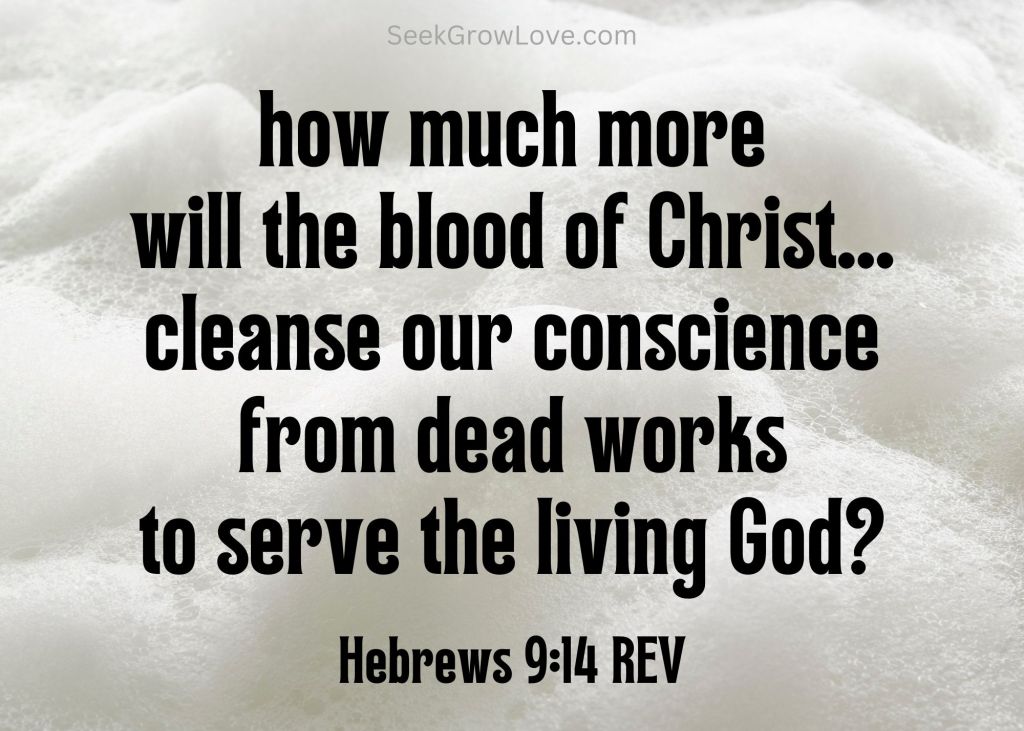
As verses 13-14 say, “For if the blood of goats and bulls and the ashes of a young cow, sprinkling those who are defiled, sanctify for the purification of the flesh, how much more will the blood of the Messiah, who through the eternal Spirit offered himself without blemish to God, cleanse our consciences from dead works to serve the living God?” What the author is comparing is that if under the old covenant the animal sacrifice was sufficient to sanctify the worshiper for the purification of the flesh, then the blood of Jesus must be able to do more than that.
And this is exactly his point: Jesus’s sacrifice is able to do what the old covenant sacrifices never could, and that is to cleanse our conscience from “dead works,” which are the sinful deeds that lead to death and require forgiveness and healing. The old covenant had no power to cleanse the worshiper’s heart from their sinful deeds.
But praise be to God that through Jesus and his sacrifice our minds and hearts can be washed clean of our sin and that we may with a pure conscience “serve the living God.”
-Jerry Wierwille
Application Questions
Compare the conscience of a sinner under the old covenant to your conscience under the blood of Jesus. What makes the difference?
How will you use your pure conscience to serve the living God today?
In verse 6 of Hebrews chapter 8, it states that Jesus has now obtained a superior ministry and therefore is the mediator of a “better covenant” with “better promises.” What then follows in verses 8-12 is the longest consecutive Old Testament quotation in the New Testament. The quotation comes from a section in chapter 31 from the Prophet Jeremiah.
Now, when the author of Hebrews says that Jesus is the mediator of a “better covenant,” it doesn’t mean that the covenant is just a little bit better. It is indeed better, but how much better? Is there a way that we could quantify the degree of “betterness” that characterizes the new covenant? I don’t think so.
The new covenant is greater and better than the old covenant to such a degree that a comparison is nearly impossible. Perhaps we might say that the distance between the two covenants is like the difference between the height of the earth’s atmosphere and then the height of the universe. As glorious as the old covenant was, it was still imperfect. But, the new covenant brings the perfection that the old covenant pointed toward and prefigured in a typological way.
And with Jesus mediating a new covenant, this indicates that the old covenant is obsolete and no longer needed since the new covenant has totally eclipsed its purpose and function. Everything that the old covenant stood for and provided—the ways that it conveyed God’s law to his people, revealed the knowledge of him, and made provision for atonement for sin—has been fulfilled and superseded in the new covenant by Christ himself.
The new covenant promises which surpass anything that the old covenant offered was prophesied by Jeremiah when he wrote, “I will put my laws into their minds and write them on their hearts. I will be their God, and they will be my people. And each person will not teach his fellow citizen, and each his brother, saying, ‘Know the Lord,’ because they will all know me, and the least to the greatest of them. For I will be merciful to their wrongdoing, and I will never again remember their sins.”
Therefore, it might help to think about the new covenant as being the “best covenant” because there will not be another covenant. There will be no “new covenant 2.0” or the “new revised covenant.” Nothing that can improve the new covenant any further. God’s law is in the hearts and minds of his people, he instructs them in his ways, all God’s people know him, and he has forgiven their sin completely, never to remember it.
The light of the new covenant is so far greater than the light of the old covenant that the old covenant simply pales in comparison. The well-known colloquial idiom, “It doesn’t even hold a candle to it” seems apt to apply here where if we imagine the new covenant having the glory and radiance of the sun, then what source of light can compete with it. The old covenant is like the moon, when reflecting the sun, the moon provides just enough light to walk around at night and see most objects near you. But it is still dark, and the potential to stumble or trip is very real. However, the light of the new covenant is like noon day where everything is illumined, and we now walk with full vision of what is before us.
The new covenant is better in every way, and we are able to receive and experience all of these better promises it has to offer. Let us count ourselves blessed to have a Savior who mediates this superior covenant that we can enjoy.
-Jerry Wierwille
Application Questions
What are the differences between the old covenant and the new? (You can find several differences in this chapter alone, but
Why do you think the all-knowing God didn’t just start out with the best/new covenant?





 Seek Grow Love