When Human Understanding Fails

Job 16-20

Job 16:1-6(NLT) Job’s Fifth Speech: A Response to Eliphaz
1 Then Job spoke again:
2 “I have heard all this before.
What miserable comforters you are!
3 Won’t you ever stop blowing hot air?
What makes you keep on talking?
4 I could say the same things if you were in my place.
I could spout off criticism and shake my head at you.
5 But if it were me, I would encourage you.
I would try to take away your grief.
6 Instead, I suffer if I defend myself,
and I suffer no less if I refuse to speak.

Bildad then answers Job back again reasoning from human understanding and tradition that he has observed.   If Job is being punished by God then there surely must be a reason for it. 

Job 18:5-14(NLT) “Surely the light of the wicked will be snuffed out.
The sparks of their fire will not glow.
6 The light in their tent will grow dark.
The lamp hanging above them will be quenched.
7 The confident stride of the wicked will be shortened.
Their own schemes will be their downfall.
8 The wicked walk into a net.
They fall into a pit.
9 A trap grabs them by the heel.
A snare holds them tight.
10 A noose lies hidden on the ground.
A rope is stretched across their path.
11 “Terrors surround the wicked
and trouble them at every step.
12 Hunger depletes their strength,
and calamity waits for them to stumble.
13 Disease eats their skin;
death devours their limbs.
14 They are torn from the security of their homes
and are brought down to the king of terrors

Job continues to say “I” have done this, “I” have done that, or “I” have said, showing that he has not grasped why the situation that he is in has happened.  All the arguments that the miserable comforters expound are based on a human viewpoint, not on the righteous requirements of a just God.  We want the outcomes of our lives to be based on the good things that we do, not on the grace which God only can give us.  Without God we would all perish instantly with the Adversary able to accuse us just as Job with consequences ending in death.  If God was not good and gracious all would perish from the earth.

In Job 19 the section of his discourse includes these cherished words:

Job 19:23-29(NLT) “Oh, that my words could be recorded.
Oh, that they could be inscribed on a monument,
24 carved with an iron chisel and filled with lead,
engraved forever in the rock.
25 “But as for me, I know that my Redeemer lives,
and he will stand upon the earth at last.
26 And after my body has decayed,
yet in my body I will see God!
27 I will see him for myself.
Yes, I will see him with my own eyes.
I am overwhelmed at the thought!
28 “How dare you go on persecuting me,
saying, ‘It’s his own fault’?
29 You should fear punishment yourselves,
for your attitude deserves punishment.
Then you will know that there is indeed a judgment

Job speaks absolutely the truth about judgment coming for all.  The revelation that there will be a Redeemer on the earth, and that this is his deliverance is amazing.  Bodily resurrection is also foreshadowed here which also lights up the Word to our eyes. 

Remember as we read the book of Job that the overriding theme is that this is the oldest lesson in the world.  Man cannot justify or give himself righteousness.  Only God is righteous and we can receive it from Him by His grace.

-Tom Siderius

Questions for Reflection:

Have you ever used the logic of the comforters using human experience to explain God’s works?

Are the speeches and answers helping you to understand the futility of our human mind to explain our life experiences?

Portal

Old Testament: Nehemiah 9 & 10

Poetry: Psalm 23

*New Testament: John 3

“Indeed, God did not send the Son into the world to condemn the world, but in order that the world might be saved through him.” John 3:17 (NRSV)

What does it mean to be saved? We all know the correct Sunday school answer. Yes, Jesus died on our behalf so that we can be forgiven of our sins and receive eternal life. I believe this is true, and at the same time, I believe the concept of salvation has to go deeper and wider than that simple transactional formula.

There’s an important question that needs to be asked. Saved from what? We all have a concept of what being saved from something looks like. Stranded on an island, you are saved by the passing boat that just happened to see your fire. You’re trapped in a burning building, but a courageous firefighter is able to find you and carry you out just before the building collapses. These are the scenarios that play out in our imaginations, the books we read, and the movies we watch. 

Is being saved any different in the Bible? The Old Testament has a fairly developed idea of salvation, but the goal of the “afterlife” is really not in view. It hints at the concept of resurrection at times, but that belief didn’t fully develop until sometime in between the Old and New Testaments. In the Old Testament, salvation is usually about deliverance from a real physical threat. A prime example of this is the Israelite exodus out of Egypt. They were being delivered out of slavery, oppression, and a very close call with death itself. The focus of salvation in the Old Testament is also much more about the collective than the individual. A large theme in the prophets is the restoration and healing of the people and nation, with deep connections to the covenant between God and his people.

The concept of salvation does evolve in the New Testament, but keeps its roots firmly planted in the soil of the Old Testament. Salvation in the New Testament finds its center in the person and ministry of Jesus. It becomes more inclusive by expanding out from the Jews to all nations and people groups. While collective salvation remains a reality, individual salvation is brought into the conversation more. There grows to be more emphasis on grace, eternal life, and the new covenant.

So far I haven’t answered the question of what we are being saved from. Consider John 3:36 (NRSV) – “Whoever believes in the Son has eternal life; whoever disobeys the Son will not see life, but must endure God’s wrath.” On the surface, it sounds a bit like we need to be saved from an angry God who will hunt us down and deal out the punishment we deserve. That is the mental picture that comes to mind with the word “wrath,” but it doesn’t best reflect the character of God. What could instead be meant by the “wrath” of God?

There are consequences to sin. We know that ultimately, those consequences lead to death (Rom 6:23). It may be that God disciplines or punishes us for our sin in an active sense, and at the same time, some of the punishment and suffering we feel is due to natural consequences of what we have done. When we sin, we separate ourselves from God and cultivate a living “hell” in our life and in the lives of everyone around us. We are then living in a space that invites destruction and death. God doesn’t have to threaten to punish or destroy us, because left to our own devices, we may very well just destroy ourselves. I may be taking an interpretive risk here, but maybe “wrath” is primarily God allowing us to suffer the natural consequences of our own stupidity. 

What we need to be saved from is our state characterized by exile, separation from God, Sin, and Death. The meanings of those things overlap and tangle so much that we might as well be talking about the same thing. Instead of living in our own twisted upside-down realm, we are meant to experience abundant life under the rule of our merciful God. Jesus didn’t show up to condemn us, but to invite us back to where we really belong. He is the mediator who was able to restore our connection to the divine. He’s the portal back to the realm where we belong.

Salvation is still very much about us being delivered from a real threat. We are being delivered from our own hazardous wasteland into the Garden, and we are called to be cultivators of the grace, abundance, and life that grow there. Salvation has as much to do with the present time and place as it does with eternity.

-Jay Laurent

Reflection Questions:

1. What have you been saved from, or how have you experienced salvation?

2. What do you think it means when Jesus tells Nicodemus he must be “born from above”?

Is it Worth It?

Old Testament Reading: Exodus 13 & 14
Psalms Reading: Psalm 35
*New Testament Reading: Romans 5

Some may be tempted to think the burden of living a Christian life just isn’t worth it.  Life is boring, you can’t have any fun, and all the rules make life almost not worth living.  If someone ever thought that, Romans 5 is for them.  This is an exciting chapter in an exciting book.

Romans 5 talks about justification – which refers to how a person can be declared righteous before God through faith in Jesus Christ.  The first half of Romans 5 talks about the benefits of being justified, and the second half tells how justification is possible.  

You might think the benefits are just for the future, limited to eternal life in God’s future kingdom.  Think again.  There are real benefits to living a life completely sold out to God right here and right now.

Romans 5:1 starts out in the past tense, “Therefore, since we have been justified through faith, we have peace with God through our Lord Jesus Christ.”  (Chapter 4 pointed out that being justified before God has always been through faith, not through works.)  If we’re living the life God called us to live, and we are living by faith, we have been reconciled to God through Jesus.  If we meet the criteria, whatever else we have done in our past is forgiven, and we have been declared righteous.

We’re told the alternative in Isaiah 48:22, “There is no peace, says the Lord, for the wicked.”   Peace with God versus no peace.  Let me think, which should I choose?  I want peace!  When you live a life of sin, you’ve declared war against God.  If you’re currently at war with God, how’s that working out for you?  Consider peace.

Romans 5:2a continues by talking about the present, “through whom [speaking of Jesus] we have gained access by faith into this grace in which we now stand.”  In the Old Testament, Jews didn’t have direct access to God.  Only priests could even enter the tabernacle, and only the high priest could go into the Holy of Holies only once a year.  And Gentiles couldn’t even come into the inner courtyard.  Through Jesus, we have gained access to God’s grace, and ultimately to God.  And this is for today, not just in some distant future.  We can boldly approach His throne of grace, and pray directly to God in Jesus’ name.

Romans 5:2b tells of the future “And we rejoice in the hope of the glory of God.”  When Jesus returns, the faithful will live eternally with God.  That’s not just a “hope” in the ordinary meaning of the word, that is our assurance.  And in the assurance for our future, we can rejoice today – no matter what problems today may bring.  Again, I want that tangible benefit today.  Especially when times are tough.

The next passage points out that we won’t be immune from suffering, just because we have a great relationship with God.  But instead of destroying us, that suffering will be for our benefit, building Christian character, and making us more firm in our future hope.

Romans 5:5 finishes this paragraph by saying, “And hope does not disappoint us, because God has poured out his love into our hearts by the Holy Spirit, whom he has given us.”  As we wait for our future hope, we also have the love of God in our hearts today (that goes right along with the peace above).

The next section tells us that God loved us so much, that while we were still sinners, Christ died for us.  We didn’t deserve it.  In fact, since we were at war with God, we deserved only death.  That shows how much God loved us, even when we were in open rebellion against Him.  So since we have been justified, we have been reconciled with God, and He will save us from His coming wrath through Jesus’ blood.

I’d say all of this is a powerfully compelling reason to live a Christian life today, completely sold out to God.  Even if there wasn’t a future reward (which there is!).

The rest of Romans 5 tells us how we are justified, but first, it reminds us how sin entered the world.  Adam sinned, and all of his descendants inherited his punishment – death.  You might think that isn’t fair.  Honestly, God was gracious in establishing this pattern, and I’ll explain why.  If each of us had the opportunity of never dying in this current age if we just didn’t sin, we’d still all sin, and all die.  So the result would be the same as inheriting our punishment from our first ancestor.  But since God established the pattern of one person earning something, and many others inheriting that… God was able to use the same pattern to have Jesus live the only perfect life, and to have his spiritual descendants inherit His reward.

This shows God’s incredible grace.  One sin caused innumerable deaths, even for those before Moses (when the law was given) who didn’t break a specific law of God.  But Jesus’ one act of obedience – paying the penalty for sin with his perfect life – was after a seemingly infinite number of sins.  Romans 5:19b says, “…so also through the obedience of the one man the many will be made righteous.

The bottom line is this:  Only Jesus deserves eternal life, because only Jesus lived the perfect life God requires.  Jesus wrote us into his will with his blood, leaving his reward (eternal life) to those who would believe in him and live the life God called them to live.  Jesus died to put the will in effect.  He now lives, and is distributing some of the benefits of that will to believers today including: 

  • Peace with God
  • Access to God’s grace and to God himself
  • Hope today for a future in God’s kingdom
  • Building Christian character through suffering
  • God’s love in our hearts

The final distribution of Jesus’ will will be at the Great White Throne Judgement when Jesus will judge the living and the dead.  Those whose names ARE NOT found in the book of life will be thrown into the fiery lake of burning sulfur.  This is the second death.  Those whose names ARE found in the book of life will have God “wipe every tear from their eyes.  There will be no more death or mourning or crying or pain.” (Revelation 21:4) And will get to live with God and Jesus in paradise forever.

So, is it worth it to live a Christian life?  As for me, absolutely!  Sign me up!  

What do you think?

-Steve Mattison

Reflection Questions

  1. Is it worth it to you to live a Christian life? Why? What benefits do you receive? What is the alternative and the consequences?
  2. What do you know about God from your reading today? Thank Him.

More Opportunities

For God’s Children To Have a Relationship with Him

Isaiah 43-44 and 1 Timothy 3

When you read through Isaiah 43 and 44, what do you see?

I see a God who loves His people, whom He has chosen.  I see a God who shows mercy and patience.  I see a protective God.  I see a jealous God.  I see a God full of power and authority.  I see a world full of broken and lost people.  I also see a Father whose children have ignored Him.  I see a Father who knows there are unrighteous people in the world trying to pull His children off the path of righteousness.  I see a Father longing for a way to have relationships with His children.  I see children who do not understand what they are missing.

All of the great qualities we observe in or read about our God can seem far away when looking at the Old Testament and reading that He set His chosen people aside for destruction and abuse, or when we see large groups of people destroyed, or when the barbaric sacrifices of animals somehow allow for the forgiveness of sins.  I feel at times that the God of the New Testament seems to be much more loving and gracious than the God of the Old Testament.  And yet, since creation, God has had a plan for redemption not just for His chosen people, but for all who called upon His name.  The whole thing can be a bit confusing if I am being honest!  I have to remind myself that God has never changed, He has simply created more opportunities for His children to have a relationship with Him.

The Christian faith is one of just that, faith.  We can scientifically prove many of the events that have happened in the Bible did in fact happen.  However, the idea that an omnipotent God who has created everything in existence chose to create a group of imperfect beings to be made in His image with the purpose of praise, but then those imperfect beings were given free will and ruined it so He had to send them away but He still made a way for them to come back to Him but it still didn’t make them perfect enough so He sent a perfect being as a sacrifice for all the imperfect beings but then the perfect being came back to life to offer hope to the imperfect but the imperfect ones kept making the creation less perfect so one day the perfect one has to come back and fix the imperfect forever so that the omniscient one can live with the imperfect ones who will now be made perfect……Let’s be honest, it doesn’t make sense.  God’s grace requires faith to accept! 

1 Timothy 3:15 – 16 says “…This is the church of the living God, which is the pillar and foundation of the truth.  Without questions, this is the great mystery of our faith: Christ was revealed in a human body and vindicated by the Spirit.  He was seen by angels and announced to the nations.  He was believed in throughout the world and taken into heaven in glory.”  

Our God is a living God.  He has been at work in the nations from day one, and He has had a plan for us to all live in relationship with Him from the start.  Why?  I have no clue.  But faith allows me to know that this is true, and our hope through Jesus Christ allows me to live each day knowing that I have an incredible gift of grace that should be used to praise and glorify the One True God.  Do you accept the completely confusing idea of God’s grace? How do you show that daily? 

(In case you were wondering, I definitely plan on asking God why He gave us free will in the Kingdom…along with many other questions 😊)

-Sarah Johnson

Today’s Bible reading plan passages can be read or listened to at BibleGateway.com here – Isaiah 43-44 and 1 Timothy 3

Identity in Christ: You are loved!

Ephesians 2

When you think of the word “love,” what comes to mind?

Our culture would like for us to believe that love is found in sappy movies, romance novels or certain songs on the radio, but that’s simply not the reality.

1st John 4:7-11 reads, “Dear friends, let us love one another, for love comes from God. Everyone who loves has been born of God and knows God. Whoever does not love does not know God, because God is love. This is how God showed his love among us: He sent his one and only Son into the world that we might live through him. This is love: not that we loved God, but that he loved us and sent his Son as an atoning sacrifice for our sins.”

God created each of us with a desire to love and be loved, but He did that so He could be the one to fulfill that desire and work through us. But His love reaches even deeper.

Ephesians 2: 1-10 “And you were dead in your trespasses and sins 2 in which you previously walked according to the ways of this world, according to the ruler of the power of the air, the spirit now working in the disobedient. 3 We too all previously lived among them in our fleshly desires, carrying out the inclinations of our flesh and thoughts, and we were by nature children under wrath as the others were also. 4 But God, who is rich in mercy, because of his great love that he had for us, 5 made us alive with Christ even though we were dead in trespasses. You are saved by grace! 6 He also raised us up with him and seated us with him in the heavens in Christ Jesus, 7 so that in the coming ages he might display the immeasurable riches of his grace through his kindness to us in Christ Jesus. 8 For you are saved by grace through faith, and this is not from yourselves; it is God’s gift— 9 not from works, so that no one can boast. 10 For we are his workmanship, created in Christ Jesus for good works, which God prepared ahead of time for us to do. “

Let’s unpack this passage a bit. First, while we were still sinners and walking in accordance with our own will and what we wanted to do, God reconciled us to Himself through Jesus, even though we didn’t deserve it, out of pure grace. We did nothing on our own to earn that privilege. Secondly, God’s purpose for this was for us to reflect His love and grace to the world so that we could one day enjoy fellowship with Him and Jesus in the Kingdom.

So now that we have received love and grace from God to the point of Him choosing to sacrifice his only Son to bring many of his sons to glory, (as the song How Deep the Father’s Love for Us points out) what are we supposed to do? How do we go about letting our Father’s love radiate though us?

1) Spend time with Him through prayer, Bible reading and worship. Just as a bond is strengthened with your best friend whenever you go out for lunch or whatever you may do to spend time with them, our bond is strengthened with God when we make it a priority to spend time with Him.

2) Invest in your personal relationships, whether that is with brothers and sisters in Christ, or people you may know that are not Christians. We are called to the breaking of bread and fellowship (Acts 2:42) but we’re also called to evangelize and share the Gospel (1st Peter 3:15, 2nd Corinthians 5:20).

3) Finally, tell your friends and family that you love them through words and actions. I know this seems obvious, but in today’s society, social media and text messaging takes away from hearing a verbal “I love you.” When we have a friend or family member that is struggling, quite often we assume that just because we see them online, they must be okay instead of going over to their house to check in and keep them company (with their permission of course). So, I encourage you to ponder how you can show your love and God’s love to those around you.

-Caitie Wood

Read or listen to today’s Bible reading plan passages at BibleGateway here – Song of Solomon 3-5 and Ephesians 2

Making Breakthroughs

In Exodus 21 and 22 God lays down many laws for the Israelites to follow in order to try and establish them as a functioning and stable nation.  There is a lot in there about how to judge between two people when somebody is injured, or commandments to respect parents and authorities, or punishments for thieves.  Some of the laws, like the ones about how to deal with slaves, are quite outdated, but I think some of them can be very beneficial to us even today.

Exodus 22

21 “You must not mistreat or oppress foreigners in any way. Remember, you yourselves were once foreigners in the land of Egypt.

I think this is a good message today for how to treat foreigners and to help us realize that every person is a child of God and has value in his eyes, and that Jesus died for them as well.  But I think it also can apply to us when we look at unsaved people, because at some point in our lives we were all wandering away from God, and so we really cannot judge others who are currently living outside of God’s will too harshly, we need to humbly chase after them with love in hopes of helping them to find the grace of God that we have, not hit them over the head with a Bible so that we can let them know how wrong they are.

Meanwhile during Jesus’ ministry he is healing people and miraculously feeding thousands of people and is starting to get through to his disciples.  

Mark 8

15 As they were crossing the lake, Jesus warned them, “Watch out! Beware of the yeast of the Pharisees and of Herod.”

16 At this they began to argue with each other because they hadn’t brought any bread. 17 Jesus knew what they were saying, so he said, “Why are you arguing about having no bread? Don’t you know or understand even yet? Are your hearts too hard to take it in? 18 ‘You have eyes—can’t you see? You have ears—can’t you hear?’ Don’t you remember anything at all? 19 When I fed the 5,000 with five loaves of bread, how many baskets of leftovers did you pick up afterward?”

“Twelve,” they said.

20 “And when I fed the 4,000 with seven loaves, how many large baskets of leftovers did you pick up?”

“Seven,” they said.

21 “Don’t you understand yet?” he asked them.

Even after he had produced food out of nothing they were still thinking about physical food, not the deeper meanings of Jesus’ messages, but just a few verses later we see a breakthrough with Peter.

Mark 8

27 Jesus and his disciples left Galilee and went up to the villages near Caesarea Philippi. As they were walking along, he asked them, “Who do people say I am?”

28 “Well,” they replied, “some say John the Baptist, some say Elijah, and others say you are one of the other prophets.”

29 Then he asked them, “But who do you say I am?”

Peter replied, “You are the Messiah.”

I can imagine the relief that Jesus must have felt knowing that finally these think-headed, hard-hearted, best friends of his were starting to understand that he was doing something much deeper than just feeding people.  He was changing their hard hearts to love others the way he loved them.  He feels that same joy when we spend time studying his word and spending time with other believers and start to understand and reflect him more.

Chris Mattison

Links to today’s Bible reading – Exodus 21-22 and Mark 8

Not Working Alone

2 Corinthians 1-4

Hello everyone, and welcome back to Paul’s letters!

2 Corinthians is truly written as a letter… almost like a story written from Paul’s perspective to the church.  Although sometimes his message can feel redundant (especially when you have to listen to it from me each day…), it really should be symbolizing just how important that message truly is.  We shouldn’t necessarily be finding new ideas each day, because the ideas should be and are consistent throughout the whole Bible!  We should, however, be finding new ways to take that message and apply it to our own life.

The main message that I took from Paul in these chapters is how this mission that I have been touching on this past week isn’t one that we do alone or on our own strength.  Our mission is one that is fueled by God.  Our words, our actions, and our endurance related to spreading the message of hope and Christ’s resurrection has nothing to do with ourselves.  THANK GOODNESS. 

However, that mission is carried out by us.  In these chapters we are called to comfort, to conduct ourselves in purity, to forgive, to love, and to be bold in our faith walk.  All these ideas require us to act on the experience of grace that we have received from God.  When we carry out these things we can do so with the competence from God (3:5), which means that we aren’t responsible for making things up about grace!  We do not have to distort God’s message (in fact you shouldn’t) for people to come to Christ.  We have to tell people about Christ and let his life do the talking!

Paul recognized that this mission wasn’t easy, he lived through the difficulties of telling people about Christ.  He talks about the importance of spreading joy among believers and keeping the body built up by reaffirming people in love (2:5-8).  He reminds the church of these things because he knows how Satan works, and knows that without joy and love, the Church will be weak (2:11). 

To build the church up, Paul closes with some fantastic verses that I want to reiterate here:

“Therefore we do not give up.  Even though our outer person is being destroyed, our inner person is being renewed day by day.  For our momentary light affliction is producing for us an absolutely incomparable eternal weight of glory.  So we do not focus on what is seen, but what is unseen.  For what is seen is temporary, but what is unseen is eternal.” (4:16-18). 

Being a Christian is hard.  Being a Christian in 2020 is hard.  But we know that everything that is hard in this current life will be nothing compared to the glory and joy that is the Kingdom.  That doesn’t change the fact that life is still hard, but it should change the way we handle this life and give us some joy and love to spread, even when the world is lacking.

No matter where you are in life today, remind yourself about the hope, grace, and joy you have in Christ.  And when someone asks you why you are still smiling despite the chaos, tell them the truth about who gave you that kind of joy.

-Sarah Blanchard Johnson

Today’s Bible reading passage can be read or listened to at BibleGateway here – 2 Corinthians 1-4

Tomorrow we will continue with 2 Corinthians 5-9.

No Longer a Slave

Galatians 4-6

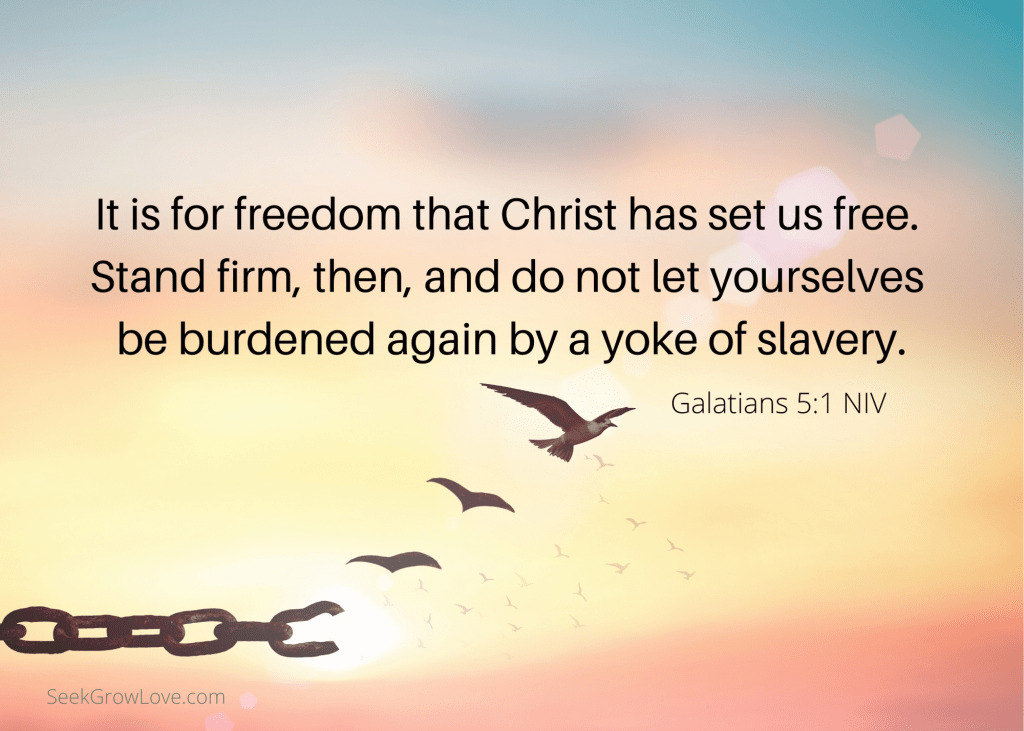
Galatians 5:1 – It is for freedom that Christ has set us free. Stand firm, then, and do not let yourselves be burdened again by a yoke of slavery.


Growing up in the great Southwest, I have had the luxury of enjoying authentic Mexican food. I could eat chips and salsa every day, all day. When I’ve got a craving, I will even eat chips and salsa from New York City. (Click here for reference to an old TV commercial.) 


Tacos, quesadillas, enchiladas, burritos are all very, very good. But one main entree dish tops them all, the chimichanga. If you’re not familiar with the chimichanga, you can think of it as a deep fried burrito topped with sour cream and guacamole. Or if you’re feeling extra decadent,  queso fundido sauce. My mouth is watering just thinking about it…


When I was in college, I spent a semester at Kansas State University. For the most part, I enjoyed going to school there. One of the only drawbacks was that back in 1993, there weren’t any Mexican restaurants in the area. And while I could get chips and salsa from the grocery store, and tacos from Taco Bell, there wasn’t any authentic Mexican cuisine to be found. 


Then one day, I was dining at an Applebee’s. And low and behold, there on the menu was a chicken chimichanga. I almost cried. I was so excited! With great anticipation, I waited for the plate to be brought out to the table. And when the dish finally arrived, it was everything I could do to hold back the tears. Not because I was so thrilled, but because the chimichanga was covered in chili! Not Mexican red or green chili, but chili beans! I was dumbfounded. How could anyone mess up my chimichanga?!?! When I spoke with my parents later that evening (they were still living in Arizona), I let the tears fall. I was so homesick. 


I tell you all of this because when I read the book of Galatians, something stands out to me. The church in Galatia had enthusiastically accepted the Gospel that the apostle Paul had preached to them. But after he had left, interlopers had begun to convince Believers that there were certain rituals that they had to practice, including circumcision, to be considered righteous. When Paul heard of this, he was so frustrated! 

Here’s Bethany’s interpretation of Galatians 5:1 – Why, why, why would you go back to living under the burden of all these rules and regulations? Don’t you know that Christ died so that you wouldn’t have to be a slave to all that? Your faith has set you FREE! Now start living like it! 


The same message applies to you and me. Once you realize what life can be like living under the grace of God through faith in what His son did on the cross on your behalf, why, why, why would you ever think about going back to a previous lifestyle? And yet, that’s what we encounter every single day. We’re faced with decisions on how to treat others, how we spend our time, how we invest our finances. It might be tempting to make concessions in stressful circumstances, but we must stay strong, to persevere and be firm in our faith. 


When you get in the habit of living in freedom, going back to a former way of living becomes just as inconceivable as eating a chimichanga with chili beans dumped all over it. When you experience the REAL DEAL – you never want to go back. 


Grace from God gives us a glimpse of His goodness.

Mercy from the Most High motivates us to move mountains.

Forgiveness from the Father fills in the fissures of the heart.

Rest within the shadow of the Rock renews our responsiveness.

Acceptance by the Almighty alters our attitudes.

Joy from Jehovah jolts our joints! 


It is for Freedom that Christ has set you Free. Now start living like it!  

Bethany Ligon

Today’s Bible passage can be read or listened to at BibleGateway here – Galatians 4-6

Tomorrow we will read Acts 17:1-18:18.

With Christ

Galatians 1-3


Social conversations today sometimes revolve around issues and individuals with whom we can relate or identify. For example, I am a fan of the Arizona Cardinals and when there is an exciting play on the field, I tend to get loud. And when the team wins a game, I feel like there is some part of me that also wins, even though I watch the game from home while ironing clothes for the week ahead. If the team loses a game, I feel bad for the team knowing how hard they fought to bring home a victory for all those who choose to cheer them on! I might not ever get the chance to score a touchdown or take a ready position on the offensive line trying to protect a quarterback, but I still feel like I am part of the team. 

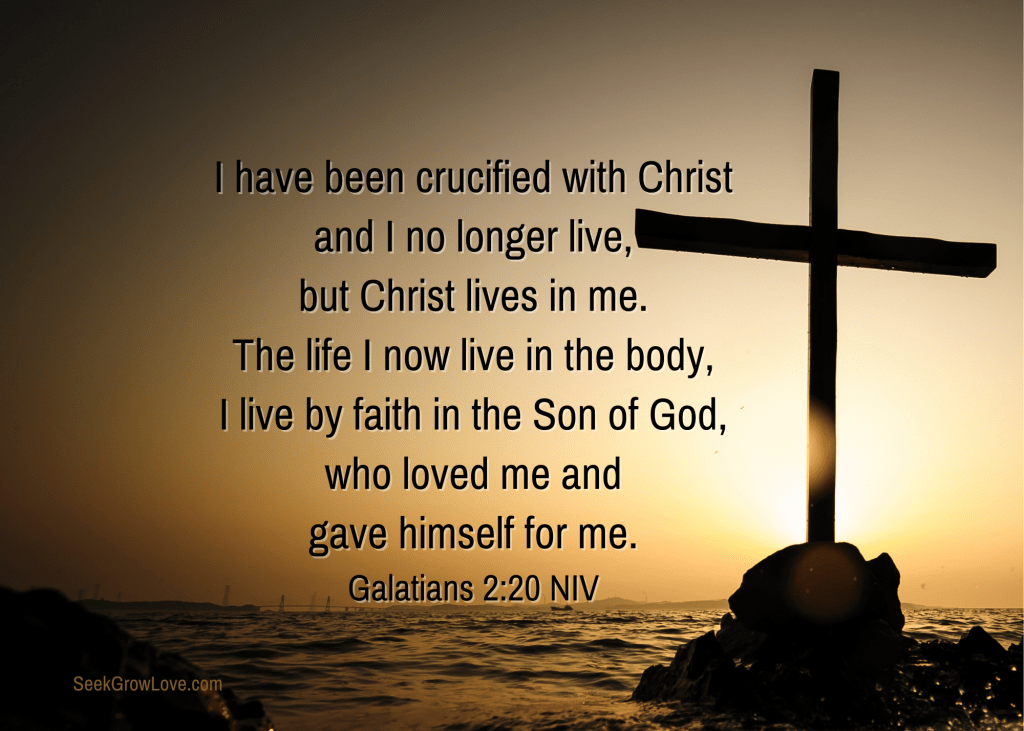
When I read the words written by the apostle Paul in his letter to the Galatians, I claim his declaration in chapter 2 verse 20 as my own. “I have been crucified with Christ” is a phrase that I believe I might have written myself if I were the one penning this epistle. When Jesus offered his life on the cross, he wasn’t doing it just for himself. He wasn’t doing it for all of the believers who were alive at the time. He allowed nails to be driven into his wrists and feet and his blood to pour out for all of us. This is something that I identify with. Jesus was willing to die for me. It’s a gift that I am willing to accept so that I do not have to pay that debt myself. I claim that Jesus is my Savior.


But Jesus is not just my Savior, he is also my Lord. “I no longer live, but Christ lives in me.” Because of what Jesus has done for me, the only response that I can have is to dedicate my life in service to him. The thoughts that I think, the words that I speak, the actions that I take, are all a reflection of what it means to “live by faith in the Son of God”. Make no mistake, I mess up often. But thankfully, because the grace of God is never ending, I can be made right again upon confession and repentance. 

And so I ask you, with whom do you identify? Is it your family? Is it your school or workplace? Is it with a professional sports team? Is it your church? While all of those people and organizations are most likely good people and places to associate yourself, remember that the ultimate person with whom you can identify is Jesus the Messiah. He died so that you wouldn’t have to. 


So what will your response to this sacrifice be? Will you align yourself with Christ? Will you choose to be on his team and play every play on the field with all of your heart? Will your thoughts, words, and actions reveal your true allegiance?

I challenge you that if you haven’t already accepted Jesus as your Savior, to do that today! And if you have already done that, remember that he is Lord of your life too. Now is the time to start living like it!  

-Bethany Ligon

Today’s Bible passage can be read or listened to at BibleGateway here – Galatians 1-3

Tomorrow we will read the rest of Galatians, chapters 4-6.

Dead Faith

James 1-5

I have enjoyed going through the first half of the book of Acts with all of you, as the book of Acts is one of my favorite books in the Bible.  I am fascinated with the history of the church after Jesus ascended to heaven, and there is no better source to take a look at than the book of Acts.  I hope you all enjoyed the first half of Acts as well.  Today, we cover the book of James, another real solid book (really all 66 books are real solid).  James is one of the first books of the Bible that I would have a new believer read, as it has a ton of applicable information.  The book provides great stepping stones to living a godly life.  If you haven’t read the book of James before, stop whatever you’re doing (Well, I guess that means stop reading this devotion), and read the book of James for yourself.  If you have read it before, I would still encourage you to revisit this piece of gold.

            James covers a wide range of topics throughout his book.  Today, we are going to spend most of our time covering two topics found in the book.  Before we do that though, I want to mention the other topics found in James.  If there is a topic that interests you, then go ahead and see what James himself has to say about it.  The main talking points in James that we won’t talk about are: hearing and doing the word, the sin of partiality, taming the tongue, wisdom from above, warning against worldliness, boasting about tomorrow, warning to the rich, patience in suffering, and the prayer of faith.  Much could be said about each of these different topics.  There is simply not enough time/space to mention all of these topics in our devotion.

            With that being said, we will talk about the testing of our faith and the relationship between faith and works.  I wanted to talk about the testing of our faith because it connects very well with what we have been talking about with the book of Acts.  In the first 14 chapters of Acts, we saw a handful of people suffer because of their faith in Jesus.  What does James have to say about this?  Well, James says, “Count it all joy, my brothers, when you meet trials of various kinds, for you know that the testing of your faith produces steadfastness.  And let steadfastness have its full effect, that you may be perfect and complete, lacking in nothing,” (James 1:2-4).  In summary, James says to consider it a joy!

            I don’t know about you, but it is not my initial thought or feeling to consider a trial a joy.  I think a large reason is because it is not fun or enjoyable to go through a trial.  However, when we think about the effects of enduring through trials of various kinds, we can come away with an appreciation.  When we successfully endure through a trial, it can produce steadfastness, which enables us to be a more complete, well-rounded person. 

Every single time that someone goes through a trial, they either grow closer or they grow further away from God.  The heroes of our faith that we took a look at in Acts went through various trials, and it appears that they grew closer to God.

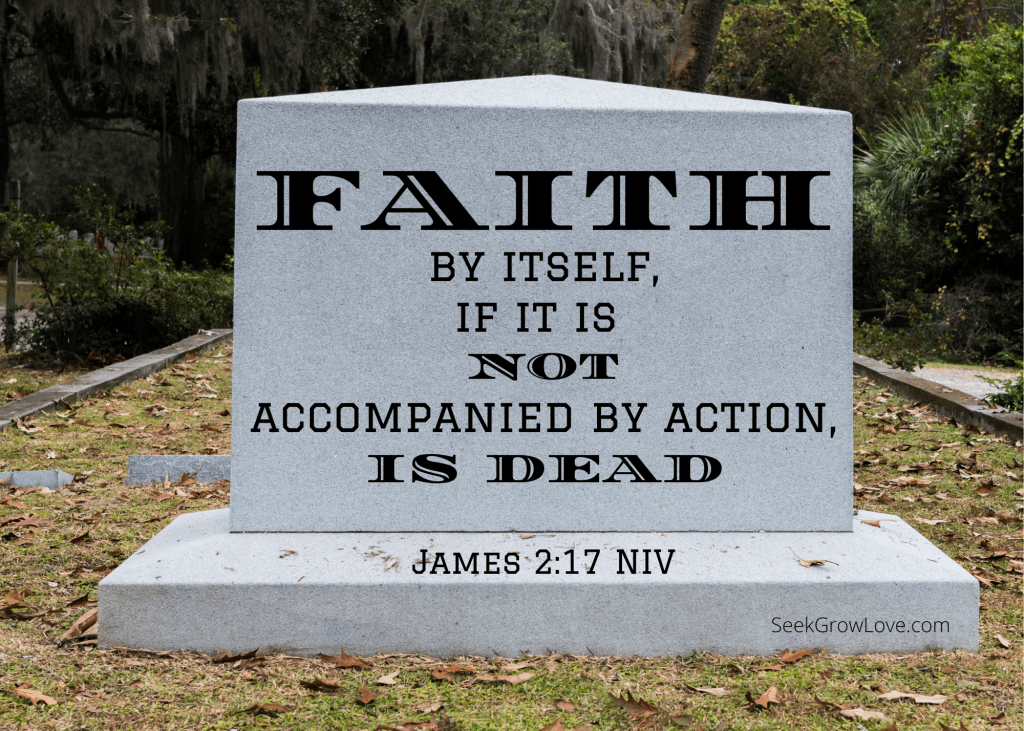
Our next main topic is the relationship between faith and works; they have an interesting relationship with one another.  They have caused a lot of discussion and even some disagreement in Christian circles.  According to James, “Faith by itself, if it does not have works, is dead,” (James 2:17).  That means that a faith that is not accompanied by any works is useless!  We need to remember though that it is by God’s grace that we are saved, and we accept that grace through our faith, not our works (Ephesians 2:8).  However, we can’t accept God’s grace with a dead faith; it must be a living and active faith that we have to accept God’s grace.  We already mentioned that a faith without any works is dead and useless.  That means that we must accept God’s grace through our faith, but we have to accompany our faith with our works.

At an initial glance, it can appear at times that James and Paul (in Ephesians) clash with one another.  However, that is not the case at all.  They both show how faith and works have a beautiful relationship with one another.  I remember being stumped over the relationship between faith and works for some time.  It took me awhile to see how they work together, and I hope this very short explanation can help clear up the confusion that any of you may have between faith and works.

Well, there we have it, folks.  This past week we got to spend time in Acts and James.  We have learned a handful of very valuable lessons from the likes of Paul, Peter, and James.  If you have read the devotions for this week, I hope you stick with it!  There is lots of great content ahead, as we get to explore the writings of Paul and others.  As always, there is also a great lineup of writers to help us all dig into God’s Word.  God bless!

-Kyle McClain

Today’s Bible passage can be read or listened to at BibleGateway here – James 1-5

Tomorrow we read Acts 15-16.