Claiming Your Inheritance

*Joshua 13-14

Psalm 35

Acts 5

-Devotion by Jeremy Martin (TN)

            In our Joshua reading today, we see once again one of the primary reasons that the Israelites were seemingly obsessed with lineage: all of those “who begat who begat who” passages that we come across in scripture.  The reason is, put simply, that’s where you got your inheritance, if you were a Jew.  That’s how you knew what your inheritance even was.  Your inheritance, to some degree, affected the level of your wealth, your occupation, everything.  Let’s say you wanted to be a fisherman; well, if your inheritance of land doesn’t have a large body of water with fish in it, you might want to consider shepherding as an option.  If you wanted to be a priest, you’d have to prove that Aaron was an ancestor of yours at some point.  Joshua 13 breaks down a number of these very specific physical inheritances for the Israelites, which were non-negotiable and non-transferrable.

            When you have been especially faithful though, and when you have the gumption to ask for it, sometimes you can receive an extra portion; this is what happens in Josh 14:6-15 (and continuing  on some in chapter 15, as far as some of the details go) when Caleb approaches Joshua and says specifically “So now, give me this hill country about which Yahweh spoke on that day, for you heard on that day that Anakim were there, with great fortified cities; perhaps Yahweh will be with me, and I will dispossess them as Yahweh has spoken.” (Josh 14:12, LSB).  It then goes on to say: “Therefore, Hebron became the inheritance of Caleb…because he fully followed Yahweh the God of Israel.” (Josh 14:14, LSB).  Read the whole section carefully, starting when he approaches Joshua.

            If you have not read yesterday’s devotion, you should go back and do it now because we’re going to talk for just a little bit more about giants; also called “the Anakim” or “the sons of Anak” (among other things).  Josh 14:15 gives us a big (no pun intended) clue here, when it says “Now the name of Hebron was formerly Kiriath-arba; for Arba was the greatest man among the Anakim…”  (that’s from the LSB version, also note that Kiriath means “city”, so “City of Arba”).

            Let’s consider for a moment.  The only giant whose height and size we know fully in scripture is Goliath of Gath, and he stood approximately 9′ 9″ according to the masoretic text (which I tend to agree with, on the basis of their impeccable and zealous exactly accurate transmission of the scriptures).  In contrast to this, the Septuagint, some of the Dead Sea Scrolls, and the historian Josephus place his height at approximately 6′ 9″ (due to a textual transmission discrepancy between the Hebrew and the Greek).  If you have any historical knowledge of the Masoretes and their almost psychotic zeal for accurately reproducing scripture, you’ll understand why I favor that first number of 9′ 9″.  We also know that Og (one of the Rephaim, another group described as giants) the king of Bashan’s iron bed was 13.5′ long by 6’wide (see Deut 3:11), and that seems logically like it’d be a little too much empty head or foot space if you were just under 7′ tall, but pretty reasonable if you were around 10′-13′ tall.  King Og is mentioned briefly in Josh 13:31.

            So we don’t actually know how big this Arba fellow was, but we DO know that he was “the greatest among the Anakim”.  So, let’s just say “really really big”.  I could speculate that he was most likely well over 10′ tall, probably by a large portion, but that’s just speculation.  The point is, he was really a big guy.  So when Caleb asks for this special inheritance, it’s with the understanding that “Hey, even though I’m 85 years old now, I’m going to go whip the biggest giant there is, and take his land.  Also, any offspring of his who are also giants, I’ll whip them too, and take their land as well.” (that’s clearly paraphrased, but spot on accurate, the bit about the offspring is noted in chapter 15).  So what’s the point of this little digression into speculation and size?

            The point is this: it’s not always easy to claim your inheritance.  Sometimes, it’s going to take a bit of gumption, and maybe a scrap.  You may have to be bold, and brave, and act with what some might call “temerity”.  Sometimes, you have to look at the biggest guy there is and go “Yea, I can take that guy.”, and if you’re Caleb, that’s not always going to be a metaphor.  In our case, it might be (or it might not, who knows?).

            In Matt 25:34 it explains that our inheritance as followers of Ha’Mashiach (The Anointed One, or The Christ)  provided that we obey God’s word, is the Kingdom of God.  Please take a moment and read the words of our King in Matthew 25:31-46.  This plainly explains to us that not our lineage, but our actions, will qualify us for our inheritance, the Kingdom of God.  Jesus tells us that to actively seek our inheritance, the Kingdom of God, should be first in our priorities (Matt 6:33), and that all the other stuff will be taken care of.

            As gentiles, we should be very cognizant of the fact that we will have to qualify for our inheritance, it doesn’t matter what your lineage is.  Note I didn’t say earn, nothing that we could ever do would be enough to enter in to the Kingdom of God, but to even qualify for consideration we need to represent the character of God correctly to our fellow creation, to enact tzedakah (look it up) and love our neighbor as ourself, and to successfully love YHVH God with all our heart, soul, and might.   Sometimes as Christians, we tend to think we should be meek and quiet, but we know that James has written “you have not because you ask not” (James 4:2).

            It may be that at times we have to act with temerity. We know that there are things that can disqualify us from our inheritance (1 Cor 6:9-11), so we must fight tooth and nail against the enemy who tries to present these things to us as desirable. We WILL have to fight giants, whether real or metaphorical.  You are going to have to go through some things, in order to qualify.  It doesn’t matter though, because nothing compares; no suffering which you may have to endure will in any way compare to the glory of the Kingdom of God (Rom 8:18).  Be like Caleb, in other words, and go boldly to claim your inheritance.

REFLECTION QUESTIONS

  1. What is it that you dread?  If you are afraid of something that is hampering your obedience whether it’s  a situation, a person, a conversation, starting an action, stopping an action, changing a habit, whatever it might be – that is your giant.  Of course it’s scary, now go fight it.  You need to identify it for yourself first though (we tend to be really good at pretending it’s not there).
  2. What things have you allowed into your life that you are seeking first, instead of your inheritance (The Kingdom), and how can you change that?
  3. Think for a moment about what steps you can take that would assist you in qualifying for entry into the Kingdom?  List out 3, and then implement them into your routine.

PRAYER

Father God, thank you.  All of these things I have, they have come from Your hand.  Please help me, lead me and guide me, grant me wisdom and humility, and if it is Your will allow me to enter into Your kingdom.  Grant me my inheritance Lord, and help me to be a servant who pleases.  In Jesus’ name, Amen.

“Here There Be Giants”

*Joshua 11-12

*Psalm 35

*Acts 4

-Devotion by Jeremy Martin (TN)

            As we start off in Acts 4 today, the priests, the captain of the guard, and the Sadducees came up to Peter and John “greatly agitated” because they were teaching and proclaiming in Jesus (Yeshua) the resurrection from the dead.  If you recall the breakdown of the “4 Philosophies” at that time, the Sadducees were “A priestly and aristocratic group who accepted only the written Torah (Pentateuch) as authoritative, rejected the oral law, and did not believe in resurrection or an afterlife.” So of course they were greatly agitated, because as a group they did not believe in resurrection…”So they were sad, you see?”  (that bad joke was stolen from Sean Finnegan’s wonderful and highly recommended podcast on Restitutio.org, which you really should give a listen to, seriously).

            The chapter goes on to tell that the religious authorities of the day grabbed them, detained them and questioned them fiercely, then released them but not before threatening them to stop talking about such things.  Their response is telling: “Whether it is right in the sight of God to hear you rather than God, you be the judge; for we cannot stop speaking about what we have seen and heard.” (Acts 4:19, LSB).  Bear in mind, these were not just some guys, these were the religious leaders of the day, the authorities, the high priest (and his descendants, Acts 4:6) and represented the final say in spiritual matters at the time.  It’s no wonder that they were marvelling at their confidence (Acts 4:13), this sort of behavior was unheard of amongst the Jews, you just didn’t defy the priests typically. 

            After they are released, they went to their own people and offered praise to God.  Please pay special attention to their wording, because it clearly defines the doctrine of the earliest church here in Acts 4: 24-31.  Without belaboring this beyond the last 2 days devotionals, please note that there is a clear delineation here, and a tiered level of authority that is clearly demonstrated with God (YHVH, the Creator, the Most High God)  in authority over His servant Yeshua, Ha’Mashiach (Jesus, the Christ, the Anointed One) who is in turn in authority over his servants, us (the ecclesia, or church).  We serve God through Yeshua, His servant and our King, whom God has anointed and established over humanity.  This is repeated throughout scripture and succinctly restated in 1 Cor 11:3.  It is highly problematic to insist on any other doctrinal statement, at least if you don’t want to stand in opposition to scripturePeter and John confidently stood firmly against the religious giants of their day, the religious authorities who had gotten off course, and continued to speak the word of God.  We face our own giants today, don’t we?

            Here’s an interesting thing.  Even if you have a map, even if you plan your route well, even if you have a compass; if you get even just a tiny bit off course you don’t end up where you wanted.  A matter of just 1 degree off, and you could end up hundreds of miles away from where you wanted to be.  The farther you go, the greater the error becomes.  In my youth, I had gotten off course (see the Feb 5th devotional for some of the sordid details).  I was in genuine fear for my life, because I was facing giants, and I knew that I could not win.  I had resigned in my mind that the best I could hope for was to inflict maximum damage in return on my way into death and was quite prepared to do so.  Psalms 35 really reminds me of that time, and of the mercy of God, who saved me.  I won’t go into detail here, but know that this Psalm is an intensely personal one for me because it accurately sums up a time when I faced giants, and lived.  Not by my actions, but by the grace of God alone and because God intervened in ways I could not have predicted or understood to remove the threat from my path (literally and physically, in some instances).  Then, in an overwhelming display of unwarranted love, he corrected my path.  I don’t even have the words to express my appreciation.  Praise God!

            As we dip into our Joshua reading today, we’re going to focus on a couple things that a lot of folks just skim over.  Remember the old song, “12 men went to Canaan land (10 were bad and 2 were good!)”?  That story is detailed in Numbers 13 and 14, and gives us a bit more understanding.  In Num 13:33 it says “There also we saw the Nephilim (the sons of Anak are part of the Nephilim); and we became like grasshoppers in our own sight, and so we were in their sight.” (LSB).  There’s a very simple and straightforward reason for this, and it’s because those guys were giants!  So who were the Nephilim?  Great question!  Flip back over to Genesis 6:4 where it says: “The Nephilim were on the earth in those days, and also afterward, when the sons of God came in to the daughters of men, and they bore children to them…” (LSB)**.  So the Nephilim were the offspring of “the sons of God” (ie, angels or some other form of heavenly being which God created) and humans, according to scripture.  **For an extremely interesting apocryphal account of this, read the book of Enoch (it’s quoted in the book of Jude, but didn’t make it into the cut for “canonical”).

            So, when the Israelites encounter ACTUAL GIANTS on the way in to the promised land, they got scared, rebelled, and as a result ended up wandering in the wilderness for another 40 years until the voices of dissension had (quite literally) died out (see Num 13&14 for the full story).  In Joshua 12, we’ve returned after 40 years to “try again”.  Now, when the Israelites are doing as God commanded and taking the promised land, it states: “Then Joshua…cut off the Anakim…(and) devoted them to destruction.  There were no Anakim left…only in Gaza, in Gath, and in Ashdod some remained” (Joshua 12:21-22, LSB).  In Josh 12:4, “Og king of Bashan” seems to be another one, “one of the remnant of the Rephaim”.  Remember where Goliath was from, by the way? See there (I slipped in another cross reference)?  Do you think he was larger or smaller than the others of his kind like him? Trivia aside though, the point is: this time they obeyed God, and they succeeded. 

            My point in bringing up these things is this: in our lives, sometimes we are given tasks that seem daunting.  Sometimes, we are called upon to fight giants.  Giants are, by their very nature, big and scary.  Many times they will stand and taunt us.  I’d point out in counterpoint that we’ve got a great big God; much bigger than any giant, and He fights for us, when we are doing His will.  It doesn’t matter how big your particular giant is, God is bigger.  As I write this devotion, it is the Sabbath before Easter Sunday.  When I consider the overwhelming love and power of our God, and the generous offer of salvation to us gentiles, I am truly humbled.  When I think about what His Anointed One suffered on my account, I am overwhelmed.  When God raised up His servant Jesus again, it let me know that there is no giant that can overwhelm me.  I may go down into the dirt, but I will stand again.  God has this.

REFLECTION QUESTIONS

  1. Did you ever realize, or even think about, where the actual biblical “giants” came from?
  2. Each of us have our own metaphorical “giants”.  What are yours?
  3. How many times has God conquered a giant for you; a problem you just couldn’t see a way around, a danger that you couldn’t escape, an intimidating moral dilemma?  Reflect on them all for a moment, and consider the goodness of God.
  4. Why is it that when we see a “giant” we forget how big God is sometimes?

PRAYER

Father God, Creator and Sustainer of all life, thank you.  Please help me to remember that I am not my own and that you bought me, and that the price paid for me was far too high.  Please forgive me when I am scared, and give me the strength to do your will, even if it’s to conquer giants.  Thank you for sending Yeshua, my King.  Thank you for life, breath, and all things.  In Jesus name, Amen.

Jesus, the Servant of God

*Joshua 9-10

*Psalm 34

*Acts 3                              

 -Devotion by Jeremy Martin (TN)    

   Without belaboring the point too much beyond yesterday’s devotion on Acts 2, we see again in Acts 3 the clear doctrinal understanding of the earliest church in Peter’s 2nd sermon after Pentecost.  “11 And as he held Peter and John, all the people, being greatly amazed, ran together to them in Solomon’s portico. 12 And when Peter saw this, he answered the people, “Men of Israel, why are you amazed by this? Why do you stare at us, as if we had made him walk by our own power or godliness? 13 The God of Abraham and of Isaac and of Jacob, the God of our fathers, has glorified his Servant Jesus …15…whom God raised from among the dead, of which we are witnesses. 16 And by trusting in his name, his name has made this man strong, whom you see and know. Yes, the trust that is through his name has given him this perfect health, as you all can see.” (REV). 

            Miracles are being performed through Peter and John, the servants of Jesus the Christ, who is himself the servant of God, whom God has glorified.  There is one God (Mark 12:29-31, Deut 6: 4-5) and one mediator between God and man, the man Christ Jesus (1 Tim 2:5) and “3… the head of every man is Christ, … and the head of Christ is God. ” (1 Cor 11:3, REV).  So according to scriptures, our “corporate flowchart” looks exactly like this:

God >Jesus >The Church. 

There is never once an implied equality in this flowchart throughout scripture: we are the servants of Jesus the Christ, who is himself the servant of God.  To state anything else is to change the scriptures, which cannot be broken (John 10:35). 

            The Jews understood very well that all blessings come from God.  Keep in mind that once they leave the fiercely monotheistic folks in Israel and the message begins to get spread to the gentiles the immediate reaction from the gentiles when they see miracles is to say “the gods have become like men and come down to us!” (Acts 14:11), because that is a theme that is repeated constantly in their mythology (see the greek mythological stories of: Philemon and Baucis, Zeus and Semele, Hermes and Phanes, to name just a very few).  As more and more of these gentile converts are brought into the church, they brought their mythologies with them and began to change the narrative from “The God who gives blessings to men” to “the God who becomes man and performs blessings” starting especially in the 4th century when the gentiles became dominant numerically in the church. Please note the reaction and horror of the servants of the Christ when this occurs in Acts 14.

            Moving on to our reading in Joshua 9-10, there are a couple key things to take away today.  Firstly, whether or not you agree with how the Gibeonites acted (craftily), because they did so enabled them to survive.  Granted, they became indentured servants, but they lived.  Had they not acted craftily their only other survivable option was relocation (see Josh 9:24 for their rationale on their actions).  Secondly, because the Jews had sworn by Yahweh to them, they acted in good faith and protected them when their neighboring kingdoms decided to attack them.  It should be noted that during this defense of the Gibeonites,  God himself took part in the battle; causing the sun to stand still for a time (Josh 9:13), and destroying the majority of the opposing armies with large hailstones (Josh 9:11).  It should also be noted that the book of Jashar is mentioned in Josh 9:13 (and also in 2 Sam 1:18), a lost non-canonical book of the old testament.

            Psalms 34 has an interesting header beneath the chapter number in my bible.  It says “Of David.  When he feigned madness before Abimelech, so that he drove him away and he departed“.  This is in itself one of those just really weird stories you come across occasionally in old testament, and takes place in 1 Sam 21:10-15.  When you look, it is actually talking about Ahimelech (with an h) in 1-9, tells the story of how David grabs Goliath’s sword, and then feigned madness before Achish.  It’s just one of those really weird one-off stories that seems as if it may be incomplete.

            Psalms 34:1-3 (REV) states: “1 I will bless Yahweh at all times. His song of praise will always be in my mouth. 2 My soul will boast in Yahweh. May the afflicted hear it and may they rejoice! 3 Oh magnify Yahweh with me! Let’s exalt his name together!”  The words of David, the man of God.  We are often afflicted by the trials of life, and tend to forget that we are to give thanks at all times, and that the trials that we are going through are probably God’s way of developing us and purifying us so that we can be better servants (James 1:2-4).

Psalms 34: 4-9 (REV) states: “4 I sought Yahweh, and he answered me, yes, he delivered me from all my fears. 5 Look to him and be radiant. Then their faces will never be ashamed. 6 This afflicted person cried out and Yahweh heard him, and delivered him out of all his distress. 7 The angel of Yahweh encamps around those who fear him, and delivers them. 8 Oh taste and see that Yahweh is good. Blessed is the person who seeks refuge in him. 9 Fear Yahweh, O you his holy ones, for those who fear him have no lack.”.  Like David, God delivered me as well.  I would venture to say that at some point He delivered you, too.  I love the poetry of v5, it reminds me of the times when Moses was in the presence of God and when he returned his face was glowing.  The hedge of protection we pray over people at times is clearly illustrated in v7.  I can say truly that I have tasted and seen that Yahweh is good, I am alive because of it.

Psalms 34: 10-15 (REV): “11 Come, you children, listen to me. I will teach you the fear of Yahweh. 12 Who is the person who desires life, loving many days to see good?13 Guard your tongue from evil and your lips from speaking deceit. 14 Turn away from evil and do good. Seek peace, and pursue it. 15 Yahweh’s eyes are toward the righteous. Yes, his ears listen to their cry for help. “.  This is a blueprint set of verses on how to live a long life.  Do you want to live?  Well:  Fear Yahweh, turn away from evil, do good.  Seek peace and pursue it.  When you do these things, God’s eyes are towards you and He will hear you when you cry out.

Psalms 34:16-22 “16 Yahweh’s face is against those who do evil, to destroy the memory of them from the earth. 17 The righteous cry out and Yahweh hears, and delivers them out of all their distresses. 18 Yahweh is near to those who have a broken heart and he delivers those who have a crushed spirit. 19 Many evils happen to a righteous person, but Yahweh delivers him out of them all. 20 He keeps watch over all of his bones. Not one of them is broken. 21 Evil will kill a wicked person. Yes, those who hate a righteous person will suffer punishment. 22 Yahweh redeems the soul of his servants. Indeed, none of those who seek refuge in him will suffer punishment.”  This set of passages warns clearly that God is against those who do evil, and will destroy them so thoroughly that even their memory will be gone from the earth.  The one who does evil and hates the righteous will suffer punishment, but Yahweh redeems the soul of his servants.  As proof, consider Jesus the Christ, the servant of Yahweh, whom God has glorified and redeemed from the dead. 

REFLECTION QUESTIONS

  1. The book of Acts is filled with miracles that God performed through His servants.  Can you recall any miracles that have happened in your lifetime?
  2. When miracles occurred in your lifetime, did you notice if you were trying to seek God with your whole heart at the time?  Consider this.
  3. Can you think of a time when God saved you from an impossible situation, and did you consider why at the time?

PRAYER

Father God, my creator and my sustainer, thank you for my life.  Please guide me and protect me, keep me from looking upon evil and keep my lips from speaking deceit.  Help me to be a servant that pleases you.  Please work miracles through me, may all of your creation offer you praise and glory.  Thank you, in Jesus name, Amen.

A Man Attested by God

*Joshua 7-8

Psalm 34

*Acts 2                            

-Devotion by Jeremy Martin (TN)

            There’s one very critical point that we often (and intentionally at times) overlook that’s clearly highlighted in our Joshua 7-8 reading this morning: if you don’t listen to and obey God, you should have no reasonable expectation that God will bless you (quite the opposite, in fact).  Romans 8:31 states “If God is for us, who can be against us?” (ESV), but keep in mind that the converse is also quite true as well: “If God is against you, who can save?”.  Just think about it; it’s illogical to assume God’s favor if you are not living according to God’s expectations, so “…consider your ways.” (Hag 1:7).

            Now let’s move on to 1st century Jerusalem, where we find the apostles and believers gathered, about 120 people,  praying constantly (Acts 1:13-15).   I’ve recently heard a theory by Dr Roy Blizzard (who actually took part in the archaeological excavation of this site in 1968) that states that they were probably meeting on the Temple stairs near one of the cleansing pools (called Mikveh or Mikvah), and based on the size of the assembly (and comparing it to the average dwelling size in Jerusalem at this time), I believe that may be correct.  Dr Blizzard postulates that “house” in this instance referred to “The House” (as in “of God”, ie, the Temple).  The Southern Steps, specifically, were a significant meeting and teaching place.  These steps were about 200 feet wide and featured a raised platform on the side, known as the “Rabbi Steps” or Teaching Steps, where Jesus and other rabbis are believed to have taught and given announcements to crowds, so it doesn’t seem unreasonable to me. 

            Furthermore, The Royal Stoa, a massive public meeting building located just above the Southern Stairs, functioned as the primary gathering area for large assemblies, such as the estimated 30,000 to 100,000 people who may have gathered for the event of Pentecost, so this may be the “upper room” referred to. The stairs themselves were designed with uneven widths to prevent running and maintain decorum, while the broad landing and adjacent Mikvehs (ritual baths filled with “living water” brought in via aquaduct from the pools near Bethlehem) facilitated large-scale gatherings, teaching sessions, and baptisms for pilgrims entering the Temple Mount.  So, if this is correct, there’s a very good chance that when Peter in his 1st sermon said “Repent and be baptized…”, he was actually pointing at one of these Mikveh.

            Acts 2:1-4 is one of the most impressive and amazing demonstrations of the holy spirit ever displayed.  When they then began to speak the word of God, the people (who were from all over) heard the words in their own language, and they were all amazedThis is the promise fulfilled from John 15:26-27: “But when the helper comes that I will send to you from the Father, the spirit of truth that comes from the Father, it will testify about me, and you also must testify, because you have been with me from the beginning.” (REV translation).

            So we can see a couple key points that need to be reiterated: 1-Jesus will send the helper from the father, 2-it is a “spirit of truth” that comes from the father and it will testify about Jesus, and 3-you also must testify.  So when Peter, filled with this spirit of truth, stands up to do just that (testify) in his first recorded sermon, we should really pay close attention as this constitutes the  earliest (and most accurate) “doctrines” of the church here in Acts 2:22-24.  

            Peter, filled with the spirit of truth, the holy spirit, preaches to his fellow Jews: “Jesus of Nazareth, a man…”.   Peter  explains that this man Jesus was “pointed out to you by God by miracles and wonders and signs, which God did through him…”.  God performed those miracles, through Jesus, and then God raised him up.  According to Peter, Jesus was not the “God-man” as men began to theorize in the late 4th century, but was in fact “God’s man” as explained and prophesied in scriptures from the beginning of creation.   The Christ, or anointed one.

              Now pay attention because this is important:  Looking through the scriptures we see that from the beginning God has told us of Messiah: that the seed of the woman shall crush the serpent (Gen 3:15), that God will raise up a prophet like Moses from among your brothers (Duet 18:18), who will be a descendant of David (2 Sam 7:12).  This does show a progressive revelation through scriptures: human, Israelite human, Israelite human descended from David (in that order, note that each additional revelation shows clarification without changing the base information).  The Jews understood this completely, because the Shema (Deut 6:4,5) was given to them early on, and it was quoted by Jesus later in Mark 12:29 as the “Most Important Commandment”.  The only problem comes when we go beyond what is written, and add theories to the scriptures that aren’t there to start.

            To become a member of the original church, in the book of Acts, here are the requirements (in their totality): “And Peter said to them, ‘Repent and be baptized, every one of you, in the name of Jesus Christ for the forgiveness of your sins, and you will receive the gift of the holy spirit.’ ” (Acts 2:38 REV).  Let me break that down for you: 1- Repent, 2- be baptized (in the name of Jesus the Christ), and 3- receive the gift of the holy spirit (the spirit of truth).  That is it, full stop.

            Recently it was just a “membership sunday” at one of the churches I attend here locally.  To join as a member, you had to agree with all of their articles of faith.  Here are the first 2 on the list (of 14): WE BELIEVE 1: In the verbal inspiration of the bible (ok, check, strongly agree, no problem). 2-In one God eternally existing as 3 persons namely the Father, Son, and Holy Spirit (Um..where does it say that?).  Here’s the thing; I love these guys, but I just don’t see that second one written explicitly (or even conceptually) in scripture.  In my own personal interpretation of the scriptures, agreeing with item 1 precludes agreement with item 2.  I think that these folks are truly my brothers and sisters, because they seek to serve God to the best of their ability and strive to live a holy life, but I disagree (in love) with some of their interpretation of scripture.  I also feel as if I am already a member of the church, based on what Acts says, but I can’t be a member of their church (and that’s a little bit hurtful).

            Another church I attend on the Sabbath has told me something similar.  WHY? The bible clearly lays out what we need to do in Acts 2 to become members of the church (3 steps). We need to restore our faith to that of the original church, the faith “once for all delivered” (Jude 1:3), and take the traditions that we’ve added away (Mark 7:7).  PLEASE note that if you disagree with anything I’ve pointed out: I am just a man, your brother in Christ.  What you believe is between you and God.  I tell you with love that you will however at some point answer to our God, and He is seeking people who will worship him in spirit and in truth (John 4:23-24), so it behooves each of us to study scriptures, divide them wisely, and live in a manner which glorifies God.

REFLECTION QUESTIONS

  1. To repent is to not only regret actions, but to change course.  If we keep committing the same sins, we have not changed our course.  To repent is the first requirement of being a part of the church, so ask yourself: have you fully repented?
  2. Have you received the gift of the holy spirit?  If so, in what manner did it manifest? (this could be a whole series of study sessions on it’s own)
  3. Has reading scriptures ever changed the way you believed about something? 

PRAYER

Father God, Thank you.  Please cleanse my heart of wrongdoing, please help me to circumcise my heart before You, and grant me the spirit of truth to teach me.  Father, please grant me wisdom, and humility, and allow me to be a servant who pleases his master.  In Jesus’ name, amen.  

Thy Will

*Deuteronomy 23-24

Psalm 29

*Mark 14

-Devotion by Jeremy Martin (TN)

            Today’s reading has a number of gems in it, that not only teach us about God’s character but also the character of His son.  In our Deuteronomy readings today we see a number of statutes; take a moment to read them all carefully and consider them as a group (note that we could spend a lot of time here, but there is a huge, critical, overwhelmingly important theological revelation in Mark 14 that we will spend a lot of our time on ).  God is holy (Deut 23: 9-14,17-18,21-24), and will be treated as such when in His presence.  God will judge each of us individually (Deut 24:16), we won’t be held responsible for the sins of another.  God wants us to treat each other with mercy and love (Deut 23:15-16, 25, and chapter 24 in it’s entirety).  The equity (or, ultimate fairness) of God is something that always amazes me.  God’s will for His people is that they honor and revere God, and treat each other with love and respect.

            We humans have a will too, but since we are human beings and not God, we have limited perceptions and because of this we tend to make poor decisions at times.  Think of it this way: as human beings walking along the road of time we can see moderately clearly where we are standing, looking backwards we can see a narrow view of where we have been (but even so it grows fainter in the distance), and looking ahead we are essentially just guessing how the path will go based on the path we’ve walked so far.  This doesn’t really highlight how limited our perceptions are, so now let’s imagine that this road is almost completely dark, and as we walk we are holding a candle that faintly illumines a tiny area around us as we walk; but there are vast worlds and other paths aside from the one that we walk that we can’t see which others are walking.  That’s what it’s like to be human. 

            My whole point is this: our perceptions are very, very limited.  Our tiny human brains can only perceive so much, the limitation of the human eyeball only accepts a very specific very tiny range of light frequencies, the human ear only hears a very specific very small range of sound frequencies,  and all of our senses have limitations built into them.  God, on the other hand, our Creator, is not limited in this fashion.  He sees the thousands upon thousands of potential paths that we all walk on, fully illumined, and from the beginning of the trail of our birth to the end of the trail at our demise.   The God who made us does not suffer from our inherent limitations, and as such, has a much clearer macroscopic picture.  It is only logical that His will is superior to ours, since He has a much clearer perception of not only us, but our neighbor, and the world (all of which He created).  The God who made your heart knows it better than you do yourself. 

            This is why the wise person submits himself to the will of God, because God has better information and therefore can make better decisions with better outcomes (Hillary Scott has a great song out called “Thy will” which I recommend).  We tend to be very limited and narrow in our vision, and tend to make poor decisions with poor outcomes when we rely on our own will because of our inherent limitations.  The more you rely upon your own will, the poorer the decisions and the worse the outcomes (and trust me, I’m speaking from painful experience on this one).

            When we come to our reading in Mark 14 today, our savior Yeshua (Jesus), our future king,  is having a crisis of faith.  You see, having been born a man; a nice Jewish boy from the line of David (Matt 1,), even though God both knit (Luke 1:35) and sent Jesus (according to Jesus, 32 times in the book of John), even though he was the prophesied and anointed Messiah (the son of David, the son of God, the king who will rule forever: 2 Sam 7), Jesus still self-identified as a son of man (a human, about 72 times in the gospels).  So even though God had knit and sent this man to be the savior of Israel (and the world), and even though Jesus was given a portion of the holy spirit that allowed him to perform signs and wonders in the name of the Most High God, he was in fact (by his own words, John 8:40) still a man. 

            Every human, when they are faced with their own mortality, has some serious thinking to do, even if you have been given a large portion of the holy spirit.  We know that God had revealed to Jesus that he was about to die because we can see from the passage here in Mark 14:32-42 that he is agonizing over his upcoming gruelling death.  I believe that one of the main reasons that our God revealed this to Jesus is that our God is, overwhelmingly, fair and equitable.  He wanted to allow a choice to His chosen Messiah; a final act of complete trust and obedience (reminiscent of the one he offered Abraham when he was asked to sacrifice his only son from Sarah to determine his faith).

            “…Abba! Father!  All things are possible for you; remove this cup from me; yet not what I will, but what You will.” ( Mark 14:36 LSB).  Jesus knows that God can do all things, and hopes there is another way and asks God to provide it, but he also completes that request with an obedient submission to the will of the Most High God, YHVH.  If you have accepted some of  the later traditions of men in understanding of the nature of God, this will create some serious questions for you; because we see clearly that Jesus is subordinate to the Father and one of the primary tenets of many groups is to insist on their equality, but that’s just not what the scriptures say.

            Jesus has his own will and it’s to not die, just as Abraham’s will was not to sacrifice his son, but he obediently complies and submits to the will of God, just like his ancestor Abraham.  This is not the act of an equal, but a loyal subordinate.  If you acknowledge this clear scriptural understanding then you are going against a lot of “traditional” requirements in many churches and you might just get kicked out of band camp if you bring it up, because that conflicts with some of the other later ‘developed’ traditions of men that have come to be traditional requirements.  Please remember though: you are the one that will stand before God to account for yourself, not your church group or pastor, but you.  Trust God.

            So what do you do if scripture doesn’t agree with your doctrinal theology?  Change your doctrinal theology, of course; we are under the scriptures and not above them.  Scripture is our guideline, the word of God transmitted in written form, and if we are going to be obedient children of God, like our Messiah, King Jesus, then we must submit to God’s authority.  When God speaks, we listen, period.  Is a servant greater than his master? “Verily, verily, I say unto you, The servant is not greater than his lord; neither he that is sent greater than he that sent him.”  (John 13:16 KJV).  In the book of John alone, Jesus explicitly states that the Father has sent him over 30 times, and also states “As the Father has sent me, I am sending you” (John 20:21 LSB).  The Christ is under the authority of God, the Father, and we are under the authority of the Christ.  It’s a pretty straightforward corporate organizational chart, if you believe scripture and hold to it as authoritative. 

REFLECTION QUESTIONS

  1. Why do we often follow our own will and not God’s?
  2. Have you ever changed something you believed because scripture indicated something different?
  3. God sent Jesus, Jesus sent us: are you being a good representative and can you improve?

PRAYER

Abba! Father!  Not my will, but Yours be done.  Show me Your will, Father, and grant me the perseverence and humility to submit to it.  Help me to be a servant who pleases you, Father.  All things belong to You, and all of the blessings that I’ve received have come from You, even my life.  Lead me and teach me, please.  Thank you, in Jesus name, Amen.

Your Brother

*Deuteronomy 21-22

Psalm 29

Mark 13

-Devotion by Jeremy Martin (TN)

            I’m very partial to and fond of the book of Deuteronomy for a couple reasons.  First and foremost, Jesus quoted out of this particular book religiously (no pun intended).  When Jesus was tempted, every single one of his responses was from the book of Deuteronomy (go ahead and verify that if you like, per temptation: hungry? Deut 8:3, test God? Deut 6:16, worship Satan? Deut 6:13).  When Jesus said “It is written…”, this is usually the book that he’s quoting from that it was written in; which tells me it was probably pretty important.

            When Jesus was asked what the greatest commandment was, he quoted Deuteronomy 6:4-5, “The Shema”: 4“Hear, O Israel! Yahweh is our God, Yahweh is one! 5You shall love Yahweh your God with all your heart and with all your soul and with all your might” (LSB Translation).  If you don’t have that one memorized and know it by heart, you really should, because according to Jesus it’s the greatest commandment; see Mark 12:29-31.  It’s one of the primary reasons that many of us understand our God in the manner in which we do, since it was given in such a clear manner.  This passage alone should have prevented a number of the innacurate understandings (but clearly didn’t, starting in about the 4th century and persisting to this very day).

            When I was younger and read some of the Old Testament statutes given to the Israelites, I thought some were just weird.  I didn’t really understand that this is because the statutes were given to an entirely different culture, in an entirely different time and place, and that they make much more sense when read holistically and with a more “macroscopic” lens.  When you take a step back most of these laws had to do with respect; respect for your community, respect for your fellow creation, and respect for your God.  The thing that I didn’t understand the most at the time was that respect for my fellow creation WAS respect for my God, or at least one aspect of it.

            Looking at just a few of these today from our reading, there is one specific point I’d like you to consider, and take away from this reading: (Deut 22:2 LSB ) “And if your brother is not near you, or if you do not know him, then you shall bring it home to your house, and it shall be with you until your brother searches for it; then you shall give it back to him.”.  This is the key question I’d like for us to think about today:  Who is our brother? We see from the above passage that they don’t need to be near us, and that we don’t even need to know them.  I would suggest that based on these two simple criteria that our brother (or sister, or “sibling” if you’d rather) is any other human being (which God created) that is sharing this planet (which God also created) with us (see also Luke 10: 25-37 for a more complete understanding).  Your brother is everyone, just as your sister is everyone, just as your neighbor is everyone.

            So when Jesus gave us the second greatest commandment in Mark 12:31, “…You shall love your neighbor as yourself.” (quoting Lev 19:18), it sets a pretty high standard for this type of love.  I mean, let’s be honest: while most of us like our neighbors plenty, do we really love them as much as we love ourself?  Do you regularly think of how much food others have when you’re buying groceries for your family?  When you buy new clothes for yourself, are you also concerned about what the guy down the street is wearing?  When you get a new car, do you ever stop and consider how the next door neighbor’s vehicle is working?  I’d say that (speaking for myself at least) while I try to be a good Christian I tend to think about myself a lot more than I think about other folks, and the further out they are from me the more that is the case.   I could say that a lot of this is due to the wealth driven society that I grew up in here in America or the “current evil age” that we’re in, but then Christ came to save us and gave everything he did while we were still in our sin.  We should remember that when we consider how we act towards others, even when wronged.

            Applying the verse above we see that people that we don’t even know are our brother, our neighbor.  So what about their needs?  What about that homeless guy, or the addict, or that guy who goes to a different church that doesn’t believe the same thing, or that guy/gal that uses weird pronouns? Can we truly say that we love them as much as we love ourself?  If we did, we’d think about all of them every time we thought about doing something for ourself, and we just don’t.  It’s an almost impossibly high standard and one in which I personally fail almost constantly, if I’m being honest.

            I believe that a very, very important thing to remember is that God created us in His own image so that we would have dominion over the things on the earth (Gen 1:26), which comes with some privilege and some responsibility.  We have been placed here on this earth with our fellow creations, and allowed to have the resources and wealth that we currently possess by the grace of God, in order to reflect the character of GodGod is the most gracious, the most merciful, and being created in His image means that we should be reflecting that graciousness and mercy as well.  Think about how patient God has been with you. Do you show that same patience to others?  Think about how generous God has been with you.  Do you show that same generosity to others?  Think about how forgiving God has been with you.  Do you show that same forgiveness to others?  Think about it for a moment.  Now consider that even with all of the offenses that humanity has committed against God, from the beginning of history, He STILL sent us Jesus.  Sober reflection on this will show us that we have a long way to go if we are going to accurately reflect God’s love.

            Have you ever been watching TV or listening to the radio and hear a loud alarming series of beeps which are followed by a “This is a test.  This is only a test” message?  Well, we don’t get that loud annoying sound in life, but I’d like you to consider that this life that you have been given is also just a test.  God has strewn seeds all along the road, and the ones that grow and develop fruit in the manner which He desires will be brought into the storehouse and saved (The Kingdom).  Those that do not grow in the manner He desires and bear the proper fruits will be discarded.  If you are ever so focused on yourself that you do not stop to consider “Am I my brothers’ keeper?”, then please stop for a moment and understand fully that the answer is a resounding YES, because God made you that way, as His representative.  So, child of God, represent.

REFLECTION QUESTIONS

How can I better reflect the character of God…

  • With my interactions with others?
  • With the wealth and other resources that God has given me?
  • With my time and attitude?
  • With my patience?
  • While bearing the fruits of the spirit?

When was the last time you…

  • Bought a homeless person a meal?
  • Offered a stranger a ride?
  • Stopped and helped a stranger who was broke down?
  • Offered to do a physically difficult task for an elderly person?
  • What are some things that you CAN do/WILL do for a “sibling”/neighbor?

PRAYER

Father God, help me to circumcise my heart, and to reflect Your character to all of my brothers and sisters, to each of the other beautiful and unique humans which You have created, to glorify You.  Please grant me the ability to show the same patience, mercy, and generosity that You’ve shown to me.  Father God, thank you most of all for Jesus.  Amen. 

The Temple

Deuteronomy 19-20

Psalm 28

*Mark 13

-Devotion by Jeremy Martin (TN)

            There are some landmark buildings and monuments that make you feel small when you’re standing next to them, and give you a sense of wonder and awe when you see them.  The Statue of Liberty,  the Taj Mahal, the Eiffel Tower, the Great Pyramid of Giza, the Hagia Sophia, etc.  The first temple of Israel (built @ 966-959 BC) was one of those types of buildings, only more so,  until it was destroyed at the onset of the Babylonian captivity, around 587 BC.

            The importance of the Temple structure to the Jewish people can’t be overstated.  The entire culture of the ancient Jewish people was centered around this structure.  Jeremiah warned the people in Jeremiah 7:4 that just living by the temple (the First Temple) wasn’t going to keep them safe, particularly since the people were living an idolatrous and sinful life, but it had become so ingrained in the cultural psyche that “this was where God was” that it was inconceivable that it, or by extension they, would ever fall…despite clear warning from all of the prophets to turn away from idolatry and wickedness and return to God OR ELSE.

            When the first temple fell, the Jewish people were in captive exile for 70 years, it was devastating to the national identity.  Daniel 9:2 details the moment when Daniel, in his captivity and exile, discerned that the time of the desolation of Jerusalem, namely 70 years, had been fulfilled (he was reading from the book of Jeremiah 29:30, look it up).  Thus began the return to Israel and specifically Jerusalem as detailed in the books of Ezra and Nehemiah after being exiled and captive in a foreign kingdom for 70 years, as spoken by YHVH through the prophets.

            The second temple was built in 516 BC, you can see from the timeline that it was one of the first things restored (after the protective walls).  This marked the triumphant return, the temple rebuilt, the restoration of the people to God.  Keep in mind, the temple was at the very center of the ancient Jewish religious experience.  Without the temple you couldn’t offer sacrifice, couldn’t fulfill the Law, couldn’t talk to God in the manner in which they’d become accustomed.  For over 70 years, the Jewish people were orphaned from both their land and their God.  It truly can’t be overstated; the importance and significance of this structure to the Jewish people.  Can you imagine the joy and cultural pride of seeing it rebuilt again, after so long in captivity?  The answer is no, you can’t even begin to imagine; unless you were a Jew living in that time and living through those events, you can’t even begin to comprehend how big a deal it was.  We can get the glimmer of an idea when reading through the Old Testament, but to actually feel what they felt is beyond our ability, we can only imagine.  It was EVERYTHING to the Jewish people.

            Now, after the Temple has been rebuilt (called “the second temple”), it stood for over 500 years and is now once again the cultural and religious center of the Jewish people.  It’s ingrained in the culture and daily religious life of the people, generationally.  “A disciple” pulls Jesus aside to proudly point at the temple, and to marvel at it’s construction and stones.

            Jesus tells the disciple that “not one stone will be standing on top of the other“.  Can you imagine the sidelong looks?  Immediately his inner circle begins to question him privately: what are you talking about? When is this going to happen?  Why won’t the temple be standing? The account in Mark 13: 1-2 is paralleled in Matt 24:1-2 and also Luke 21: 5-6.  Each account has slightly varying details which is to be expected from different viewpoints (this is actually a “proof of veracity” by detectives when investigating and taking statements from witnesses, by the way, if they are all too closely aligned then collusion has usually occured).  I want you to take note that this conversation saved numerous early Christian lives.  Because they listened.

            The 2nd Temple was destroyed in 70 AD, by Roman forces (led by Titus) that had besieged Jerusalem.  This was a particularly brutal event.  Before the Roman forces ever arrived Jerusalem had been engaged in what was effectively a 3-way civil war which destroyed most of their food supplies, and then the Romans came.  This is an extremely well documented event; and is exceptionally horrifying and morbid.  I will spare you some of the gory details of starvation, famine, and cannibalism (such as Maria of Perea), but if you are interested look up “Siege of Jerusalem (70 CE)” on wikipedia.  There will be more information there than you can scour from your mind about the horrors of this terrible war that are well documented by Josephus (who was conscripted and spared for this purpose) and others. The Arch of Titus still stands as a testament in stone to this event.  It’s truly terrible, and horrific atrocities occurred. 

            Do you know who didn’t suffer through this horror, though? The early Christian church.  The parallel account in Luke 21: 20-22 is the clearest reading of this warning: “But when you see Jerusalem surrounded by armies, then know that it’s desolation is at hand.  Then those who are in Judea must flee to the mountains…because these are the days of vengeance…“(LSB).  Vengeance for what, you may ask? Well, think about it, Jesus was crucified about 30 years prior.  It is well documented by early church historians (including Eusibius of Caesarea, Remigius, and Epiphanius) that the  early church fled Judea to Pella (in the Decapolis region east of the Jordan River),  around 66-69 AD…as the Romans were coming and began surrounding the city of Jerusalem.  To understand the tribulation they avoided by doing so I really recommend you read that article mentioned above,  but the thing to note is that they listened to Jesus, and then they acted.

            When we read all of Jesus’ words in Mark 13, let’s be honest: it’s pretty ominous.  It doesn’t paint a pretty picture.  It says that as believers, we will probably have to go through some unpleasantness to put it lightly.  Pay special note to Mark 13:13 though, because in this is our promise: “…but the one who endures to the end, he will be saved.” (LSB).  We as Christians need to listen, our very lives depend on it.  If you want to see the kingdom of God, we must endure to the end.  One of my favorite bible verses is Zeph 2:3: “Seek Yahweh, All you humble of the earth who have worked his justice; seek righteousness, seek humility.  Perhaps you will be hidden in the day of Yahweh’s anger.” (LSB).

So what can we, as followers of Christ, do to protect ourselves?

  • Seek Yahweh. Listen to Him, and those whom He sent to instruct us (particularly the Christ).
  • Pray, fast, work His justice upon the earth.  (See that homeless guy? Feed him.  See that elderly widow? Go ask if she needs help.  Go and visit the jails or the hospitals, offer the orphan hope, turn the other cheek when offended, freely give to those in need, work His justice upon the earth!)
  • Ask our Mediator, the Christ, to intercede for us.
  • Seek Righteousness, seek Humility.

REFLECTION QUESTIONS

  1. Do you regularly “work His justice upon the earth”?
  2. How can you improve in that area, in both frequency and implementation?
  3. How can you listen better, to both the written words and spirit of, our God?
  4. What are some ways that we can build up our endurance to prepare?

PRAYER

Father God, thank You for life, breath, and all things.  Thank You for sending us Your son to teach us the way to the kingdom.  Please help us to humbly acknowledge You in all things, in all of our ways, and to listen when You speak to us.  Please instruct us, lead us, and keep us safe.  Grant us the endurance that we will need in order to please You.  In Jesus name, Amen.

The Question

*Deuteronomy 7-8

*Psalm 25

*Mark 10

“…Good Teacher, what shall I do to inherit eternal life?” (Mark 10:17)

            I suppose that this question directly and pointedly asks the question we all wonder at in our heart.  Hebrews 11:6 clearly states “…for he who draws near to God must believe that He is and that He is a rewarder of those who seek Him.“.   God doesn’t require blind and unthinking obedience, he is a God of reason, and wants you to understand that there is a reward for your obedience and faith; there’s a reason you should want to do what God tells us. 

            If this was not the case, this would have been the perfect opportunity for Jesus to say “Hey man, why are you being so selfish?”, but Jesus recognized the sincerity of the man’s question and answered him equally sincerely by saying, “…Why do you call Me good? No one is good except God alone. You know the commandments, ‘DO NOT MURDER, DO NOT COMMIT ADULTERY, DO NOT STEAL, DO NOT BEAR FALSE WITNESS, Do not defraud, HONOR YOUR FATHER AND MOTHER.’” (Mark 10:18-19 LSB).

            There are 2 very important bits that we need to take away from this response.  Firstly Jesus said “Why do you call me good?  No one is good except God alone.”.  This is (yet another) clear delineation between our King, the Christ (anointed one),  and God Himself.  If you have a more “complex” interpretation of God than is explicitly stated biblically, this verse creates complex issues, if you’re being honest.  There’s a simpler reading.  Secondly, Jesus’ first “go to” response is “what do the commandments say?” (Exodus 20, for reference).

            Jesus then goes on to say the man should sell all that he has, and give to the poor.  Keeping the commandments alone isn’t enough.  This makes the man sad because it seems as if his priority is wealth.   If you like, do a study on the Jewish concept of “tzedekah”; it’s a great understanding of how we should view worldly wealth conceptually (and most Christians have never even heard of it).  We’ll have a devotion that focuses on that concept later.

            In this present evil age, it is very difficult to keep our priorities straight.  We are constantly bombarded with imagery and concepts that are intentionally designed to divert our attention from our Creator and towards…anything and everything else.  Jesus gave us our priority, and told us to actively strive for our reward in Matthew 6:33  “But seek first His kingdom and His righteousness, and all these things will be added to you.” (LSB).  Our entire life should be focused on seeking God’s kingdom, and striving to have and exhibit the character of God.

            The word here used for righteousness is δικαιοσύνην and could be more accurately translated (as most places that righteousness is used) as “equity”, and I prefer that translation as it’s more accurate and has more depth and nuance to it.  Here’s a handy definition of equity as a refresher:

Equity (noun): (from the American Heritage Dictionary of Common Language, 5th ed)  

1.      The state or quality of being just and fair.
  • Something that is just and fair.
  • Justice achieved not simply according to the strict letter of the law but in accordance with principles of substantial justice and the unique facts of the case

            So we are to seek the Kingdom of God AND His (God’s) righteousness, or equity.  To be just and fair, not just by the letter of the law, but in our entire character and intent.  Note that this latter command to seek the righteousness of God is not only a job, but is in itself a reward, and is a necessary component to entering His Kingdom.  This character reflects not only how we are supposed to act, but how we are supposed to be, deep down inside where people can’t see.

“For you are a holy people to Yahweh your God…You shall know therefore that Yahweh your God, He is God, the faithful God, who keeps His covenant and His  loving-kindness to a thousand generations with those who love Him and keep His commandments…Therefore, you shall keep the commandments…”(Deut 7:6&9-11, LSB) So, is it important to keep the commandments? Well, according to Jesus our King, it is.  Then after we submit to this foundational obedience we must go even further, not just obeying the letter of the law, but actually modelling the character of our amazingly wonderful Creator, Yahweh God.

            We’re easily misled, as humans.  Sometimes by people, sometimes by traditions that people have elevated, and sometimes even our own hearts can lead us astray. We know from scripture that “the heart is more deceitful than all else” (Jer 17:9 LSB), and that we are to “Trust in Yahweh…lean not on your own understanding” (Prov 3:5-6 LSB).  God gave us His word, the scriptures, to be our guide.  All of the scriptures.  In our reading of Psalms 25  today, we have some of our promises and instructions for being “qodesh”, or holy: “Make me know your ways, O Yahweh, teach me your paths…Good and upright is Yahweh, therefore He instructs sinners in the way…and may he teach the humble His way...for Your name’s sake, O Yahweh, pardon my iniquity for it is great…the secret of Yahweh is for those who fear Him, and He will make them know His covenant.” (Ps 25:4,8,9,11-14 LSB)  This tells us clearly that even in this present evil age when we are so easily confused and misled, God Himself will instruct us, if we humbly and obediently seek Him.

            When Jesus was tempted, after fasting for 40 days in the wilderness, the first thing he was tempted with was food.  Have you ever fasted for more than a day or two?  Towards the end did you find that you were pretty focused on getting something to eat?  Jesus’ reply to the Accuser was to quote the scriptures, “…man does not live by bread alone, but by everything that proceeds out of the mouth of Yahweh” (Deut 8:3, LSB).  Interestingly, every rebuttal that Jesus gives while being tempted was from the book of Deuteronomy.  Jesus seems to have thought Deuteronomy was pretty relevant; when asked what the greatest commandment was, he quoted Deut 6:4-5 (The Shema, that story is found in Mark 12) first as the greatest commandment. Is the Old Testament relevant to Christians? Well, to the Christ, it was.  Is a servant greater than his master?  When you are tempted, follow Jesus’ example; quoting the scripture not only chastens our enemy, but edifies ourselves with our intent.  Memorize some key verses to help you in defending yourself.

REFLECTION QUESTIONS

  1. Jesus saw the 10 commandments as basic foundational requirements.  Do you obey all 10 of the commandments, as they are explicitly written?  Why, or why not?
  2. We are to seek first the Kingdom of God, and His righteousness (or, “equity”).  How is that going for you?  What can you specifically do on a daily basis to more accurately reflect the magnificent love and character of God to your fellow creation?
  3. We are all tempted in a manner that is specific to our weakness(es).  Do you have at least 3 key scriptures memorized, to defend yourself from your specific temptations?  What are they?  If not, why?

PRAYER

Lord God Yahweh, please, teach me Your ways.  Straighten my paths before me, Father, and lead me along the path that leads to Your kingdom.  Circumcise my heart, and let me humbly seek your will through obediently following Your word and Your will, as given to us in scriptures and in the teachings of the Christ.  Father, forgive me for when I fall short, please be merciful and loving towards me, and help me to reflect that mercy and love to all of Your creation.  Thank you, Father, in Jesus’ name, Amen.

His Eyelids Test the Sons of Men

Leviticus 14-15

*Psalm 11

Matthew 24

Devotion by Jeremy Martin (TN)

            Today, as you are reading this devotional, it’s my birthday which is a little ironic because as I am writing this particular devotion a week before it is released, it’s on the anniversary of my death day (2/14, see my devotional on 2/5/26 for details).  It’s an interesting contrast when you consider it.  I am alive by the grace of God.  Today when I woke up, my wife asked me (as she normally does when she wakes up) “How are you today?”  My response was, as it normally is, “I am alive!  I’m wonderful, I should be dead but I’m alive.  God is good.”. 

            If you think about it, we should all share that same sentiment: God is good, we exist at all because of His goodness and mercy, we are alive simply because He wills it.  There are things you don’t even know about that God probably did to ensure that you woke up today, opened your eyes, and breathed.  There are times in your life that you might have died, whether you are aware of them or not, when God saved you and let you live up until right now, today.  What a blessing! Sometimes we take that for granted, please take my advice: don’t.  Life is precious, and if you are reading this, it’s a gift that God gave you directly because He wanted to.  Be grateful.  This too shall pass, enjoy it now.

            Today we’re going to discuss something weird.  It might even be considered controversial and a little disturbing by some, but we’ll draw our conclusions from scripture.  We’re going in for a deep dive today, are you ready?  Listen: I know that it’s a lot more time consuming, but it will really help your understanding if you look up all of the verses listed today, as we’ll be going to quite a few other scriptures to get a “holistic” understanding.  They’ll all be in bold font.  Our focus today will be Ps 11, read that in it’s entirety, and then let’s consider Ps 11:4 specifically, which says “Yahweh is in His holy temply; Yahweh’s throne is in heaven; His eyes behold, His eyelids test the sons of men.” (LSB). 

            We all know and understand the “His eyes behold” portion, and know that God sees mankind and gauges our actions (As proof texts read the following and don’t take my word for it:  Ps 33:13-15, Ps 14:2, 2 Chronicles 16:9, Prov 15:3, Zech 4:10, Hebrews 13:2, Mal 3:16) it’s a constant theme throughout scripture.  God Himself, or His agents, are observing our actions constantly.  How else could He rightly judge?  The whole earth is His, and everything in it (Ps 24:1).  But what does it mean to say “His eyelids test the sons of men”?

            Jesus explains in Matt 5:28 that if you sin in your heart, it’s still a sin.  James 1:14-15 explains that our hidden desires, when fed, lead to sin and then death.  Wrong thinking leads to wrong doing.  I can’t speak for you, but I can speak for myself personally and say that even when I have done no physical sin, I constantly struggle internally to be holy.  I sin in my heart constantly, and I’m really trying not to.  Whether pride, or lust, or envy, or greed.  YOU can’t see it, but it’s there, and I’m painfully aware it’s there because for the last couple years I’ve been trying to purify my heart and follow Jesus in every way.  Here’s the thing, though: God sees it (1 Sam 16:7), because His eyelids test the sons of men.

            Q: How, though?  A: In your sleep.  Have you ever been asleep and had a dream that you recalled briefly upon waking that involved a moral dilemma, or course of actions that you had to choose between?  That was what I call a “dream test”.  God tests your heart, almost constantly, many times in dreams or “visions in the night”.  Not only that though, but He instructs us as well.  You very seldom recall it, but once you start paying attention, you’ll notice more of it.  Sound crazy?  Check these scriptures out : Job 33: 14-18, Ps 7:9, Ps 16:7, Ps 17:3, Ps 139:1-4, Is 26:9, Jer 17:10, Matt 1:20, Acts 18:9-10, Rev 2:23.    My point is this: you can clearly see, through scripture (and scripture cannot be broken) that God not only tests us but instructs us in our sleep.  In dreams, in visions of the night.

**As a sidenote Job 33 is my favorite chapter in the bible because it is MY story, and the story of God’s grace and mercy: it was written for and about me.  It’s also where I discovered this concept.  See Job 33:14-30 if you’re interested.

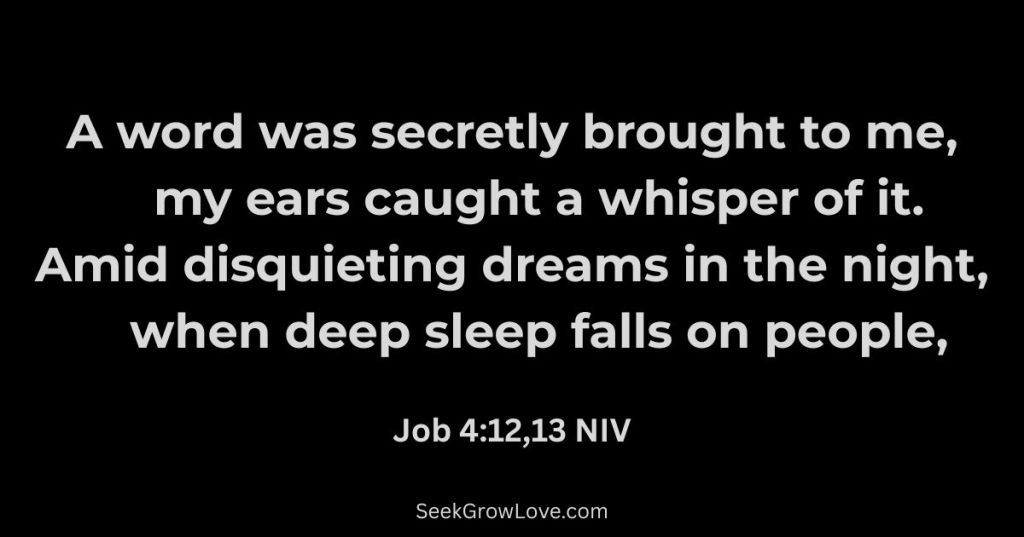
            I think it’s important at this point to note that even if we have a revealing dream, we must always test the spirits to make sure they are from God (1 John 4:1).   Since we are engaged in a spiritual war (Eph 6:12) it is absolutely plausible and probable that your enemy may test you as well, or try to divert you.  For an example of this read Job 4:12-21 very carefully, consider the source, and recall that later Eliphaz is chastised by God because “you have not spoken of Me what is right” (Job 42:7).  This stuff is a little scary, but remember that Yahweh God is “Most High”, and protects us fiercely as a loving Father (Zech 2:8, 2 Thess 3:3).

            Your creator, He who formed your heart, knows your heart…better even than you yourself do.  This is why David asks God to reveal to him his hidden faults and cleanse them in Ps 19:12; David understands that God knows him better than he knows himself.  We are called to not just act right, but to be right.  Even in our hearts, where we think no one else can see, because GOD SEES.  This is the most challenging thing, for me, because I’ve found that if you’ve immersed yourself in the world you begin to think in worldly terms and it’s hard to change your perspective.  We have to be born again (John 3:3, keep your finger here), to repent (change course) and be born of the spirit (John 3:5).  THIS IS A REQUIREMENT TO ENTER THE KINGDOM OF GOD, not an optional career path as a Christian (John 3:7 ok, you can move your finger now).

            God is trying to teach us, He is testing us and helping us pass the future tests by giving us instruction and direction when we are sleeping.  Sometimes, if we listen closely, He will instruct us when we’re awake (Is 30:21, Ps 32:8).  He also speaks to us every time we read the scriptures.  The problem isn’t that God isn’t speaking to us, the problem is that (particularly among the distractions of this evil age) we’re not listening hard enough.  So what can we do to listen to God better?  Well, funny you should ask…

PRACTICAL STEPS TO ACTIVELY LISTEN TO GOD:

  1. Pray before you sleep, ask God to speak to you.
  2. Read scripture right before you go to sleep to prepare your heart and your head to listen
  3. Keep a journal by your bed to write down dreams or messages (Trust me.)
  4. Expect it: God has been and will continue trying to speak to you.  LISTEN.

Reflection Questions

  1. How many times a day do you hear the voice of God?
  2. How many times a day do you actively seek to hear the voice of God?
  3. Do you think there’s a correlation between those two, and how can you increase both?
  4. Have you ever had a dream and knew that it was from God immediately when you woke up?
  5. If answer to the question above is “yes”, did you journal it to remind yourself? (Please consider doing so, if you don’t already).

PRAYER

Father God, Creator and Sustainer of all things, please instruct me.  Teach me, Lord.  Open my ears that I might hear, and open my eyes that I might see.  Help me to do your will, to be humble before you, and place You in the rightful spot on the throne of my heart.  Grant me wisdom in equal portions to the mercy You grant me daily.  Be my shelter, Father, and protect me in this evil time.  Please forgive me when I fall short in my heart, and lead me along the path that enters Your kingdom.  I thank You and I praise You, in Jesus’ name, Amen.

Strange Fire

*Leviticus 10-11

Psalm 10

Matthew 23


Devotion by Jeremy Martin (TN)

            There are a number of cautionary tales in the bible.  Whenever I see a few specific characters, I mentally always add “The cautionary tale of….” and that character’s name to remind me that while every single one of us has a purpose, sometimes that purpose is just to be an example to others of what not to do.  The cautionary tale of Queen Vashti is one of my favorites (See the book of Esther), about privilege and responsibility.  Today’s reading is one of those, “The cautionary tale of Nadab and Abihu”, and it’s always intrigued me as well, primarily because I’ve always wondered what “strange fire” was.

            First, a little background.  Aaron and his descendants were designated (by God, see Leviticus 8 for details on their ordaining) to be the priests of Israel, the men who would stand before God and offer propitiation for the sins of the nation.  Aaron had 4 sons by his wife Elisheba (Ex 6:23), and Nadab and Abihu were the two oldest.  Aaron was the “High Priest”, and had some specific duties that only he was supposed to carry out, and his sons were all  priests.  All of his descendants are priests as well, but it should be noted that Nadab and Abihu did not have any children so their younger brothers stepped up to fill their role after the events in today’s reading (Eleazar and Ithamar, as noted in Num 4:4 and later in Lev 10).

            Keep in mind also that these newly appointed priests were just freshly put in the position, back in Lev 8.  We then have to go back a chapter from today’s reading to get the pattern of what a normal ritual should look like, going back and reading from Lev 9:1-23 for the particulars, and culminating in Lev 9:24 when “Then fire came out from before Yahweh and consumed the portions of fat on the altar.  And all the people saw it and shouted out and fell on their faces.” (LSB) .  I think I’d fall on my face too, it’s a pretty amazing scene.  It’s also pretty important to note that Aaron as the high priest was the one who was supposed to offer the sacrifices for the nation, as noted in Lev 9:6-10 and Ex 30:7-8.

            So, seemingly immediately after the miraculous fire coming out from before Yahweh and all of the people falling on their face, enter Nadab and Abihu, who “took their respective firepans and put fire in them.  Then they placed incense on it and offered strange fire before Yahweh, which He had not commanded.” (Lev 10:1, LSB)..  Then, as before, “fire came out from before Yahweh” but instead of burning up the offering, it burned up Nadab and Abihu.

            So what is strange fire?  I’ve honestly always wondered.  Carefully dissecting today’s reading,  there were probably a couple factors in their unfortunate demise.  First off, it was presumptuous of Nadab and Abihu to offer the incense before God, since that was the job of the High Priest.  Secondly, they used their own fire on the incense (Lev 10:1) instead of the “fire which came forth from Yahweh”.  The word that we translate as “strange” fire could also be equally accurately translated as “profane” fire, by the way.  This seems like a pretty cavalier attitude from a couple guys who just spent an entire week (Lev 8) preparing spiritually to enter the priesthood.  Then Moses says to Aaron “It is what Yahweh spoke, saying, by those who come near Me I will be treated as holy, and before all the people I will be glorified.” (Lev 10:3, LSB).

            While this was a bit presumptuous on Nadab and Abihu’s part, read on in Lev 10:8-11: “Yahweh then spoke…saying, “do not drink wine or strong drink…when you come into the tent of meeting, so that you will not die…so as to separate between the holy and the profane…” (LSB).  It doesn’t seem likely that this was a random statement given the circumstances, but more likely a bit of preventative education from God  for future priests.  This seems to indicate that maybe they were impaired with alcohol as well, which might help to explain the (extremely poor) decision to offer “strange fire” on their own.  There was more than one thing going on, it looks like.

            What’s strangest to me in this story is that just prior to these events, both Nadab and Abihu were present with the 70 elders when God appeared to them in Ex 24:3-8.  These are men that should have had an extremely healthy respect for the most high God.  These are men that should have known with every fiber of their being that the Lord God Almighty is Qodesh (Holy, Set Apart, Seperated), and had seen with their own eyes the awesome and fearful power of the living God.  These are men that were likely in line to be High Priests themselves, but because they did not separate in their minds and actions between the holy and the profane, the clean and the unclean, they died in a fire.  They should have known better.

            When we approach our God, we need to make sure that we are not offering strange fire.  We should be sober (1 Pet 1:13) and focused.  We need to separate in our mind between the clean and the unclean, the holy and the profane, before we approach the altar.  We need to purify ourselves.  Consider for a moment a tiny ant, and your relationship with it comparatively.  Our role before our Creator is infinitesmally smaller than that, comparatively.  When we pray, when we seek God, we need to understand that this is the most important and critical moment in our existence, every time, and not a casual conversation: we are approaching the Lord God Almighty, the Creator of heaven and earth, the master of all life who sustains us with His breath (Job 34:14-15) and we should tremble.   Approaching the Lord God Most High is not something that is to be taken casually or lightly, but with awe and reverence.

            Since God has sent us his Christ, we no longer need to make ritual sacrifices, the sacrifice has been made once and for all.   The sacrifices that we need to make, the sacrifices that our God desires from us are righteousness (which can also be translated as “equity”), and obedience (1 Sam 15:22). We need to reflect the amazing and awesome character of our God, and love Him with our whole heart, as well as loving the rest of His creation as much as we do ourselves (Mark 12:29-31), just like He has loved us. Jer 29:13 says “You will seek me and find me when you search for me with all your heart.”  (LSB).  If you go seeking inappropriately and offering strange fire, be very aware that instead of finding God, God might find you.  Don’t become a cautionary tale.

REFLECTION QUESTIONS

  1. Lots of times when we pray, we basically just present God with our “to do” list.  Do you pause for a few moments and consider the level of interaction between a single tiny human and the omnipotent Creator of all things in the universe before you pray?  Every time?
  2. When you open your Bible to read it, do you pause for a few moments to wonder at the amazing grace and love of the Lord God most high who has given you His words as a guide, tiny human?
  3. Do you seek fully to know your God with the attitude of an unworthy servant seeking their hardest to please their master? All the time, or just on church days?
  4. Consider for just a moment, every day, what am amazing God we have.  It should melt your heart.   He sent His own son as a sin offering, to cut a covenant with us.  What are you going to do to show God how much you love Him back, today?

PRAYER

Father God, my Master and my Creator, forgive me, heal me, and teach me.  I am an unworthy servant.  You are wonderful and beautiful, and greater than all.  Help me to be a servant who pleases his master.  I was not worth the price You paid for me, have mercy on me Lord God.  Help me to love as You love.  Grant me your spirit, and teach me wisdom so that I can please you.  Thank you heavenly Father, in Jesus’ name, Amen.