With Humility, Carry Your Cross & Find the Lost

Luke 14-15

Devotion by Jerry Wierwille (New York)

Luke 14-15 presents some of Jesus’ most challenging teachings, calling us to embrace humility, count the true cost of discipleship, and rejoice in God’s relentless pursuit of the lost. Also, we find some of Jesus’ most memorable parables and statements that help us to understand what it means to be a servant and call him “Lord,” and the depth of God’s grace for all who turn to Him.

Humility and Hospitality in God’s Kingdom

Luke 14 opens with Jesus at a Sabbath meal in the house of a Pharisee, where he observes how the guests desired to sit in places of honor. Jesus uses this moment to teach about humility, saying, “Everyone who exalts himself will be humbled, and whoever humbles himself will be exalted” (Luke 14:11). In God’s kingdom, Jesus is declaring that status is not measured by one’s social standing, but by a heart that is willing to serve and take the lowest place. Jesus goes further, urging his listeners to invite not just friends and wealthy neighbors to their feasts, but “the poor, the maimed, the lame, the blind” (Luke 14:13). True hospitality, he teaches, is generous and selfless, reflecting God’s own gracious invitation to everyone.

Reflect: In what ways can you practice humility in your daily interactions with others? Who in your life might need an invitation to experience God’s love through your hospitality or kindness?

Counting the Cost

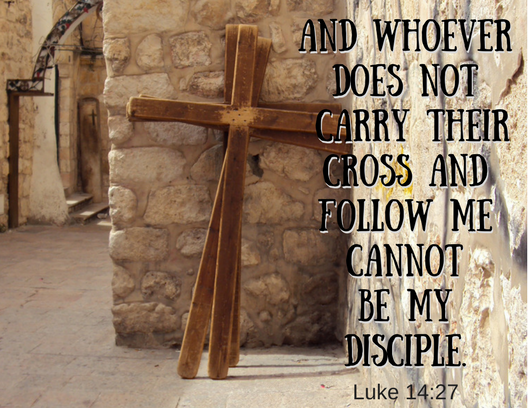
As crowds follow Jesus, he turns to them with sobering words and says, “If anyone comes to me, and does not hate his own father, and mother, and wife, and children, and brothers, and sisters, yes, and his own life also, he is not able to be my disciple. Whoever does not carry his cross and come follow after me is not able to be my disciple” (Luke 14:26-27). This statement would have certainly caused his audience to be taken back, wondering what this stipulation could mean. But Jesus is not commanding hatred or any ill-will toward others. Rather, he is using intentionally strong language to emphasize the supreme loyalty required to follow him. Discipleship means putting Jesus above all other relationships and comforts, and being willing to endure hardship and sacrifice for his sake. He illustrates this with parables about building a tower and a king preparing for war—both which require careful consideration of the cost (Luke 14:28-33). Jesus’ main point is that following him must be a wholehearted commitment and not a partial or casual decision.

Reflect: What does it mean for you to “carry your cross” in your current season? Are there certain comforts or relationships that are impeding your commitment to Christ that you do not want to let go of?

The Joy of God’s Restoration

Luke 15 is a chapter overflowing with God’s heart for the lost. The religious leaders grumble at Jesus because he welcomes and eats with sinners; something which they find repulsive and utterly alarming. In response to their judgmentalism and resistance to seek those who need help, Jesus tells three parables—the lost sheep, the lost coin, and the lost son. Each story highlights God’s relentless pursuit of the lost and the extravagant joy that accompanies when even one sinner repents and is saved (i.e., “found”).

The Parable of the Lost Sheep (Luke 15:4-7) shows a shepherd leaving ninety-nine sheep to find the one that is lost, rejoicing when it is found. “I tell you that in the same way there will be more joy in heaven over one sinner who repents than over ninety-nine righteous people who have no need of repentance.” In like manner, the Parable of the Lost Coin (Luke 15:8-10) and the Parable of the Lost Son (Luke 15:11-32) echo this theme about how God’s love actively seeks, restores, and celebrates the return of those who were lost.

These parables reveal the depth of God’s grace and mercy and the value he places on every individual, no matter how small they might seem. In the parable of the Lost Son, in particular, the father’s embrace of his long-lost son illustrates God’s loving heart and readiness to forgive and restore, no matter how far we have wandered, if we will just turn back to Him in repentance.

Reflect: Where have you experienced God’s restoring grace in your life? Who in your life might need to hear about God’s joy in welcoming the lost home?

Encouragement

This section of Scripture invites us to embrace humility, count the cost of following Jesus, and rejoice in God’s heart for the lost. As you reflect on these teachings of Jesus, consider how you can embody Christ’s humility, make courageous choices to follow him, and join in God’s joy by welcoming others into His grace and forgiveness. May you find encouragement in knowing that every step toward Jesus is met with God’s open arms and heaven’s jubilant celebration, for this is the will of God.

Be Ready, Repent, Choose Jesus

Luke 12-13

Devotion by Jerry Wierwille (New York)

Luke 12–13 contains a series of teachings and parables from Jesus that invite us to reflect deeply on our priorities, our readiness for God’s kingdom, and the call to genuine repentance.

Living with Kingdom Readiness

Jesus’ words in Luke 12:35-40 call his followers to be dressed and ready for service and to “keep your lamps burning.” He uses the image of servants waiting for their master’s return, emphasizing the need for constant readiness. Through the analogy, Jesus emphasizes that life is not just about mundane daily routines, but first and foremost, it is about living in anticipation of God’s purposes and Christ’s return.

This urgency is underscored in Luke 12:54-56, where Jesus rebukes the crowds for being able to interpret the weather but failing to “interpret this [present] time.” Jesus’ ministry marked a pivotal moment in God’s plan, and people were called to recognize the significance of what God was doing through him. The call is to spiritual alertness—to see beyond the surface of daily events and discern God’s activity in our world, especially in and through Jesus the Messiah.

Reflect: Are you living with a sense of spiritual urgency? What might it look like for you to “keep your lamp burning” in your current season of life? How can you cultivate a heart that is attentive to God’s work happening around you?

Unless You Repent…

Luke 13 opens with a sobering reminder of the necessity of repentance: “Unless you repent, you will all perish as well” (Luke 13:3, 5). Jesus refers to recent disasters—the Galileans killed by Pilate and those who died when the tower in Siloam fell—not to explain the tragedies, but to call everyone to carefully examine their own lives.

Jesus’ call to repentance is not meant to instill fear, but to bring attention to the opportunity for repentance. God’s patience gives us time to turn to Him, as illustrated by the parable of the barren fig tree (Luke 13:6-9). The owner seeks fruit, but the gardener pleads for more time to nurture the tree. In the same way, God graciously gives us opportunities to bear fruit in our lives, but there is a time when judgment will happen and the tree that does not bear fruit will be “cut down” (Luke 13:9).

Reflect: Where do you sense God inviting you to repentance and growth? Are there areas in your life that need to be surrendered or renewed? How can you respond to God’s patience and grace today?

Choosing Jesus

One of the more challenging statements of Jesus in this section is, “Do you think that I have come to bring peace on the earth? I tell you, no, but rather division” (Luke 12:51). Jesus explains that following him may even divide families, as people must decide whether to trust in him and align their lives with him, or not.

Division is not Jesus’ desire, and neither is conflict. But rather, it is a recognition that the truth of his message demands a response. The good news confronts every person with a choice: will I follow Jesus, even if it costs me personal relationships or people’s approval? The emphasis is not about the outcome of disagreement between people, but to remain a faithful believer and disciple, even when it is difficult and requires significant sacrifice.

Reflect: Are there relationships or situations where following Jesus has brought tension or misunderstanding? How can you remain faithful and loving, even when it is costly to you? What helps you choose Jesus above all else?

Encouragement

Throughout Luke 12-13, Jesus challenges us to live with spiritual urgency, to embrace repentance, and to follow him wholeheartedly—even when it leads to making hard choices.

Take time today to ask God to open your eyes to His work, to soften your heart toward repentance, and to give you courage to follow Jesus wherever he leads and to endure whatever it takes. As you do, may you experience the fruit that comes from a life marked by readiness, transformation, and hope in God’s kingdom.

Who is this Good Shepherd?

Luke 10, John 10:22-42

Devotion by Jerry Wierwille (New York)

John 10:22-42 opens with the Feast of Dedication in Jerusalem, where Jesus walks in Solomon’s porch and faces many direct questions about his identity. The passage is filled with challenges to expected norms, the importance of faith, and the safety and strength of the Shepherd’s hand.

The Challenge of Faith

As Jesus walks through the Temple, a group gathers around him, pressing in on him with questions that reveals both their curiosity but also their skepticism: “How long will you keep our souls in suspense? If you are the Christ, tell us plainly” (John 10:24). Jesus responds by saying, “I told you, and you do not believe. The works that I do in my Father’s name, these testify about me. But you do not believe because you are not of my sheep” (John 10:25-26).

Here, Jesus points out that belief is not simply a matter of intellectual assent or witnessing miracles. True belief is about recognizing the Shepherd’s voice and responding in trust. The works of Jesus—his miracles, his teachings, his ministry—are clear evidence of his mission and that he is from God. Yet, as Jesus notes, only those who are truly his “sheep” respond to him in faith. This situation echoes a recurring theme in Scripture: the spiritual life of faith is not about seeing the miraculous but about having a heart that is receptive to the things of God.

Reflect: Are there areas in your life where you find it difficult to trust Jesus, even when you see evidence of God’s work? What might it look like to move from being less skeptical to more faithful, trusting the Shepherd’s voice even when some answers are not immediate or obvious?

The Shepherd’s Hand

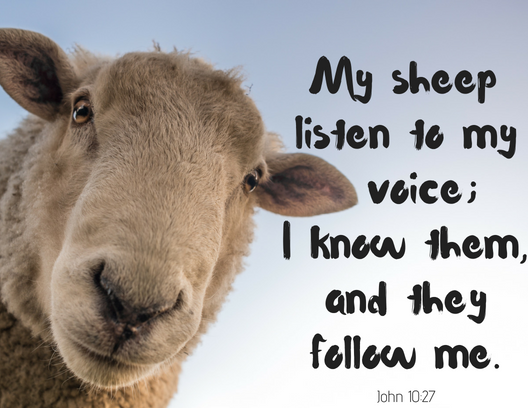
Jesus continues with one of the most comforting promises in all of Scripture: “My sheep listen to my voice, and I know them, and they follow me. I give them life in the age to come, and they will absolutely not perish, and no one will snatch them out of my hand. My Father, who has given them to me, is greater than all, and no one is able to snatch them out of the Father’s hand. I and the Father are one” (John 10:27-30).

This passage reveals one of the most profound promises that comes from belonging to Jesus. His followers are not only known by him, but are also protected by the power of God. The assurance that “no one will snatch them out of my hand” is a promise of lasting spiritual safety and belonging for those who follow Jesus. Undergirding this assertion is the truth about the unity of Jesus and God. But it is not a unity of identity, but about a perfect partnership in purpose and action. This unity in purpose with God and Jesus is the foundation for the believer’s confidence and hope.

Reflect: In what ways do you need to rest securely in the hand of the Shepherd? How does knowing that the purposes of Jesus and God are unified change your outlook on challenges, fears, or uncertainties?

Invitation to Deeper Faith

The immediate response to Jesus is intense and divisive. Some pick up stones, accusing him of blasphemy for making himself “a god” (John 10:33). Jesus, however, points them back to Scripture, referencing Psalm 82:6: “Is it not written in your law, ‘I said, you are gods’?” (John 10:34). He challenges their understanding and invites them to examine his works as evidence of his mission from God: “If I am not doing the works of my Father, do not believe me. But if I am doing them, though you do not believe me, believe the works, so that you will come to know and continue to know that the Father is in union with me, and I am in union with the Father” (John 10:37-38).

As the opposition persists, Jesus withdraws beyond the Jordan, where many people come to him. They recall John the Baptist’s testimony and recognize that everything John said about Jesus was true (John 10:41-42). The Jordan area was away from the hustle and bustle of Jerusalem and was a quiet countryside. Many believe in him there, showing that trust often grows in places and moments where hearts are open and receptive.

Reflect: Are you willing to examine Jesus’ works and words with fresh eyes/ears and an open heart? How can you invite others to explore the truth of who Jesus is, even when it challenges their expectations?

Encouragement

This section reveals who Jesus is and why people should listen to him and believe him. He is the Shepherd who gives life to those who follow him, challenging the audience to move from doubt to faith. Take time today to listen for his voice, trust in his protection, and share his truth with those around you. As you do, may you experience the peace, assurance, and security that only the Good Shepherd can give.

Spiritual Sight – or – Spiritual Blindness

John 9:1–10:21

Devotion by Jerry Wierwille (New York)

Several accounts in John 9:1–10:21 invite us to reflect deeply on spiritual sight, the voice of Jesus, and the abundant life he offers. We are going to look at three separate aspects of the section and then reflect on their significance.

From Blindness to Sight

The section begins with Jesus encountering a man born blind. Jesus’ disciples ask whose sin caused this—his or his parents’—but the question is ill-posed, and Jesus redirects their thinking by saying, “Neither did this man sin, nor his parents; but let the works of God be revealed in him” (John 9:3). Jesus then heals the man, giving him physical sight.

This healing is more than a mere miracle—it’s a sign of God’s power and how God can transform lives. The man’s journey from blindness to sight mirrors the spiritual awakening that Jesus brings to those who invite him into their life. It was undeniable the transformation that had happened physically in the man. Later, when questioned, the man boldly testifies, “One thing I do know, that, though I was blind, now I see” (John 9:25).

Reflect: Where have you experienced God’s transforming work in your life? Where have you been blind but now you see? And are there areas where you still need the light that Jesus brings to break through the darkness that can blind us? The passage encourages us to trust that God can reveal His work in us even in situations that seem hopeless or confusing.

Humility vs. Pride: Who Really Is Blind, And Who Can See?

After noting that the man was healed, the Pharisees investigate, but their hearts remain hardened to the truth. Jesus tells them, “For judgment I came into this world, that those who do not see will see, and that those who see will become blind” (John 9:39). The Pharisees, confident in their own understanding, ask, “We are not blind too, are we?” Jesus replies, “If you were blind, you would have no sin, but now, since you say, ‘We see,’ your sin remains” (John 9:41).

Ironically, Pharisees are both “blind” and “deaf” to the truth. Humble people, like the man born blind, can “see” and “hear” Jesus, while the proud cannot. This theme echoes throughout Scripture: spiritual pride blinds us to God’s work, while humility opens our eyes and ears. The Pharisees thought they could “see,” but that false confidence was their undoing. Jesus says because of this their “sin remains.”

Reflect: Are there areas where pride or self-reliance might be keeping you from seeing or hearing what God wants to show you? Is there a concrete action you can take to promote cultivating a humble, receptive heart in your life?

Hearing and Following Jesus’ Voice

As the section continues, Jesus states, “I am the door. If anyone enters by me, he will be saved, and will go in and go out, and will find pasture. The thief does not come except to steal and kill and destroy. I came so they can have life and have it abundantly” (John 10:9-10). Jesus’ self-ascription is “the Good Shepherd,” and his sheep know his voice and follow him.

When the text says that the true “sheep” (i.e., believers) “hear” the voice of the Shepherd (i.e., Jesus), while others do not, this is not talking about mere intellectual understanding, but about a trusting relationship. To “hear” the voice of Jesus means that you follow him because he leads, protects, and provides for you (his sheep), offering more than what is needed for survival, but a more abundant life.

Reflect: Are you attuned to Jesus’ voice in your daily life? What practices help you recognize and respond to him as your Good Shepherd? In a world full of competing voices and influences, this section invites us to focus on hearing the voice of Jesus and to be willing to follow him wherever he leads.

Encouragement

Through the narrative of this section, we are being challenged to move from spiritual blindness to sight, to embrace humility over pride, and to follow the Good Shepherd who offers an abundant life. Take time today to ask God to open your eyes, soften your heart, and help you listen for Jesus’ voice. As you do, may you experience the fullness of life that he promises and that only he can give.

The Conclusion

Old Testament: 1 Chronicles 23 & 24

Poetry: Ecclesiastes 12

New Testament: Colossians 3:1-17

In the final portion of the book, Solomon turns to remind his readers to think often of their Creator early in life before all the “evil days” come. His point is not to just think of God when you are young, but the need to establish the foundation of one’s life in their youth. The phrase “evil days” probably refers to old age (and eventually death). As life goes on, there is more opportunity for trouble and adversity. Old age has its host of difficulties and struggles. One’s youth is often thought of as the best of times, and during that period of life it is good to develop the habit of remembering the Creator before the days of “evil” come. That doesn’t mean that older individuals cannot “remember” the Creator. Solomon is simply asserting that this practice is best formulated and built into the foundation of life at an early age before life’s complications arise and produce much turmoil and frustration.

Verses 1-7 is a whole poem that focuses on the remembrance of one’s youth and the pleasures of life that a young person is able to enjoy in contrast to the gradual decline of physical abilities and the dulling of the senses with age, a relentless progression ultimately toward death. To be “afraid of heights” and the “terrors…in the road” refer to the weakening of the body and the feebleness that accompanies aging to where a person cannot defend themselves. The “almond tree will blossom” is likely a figurative reference to the graying of one’s hair with age, like the white blossoms of the almond tree when it is in season.

The complicated saying that the “grasshopper will be a burden” likely represents small activities and simple tasks; when you are old even the smallest endeavors can seem difficult. Furthermore, when one’s “desire will fail” perhaps refers to sexual desire, but if that is true, by metonymy it refers to the failing of the physical body in general. And the “age-long home” is the place, after the failing of the body, when a person goes to the grave.

Verse 8 is a large inclusion (i.e., bookends) restating the thesis that Solomon presented at the outset of the book in 1:2, ““Utterly pointless,” says the Sage. “Everything is pointless!”

The change in voice to the 3rd person (i.e., “the Sage”) perhaps indicates that a narrator is giving an epilogue to the foregoing discourse (chs. 1:1-12:7). This epilogue functions to frame the previous discourse and Solomon’s investigation.

The summary of what Solomon discovered is that to submit to and obey God is what it means to truly live as a human being. It might be difficult to understand why Solomon asserts the “pointlessness” of life so heavily and exposes it in so many facets of life under the sun. His approach can appear to lean toward doubting everything or concluding that nothing ultimately matters (i.e., nihilism). But the pointlessness of everything he saw has driven him in the end to a deep piety and dependence on God. To understand that everything that happens under the sun has no ultimate significance or meaning only draws out the fact that meaning must reside outside of life under the sun and the work that humans do. In the face of all the oppression, injustice, uncertainty, and death in life, the Sage finds the only true meaning in life is humbling oneself before the Almighty Creator and remembering that he is God, and we are not. Our role as creatures is to worship and obey the one who makes everything and to not try and control or manipulate life, because everything we can try and do on our own is ultimately pointless. The only ultimate meaning is found in relation to the Ultimate Being whose breath fills the world and whose hand spans the universe. It is to him that we are accountable and will be judged for everything we do, whether good or evil.

So, let’s live for Yahweh and trust in him and not in our own understanding. We are weak and finite creatures, and our meaning and purpose in life can only be discovered through an obedient and faithful relationship with our God and Creator. This is the wisdom of the book of Ecclesiastes.

-Jerry Wierwille

Reflection Questions

  1. If you were to write a book of wisdom – what would your conclusion be? Where did you learn this “wisdom” from? Do you think God would agree with your conclusion?
  2. Regardless of your age, what changes have you seen in yourself as you have grown older? How does growing older affect your wisdom? What changes in your relationship with God would you like to see as you keep growing older? What can you do to bring this about?
  3. What challenges do you find in Ecclesiastes 12? Will you rise to these challenges?

Life is Uncertain

Old Testament: 1 Chronicles 21 & 22

Poetry: Ecclesiastes 11

New Testament: Colossians 2

Life is uncertain. That seems to be the theme that Solomon focuses on in this chapter. His first statement seems quite enigmatic, “Cast your bread on the waters; for you may find it after many days.” “Casting one’s bread on the waters” may be a metaphor for maritime trade, and what one might “find after many days” could refer to the revenue that comes back to the person after the goods are sold. The numerical proverb in verse 2 could suggest the wisdom in diversification of cargo on different ships, so that if something happened to one ship, the entire shipment won’t be lost. The reasoning for this is that a person cannot know “what evil may happen on the earth,” referring to unforeseen disasters and circumstances in the future.

Another imagery that is used is that of clouds that are full of rain (v. 3). The imagery is meant to depict the randomness of life and the unpredictability of events. The implicit idea that the imagery represents is the uncertainty of disasters or bad things that will negatively impact one’s life. We have no control over where a cloud will drop its rain. We know that clouds bring moisture, but the definitiveness of when and where that will take place is outside the ability of a person to know. We are simply subject to the randomness of weather patterns. Now, ultimately we know that weather is not truly random, but it is impossible for us to know all the factors that play into the weather and the behavior of clouds.

A modern expression that captures this same idea is: “That’s the way the cookie crumbles.” No one can predict how it is going to happen. But when it does, then that is how it happens.

Next an agricultural illustration is used describing farmers and how the inevitable randomness can cause one to be paralyzed by the inability to know the future. If a farmer tries to predict when the wind will be favorable for planting, they will never sow their seed because the wind might change at any moment. In addition, the farmer who stares at the clouds in order to predict when it will be dry to harvest will never gather the crops because it might rain before the harvest can be completed.

As one scholar summarizes the point of v. 4, “…one cannot use the possibility of misfortune as an excuse for inactivity. Someone who is forever afraid of storms will never get around to working his field. The Teacher in effect says, ‘Just face the fact that things may go wrong, but get out there and do your work anyway.’” (Duane A. Garrett, Proverbs, Ecclesiastes, Song of Songs, [Vol. 14, The New American Commentary], 338)

We humans are vastly ignorant about the inner workings of life and of God. In this verse, Solomon is stressing that fact but using the developing fetus in a womb as a clear example of something we know nothing about. One of the great mysteries of human existence is how life comes together in a fetus as it forms in the womb. We have no idea how “spirit” (i.e., life) enters the bones of a baby.

This example of human ignorance is being used to make the point that even though we don’t understand how many things in life really work, we should not let a lack of knowledge paralyze us into inactivity.

Thus, while trying to figure out what is going to come in the future is not profitable, we should still act wisely and take reasonable chances in life, unlike the skeptic and fearful who will not move forward in life even if the opportunity is there.

This illustration is compared then to the “work of God” in the world. Solomon describes God as the one who “makes everything.” The reference is to the operations of creation (e.g., gestation). God causes the sun to rise and the rain to fall, just as he gives life to the fetus and causes it to grow in the womb. And so, in the same way that we don’t understand how certain things happen, like a pregnant woman who is trusting God that the baby will develop as God designed, so also all future plans must likewise be put in the hands of God. We ultimately cannot control success or failure. We must simply do our best and trust God with the rest (i.e., the outcome).

In light of the general ignorance about life and the work of God, Solomon encourages the reader to work hard in the face of uncertainty, even if we don’t understand what is going to happen. He instructs farmers to “sow your seed,” meaning go out and plant the crops, and “do not withhold your hand,” meaning don’t refrain from working. Finish the job!

We have no idea whether something will turn out good or bad. We have to wait and see. Maybe one thing will work, and another will fail, or perhaps both will work, or both will fail. But one thing we can be sure of, if we don’t do anything, then nothing will ever happen.

“Light is sweet” appears as a mismatched metaphor. How can “light” be tasted. Here “light” is likely a metonymy of association referring to the perception of light by the senses of one who is alive. Thus, it refers figuratively to “life” and represents a living person (cf. Job 3:20; 33:30; Ps 56:14). This is the opposite of “darkness” which represents “death.” And “sweet” is a metaphor of taste referring to a pleasurable experience, not actual tasting with one’s mouth. This figuratively represents something that is good and delightful. Furthermore, “to see the sun” refers to being alive and able to work and do something “under the sun.” The idea is that being alive is “good” and something to be enjoyed.

Verse 8 provides the reader with encouragement to rejoice in life no matter what age a person might be. But that rejoicing is to be accompanied by an awareness that life is filled with “darkness” and that everything that happens cannot be explained or give ultimate meaning to life. Sometimes bad things happen, and no explanation can be offered to explain them. Thus, attempting to know the reason why everything happens is not possible, and therefore, it is “pointless.”

Solomon is advancing the premise that joy should accompany a person throughout their life, but life is not solely one of bliss and ease, it is also filled with hardship, pain, and various evils. And this is why he returns to the idea of “joy,” and now in more forceful terms, he flat out instructs the reader to “Rejoice!” The instruction is not meant exclusively to be directed or applied exclusively to young people. What is meant by the expression is for “joy” to become a set pattern early on in one’s life.

The phrase “let your heart cheer you…walk in the ways of your heart…in the sight of your eyes” uses the terms “heart” and “eyes” as organs of desire, and they refer to one’s inner yearnings and inclinations. The exhortation is not to follow whatever impulses one has regardless if they are immoral or reckless. Rather, one is to pursue desires and the joy they bring into life with the awareness of God’s impending judgment over everything you do.

Lastly, with God’s judgment in mind, a person should not allow the frustrations of life to incumber their pursuit of joy. We must not let the enigma of life and the unexplainable and uncontrollable realities weigh down our rejoicing in life. On the other hand, a person must not let their desires draw them into evil either. Pursuing one’s desires often can lead to wickedness and sin. Thus, one must be diligent about avoiding temptations that arise from the desires in our flesh. So, despite the human condition, we are to overcome the troubles that the “pointlessness” in life brings and focus on the joy that we can experience in the midst of it.

-Jerry Wierwille

Reflection Questions

  1. Have you ever used the possibility of misfortune as an excuse for your inactivity? If so, what might Solomon say to you?
  2. “Pursuing one’s desires often can lead to wickedness and sin.” How have you seen this in your own life? What desires? What wickedness and sin? How can you protect against this? Should some desires be changed? How? Should you go about pursuing some desires in different ways?
  3. Even with the unknowns and the difficulties in life, how can you still pursue and show joy?

Wise Words

Old Testament: 1 Chronicles 19-20

Poetry: Ecclesiastes 10

New Testament: Colossians 1:15-29

Ecclesiastes chapter 9 ended with an expression of the power of foolishness: “Wisdom is better than weapons of war; but one sinner destroys much good” (9:18).

Here in verse 1, the premise of 9:18 is now carried forward. The principle that is being addressed is that a little bit of a bad thing (e.g., foolishness) can completely ruin a good thing. The modern saying “A fly in the ointment” contains the same wisdom and is used to represent how something small (or seemingly insignificant) can have a powerful or far-reaching effect. There are many small things that can produce a powerful effect.

We have another modern proverb to convey the same idea, “One rotten (bad) apple spoils the barrel.” This is a truism as we now know because of microorganisms (e.g., mold, bacteria, yeast), which tend to have a permeating effect. Once they are introduced, they will continue to spread until they have affected every part of the substance and adjacent substances.

Foolishness and sin are often likened to a foul stench, such as Proverbs 13:5—“A righteous person hates a deceptive word, but a wicked person will become a stench and display his shame.” Clearly the “stench” in Proverbs 13:5 is the speech (i.e., words) of the wicked person (i.e., fool). What Solomon has in mind is likely the words of the “sinner” in 9:18, not just the person. Thus, what he is saying is that it only takes a few foolish words to bring about a whole world of destruction. Furthermore, a fool cannot conceal their foolishness, but clearly demonstrates it each time they open their mouth or do anything.

While a ruler or person in authority is not immune to foolishness, verse 4 does not seem to be closely connected with the previous verses but offers advice on how to act in the presence of those with authority. Previously, Solomon had advised that a person follow the command of the king and not argue with him (8:2-9), it seems that he is saying the opposite here. However, the present context is not about opposing the king, but how to deal with him when he is angry with you. To walk out on the king in his anger will only incite him to be even more angry with you. Rather, Solomon suggests to change how you interact with him; it is wise to use a “calm” demeanor, as that can reduce his anger and offense against you.

Part of Solomon’s observational dilemma is that what he sees in the world is perplexing and out of order with what he thinks should be the case. When he sees, “Foolishness is set in many high positions, while the rich sit in a low place. I have seen servants on horses while officials walk on the ground like servants.” The point of Solomon’s examples is to say that if foolishness is in charge, then the world will be upside down and wisdom won’t work as expected.

In another way of looking at the world, Solomon notices that things can happen to the best of us (i.e., skilled and knowledgeable in their craft). One way to see Solomon’s point is that being a skilled expert does not remove all potential danger or guarantee success. The other way is that a skilled expert will fail if they don’t properly apply their knowledge.

Foolishness has a progression to it. The beginning is foolishness (v. 13), but the foolishness deteriorates the situation into becoming “hurtful madness.” Foolish words harm both the speaker and the listener, but a fool is oblivious to this. It seems that the fool has a false perception of understanding or control over life that they don’t recognize how they are stumbling further into foolishness and disastrous consequences.

The delusional consequences of the fool are further elaborated by depicting him as forgetting how to go to a city where he presumably works or needs to go to sell goods. The effort of the fool is compounded by the fact that he does not even have the basic understanding of how to carry out business. And thus, the fool’s effort must be multiplied because of his lack of sense about where he needs to go. To run a successful industry requires knowledge about trade and commerce, and the fool is deceived into thinking they can be successful without it.

If a foolish leader will bring about disorder and chaos, in vv. 16-17 Solomon now contrasts the consequences of foolish leadership with the advantage of wise leaders.

Solomon identifies in verse 16 two detrimental qualities of leadership: being immature and being neglectful. “Feasting in the morning” implies that when leaders should be tending to the business of the kingdom (i.e., in the morning), they instead are reclining to eat. This does not refer to breakfast but a large-scale banquet typically involving entertainment, music, and drinking wine.

The concluding phrase of verse 19 might be the most difficult of the chapter. On the surface, the verse seems to be advocating a sensual lifestyle of eating, drinking, and using money to satisfy one’s desires and enjoy the luxuries of life.

While the phrasing is a little difficult and the Hebrew offers a high degree of latitude in meaning, it seems that what Solomon is affirming is the need to have money in order to buy food and wine and other provisions for enjoying the simple aspects of life that Solomon has been endorsing all along.

Solomon closes with a warning about how to conduct oneself in the presence of a king (or any authority figure). He warns about the dangers in cursing the ruler or person in authority, even in one’s thoughts or “sleeping chamber” (i.e., in secret). The point of the warning is that the danger of consequences is not worth the risk. The king is sovereign and can issue severe punishments. We have a modern saying that expresses the same admonition: “The walls have ears.” The warnings are hyperbolic (e.g., exaggerated) because no one can know another person’s thoughts. But the emphasis is to be overly cautious about how you act and what you say about a ruler or person in authority. You never know who might be listening; and you don’t want to be caught and suffer the consequences.

-Jerry Wierwille

Reflection Questions

  1. What examples can you give of how a little of a bad thing can spoil a good thing? Can you think of a time when you tried to let just a little bit of a bad thing in and it led to big problems and a lot of spoilage? What could you have done differently to lead to different/better results?
  2. What verse do you like best in Ecclesiastes 10? What wisdom do you find in Ecclesiastes 10?

Embrace Life

Old Testament: 1 Chronicles 17 & 18

Poetry: Ecclesiastes 9

New Testament: Colossians 1:1-14

One of life’s great paradoxes is that it is predictably unpredictable. Life never seems to go the way we think. Solomon reflects on the inevitability of mortality where death is the great equalizer, the advantage of being alive, and encourages the reader to relish and enjoy life on the way to death, because that is what awaits everyone in the end.

There is a common “fate” that awaits every person: death. And regardless of a person’s righteousness or wickedness, the same end is waiting for them. Solomon says, “people do not know whether it is love or hatred; everything is ahead of them.” “Love or hatred” refers to divine favor or judgment. No one knows what their work will produce because it lies in the future. According to Solomon’s method of investigation, no one can say whether they will receive “love” or “hatred” in the future.

Solomon describes the common denominator of life—death—as an “evil” that is done under the sun. No one can predict when it will happen, and no one can escape it. There is “one event” that happens to all. After death, a person has no further reward or enjoyment of things done under the sun.

But for those who have not joined the ranks of the dead, Solomon says “there is still hope!” There is “hope” that while being alive a person can acknowledge the reality of death and thereby embrace the joys in life that they can, because no possibility exists for the dead as their life has ended and there is no going back.

In Solomon’s perspective, life is better than death. Period! Even a measly, no good dog (the ancient world did not have a high view of dogs) is better than a dead lion (viewed as one of the strongest and greatest of all animals in the ancient world). He brings the “hope” of the living into plain view by bluntly stating the obvious, “the living know they will die, but the dead do not know anything.”

Solomon’s point is for the reader to embrace life and all its blessings and joys. We only have a certain amount of time to do this, and then it is over, and we can’t have more.  When a person dies “their hatred, and their envy” all perish with them. And so, while we are living, Solomon advises that we pursue life to the fullest and to engage in every activity with all that we are. Soon enough, we won’t be able to. So live it up, Solomon says, “Let your garments be always white, and do not let oil be lacking from your head. Enjoy life with the wife whom you have loved.” He is using very festive language here about wearing white garments and applying oil on one’s head.

But it is important to note that as part of the life that Solomon suggests one should live, he includes dedicating the time to work hard. That is part of the fullness of life, and the food and drink from one’s labor is part of the essential joys one can partake of in life.

Solomon turns to address the uncertainty of life as something perplexing and which he finds unsatisfying. Everything he lists seems to be disordered. The race should be won by the fastest racer, the battle should be won by the strongest soldier, wise people should have food to eat, foolish people shouldn’t have money, people who are skilled should be preferred (i.e., have favor), etc. But Solomon identifies that “time and chance happen to them all.” The point is misfortune and disaster are not selective about who they happen to fall on any given day. Everyone is susceptible to the chance of bad things happening to them. To prove his point, Solomon draws upon two negative images—fish in a net and birds in a snare—to illustrate the horror of the human condition where people find themselves encountering adversity when they least expect it.

In the final section of the chapter, Solomon tells a parable of a small city that is saved by the wisdom of a poor man, but in time, the poor man was forgotten about. So, Solomon affirms traditional wisdom that says, “Wisdom is better than strength.” But people did not recognize the poor man’s wisdom as such and soon forgot about it and him.

While traditional wisdom says that “wisdom is better than strength,” Solomon’s observations seem to complicate that conclusion because things are not always that way in reality. According to the narrative in his parable, it only takes one sinner to destroy (i.e., neglect) what wisdom says. And so, Solomon is asserting that as powerful and valuable as wisdom is, it has its limits. It is certainly preferrable to foolishness, but it is not immune to the destructive effects of a little foolishness. A small bit of foolishness can spoil the greatness of wisdom. This then begs the question, “What real value is wisdom if it can be overthrown so easily by a single fool?”

-Jerry Wierwille

Reflection Questions

  1. How has the unpredictability of life ever caught you by surprise?
  2. What do you enjoy about life? How do you embrace it? Does this include your labor?
  3. Can you give an example of when or how, “A small bit of foolishness can spoil the greatness of wisdom”?

What you See vs. What you Know

Old Testament: 1 Chronicles 15 & 16

Poetry: Ecclesiastes 8

New Testament: Philippians 4:10-23

Solomon begins by asking “Who is like the wise man?” in a rhetorical fashion to get the reader to consider if they are like the wise man in the verses that follow where Solomon will set forth several scenarios involving a king (who represents any authority figure) and how certain responses are appropriate or not. The phrase “makes his face shine…hardness of his face is changed” refers to how using wisdom can change the way someone is presenting themselves to their superiors. One’s demeanor and conduct, if done with wisdom, can sway the other person’s opinion of them and earn them their favor.

Verse 3 is probably better as expressing the wisdom in leaving the king’s presence and carrying out his command rather than the instruction to remain since the following phrase instructs the reader to not “persist in an evil thing” by objecting to the king’s command and remaining in his presence to argue and oppose him.

An “evil thing” is likely a reference to a “bad idea” or a proposal that is not favorably received by the king. On the basis of the king’s authority as absolute, anything that interferes with or opposes his will automatically becomes “evil.” However, this is not moral evil, it is just Solomon’s way of describing something that causes trouble (the Hebrew word for “evil” also can mean “trouble”).

Wisdom would say for a person to respect those in authority and not push their agenda or object rudely to their directions. Why is that? Well, Solomon says that “the king’s word is authoritative.” Now, Solomon has in mind a monarchical government where the ruler (i.e., the king) is a totalitarian. This was the common form of government in the ancient world. But in our world, we could think of someone who has a superior rank (e.g., our teachers, boss, or civil leader).

“Whoever keeps the commandment” refers to the person who listens and obeys the king. This person will be safe, and no harm will come to them. Punishment does not fall on the one who does what they are told. Rather, the consequences are reserved for the one who rebels and disobeys.

But if there is a disagreement with the king, Solomon notes that there is “a proper time and procedure,” meaning that there is an appropriate way to provide feedback and one’s opinion for the king’s consideration. The wording here is extremely close to the wording we saw in 3:1—“For everything there is a season, and a time for every matter under heaven.”

Verse 10 begins a new section in Solomon’s discourse in the chapter. The issue that Solomon raises is about justice and retribution. He sets forth a scenario where he sees wicked people live and then die, and he watches them get buried. He even describes them as previously participating in the temple worship of Yahweh, and they received the praise of people in the city where they carried out their wicked schemes.

Here in this section, the pointlessness that Solomon is interested in expressing is about the delay judgment of these wicked people. He asserts that they were never judged while they were alive, and so it seems as though they never were punished, and the victims never received justice for their crimes.

vv. 12-13—this is the first assertion that Solomon makes that departs from his methodology of observation. It is outside the scope of inquiry to know that it will be “better” for the person who fears Yahweh and is reverent before him, since all of his observations point toward an experiential indifference between the righteous and the wicked. In fact, he even notes an inversion that he sees in the world where the wicked live long and the righteous die young.

Solomon is expressing a distinction between what he “knows” and what he “observes.” What he “sees” happening is vastly different from what he internally “knows.” And so, we begin to see the dilemma that Solomon is facing in his quest. But he doesn’t resolve the tension here. He merely presents it.

Solomon expressed a similar idea in 3:16-17, where he said, “16And moreover I saw this under the sun: in the place of justice, that wickedness was there, and in the place of righteousness, that wickedness was there. 17I said in my heart, “God will judge the righteous person and the wicked person, for there is a time of judgment for every purpose and for every deed.”

The judgment of God was not something that Solomon observed. In fact, what he saw was a complete absence of justice “under the sun.” And thus, the issue of delayed justice is brought back up again in verse 14: the righteous are punished and the wicked go free.

Since the judgment of the wicked is not happening in the present world, but Solomon “knows” that it will occur, his advice is to not focus on it, but to enjoy life despite the brokenness and the injustice happening all around. The “joy” that Solomon says is to accompany one’s work and the eating and drinking the fruit of that work has been a theme already mentioned twice before in 2:24 and 5:18.

In certain circumstances in life, we often make a deductive choice on what would be at least a good way to respond. For Solomon, his deduction is at least, “enjoy life,” by eating, drinking, and being merry. This is at least a good response for humankind with the work that God has given them to do.

The exhaustive effort that Solomon has applied to his search has caused him to lose sleep. The lack of any satisfying answer has left him disturbed and unable to find rest. All day and all night, his mind is busy, preoccupied with the question that he feels he must answer. But because he cannot solve it and discover the ultimate meaning of life, he resorted to a simplified suggestion as a baseline of what he knows—it is good to enjoy life as one labors all the days that God has given to them.

Solomon offers verse 17 as a summary of his effort and makes a grand claim that he has observed it all—all the work of God—and his conclusion is that no one can find it out. No matter how thorough Solomon has been or could be in his investigation, his methods fail; he cannot discover the answer to the ultimate meaning of life. And if a wise person thinks that he can figure it out, he’s wrong, Solomon says—He can’t, because no one can.

-Jerry Wierwille

Reflection Questions

  1. Can you give some examples of when what you “see” is different than what you “know”?
  2. What is your approach to people in authority? Is there anything you can learn from Solomon in this chapter regarding your interactions with people in authority?
  3. What are the benefits to being a wise person? What are the limitations to human wisdom?

Satisfaction in Life

Old Testament: 1 Chronicles 11 & 12

Poetry: Ecclesiastes 6

New Testament: Philippians 4:8

In chapter six, Solomon reiterates some of his former sentiments but in a reverse fashion. In 5:18-19, Solomon said, “18Here is what I have seen to be good: it is appropriate for one to eat and to drink and to see good in all his labor in which he labors under the sun, all the days of his life that God has given him for this is his portion. 19Every man also to whom God has given wealth and riches, and has given him power to enjoy them and to accept his portion and to take pleasure in his labor—this is the gift of God.”

Solomon’s frustration has reached nearly a fever pitch by what he sees happening around him with people not being able to enjoy the wealth and honor that God has given them. He offers an anecdote to explain the “evil” that he sees happening “under the sun” and the heavy weight that is upon all humankind: God gives to a person “wealth, riches, and honor” to the degree that they have no lack of anything, and they have all that ever desired. But that is all that they get! God does not give them the accompanying ability to enjoy the bounty and pleasant life that having everything you want is supposed to offer.

Solomon cannot understand why this is the case for some people. His logic is that if someone works hard and God gives them “wealth, riches, and honor,” but then they don’t get to enjoy those things, but rather someone else does, this is wrong and unexplainable in his eyes. To “eat” something was often a metaphor for fully experiencing and enjoying it. It is as if Solomon is thinking, “Why shouldn’t someone get to enjoy the fruit of another person’s labor?” And so, he is repulsed by this observation and finds it entirely enigmatic and confusing.

We are not told why God would withhold giving a person the ability to enjoy the benefits of their hard work and the revenue and recognition that it has produced. But the answer to “why’ really isn’t the focus of his story. Instead, Solomon is bewildered that it even happens at all, and that in his view, such a reality is mysterious and frustrating. He even goes so far as to say that this is an “evil” and a “severe affliction.”

In vv. 3-6, Solomon considers that as enjoyable as having a large family with many children would be, it can’t be the answer to his question about the meaning of life because Solomon says that even if a person had a hundred children, if their “soul is not satisfied with good things,” then it is all pointless. So apparently, children are not the answer for true satisfaction in life.

It is the absence of enjoying the “good things” that brings discontentment. But what are those “good things” if not one’s family? The “good” that Solomon has mentioned already in the book of Ecclesiastes is eating, drinking, and rejoicing in one’s work (5:18). Essentially, Solomon is saying that no matter how good the circumstances are or what you possess or what you can do, if you don’t simply enjoy life, then everything else is pointless.

Furthermore, in his vexation over this issue, Solomon turns to offer a dark comparison by suggesting that a stillborn child is better off than a person who remains unsatisfied in life. This is a grisly move that is emotionally charged, for Solomon thinks that the baby who never had the chance to draw breath is better off than a person who lives an unsatisfied life. Now, Solomon is not defying the Creator and saying that life is worthless and not even worth living. Remember, what Solomon says he says with a certain perspective in mind. Here, he sees the stillborn baby as not having to suffer and endure the frustration and pointlessness of all that goes on under the sun. They don’t have to be subject to a life deprived of enjoyment and filled with futile desires that can never be met.

Solomon appears to move on from this thought (vv. 1-6) to address yet another issue: wisdom and foolishness.

In broad terms in verse 7, Solomon attributes the reason for all human work as being aimed at satisfying his sensual desires, but those desires are never fulfilled. A person is never completely content and satiated—the desires just keep returning. And so, the search for satisfaction is never ending; it is a vicious cycle that keeps spinning. Thus, the inability to find satisfaction is a deep frustration to Solomon.

Solomon perceives that perhaps there is an answer in the teaching of wisdom as wisdom was viewed in the biblical culture as the normative way to acquire material wealth. If a person was wise, then they would be blessed and would prosper and accrue riches. But the wise are not immune to the desire for wealth and material goods which ultimately does not lead to satisfaction.

Furthermore, Solomon does not find wisdom to provide an advantage for the poor person. His point is not that wisdom is unable to help the poor person in their material needs, but that wisdom doesn’t give the poor person an advantage in finding satisfaction in life. Even if the poor person were to gain wealth through employing wisdom in their dealings, they are no closer to satisfying their true desires than the person who was wise to begin with. Wisdom can help a person obtain money, but not meaning in life.

Verse 9 provides the proverbial statement, “Better is the sight of the eyes than the wandering of the desire.” The general idea of the proverb is that what is present in one’s hand that they can use and enjoy is much better than what one desires but does not yet have (and may never have).

Beyond these issues, many questions can plague a person about their life, but which of them can provide the answer to the meaning of life. Solomon exasperates himself to no end trying to understand this answer. Ultimately, he seems to think that no one can know what is “good” for a person in life since life is so brief, and no one can know what will happen in the future after they are gone. Endless questions about if what we do now will have any lasting effect for those who come after us. But we are all left not knowing if there is a “profit” in what we do because we are limited to only knowing the here and now. “For who can tell a person what will be after him under the sun?” (v. 12b).

-Jerry Wierwille

Reflection Questions

  1. Where do you agree with Solomon? Anything you disagree with in Ecclesiastes 6? (Remember, he has not yet come to his final conclusions.)
  2. Can you give some examples of where you have found truth from the proverb in Ecclesiastes 6:9?
  3. How content are you right now with your life? Why or why not? What might Solomon say to you? What might God say to you?