Excited about Church

Old Testament: Micah 5

Poetry: Psalm 84 (day 2)

New Testament: Luke 18:9-14

How excited are you about going to church?  You might think church is boring, the singing doesn’t inspire you, the sermon puts you to sleep, the building is nothing to write home about, etc.  If you think like this, you are probably also thinking, “Why even bother going to church when there are so many more exciting things I could be doing?”

If you think church is bad now, just imagine how bad it was when they used a tent as a church (called the Tabernacle), and slaughtered animals to cover sins.  How well would you have liked going to church then?!  (Can you imagine the smell?)

Our reading today is from Psalm 84, which starts out, “How lovely is your dwelling place, O Lord Almighty!”  The writer wasn’t talking about the throne room of God in heaven, he was talking about the Tabernacle (tent) where he went to worship God.

Psalm 84 continues, “My soul yearns, even faints, for the courts of the Lord; my heart and my flesh cry out for the living God.”

The writer wasn’t getting excited about visiting a tent, he was getting excited about being able to be in the presence of God.  He was yearning, fainting, crying out to be near God.

Verse 4 goes on to say, “Blessed are those who dwell in your house; they are ever praising you.”

I’m guessing the writer is referring to the singers whose job was to stay at church and sing praises to God all day long. He was envious they didn’t even have to leave there to go to work (they were at work) – they were so lucky!  They got to be near God all the time.

Verse 10 says, “Better is one day in your courts than a thousand elsewhere; I would rather be a doorkeeper in the house of my God than dwell in the tents of the wicked.”

You may dread going to church.  The writer of Psalm 84 dreaded having to leave church.  He’d rather spend one day at church than almost 3 years anywhere else.  He’d rather be a doorstop at church than party all the time with his wicked friends.

Why did the author crave going to church so much?  The answer is: because he loved God, and he associated being at church with being in God’s presence – so he couldn’t get enough of it.  

Today, as a result of Jesus’ sacrifice on the cross, we have far greater access to God than the people in the Old Testament (including the writer of Psalm 84) had.  We’re told in Hebrews 4:16, “Let us then approach God’s throne of grace with confidence, so that we may receive mercy and find grace to help us in our time of need.”

God didn’t just send Jesus to die for our sins, God also wants to adopt us as His children.  And there’s an inheritance involved – the Kingdom of God.

1 Corinthians 2:9 says, “… No eye has seen, no ear has heard, no mind has conceived what God has prepared for those who love him.”

I don’t know about you, but I have a pretty vivid imagination, and can imagine some amazing things.  But, according to this verse, I can’t imagine how great the Kingdom will be.  Start with no more death or mourning or crying or pain, add in a little euphoria in the presence of God forever, and you’re just scratching the surface for what God has prepared for those who love him.

I want that!

God wants to adopt us as His children, but there’s a catch.  He will only adopt us if we accept Jesus as our Lord and Savor, are baptized, and live our lives for Him.  Only then will we get to live with Him forever.

Maybe, our level of excitement in going to church is related to our level of excitement for God.  Once we recognize how much God has already done for us, and what He has planned for those who love him, we’ll get more excited about God.  And once we do, I suspect we’ll get more excited about going to church too. 

-Steve Mattison

Reflection Questions

  1. What are your thoughts and feelings right now about going to church? Where do you think they come from?
  2. How excited for God are you? What has He done for you already? What do you know about – and what can you imagine – about being in the Kingdom of God? Have you already been adopted into God’s family? Are there steps you need to do in this adoption process?
  3. Is there anything about your perception and understanding about going to church that you think God wants you to change?

Your Longing

Old Testament: Malachi 4

Poetry: Psalm 84

New Testament: Luke 18:1-8

Close your eyes with me and replay in your mind the best day of your life so far. Try to recall all the vivid details – the sights, sounds, and smells, the intense feelings! (Then open your eyes so you can continue reading!)

Want to hear about one of the best days of my life? There are obvious ones not to be downplayed, such as my wedding day and holding each of my children outside the womb for the first time, but one of the most special days of my life was the day I swam with the manatees. 

Perhaps it sounds silly to you, but I adore manatees. I have spent copious amounts of time gazing at them through the massive glass aquariums at our two local zoos, both of which have manatee rehabilitation centers. So you can imagine my excitement a few years ago when my husband agreed that on our trip to Florida that year, we could splurge on an excursion to swim with the manatees in the Crystal River! I’ll never forget floating on the water while observing my beloved sea cows in a submerged, restful state ten feet away, surfacing every few minutes for air. It was an incredible experience to watch the momma manatee with her calf coasting through the shallow river beside us, the small herds interacting peacefully just under the surface, the chubby mermaids living their best (slow) life soaking in the warmth of the underwater spring. The tranquil experience was very healing for me, as one prone to anxiety who had to overcome many anxious thoughts to even pursue this swim-with-manatees dream. My mind still wanders in wishes… Why can’t life just be as peaceful for us as it is for our manatee friends? I’ve relived that day in my mind many times, and it always brings a smile to my face. 

“How lovely is your dwelling place, O LORD Almighty. I long, yes, I faint with longing, to enter the courts of the LORD. With my whole being, body and soul, I will shout joyfully to the living God… A single day in your courts is better than a thousand anywhere else! I would rather be a gatekeeper in the house of my God than live the good life in the homes of the wicked.” (Psalm 84:1-2,10, NLT). 

Psalm 84 is generally considered a song of pilgrimage, one that was recited or sung when God’s people would journey to the Temple to worship. The writer was longing to be in God’s presence again. Now that Jesus has made a way for us to connect to God again even without a temple, this song could apply to coming into His presence anytime, anywhere, describing our longing just to be near him. Though I am so grateful that we can come into His presence all the time now through prayer and worship, I have always thought of this Psalm as more of a hope of the coming Kingdom. Perhaps we take for granted that we can approach God at any time with our praise and concerns. (I know I do.) And perhaps we don’t really wholeheartedly perceive the amazing promise of the Kingdom. (I know I don’t.)  

This world claims to have it all: fame, fortune, fun. But it will never truly satisfy. C.S. Lewis once said, “It would seem that Our Lord finds our desires not too strong, but too weak. We are half-hearted creatures, fooling about with drink and sex and ambition when infinite joy is offered us, like an ignorant child who wants to go on making mud pies in a slum because he cannot imagine what is meant by the offer of a holiday at the sea. We are far too easily pleased.”

Sometimes I feel so overwhelmed with my never-ending to-do list and difficult, anxiety-provoking decisions that I lose focus of the eternal perspective. And other times, I think that everything is awesome and couldn’t possibly get better! For good or bad, it’s easy to get lost in the chaos of each day, isn’t it? It is important to focus on our purpose as followers of Christ and on the amazing hope of the Kingdom, which will be better than anything we can imagine. Even your best day in this life is nothing compared to the Kingdom experience, in which we will live with God and Jesus forever and where there will be no more sickness or crying or pain (see Revelation 21:4). 

Even just one day in God’s Kingdom will be better than a thousand of your best days in this lifetime. What a fantastic hope we have! 

-Rachel Cain

Reflections:

Close your eyes and imagine what the Kingdom will be like. Now, multiply that by a bazillion and you still won’t even be close to envisioning the peace and beauty of the Kingdom! 

Approach God in prayer and worship this week with a similar longing as expressed in this Psalm. Thank Him for the ability to enter His presence. Pray for a deepening desire to experience His presence during this life, as we await the coming Kingdom.

Socks and Shoes

Old Testament: Hosea 12-14

Poetry: Psalm 80

New Testament: Luke 16:1-15


If ever there was a dynasty in collegiate sports, it was the UCLA Bruins in the 1960s and 1970s. Over the course of a dozen years, they won 10 NCAA basketball championships.  At one point during this spell, they didn’t even lose a single game for three years.  There hasn’t been a run like it, or may never be again, and much credit goes to Coach John Wooden and his staff. Wooden didn’t seek out cutting edge strategies or even the most talented players. He cared about self-management and stewardship.  Before stepping on the court each player was taught how to put on their socks and tie their shoes. While this may seem demeaning or elementary, it had a dual purpose. The first, to minimize blisters and injury that could prevent a loss of practice time.  The second, to see if his players were faithful in the small things. If there was fidelity and discipline to this aspect, it is more likely this same commitment would be found to honing all the fundamentals of the game.

The connection of John Wooden doesn’t initially seem apparent when we examine the Parable of the Shrewd Manager. Initially it seems like a sneaky story about self-preservation instead of faithfulness.  An accusation from the owners comes against a middle level management, misusing company resources. When the news reaches the manager’s ear that he will be receiving a pink slip, he makes a game plan that will move him from one company ladder to another.  He quickly calls in those who have business dealings with the owner to settle their debts quickly and at a far lesser rate than what they owe in hopes of getting his back scratched in return upon his dismissal.  These executive decisions do not get ire, but instead the praise of his employer.  Our takeaway is likewise to be shrewd with our resources, taking responsibility for what is directly in front of us.

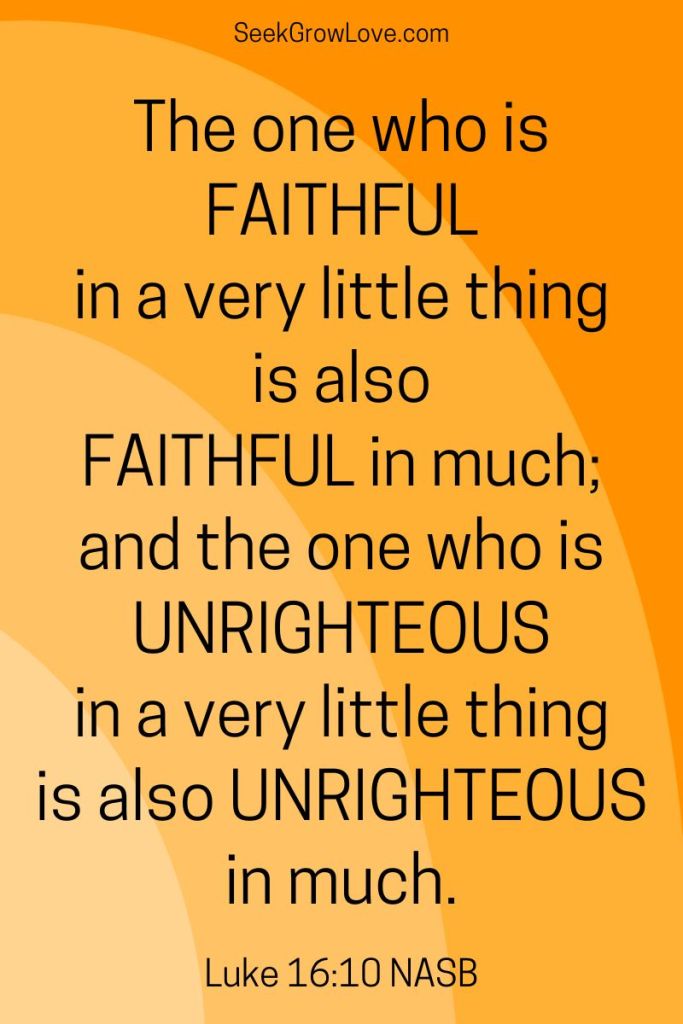
“Whoever can be trusted with very little can also be trusted with much, and whoever is dishonest with very little will also be dishonest with much. So if you have not been trustworthy in handling worldly wealth, who will trust you with true riches? – Luke 16:10-11

In every aspect of our dealings with others, whether with little or much, there is a responsibility to take disciplined, calculated action. Instead of acting in fear of losing our livelihood, we work on becoming the best version of ourselves because this shrewdness makes us trustworthy and impactful for the sake of the Gospel.  Jesus emphasizes that even the smallest actions are important, and really the basis for the amount of work that will be assigned to us. If we don’t take the time to tie our shoes right, and ultimately miss out on practice or games, we need to sit on a bench.  Furthermore, we cannot be expected to lead a revival, or even a Sunday School class, if we cannot be trusted with being disciplined enough to do our own Bible study.  We can’t be expected to receive God’s blessing on our business if we keep a tight grip on our purse when it is time to tithe.  Going back to the beginning of our week, staying true to a system or fundamentals, will not only develop a single resource, but ultimately encompasses every aspect of our lives, including our relationships, time, and talents.

Finally, one more theme to quickly revisit appears in today’s reading. Despite Israel’s mismanagement, let us again be reminded God’s desire is not to let them go, but to bring them back into the fold when he says: “I will heal their waywardness and love them freely, for my anger has turned away from them” (Hosea 14:4, NIV). This restoration is contingent upon living a life of integrity and faithfulness to God.  If we’re going to set foot on the court, let’s not even think about winning first.  Let’s make sure first that our socks and shoes are put on properly, looking at our calendar, our bank accounts, and our relationship, and demonstrating to God that we will be faithful with those things that are already set before us, so we may be shrewd managers, benefitting the greatest dynasty yet to come, the Kingdom of God.

-Aaron Winner

Reflection Questions

  1. What small actions have you (now or in the past) tried to skip over? What is the importance of doing these small steps consistently and well before trying to jump ahead to bigger things?
  2. What resources has God currently put you in charge of? What can you do to care for these well?
  3. How do you think God would rate your faithfulness?
  4. What is the biggest take-away you learned from Hosea this week?

Seeking Shepherd

Old Testament: Hosea 3-5

Poetry: Psalm 77

New Testament: Luke 15:1-7

I have a free pizza awaiting me today. I couldn’t be more excited. Every year around my birthday, as a reward for not dying, I redeem a voucher for an entire pie of my choosing at my favorite pizzeria. There is something more satisfying about good food when you haven’t paid for it, although I’m not advocating for dining and dashing, simply making friends with chefs, restaurant owners, or in this case, signing up for an email newsletter.  As I read for today, and I think about greasy-cupped pepperonis, I can’t help but think deeper about redemption. 

Befriend a realist, and it won’t be long before you hear the wisdom, “nothing is free.” Redemption rings true to this adage because by definition it means that the price or obligation has already been fulfilled. Therefore, you receive the reward without the typical settling of debt.  The dough, the cheese, the sauce, and the toppings have already been purchased, but I wasn’t the buyer. In a more significant example, enslaved men and women could be released of bondage, receive paperwork, and be transported to the North due to the fundraising efforts of American abolitionists.  In the Old Testament, God’s laws command redemption of property, or giving back land, houses, animals, and freedom, to the impoverished when they sell as a last resort to make ends meet, with the buyer gaining nothing in their return (Lev. 25:25-55). But in a much greater way than any of these examples, we have redemption through Christ.

There is absolutely nothing we can do to deserve the Love of God, yet it is poured out upon us as an abundant gift. God demonstrates His love and redemption in Hosea’s actions in redeeming Gomer in the midst of adultery, “The LORD said to me, ‘Go, show your love to your wife again, though she is loved by another man and is an adulteress. Love her as the LORD loves the Israelites, though they turn to other gods’” These words tell us that God does not simply pine for relationship with us while we are in sin, but that He actively pursues in the midst of our fall. God hates sin, but He is unrelenting.  His grace goes farther than the guilt, and hopefully, guides us back to Him.


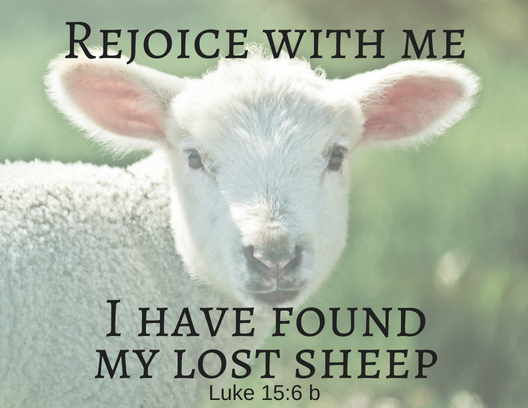
In the same manner, Jesus demonstrates this as the Good Shepherd watching over His flock. “Suppose one of you has a hundred sheep and loses one of them. Doesn’t he leave the ninety-nine in the open country and go after the lost sheep until he finds it? And when he finds it, he joyfully puts it on his shoulders and goes home.” Again, Jesus illustrates the commitment of the Father and His love for all within the body. It says heaven rejoices, but aren’t we too supposed to rejoice in the redemption?  As those who already know Christ, we should not be lining up for apologies, but instead extending the hands of grace.  If we were robbed by the redeemed of our possessions, our time, or our emotions, they have all become forfeit for the sake of redemption.

Despite our own unfaithfulness and wandering, God’s love has found us and refuses to let go.  He has already executed the campaign to offer you an eternal reward far greater than we could ever imagine (and I can imagine quite a bit of pizza).  Therefore it is our job to continue the work of Jesus, tending to His sheep.  We search the fields for the lost one, giving constant and enduring love to those failing to be victorious over temptation. It is simply put, but the practice is daunting. It is having an awkward conversation at the gas station with someone who hasn’t been to church in a few years.  It is  offering a listening ear to someone in distress, possibly never knowing if you have heard the truth.  It is showing kindness and compassion at business close when all you wanted was to get home to relax. Every act of love is a step toward spiritual restoration, not only for others, but ourselves, because we too have hope in life eternal at the expense of the Creator through His Seeking Shepherd.

-Aaron Winner

Reflection Questions

  1. What similarities do you find between the lives of Hosea and Gomer and the parable of the lost sheep?
  2. What lost sheep have you seen restored?
  3. What sheep do you know who are still lost? What acts of love can you be a part of to demonstrate the Father’s love to them?

A Radical Relationship

Old Testament: Hosea 1-2

Poetry: Psalm 76

New Testament: Luke 14:25-35

Since the pandemic, mental health has become an important topic that has not only been destigmatized, but has rapidly appeared in popular culture.  Looking at the vocabulary passed along in social media, I’m sure you’ve seen a quote or two referencing toxic behaviors, triggers, gaslighting, or keeping some type of balance.  The vast majority of those offering this advice are not certified to give it, but many have the ability to identify, and for the most part avoid, unhealthy relationships and behaviors that would emotionally exhaust us. So I, as one not certified to give advice, offer some advice, albeit unpopular and radical wisdom for the day and age we live in: God asks us to form addictive, dependent relationships in abandonment of self.

When the LORD began to speak through Hosea, the LORD said to him, ‘Go, marry a promiscuous woman and have children with her, for like an adulterous wife this land is guilty of unfaithfulness to the LORD’” (Hosea 1:2, NIV)

In a very specific instance, God instructs Hosea to marry Gomer, taking on an unhealthy relationship, knowingly to a woman who would be unfaithful to him. Not only a symbolic representation, but a real life metaphor, Hosea’s heart mimicked that of the Most High who was heartbroken by Israel’s infidelity. Yet in the same way, Hosea’s persistent love and commitment would mirror God’s unwavering love for His people. In spite of our own betrayal, God beckons us to return to Him and be restored.  This is a promise for Israel but truly, for each one of us.

Jesus also speaks directly to the demands of this type of abandonment in relationships.  Conversely, His focus is the reciprocation of God’s reckless love to us.  In the same manner, we prioritize Him above all else, even above family and possessions. In maybe the toughest pill to swallow in the ministry of Jesus, he states in Luke 14:26, “If anyone comes to me and does not hate father and mother, wife and children, brothers and sisters—yes, even their own life—such a person cannot be my disciple.”  Jesus double-downs on this statement, saying that we each must carry our own cross to follow Him. The demands of following Christ are toxic to self and most indeed will destroy us.

But this is the very cost of knowing Christ. If we were not aware of it before, be reminded of it as you read and re-read these words today. There must be a willingness to give up everything that hinders our relationship with God, and not only accept this, but embrace the sacrifices of discipleship.  No doubt there could be a growing dissonance in our minds. If this is the case, it could be that we are trying to preserve the self that remains instead of running to our relationship with the abandonment of Hosea, and ultimately, our Heavenly Father.  True discipleship demands more than superficial commitment. It requires a deep and wide devotion to Jesus, the same dedication He showed to His Father and to us.

Although we have lived in a manner that made us unworthy, God’s love for us is restorative and sufficient for any loss. The Church of God is His bride in the coming kingdom, and it matters not our history before coming to Him. We must no longer accept Jesus, for this implies He is tolerated. We must make a covenant with Him, becoming one. He has fully demonstrated His love for us, so we must embrace the cost of this radical relationship that continues to transform every aspect of our life.

-Aaron Winner

Reflection Questions

  1. “True discipleship demands more than superficial commitment.” Where else can you see this principle taught and illustrated in the Bible?
  2. How deep does your commitment to God go? What do you find gets in the way of diving deeper into commitment?
  3. How would you describe God’s love? What is your response to His love for you? OR – asked another way – What is God asking of you in your relationship to Him and to His Son? And what does He offer in return?

Your Purpose

Old Testament: Amos 1 & 2

Poetry: Psalm 73

New Testament: Luke 12:22-59

Have you ever wondered what your purpose is? Why are you here? What am I suppose to accomplish in this lifetime? 

I think it’s pretty simple yet we make it so complicated sometimes, or at least I do. 

Luke 12:22-23

Do Not Be Anxious

[22] And he said to his disciples, “Therefore I tell you, do not be anxious about your life, what you will eat, nor about your body, what you will put on. [23] For life is more than food, and the body more than clothing.

I am blessed because I rarely worry about what I am going to eat or what I am going to wear. If Jesus is telling his disciples not to worry about their essential needs, I highly doubt I should be worried about what others may think concerning the kind of car I drive, the shoes I wear, the house I live in, or even if I’m going to have enough money saved so I retire in 30 years, etc.  Don’t get me wrong, I believe there is value in planning ahead and being wise with your money, but if you do it at the expense of being less generous, spending less time with family and friends, and most importantly getting so consumed that you forget about your relationship with God. It’s all in vain and meaningless. 

Luke 12:31

[31] Instead, seek his kingdom, and these things will be added to you.

This sums up how we ought to live and where our priorities should lie. Seeking the Kingdom isn’t always the easiest decision in the moment, but it is always the best decision. Seeking the kingdom isn’t always the best financial decision in the moment, but it’s always the best financial choice in the end. Seeking the kingdom won’t always give you everything you think you need and want now, but it will give you everything you thought you wanted and needed and so much more when the Kingdom is revealed. 

I challenge you and myself to see how we can make a real difference for the coming kingdom now, and how we can store up treasure in heaven where no thief can steal and no moth can destroy! 

Luke 12:33-34

[33] Sell your possessions, and give to the needy. Provide yourselves with moneybags that do not grow old, with a treasure in the heavens that does not fail, where no thief approaches and no moth destroys. [34] For where your treasure is, there will your heart be also.

-Luke Elwell

(originally posted for SeekGrowLove December 19, 2022)

REFLECTION QUESTIONS

  1. Is there a time when you where anxious about something? How else could you have reacted?
  2. What are some ways to seek the Kingdom? How will you personally seek the Kingdom today?

The One Thing You Need

Old Testament: 2 Kings 13 & 14

Poetry: Proverbs 29

New Testament: Luke 10:38-42

Have you ever had the opportunity to go see, and possibly meet, a celebrity (actor, musician, athlete) in person? Ten years ago, the New York Giants and the New England Patriots were in Arizona to play in Super Bowl XLII. You may be thinking that I tried to get to see either Eli Manning (the Giants quarterback) or Tom Brady (the Patriots quarterback). But my interest wasn’t in either of them. No, I knew that Eli’s brother, Peyton, would be in town to attend some parties before the game. I had a friend of a friend of a friend who had tickets to one of those parties and I daydreamed hard about getting to meet the future NFL Hall of Famer.

A few years before that I was in Monaco and my tour guide had heard that George Clooney, Brad Pitt and Matt Damen were supposed to be filming a scene in the movie Ocean’s 12 at the famous Monte Carlo Casino. The group of students that I was traveling with and I stood with a crowd of people for almost an hour hoping to get a glimpse of the three actors. Well that never happened. But we did get to witness two extras walk down the steps of the casino and that scene is in the movie, so it wasn’t a complete waste of our time. Kinda.

When I read Mark chapter 5 I imagine that the crowds that followed Jesus around were a bit like the superfans of a celebrity. Wherever He went, masses of people would go and seek Him out. Not because He was rich and famous, but because they had heard He could perform some pretty crazy healing miracles. In this chapter we read about three people who were not just highly interested in meeting Jesus, they were desperate to meet Jesus. And so they did what they had to do, to get near Him. The demon-possessed man saw Jesus at a distance and ran and fell on his knees at Jesus’ feet (verse 6). The father of a dying young girl worked his way through the crowd and fell at Jesus’ feet (verse 22). The sick woman reached through the swarm of people to touch his cloak and then fell at His feet (verses 28, 33).

Desperation brings you to a place of complete abandonment of pride and social decorum and a complete surrender to experience an ounce of relief. Imagine being so in need of healing that you fight your way through a crowd of strangers to fall onto your knees at the feet of Jesus. The wonderful thing is that Jesus had compassion on each and every one of those people and He will have compassion on you too.

But Jesus doesn’t want you to humble yourself just when you’re desperate for healing. He wants you to be desperate to spend time with Him every day, even when things are going well for you. His desire is for us to sit at His feet and enjoy His presence no matter what is going on in our lives. Remember Mary, Martha’s sister, who sat at her Lord’s feet and she was praised for doing what was right (Luke 10:38-42)? Mary had the right idea. It’s during these times that we learn how to follow Him and to love Him. It’s during these times that we understand what it means to love others and become a fisher of men.

Psalm 16:11 says, “You have made known to me the path of life; you will fill me with joy in your presence, with eternal pleasures at your right hand.” When we find ourselves at the feet of Jesus, life, in all of its complexities, will begin to make a little bit of sense because we no longer view things at face value, but we get glimpses of how our life experiences fit into God’s eternal plan. Yes, we will still know sorrow and grief, but we will also have an eternal hope, a peace that surpasses understanding, and overflowing joy.

So let’s take a few minutes to fall on our knees at the feet of our Savior and Lord.   

-Bethany Ligon

(originally posted for SeekGrowLove Sept 15, 2017)

Reflection Questions

  1. What is the benefit of coming to the feet of Jesus when you are worried and upset and in need? What is the benefit of coming to Jesus when you just want to be closer to him and learn from him?
  2. What have you received at the feet of Jesus?
  3. What worries and distractions have you allowed to keep you from the One Thing you need? What is that One Thing?

Where is Your Faith?

Old Testament: 2 Kings 5 & 6

Poetry: Proverbs 25

New Testament: Luke 8

Reading today’s passage in Luke 8, I was surprised at how many incredible stories of Jesus are packed into just one chapter. It really shows the power that Jesus holds. He preaches messages to large crowds, he calms the storm, and heals a sick woman just from being touched. There are even multiple accounts of people being cured of evil spirits. Additionally, we even get to hear the miraculous resurrection of Jairus’ daughter. Jesus’ power is stronger than the ties of death. A common theme among these stories is the presence of faith or the lack thereof. Jesus asks his disciples, “Where is your faith” when they were scared and stuck in a storm. Some would point to Jesus’ ability to give commands to the winds and the waves and his power over death as evidence that Jesus is greater than who he says he is. But when we look at other accounts in the Bible of God using men to do his work and will, we can easily see that God is powerful enough to work through humans. Our reading today in 2 Kings 5 tells the story of Elisha performing a miracle through the power of God and healing a man of leprosy. There are many other examples of great miracles that could only be through the hand of God, such as in 1 Kings 17 when Elijah raised the widow’s son.

God is omnipotent and His power is not diminished when He works through humans. This same idea also extends to the fact that Jesus’ death on the cross covers the atonement for the sins of the entire world. How can this be since Jesus is a man? Through the power of God. This was part of God’s plan of salvation. Since sin and death came through a man (Adam), life and righteousness also come from a man (Jesus). Jesus could not have done it on his own accord- but through the power of God his sacrifice was sufficient. Therefore, it has nothing to do with Jesus’ qualifications and everything to do with the qualifications of God. This is great news for us because it means that God can use us in unimaginable ways because our God is greater and more powerful than we would be able to accomplish on our own and is waiting to use us when we offer ourselves to him.

Throughout the Gospels we can see the faithfulness Jesus shows to God. This is an important step to being used by God. Luke chapter 8 shows the importance of having faith. Jairus’ daughter was raised WHEN Jairus had the faith that Jesus could do it, the woman who was sick was healed WHEN she had the faith that touching Jesus would be enough. We can even see that the demons had faith in Jesus that he could command them to leave the man. The demons even acknowledge who Jesus is and recognizes that Jesus gets his power from the Most High.

Not only do we need to have our faith in God but we also need to be close to him and have a relationship with God. The parable of the sower likewise teaches us how a firm foundation in God keeps us rooted in God and His ways. We can believe in God for a time but if we are not continually seeking Him then we will not be listening for God when He tries to use us to accomplish His work.

-Makayla Railton

Questions:

Have you been building your firm foundation on God so that you can withstand life’s temptations and troubles and still be rooted in God?

Do you feel like you are waiting for God to qualify you before He can use you? Whose power are you relying on?

Do You See?

Old Testament: 2 Kings 3 & 4

Poetry: Proverbs 24

New Testament: Luke 7:36-50

I want you to imagine with me. 


You are a powerful man in ancient Israel. You hear about a miracle worker and rabbi. This guy, in just the last couple days reportedly saved a slave of some centurion without even being near him. More than that, he brought the dead back to life! Could such a thing be? Nothing like it has happened in your lifetime. This man reminds you of Moses, Elijah, and the prophets that you have grown up hearing about and spent your life studying. You know that such a man must be holy, must be from God. You invite this man to eat with you, so you can see for yourself how this holy, miraculous man interacts with people.

So you see him. And he’s shorter than you expected. Actually, he’s quite unremarkable in appearance. He is not wealthy, he does not come from money or make much when out teaching. He is lean from walking and fasting. He has an entourage of men with thick accents, no training, and a certain lack of decorum. They look and act like fishermen. To your surprise, you learn they ARE fishermen. One is even a tax collector. It’s only natural to begin to doubt. But when he opens his mouth to teach, it intrigues you. The passion with which he speaks. The intensity in his eyes. The compassion in his touch, to all people, draws you in, and you invite him over for dinner. Doubts gnaw at your mind, but surely in a personal setting those will fall away.

However, at dinner, things get really out of hand. As per usual, you have your home open to use by the people of the city, because God has blessed you for your devote life and upright character. Everyone, all thirteen (and more) of this teacher’s usual crew start to relax, kick back their feet, and eat. But, in the middle of dinner, she comes in. The years of hard life, of acting in such impolite, anti-social, uncouth, wicked and sinful ways, of trying and failing to do better, showed in every movement in the presence of this teacher. But instead of running like she should have, she bends down, weeping, and cries on his feet, wipes his feet clean with her tears. She takes his barely washed feet and anoints them with the sweetest perfume, the smell wafting over you all. She is making a scene, at YOUR dinner. And you know what kind of person she is. She doesn’t deserve this attention, she only wants to ruin your hospitality, because that’s the kind of person she is. 

No, no this man must be a phony. How could a man who raises the dead not know what this woman does every day? How could such a “holy man” allow so much uncleanness to caress his feet? Why let someone like her defile someone like him?


Then he says your name and breaks you out of your reverie. He calls your name. He tells you about two debtors, both forgiven – one much and one little. He asks “Who will love the forgiver more?”

“The one who was forgiven much,” you answer wisely. 


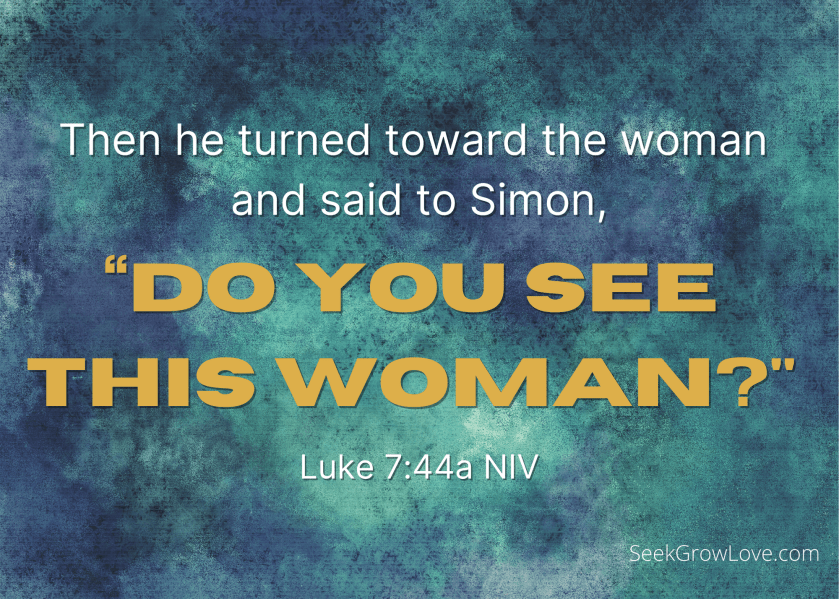
He turns to the woman and takes her worried, nervous, anxious trembling hands in his own. He turns his soft but piercing eyes to her own, red from weeping. He says to you, “Do you see this woman?” He lets the words hang in silence for a moment. She rubs her nose. For the first time you notice that some of her hair is starting to turn gray. You notice that she is not old, but the lines come from stress. You notice that she must have washed to come, as she looks cleaner than you have seen her in a long time… You see yourself seeing this woman, who you see everyday, in a new way. She is a whole person. She is more than the sum of her mistakes. She is loving this teacher. She is showing him honors “She has done for me what you have not,” he says. “She has much to be forgiven for, and so she loves, knowing now that she is forgiven. In your own eyes, your sins are so much smaller, and so your love is so much less.”


The rest of the table murmurs about the teacher forgiving sins, but as they talk he says to the woman “Your faith has saved you, go in peace.” She smiles at him with gratitude and joy…

Do you see this woman?

Or do you see the sins? The immorality? The wickedness? The hardness of life? The addictions? The abuse?


Jesus opened the eyes of the blind, and more importantly, causes the spiritually blind to see the world. May this imaging open your eyes. This man who raised up the dead, more importantly, raised up the living to new life. May this story cause you to raise the living to new life. 


And may this question reverberate in your head all day :

Do you see this woman?

(Optional note for those confused about the devotion : spiritual imagining, putting ourselves in the story, is an ancient spiritual tradition. One great example that is often used is in Luke 15, the parable of the “Lost/Prodigal Son”, or better “The Lost Sons” or best “The Searching/Prodigal Father”. You may see yourself as the son who runs off, the servants rejoicing, the son who is angry for forgiveness, or the father looking for his boys. It says much about ourselves and our relationship with God and others to see who we identify with, and to put ourselves in strange places in the story. Today we looked through Simon’s eyes in Luke 7, not because it is the best, but because of course he would doubt Jesus. Of course he would question him. Of course he would be offended at the woman. And of course, all of that is undue, because Jesus overcomes our doubts through miracles, our questions through answers and better questions, and our offense by unending grace. May this story take a new meaning to you as you ask yourself: Do you see this woman?)

-Jacob Ballard

(originally posted for SeekGrowLove March 16, 2021)

Reflection Questions

  1. Would you more often see yourself as the sinful woman or as Simon the Pharisee?
  2. What do each of these 2 characters need?
  3. Jesus initiates the discussion with Simon after Simon had just “said to himself”. What recent thoughts of yours might Jesus question if he were in your house today? What do you think he would ask/say/explain to counter your thoughts?

Say the Word

Old Testament: 2 Kings 1-2

Poetry: Proverbs 23

New Testament: Luke 7:1-35

In Luke 7:1-10 we find the story of the centurion’s servant.  The centurion was a conqueror and a foreigner, but despite this we find that he is a God fearing man who supports the Jews by building a synagogue for them.  He has a servant who is dying so he sends messengers to Jesus to have Jesus heal the servant. He shows great humility and faith in Jesus through his actions and the servant is healed because of his great faith. Faith unequalled in all of Israel according to Jesus.

I think there are a couple of important lessons in this.

First, maybe you are like the centurion, maybe you didn’t grow up in the church and are a new believer, and maybe you are looking at Christianity from the outside and wondering if you can even be a part of this community.  Of course you can! Salvation and God’s work in the world is based on faith, not upbringing or culture or works. So don’t worry about your past, because God can work powerfully in your life no matter what is in your past!

Second, maybe you are like the Israelites in this story, you grew up in church or have been a Christian for a while and are maturing in your walk with God. I think for you this story has an encouragement and a warning. I encourage you to be like the Jewish people that the centurion sent to Jesus that were able to see past the fact that the centurion was a foreigner and conqueror and see the faith he had and to then recommend that Jesus help him. We should always be ready to welcome new believers based on their faith, and not judging them the way the world might judge them.

 I also warn you to not be complacent or lukewarm like much of the Jewish community was when Jesus was with them. Jesus said that this centurion had more faith than any other in Israel. Many in Israel missed out on being healed and having their sins forgiven in Israel because they were out of tune with God and were not able to see when he was moving. I encourage you to be disciplined in your prayer life and in reading the scriptures so that your relationship with God will not grow stale.

-Chris Mattison

(originally posted Dec 10, 2017)

Reflection Questions

  1. What healings (physical and/or spiritual) have you witnessed?
  2. What do you think Jesus found most amazing about the faith of the centurion?
  3. Would Jesus find anything amazing about your faith? How can you work at growing your faith?