Looking outward rather than inward is a common tendency among mankind. I cannot stress the importance of making the decision to accept our downfalls and repent instead of continuing on in a faux form of oblivious happiness. It’s difficult in our fast-paced, always moving lives to make enough time to stop and reflect on some of the crucial lessons given to us on this topic throughout Jesus’ ministry, and Luke 5 has so many of them.
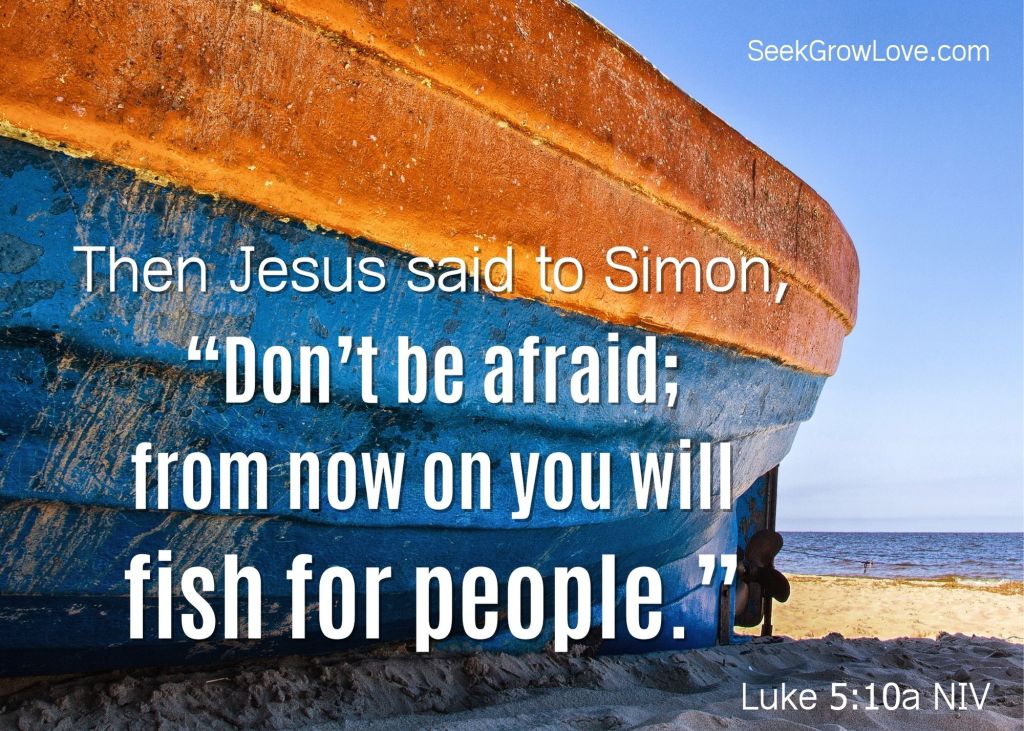
In verses 1-11 we see Jesus go before Simon Peter and his fishers who had no luck with catching fish all night. Jesus commands them to cast their nets again and a miracle occurs where every net is filled so heavy the boats began to sink. While this is an extraordinary story and example of Jesus’s ability to perform miracles and convert crowds, there’s a powerful underlying message within the conversation between Simon Peter and Jesus. When Simon sees the miracle, his first reaction wasn’t to shout in joy or surprise at the amount of fish he was just blessed with. It was to repent. Simon Peter acknowledged at that moment the truth of God and the fact that Jesus was the Messiah, and found himself unworthy. Jesus, however, does not judge or criticize Simon Peter, but instead gives him a purpose and a promise; the promise of the kingdom as long as he followed him and made fishers of men. Many times we come to expect blessings from God without realizing the greatest reward is already promised. In the same way, Simon Peter understood how he was not worthy of the miracle granted to him, and repented.
We too must come to understand the price of our sins and how we are unworthy of God’s grace. Without repentance of our sins, we can never truly come to accept why we’re unworthy of this reward, and why Jesus died on the cross for our sins, forming a New Covenant under which all our sins are freely forgiven. So in all that we do, repent and show thanks to God for the sacrifice of Jesus and the promise bestowed upon us.
-Isabella Osborn
Reflection Questions
What can you learn from Peter in Luke 5:1-11? What can you learn from Jesus in this passage? Which message did you most need to hear today?
What do you see when you look inward? How does it make you feel? What does it make you want to do? Pray about it?
What purpose and promise do you think Jesus sets before you?
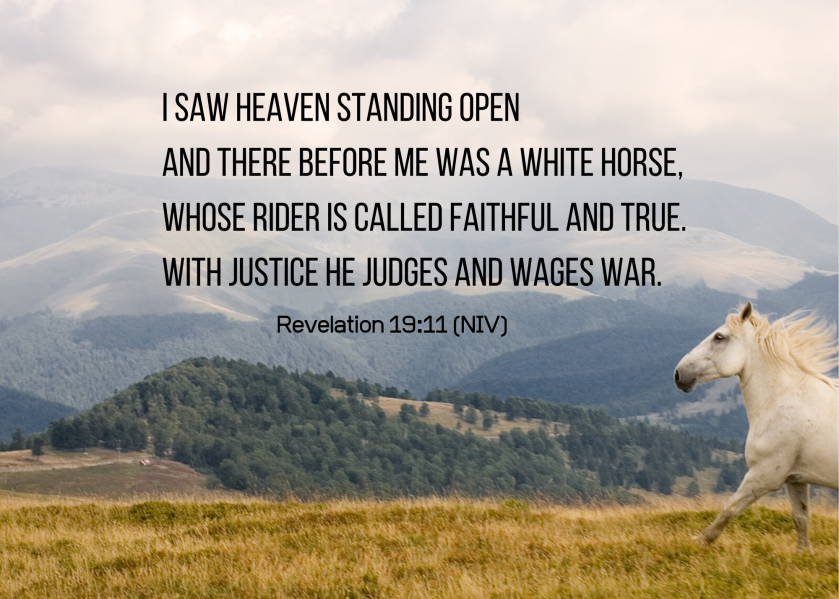
If you can remember way back to November 21, we read about a rider on a white horse, the first of the “four horsemen of the apocalypse” in chapter 6. The four horsemen constitute the opening section of the “chronology” of Revelation. (If we can call it that. Revelation is in part so fascinating because it loops around, runs back to creation, brings us to the time of Christ, and then thrusts us into the future again!) In chapter 6, the horseman was conquest, the personified human impulse to dominate and subjugate others. The horsemen collectively are personifying human evil with the brakes cut. Humanity is allowed to get as bad as it will get, and then God steps in, in judgement.
But today, the same imagery of a person on a white horse is used, with VASTLY different purposes. The one who rides the horse does come to conquer, but his name is faithful and true. His motivation and goal is righteousness. Then we see him: eyes of fire, head full of crowns, a mystery to all except God himself, drenched in the blood that saves, the Word made flesh. Christ, magnified, glorified, empowered and regal, comes to take the crowns from the world leaders that are his by birth, his by death, and his by resurrection. He truly is King of Kings and Lord of Lords.
I recreate so much of the language to encourage you to stop and read 19:11-16 – and actually, the whole chapter while you are at it. This is the Christ we are called to serve, recognize, praise and adore. This is the Christ who comes again, for the second time. When first he came, why we celebrate Advent and Christmas, he was born in a lowly stable with a manger for a bed. He comes the second time riding the warhorse, not lying where it feeds. At Christmas, he was born to a young woman and her husband-to-be and raised as a refugee in Egypt. At the second coming, he will be bringing together those who follow him from every corner of the world, and setting his people up tall, not refugees and sojourners but citizens of the world made new. At Christmas, only shepherds (and magi, but not really) came to him and gave him gifts and bowed down to the king. At his second coming all will bow to Christ, highly exalted and magnified above every name and above every power.
May we praise and adore the Christ who came and is coming again.
Jake Ballard
Questions
We need to reexamine our view of Jesus. Jesus was a child born to the poor, oppressed and disposed. Jesus was a meek and mild suffering servant. But Jesus IS and WILL be Lord over all. Jesus IS and WILL be king of kings and lord of lords. Do you give him the worth and honor due him?
As you celebrate Jesus’ first coming, how can you put more focus on his second coming?
With chapter six the Lamb begins to open the seven seals of God’s book. John has not been told what that book contains, but he understands it is important. It becomes clear that the breaking of each seal moves history forward toward the kingdom of God. Some people may think of the book of Revelation as a set of descriptions of disasters – it is not, really, but for those who think of it that way the start of their evidence is here. Great violence will precede the arrival of the reign of peace we all anticipate.
People have tried to understand what the seven seals of the book are like by questioning how they are set up. Must they all be broken before anything can be done with the book? Or does the breaking of each seal allow a new section of the book to be read out, until the next seal is reached? Might it be that the portion being read describes what John is seeing? Or are the contents of the book about matters beyond all of this? Either way, there is more to God’s plan than what is relayed to us at this time.
The first four seals (v. 2-8) tell us about the famous “four horsemen of the apocalypse” (“apocalypse” just comes from the Greek word for “revelation” or “uncovering” found in Revelation 1:1). We could describe them in different ways, but it looks like a pattern of conquest leading to war and crop failure and then widespread death (including from famine and wild animals). Here we get one of Revelation’s really big numbers – one fourth of the world is given over to the power of the fourth horseman. We don’t know if that means one fourth of the world’s population dies, or if that large a region of the world was affected by the warfare, but this implies massive displacement of people along with the deaths.
The fifth seal reminds us not to get too particular in our interpretation, however, as it shows us the souls of those who had died for the word of God complaining about the delay in judgment. Not the most literal image, certainly. Its presence here lets us understand the urgency and value God places on the restoration of those who have served Him, even though they are not literally suffering anxiety over the delay. It is similar to when God told Cain that Abel’s blood cried out to Him from the ground (Genesis 4:10). God is motivated to action even when the victim of evil is no longer alive to cry out. And even if by our standards God seems slow to act, God will act (2 Peter 3:9). The fifth seal reminds us why all of this destruction happens – God loves His children and will not leave guilt unanswered. The fifth seal also provides one reason why it is not happening faster – because there were still more to be killed who chose to serve God, and so of course there had been more to be saved in choosing God (v. 11).
The events described in verses 12 and 13 align this chapter with Jesus’ words in Matthew 24:29; Mark 13:24 (where Jesus quotes Joel 2:31). Notably, Revelation has sometimes been described as having perhaps 500 references to the Old Testament, possibly without a single direct quotation used in it. This can make it a challenge to keep up with the allusions to other texts.
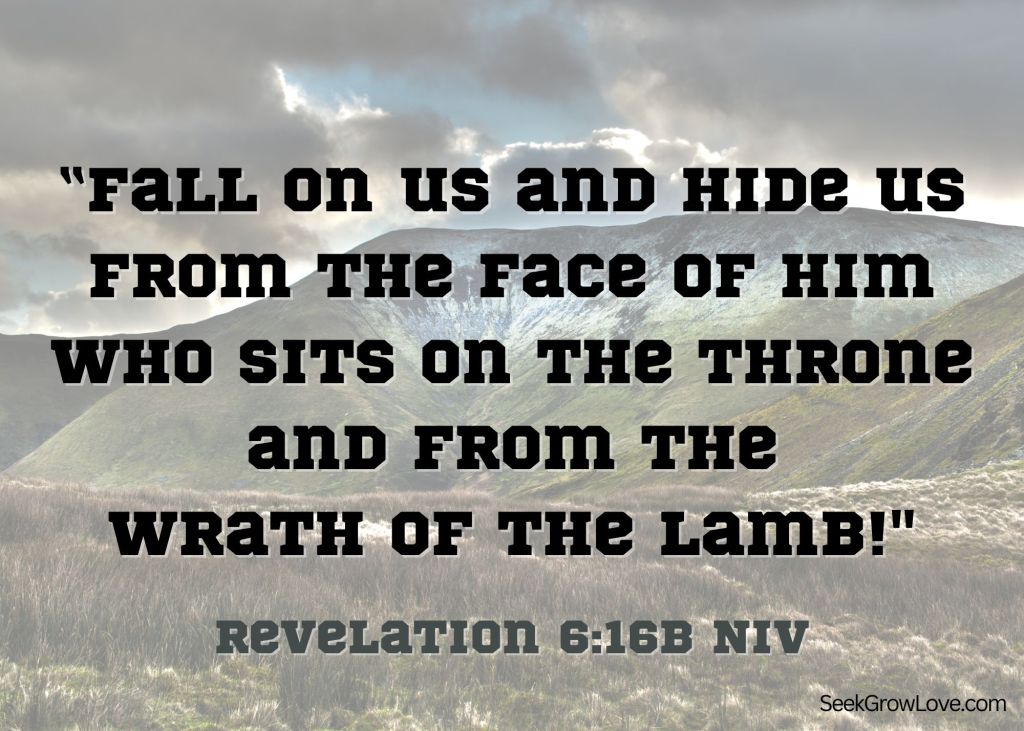
The splitting of the sky like a scroll in verse 14 picks up an image from Isaiah 34:4; if we read from that chapter we will get more language of the day of God’s vengeance. All the mountains and islands of the world moving seems to be more than the great earthquake in Revelation 6:12 could accomplish, so we may need to suppose many related earthquakes and aftershocks. A fourth of the world had been disrupted, but now all of it is. The world’s kings and all who had served them try to hide in what is left of the caves and rocks of the mountains. “Fall on us and hide us,” they plead, because the day of wrath of God and the Lamb has come “and who is able to stand?”
It seems like this is a parallel with the souls under the altar. Instead of being told to wait, and comforted, these people are trying to hide and finding no comfort. Something has happened that lets them know why the world is disrupted, but they have not chosen to repent. The text has not taken any effort to describe what kind of people they are, but the language is being picked up from passages about the wicked who spurned God (Isaiah 2:19; Hosea 10:8). I still find it hard not to grieve for them, even just reading about them in advance of their struggles. But I recognize that if we are ever to do anything for them we need to try to do that in advance, to prevent them from reaching this moment in time, and such a point of corruption. I’m not sure if I am meant to feel sympathy for people in the day of God’s wrath or not, but I know this – no one is living in that day yet, so I can still serve.
Lord, please help me to care deeply about the lives of the people around me. There are so many lost sheep in need of a shepherd, and even dogs who need the opportunity to eat crumbs from beneath the table. One day it will be the last day, and no one will be able to stand. But right now there are things that can be done to strengthen those with weak ankles, to lift up those with faltering hearts, to encourage and to love. Please let me be forgiving, bold, honest, compassionate, so that Christ can be seen in His body and your name can be exalted. Thank you, Amen.
-Daniel Smead
Reflection Questions
What feelings do you have as you read through Revelation 6? What images are most powerful to you? How does it make you view the One who sits on the throne and the Lamb who has the power to open the seals?
How can you prepare today – and every day between now and then – for the coming wrath of the Lord and His Lamb?
Continue to pray the prayer at the end of the devotion. Who is God revealing to you and what would God have you do for them? How? When? Why? With what attitude?
A few weeks ago, we got to experience an up-close view of a bit of a twist on the classic caterpillar to butterfly spiritual analogy. Maybe you’ve heard the classic version in youth group, Bible School, or a devotion book….the idea that we are all new creations if we are Christians. That we start as these creepy, crawly, fuzzy little beings and then as a gift of God, through faith in Christ….voila….we are made completely new into creations of beauty and wonder like a butterfly.
Thanks to our friend, Terri Tschaenn, and her milkweed stash….we have gotten to watch this truly amazing experience of God’s creation several times, and it hasn’t gotten old yet. We’ve gotten to feed those adorably cute little caterpillars as they grow at amazing rates each day. We’ve watched the miraculous chrysalis formation, and we’ve gotten to hold brand new monarch butterflies on our pinky fingers before they fly off. It is amazing. It is beautiful. And, it certainly is representative of the hope of new life and transformation God tells us about in 2 Corinthians 5:17.
But. . .does every caterpillar turn into a butterfly? Hmmm.
Terri told us the unfortunate story of one of her baby caterpillars that accidentally met a predator while she was trying to keep it safe in her school classroom….and….chomp. All gone. No butterfly. And, recently, we watched our caterpillar which we had been watching grow for several weeks, for some unknown reason, never develop his chrysalis at all. Instead, he slowly wasted away and died. It was rather depressing to watch. He had eaten milkweed like all the rest, had gotten to full size, and had looked “just right” to us from the surface. But, inside….something was wrong. He never experienced the stage of transformation. And, instead of achieving beauty and new life, he died a caterpillar. It is common. It is sad. And, it is also certainly representative of what God tells us about in scripture whether or not it makes for as many Sunday School craft ideas on Pinterest.
The Bible warns us about the Christians who look like Christians, but who haven’t experienced a transformation through repentance and faith in the Messiah, Jesus Christ. These Christians are lukewarm. Just like the caterpillars who die, they lack something inside. But mind you, these aren’t atheist caterpillars or caterpillars who don’t go to church. These are Christian caterpillars. Ones who look just like us. Ones who go to church with us. Maybe us. They haven’t achieved the transformation of repentance and faith in Christ which leads to obedience. And their demise if they don’t repent? “I will spit you out of my mouth” (Revelation 3:16, NASV).
Truth can hurt, but it matters. It matters because God and Jesus love us. And true love includes speaking honestly and intentionally. It also matters because unless we repent, at the judgment day, we do not become “butterflies” to live eternally with God and his son Jesus in the kingdom of God. The alternative to that option is death. Today, we live in a world telling us that almost any belief imaginable is “Christian”, and it can get quite confusing as we seek to be on the narrow road and not in the lukewarm masses. It requires diligent searching of scripture and faithful prayer on our parts. We cannot rely alone on our teachers, our families, our churches, and traditions of men. We must not just believe “in” God and Jesus, but know what they say and apply those words to our lives. So, if we find ourselves lukewarm and amongst lukewarm believers. . .what does Jesus say to us?
“Those whom I love I rebuke and discipline. So be earnest and repent.20 Here I am! I stand at the door and knock. If anyone hears my voice and opens the door, I will come in and eat with that person, and they with me. To the one who is victorious, I will give the right to sit with me on my throne, just as I was victorious and sat down with my Father on his throne.” (Revelation 3:19-21, NASV).
Let’s seek and pray to be more than lukewarm this week and to be victorious in Christ.
-Jennifer Hall
(posted originally for SeekGrowLove – then named Grow16 – on June 24, 2018)
Reflection Questions
What good things were the churches of Revelation 3 doing? What needed to be changed in these churches?
What do you think Jesus would want you – and your church – to repent of?
One of the major downfalls of us as humans is that we love evidence. We hear a cool fact, and want to know where it is cited. We learn something in school, and we need a peer reviewed article. When a statistic is cited we like to know how the study was conducted. The cool thing about God is that he knows this about us. In Micah 5 we receive prophecy about Jesus which reads; “Now muster yourselves in troops, daughter of troops; They have laid siege against us; With a rod they will smite the judge of Israel on the cheek. But as for you, Bethlehem Ephrathah, Too little to be among the clans of Judah, From you One will go forth for Me to be ruler in Israel. His goings forth are from long ago, From the days of eternity.” (Micah 5:1-2)
This direct prophecy from God through Micah foretells of the only king the Israelites will ever need, Jesus Christ the Messiah. The remainder of Micah 5 relays the message that the land of the Israelites will be laid waste for their sins and for their breaking of the covenant God set forth to protect them.
There’s a message that parallels something rather unfortunate that goes on in our modern churches today. I have been quite blessed in my experience in church growing up. The people surrounding me who I have known as God’s people have acted accordingly. However, as I meet others my age, I learn that is not always the case. This experience, I have come to learn, is called church hurt. It seems to be when people experience behavior that doesn’t quite align with the ways a Christian should conduct themselves, causing a disruption between what is expected from God’s people and the reality of their actions. But like all sin it’s hardly anything new. Micah was attempting to call out the corrupt leaders of his day, comparing them to Ahab stealing the family vineyard from Naboth, (see 1 Kings 21) and to call out the Prophets who are offering “God’s protection” to those who are willing to pay.
Throughout the book, Micah continues to warn that God has withdrawn his protection and is going to allow the Babylonians to take over and use them to remove the corruption of the Israelites.
“Then the remnant of Jacob Will be among many peoples Like dew from the Lord, Like showers on vegetation Which do not wait for man or delay for the sons of men. The remnant of Jacob Will be among the nations, Among many peoples Like a lion among the beasts of the forest, Like a young lion among flocks of sheep, Which, if he passes through, Tramples down and tears, And there is none to rescue. Your hand will be lifted up against your adversaries, And all your enemies will be cut off.” (Micah 5:7-9)
This is where we are today. Remnants of Jacob. We wait for the day of our prophesied King to return to rule correctly. So what do we do in the meantime? Despite having a bad experience, continue meeting with your fellow Christians, but be on guard for the “Wolf in sheep’s clothing” (Matthew 7:15). There will be a day when we are gathered together as one nation truly under God, and we’ll be awarded according to our faith in the King born in Bethlehem which prompts us to obey and work for him.
-John Evans
Reflection Questions
What is the good news of Micah 5? And for whom is it good news?
What is the bad news of Micah 5? And for whom is it bad news?
Do they both still apply today? Which do we hear more of today?
Kid play songs of the day are from 1 John 4: 9 & 10 “This is how God showed his love among us: He sent his one and only Son into the world that we might live through him. 10This is love: not that we loved God, but that He loved us and sent His son as an atoning sacrifice for our sin.” (Aaron Winner has a great song with these verses too).
Having grown up in the Christian church, I think this wonderful news is something that I can often gloss over. God loved us, so he sent Jesus to die on the cross for our sins that we might be saved. Yeah, I know.
But when you stop and read it, it is really amazing, especially from our human perspective. It is pretty easy to do something nice for other people when they love you, when they are nice to you. But God did this for a people who had turned away from Him, and for future people that would continue to turn from Him.
Thankfully, God’s love does not have a prerequisite. Based on literally nothing we or anyone else has done, He loves us. And loved us enough to put His son through excruciating pain to the point of death so that we might be reconciled to him.
How do we show our love? Do we have requirements for who we show our love to?
The concept of loving someone no matter what they have or have not done goes against our human nature. It is something we probably need to ask for God’s help for. It’s ok if we can’t do it on our own. Because of God’s great love for us, we can be reconciled to Him, and we can ask Him for help in loving others.
I don’t know about you, but I forget to ask for help sometimes. It is not even always conscious, but my pride gets in the way. I think I should be able to do what I’m supposed to do on my own. But as humans, we are flawed. And I do believe that it is ok to ask God for help in loving people the way we are supposed to.
~Stephanie Fletcher
Reflection Questions
Take time to consider Stephanie’s questions: “How do we show our love? Do we have requirements for who we show our love to?”
If you have never heard of G.T. and the Halo Express, 1) you are missing out on quality kids music/plays and 2) sorry, you won’t be able to sing along with my devotions for the next few days.
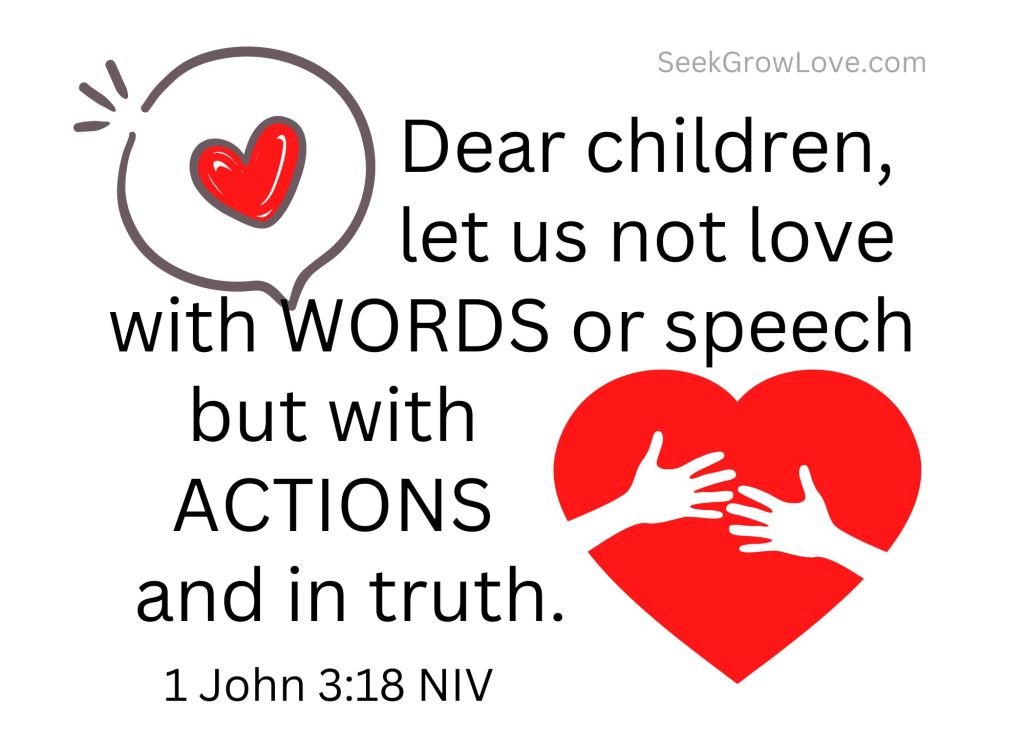
I encourage you to read the whole chapter of 1 John 3, but I am just going to focus on one verse, my favorite – 18, (thanks to memorizing it in this kids play growing up). The translation I learned was “Dear children, let us not love with words or tongue but with actions and in truth.”
I have been listening to this one with my daughter, and it has sparked some discussion. The song breaks it up a little bit, and the line that is sung together is “let us not love with words or tongue.” When we look at the whole verse, it is easy to know that we shouldn’t stop there. But for a 4 year old who doesn’t quite understand all the subtleties of language yet, that was confusing. Why should we not love with words?
This isn’t saying we shouldn’t use our words to be loving, but rather that it shouldn’t stop at that. If all we do is say that we love someone, it really means nothing. We need to show people that we love them in how we act, and by being truthful.
It reminds me of James 2:17“In the same way, faith by itself, if it is not accompanied by action, is dead.”
My dad taught a memorable object lesson to our class when I was growing up. He took us for a car ride in one of the many winter months (it’s Minnesota – they all blend together) with the windows rolled down. As he drove, he asked us, “Are you cold?” When we of course said yes, his response was, “I’m really sorry you’re cold! I wish you were warm.” And he kept on driving. His point was that even if you say the right things, when you can make a difference in the situation (such as putting the windows up) but do nothing, what you say doesn’t matter.
Jesus truly showed his love in action by his sacrifice for us. We ought to show others that we love them, not just tell them.
It is a good reminder for a 4-year-old to be loving in her actions toward her little brother and a good reminder for everyone to be loving in their actions towards anyone they interact with.
~Stephanie Fletcher
Reflection Questions
When have you found yourself saying the loving thing – but not showing love with your actions? What problem is created here? How can you fix this?
According to the rest of the chapter what else do our actions show?
It is impossible for me to read this opening statement in 1 John 1:1 without immediately thinking of its strong parallel to John 1:1. John 1:1 says in the beginning was the word and 1 John 1:1 says that all they have seen and heard and touched – that was from the beginning (what beginning?) concerning the word of life. John was with Jesus from the beginning of his ministry, so he may be referring to the beginning of Jesus’ ministry. There is a lot to unpack here, so I will leave that for another day, but you can think about some of these correlations.
John says that they are proclaiming the word so that his readers may have fellowship with John and his community, as well as fellowship with God and Jesus through the ministry of the word (that is an implication of having true fellowship with John et. al.). Also, John emphasizes that he is writing these things so that joy may be made complete. True joy, that transcends all circumstances, is a direct result of having fellowship with God and Jesus in a life of faith (see also James 1 for insight into the relationship between authentic faith and joy).
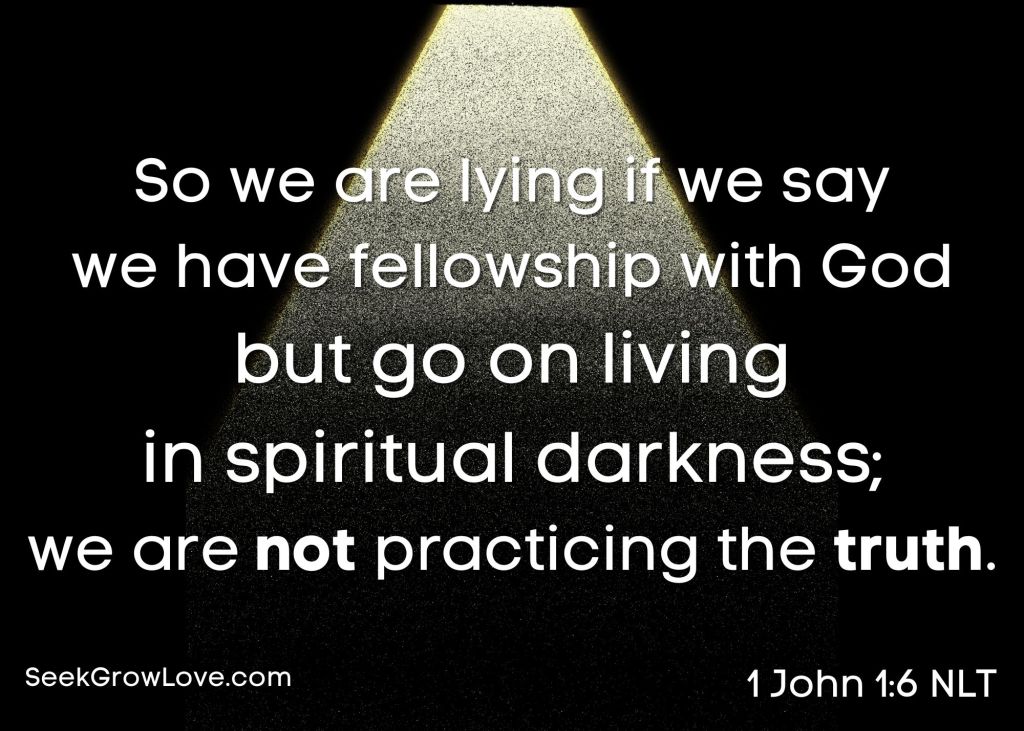
John then gets into a dichotomy between light and darkness. God is light and in him there is no darkness, therefore if we are walking in darkness (not in the midst of darkness but having elements of darkness ingrained into our life) we do not have fellowship with God. We are deceiving ourselves if we think that we can live a dualistic life embracing both God’s will and abiding in the ways of the world. Purity of heart precludes us from walking in darkness. If we’re doing this (walking in darkness), the implication is that we are liars and live a life that is antithetical to the truth.
Conversely, if we walk in the light (i.e., the truth, abide in the word), we have true fellowship with one another and we have our sins cleansed by the blood of Jesus. Walking in light does not mean that we have no sin, that would be a ridiculous assertion, but it means that we do not live lives defined by sin. We all stumble, but there is a difference between falling short and living in sinful pursuit. Our self-deception can come from being double-minded, or from a false notion that being forgiven makes us sinless. We are free from the bondage of sin through Christ, but we still fall short of perfection. In confessing our sin (and repenting of it), we are cleansed and through our faith are counted as righteous. If we don’t acknowledge our sinfulness, how can we confess (we can’t!)? Worse than deceiving ourselves, if we deny that we sin, we make God out to be a liar!
It’s not a good look to make God out to be a liar, so I would strongly encourage each of us to take into consideration our behaviors and not try to explain them in a way that denies the authority of scripture to call out wicked behavior and attempt to justify our (sinful) behavior as acceptable. Sin is offensive to God, so we should not attempt to explain it away as inoffensive. Confession is a powerful tool, and we should be quick to utilize this, rather than explain away or double down on any sinful elements that encroach on our lives. It is better to suffer for doing what is right now (deny our sinful desires) than to embrace sin and deception now and miss out on the amazing Kingdom of God (which will trump all imaginable satisfaction in this life).
-J.J. Fletcher
Reflection:
1. Do I regularly confess my sin to God? Do I confess my sin to other believers (1 or 2 people who you can trust) and reap the benefits of having accountability in brothers or sisters (who likely have had similar struggles) that can speak truth into my life?
2. What am I doing that could constitute self-deception? How might you assess and address this?
3. What relationships do I have that allow people to speak truth into my life? Do I surround myself with yes men? Do I live in an echo chamber? What changes can I make in my life that can help me more effectively eliminate sinful habits?
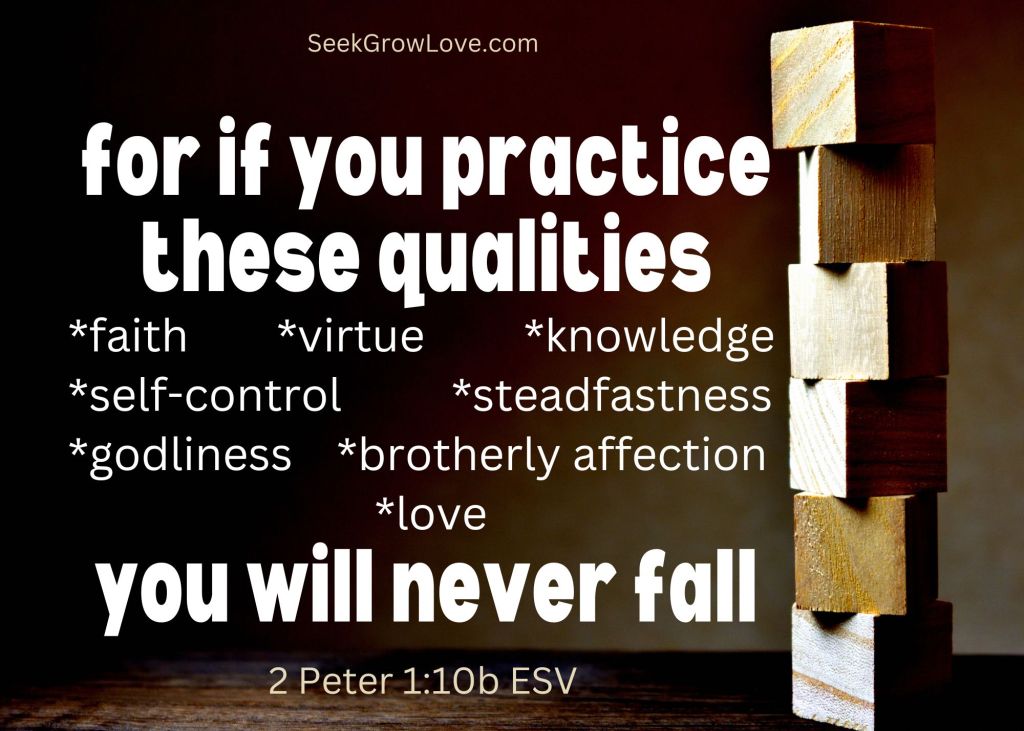
“His divine power has granted to us all things that pertain to life and godliness, through the knowledge of him who called us to his own glory and excellence, by which he has granted to us his precious and very great promises, so that through them you may become partakers of the divine nature, having escaped from the corruption that is in the world because of sinful desire. For this very reason, make every effort to supplement your faith with virtue, and virtue with knowledge, and knowledge with self-control, and self-control with steadfastness, and steadfastness with godliness, and godliness with brotherly affection, and brotherly affection with love. For if these qualities are yours and are increasing, they keep you from being ineffective or unfruitful in the knowledge of our Lord Jesus Christ. For whoever lacks these qualities is so nearsighted that he is blind, having forgotten that he was cleansed from his former sins. Therefore, brothers, be all the more diligent to confirm your calling and election, for if you practice these qualities, you will never fall. For in this way there will be richly provided for you an entrance into the eternal kingdom of our Lord and Savior Jesus Christ.” (2 Peter 1:3–11 ESV)
We have great and precious promises that have been made that will enable us to become partakers of the divine nature! As Jesus put on a new nature in his resurrection from the dead, so shall we when through faith, we endure through life’s many challenges and inherit the promise of the coming Kingdom of God.
Hebrews 11:1 says that “…faith is the assurance of things hoped for, the conviction of things not seen.” As we have faith that God will restore all things (Acts 3:21), upon our faith we must add virtue: meaning good quality of life or uprightness – not simply believing but living out our lives as something that reflects the nature of God’s goodness, justness, and righteousness. After believing and living a changed life, we are to add knowledge to that; we should always be striving to learn from God’s inspired word and learn from his spirit as it is active in us… And more than that, seek after his spirit that we might become more in line with his will and come to a greater understanding of its importance and how beneficial it is to us to walk in his ways.
Following the call to add knowledge, we encounter again the call to be self-controlled! It really does seem that much of what we read in scripture hinges on self-control and that circles back to our need to not stifle the spirit in our lives. If one of the elements that the fruit of the spirit brings forth in our lives is self-control, then we ought to do whatever it takes to drive away any behaviors that might cause God’s spirit to depart from us (Judges 16, 1 Samuel 16). Self-control allows us to endure – to stay on the course – as Paul might say, “to run the race”. We have to endure through all of the challenges and temptations that life throws at us, and we must allow the motivation of our hope, our uprightness, and the self-control that we are enabled to have through God’s spirit carry us through.
As we endure, we ought to have a reverential feeling or devotion to God, that’s what the Greek work translated godliness indicates. As we experience God’s goodness and see how His spirit works in us, we should feel more and more awe and reverence to our creator… After all, He put the plan into place that leads us into a life that transcends the brokenness that sin imparts on our lives – even though we sin and are affected by sin, God’s directives lead us onto a path that (through Jesus) casts that sin aside and draws us into community with him.
And as all these things are ingrained into our life, the part that affects others the most is the cherry on top… We are to have brotherly affection (love) as a defining characteristic in our lives! Love and care for one another as believers will lead us to speak into one another’s lives and help us when we hit rough patches. Even the most spiritually minded people hit dark periods in their lives (google the dark night of the soul). If we love our brothers and sisters in Christ, we will take the time to come alongside them, to care for them, to call them out, to admonish and encourage – brotherly affection means being intimately involved in the lives of our faith family – not being apathetic or half-hearted. We need to invest in each other as Christ has invested in us through his sacrifice (sometimes we must be self-sacrificial).
These qualities keep us from being ineffective witnesses and fruitless workers. We must be bearing the fruit of the word implanted in us (James 1) and strive to be effective ministers to the lives of those who are hurting and struggling. Peter says that whoever lacks these qualities is so nearsighted that he is blind! Yikes… lacking these qualities as I read this means that we cannot see beyond ourselves, and that it a tremendous problem when one of our chief goals is to preach the gospel to all creation.
If we take these qualities to head and practice them diligently it says we confirm our election (or being chosen out) into beneficiaries of the grace of God. Also, it says if we practice these things we will never fall. So, practice these things so that you may have entrance into the eternal kingdom of our Lord and Savior Jesus Christ (v11).
-J.J. Fletcher
Reflection:
1. Think about how Jesus exemplified all these characteristics listed in verses 5-7. If he had not exemplified all these things, would he have had the wherewithal to endure through his father’s plan of salvation through him? How can we expect to live exemplary lives if we do not take these characteristics to heart.
2. Think about the first 6 items listed (faith, virtue, knowledge, self-control, steadfastness, and godliness) and the final one: brotherly affection/love. What do the first 6 produce without the 7th? We’re designed (as individuals and as a church body) to be in community, how might we be rendered fruitless and ineffective if we excel at the 6, but lack the 7th?
Chapter 4 ends with verse 19: Therefore, let those who suffer according to God’s will entrust their souls to a faithful Creator while doing good (ESV).
The suffering in the New Testament is related to living a life set apart from worldliness, which is opposed to God’s will. It is not God’s will that we should suffer, but when we follow in the ways that he has prescribed for us we will undoubtedly face opposition and ultimately suffer for the sake of the Gospel. We need to trust that our creator will ultimately use that suffering for good. There’s a popular song that we sing at my church that has the line “you take what the enemy meant for evil, and you turn it for good” (drawing on Genesis 50 for inspiration).
Chapter 5 then begins with Peter addressing the leaders of the church, specifically calling to mind the sufferings of Christ. Pastors/elders are to function in the role of shepherds for the congregations that have been entrusted to them in leadership. The verb that is translated as “shepherd” also can be translated as “feed” – does this directive remind you of any instructions that Peter himself received from Jesus?
In John 21 three times Jesus asks Peter if he loves him (notice a correlation between Peter’s three denials of Jesus and the three affirmations that Jesus receives from him?) and three times tells him to feed his sheep (this is a different Greek word in John, but it means essentially the same thing). As the primary leader of the church Peter was to feed Jesus’ sheep, meaning Christians. The impetus for this spiritual leadership is not to be out of self-importance or in Peter’s case even that Jesus chose him to lead, but out of love for his master and savior (and friend!). When we see Peter lead, he is following in obedience to the one who called him out of the boat and invested in him and entrusted him to feed his sheep. Peter certainly was not doing this for gain or for an easy life, I imagine his life would have been much easier had he simply decided to go back to fishing full time, but he faced many trials and much opposition in his preaching the word and leading the church.
In the same way, those of us who are called to be pastors and elders (who are specifically addressed here, but anyone who holds an office in the church should take heed of this) should be using their love of Jesus as their motivation for leading. Presumably most church leaders start off this way, but it can easily go to one’s head. There are many public instances of pastors who have become controlling, power hungry, and abusive (quite often we see this in large churches with lucrative opportunities for pastors) – but even in small churches the desire to control can infiltrate the hearts of those who are called to lead or “run” the church. Elders (I’ll include pastors in this title from here on out) are to be willing and eager to carry out the work that they have been called to. With a calling to leadership comes responsibility – a significant thing to note is that we who are in authority (and who teach) are held to a higher level of accountability (James 3:1). Those who are in authority are to be an example to those who they oversee spiritually, and humility is one way in which we should be an example. Jesus stated that he was gentle and humble (Matthew 11:29), and we see in Philippians 2 that humility was essential in Jesus salvific work as God’s anointed one.
As Jesus was humble and as we who are elders (overseers) are to be humble (following Christ’s example), so then are the members of the body to exercise humility and submit to those who are in authority over them. If leaders are humble and operating as Jesus would expect them to, then humble Christians submitting to the godly authority that has been placed over them will thrive in their submission. We’re never going to agree on everything and that is why the decisions of local congregations are to be subject to the elders and not left up to the democratic will of a large collective. Elders absolutely can delegate responsibilities and set up clear roles for the body (Acts 6), but the authority over the church should lie with them.
We just added two new elders at my church yesterday. The process was not a short one… Myself and our other elders had many discussions on who we thought would be a good fit to assume these offices and eventually recommended that these two individuals be confirmed as elders. We don’t accept nominations for elders, but rather we look for men who meet the requirements of elders as listed in Titus 1, and then we have a confirmation vote. Other churches do things differently and may have boards structured in different ways or may be more egalitarian in the way that they define elders, I don’t condemn that, but we need to take seriously the guidelines that are listed in scripture and not be too quick to structure things in a way that is more reflective of the nation/society we live in than how the early church did things. Regardless of our views on church leadership one thing we need to be able to do is disagree with grace and love.
We need to make sure that whatever disagreements we have are dealt with in love and we need to not let them distract from what God would have us do and we need to make sure that we keep our minds clear (5:8, reaffirming 4:7), be on the lookout, and refrain from being anxious (cast those anxieties on God, see also Matthew 6), because the enemy prowls like a lion looking for someone to devour. When we allow conflict to take root or we allow anxiety to be prevalent in our churches, bad things will happen. We may often think about the enemy being on the prowl for individuals, but he’d also love to devour a local church and render it ineffective at making disciples or worse, cause it to die out (is that really worse?). I bet we could all think of examples of things we can (or do) divide over, one such argument could be what Peter means by “our enemy the devil”, but we need to take seriously the words of the author of Hebrews when he/she says: “Strive for peace with everyone, and for the holiness without which no one will see the Lord. See to it that no one fails to obtain the grace of God; that no “root of bitterness” springs up and causes trouble, and by it many become defiled;” (Hebrews 12:14–15 ESV).
-J.J. Fletcher
Reflection Questions:
1. For those of you in authority: do you do it willingly? Eagerly? Without being domineering? Sometimes we do have to be forceful and make unpopular decisions, but that can still be done in a graceful and kind way. Do you need to be humbler, or do you think you have that well under control? Do you have an individual in mind that has authority problems with whom you can practice extra grace?
2. For those of you under authority: Do you respect those who have been placed in authority over you? Do you easily submit to that authority? Do you gossip about the leaders of your church and cause problems that way? Do you stop attending church when changes occur, or decisions are made that you disagree with? Do you go church hopping and just stick around till someone ticks you off and move on to the next place (which might just be going back to a former church until the vicious cycle starts over again?
Podcast Recommendation: The Rise and Fall of Mars Hill (from Christianity Today). It can be difficult to listen at times, but it has lots of examples on how to do leadership wrong, which we can benefit from.





 Seek Grow Love