An Extra Kind of Day

Genesis 37-38

Proverbs 19

Matthew 8

Today we will do something a little extra. I am feeling extra thankful for all of the writers who have written over the past 9 ½ years. So instead of posting just one devotion, here are three, one for each passage, from 3 different writers, originally posted for SeekGrowLove years ago. Read as much as you like or just pick one, your choice. And if you ever want a devotion from a certain passage, or writer, you can always use the search feature (it works best with quotation marks). God Bless You as You Seek Him in His Word.

JOSEPH: Trouble Comes…For a Time – From Genesis 37

One day Joseph’s brothers were out watching the flocks in the fields (and in the sun), and Joseph was kept at home to relax.  Later on, their dad sent Joseph out to check on the brothers.  When the brothers saw Joseph coming from a distance, they hated him so much that they talked about killing him. After some discussion, they decided to beat him up and threw him into a large, dried out, underground water storage container.  Later, they pulled him back out.  Joseph thought his ordeal was over, but instead his brothers sold him to a caravan of traveling merchants.  Joseph pleaded with them for mercy, but his brothers just smiled and waved goodbye.  You can read about this in Genesis 37 and some of the following chapters also reveal some of the details.  Joseph had basically done nothing wrong, but he found himself betrayed by his own brothers and sold into slavery.

Sometimes people think that if they do everything right, then no bad things will ever happen to them.  Sometimes people are very cautious in order to avoid problems or troubles.  Some people think that if they serve God without making any mistakes, they will then have a nearly perfect life.  But life doesn’t work in these ways.  Joseph did nothing wrong, but he was sold into slavery.  In John 16:33, Jesus said, “In this world you will have trouble.”  The Bible never promises us an easy, trouble free life.  In fact, we are promised we will have trouble.

Joseph was taken to Egypt as a slave, but during his time there, he would see God’s plan unfold for his life.  A much greater good would occur because of his time as a slave.  Perhaps some day you will face tough times when God is trying to bring about long term good.  It will be hard to face at the time, but in the long term, you will see God’s hand at work in your life.

-Jason Turner (originally posted October 22, 2018 for SGL)

CHECK YOUR SEED – from Proverbs 19

A person’s own folly (foolishness) leads to their ruin, yet their heart rages against the Lord. Proverbs 19:3

When I was in college I remember sitting by a young lady who just loved Professional Wrestling. You know the form of athletic performance art with theatrical events and lots of shouting, not the sport of wrestling.  She could tell you in great detail about the striking attacks, holds, throws and acrobatic maneuvers that she had witnessed while attending the recent matches. One day while she was telling me about what had happened last night during the wrestling match we received our graded science papers.  That is when I saw her completely change.  She had received a failing grade and she was furious. She became so angry at the teacher.  She said things about him under her breath and in her mind he could do “nothing right” during that semester. Her reaction is still vivid in my mind.  She began hating this professor because he had given her a grade that indicated her level of knowledge on the material. She completely removed herself from the equation. She put all the blame on the professor, but did not see that her lack of interest and absence from study was the cause of her grade.

Today we are exploring Proverbs 19.  Verse 3 reminds us that oftentimes we are the ones deciding how our lives will go.  God has created the world with governing principles and laws that manage the earth. Human beings are given free will so there is cause and effect from our actions. We might think of it as sowing and reaping. As Galatians teaches us, “Do not be deceived: God cannot be mocked. A man reaps what he sows.” (6:7) Rewards or negative consequences are the result of our actions.  I think this statement says it best: If you don’t like the harvest you are reaping, check the seed you are sowing.

There are repercussions of our actions, but we want God to rescue us from the pain and consequences of our bad decisions. Many times we must experience the real pain to move us to the point where we desire to make lasting change.

Now there are many troubles that we will encounter in this fallen world and many of them we have no control over, but the advice of Proverbs is addressing the areas of our life that we can control. God is on our side and He wants us to make the best decisions. He provides correction through the scripture and if we want to be wise (and avoid a lot of pain and drama) we should follow it. Listen to advice and accept discipline, and at the end you will be counted among the wise (verse 20).

Devotion by Rebecca Dauksas (SC) – originally posted Aug 23, 2017 for SeekGrowLove – then named Grow16Bible Reading)

WHEN GOD RESPONDS – from Matthew 8

In Matthew 8, Jesus is recorded as miraculously healing several distinct individuals that represent three classification of people who were viewed with lesser status in Jewish eyes. The first is a leper, who is considered unclean for a Jewish man to touch (vv. 1-4). Next is a servant of a Roman centurion, who was a Gentile foreigner and likely part of the oppressive Roman Empire, which Jews considered to be their enemy (vv. 5-13). Lastly, Jesus heals Peter’s mother-in-law (vv. 14-15), which is unique as women were not looked upon with much recognition or significance in Jewish society. In addition, the passage also reveals that Jesus healed numerous other people who were demon-possessed around Capernaum as well (vv. 16-17).

In verses 5-10 when Jesus is approached by the centurion, he concedes to the centurion’s request to come and heal his servant. Jesus’ agreement to come to the centurion’s home is quite a startlingly turn of events in this passage as a Jewish person would be deemed ceremonially unclean if they entered the house of a Gentile (cf. Jn 18:28; Acts 10:28). But nevertheless, Jesus humbly agrees to go and heal the man (vv. 5-7).

But the centurion replies quickly to Jesus expressing his “unworthiness” for Jesus to make the effort to come to his house. Rather, the centurion reveals a keen understanding of Jesus’ authority to speak with the power of God. The centurion explains that he knows what authority means because he speaks, and someone obeys, and the task is accomplished. In the same way, he claims that Jesus only needs to speak the “word,” and according to the authority of his “word,” the centurion’s servant will be healed (v. 8).

This proclamation amazes Jesus because the centurion understood the power and authority of God that Jesus represented. And in response to the centurion’s understanding of this reality, Jesus declares, “Truly, I tell you, with no one in Israel have I found such faith” (v. 10). What an unsuspecting pronouncement—that Jesus would confess such a great faith from this Gentile that superseded any he had seen in all of Israel. The emphasis here is that even a Gentile, who was not considered a member of God’s people, will see the power of God at work when they trust in Jesus, God’s Anointed.

What the passage can teach us is that God’s power flows in response to the exercising of faith (trust) in God as the source of all power and in Jesus as God’s Messiah. If we want to see God’s power at work in our lives, it begins by recognizing that God moves when we believe and trust in him, knowing that he is able to do even what may seem impossible in our eyes. Our trust in God doesn’t make God move; rather, God responds when we trust in him. And we must also trust in his character—that he responds as the good and loving God that we know he is.

-Jerry Wierwille -originally posted on March 11, 2018 for SGL

Reflection Questions

  1. What tough times (which came as a result of something you had no control over) have you faced which have brought about long term good?
  2. When have you received rewards as a result of your actions? When have you experienced negative consequences? What might you have done instead to avoid those negative consequences?
  3. On a scale of 1-10 where would you rate your trust in God and His character? It is hard to trust what we do not know. How can you learn more about God? How can You see Him at work? Are you willing to?

Prayer

Dear God, You are such a wise, all-powerful, all-knowing God who gives good gifts! We thank You for Your loving care and for those You have brought into our lives who speak Your words to us. Help us know You and Your ways more and more that we will trust You and follow in Your way. In Your Son’s name we pray, Amen.

Looking Again and Again at the Sermon on the Mount

Genesis 31-32

Proverbs 16

*Matthew 7

-Marcia Railton (IN)

For the last couple of years January often has me writing something on the Sermon on the Mount. I admit, at first it can seem like a chore to do. But, I have been thankful for the opportunity to take a deeper look into these passages, often seeing ways I need to “Think Again” to change my opinions, thoughts and ultimately my actions to become more like Jesus. It is a great way to start the year. But, how would I be different, inside and out, if I read, thought about, lived out the Sermon on the Mount every day?

So today, I will start with a few of the thoughts I have previously shared on Matthew 7 (with a few revisions, that’s part of the beauty of reading the Sermon on the Mount again and again and thinking again). You can read them – or just read Matthew 7 again. And then, in our longer than normal reflection section let’s talk about how we can be more intentional about keeping this spectacular sermon in our minds, mouths, heart and hands everyday.

Adapted from parts of The Rest of “Do Not Judge” – (from January 10, 2024 for SGL)

Unfortunately, the world has heard just the first three words, “Do Not Judge” and has twisted Jesus’ words into permission to sin and accept sin. But that is not the case! Jesus tells us over and over again (and even multiple times in this same chapter) to look carefully and judge whether people and actions and ideas are good or bad, righteous or wicked, wise or foolish, innocent or dangerous, taking us closer to God or further from Him. He warns you and I about the wolf in sheep’s clothing who wants to deceive you and figurative dogs and pigs that will tear you to pieces. And if you have already decided that it is not your place to judge if they are good or evil or to discern if they want what is good and godly for you or what will destroy you, then I fear you are already sitting in a very dangerous spot. 

So, what did Jesus mean when he started out with the words, “Do not Judge…or you too will be judged” and then gave the excellent illustration of the speck and the plank? Make sure you read it for yourself from Matthew 7. I think he was saying judge yourself first in order to be helpful in then spotting sin in others. Specks are hard to see clearly when we have a plank lodged in our eye socket. And our restored sight is crucial in then being able to delicately help our neighbor remove the irritating speck in their eye. When we judge rightly we can start out by putting every single one of us in the same sorry sinking boat of sinners in need of a Savior – just make sure you jump into that boat first. Stop bad talking and blaming the neighbors and church members and family and see yourself for what you are and what you do. Don’t sugar-coat the truth trying to make yourself look better than the rest. 

Sin causes vision problems – those dangerous specks and planks in the eye are not conducive to seeing the world or yourself clearly. It can be all too easy to completely overlook seeing our own sins and instead attack others for not measuring up to Jesus’ standard. I have been quick to blame my husband and my kids and my friends, when the fault was also with me. I have mistreated people, sometimes to their face, sometimes behind their back. And I have tried to ‘fix’ things my way rather than patiently trusting God for what He said He would do in His time. I can be very selfish and prideful and rude. And the list goes on. And if I don’t accept and work to correct these problems and sins in myself FIRST then I will be hypocritical and ineffective when I, with that plank still stuck in my eye, turn to help my neighbor who has a speck in her eye.

Jesus was not saying specks and planks in the eye are okay and we should leave them be. Sin is not okay. He was telling us the order in which to correct things – self first SO THAT you can actually be useful in helping others recognize and remove the sins that are affecting their sight and health and well-being. Sin surgery for yourself first. Recognize it for what it is and get it out! Then look with compassion not contempt on the neighbors of the world, some of whom do not even know God’s law and have no idea they are stuck in sin because they only heard “Do Not Judge” and never heard the rest.

Adapted from parts of Will it Stand or Fall – (from January 12, 2024 for SGL)

Jesus too, warns of storms with such driving rains and rising waters which have the power to totally destroy and wipe out homes if we don’t take the proper actions beforehand. Storms are coming – and in some cases they have already begun. Jesus tells us, some houses will stand, some will not. It depends on their foundation. Is the house built on rock - or on sand – which is determined by how wise – or how foolish – the builder is. Both builders listen to the words of Jesus – good first step. The wise builder proceeds to “put it into practice” – and his house endures the storm. The foolish builder with his house built on sand has heard the words of Jesus but does not put them into practice. And when the storm comes, his house is destroyed.

Hear the words of Jesus. And then, put it into practice. It is not enough to sit at his feet listening every week or even every morning – if you don’t then spend your days DOING what he says. We have just spent the last several days reading and looking at Jesus’ Sermon on the Mount (Matthew 5-7). Now, what will we do with it? What will it look like to put it into practice today and tomorrow and every day of 2024 (and now 2026) and the rest of our lives – however long or short that may be? Both houses will experience the winds and the rain. Will your house stand?

Reflection Questions

  1. Judge yourself first – what sins are on the plank in your eye? How has sin (the plank in your eye) affected your vision? Do you want it gone? What are the benefits to having it removed? What is needed to remove it?
  2. Looking through Matthew 7, what thought or call to action strikes you as one God wants to see you really working on this month?
  3. It is not enough to be considering these words of Jesus just every January when our Bible reading plan has us reading through the book of Matthew. We need to be tending to our foundation regularly to ensure our homes will withstand the storms. How can we get these words into our hearts so we make them a part of our daily thought/judging/discerning process and then put it into practice so we don’t find ourselves (and our loved ones) surprised at the end of the wide path that leads to destruction? Every day this year I want to read something from the Sermon on the Mount. How about even multiple times a day? I printed a simple Matthew 5-7 document to hang throughout my house – one page in the laundry room, one page on the inside of the medicine cabinet, another in the front of my Bible, etc…. Through the year I can rotate them around if one is more neglected. Feel free to make yours pretty and colorful and/or underlined and marked up. I am excited about learning this familiar sermon better. But not just learning it – living it, more and more. Will you join me? Here’s one to print for you:

Prayer

Dear God Almighty, we praise You because you are perfect in all Your ways. Thank you for the gift of Your Son who not only tells us but also shows us how to live different from the world, and also different from the “religious leaders” of his day, on the narrow path, a light for the world, with a heart devoted to pleasing You, with our foundation on the rock, putting into action every day the words and wisdom in this spectacular Sermon on the Mount. Lord, I confess the plank in my eye. Help me see it. I don’t want it to stay. I want to see clearly and I know this requires sin surgery in my own life, thoughts, attitudes and actions. Help me remove it, realizing it might be a painful process – but with such marvelous benefits in this life and the one to come. Thank you for Your forgiveness, Your wisdom shared through Your Son, Your guidance and proddings through Your Holy Spirit. Help me to listen well this whole year to this Sermon on the Mount, that I might become more and more like Your Son Jesus who preached and lived and died these words for me, and is coming again to live eternally with those who choose to hear and DO your words. In his precious name I pray, Amen.

Think Again – Do Not Worry

Genesis 25-26

Proverbs 13

Matthew 6

Devotion on Matthew 6 by Marcia Railton (IN)

The Sermon on the Mount continues in Matthew 6 with so much wisdom. At the end of the devotion yesterday, the last question suggested we look for anything useful in this chapter for Thinking Again – a challenge to consider how we can rethink our opinions and thoughts to be more inline with God’s. I found a few…

I should “think again” about my motives in giving, praying and fasting. (Do these – for all the right reasons.)

I should “think again” about the importance of forgiving others. (Do it, or my Heavenly Father will not forgive me of my sins!)

I should “think again” about what I truly value and prioritize. (My worldly stuff – ALL I own or wish I owned – is worthless. How can I focus instead on building up what really matters to God and has eternal value?)

I should “think again” about who or what I am actually serving. (Does my love, loyalty and life – both thoughts and actions- prove that I have made God the Master of my life?)

That thought leads perfectly into the next big “Think Again” – I should “think again” and see that I do not need to waste my life in worry. I love this passage! I need this passage, and just maybe you do, too – at least from time to time.

“Look at the birds of the sky” and “Consider the lilies of the field…” This is such wise advice from Jesus, for anytime, but especially when we are stuck in our worry. Stop looking at yourself and your little world of trouble. Look up. Look out. Watch nature. There are interesting studies on the benefits of being in nature (or even seeing a tree through the window) to lower cortisol (a stress regulating hormone) and depression. Yes, psychologists and scientists are right, nature is good and helpful. But, even better, is knowing and trusting the God who created it. He not only created it, but He continues to care for His creation – including creating and caring for you. That is what God’s Son is telling us in Matthew 6:25-34. Look up. Look out. See God.

What do you see when you see God?

If my God is wimpy, I will have a lot to worry about.

If my God is cold or heartless, I will have a lot to worry about.

If my God is clueless, I will have a lot to worry about.

But that is NOT my God!

My Father knows what I need. My Father cares for me. He values me. He sees me. He is able. He alone can take care of everything I truly need and so much more.

How do you see God? Are you allowing your worry to replace your faith in God?

See Him for who He really is! Seek Him first and replace all those worried thoughts. Think Again – do not worry!

Reflection Questions

  1. If you are battling with worry take a little time and write out Jesus’ words from Matthew 6:25-34. For each sentence also try putting the same thought into your own words. What is Jesus saying to you?
  2. What thoughts does God want you to be thinking? Is your worry replacing your trust in God. What does God want you to replace your worry with? (See Philippians 4:4-9) How can you help yourself more consistently think again?
  3. Tell me about your God. Is He wimpy, cold or clueless? Is He your Master, really and truly? What do you know about Him? Do you trust Him? How will I know what you think about God by watching what you do and think and say?
  4. What will it look like this week for you to “Seek first His Kingdom and His righteousness” (Matthew 6:33)

PRAYER

Dear God, I praise You for You are God alone. You are the Creator and Sustainer. You are indeed strong and mighty, all-knowing and all-powerful. Yet, You still see and care for me. I thank you for your love and our history together, the way you have cared for me, and my loved ones, and those who came before me over and over – throughout time. Help me to see You clearly, Father, so I do not waste time worrying. May my focus be on You, Your Kingdom, and Your Righteousness. Help me live these words of wisdom from Your Son. In his name I pray to You. Amen.

Attitude Check

Genesis 15 & 16, Proverbs 9, Matthew 5

Devotion by Marcia Railton (IN)

As we read through the Sermon on the Mount, the first of 5 segments of Jesus’ teaching in the book of Matthew, we will spend three days not two on each of the chapters 5-7. Today’s devotion will focus on the first section of chapter 5 – the Beatitudes. Whether this is your first time reading them, or you can quote them all, sometimes it is helpful reading a variety of versions to get a better understanding of Jesus’ words and how to put them into practice. Take special note of some variations of “Blessed”.

Poor in Spirit – Verse 3 – “Blessed are the poor in spirit, for theirs is the kingdom of heaven.” (NASB), “Great blessings belong to those who know they are spiritually in need.” (ERV), “the humble, who rate themselves insignificant” (AMPC), “those devoid of spiritual arrogance” (AMP), “those people who depend only on him” (CEV), “Those people who know they have great spiritual needs are happy. (ICB), “’Humble men are very fortunate’ he told them, ‘for the Kingdom of Heaven is given to them.'” (TLB)

Those Who Mourn – Verse 4 – “Blessed are those who mourn, for they will be comforted.” (NASB), “God makes happy those who are sad. They will have comfort.” (WE), “They are blessed who grieve, for God will comfort them.” (NCV), “Those who mourn are fortunate! for they shall be comforted.” (TLB)

The Meek – Verse 5 – “Blessed (happy, blithesome, joyous, spiritually prosperous—with life-joy and satisfaction in God’s favor and salvation, regardless of their outward conditions) are the meek (the mild, patient, long-suffering), for they shall inherit the earth!” (AMPC), “Blessed [inwardly peaceful, spiritually secure, worthy of respect] are the gentle [the kind-hearted, the sweet-spirited, the self-controlled], for they will inherit the earth.” (AMP), “God blesses those who are humble, for they will inherit the whole earth.” (NLT), “God makes happy those who quietly trust him and do not try to get their own way. The world will belong to them.” (WE), meek also replaced with “gentle” (NASB).

Hunger & Thirst for Righteousness – Verse 6 – “Blessed are those who hunger and thirst for righteousness, for they will be satisfied.” (NASB), “God blesses those people who want to obey him more than to eat or drink. They will be given what they want!” (CEV), “Great blessings belong to those who want to do right more than anything else. God will fully satisfy them.” (ERV), “Blessed are those who hunger and thirst for God’s approval. They will be satisfied.” (NOG)

The Merciful – Verse 7 – “Blessed are the merciful, for they shall receive mercy.” (ESV), “Great blessings belong to those who show mercy to others. Mercy will be given to them.” (ERV), “Those who show loving-kindness are happy, because they will have loving-kindness shown to them.” (NLV), “God makes happy those who are kind. He will be kind to them.” (WE)

Pure in Heart – Verse 8 – “Blessed are the pure in heart, For they shall see God.” (NKJV), “Those who are pure in their thinking are happy. They will be with God.” (ICB), “Happy are the utterly sincere, for they will see God!” (PHILLIPS), “They are blessed whose thoughts are pure, for they will see God.” (NCV)

Peacemakers – Verse 9 – “Blessed are the peacemakers, for they will be called children of God.” (NABRE), ““Happy are those who work for peace; God will call them his children!” (GNT), “Great blessings belong to those who work to bring peace. God will call them his sons and daughters.” (ERV), “Blessed (enjoying enviable happiness, spiritually prosperous—with life-joy and satisfaction in God’s favor and salvation, regardless of their outward conditions) are the makers and maintainers of peace, for they shall be called the sons of God! (AMPC)

Persecuted for Righteousness – Verse 10 – “Blessed are those who are persecuted for righteousness’ sake, for theirs is the kingdom of heaven.” (ESV), “Blessed are those who suffer for doing what is right. The kingdom of heaven belongs to them.” (NIRV), “Blessed are those who are persecuted for doing what God approves of. The kingdom of heaven belongs to them.” (NOG),

You may have noticed that this list of Beatitudes does not look like the Ten Commandments. It does not tell us what to avoid doing. It does not even specifically tell us what to do. It does not list for us the ten things to make sure we do so that we can check them off the list for each day. It does not say: Blessed are those who read their Bible every day. Blessed are those who spend at least 15 minutes in prayer each day. Blessed are those who tithe 10%, (but 11% is better). Blessed are those who have perfect attendance at every church function.

I am a natural born rule follower who wants to please God. So my first instinct is to want that daily checklist. Can you tell me God, exactly how many minutes of distraction is allowed when I should be focused on You and the job I said I would do for You? Where is the line where human nature crosses over into disobedience? If there was a big red line I might not cross it – too many times – maybe – until I saw how easy it was to cross over to please myself instead of God. Who am I kidding, I might like rules. But I don’t always like following them. Maybe it would be better if I had a checklist, a big red line to not cross and an electric zapper for when I do, which will obviously have to grow in intensity. Or, maybe just an easy 3 warning zaps and then immediate death. Guess what – I wouldn’t make a very good God at all! Thankfully, God is a very good God. And He has designed a very good way for His children – telling us what to do (and not do), and also, here His Son lays out the list of how we are to do what He wants us to do. What does our heart look like when we follow Him?

Having this list of attitudes in no way means that we no longer have to concern ourselves with doing what God wants as well as avoiding the things He doesn’t want. In fact we ought to be doing the things that please God so much that we are getting into trouble, persecuted by the world, for doing the things that God wants us to do. Jesus says, “whoever does them and teaches them will be called great in the kingdom of heaven. 20 For I tell you, unless your righteousness exceeds that of the scribes and Pharisees, you will never enter the kingdom of heaven.” (Matthew 5:19b-20 ESV). The Pharisees were the checklist experts! Even tithing on their herbs and not lifting a finger on the Sabbath. They had all God’s laws down pat! They were so diligent – making new laws to protect God’s law, watching others carefully to point out any time they slip, puffed up with pride over how well they checked the boxes, always focused on their checklist, instead of their heart. Jesus said – Do better. Watch your heart. Catch your motives. Strike your pride. Use wisdom.

Realize you are spiritually in need. Get rid of your spiritual arrogance. Be poor in spirit.

Grieve and mourn – not just for your losses, but for what grieves God.

Be meek, humble, gentle. It’s not weakness – it’s being like Jesus.

More than anything else, desire in your own life what God says is right.

Be full and overflowing with mercy and loving-kindness for others.

Make your heart clean with pure, God-honoring thoughts and decisions.

Strive for peace and help others do likewise.

WHILE also being willing to stand up and do right even when the world persecutes you for it.

Do what God wants, in the way that God wants.

Have a humble heart that truly wants to please God.

Watch your attitudes as much as your actions – and you will be blessed.

Reflection Questions

  1. How would you describe the term “blessed”? Is it more than “happy”?
  2. What do you notice about the consequences or rewards for those with these attitudes? Are some for now? Are some for the future? Are some for both? What do you know about God’s promises?
  3. Have you experienced any persecution from the world for doing what is right? If so, was it worth it? What did you learn? If not, why not?
  4. Which of these Beatitudes would you like to focus on increasing in your life this week? What changes will it require?

Prayer

Dear Heavenly Father, I thank you for being a good God who still loves and longs for relationship with your very human and imperfect creation. Thank you for your Son who shows us how to be pleasing to You. Help me to see Jesus’ heart and his desires, his attitudes and actions, so I can better seek to reflect that in myself. Help me to diligently work at cleaning out all impurity, pride, and wrong motives and attitudes to be what you want to see in me. Help me to do what you want, in the way that you want. Thank you for your promises for today and for the future. Help me be ready, and prepare others to be ready, for your Son’s Coming Return. In Jesus’ name I pray, Amen.

Standing or Falling

Genesis 13-14, Proverbs 8, Matthew 4

Devotion by Marcia Railton (IN)

Smooth, delicious chocolate, sometimes with crunchy nuts or gooey caramel (instead of the nutritious salad fixings abandoned in my fridge). Or really sugar in just about any form.

A “well-deserved” social media break, just for a few minutes, that turns into much longer.

On-line shopping to find just the right pair of shoes for a trip, or maybe I need pants, or what about that sweater, would that color look good on me?

Those were three temptations I caved in to just last night when I was supposed to be writing this devotion! Yikes! When my sleepy husband asked why I was so late in getting to bed, I said something like I had been busy falling into temptation. No, I hadn’t spent the late night hours murdering my neighbor, stealing from the bank on the corner, or bowing down to carved idols. But, I had said ‘Yes’ to my own selfish, meaningless, unhealthy pursuits instead of being and doing what God most desired for me – what was best for me.

Perhaps, I should not be the one writing the devotion today. I am obviously not a specialist in standing up to temptation. I need an example to follow, I need to learn from a master – Ah, yes, thank God, He DID indeed provide the perfect example who longs to be my master. He gave us His human Son Jesus. And right after the baptism of Jesus, and right before Jesus begins his years of ministry, God’s Holy Spirit led Jesus, God’s own beloved, pleasing Son, into the wilderness where he fasted for 40 days and 40 nights.

As we are looking for clues on how Jesus faced temptation so successfully, there’s a couple great ones right there. Jesus was already open to and actively being led by the Spirit. What did God’s spirit want for him? That’s what He wanted too, even when it meant willingly going into a difficult, sometimes even dangerous space.

Compare Jesus’ location and circumstance with Adam and Eve’s when they were also confronted with choices to make. The first son of God was surrounded with God’s bounty and beauty and provision in the spectacular garden. Good, healthy, God-honoring fruit literally surrounded them when they instead listened to the deception of the serpent and chose to eat of the tree that God had already clearly said “No” to. Jesus didn’t use his harsh surroundings or difficult circumstances as an excuse to be weak. Instead, he found strength in using that time to fast and pray and draw closer to God which indeed made him even stronger and better prepared to face his adversary. Don’t get so comfortable in your pleasant surroundings that you become weak and don’t recognize temptation for what it is. Don’t fear the time spent in the harsh wilderness, but use the opportunity to cling closer and closer to what really matters – the God who is always there.

After the 40 days of fasting Jesus gives us the next big answer of how he faced each one of Satan’s three temptations in the wilderness – with the very words of God His Father, each and every time. In fact, the first Scripture Jesus quotes to Satan are strong words about the sustaining power from the words of God, and our need for God’s word, from the book of Deuteronomy: “‘Man shall not live by bread alone, but by every word that comes from the mouth of God.’” (Matthew 4:4) If we try to face temptation without the power of God’s word we will be weak. Matthew 4:4 is a great verse for me to remember today when I sit down to work on tomorrow’s devotion! Here’s a few more:

For the word of God is alive and active. Sharper than any double-edged sword, it penetrates even to dividing soul and spirit, joints and marrow; it judges the thoughts and attitudes of the heart. – Hebrews 4:12

Stand firm then, with the belt of truth buckled around your waist, with the breastplate of righteousness in place, 15 and with your feet fitted with the readiness that comes from the gospel of peace. 16 In addition to all this, take up the shield of faith, with which you can extinguish all the flaming arrows of the evil one. 17 Take the helmet of salvation and the sword of the Spirit, which is the word of God. – Ephesians 6:14-17

God’s word: read it, learn it, use it – and live (better and stronger today and also for eternity).

God’s word: neglect it, forget it, try to do life your own way – and die (but first, you will likely waste a lot of time, have a lot of self-made sorrow, and miss out on doing God’s will).

His Words are not just for gaining knowledge, they are for fighting temptation, finding truth, for making strong and giving life. Don’t miss out!

Let’s review what we have seen from Jesus about successfully facing temptation: Jesus was willing to be led by the Spirit. He used his time in the wilderness well. He fasted and drew closer to God. He recognized Satan for who he was. He discerned the lies and empty promises of the deceiver and actively chose what God said and promised instead. He wanted God’s will, not his own. He knew God’s Word. He used God’s Word as a sword to do battle against untruth, temptations and the tempter. He said, “Away with you Satan!” And he was victorious!

What about you? Do you know what temptations you face regularly? What do you crave? What do you covet? What are you jealous of? What leads you astray? What do you feel guilty about? Where do you lose self-control? What good do you neglect and why? How do you waste time? What do you say ‘Yes’ to that God wanted you to say ‘No” to? And, what do you say ‘No’ to that God wanted you to say ‘Yes’ to? What is Satan whispering in your ear or in your heart? What do you worship (with your time, money, devotion, or decisions)?

Realize you have choices, decisions to make. Big ones and little ones. It’s not just about not murdering your neighbor and not bowing down to carved idols. It’s also about how you treat the gift of the miraculous body God gave you. It’s about how you choose to spend the gift of the time God gives you. It’s about how you treat the people God surrounds you with. It’s about if you choose what you want, or what God wants.

And Satan (as well as the world and marketers today) can make the bad choice, or the selfish one, or the unhealthy one, look pretty good, that’s what makes it tempting. If it looked like the garbage it is, we would gladly turn from it. Don’t be fooled by the stone that looks like bread, the impressive view, and Satan’s promises.

God gives the perfect example of His Son. Follow that example – not mine.

God gives His Word, the Scriptures – the sword to do battle with the tempter. It worked for Jesus. I need to use it better!

God gives knowledge, wisdom and discernment – ask for it and use it.

God gives the spirit of self-control – that’s the one I want.

God gives forgiveness and new beginnings.

Prayer

Dear God – I am sorry. Please forgive me of the many times I fall to temptation. Help me do better, Lord God. Help me follow the example of your Son when I am in the wilderness and also when I am in the garden. Help me go where Your Spirit is leading. Help me forsake what I want and choose instead what You want, which is indeed the best for me. Help me see garbage for what it is, and turn from it to you and your gifts, again and again. I ask for wisdom and discernment to see what is from You and what are deceptions from the deceiver. Help me use your Word well to be strong against temptation. Thank you for your Word, your forgiveness, love and mercy and a new day to work at doing Your will better. Help me use all that you give me to stand strong against temptation. Thank you for the example and sacrifice of your Son Jesus. In his name we pray to You the Almighty. Amen.

Reflection Questions

  1. Compare and contrast when Satan came to the garden and when he came to the wilderness? What similarities do you see? What differences? Is Satan still making visits? What does it look like?
  2. Consider the paragraph of questions regarding what are temptations for you. What do you see about your own temptations? What temptations do you sometimes fall to?
  3. Eating chocolate isn’t always a sin or temptation is it? But is it sometimes? When? Why? What makes the difference?
  4. What scriptures can you find (and put in your home and in your heart) to help you face your temptations better armed with the Sword of the Spirit?
  5. Have you ever tried fasting when facing a particularly difficult time of temptation?

Fruit in the Wilderness

Genesis 9-11, Proverbs 6, Matthew 3

Devotion by Marcia Railton (IN)

You might not expect a man who works in the wilderness and eats locusts and wild honey to talk much about fruit. But here in Matthew 3 we hear from just such a man, one who is often referred to as John the Baptist, speaking twice of fruit.

Perhaps his most famous line is, “Repent, for the kingdom of heaven has come near!” (Matthew 3:2 NASB). It is such an effective charge and accurate description of the ministry given by God, that Jesus will also say the exact same thing when he begins his preaching in the next chapter (Matthew 4:17). The kingdom of heaven is a term used only by Matthew, and he, a Jew who was very careful about his use of “God”, spoke often of the kingdom of heaven. The other gospel and New Testament writers did not use the term kingdom of heaven but rather called it the kingdom of God. In the Old Testament neither phrase was used, but the people of God were definitely looking for the promised Messiah, the Chosen and Anointed One of God who would save them, and they too were looking forward to a kingdom set up by the God of heaven, an everlasting kingdom (such as Daniel 2:44). As the Messiah, Jesus Christ, was now ready to begin his preaching ministry on earth the kingdom was closer than it had ever been before! The time to repent had certainly come!

As John addresses some of his audience, the Pharisees and Sadducees (who in their pride and self-righteousness will reject the Messiah), John calls them a “brood of vipers” (or offspring of vipers), referring to being poisonous, spiritually speaking. Perhaps this sounds familiar to us because on more than one occasion Jesus will use the same term for them as well (Matthew 12:34 and again in 23:33).

So with the “pleasantries” aside, John gets right to the meat, or perhaps in this case, the fruit of his preaching saying: “Therefore produce fruit consistent with repentance; and do not assume that you can say to yourselves, ‘We have Abraham as our father’; for I tell you that God is able, from these stones, to raise up children for Abraham. 10 And the axe is already laid at the root of the trees; therefore, every tree that does not bear good fruit is being cut down and thrown into the fire” (Matthew 3:8-10 NASB). Having told his listeners to repent he now tells them to bear fruit consistent with repentance. In other words, don’t tell me that you repent – show me that you repent. To repent is much more than recognizing or even saying that you have been and done wrong. To truly repent requires a change, a movement, an actual TURN from sin. A visible, tangible, positive, nourishing, healthy “fruit” that is evidence of the inner heart change.

The Jewish Pharisees and Sadducees were relying on their genealogy, their fancy titles, their turned up noses, their faithful fathers, their long lists of human made rules, their strict checkmarks. God wasn’t impressed. John was sent to prepare the people for Jesus. He said, repent, it’s time to change. Jesus would also repeat John’s words: “Every tree that does not bear good fruit is cut down and thrown into the fire” (Matthew 7:19). It is important. Eternal life and death important. Are you bearing good fruit consistent with repentance?

Reflection Questions

  1. What have you repented of? What do you need to repent of? Beyond saying you are sorry, what will it look like to change and turn from sin? What will the fruit in keeping with repentance look like in your life?
  2. John the Baptizer was known for his message of repentance and the act of baptizing, and in fact Jesus’ baptism by John also happens in this chapter, when the voice from heaven (that would be God) acknowledges that Jesus is His beloved and pleasing Son (I love that part!). How does John’s message of repentance and the act of baptism go hand and hand? Why do you think the perfect Son of God was baptized?
  3. Jesus continues the fruit theme a few chapters later saying, “You will know them by their fruit” (Matthew 7:19). What fruit are you known by: good fruit or bad? Give an example of each (good and bad) that you have grown in the past? What type of good fruit do you want to grow today and in the future? What is required to grow this good fruit?

Prayer

Dear God, we thank you for your beloved and pleasing Son, your chosen Messiah, and the example and teaching he brought and the kingdom that is closer today than it was yesterday. Thank you for John who prepared the way for Jesus. Help us also prepare others to meet Jesus. Thank you for the opportunity you give us to repent and turn from sin towards You and Your better way. Help me not be like a Pharisee who proudly thought they had it all together. Show me, Lord, where I need to change, what I need to repent of, and what good fruit you want me to bear. Help be honestly see and get rid of bad fruit in my life so I am prepared for Your Son’s return. In his name we pray, Amen.

Hide and Seek

Genesis 3, Proverbs 3, Matthew 2

Devotion by Aaron Winner (SC)

Our two-year-old’s favorite game is probably hide and seek. She is actually pretty remarkable at staying still and quieting her breaths so she will not be found. The only problem with her strategy is that she always chooses the same hiding spot—the curtains in our master bedroom. For her, the game is not about actually remaining hidden. It would lose its appeal quickly if she stayed concealed too long. Her joy is ultimately to be found and to be reunited with family, “Daddy, you found me!”

In today’s reading, we see God playing the seeker as He looks for His favored creation in the garden. No matter how still Adam and Eve remain, God knows the hiding place. When He asks, “Where are you?”, it is a loaded question from the one who knows us most intimately, both our physical location and hearts. God is not met by the joyful giggles of a toddler, but by the shameful chagrin of sin (Prov. 3:7). Even though God knew where He would find them and did not withhold discipline (Prov. 3:12), by His infinite grace, He still searched for them.

That same grace carries forward into the arrival of the Son of Man. God hung a star in the east to announce the birth of Jesus Christ. He is the hope first spoken in Genesis, the One who would crush the head of the serpent (Gen 3:15). Though the distance was far, men who were seeking found a child, guided by both the heavens and the Word of God (Matt. 2:6). God makes His mercies known.

And so, when we are searching, we are always led to the same place. If we are looking for rest, we look to Jesus. If we are looking for meaning, we look to Jesus. If we are looking for hope, we look to Jesus. Throughout the Old Testament, again and again, God “hides” His promise of His Son in plain sight some 300 times, all pointing toward the life, death, resurrection, and return of Jesus Christ, who conquers sin once and for all.

So who are we fooling if we think we can remain hidden among the foliage and unseen by God? If we feel distant from him, the heavens and His word are still declaring we need only turn to the same place where our faith begins, Jesus Christ. Unchanged is the place where grace and hope begin.

Let us pray this together:

Abba Father, I have been desperately hoping you would find me. I will trust in You with all of my heart. I won’t lean on my understanding but Yours. Give me correction along with your grace that is greater still. In all Your ways, let me submit to You, for I know You will make my path straight. Lead me to the advent of Christ, to be found among the faithful who seek You. In your name of your Son, whose resurrection gives us hope. Amen

Reflection Questions

  1. It is good for us to remember we do not have the mind of God – but what tone of voice do you imagine God used when asking, “Where are you?” Why might He have started with a question, and this specific question? What tone of voice might He have used when giving correction and consequences?
  2. How are you like Adam? How are you like Eve? How did God show grace and correction with consequences to Adam and Eve? How have you experienced both grace and correction with consequences from God? What is the purpose of each?
  3. Adam and Eve obviously didn’t have Proverbs 3:5-7 on their refrigerator. How might it have helped them to know these verses of wisdom? How can you better live out Proverbs 3:5-7? When do you most need to hear these verses? How can you memorize them and/or plaster them in your life so they will be part of your first line of defense against temptation so you can spend less time hiding from God.
  4. From today’s readings, what are some beautiful things about God’s plan of salvation through His Son Jesus?

Unpacking the Beginning

Genesis 1, Proverbs 1, Matthew 1

Devotion by Aaron Winner (SC)

Twenty years ago, I moved 1,000 miles with all my possessions loaded into a Buick Skylark, including my goldfish riding shotgun, to share a two-bedroom apartment with my newlywed wife. Now, as we move out of our home of fourteen years, it has taken six trips with a U-Haul, countless carloads, and a dumpster to move just 10 miles away. Granted, our family has grown to five people and a dog, but the math still doesn’t justify an increase of roughly 100 times more stuff. I can’t help but wonder: When did we get all of this? And why? Does it make us better equipped? Not necessarily. Does it bring us joy? Not really—especially not over the last month. Does it move us closer to God? Rarely.

This is not the rant of a minimalist millennial, nor a critique of your cherished possessions. There is still quite a plank in my own eye here. Rather, it is simply an acknowledgment that while we stand at the beginning of a calendar year, the beginning of a new reading plan, and the beginning of both the Old and New Testaments, we are not at the beginning of our lives. We carry things with us as we move from one year to the next. Our trailers in tow may look different, but they are often filled with trophies and affirmations, expectations and disappointment, habits and vices, grief and trauma. There can be a quiet vanity, trending toward insanity, in everything we accumulate along the way. However, in all of this, we can still look to “In the beginning…”

In Genesis 1, we are reminded that beginnings matter because our sovereign God is a God of purpose. Creation is not a random display of infinite power, but an act that makes all things matter (excuse the science pun). God purposely names, separates, and shapes what was formless, repeatedly calling it “good.” From the very first verse, we learn that clarity and meaning do not come from compiling, but from God’s intentional and intelligent design.

“The fear of the LORD is the beginning of knowledge; fools despise wisdom and instruction.” —Proverbs 1:7

Accumulation can be a trap —more plans, better systems, or tighter control—will somehow translate into the power and wisdom of our Creator. However, Proverbs’ opening provides a clear contrast. It is a pursuit in fear and reverence that makes God’s wisdom accessible. As we begin to examine what fills our moving truck from one year to the next, it is through God’s understanding that we prioritize what matters, process the hurt, and chunk into the bin the things that no longer serve His purpose for us. A good start might simply be to pause your reading long enough to tell your Heavenly Father you are ready to revere Him in the coming year.

Finally, our last beginning comes from the Gospel of Matthew, where Mary is foretold of the birth of Jesus. Gabriel says He will be called Emmanuel—“God with us”—the ultimate title given to God’s greatest gift of great joy to creation. He entered a crowded, cluttered world, as He still does today, not asking us to take on baggage on His behalf, but instead inviting us to bear only the burden of His cross.It is the one thing that should be clear and conspicuous as we wander, move, and rove; it is Christ who shoulders the majority of the burden, carrying it alongside us.

As I consider this moment —and the truckloads of stuff waiting in storage—perhaps the question is not what can I add to make this year memorable, but instead, where can I begin to let go in reverent surrender. As we begin to unpack what the next year might hold, let us first make room for God’s presence, preparing only to keep only what can be called good by our Heavenly Father in the beginning.

Reflection Questions

  1. What are you carrying with you into the New Year? What positive things? What has been put into your moving truck that is not beneficial to you? What might God like to see you surrender this year?
  2. What do you love about the creation account? What do you learn about God from His creation?
  3. How do you/could you prioritize the fear of the Lord? Pray for God to give you wisdom, insight and dedication to living this new start in a way that is pleasing to Him.

Our Perfect and Eternal Life

Revelation 20-22

Devotion by Isaac Cain (NE)

As I write these words to you now, I am sitting in the kitchen of my house on a pleasant morning. My wife is playing music in the background, and I am hearing all kinds of crazy sounds from my two cats who are chasing each other around the house. This is a great day, and God has blessed me so richly.

For me to get to this blessed moment in my life there was a cost – I had to leave a series of previous modes of life. I once lived with my parents and I had to leave their loving care to gain my education at the Atlanta Bible College. Eventually I had to leave college and close contact with some of my closest friends to marry my lovely wife.

In the same, but much grander way, humanity is promised a wonderful mode of life in God’s care, but to get there, the old way of life has to come to an end. We can’t enter into an age of life where there is no more sickness, death, or sin until those things are gone. 

These chapters of Revelation teach us that before God can bring about His perfect salvation, He first needs to do away with this current age. This is why God is just, this is why God is devoting so much effort and energy into enacting His wrath against wickedness – so that the New Jerusalem can truly be ushered in for eternity:

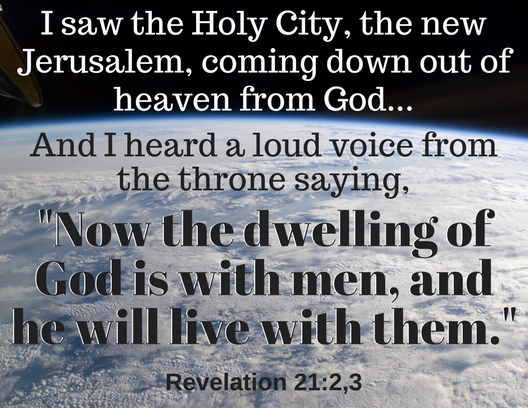
“Then I saw a new heaven and a new earth, for the first heaven and the first earth had passed away, and the sea was no more. And I saw the holy city, new Jerusalem, coming down out of heaven from God, prepared as a bride adorned for her husband.” (Revelation 21:1-2 ESV)

We humans like to live in the known and are uncomfortable with giving up what we know for what we don’t. This is so true that we humans are even willing to remain in an unfavorable situation if it means not having to leave it behind and wander into uncertainty. But for us as Christians, we need to overcome this and completely forsake this age and any sin that we are holding onto and embrace what God has to offer us instead. Besides, God has even blessed us with letting us know ahead of time where we are going and what we are getting ourselves into, and it is perfect.

In this life we only have a taste of the goodness to come in God’s kingdom. Imagine every single moment of your life you are literally perfect, everyone you come across is also perfect in their own unique way. You have no need for medicines, hospitals, cemeteries, or even locks to your house. You can walk right up to the tree of life, which is everywhere you go. But most importantly, you can have communion with God Himself and His Son Jesus! This reality is what we are enduring and waiting for, and thank God He is one day going to cast away the trials, burdens, and hardships we suffer in this life and is walking us towards a future that is partially known, but is waiting to be better understood. 

Reflection Questions

What are ways you can maintain God’s future hope in the forefront of your mind and heart?

In what ways should reading these chapters of Revelation motivate us to share the gospel with those around us?

Stay Awake and Ready

Revelation 14-16

Devotion by Isaac Cain (NE)

Growing up in the midwest it was common for part of the “goodbye” routine to someone who’s about to drive away is to say “and watch for the deer”. Deer suddenly running out in front of a car is a common enough occurrence where it has become a regional culture to always remind one another of the potential threat. I personally have had many nights driving slowly with corn fields on either side vigilantly watching to make a response.

This readiness is exactly what God or Jesus (it’s not exactly clear) calls for us to do as his followers.

“Behold, I am coming like a thief! Blessed is the one who stays awake, keeping his garments on, that he may not go about naked and be seen exposed!” (Revelation 16:15) 

This reading section has all kinds of significant moments of judgment from God against all who have rebelled against Him – and you do not want to be on the receiving end of any of them.  We read of painful sores, rivers of blood, the world’s largest earthquake (literally chapter 16 states it is the world’s largest earthquake!), and hail weighing up to 100 pounds falling onto God’s enemies! Therefore, we are given a loving warning to keep true to the faith and allegiance to Jesus. 


Our watching, vigilance, daily process of dying to ourselves and living for Christ daily is not in vain. We not only evade the intense wrath of God, but we also receive the intense salvation and life from God. These peeks into the future are not serving as a trivial knowledge that does not serve much utility to our daily lives now. Instead, they serve as a tangible vision for what direction each of our daily steps needs to be headed. 

We currently are like the midwest driver at night surrounded by cornfields. At any point, the deer that we know is coming, is going to jump out in front of us, we will miss it, but the non-attentive driver will not be as fortunate. Not only that, but being a vigilant driver serves to our benefit throughout the drive anyway. There are far more things to consider when driving than simply not hitting the deer like staying in your lane, not running into other cars, going out into the ditch, or the countless other bad scenarios my mom concerned herself with when I first went behind the wheel! Staying awake and ready not only avoids the dreaded end and receives the blessed end, but it also helps us avoid the avoidable pains of this life.

So let us heed the warning from Revelation today as we navigate through this life to always remember to “watch for the deer” to worship God, receive salvation, and experience God’s goodness in this life.

Reflection Questions

What is the difference between being a vigilant Christian and a paranoid one?

How does God seem to balance His love and His justice against wickedness in these chapters?